Archive for the ‘ham radio’ Category
 The Planning for MANNA@80 Continues…
 March 25th, 2025 |
  Author:
Planning for the special event stations commemorating the life-saving food drops to NW Netherlands near the end of World War II is now in full swing. 62 nationalities were part of Bomber Command in WW2.
Please visit Operation Manna @ 80 for a full list of stations around the globe. Here are the Canadian stations participating:
VB7MAN Surrey Amateur Radio Communications
In Canada, Surrey Amateur Radio Communications (SARC) has been granted special event callsign VB7MAN from April 1st to May 10th. We will be on the air from our training station and elsewhere prior to, during, and after the event and will seek involvement of the high school students from our RF Communications class. Contacts with Europe can be sporadic from our location but we are generally able to contact North and South America, Asia, and Oceania. We have created a QSL card to commemorate the event. The card bears the $100 Royal Canadian Mint gold and silver coin struck in 2020 for the 75th anniversary.

We will update this page as plans progress but hope to make a QSO with you in April or May. Any certified amateur in BC may operate the special event callsign, as long as it is only used in one location at a time. If you wish to use the call on any band or mode, a Google calendar has been set up to reserve the call for your use between April 1st and May 10th. If you wish to book an operating time for VB7MAN, please contact [email protected].
John VE7TI
Coordinator [email protected]
>
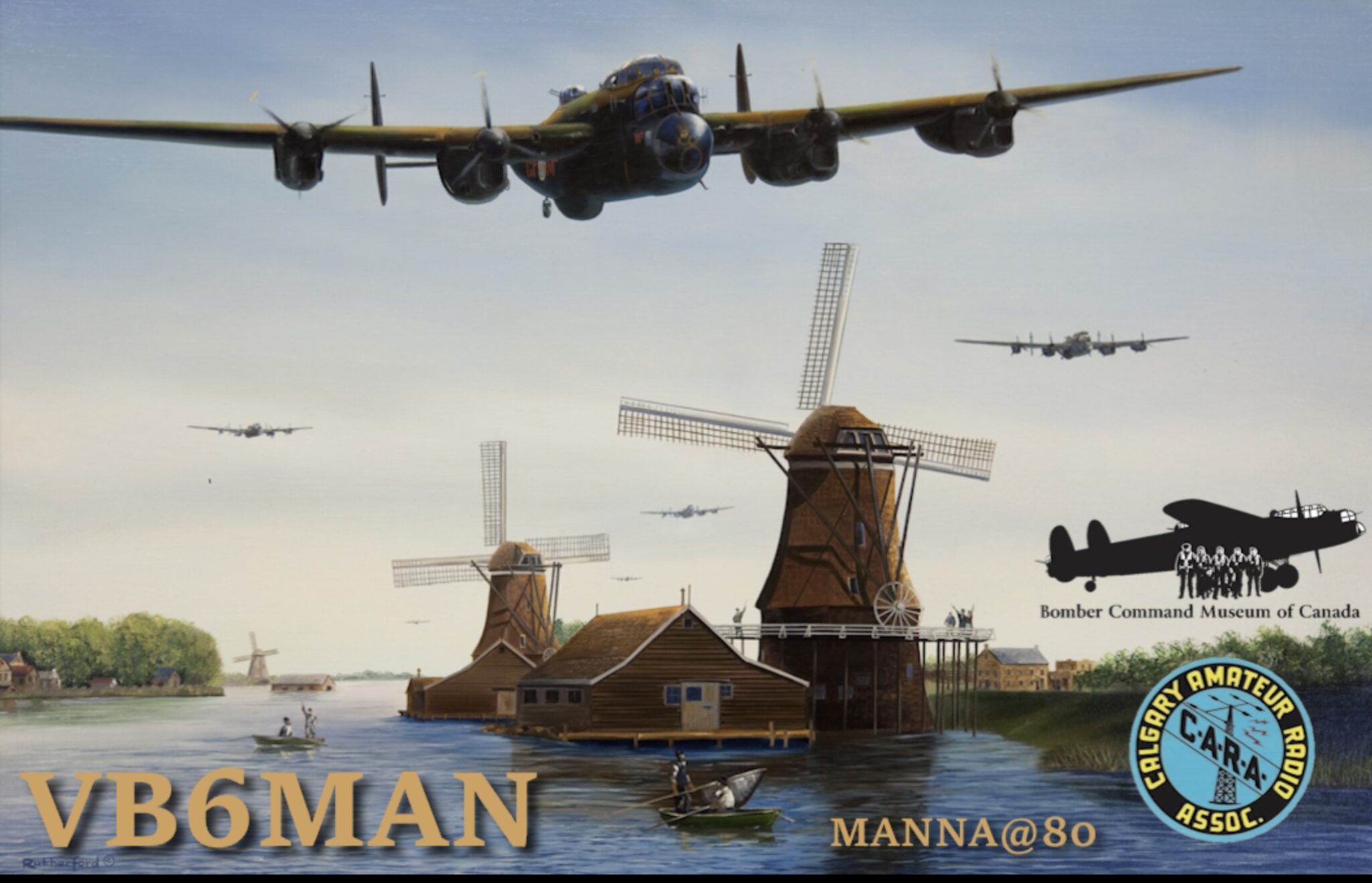
VB6MAN Calgary Amateur Radio Association
CARA will be operating from the Bomber Command Museum of Canada in Nanton, Alberta. They will activate on April 25, 26, and 27th and May 9 and 10. The final dates and hours of operations will depend on the radio amateur operators participating.
>
VE1MAN Nova Scotia
The Canadian teams closest to Europe will be operating from their club station as VE1MAN. They may be activating from a former WW2 air base or another location of significance to tie in with the event.
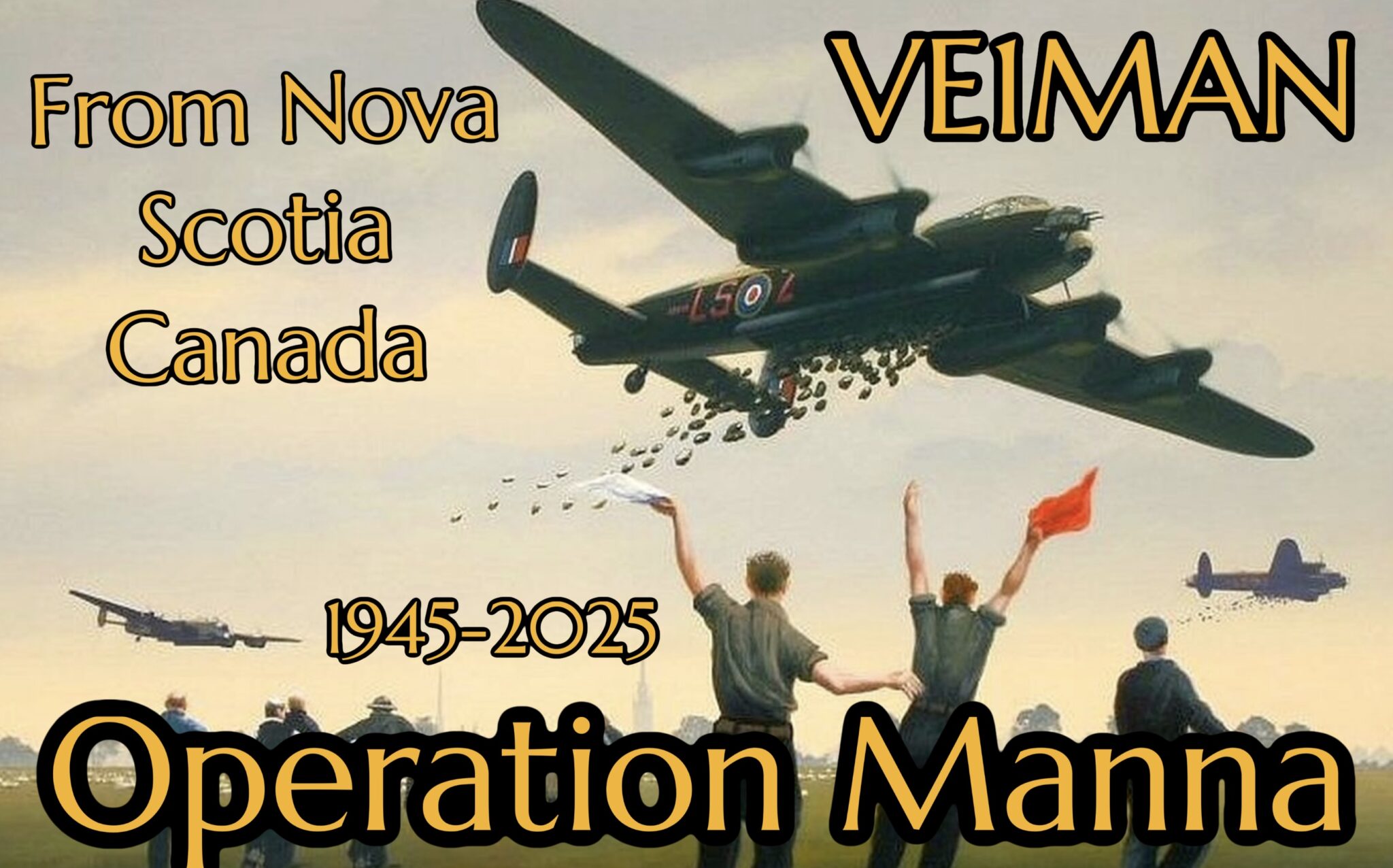
Radio Amateurs of Canada published an article about MANNA@80 in the March-April issue of The Canadian Amateur, as did the Radio Society of Great Britain in their national magazine RADCOM.
~
Weak-Signal Performance of Common Modulation Formats
At first, I was just looking around on the web for some simple Rules of Thumb that compare the weak-signal performance of commonly used analog and digital modulation types. I was mostly focused on FT8 and FT4 but I also wanted to compare SSB and CW. I failed to find a simple comparison of these modes but I did find a number of good articles that compared some but not all of them. This article is my attempt to aggregate the available information into something easy to understand.
 Disclaimers
I decided to leverage the work of others and to not try deriving everything from basic principles. I am telling myself that I am perfectly capable of doing the analysis but that I would never find the time to actually complete it. (Yeah, that’s my story, and I’m sticking to it.) Where the articles disagree, I tried to identify which one(s) had the most convincing analysis or rationale and used those values.
My goal is to compare common modulation types primarily in terms of weak-signal performance. This means focusing on how well a signal can be detected with low signal-to-noise ratio (SNR). I have ignored other factors, such as signal fading, frequency drift, multipath distortion, etc. Also ignored are factors such as the information rate provided by the modulation type and the required signal bandwidth. This is focused on having the ability to pass just enough info to make the contact.
Literature Survey
Searching the internet provided me with a number of good articles that have examined this topic, listed below in the References section. My approach is to compare the results of these articles and aggregate them into a concise summary. These minimum SNR values are listed in the table shown below, along with my aggregated conclusions in the righthand column.
Most of these articles presented SNR data in terms of a 2500 Hz bandwidth, with the goal of providing an easy comparison between modulation types. SSB is the widest signal discussed, and it roughly fits into a 2500 Hz bandwidth, which is often the IF bandwidth of the receiver being used. Some authors make this explicit by tagging this SNR as SNR2500. It is common practice in communications work to normalize the bandwidth to 1 Hz, which indicates the modulation’s bandwidth efficiency. However, we’ll stick with SNR2500.
I started with the article by PA3FWM [Ref 1], which provides a look at many of the modes I was interested in comparing. Unfortunately, this article does not include FT4 and FT8. N6MW [Ref 2] has a good treatment of FT4 and FT8 as well as minimum SNR values for SSB and CW. These lined up well with the PA3FWM values, so that was a good sign. N6MW referenced the foundational article about FT4 and FT8, published in QEX, written by the FT4 and FT8 developers [Ref 3]. The KB9II article [Ref 4] focuses on VHF weak-signal performance and provides minimum SNRs for SSB, RTTY, CW, and PSK31. He introduces the concepts of SNR (average) and SNR (peak). I used the SNR (average) numbers in the table. The KF6HI [Ref 5] article provided another set of SNR values that lined up pretty well. Finally, I came across a presentation by K0LB and KK4SNO [Ref 6] that includes a slide summarizing SNR performance. Because it is slideware, it does not include much about the sources of their numbers, but it seems useful to include them in the table.

The authors have somewhat different approaches to determining their SNR2500 numbers, mostly related to the assumptions used. You may want to read through these papers to gain a better understanding of the fine points. Overall, there is good alignment on results, with a few exceptions.
SSB
The single-sideband SNR2500 values are a mix of 10 dB and 6 dB. Frankly, I think 10 dB is a bit high for “minimum SNR” because I’ve spent quite a bit of time making weak-signal VHF/UHF contacts with the signal right at the noise level. I’ve squeezed out radio contacts with SNR much less than 10 dB. I looked at the rationale supplied in the articles for this value and it is mostly just assumed. So I went with my own experience and chose something smaller, 6 dB, aligning with KB9II and KF6HI. Even this number might be a bit conservative.
RTTY
I found only four values for RTTY, and they vary quite a bit. After studying the articles, I judged KB9II to have the best justification, so I went with -9 dB. I suspect that the actual decode performance may vary depending on the type and quality of the detector.
CW
The SNR2500 numbers for CW varied significantly, over a range of 10 dB. One way to estimate CW performance is to use the bandwidth of the receiver and compare it to 2500 Hz. Using a typical CW filter bandwidth of 200 Hz, SNR2500 = 10 log (200/2500) = -11.0 dB. However, it is well-known that the human ear/brain combination provides additional signal processing. The classic article by W2RS [Ref 7] covers this topic quite well. Using actual on-the-air tests, the article explains that the skill of the operator can introduce a variation of 3 to 6 dB. Another interesting note is that if the operator knows in advance the type of information they are expecting (such as the callsign of the other station), it provides a 3-dB advantage.
We can and probably will debate the SNR2500 value for CW until the cows come home, but I decided to adopt -12 dB in the right-hand column. This is probably conservative for a highly skilled operator.
FT8, FT4
For FT8 and FT4, I used the N6MW values, which come directly from the FT4 and FT8 paper [Ref 3]. I rounded off to the nearest decibel to be consistent with the rest of the column.
JT65
The JT65 values are quite consistent. An article by K1JT [Ref 8] says JT65 SNR is “roughly -28 to -24 dB in 2500 Hz,” so I put -24 dB in the righthand column.
WSPR
WSPR is a popular beacon mode and the king of weak-signal reception. Signal reports are collected worldwide and shared via WSPRnet.org. WSPR performance will vary depending on the specific settings used on the software and we have some variation in the table. The K1JT & W1BW article [Ref 9] says, “The WSPR protocol is effective at signal-to-noise ratios as low as –28 dB in a 2500 Hz bandwidth, some 10 to 15 dB below the threshold of audibility.” So I used -28 dB in the aggregated column.
Conclusions
The rightmost column in the table provides a reasonable comparison of the listed modulation types. I don’t claim that the values are perfect, but they should be helpful in understanding the performance of these modes. These data show that SSB is the least sensitive mode, followed by RTTY and PSK31. As mentioned earlier, the CW number is open to debate but it performs better than RTTY and PSK31. This brings us to FT4 and FT8, which are commonly used WSJT protocols with reasonable throughput. (FT4 and FT8 using 7.5 and 15-second transmit/receive intervals.) JT65 operates at lower SNR, but it is really in a different category, It is designed for Earth-Moon-Earth contacts, using one-minute intervals. WSPR is also unique as a beaconing system and not designed for two-way radio contacts, but it does have the best SNR performance on the list.
When using this data, keep in mind that most of these modes degrade slowly so there may not be a sharp cutoff at an exact signal level. The values are Rules of Thumb, accurate to within a few dB.
Thanks to Jim/K5ND and Bob/WØBV for reviewing this article and providing feedback.
73 Bob K0NR
References
Signal/noise ratio of digital amateur modes – Pieter-Tjerk de Boer, PA3FWM
FT8 Modulation and Decoding – A Dive into SNR interpretation N6MW
The FT4 and FT8 Communication Protocols – Steve Franke, K9AN- Bill Somerville, G4WJS – Joe Taylor, K1JT
A Comparison of Common Digital Modes for Weak Signal VHF Communications – John Matz, KB9II
Signal to Noise Ratio, definition and application to Radio Communications – KF6HI
Digital Modes in Amateur Radio – Larry, K0LB and Scott, KK4SNO
The Weak-Signal Capability of the Human Ear – Ray Soifer, W2RS
EME with JT65 – Joe Taylor, K1JT
WSPRing Around the World – Joe Taylor, K1JT, and Bruce Walker, W1BW
The post Weak-Signal Performance of Common Modulation Formats appeared first on The KØNR Radio Site.
Canadian Amateur Radio Hall of Fame Presentation
At the Surrey Amateur Radio Communications March general meeting, Hitoshi Takahashi VE7LET, the Radio Amateurs of Canada Director for BC & Yukon, presented John Schouten VE7TI with a plaque commemorating his appointment to the Canadian Amateur Radio Hall of Fame for 2024.
 |
| John Schouten [left] and Hitoshi Takahashi [right] |
 | |
[left to right] Hiroshi Takahashi,
|
Radio Amateurs of Canada recognizes deserving Amateurs by appointments to the Canadian Amateur Radio Hall of Fame. The Constitution for the Hall specifies that the appointment as Member of the Hall is made for “outstanding achievement and excellence of the highest degree, for serious and sustained service to Amateur Radio in Canada, or to Amateur Radio at large”. The Trustees of the Hall have interpreted the Constitution to mean that the person has performed significant service over many years to enhance the well-being of Amateur Radio. Radio Amateurs of Canada and the Board of Trustees of CARHOF sincerely congratulates John Schouten VE7TI, on his appointment to the Hall of Fame.
A detailed account of his achievements will be presented in an upcoming edition of The Canadian Amateur magazine.
For more information on the Canadian Amateur Radio Hall of Fame please visit: https://wp.rac.ca/carhof/
Frank Davis, VO1HP
Chair, Board of Trustees
Canadian Amateur Radio Hall of Fame
~
The Communicator March – April 2025
You will find some great articles in this issue, along with our regular columnists.
Now read in over 165 countries, this issue brings you 115+ pages of Amateur Radio content from the Southwest corner of Canada and around the globe. With less fluff and ads than other Amateur Radio publications, you will find Amateur Radio related articles, projects, profiles, news, tips and how-to's for all levels of the hobby.

Download the January - February Communicator in
LARGE or SMALL format, or read it on-line like a magazine
Previous Communicator issues:
Search for past Communicator issues
We are working on providing you with a comprehensive searchable index,
but in the meantime a searchable topic index is HERE.
As always, thank you to our contributors, and your feedback is always welcome.
The deadline for the next edition is April 15th.
If you have news or events from your club or photos, stories, projects or other items of interest from BC or elsewhere, please contact us at [email protected]
73,
John VE7TI
'The Communicator' Editor
The Table of Contents for the March - April 2025 Communicator issue:
- The Rest of the Story - Alfred Lewis Vail 4
- Bob King G3ASE: World War II RSS Monitor 8
- World Amateur Radio Day 10
- News You Can’t Lose - BandOpticon 12
- Page13—News You Can Lose 13
- Radio Ramblings: Passive Radar Update, BladeRF SDR, $5 Yagi 14
- The Wobbulator 25
- Rubber Coating Removal 28
- Dealing With Leaking Dry Cells 29
- An affordable and easy PCB vise solution for electronics hobbyists 30
- The ‘7300’ User Group - The spectrum scope and waterfall 31
- Remote control and operation 34
- Do you own an Alinco DR/135/235/435T or TYT9000? 37
- The Background Noise on the HF Amateur Bands 38
- BCQP 2025 — Initial Thoughts 44
- From the ATV Journal - An Impressive, Low Cost LNA 46
- Pi Pico Makes SSTV Reception a Snap 49
- ISED Releases New Canadian Basic Amateur Radio Question Bank 50
- Forget the Coax, Use Cat 6 52
- Ohm’s Law: Look what you can do with it 53
- Stranded: An Unlikely Friendship 55
- A satellite primer 58
- A DMR Primer 59
- Those Darn Wall-Wart Power Supplies! 60
- Operation Manna @ 80: Honouring the legacy through amateur radio 63
- Ham Radio Gizmos Platform Launches Documentary Series 66
- Ham Radio Outside the Box: An Off-Center Fed Sleeve Dipole 67
- Are You a Rag Chewer or a “59 73” Operator? 70
- 2 Meters: Another Slacker DXpedition 71
- KB6NU: How do we encourage more experimentation in amateur radio? 74
- What CAD software do you use? 75
- SARC on 24 GHz! 76
- The Solar Max: Is a second peak coming? 77
- Foundations of Amateur Radio 78
- No-ham Recipes: Toad-in-the-hole 81
- Back to Basics: Understanding Ohm's Law 82
- Profiles of SARC members 88
- Index of Past Profiles of SARC members 90
- Winter Field Day 95
- A Review of Distracted Driving Regulations in BC 109
- QRT: The Crucial Role of Amateur Radio 110
Chasing States
 Sometimes, I just need a reason to get on the air. Specific operating goals can help with this, whatever form they take, including operating awards. One of the first awards I earned many years ago was Worked All States (WAS). The mixed WAS is not that difficult because you can use any of the HF bands to make the contacts. Some bands are better for close-in states while others are better for long distances. Do a lot of operating, and you’ll eventually earn WAS. And it is fun to chase states.
Six Meter WAS
A few months ago, I looked at my Logbook of The World (LoTW) stats and noticed that I was one state shy of having WAS on 6 meters. I was not working towards this objective, but I was making a lot of contacts on six, trying to work countries and grids. The state I was missing was Utah, which is adjacent to my state of Colorado. I know I had worked Utah before, but I didn’t have it confirmed. Utah is not that easy to work from my location, because the populated areas of the state are in a dead zone: too far away for tropo propagation but too close for sporadic-e. Once I realized I only needed Utah, I kept watch for Utah stations showed up on 6 meters. Soon, I worked KI7MD using meteor scatter and asked him to confirm the contact in LoTW. OK, there you g, I had WAS on 6 meters. I consider this a real accomplishment, one that took many years.Chasing States By Band
Well, of course, it did not stop there. Another review of my LoTW results by state and band revealed that I already had WAS on 20 meters. I patted myself on the back for that accomplishment, even though I just stumbled across it. Then I noticed I had 43 states on 40 meters. Hmm, that should not be too difficult to complete because 40m propagation covers the US quite well. Alaska and Hawaii were both already confirmed so the challenge was filling in the missing lower 48 states. I’ve been doing quite a bit of FT8 operating lately, so I set JTAlert up to alert me when any of the states I needed were received on 40 meters. Whenever they popped up, I’d make it a point to work them, if possible. Soon, the missing states were filled in, and I had achieved WAS on 40m. Technically, I have the confirmations in LoTW (good enough for me), but I have not applied to have the award issued. Well, what band should I pursue next? I was a latecomer to the 30-meter band, making my first contact on that band in Feb 2024. However, I have learned to really like it with its propagation characteristics being an interesting mix of stateside and DX. I had about 30 states confirmed on 30m, so I figured it would not take too long to fill in the blanks. Again, I used FT8 aided by JTAlert to keep watch for the states I needed. I wasn’t completely zoned in on working these states…usually, I was on the air for other reasons, but when JTAlert told me there was a WAS contact to be had, I grabbed it. Right now, I have 49 states confirmed on 30m, with Delaware being the only one missing. Now, someone out there is thinking, “Don’t pursue WAS one band at a time; go for them all at once!” That probably would be more efficient, but that’s not what I am after. I just like having a few operating goals in front of me to focus my efforts and pursuing states on a single band fits that just fine.WAS Score Card
Here’s a snapshot of my WAS numbers today, from LoTW. After I finish up 30m, I will probably focus on 15m or 10m. I tend to be on those bands anyway for chasing DX. On those bands, I seem to be missing the closer in states with lower population density such as Kansas, North Dakota, Nebraska, New Mexico, and Utah. This is predictable with the longer F2 propagation normally found on those bands. I don’t know that I’ll ever get WAS on 2m and I am more focused on VUCC for that band. Note that I have 4 states on 70cm: Arizona, Colorado, New Mexico and Wyoming. I am a bit surprised by that. Anyway, if you are looking for a reason to get on the air, chasing states might be interesting. Remember, it’s all about having fun messing around with radio. 73 Bob K0NR The post Chasing States appeared first on The KØNR Radio Site.
 Ham Radio License Class – Monument CO
 The Tri-Lakes Monument Radio Association is offering an amateur radio license class that includes the Technician (beginner) license material and the General license material. You can pursue Technician, General, or both!
Starts March 1st
• Earn or upgrade your FCC Amateur Radio License.
 Earn the FCC Technician license or upgrade to the FCC General license.
• Convenient online learning with personal assistance and demos.
• Learn to operate ham radio for emergency communications.
• Learn to use the many VHF/UHF FM radio repeaters in Colorado.
• License exam session included, all learning materials included.
Instruction:
• A 20-hour, paced course of study
• Initial session equipment demonstrations
• Student self-study with the Ham Radio School Technician or General License Course, includes eBook readings, Video instruction, Focused reviews and quizzes, Optional in-depth learning media, Practice exams
• One-on-one personalized support from a knowledgeable and experienced ham radio operator
• Regular review sessions for Q&A, extra help
Schedule:
• Introductory Session, In Person Sat March 1, 1-4 pm Woodmoor Barn, Monument
• Zoom Instructional Review Sessions: Thursdays 7 to 8 pm
• FCC License Examination Sat March 29, 10:30 am Monument Library
• Get On the Air Session, In Person Sat April 5, 1-4 pm Woodmoor Barn, Monument
Class registration fee: $50 Technician or General ($40 under age 18)
Register for Technician
Register for General
For questions, contact Bob Witte KØNR: b[email protected]
Sponsored by the Tri-Lakes Monument Radio Association
The post Ham Radio License Class – Monument CO appeared first on The KØNR Radio Site.
VP2V/K0NR: Another Slacker DXpedition
Operating from countries outside the US can be a lot of fun. I just completed another Slacker DXpedition, this time to the British Virgin Islands. The formula for this type of operation is simple: identify an interesting vacation spot that is also considered DX, travel there with friends and family, take along some compact radio gear, and get on the air.  A key point is not to overdo the radio operating, or the friends and family will veto any radio activity on future trips. This was not a super-gonzo turbo-charged DXpedition. I just worked in some radio action in between snorkeling and exploring the island. This is referred to as a “holiday style” DXpedition, or maybe it’s just the slacker approach.
VP2V British Virgin Islands
The idea for this trip originated with a group of friends who often travel together to fun places, often an island in the Caribbean. BVI had been on our list for a while, and we had a trip planned back in 2020, but the COVID-19 pandemic caused us to cancel it at the last minute. It has taken us some time to get a plan back together, but here we are doing the trip five years later.
When a travel opportunity like this surfaces, I check out the implications of amateur radio licensing for that country. For a US radio amateur (and probably most other countries), getting a radio license for VP2V is easy. The Telecommunications Regulatory Commission (TRC) website has clear instructions on how to apply. Joyce/K0JJW and I filled out a form, provided copies of our passports and FCC licenses, and paid a $20 license fee. This did require a trip to a notary public to have these documents notarized. My friend, Paul/KF9EY was on the trip so he also obtained his VP2V license.
Location
We rented a fantastic house (Ana Capri Estate) on the north side of the island of Tortola. This house has a great view out over the water. Tortola is the main island of the BVI, and international flights are available at the airport on the east end.

The Ham Station

We took along our usual portable ham station, with a few updates. Our Yaesu FT-991 has served us well for POTA, SOTA, and island activations in the past, so it is our go-to radio for this sort of operation. The key features include a 100-watt RF output, a built-in sound card for digital modes, an internal antenna tuner, and a small enough size. This radio has HF plus 6m, 2m, and 70cm, which can be handy. Add a compact Samlex switching power supply, and we are ready. Recently, we have moved away from using End-fed Halfwave (EFHW) antennas and started using an End-Fed-Random Wire (EFRW), also called an End-Fed Long Wire (EFLW). The difference is subtle but important. The EFRW uses a wire length that is intentionally not resonant on any band, fed by 9:1 UNUN matching device. This setup radiates well over a range of frequencies but does require an antenna tuner because it is not a consistent 50-ohm impedance on all bands. I’ve found this to be a reasonable tradeoff between quick-changing band coverage and performance.

For this trip, we used the Palomar Engineers Bullet-9 UNUN, rated for 500 watts PEP. A variety of wire lengths can be used with this approach, with longer wires supporting lower frequencies. The 34-foot wire element supports operating on all bands from 40m to 6m, supported by the SOTABeams Travel Mast. The Travel Mast compacts to just 26.5 inches and extends to 32 feet. Actually, I modified the top of the mast to make it stronger, so the net height is closer to 29 feet. The end-fed wire antenna is almost vertical when deployed in this manner.
In past portable efforts, I’ve encountered issues with inconsistent antenna match and RF getting back into the FT-991. I checked this out carefully before the trip and adopted some mitigation practices that seem to help. First, I made sure the wire antenna could be supported almost vertically. This is not a strict requirement but it seems to help with getting a good match across all bands. I don’t use a counterpoise, but I do have 50 feet of RG-8X coax lying on the ground, which provides a bit of counterpoise. This length of coax also lets me keep the antenna separated from the transceiver by a reasonable distance, reducing the opportunity for RF to get back into the transceiver. Finally, I use a short USB cable, with ferrite cores on both ends, to connect my notebook PC to the FT-911. In the past, the USB connection between my PC and radio sometimes quit. These precautions appear to have paid off, as the station worked without any issues.

Operating
We set up the station outdoors under a covered patio to enjoy the fantastic view and (mostly) great weather while operating. This was not optimal, as we did get chased inside a few times when rain squalls moved in. They never lasted long, so I think the tradeoff was worth it.
The propagation on the HF bands has been quite good lately, and we continued to enjoy that while in BVI. We did not have much of an operating plan (“slacker style”) but intended to operate on the higher HF bands, mostly 20m and higher, using SSB, FT8, and FT4. Bob/W0BV pointed out that VP2V is somewhat rare, showing up at number 114 on the ClubLog Most Wanted List. Sure enough, whenever we called CQ, we were greeted with a nice pileup.

My VP2V/K0NR log has 1030 contacts, including 61 DXCC entities and 23 CQ Zones. I focused mostly on keeping the run rate up and just making contacts. About half of the Qs were with the US. The logs of VP2V/K0JJW and VP2V/KF9EY are not included in these numbers. I tended to stay on the higher bands as they were working quite well.
VP2V/K0NR Log
Band Phone Dig Total  %
30       0  79    79  8
20       0  46    46  4
17       0  90    90  9
15       0 161   161 16
12      44 349   393 38
10       0 260   260 25
 2       1   0     1  0
--    ---- ---   --- --
Total   45 985 1,030 100
As you can see from the numbers above, I made a lot of digital contacts (FT8/FT4). I found FT8 to be slow, and the normal FT8 frequency became crowded. There was much less congestion on FT4, and the run rate was better, so I found that to be effective. I enjoyed the SSB pileups for a while but found it to be a challenge to manage them. While I can work CW, I did not try to manage a pileup on that mode.
I found a 2m repeater on the island 146.73 MHz (—offset, no tone) and made a few calls on it, but I did not receive a reply.
QSLs will be via Logbook of The World only. I won’t be printing cards for this effort but the logs for VP2V/K0NR and VP2V/K0JJW are already loaded into LoTW. Thanks to everyone that worked us!
British Virgin Islands
BVI was a fantastic place to vacation. During our ten days there, we enjoyed the beaches, snorkeling, and sailing excursions. If you are interested in that, there are many online tourism sites to explore.

Thanks for stopping by.
73 Bob VP2V/K0NR
The post VP2V/K0NR: Another Slacker DXpedition appeared first on The KØNR Radio Site.













