Archive for the ‘ham radio’ Category
 Handiham World for 31 March 2010
 March 30th, 2010 |
  Author:
 Welcome to Handiham World!
Before we do anything else, I’d like to share last week’s Midwinter Madness Hamfest with our readers. After that, we have a special edition of the Handiham World that is dedicated to operator improvement.
Midwinter Madness Hamfest Photos

Our thanks to the Robbinsdale ARC for table space at Midwinter Madness, the closest Hamfest to Handiham Headquarters! Photo credit: RARC.
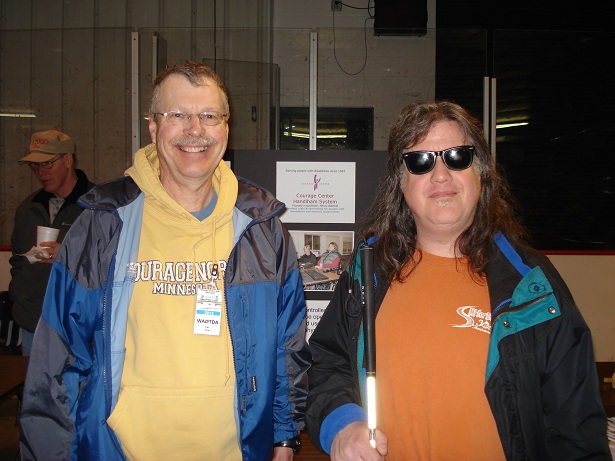
Pat, WA0TDA, and Matt, KA0PQW pose in front of the Handiham table. Photo by Susan Tice.
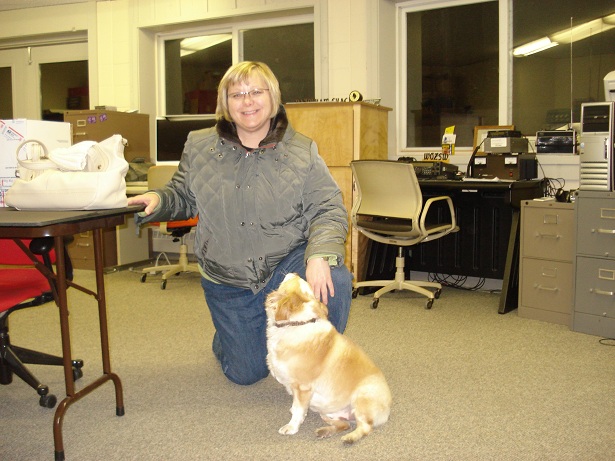
Susan Tice and Jasper get ready for the hamfest by helping to pack the booth equipment at Handiham Headquarters. Asked if it was a tough job, Jasper said, “ruff”. WA0TDA photo.
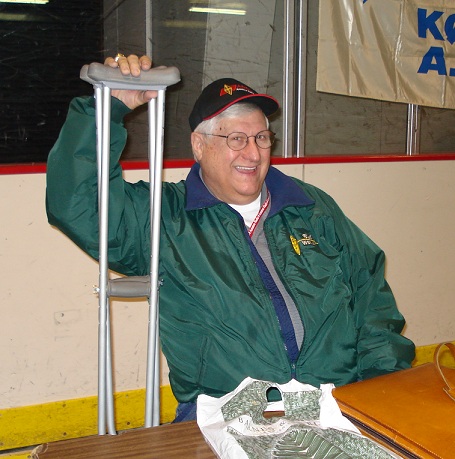
Bob, W0LAW, ARRL Minnesota Traffic Manager, mugs it for the camera at the ARRL booth, right next to the Handiham booth. WA0TDA photo.
Now, to our special feature: Communicating with other hams: It’s all about exchanging information.
Ready to review the basics? Good! Let’s get started.
The basics
Start with callsigns: My callsign is WA0TDA.
Every other station has one, so you will use both of them to initiate a contact:
“W0ZSW, this is WA0TDA”.
Identify!
• Use your callsign.
• Speak clearly & slowly.
• Use phonetics when conditions make hearing difficult.
• Position your microphone correctly.
• Repeat (or ask for a repeat) of the information as necessary.
When you are done talking… (Read more on the Handiham website, or listen to the audio podcast.)

Polar Bear Midnight Madness Event Mar 2010
A fitting end to this season of PBMME … Saturday the weather was finally decent here in Orlando and with 80F temperature and lots of sun, I certainly earned my red neck for the season! I set up my portable station near the tall pine trees in our neighborhood park on Lake Fredrica. A few curious neighbors came by to find out what the crazy guy with the wires in the tree was doing!
I am really liking the latest antenna launching combo shown in the photo below. I have been using a slingshot taped to a shelf bracket and equipped with a spincast reel, but have been considering other alternatives. The monofilament fishing line is prone to wind knots and tangles and does not always slip through the branches as well as I’d like. I found an old post by Russ Carpenter, AA7QU, a co-founder of Adventure Radio Society, which described using an archery reel and super slick braided line. Sure is nice to learn from those that have gone before! The bright yellow line is very easy to see though very thin, 3x stronger than monofilament and flies through both air and branches with ease! KEEPER! Think I will do away with the spincast reel and save it for the grandkids!

Antenna Launching options

Here's my site for the event

Great trees for antenna wire hanging!
If you look closely, you can see the 30m half wave going up to the tree on the left. Nearly vertical for 46 feet and is spooled on a Coleman Camping clothes line and used with a 3 ft counterpoise.
To the right is my 20ft Jackite pole and a W3EDP 84 ft antenna with a 17 ft parallel feed with 3/16 inch PET pipe spacers about every 2.5 ft. it tunes 80-15m with my BLT+ tuner.
The Polar Bear QRP Group is a great bunch of guys… (no yl’s or xyl’s that I’ve heard yet) and our monthly outings are something I look forward to each month. The Yahoo Group is a good source of information and laughs as we swap stories and share our adventures. If you like QRP and portable operation, this is the group to join.
Handiham World for 24 March 2010
Welcome to Handiham World!

Recently we talked a bit about how to put some logic into your decision making when you are comparing equipment or antenna performance. The topic was the venerable A-B test, using a two-way switch that could be connect first one antenna, then another. The idea behind this kind of testing is to eliminate as many variables as possible so that we are really just comparing the two things that we want to compare. After all, using separate transceivers (each one connected to its own antenna) puts into play the extra variable of radio performance when what we really want to do is compare one antenna to another one. It makes much more sense to use a single radio and an A-B switch with the common side connected to a single radio and the switched outputs each connected to separate antennas.
Now I would like to introduce you to another related concept to help you work your way through troubleshooting. It is called a “decision tree”. A decision tree gets its name because it branches out much like a tree. From the main trunk, let’s say there are two large branches. From each of those branches there are two more, and so on. At the base of the tree it is easy to see just the trunk, but high up in the air atop the tree there are thousands of branches. The concept of the branching tree can help us to solve problems with our electronic equipment. Decisions must be made logically and empirically, beginning at one point where the symptom of the problem presents itself and is easy to see, much like the trunk of the tree. Sometimes there may be many, many possible causes for that very same symptom — all of these possible causes are represented by the many branches at the top of the tree. If we look at the top of the tree, we will see a confusing collection of branches, or possible causes to our problem. The idea of the decision tree is to start at the trunk with the most obvious symptom and follow the branches outward and upward until we arrive at the single twig at the top of the tree that is the cause of our problem.
Now, let’s see how this works with a problem that most of us have encountered with our radios.
Let’s say that we go down to the ham shack in the basement and turn on the HF radio. Oddly enough, nothing seems to happen; no sound comes out of the speaker. Of course with a problem like this there can be many possible causes. Putting the idea of the decision tree to work for us can save time and effort as we work our way logically toward a solution to the problem.
1. Did the radio power up?
If the answer is yes, proceed to number two.
If the answer is no, we follow this branch:
Is the power switch in the on position?
If the answer is no, turn on the power switch and your problem is solved.
If the answer is yes, you now have another branch to follow:
Is the radio getting power from the power supply?
If the answer is no, you need to follow another branch:
Is the power supply is turned on?
If the answer is no, turn on the power supply and the power is now available to the radio and you may proceed to operate normally.
If the answer is yes, you are off to the next branch:
Is the power supply plugged into a live AC outlet?
If the answer is no, you need to plug it in or find another outlet that is live, then proceed to operate normally.
If the answer is yes, you need to check the fuse or circuit breaker in the power supply and proceed along a line of determining a problem with the supply rather than the radio.
2. Is the audio gain turned up high enough to hear sound?
If the answer is no, turn up the gain and proceed to operate normally.
If the answer is yes, you are off to the next branch:
Is there any sound at all when you listen closely, such as a weak hiss?
If the answer is no, you will want to follow a line of checking external speaker connections, whether headphones have been left plugged in by mistake, and so on. Several more branches can be followed here – you get the idea.
If the answer is yes, you will want to follow several other branches that will include checking the RF gain control, the antenna connection, any tuners or other accessories in the feedline, and so on.
As you can see, a decision tree can be quite long and branching, even for a simple problem. However, the idea is to begin logically with the things that are easiest to check and most likely to be the cause of the problem. It certainly wouldn’t do to immediately run outside and check the antenna if you didn’t hear sound from the radio. Audio gain controls that are turned down, squelch controls that are turned up too high, RF gain controls that have been turned way down, or an antenna switch that is in the wrong position are all more likely causes of the problem. Furthermore, you wouldn’t want to start working on repairing your transceiver if a circuit breaker in your house’s main breaker box has tripped, causing the outlet into which your power supply is plugged to be dead. It is all about following a logical, thoughtful path in problem solving.
Believe me, this is not something that new ham radio operators — and even some with extra class licenses — always know how to do. Logical troubleshooting is something that can be learned by experience. Sometimes equipment repair manuals include graphical decision trees to help technicians working at the service department proceed through the diagnostic process and a logical and efficient manner. These days, software can help us make decisions as well, but I would like to see our Handiham members be as independent and self-sufficient in troubleshooting basic problems as possible. At the upcoming Minnesota radio camp we will be considering how to solve basic problems in the ham shack. Practicing this skill makes us all more independent and ultimately better operators. After all, amateur radio is a technical activity, and we should be able to do some basic troubleshooting.
For Handiham World, I’m…
Patrick Tice, [email protected]

MEN OF ADVENTURE by Dan Caesar NI9Y PB #218
These last two Polar Bear adventure radio sprints in January and February was quite an experience operating QRP (5 watts or less) outside in the snow. I never thought I would never do anything like this in freezing weather. There I was knee deep in snow; with a wind chill around 15 degrees, under an open air shelter at Cobus Creek Park, located in the northwest corner of Elkhart County in January. I was invited by Bob, KB9IVA, who said it would be fun. So I got my portable gear and winter parka and headed out to the site. When I arrived Bob wasn’t there. I got out of the warm car and looked over the snow covered picnic table. The bright sun reflected off the stone on the side of the building helped warm things up a bit.

First one gets the warmest spot!
Then the sun disappeared and it became colder. The heated outhouse was open so I warmed up for a few minutes.

QRP in the parking lot!
It was too cold for me to set up outside so I operated in my mobile on 40 meters. Bob arrived in a snowmobile outfit with a bag full of tools, and his ICOM-703 and MP-1 portable all band vertical antenna.
The antenna would not tune properly so I ran 25 feet of RG-59U coax from my mobile antenna to the picnic table. Then the portable battery pack ran out of juice. So I took my emergency car starter battery and hay wired a connection to the ICOM-703 and we were back on the air. When it’s cold radios and batteries don’t work properly. Wires become stiff, batteries quickly discharge, and the straight key was difficult to use. Not to mention your exposed fingers feel frostbitten. I had forgotten my gloves but you couldn’t send CW with them on anyway.

Our vertical in the park!

Cold stiff hands on a very cold key! YIKES!
I was more prepared for the February sprint but didn’t count on blowing snow. Participating in this sprint was, Bob, WA9S Keith, and Steve KB9ZVJ and I Ni9Y. Keith arrived late and operated inside his Jeep. I Made a half-dozen contacts from Utah to Colorado to the East coast with my HB1-A 4 watt transceiver using a 50’ end-fed wire only 27 inches high. Then the wires snapped off my battery pack. So we quickly repaired the pack with a new connector and we were back in business again.

2 Cold QRP Guys operate in the Feb 2010 PBMME
Bob had his IC-703. His headphone band cracked in two in the cold. Bob’s straight key was almost brittle and hard to use with gloves on. Steve operated SSB with his Yaesu rig, powered by a riding mower battery, feeding a sloping 20 meter dipole about 5 feet high.

A snow proof antenna for 20m

Last man sending!
It was getting too cold for me so I packed up and left as the snow began to really come down. Steve saw me packing so he packed up and so did Bob. Keith stayed behind moving to the picnic table and made more contacts in a small blizzard. Then Park Ranger paid a surprise visit to find out what in the world was going on. The ranger was satisfied that we weren’t suspicious characters after Keith explained the situation. The ranger failed to notice Keith had wrapped his antenna rope around the door handle on women’s entrance to the outhouse. There was no way anyone could open that door. The ranger probably thought we were a bunch of nuts playing radio in the snow. It was fun and we probably will do it again next season. Only next time I will be more prepared for polar bear weather. Oh yes I forgot to say this was the POLAR BEAR MOONLIGHT MADNESS event. You can read all about on their website http://www.n3epa.org/Pages/PolarBear.htm. Polar Bears all over the country and in Europe participated in the madness. The final polar bear event was held March 20th but I took a pass on that one because all the snow is gone so it wouldn’t be as much fun operating in warm spring weather!!!
The MEN OF ADVENTURE will soon take off again. Barry, WD4MSM says “QRP To The Field” has just been announced for 2010. He recalled that we took part in the 2009 version that had as its theme “The Great Depression.” We operated from the WPA site of Monkey Island in Mishawaka (the bridge to Monkey Island was built by the WPA).
This looks as if it might be an ideal outing for us. Saturday, April 24, 2010
Spicer Lake Nature Preserve http://www.sjcparks.org/spicer.html
Small picnic shelter available; Trees for antenna support if needed;
Restrooms (heated and immaculate) just steps away; Ample parking for hundreds!
Just minutes from South Bend; Plenty to do for family members and visitors (trails, grills, visitor center, two lakes, etc.); Handicap accessible trails and parking immediately next to the suggested operating position.
You to can join the MEN OF ADVENTURE even if you don’t have a QRP rig. Just show up to learn about portable operation and how to put up antennas where they don’t belong. Who knows maybe you to will be just as nuts as the other members of the group are? Present company accepted.
That’s it for this edition.
73’s Dan, email DAN
p.s. Consider operating the special event KØS Strange Antenna Challenge Special Event — May 29-31, 2010.
Start Date & Time: Saturday, May 29, 2010, 1000Z
End Date & Time: Monday, May 31, 2010 at midnight (local time zones)
This is not a serious event. We are all out here for fun! K0S will employ out-of-the-ordinary antennas to promote Amateur Radio and making do with what might be available during an emergency. Individuals and clubs may participate as “satellite stations” by using anything but wire or pipe for a radiating element and adding “/K0S” to their call signs. Details are on the KØS, Strange Antenna Challenge Web site. Strange antennas used in past events, dating back to 2002, have included folding chairs, paint easels, ladders, tape measures, dog kennels, fences, cots and chicken fencing with a trampoline as a ground plane. “More people share in the fun each year,” says Erik Weaver, N0EW, a Strange Antenna Challenge founder. “I hope you give me a call this year with your very own strange antenna. Now let’s play radio!”
Handiham World for 17 March 2010
Welcome to Handiham World!

Photo: Pat, WA0TDA, with microphone, sports a green T-shirt, green beads, and a green screen background for St. Patrick’s Day. Hey, if Chicago can dye a river green, we can do this!
Happy St. Patrick’s Day, everyone. This is the first time in my memory that the Irish holiday has fallen on the same day as our weekly newsletter and podcast, so why not just use it as an excuse for a fun way to start our weekly column?
I’m not sure if there are any special ham radio events associated with St. Patrick’s Day, but I do know that there are plenty of parades and other civic events. St. Patrick’s Day is always a big deal in cities like Boston, Massachusetts and St. Paul, Minnesota where there are historical Irish roots. Any time you have a parade or civic event there is an opportunity for amateur radio support in the form of communications. While I know of no amateur radio support for parade activities during today’s activities here in the Twin Cities, amateur radio volunteers do support plenty of other worthwhile civic events. Marathons, bicycle races, walkathons, and other types of parades or large events that cover considerable territory are all candidates for amateur radio communications support.
These types of activities are similar in many ways to the volunteer work that amateur radio operators do in emergencies. However, there is a difference in that many of the communications in an event are much more routine and may be structured in a more informal way than communications in an emergency where a command structure is set up under very specific guidelines. In a public service event, which is what these non-emergency activities are called, your radio club may decide to participate as a group and call for volunteers. It always helps when public service communicators have some training and experience, but public service communication may be a less demanding place to get started than in emergency communications. It all depends on the event and the person in charge of communications. Some events are so large and complicated or cover so much territory or have potential for generating emergency response-style situations that they may be looking for volunteers who are more familiar with a structured incident command system. On the other hand, some events are more easily managed with semi-formal organization and communication. While good operating practice is essential for either, you may want to get your feet wet by helping with communications at one of these smaller events in the realm of public service.
Good communications basics will include knowing how to identify your station, including identification by location if that is the most efficient way to identify and it is what your group has agreed to do. This is called a tactical identification. Of course you do still have to use your FCC-issued callsign periodically as specified by Part 97 rules. A tactical identification might be something like “rest stop five”. At the end of a series of transmissions and every 10 minutes you do have to use your regular callsign. There are many other things to learn about public service communications that will help you learn “on the job” as you gain experience and work toward being a capable volunteer in ARES, able to handle more demanding formal communications within an incident command structure.
In many ways, amateur radio is like other learning activities. If you were to have to learn calculus or how to speak Chinese, you would not begin with differential equations or interpretation of ancient Chinese texts. You would instead choose to begin at, well, the beginning! You would start with simple concepts and easy tasks, practicing and learning incrementally, gaining knowledge every time you study or practice. Amateur radio is a huge and complicated activity when you consider all of the different licensing classes, the many different types of technology, multiple modes of operation, and extraordinary array of on the air activities. No one expects you to get your first license and be able to do everything — and that goes for being a public service communicator. You need to start at the beginning, perhaps volunteering at an event like a St. Patrick’s Day parade. Don’t forget to wear green, and a reflective vest if you are on the parade route.
For Handiham World, I’m…
Patrick Tice, [email protected]

Handiham World for 10 March 2010
Welcome to Handiham World!

Recently I had a nice visit with another operator, and what do you think we talked about?
That’s right – we talked about our stations! The conversation took a turn to receiver performance, and he mentioned that one of his radios has a much more sensitive but quieter receiver than the other. I wondered how he knew that, and he said that he had performed an “A-B” test. That’s what today’s essay is about – not receiver performance.
When we compare two pieces of equipment, we want to know which one performs the best. How many times have you heard someone make a claim on the air for one rig’s superiority over another one? Or that one antenna works better than another? Whenever I hear such claims, I wonder if they are really backed up by testing. I know that most of us will never have a test lab full of instrumentation to run tests the way they are done at the ARRL product review lab, but that doesn’t mean that we have no way to perform simple, but more meaningful testing.
Imagine these situations:
Scenario 1: I have two HF antennas in my back yard. One is a vertical and one is a dipole. The dipole is connected to my Icom IC-706M2G and the vertical is connected to my Icom IC-7200. I decide to see which antenna works best for DX, so I listen on 20 meters and I hear a European on 14.060 MHz. The station is easy to copy on the vertical antenna, and the S-meter reading shows S9. I listen on the dipole and the same station on 14.060 is only S5. Do I conclude that the vertical works better?
Scenario 2: I have two HF antennas in my back yard. One is a vertical and one is a dipole. I have both of them connected to an antenna switch, so that I can switch from the vertical to the dipole by turning the antenna switch. The antenna switch is connected to my Icom IC-7200 transceiver. I start my test by listening on the vertical. I hear a station on 14.060 MHz, and the S-meter reading is S9. Then, without changing anything on the radio, I flip the antenna switch to the dipole. I now have an S-meter reading of S9 + 10 dB. I quickly change the antenna switch back to the vertical and the signal drops back down to S9 again. Changing the switch once more to the dipole brings the signal back up. Do I conclude that the dipole works better?
In both situations, I was listening on one antenna and then the other, but the results in scenario 2 were different than those in scenario 1. What could have caused the difference?
Here is a basic rule about comparing two things: You must try to eliminate as many “variables” as possible so that you are really only comparing the two things you want to compare. This is how scientists and engineers perform tests related to theoretical concepts or engineering projects. To make this as simple as possible, let’s make up a very basic example. Let’s say we have a family argument about which sibling is taller. One brother says that he is growing faster and is taller than his brother. Of course as a parent you can easily make the two kids stand side by side and then you can easily see which one is taller. But what if one stands on his tiptoes? Or if one wears shoes and the other is barefooted? Or if one wears a hat and the other doesn’t? As a parent who needs to be fair about deciding, you will have to insist that the variables of shoes, hats, and standing flat-footed are all eliminated so that the one variable you really want to measure, which kid is tallest, will not be affected by those other things.
Getting back to our scenarios about the antennas, we see that in the first situation we are using two different antennas, which is the variable we want to test, but we are also using two different radios. The difference between one radio and the other is a variable that we are not controlling, and that could account for the results we are getting instead of the choice of antenna. Perhaps the attenuator was turned on for one radio and not for the other. Maybe the antenna tuner was not activated for one radio. It could be that the run of coax between an antenna and one of the radios was defective. Do you see all these variables?
In scenario 2, we use only one radio, and we have an “A-B” antenna switch to make it easy to change from one antenna to the other, and to do so very quickly to eliminate changing band conditions or radio settings and radio performance as variables. Furthermore, we can change the switch back and forth several times to confirm our tests. Now we have performed a more scientific test, because we have eliminated as many variables as we could, at least the easy ones, so that we could really compare just the antennas.
I am convinced that there are a lot of folks out there who are simply talking baloney when they brag about how one piece of equipment is so much better than another one. As often as not, they have never performed a real A-B test and are relying on their impressions rather than empirical evidence. Building up a habit of eliminating variables and focusing on only the thing you really want to test is at the core of successful troubleshooting when you are trying to find a problem. It is essential to making sense of how things work in ham radio, as well as in so many other parts of life.
So think to yourself, “When I test my equipment, am I really testing just one thing?”
If you can answer yes, you are well on the way to solving all of your ham radio mysteries!
For Handiham World, I’m…
Patrick Tice, [email protected]

Handiham World for 24 February 2010
Welcome to Handiham World!
If there is any theme that runs through publicity about amateur radio these days, it is generally one about the reliability of our communications in an emergency situation. In story after story that I see ferreted out by Google News, ham radio operators tell the press and the public about the way amateur radio operators can stay on the air to provide vital communications when cellular phones are overloaded or down altogether and other communications infrastructure has failed. The training and volunteerism of amateur radio operators are also highlights of these articles, and the very best of these stories also include some human factor – a volunteer operator who has helped the community, a team of operators who have worked in tandem with emergency personnel to provide backup communications, and sometimes even a victim who owes a debt of gratitude to amateur radio. These are themes that the ARRL has taken a leadership role in promoting, and the evidence is that the strategy has worked. More new hams than ever joined the ranks of amateur radio here in the United States last year.
Quoting from a story on ARRL’s website, “A total of 30,144 new licenses were granted in 2009, an increase of almost 7.5 percent from 2008. In 2005, 16,368 new hams joined Amateur Radio’s ranks; just five years later, that number had increased by almost 14,000 — a whopping 84 percent! The ARRL VEC is one of 14 VECs who administer Amateur Radio license exams.”
Of the many reasons people become interested in amateur radio, the one I have heard most often in recent years is that new hams want to earn a license so that they will have the means to help in emergencies and to be of service to the community. This, among the other themes, has been expertly promoted by ARRL in special websites, publicity releases, articles, and videos. Taking on the erroneous image of ham radio as an “outdated technology” that has been all but replaced by the internet, ARRL answers the questions of why we are relevant in the 21st Century on its WordPress “We Do That Radio” and “emergency-radio” websites.
Well, with all of that in mind, we turn to the large cardboard envelope I received from Matt Arthur, KA0PQW, this week. Matt had told me he was sending me an article, but I was surprised and delighted to see that it read:
Honored by President Obama
Local ham radio hobbyist recognized

The story appeared in the February 18, 2010 edition of the Star-Eagle newspaper, and featured a photo of Matt, KA0PQW, in his well-equipped ham shack. In the article, staff writer Jody Wynnemer explained that when a letter arrived from the White House, Matt had learned that he had been selected to receive a President’s Volunteer Service Award.
“Congratulations on receiving the President’s Volunteer Service Award, and thank you for helping to address the most pressing needs in your community and our country”, the letter began.
Matt was recognized for his work with the Community Emergency Response Team in Steele County, Minnesota. He recalled how he volunteered and handled communications during a flood in 2007. It had been nine hours until the National Guard could relieve him, and in the meantime he handled traffic in and out of the flood zone, passing messages to authorities in Winona.
Those of us who know Matt as a Handiham leader and volunteer understand what a great spokesman he is for amateur radio. To paraphrase a familiar saying about politics, all good ham radio work is local – at least that’s how it begins. Local ham radio classes, local Skywarn training, local ARES exercises, local club meetings and programs – and local news stories, just like the one that features Matt. Of course ham radio is worldwide by its nature, but getting the word out about the things we can do really does begin right at home.
Congratulations to Matt, KA0PQW, on this wonderful honor!
For Handiham World, I’m…
Patrick Tice, [email protected]














