Archive for the ‘ham radio’ Category
 Handiham World for 12 January 2011
 January 12th, 2011 |
  Author:
 Welcome to Handiham World!
Today it is time for adventures in “troubleshooting”.
Learning how to troubleshoot problems in your amateur radio station is one of the most important skills you will ever develop. The reason is that most of the time you are going to be the only person available to do anything about a problem that crops up. After all, you are the owner and operator of the station and are likely to be the one who discovers the problem in the first place. Amateur radio is a technical activity, and it has always been my feeling that a healthy curiosity about what makes things work contributes to our ability to learn how to troubleshoot problems logically. Of course fixing a problem is different, since you may not have the necessary parts at hand, be able to climb a tower yourself, or be able to replace a part that you cannot see or reach inside a piece of equipment. Still, there is a great deal of satisfaction to be had in knowing how things work and being able to figure out why they are not working at the moment.
For example, the day before yesterday I noticed in a routine check of my HF antennas that the end-fed wire and the Windom were both delivering plenty of signals, but the ground-mounted Butternut vertical out in the backyard was dead silent. There was not even a trace of the usual noise or static. I know from experience that when an antenna returns this kind of result, there is usually a break somewhere between the transceiver and the antenna, usually a connector or feed line problem.
So, how does one proceed with this kind of a problem? A consideration is whether or not any changes have been made recently in the configuration of the equipment in the ham shack. In other words, if you have recently installed a new antenna tuner or replaced a switch or some other component in the antenna and feed line system, you might want to consider the possibility that things were either not connected correctly or that a connecting cable in the shack is intermittent. Frankly, the first thing to consider (for me, anyway) is some kind of operator error. Did I disconnect something to run a test and then forget about it? Did I forget to flip a switch? Am I sure I pressed the right button on the automatic antenna tuner? I tend to like to eliminate “indoor” problems like these before pulling on my boots and winter gear and trudging out into the backyard, which happens to be full of snow this time of year.
Since I have made no changes to my equipment configuration here in the ham shack, and have triple-checked that I am operating the automatic antenna tuner and rig correctly, I guess there is nothing for it but to make an expedition out to the backyard. I know from experience that most of my antenna problems in the past have been weather-related in one form or another. After all, the antennas and their components are outdoors and can be damaged by ice, moisture intrusion, wind, and ultraviolet exposure. Since this particular symptom of the vertical antenna suddenly going completely silent is not something that happened gradually, I am going to be looking for a break in the feed line, and my prime suspect is going to be at the feed point near the base of the vertical.
A check of what can be seen at the feedpoint shows the connection to be intact. Next, it is time for a continuity check, so out comes my 30+ year old clunker Radio Shack VOM. This thing has been on more troubleshooting trips than I can remember, including trips up towers and many Field Days! The way the vertical’s feedpoint is configured is going to result in a dead short at DC. This is normal, because there is a copper coil across the feedpoint between the center conductor of the coax and ground. Thus, the “normal” condition is for the ohm meter to read a DC short when connected between the center of the coax and the braid. I pulled the coax off the back of the LDG tuner and checked for the expected DC short. The coax was open! This indicates a most unfortunate problem, a break somewhere in the feed line system between the feed point and the ham shack. Further troubleshooting will have to wait until the ground is clear of snow and thawed because the feed line is buried underground and in January in Minnesota the ground is like concrete.
Sometimes troubleshooting is like that. What you have to do is logically narrow down the possibilities so that you can focus your efforts on the part of the system where the fault most likely lies. In some cases, circumstances or conditions will not permit you to troubleshoot to a final conclusion or make repairs until those conditions or circumstances change. So I guess I am without my vertical antenna unless I run a second feed line over the snow and out to the antenna. A better bet is probably just to switch all of my operations to the remaining two wire antennas and to make use of the two Handiham remote base stations from time to time.
Although this story will be continued once the snow melts and the ground thaws out, it does put me in mind of an exceptional job of troubleshooting done by one of the members of my college ham radio club decades ago. If I remember correctly, a Johnson Viking Ranger transmitter was not working properly. Several attempts by various club members to figure out what was going on were unsuccessful. Finally one of the members decided to really devote some serious time to the problem and trace it down once and for all. Believe it or not, the fault was a broken wire underneath the chassis. In those days point to point wiring between tube sockets was common. Vacuum tube equipment was failure prone, and the most likely culprit was always the tubes themselves. In this case, a wire had broken inside the insulation, making the problem difficult to spot. Perhaps this short length of insulated wire was defective when it was manufactured and repeated heating and cooling of the transmitter as it was turned on and turned off ultimately caused the wire to open up inside the insulating jacket. The point of this story is that things like this sometimes happen, even to some of the most seemingly reliable and simple components in a system. I always admire the way engineers and technicians at NASA troubleshoot their way through complicated systems and come up with elegant and effective solutions to problems no one ever expected.
Next week: I replace my Internet router and configure EchoLink port forwarding. Will I ever be on EchoLink again? Tune in and find out!

Handiham World for 5 January 2011
Welcome to Handiham World!

You know how people seem to be drawn to making resolutions at this time of year? Losing weight, balancing the checkbook (if you even use one anymore), keeping the house clean, and all the usual things that seem to be hard to get done and awfully easy to leave until tomorrow – those are the usual New Year’s resolutions. Well, on New Year’s Day I was listening to National Public Radio, and I heard a discussion of resolutions, and I thought that they came up with a brilliant suggestion. Since making and keeping resolutions seems to be so difficult, why not quit making resolutions for yourself and instead just make them for other people?
Now, THERE’S an idea! Since I am so lousy at keeping my own resolutions, I will instead tell YOU what you should do. Not only will it be easier for me, you will benefit by my great wisdom and while I sit and drink coffee and eat donuts, YOU can be the one working out at the gym and eating celery. What could possibly go wrong?
So here are my New Year’s resolutions for you:
| You will get on the air every day, if you possibly can. I call this idea DOTA, which stands for “Daily On The Air”. Not only is this a good way to stay in touch with your friends, it is also a necessity if you want to be familiar with your equipment. I was discussing this with Linda, N7HVF, recently in an email exchange. We both agreed that it is hard to remember how to use some of the feature on your equipment if you don’t get on the air regularly, preferably every day. | |
| You will follow the Amateur’s Code to the best of your ability. The Amateur’s Code appears as regularly as clockwork in each new edition of the ARRL Handbook. It was written by Paul Segal, W9EEA, in 1928, and it is as good a set of guidelines today as it was then. To refresh your memory, the amateur is considerate, loyal, progressive, friendly, balanced, and patriotic. In the months ahead, we will be looking at each of these guidelines individually and discussing each in more depth. I will be happy to have my brand-new 2011 ARRL Handbook available to help us as a reference. It’s an awesome book, and the entire contents – every bit of text – is searchable in PDF on an accompanying compact disk. I’m sure they still have a good price on the Handbook at ARRL.org in case you want to pick one up. | |
| You will attend your local radio club meetings and do something to participate, whether it is writing an article for the club newsletter, taking a leadership post, being part of an ARES group, volunteering to plan or run an operation on Field Day, helping another club member with a project, or maintaining the club’s equipment, repeater, or website. | |
| If you are not a member of a radio club, you will find one and (hopefully) join up. | |
| You will be an ambassador for Amateur Radio by welcoming questions from non-hams about our hobby and by stepping up to the plate to showcase ham radio whenever you can, whether it is at a trade show, school classroom, or through a media outlet. | |
| You will resolve to give back as much as you get out of ham radio. Get in the habit of saying “yes” when someone asks you to serve, participate, help, whatever. One good way to do this is to be a net control station when someone asks for help covering their net session. | |
| If you are a member of the Handiham Radio Club, you resolve to participate in the Handiham nets as much as you can, and also help by suggesting club activities and then participating. | |
| Finally, you will practice good operating skills, and you will start by always using your callsign correctly and never saying “73’s” instead of the correct “73” when you finish a QSO. |
I hope these New Year’s resolutions keep you busy. If anyone has resolutions for me, I am holding my hands over my ears right now and saying, “Nyaa, nyaa, nyaa, I can’t heeeear you!”
Patrick Tice, WA0TDA
Handiham System Manager
[email protected]
Shortwave America – alive and growing in 2011

October 21st, 2008 – That’s the day Shortwave America was born. Several inspirations take responsibility for this now popular web publication coming to life, along with necessity being the mother of invention and the sharp mind of a seasoned writer in possession of a dream.
Dan Hensley, KC9NCF, has been an avid lover of radio communications since he was young. His father and mother were both licensed in the radio service long ago, and his father moved on to amateur radio in the 80s. It was in the late 80s that Dan was exposed to commercial radio by Doug Zelden; otherwise known as “Rabbi Doug” who was his grade school teacher and also a semi-regular character on the “Kevin Matthews” show back when WLUP AM – 1000 was still on the air. Doug was responsible for introducing Dan to Kevin and the gang at AM 1000. Ed Tyll then noticed Dan and had him in the studio twice, and then as a regular guest during his late night show via telephone.
In the early 2000’s, John and Jeff of “The John & Jeff Show” got to work with Dan for a short while. It was December of 2006 when Dan got his FCC Technician license, then following up with his General Class License at the last Handiham California Radio Camp in 2008.
Since that October day in 2008, Shortwave America has seen continued growth and has served the mission of keeping radio alive through station loggings, radio related observations, silliness and sarcasm. Mix all of this together with interviews of popular radio personalities, creative flow, ingenuity, hard work, devotion, and what you get is a recipe for success.
This past year, Shortwave America has been featured twice on the longest running short-wave radio show known to mankind; “The Happy Station Show” which was revived by Keith Perron at PCJ Radio. Shortwave America also saw the following highlights in 2010: The creation of a Numbers Station Monitoring Resource that became popular with everyone at Enigma2000 and the Spooks List, a focus on Communications Freedom In Iran that saw Canadian radio host, Shabnam Assadollahi as both an interview subject and a special guest with her interview of Dr, Mehrdad Emadi who is the Senior Economic Adviser to the European Union. As part of that communications freedom focus, Shortwave America also interviewed Mehrdad Emadi and Homayoun Mobasseri of NEDA For A Free Iran.
Pam Mark Hall, a popular Christian Contemporary Music Musician from long ago even promoted that three part series and became a fan of Shortwave America. There was a special focus on RadioReference in the context of their live audio feeds, a piece that went viral involving an 1800 foot tall radio tower climbing video, daily increasing international readership, and a piece that inspired a viral spoof of DXer’s Unlimited host, Arnie Coro.
Shortwave America has become popular with the users of a popular internet HF radio forum called HF Underground and its owner, Chris Smolinski; who also owns the Spy Numbers Database. Shortwave America has seen praise from the likes of Mr. Fahey who was responsible for uncovering and discovering the transponder used by the Chinese Government for operating what is known as “Firedrake” and then isolating the audio channels. That piece was done when it was publicized that the China Radio International Censor tape was publicly released. Other praise has been given by a veteran cryptographer, Pirate Radio Weekly, The Southgate Amateur Radio Club who featured Shortwave America in a piece about residents of Peoria, Illinois becoming upset about a ham who is building several towers in the area, Lisnews, and a list of other sources.
An important piece for Shortwave America that contributed to its growing popularity was “History Of The California Repeater Wars – Part 1” that included audio captured directly by Dan during one of the more disgusting skirmishes on the W6NUT repeater in Los Angeles. During the production of this piece, WA6ITF of Amateur Radio NEWSLINE was interviewed and generously provided some information as part of the focus of that work.
Shortwave America has become so wildly popular that it now has over nine thousand loyal readers and is looking to expand by way of an official website, an on-line product store, and will start giving access to six or more popular radio shows focusing on amateur and short-wave radio. Shortwave America has recently added two listening galleries that readers can use to listen to short-wave stations on-line and will soon feature an amateur radio listening gallery. The first listening gallery is devoted entirely to Radio Netherlands Worldwide. All listening galleries are located at the top of the Shortwave America homepage.
Shortwave America plans more interviews, a podcast, the possible addition of an international liaison team to assist in language translation and relations with readers from across the world. Shortwave America has recently added a reader’s hotline where readers, the general public, and members of the radio community can leave messages about anything that is radio related from breaking news stories to questions, comments, criticism, ideas, discoveries, and any other radio subject matter. You can call the Shortwave America hotline at: 1-206-666-8235.
Eventually, the hotline will become a toll-free 800 number if there is enough interest in it. A reader’s poll was just recently closed, and the stats there will be calculated to determine what the readers want to see, what can become a reality and how best to achieve those goals. Shortwave America is quickly becoming competitive with the most popular mainstream sites such as hfradio.org, RadioReference, hamisland, and will hopefully rival QRZ and E-Ham.
(Information from Shortwave America)

Handiham World for 5 January 2011
Welcome to Handiham World!
You know how people seem to be drawn to making resolutions at this time of year? Losing weight, balancing the checkbook (if you even use one anymore), keeping the house clean, and all the usual things that seem to be hard to get done and awfully easy to leave until tomorrow – those are the usual New Year’s resolutions. Well, on New Year’s Day I was listening to National Public Radio, and I heard a discussion of resolutions, and I thought that they came up with a brilliant suggestion. Since making and keeping resolutions seems to be so difficult, why not quit making resolutions for yourself and instead just make them for other people?
Now, THERE’S an idea! Since I am so lousy at keeping my own resolutions, I will instead tell YOU what you should do. Not only will it be easier for me, you will benefit by my great wisdom and while I sit and drink coffee and eat donuts, YOU can be the one working out at the gym and eating celery. What could possibly go wrong?
So here are my New Year’s resolutions for you:
| You will get on the air every day, if you possibly can. I call this idea DOTA, which stands for “Daily On The Air”. Not only is this a good way to stay in touch with your friends, it is also a necessity if you want to be familiar with your equipment. I was discussing this with Linda, N7HVF, recently in an email exchange. We both agreed that it is hard to remember how to use some of the feature on your equipment if you don’t get on the air regularly, preferably every day. | |
| You will follow the Amateur’s Code to the best of your ability. The Amateur’s Code appears as regularly as clockwork in each new edition of the ARRL Handbook. It was written by Paul Segal, W9EEA, in 1928, and it is as good a set of guidelines today as it was then. To refresh your memory, the amateur is considerate, loyal, progressive, friendly, balanced, and patriotic. In the months ahead, we will be looking at each of these guidelines individually and discussing each in more depth. I will be happy to have my brand-new 2011 ARRL Handbook available to help us as a reference. It’s an awesome book, and the entire contents – every bit of text – is searchable in PDF on an accompanying compact disk. I’m sure they still have a good price on the Handbook at ARRL.org in case you want to pick one up. | |
| You will attend your local radio club meetings and do something to participate, whether it is writing an article for the club newsletter, taking a leadership post, being part of an ARES group, volunteering to plan or run an operation on Field Day, helping another club member with a project, or maintaining the club’s equipment, repeater, or website. | |
| If you are not a member of a radio club, you will find one and (hopefully) join up. | |
| You will be an ambassador for Amateur Radio by welcoming questions from non-hams about our hobby and by stepping up to the plate to showcase ham radio whenever you can, whether it is at a trade show, school classroom, or through a media outlet. | |
| You will resolve to give back as much as you get out of ham radio. Get in the habit of saying “yes” when someone asks you to serve, participate, help, whatever. One good way to do this is to be a net control station when someone asks for help covering their net session. | |
| If you are a member of the Handiham Radio Club, you resolve to participate in the Handiham nets as much as you can, and also help by suggesting club activities and then participating. | |
| Finally, you will practice good operating skills, and you will start by always using your callsign correctly and never saying “73’s” instead of the correct “73” when you finish a QSO. |
I hope these New Year’s resolutions keep you busy. If anyone has resolutions for me, I am holding my hands over my ears right now and saying, “Nyaa, nyaa, nyaa, I can’t heeeear you!”
Patrick Tice, WA0TDA Handiham System Manager [email protected]
Shortwave America – alive and growing in 2011
October 21st, 2008 – That’s the day Shortwave America was born. Several inspirations take responsibility for this now popular web publication coming to life, along with necessity being the mother of invention and the sharp mind of a seasoned writer in possession of a dream.
Dan Hensley, KC9NCF, has been an avid lover of radio communications since he was young. His father and mother were both licensed in the radio service long ago, and his father moved on to amateur radio in the 80s. It was in the late 80s that Dan was exposed to commercial radio by Doug Zelden; otherwise known as “Rabbi Doug” who was his grade school teacher and also a semi-regular character on the “Kevin Matthews” show back when WLUP AM – 1000 was still on the air. Doug was responsible for introducing Dan to Kevin and the gang at AM 1000. Ed Tyll then noticed Dan and had him in the studio twice, and then as a regular guest during his late night show via telephone.
In the early 2000’s, John and Jeff of “The John & Jeff Show” got to work with Dan for a short while. It was December of 2006 when Dan got his FCC Technician license, then following up with his General Class License at the last Handiham California Radio Camp in 2008.
Since that October day in 2008, Shortwave America has seen continued growth and has served the mission of keeping radio alive through station loggings, radio related observations, silliness and sarcasm. Mix all of this together with interviews of popular radio personalities, creative flow, ingenuity, hard work, devotion, and what you get is a recipe for success.
This past year, Shortwave America has been featured twice on the longest running short-wave radio show known to mankind; “The Happy Station Show” which was revived by Keith Perron at PCJ Radio. Shortwave America also saw the following highlights in 2010: The creation of a Numbers Station Monitoring Resource that became popular with everyone at Enigma2000 and the Spooks List, a focus on Communications Freedom In Iran that saw Canadian radio host, Shabnam Assadollahi as both an interview subject and a special guest with her interview of Dr, Mehrdad Emadi who is the Senior Economic Adviser to the European Union. As part of that communications freedom focus, Shortwave America also interviewed Mehrdad Emadi and Homayoun Mobasseri of NEDA For A Free Iran.
Pam Mark Hall, a popular Christian Contemporary Music Musician from long ago even promoted that three part series and became a fan of Shortwave America. There was a special focus on RadioReference in the context of their live audio feeds, a piece that went viral involving an 1800 foot tall radio tower climbing video, daily increasing international readership, and a piece that inspired a viral spoof of DXer’s Unlimited host, Arnie Coro.
Shortwave America has become popular with the users of a popular internet HF radio forum called HF Underground and its owner, Chris Smolinski; who also owns the Spy Numbers Database. Shortwave America has seen praise from the likes of Mr. Fahey who was responsible for uncovering and discovering the transponder used by the Chinese Government for operating what is known as “Firedrake” and then isolating the audio channels. That piece was done when it was publicized that the China Radio International Censor tape was publicly released. Other praise has been given by a veteran cryptographer, Pirate Radio Weekly, The Southgate Amateur Radio Club who featured Shortwave America in a piece about residents of Peoria, Illinois becoming upset about a ham who is building several towers in the area, Lisnews, and a list of other sources.
An important piece for Shortwave America that contributed to its growing popularity was “History Of The California Repeater Wars – Part 1” that included audio captured directly by Dan during one of the more disgusting skirmishes on the W6NUT repeater in Los Angeles. During the production of this piece, WA6ITF of Amateur Radio NEWSLINE was interviewed and generously provided some information as part of the focus of that work.
Shortwave America has become so wildly popular that it now has over nine thousand loyal readers and is looking to expand by way of an official website, an on-line product store, and will start giving access to six or more popular radio shows focusing on amateur and short-wave radio. Shortwave America has recently added two listening galleries that readers can use to listen to short-wave stations on-line and will soon feature an amateur radio listening gallery. The first listening gallery is devoted entirely to Radio Netherlands Worldwide. All listening galleries are located at the top of the Shortwave America homepage.
Shortwave America plans more interviews, a podcast, the possible addition of an international liaison team to assist in language translation and relations with readers from across the world. Shortwave America has recently added a reader’s hotline where readers, the general public, and members of the radio community can leave messages about anything that is radio related from breaking news stories to questions, comments, criticism, ideas, discoveries, and any other radio subject matter. You can call the Shortwave America hotline at: 1-206-666-8235.
Eventually, the hotline will become a toll-free 800 number if there is enough interest in it. A reader’s poll was just recently closed, and the stats there will be calculated to determine what the readers want to see, what can become a reality and how best to achieve those goals. Shortwave America is quickly becoming competitive with the most popular mainstream sites such as hfradio.org, RadioReference, hamisland, and will hopefully rival QRZ and E-Ham.
(Information from Shortwave America)
Handiham World for 29 December 2010
Welcome to Handiham World!
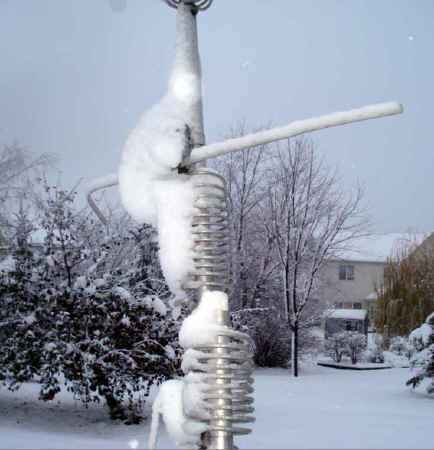
Photo: Snow is piled up on the WA0TDA Butternut vertical. Welcome to another new year.
Can you believe it? It’s the last week of 2010, and we are tying the ribbons on another year here at Handiham headquarters. I can’t help but notice on the television, radio, and other media that a popular activity this time of year is the retrospective. Everyone seems to want to set out their own list of significant events that happened over the past year. Why should we be any different? At the end of the year it probably makes sense to take stock of what has happened, both good and bad, and where we think we might need to go from here.
Let’s get the bad out of the way first so that we don’t have to worry about it anymore. From our perspective, 2010 wasn’t exactly an easy year to get through. The lingering effects of the Great Recession were still very evident in the world of non–profits. We had to deal with budget cutbacks and staff cuts. The economists say that we are no longer in a recession, but some of the everyday conversations I have had throughout the past year in places ranging from the barbershop to the city park while walking the dog say otherwise. The nice lady who cuts my hair at the barbershop was also cutting back on Christmas gifts for her kids. Her husband had been laid off for some time now. A fellow dog walker mentioned the involuntary furlough from his work. Nonetheless, we still hold out hope that people will come through for us and support the Handiham program, and we certainly hope that the economists have their heads on straight and that they are right about everything getting better.
We consolidated our office move from Golden Valley out to Camp Courage at Maple Lake, Minnesota during 2010. Our office space is roomy and convenient for operation of the new remote base equipment available to our members via the Internet. 2010 also saw the move of Minnesota Radio Camp from Camp Courage North to our new headquarters at Camp Courage in Maple Lake. We all appreciated the new state-of-the-art cabin space, though we encountered some noise problems on the HF stations from florescent lighting fixtures. Holding the camp in the month of May didn’t work out quite as well as we planned, with somewhat windy weather limiting our time available to operate maritime mobile from the pontoon boat. The volunteers of the Stillwater Amateur Radio Association stepped up to the plate and really helped get the stations set up and operate the VE session. All told, I would have to rate the office move as much more difficult than the radio camp move, but both worked out quite well in the end. Our phone numbers and mailing address remained the same as before, which made things easier.
2010 saw the addition of the second remote base station, W0ZSW, which we located at our new headquarters. The existing remote base at Courage North, W0EQO, remained in operation and will continue to do so. Since the stations are hundreds of miles apart, they can be operated at the same time with no worries about interference with each other. Station reliability has been good over the past year with minimal downtime. Our users have been resourceful and have enjoyed the stations with very few requests for technical support.
Another resource added to our Camp Courage infrastructure was the W0EQO 2 m repeater, thanks to a loan of the equipment from Don, N0BVE, and installation and oversight assistance from other folks, including Matt, KA0PQW. This repeater has been in operation serving the Maple Lake area since last May. We are on track to get a new frequency pair and do some necessary upgrades.
2010 saw increased participation in our online audio lectures and a drop in cassette tape production. This is expected as Handiham members make the transition to web-based and digital audio. We made a few new Daisy book projects and we are trying to figure out how successful these were and where we will go with them in 2011. Ken, KB3LLA, helped us out quite a bit when we had Daisy questions. Our volunteers who read for us monthly, Ken Padgitt, W9MJY, and Bob Zeida, N1BLF, continued their efforts in support of making current amateur radio publications accessible to our blind members, enabling us to have material in a much more timely manner then it would be available from other sources.
Band conditions improved somewhat in 2010, but so far this new solar cycle has been lagging and HF band conditions along with it. Fortunately, the Handiham EchoLink net stayed healthy and enjoyed good participation throughout the year. Regular net control assignments were developed during 2010, and that extra organization really helped keep the net on track. Our net control volunteers did a wonderful job, though, as some have noted, there have been a few bumps in the road considering that some of our net participants are relatively new to amateur radio and EchoLink. Overall, I would judge the net to be a wonderful success over the past year and I am thankful that we have it available as HF band conditions continued to be marginal. The addition of the *HANDIHAM* high capacity conference server hosted by Mike, N0VZC, was a huge help in keeping the Handiham EchoLink net organized.
I would have to say that 2010 struck me as the year that Chinese handheld radios started coming into their own. Several models include self-voicing features that blind users will find helpful. One game-changer in this radio market is the low cost of even dual-band handheld radios coming from China. We will be watching this trend with a great deal of interest, especially the availability of self-voicing accessibility features. 2010 was the first year ever that a self-voicing Chinese handheld radio was demonstrated at Handiham Radio Camp, thanks to Larry, KA0LSG.
When I installed a new ICOM IC-7200 transceiver here in my own ham shack early this year, I was pleased to note that it came with a speech function already in the circuitry, which meant that there was no extra speech chip for blind users to purchase. Another trend in the new radios is the USB connector at the back to provide for rig control and porting of audio between the transceiver and the computer. This will make remote base control easier than ever. It also has the potential to allow users with disabilities to control more radio functions more easily via computer software.
ARRL put its excellent new website online during 2010. Overall, the availability of more amateur radio resources via the Internet was a positive trend because people with disabilities often use computers to gain access to information. We continued to keep the Handiham website updated and accessible as well, and continue to work toward simplicity of use and solid functionality so that our Handiham members will be able to make the most of everything that we put online. As far as I can recall, we had only one short web outage during 2010, which meant that the website was pretty reliable.
Overall I would have to describe 2010 as a year in which the Handiham system made significant strides toward serving members in new and better ways while continuing to hold fast to our values of helping people with disabilities to earn their amateur radio licenses and be part of a vibrant amateur radio community. Those things have always been at the core of what we do, and we have all pulled together to make the past year a success, even with not so good HF band conditions and the less than ideal economic situation. I guess I would have to say that I am pretty satisfied with where we are at the moment, and I am keeping my fingers crossed and hoping for 2011 to be a year full of good DX, lots of activity on the ham radio nets, and – as always – fun and friendship combined with learning and public service here in our Handiham community.
Patrick Tice, WA0TDA
Handiham System Manager
[email protected]
Predictions for the New Year
So where do you think the new year of 2011 will lead us in amateur radio? Will there be any stunning new technology introduced at Dayton HAMVENTION® in May? Will the sun burst to life with impressive sunspot numbers, resulting in fantastic DX conditions? Will any new assistive technology leap to the forefront as the “must-have” new gadget of the year?
I’m going to stick my neck out and share my prognostications for 2011. They may be flat-out wrong, but the weatherman is wrong lots of the time too, and he still has his job.
| Chinese handheld radios and newly-introduced mobile VHF/UHF radios will continue to create interest in the amateur radio market worldwide. The low prices for these units may produce some downward price pressure in the overall amateur radio equipment market. Whether this will ultimately mean lower prices for consumers in the short term with fewer choices later on, it is hard to say. Quality will remain somewhat less impressive in these Chinese radios compared to that of the Japanese manufacturers, at least in this coming year. | |
| The sunspot cycle will produce higher numbers, but still be sub-par compared to previous cycles when we enjoyed great HF band conditions. Still, it will be more fun to get on HF and work DX, and it will be easier to do so in 2011 than it was several years ago thanks to improving solar conditions. Bottom line: Now is the time to upgrade to General. | |
| This is an easy prediction because it happens every time there’s a change in the question pool. People will suddenly discover that they have been dragging their feet a little bit too long in studying for their General Class licenses and that they will be required to test from a completely new General Class question pool starting on July 1. I don’t know why this always seems to be a surprise, but I guess people just have a hard time remembering that the question pools are changed on a rotating basis. 2011 is the year for the new General Class. Just as predictable is the likelihood of a higher demand for VE sessions in late June. If you find yourself in this predicament, study now and test as early as possible. | |
| Remote base operation of HF stations will come back into the amateur radio consciousness as more and more equipment becomes available with easy computer connectivity, such as USB ports that can send and receive both rig control data and digital audio between the radio and the computer. This development will make it easier for people to consider setting up their own remote base stations. Meanwhile, EchoLink will remain a very strong contender, getting quite a bit of use around the world every day. These technological developments will continue to dovetail nicely with the goals and capabilities of an aging population of baby boomers looking toward retirement housing but not wanting to deal with huge antenna systems. | |
| 2011 just could be the year when the online-only magazine Worldradio really shines as a leader in the amateur radio publishing business. As everyone knows, publishing houses are caught in a tug-of-war between print and digital. People with disabilities have a stake in digital, because it has the potential to provide much more timely accessibility to more material than print publications ever could. It may be just a little too early to predict the availability of all amateur radio publications online, but I think the unmistakable trend in the publishing business is to at least augment print material with similar if not exact duplicates available online with either an advertising-based business model or a pay-for business model or some combination of the two. This will be interesting to watch. In 2010 the ARRL made its Technician, General, and Extra Q&A books available through Amazon’s Kindle reader. All of these ARRL publications have the text-to-speech Kindle option enabled, a great convenience for blind and low vision users. I will say for sure that I think 2011 will see more and more digital publications in the amateur radio realm. | |
| Repeater systems without Internet connectivity such as EchoLink, WIRES, or IRLP will continue to be underutilized during 2011. In 2010, some of these repeater systems barely had any activity at all. Other digital repeater systems will probably hold their own, but remain regional in nature and not reach most of the amateur radio users. | |
| Amateur radio operators may get a real public service workout this Spring as huge amounts of snowfall and heavy precipitation in March bring regional flooding here in the Midwest and in other parts of the country. There is already a great deal of snow on the ground in the upper Midwest and Spring flooding is a near-certainty. |
And my last big prediction:
| We will be ready to deliver an exciting new year of Handiham services beginning on Monday, 3 January 2011. |

Handiham World for 29 December 2010
Welcome to Handiham World!
Photo: Snow is piled up on the WA0TDA Butternut vertical. Welcome to another new year.Can you believe it? It’s the last week of 2010, and we are tying the ribbons on another year here at Handiham headquarters. I can’t help but notice on the television, radio, and other media that a popular activity this time of year is the retrospective. Everyone seems to want to set out their own list of significant events that happened over the past year. Why should we be any different? At the end of the year it probably makes sense to take stock of what has happened, both good and bad, and where we think we might need to go from here.
Let’s get the bad out of the way first so that we don’t have to worry about it anymore. From our perspective, 2010 wasn’t exactly an easy year to get through. The lingering effects of the Great Recession were still very evident in the world of non–profits. We had to deal with budget cutbacks and staff cuts. The economists say that we are no longer in a recession, but some of the everyday conversations I have had throughout the past year in places ranging from the barbershop to the city park while walking the dog say otherwise. The nice lady who cuts my hair at the barbershop was also cutting back on Christmas gifts for her kids. Her husband had been laid off for some time now. A fellow dog walker mentioned the involuntary furlough from his work. Nonetheless, we still hold out hope that people will come through for us and support the Handiham program, and we certainly hope that the economists have their heads on straight and that they are right about everything getting better.
We consolidated our office move from Golden Valley out to Camp Courage at Maple Lake, Minnesota during 2010. Our office space is roomy and convenient for operation of the new remote base equipment available to our members via the Internet. 2010 also saw the move of Minnesota Radio Camp from Camp Courage North to our new headquarters at Camp Courage in Maple Lake. We all appreciated the new state-of-the-art cabin space, though we encountered some noise problems on the HF stations from florescent lighting fixtures. Holding the camp in the month of May didn’t work out quite as well as we planned, with somewhat windy weather limiting our time available to operate maritime mobile from the pontoon boat. The volunteers of the Stillwater Amateur Radio Association stepped up to the plate and really helped get the stations set up and operate the VE session. All told, I would have to rate the office move as much more difficult than the radio camp move, but both worked out quite well in the end. Our phone numbers and mailing address remained the same as before, which made things easier.
2010 saw the addition of the second remote base station, W0ZSW, which we located at our new headquarters. The existing remote base at Courage North, W0EQO, remained in operation and will continue to do so. Since the stations are hundreds of miles apart, they can be operated at the same time with no worries about interference with each other. Station reliability has been good over the past year with minimal downtime. Our users have been resourceful and have enjoyed the stations with very few requests for technical support.
Another resource added to our Camp Courage infrastructure was the W0EQO 2 m repeater, thanks to a loan of the equipment from Don, N0BVE, and installation and oversight assistance from other folks, including Matt, KA0PQW. This repeater has been in operation serving the Maple Lake area since last May. We are on track to get a new frequency pair and do some necessary upgrades.
2010 saw increased participation in our online audio lectures and a drop in cassette tape production. This is expected as Handiham members make the transition to web-based and digital audio. We made a few new Daisy book projects and we are trying to figure out how successful these were and where we will go with them in 2011. Ken, KB3LLA, helped us out quite a bit when we had Daisy questions. Our volunteers who read for us monthly, Ken Padgitt, W9MJY, and Bob Zeida, N1BLF, continued their efforts in support of making current amateur radio publications accessible to our blind members, enabling us to have material in a much more timely manner then it would be available from other sources.
Band conditions improved somewhat in 2010, but so far this new solar cycle has been lagging and HF band conditions along with it. Fortunately, the Handiham EchoLink net stayed healthy and enjoyed good participation throughout the year. Regular net control assignments were developed during 2010, and that extra organization really helped keep the net on track. Our net control volunteers did a wonderful job, though, as some have noted, there have been a few bumps in the road considering that some of our net participants are relatively new to amateur radio and EchoLink. Overall, I would judge the net to be a wonderful success over the past year and I am thankful that we have it available as HF band conditions continued to be marginal. The addition of the *HANDIHAM* high capacity conference server hosted by Mike, N0VZC, was a huge help in keeping the Handiham EchoLink net organized.
I would have to say that 2010 struck me as the year that Chinese handheld radios started coming into their own. Several models include self-voicing features that blind users will find helpful. One game-changer in this radio market is the low cost of even dual-band handheld radios coming from China. We will be watching this trend with a great deal of interest, especially the availability of self-voicing accessibility features. 2010 was the first year ever that a self-voicing Chinese handheld radio was demonstrated at Handiham Radio Camp, thanks to Larry, KA0LSG.
When I installed a new ICOM IC-7200 transceiver here in my own ham shack early this year, I was pleased to note that it came with a speech function already in the circuitry, which meant that there was no extra speech chip for blind users to purchase. Another trend in the new radios is the USB connector at the back to provide for rig control and porting of audio between the transceiver and the computer. This will make remote base control easier than ever. It also has the potential to allow users with disabilities to control more radio functions more easily via computer software.
ARRL put its excellent new website online during 2010. Overall, the availability of more amateur radio resources via the Internet was a positive trend because people with disabilities often use computers to gain access to information. We continued to keep the Handiham website updated and accessible as well, and continue to work toward simplicity of use and solid functionality so that our Handiham members will be able to make the most of everything that we put online. As far as I can recall, we had only one short web outage during 2010, which meant that the website was pretty reliable.
Overall I would have to describe 2010 as a year in which the Handiham system made significant strides toward serving members in new and better ways while continuing to hold fast to our values of helping people with disabilities to earn their amateur radio licenses and be part of a vibrant amateur radio community. Those things have always been at the core of what we do, and we have all pulled together to make the past year a success, even with not so good HF band conditions and the less than ideal economic situation. I guess I would have to say that I am pretty satisfied with where we are at the moment, and I am keeping my fingers crossed and hoping for 2011 to be a year full of good DX, lots of activity on the ham radio nets, and – as always – fun and friendship combined with learning and public service here in our Handiham community.
Patrick Tice, WA0TDA Handiham System Manager [email protected]
Predictions for the New Year
So where do you think the new year of 2011 will lead us in amateur radio? Will there be any stunning new technology introduced at Dayton HAMVENTION® in May? Will the sun burst to life with impressive sunspot numbers, resulting in fantastic DX conditions? Will any new assistive technology leap to the forefront as the “must-have” new gadget of the year?
I’m going to stick my neck out and share my prognostications for 2011. They may be flat-out wrong, but the weatherman is wrong lots of the time too, and he still has his job.
| Chinese handheld radios and newly-introduced mobile VHF/UHF radios will continue to create interest in the amateur radio market worldwide. The low prices for these units may produce some downward price pressure in the overall amateur radio equipment market. Whether this will ultimately mean lower prices for consumers in the short term with fewer choices later on, it is hard to say. Quality will remain somewhat less impressive in these Chinese radios compared to that of the Japanese manufacturers, at least in this coming year. | |
| The sunspot cycle will produce higher numbers, but still be sub-par compared to previous cycles when we enjoyed great HF band conditions. Still, it will be more fun to get on HF and work DX, and it will be easier to do so in 2011 than it was several years ago thanks to improving solar conditions. Bottom line: Now is the time to upgrade to General. | |
| This is an easy prediction because it happens every time there’s a change in the question pool. People will suddenly discover that they have been dragging their feet a little bit too long in studying for their General Class licenses and that they will be required to test from a completely new General Class question pool starting on July 1. I don’t know why this always seems to be a surprise, but I guess people just have a hard time remembering that the question pools are changed on a rotating basis. 2011 is the year for the new General Class. Just as predictable is the likelihood of a higher demand for VE sessions in late June. If you find yourself in this predicament, study now and test as early as possible. | |
| Remote base operation of HF stations will come back into the amateur radio consciousness as more and more equipment becomes available with easy computer connectivity, such as USB ports that can send and receive both rig control data and digital audio between the radio and the computer. This development will make it easier for people to consider setting up their own remote base stations. Meanwhile, EchoLink will remain a very strong contender, getting quite a bit of use around the world every day. These technological developments will continue to dovetail nicely with the goals and capabilities of an aging population of baby boomers looking toward retirement housing but not wanting to deal with huge antenna systems. | |
| 2011 just could be the year when the online-only magazine Worldradio really shines as a leader in the amateur radio publishing business. As everyone knows, publishing houses are caught in a tug-of-war between print and digital. People with disabilities have a stake in digital, because it has the potential to provide much more timely accessibility to more material than print publications ever could. It may be just a little too early to predict the availability of all amateur radio publications online, but I think the unmistakable trend in the publishing business is to at least augment print material with similar if not exact duplicates available online with either an advertising-based business model or a pay-for business model or some combination of the two. This will be interesting to watch. In 2010 the ARRL made its Technician, General, and Extra Q&A books available through Amazon’s Kindle reader. All of these ARRL publications have the text-to-speech Kindle option enabled, a great convenience for blind and low vision users. I will say for sure that I think 2011 will see more and more digital publications in the amateur radio realm. | |
| Repeater systems without Internet connectivity such as EchoLink, WIRES, or IRLP will continue to be underutilized during 2011. In 2010, some of these repeater systems barely had any activity at all. Other digital repeater systems will probably hold their own, but remain regional in nature and not reach most of the amateur radio users. | |
| Amateur radio operators may get a real public service workout this Spring as huge amounts of snowfall and heavy precipitation in March bring regional flooding here in the Midwest and in other parts of the country. There is already a great deal of snow on the ground in the upper Midwest and Spring flooding is a near-certainty. |
And my last big prediction:
| We will be ready to deliver an exciting new year of Handiham services beginning on Monday, 3 January 2011. |
Handiham World for 22 December 2010
Welcome to Handiham World!
As we cruise into the final weeks of the year, we need to remind our readers & listeners that we survive only because of your generosity. Non-profit programs like Handihams look for a significant part of our support at year’s end. I hope you will take a few minutes to find the return envelope in your Handiham World print edition and help us out with anything you can. If you don’t have an envelope, you can call Nancy at 1-866-426-3442 to donate by credit card, or choose the donate online option at Courage Center’s website. The instructions on how to designate your gift specifically to the Handiham program or donate by mail are in your weekly e-letter and on the Handiham website.
Thank you for your support!
Ah, yes. Computers. We love them and we hate them. The ham shack computer is so full of promise; it can do logging, rig control, callsign look up, digital modes, QSL cards, EchoLink, remote base operation, and then switch gears and become the family’s web browser and email hub. It may even turn into a gaming console when it is not running the ham station.
That’s when everything is working, of course. As computer users, we have all experienced the frustration of a locked-up machine, an unresponsive application, or a blue screen of death or its equivalent. You Mac and Linux users out there have had similar problems, so don’t sit there smirking!
Today’s topic is computers, mostly as related to ham radio, of course. We’ll have a few of the usual weekly features as well.
Patrick Tice, WA0TDA
Handiham System Manager
[email protected]

Multitasking – How much is okay?

We have all heard the term “multitasking”, which seems to be in the popular media spotlight these days. When you multitask, you supposedly do several things at once. Multitasking is supposed to save time and make you more efficient. This is not always the case, as has been often-noted when people who are supposed to be paying attention to a critical task like driving a car are also trying to put on lipstick, send a text message on a cell phone, or (for that matter) find a frequency on their amateur radio transceiver. The results can be disastrous!
On the other hand, sometimes multitasking makes sense. When I am out taking a brisk walk in the park for my daily exercise, I can also take the dog along so that he gets his walk. In addition, I can take along an iPod and listen to the ARRL Audio News and Amateur Radio NEWSLINE. This kind of multitasking works well because the resources demanded for each task do not overlap too much. For example, I don’t need to use a lot of brain power to put one foot in front of the other while taking a walk in the park. Instead, that brain power can be used to think about what I am hearing about amateur radio news on the iPod. Occasionally, the dog will need to stop and a small amount of brainpower will be redirected to that interruption. The important thing to remember about multitasking is that each task will require specific resources. Sometimes the resources needed for one task will be the same ones needed for a second task, so it will be necessary to use the resources first for task one then for task two, perhaps switching back and forth between the two different tasks as a way of sharing resources.
Computers work the same way. In a single-processor computer, even though you may be performing multiple tasks, the processor is really only doing one thing at a time. Sharing the resource of processor power can be done by switching between tasks rapidly so that it seems as if the computer really is multitasking. Some computers have multiple core processors, which allows them to run parallel processes for true multitasking. What I am getting to with this talk about multitasking is that it is possible for us to ask too much of our personal computers. You may have found out (as I have) that some software programs simply don’t play well with others. You may find yourself having to close one software program before you can use another one. Hardware resources in any single computer are limited as well. If you are using your personal computer for rig control, you are probably tying up a serial port. If you are using your computer for EchoLink operation, you are tying up soundcard resources. You may find it difficult to switch between EchoLink operation and voice dictation using the same soundcard. After using one sound-enabled application, you may find out that the level settings for the next sound application you want to use are completely off base, requiring you to make a trip to the Windows mixer to reset everything. If the ham shack computer is also the family computer, you may run into the problem of who gets to use the computer when you want to get on the air.
The personal computer is really good at multitasking, but there may come a time when you have to decide to set up a dedicated ham shack machine. The advantages are many and include not having to draw straws to see who gets the computer during the big contest weekend, having only ham radio related software that you really need installed on the ham shack machine, and the ability to dedicate hardware settings and connections to ham radio rig control and VoIP applications like EchoLink. You can even set your web browser settings so that frequently used ham radio websites come up right away in tabs. There is also great advantage in returning to the ham shack, sitting down, and finding the computer in more or less the same state that you left it in the last time you used it. Yes, you are still asking the ham shack computer to be a multitasker of sorts but instead of having to do everything that the entire family might demand of it, your ham shack computer can now do targeted multitasking related to amateur radio use and applications. With the price of personal computers falling, it seems reasonable to go the route of a dedicated computer for your ham radio hobby.
“That is all well and good”, you say, “but even my ham shack computer doesn’t seem to have enough hardware resources like sound card inputs to handle all of the different amateur radio applications.”
Ah, yes. That is a common complaint. These days it is not unusual for the ham shack computer to be used in digital modes operation, EchoLink, and remote base operation using Skype. How are all of these sound applications supposed to work on a single machine?
One solution is to add USB sound devices. Each USB sound device functions independently from the computer’s internal sound card circuitry. For example, if you use the computer’s existing sound card for PSK-31 operation, you may find it more convenient to have a USB headset microphone for use with EchoLink. Since each functions independently, the mixer settings should remain at their proper settings once set up for each application. You can buy USB headsets for as little as $30 on sale, and you can get a pretty good one any time for under $60. The time saved in not having to fiddle around with mixer settings or plug and unplug cables into the soundcard every time you change modes of operation on your ham shack computer is well worth the small expense and effort to get a USB headset installed. Incidentally, if you have a need for a second USB sound system, whether it is a desk microphone, a webcam with USB microphone, or a second USB headset, you can generally simply plug it in to a second USB port and set it up for still another application. This would enable you to have separate sound systems for PSK-31, EchoLink, and Skype. If you are going to ask the computer to multitask on sound operations, this is a great way to cut down on potential conflicts and save yourself a lot of time and grief.
Before we leave the subject of multitasking, I want to share a tip for our readers and listeners who drive a car and operate a mobile ham radio station. All I have in my car is a 2 m mobile rig, but it has a huge potential to distract me from my main task, which should be paying attention to my driving. I find that I can talk on the radio all right while driving and of course everyone understands if you tell them that you need to pay attention to your driving while at a busy intersection or if traffic and weather conditions are deteriorating. The main distraction with mobile operation involves changing channels on the 2 m radio and taking your eyes off the road. I have solved this problem by setting up the radio’s memory channels so that I can navigate through them without taking my eyes off the road. One trick familiar to many blind Handiham members who can operate just about any 2 m radio with memories is to set up the local National Weather Service in channel space one. Since the National Weather Service is always on the air, you can just twist the memory channel knob until you find their broadcast and then click the tuning knob clockwise or counterclockwise a given number of clicks, counting clicks to the channel you want to use. Even if there is nothing on that repeater channel, by counting clicks from the known National Weather Service channel you now are assured that you are on the correct repeater. Another thing I figured out was to set up repeaters in memory slots that track logically by geography. For example, I start with my local repeater, then I travel west on the interstate and soon find that I need to switch to a second repeater and then finally a third repeater as I continue going west. On my radio, the local repeater can be found before I even leave the driveway. After that, I have the radio set up so that one counterclockwise click of the memory channel knob takes me to the next repeater to the west. Another counterclockwise click takes me to the third repeater, again as I proceed in a westbound direction. On the return trip I reversed the process and my memory channel clicks take me clockwise as I drive to the east. Sometimes these simple solutions in setting up our radios can minimize dangerous multitasking while driving.
I don’t want to say that multitasking is always good or always bad. We all multitask to some extent, and we ask our ham shack computers to do it all the time. The trick is to think things through and plan to set up your station and your equipment so that multitasking works for you! (Read more on the Handiham dot org website.)

Handiham World for 15 December 2010
Welcome to Handiham World!
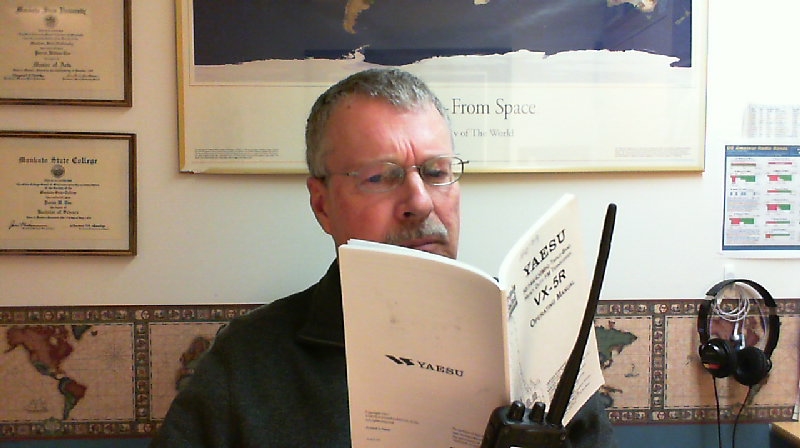
Last week we asked: How do you use equipment manuals, and what can be done to make learning about a radio easier? Let me know so that we can figure out where to go with this next new frontier.
As you might expect, we got some interesting and insightful responses. I will condense the main ideas down to just two different methods of making a manual accessible.
- A popular suggestion was to create the manual in HTML with links from topics listed in the contents directly to the relevant section of the manual. So, for example, if you wanted to read about how to set a memory channel, you would find “setting memory channels” in the contents, then follow that link directly to the part of the manual main text that has the instruction on setting memories. One example of why HTML is good was sent by Gerry, WB6IVF. He said: ” I think that HTML is the best because you can create links that are accessible by the tab key, and you can use the arrows to move with in a line and spell something or transcribe something to Braille character by character. So in other words, if a document looked to a blind person like a web page, I think we would find it easy to get around. Daisy is good, but it isn’t easy for everyone to use yet.”
Another writer favored HTML, but added that a special description of the front and rear panels of the radio should be written so that blind readers would not have to ask someone sighted to map out the location of controls for them from the print diagrams.
- Some of you have Kurzweil scanners and are able to scan the print manual, or alternatively to download the manual from a company website and use the embedded text in the PDF version. Getting the information into the linear system used by screenreaders is still somewhat problematic as some items like sidebars and captions can get out of context. However, the availability of embedded text PDF manuals is still a great advancement from the paper-only days! A description of the panels is still needed, however.
I was surprised at this request for HTML functionality, but it really does make a lot of sense. While DAISY does provide for at least a similar way to navigate through a book, it is still a learning process that is new to many users. DAISY is built upon XML, and as such is similar to web-based documents. The question in coming months and perhaps years is whether the standard for DAISY will be so well-accepted that it will be preferable to website-like manuals designed in plain old HTML. We could try converting a text to HTML and give it a test run, but the question will then be what to do with users who do not have computers but who have the government-issued NLS DAISY players.
Time will tell, of course. I am going to put on my prognosticator’s hat and predict that cassette tapes will really take a hit in 2011. I’ve always hated the way it’s so hard to find a particular part of an audio instruction manual in a tape. Another problem was the way adequate control layouts were not always added by the volunteers who read the manuals. This year Sony discontinued the venerable Walkman portable cassette player, and of course the National Library Service discontinued support for the old 4-track production system. RFB&D also moved forward, leaving cassette tapes behind. At Handihams, we still get a few requests for tapes, but in 2011 these will all be “special order”, as they are no longer in stock and have to be produced on an as-needed basis.
The new methods of producing manuals will be HTML and DAISY. We hope that these can be augmented with users teaching via audio how to find one’s way around the radio and adjust the settings, as well as to use the radio’s basic functions. Actual users with experience doing these “quick start” guides can really be helpful, not as a substitute for the manuals, but as an added reference.














