Archive for the ‘ham radio’ Category
 Give a Hoot? How NOT to Avoid Mosquito Bites!!
 May 31st, 2011 |
  Author:
 The Hoot Owl Sprint sponsored by the QRP-ARCI requires one to operate from 2000-2359 local time. The objective (?) is to test our ability to operate QRP Portable in the night hours, portable if possible. I chose a secret location with TALL pine trees next to an alligator occupied lake in the SE suburbs of Orlando for my site. Knowing the place is prone to giant mosquitos, I planned to use my screen house enclosure. Weather was HOT and WINDY with gusts of over 25mph so that killed option to hide from the critters inside my screen house. SHUCKS. But, the good news was the wind also blew the mosquitos out of the air so I settled in for operating from my portable table in the middle of the tall trees.
Wind did blow Ole’ Murphy in and added a couple hours to getting my 88 ft doublet up into the pines as my 1 oz sinkers hung in mid-air. The tension on the line with all that wind equaled the weight of the sinker and once it got up over the 60 ft limb it merely hung in space and didn’t descend no matter how many things I tried. Very frustrating! Eventually my Scottish and Irish nature won out over nature and I settled for a 45 ft high perch for my antenna in a slight horizontal vee config favoring NNW direction. From FL this is not a bad direction to point as it covers the better part of the USA! So with my jeans and a light jacket to break the wind, I began my contest effort, missing the first hour due to delay in getting the antenna up, so it was really dark by the time I made my first contact which was my good friend and fellow Polar Bear QRP group member the Hill Billy Bear, AF4O in Tennessee.
What a mess, I had just turned the rig on and had not even setup my BLT+ tuner but heard a quick CQ from AF4O and wanted to make the contact. I didn’t notice until afterwards that I was still in SWR position and not in operate, so the contact I made with him was thru the LED SWR Bridge which must have reduced my 2+ watt output to the lowish milliwatt range. How’s that for QRPp? Amazing that we even connected and my keying was so poor as the wind was blowing so hard the tuner was getting airborne during our brief exchange! Finally settled down and taped it to the table for the rest of the evening. Thanks for hanging in there with me Chuck! Operating in a strange place, in the middle of nowhere in the dark was a bit unsettling I was to learn.
The night effort was fun and I got to work several Polar Bear friends, Larry W2LJ, Hank WQ8RP using his club call, and Martin VA3SIE/VE2/P (what fun to send that call each time, eh?) Sure worth the effort to get out and experience the wierd band conditions. 20m was open until midnite but was pipelining to various parts of the country with STRONG sigs until it shifted to another region without much warning. It was either good or bad like that all evening but much more reliable than 40m here in the FL area.

Achilles HEAD shot
The lesson of the night was an itchy one. I was well covered from potential mosquitos and the wind was in my favor. BUT, they found my Achilles heel (or should I say Achilles HEAD?) They managed to bite my head without my noticing in the upside down U-shaped area where the cap adjuster is in the back. I am sporting about a dozen (almost the same as my 3 hr QSO total of 13) bites that itch like crazy in that small area that was not well covered by clothing or insect repellent. So next time I go out contesting in the night, I’ll be prepared… Look out, I’m ready for ya skeeters. Grrrrrrrr!
Handiham World for 25 May 2011
Welcome to Handiham World!
 Photo: Larry Huggins, KA0LSG, Handiham volunteer. Hap Holly, KC9RP, is in the background since our Handiham booth and the RAIN Report booth were neighbors.
 Photo: Volunteer John Pedley, N0IPO, hangs the banner at the back of the booth because he is the tallest of our crew and can reach the hooks.
 Photo: Larry, KA0LSG, John, N0BFJ, and Ken, KB3LLA, on booth duty.
Thanks to all who stopped by to visit us at Hamvention® 2011 and to volunteers John Hoenshell, N0BFJ, Larry Huggins, KA0LSG, John Pedley, N0IPO, and Ken Silberman, KB3LLA, Handiham Radio Club President, for staffing the booth. We’ll have a full report later, but I also wanted to thank DARA for their generous support in awarding the Handiham System a check for $500 and to John Hoenshell, N0BFJ, for his financial support of the Hamvention trip that enables us to be there.
The ARRL Youth Forum, conducted by Carole Perry, WB2MGP, was a must-see, because our young people are the future of amateur radio – we all know that – but I like listening to the poised young folks telling us about the aspects of ham radio that they have mastered. And do you know what? I feel positively uplifted by their energy and enthusiasm for science and technology, as well as for public service. I know the world will be better off with people like them in our future.
We are giving a special shout out to 10 year old Amanda Lee, KD0JAY, for her excellent presentation about “People with Disabilities and Ham Radio” and Handihams at the Youth Forum! Hopefully a video of her presentation will be available on YouTube soon. Amanda told us that she was inspired by Gerry, WB6IVF, who had been mentioned in our past columns as the owner of the “Unseen Bean” coffee roasting business.
 Photo: Shirley Roberts, N8LX, and Lynn Roberts, N8LXK, at the Handiham booth.
Shirley Roberts, N8LX, is a celebrity this year, because she won the Dayton Hamvention® Amateur of the Year award. She and her husband Lee, N8LXK, stopped by and paid us an extended visit at the Handiham booth. Shirley and her many accomplishments in amateur radio public service are featured in the Richard Fisher, KI6SN, Public Service column in the May 2011 CQ Magazine. Shirley is active in many ham radio organizations, including the ACB radio club, QCWA, Handihams, ARRL, and, of course, SKYWARN® as a liaison.
Speaking of CQ, when I stopped by the CQ/Worldradio booth to visit with publisher Rich Moseson, W2VU, he pointed out a giant reproduction of the Worldradio June 2011 cover, and there I was, right on the front. The photo was taken by Avery Finn, K0HLA, and shows a smiling Pat Tice wielding that familiar Handiham coffee mug. The photo accompanies a story about how I have completed 20 years with the Courage Center Handiham System in May, 2011. Be sure to read it! Bob Zeida, N1BLF, writes that he should have the audio version ready in time for the Friday Handiham Audio Digest, available to our blind members.

Wandering around is always fun. The main arena section has a very high roof and hosts some familiar manufacturers like Kenwood, Icom, and MFJ. In this photo taken from the stands, we look down at the MFJ booth with its many tall vertical antennas.

I make no secret of the fact that I like my own Icom IC-7200. Imagine my surprise to see it dressed up in a camo paint job at the Icom booth! We have mentioned in the past that the IC-7200 comes with speech frequency readout installed. Kudos to Icom for including this accessibility feature instead of making it an option.
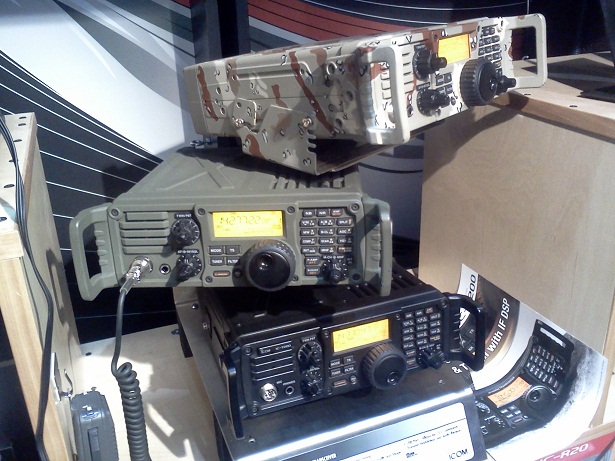 Photo: Stack of three IC-7200 transceivers, one in plain black, one in army green, and one in camo paint.
What a great show it was again this year! Now that we are all jazzed up from all the new ham radio stuff we saw at Dayton, it’s time to roll up our sleeves and get busy with the summer antenna work and ARRL Field Day!
Patrick Tice [email protected] Handiham Manager
Read more or find the audio podcast on handiham.org.

Handiham World for 25 May 2011
Welcome to Handiham World!
Photo: Larry Huggins, KA0LSG, Handiham volunteer. Hap Holly, KC9RP, is in the background since our Handiham booth and the RAIN Report booth were neighbors.
Photo: Volunteer John Pedley, N0IPO, hangs the banner at the back of the booth because he is the tallest of our crew and can reach the hooks.
Photo: Larry, KA0LSG, John, N0BFJ, and Ken, KB3LLA, on booth duty.
Thanks to all who stopped by to visit us at Hamvention® 2011 and to volunteers John Hoenshell, N0BFJ, Larry Huggins, KA0LSG, John Pedley, N0IPO, and Ken Silberman, KB3LLA, Handiham Radio Club President, for staffing the booth. We’ll have a full report later, but I also wanted to thank DARA for their generous support in awarding the Handiham System a check for $500 and to John Hoenshell, N0BFJ, for his financial support of the Hamvention trip that enables us to be there.
The ARRL Youth Forum, conducted by Carole Perry, WB2MGP, was a must-see, because our young people are the future of amateur radio – we all know that – but I like listening to the poised young folks telling us about the aspects of ham radio that they have mastered. And do you know what? I feel positively uplifted by their energy and enthusiasm for science and technology, as well as for public service. I know the world will be better off with people like them in our future.
We are giving a special shout out to 10 year old Amanda Lee, KD0JAY, for her excellent presentation about “People with Disabilities and Ham Radio” and Handihams at the Youth Forum! Hopefully a video of her presentation will be available on YouTube soon. Amanda told us that she was inspired by Gerry, WB6IVF, who had been mentioned in our past columns as the owner of the “Unseen Bean” coffee roasting business.
Photo: Shirley Roberts, N8LX, and Lynn Roberts, N8LXK, at the Handiham booth.
Shirley Roberts, N8LX, is a celebrity this year, because she won the Dayton Hamvention® Amateur of the Year award. She and her husband Lee, N8LXK, stopped by and paid us an extended visit at the Handiham booth. Shirley and her many accomplishments in amateur radio public service are featured in the Richard Fisher, KI6SN, Public Service column in the May 2011 CQ Magazine. Shirley is active in many ham radio organizations, including the ACB radio club, QCWA, Handihams, ARRL, and, of course, SKYWARN® as a liaison.
Speaking of CQ, when I stopped by the CQ/Worldradio booth to visit with publisher Rich Moseson, W2VU, he pointed out a giant reproduction of the Worldradio June 2011 cover, and there I was, right on the front. The photo was taken by Avery Finn, K0HLA, and shows a smiling Pat Tice wielding that familiar Handiham coffee mug. The photo accompanies a story about how I have completed 20 years with the Courage Center Handiham System in May, 2011. Be sure to read it! Bob Zeida, N1BLF, writes that he should have the audio version ready in time for the Friday Handiham Audio Digest, available to our blind members.
Wandering around is always fun. The main arena section has a very high roof and hosts some familiar manufacturers like Kenwood, Icom, and MFJ. In this photo taken from the stands, we look down at the MFJ booth with its many tall vertical antennas.
I make no secret of the fact that I like my own Icom IC-7200. Imagine my surprise to see it dressed up in a camo paint job at the Icom booth! We have mentioned in the past that the IC-7200 comes with speech frequency readout installed. Kudos to Icom for including this accessibility feature instead of making it an option.
Photo: Stack of three IC-7200 transceivers, one in plain black, one in army green, and one in camo paint.
What a great show it was again this year! Now that we are all jazzed up from all the new ham radio stuff we saw at Dayton, it’s time to roll up our sleeves and get busy with the summer antenna work and ARRL Field Day!
Patrick Tice
[email protected]
Handiham Manager
Read more or find the audio podcast on handiham.org.
Handiham World for 18 May 2011
Welcome to Handiham World!
Hamvention® 2011 – Visit the Handihams!

Handihams planning for Dayton HAMVENTION®.
Image: Pat, WA0TDA, peeks out from behind a display at the Handiham booth during a previous Hamvention.
It is hard to believe that it is the month of May already, and that means that it is nearly time for the biggest and best ham radio get-together, Hamvention(TM) in Dayton, Ohio. Thanks to support from a generous donor, John Hoenshell, N0BFJ, who underwrites much of the expense, we are once again able to have a booth on the Hamvention floor. If you are planning to attend, and we certainly hope that you are, please stop by booth SA0330 and pay us a visit. SA=Silver Arena. Hamvention begins on Friday, May 20th and runs through the weekend of the 21st and 22nd.
As you might expect, we are busy getting ready for the big show.
When you stop by the Handiham booth, you will be able to sign our guest register. We always have a few extra chairs if you want to sit down and talk with us for while. If you are a wheelchair user, you will find that we always place our display table at the very back of the booth, which allows you to bring your wheelchair into our area and get out of the main traffic stream in the aisle.
Ken, KB3LLA, Handiham Radio Club President, will be at the booth whenever he isn’t out somewhere on the show floor finding out about all the new amateur radio gear. I will be there, as will Handiham volunteers John Hoenshell, N0BFJ, Larry Huggins, KA0LSG, and John Pedley, N0IPO. If you hang around too much, we will put you to work as a greeter and Handiham representative!
So consider the welcome mat out and waiting for you. We hope you can stop by and see us in person, but if not, we are going to try to get on the Handiham EchoLink Net on Saturday and on the same node and frequency at other times throughout the day on Saturday. This all depends on whether or not we are able to get a reliable Internet connection, so no promises.
I hope to see you there!
Patrick Tice [email protected] Handiham Manager

Handiham World for 18 May 2011
Welcome to Handiham World!
Hamvention® 2011 – Visit the Handihams!
Handihams planning for Dayton HAMVENTION®.
Image: Pat, WA0TDA, peeks out from behind a display at the Handiham booth during a previous Hamvention.
It is hard to believe that it is the month of May already, and that means that it is nearly time for the biggest and best ham radio get-together, Hamvention(TM) in Dayton, Ohio. Thanks to support from a generous donor, John Hoenshell, N0BFJ, who underwrites much of the expense, we are once again able to have a booth on the Hamvention floor. If you are planning to attend, and we certainly hope that you are, please stop by booth SA0330 and pay us a visit. SA=Silver Arena. Hamvention begins on Friday, May 20th and runs through the weekend of the 21st and 22nd.
As you might expect, we are busy getting ready for the big show.
When you stop by the Handiham booth, you will be able to sign our guest register. We always have a few extra chairs if you want to sit down and talk with us for while. If you are a wheelchair user, you will find that we always place our display table at the very back of the booth, which allows you to bring your wheelchair into our area and get out of the main traffic stream in the aisle.
Ken, KB3LLA, Handiham Radio Club President, will be at the booth whenever he isn’t out somewhere on the show floor finding out about all the new amateur radio gear. I will be there, as will Handiham volunteers John Hoenshell, N0BFJ, Larry Huggins, KA0LSG, and John Pedley, N0IPO. If you hang around too much, we will put you to work as a greeter and Handiham representative!
So consider the welcome mat out and waiting for you. We hope you can stop by and see us in person, but if not, we are going to try to get on the Handiham EchoLink Net on Saturday and on the same node and frequency at other times throughout the day on Saturday. This all depends on whether or not we are able to get a reliable Internet connection, so no promises.
I hope to see you there!
Patrick Tice
[email protected]
Handiham Manager
Handiham World for 11 May 2011
Welcome to Handiham World!

What time is it? Think about that awhile and we’ll come back to it shortly.
This morning while having my coffee and listening to the radio – NPR – I heard some guy who’s a technology specialist talking about how standalone devices are becoming obsolete because they are being replaced by smart phones and tablet computers that do all kinds of stuff for us. I thought it was strange that he forgot to mention the standalone camera, at least the non-professional snapshot or low-quality video camera, which is certainly being superseded by the built-in cameras in smart phones. He was on the mark when he mentioned that paper address books are becoming obsolete. Most people who carry cell phones these days probably have their contacts in the phone’s address book. Smart phones and tablet computers might just win the day over standalone e-readers, too. Standalone music players are taking a hit as smart phones become more convenient for playing everything from audio podcasts to audio books. Accessibility features on these multifunction devices are getting better and better, and it is my belief that it is only a matter of time before most accessibility features are simply built in to every consumer smart phone or tablet right off the shelf.
Now where was I? Oh yes; we were talking about how many different things these new smart devices do. They are book readers, take pictures, take notes in both text and audio, record videos, surf the web, handle e-mail and texting with aplomb, make telephone calls (yes, some of us still do use the telephone), and those are only the mainstream common functions of such devices. Applications are being developed at such a rapid pace that it would be a full-time job just to do an overview of all of the specialized functions and tools that are becoming available daily.
Anyway, the point of the story on the radio was that these multifunction smart devices are making other standalone devices obsolete. As an amateur radio operator, I have grown used to self-styled technology pundits predicting the imminent demise of ham radio at the hands of new technology. Of course ham radio is stronger and more popular than ever, and because of its propensity to attract a certain number of techie geeky people to its ranks, it has been able to shoot out some tendrils into the new technologies that the pundits thought would bring about its demise. Take, for example, the smart phone. Both the Android and the iPhone platforms are ham radio friendly thanks to the availability of the EchoLink application. While I may be interested in carrying a handheld radio if it is small and convenient enough, I know that I can access a huge interconnected world-wide resource of repeater systems through my smart phone. Thus, ham radio will come along with me and be available more times and in more places than it ever has been before. Sure, my preference might be to use the handheld radio if I am taking a walk in the park and can access my local repeater. On the other hand, that same handheld radio might be nearly useless on a road trip where repeater resources are more distant and when one has to constantly fiddle around trying to find the right frequency and tone combinations. The smart phone EchoLink application eliminates those problems and allows me to stay connected with my friends on my preferred local repeater.
Here is a test that shows how the sands of technology are shifting under our feet. Ask the simple question “what time is it?”
You might be surprised at the answer, because it depends a lot on how people use and perceive technology. If the person you ask wears a watch and looks at it to find out the time, you are probably dealing with an older guy like me. If the person pulls out a smartphone and looks at that to determine the time, you probably are dealing with a younger person – probably someone in their 20’s or younger. You know who was ahead of the curve on this one? Avery, K0HLA! I remember Avery telling me several years ago when we were both working at the old Handiham headquarters office at Courage Center about how he just used his cell phone when he needed to find out the time and how he thus did not need to wear a watch. There are probably lots of amateur radio operators who are following that very trend line in spite of their, shall we say “advanced years”. Remember that to a teenager even those who are past their mid-20s are geezers! Ham radio operators do like technology and many of us enjoy being early adopters who like to learn new things and try new things. I have to confess that since I traded in my old clunky cell phone with its tiny hard to read screen even I have found myself checking the phone to get the correct time. I don’t think I’m quite ready to give up either my wristwatch or my handheld radio, though.
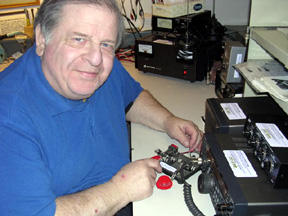
Photo: Trendsetter Avery, K0HLA, operates CW at Handiham headquarters. Notice that neither arm has a wristwatch!
If I might be so bold as to suggest how you should live your life, try to be open-minded and non-judgmental about some of these new technologies. That kind of mental attitude opens the road to using new technologies in ways that can really enhance your amateur radio experience. Now all I have to do is catch up with Avery on telling time!
Pat Tice
[email protected]

Troubleshooting 101: A quick diode check.
This week we use a multimeter for a quick and easy check of a power diode.
Suppose you have a simple power supply with discrete diodes. For the uninitiated who have never built a small power supply, discrete diodes are not diodes that can keep a secret. A discrete diode is a single component solid-state device, often times a small plastic cylinder similar in form factor to a resistor with two wire leads, one coming out of each and of the small plastic cylinder. The diode is marked with some kind of polarity marking to indicate which lead belongs to the anode side and which belongs to the cathode. If a power supply fails and the fuse blows or the breaker trips within the power supply, this indicates a condition where too much current is being drawn and a prime suspect is one of the diodes. Often times you can check power supply diodes without taking them out of the circuit. All you have to do is use your multimeter to run a few simple tests.
Of course before you do anything with the power supply that you are going to be working on, what do you have to do? Unplug it and be darned sure that it is not powered up or connected to any other piece of equipment, that’s what! In addition, any power supply with large filter capacitors might require the discharge of those capacitors to ground in order to make the supply safe to work on. If memory serves me right we have talked about discharging filter capacitors before. In small power supplies I use a metal screwdriver with a clip lead attached between it and the chassis ground to discharge filter capacitors. Working on this stuff is something best done with someone who has a bit of experience if you are entirely new to troubleshooting power supplies. Anyway, assuming everything is unplugged, disconnected, and discharged, you can go ahead and locate the power diodes. If they are discrete diodes, you can run a simple test with your multimeter’s ohmmeter function.
Put the multimeter into the ohms times one position. This is generally the best setting to do simple tests with solid-state devices. Remember that everything must be powered off and discharged not only to prevent electric shock but to protect your multimeter. We want absolutely no voltages to be present in the circuitry under test. With the multimeter in the ohms times one position, place one lead on the cathode side of the diode and the other lead on the anode side. Note the reading, then reverse the two leads. If the diode is good, there should be a significant difference in the reading between the two tests. If the diode measures about the same in both tests, it is probably shorted. You cannot always assume that something else in the circuitry is not causing these readings, so it may be necessary to disconnect one lead of the diode from the circuitry and run the tests again. A good way to practice the ohmmeter test for diodes is to just use spare diodes from the junk box. That way you can test each diode in your parts drawer without having to worry about any interference to the readings from other components that might be in parallel with the diode under test. A good diode will read maybe three-quarter scale or so in one direction and then when you reverse the multimeter leads you will get almost no reading in the other direction. A shorted diode will read almost full-scale in both directions. I recommend practicing on some diodes selected from a knowledgeable radio club member’s junk box with some help getting the multimeter set up right and learning to hold the leads in place or learning to work with clip leads.
I have used a multimeter many times over the years to perform simple tests to figure out if transistors – usually power transistors of some type – or power supply diodes were good or shorted. Of course these days discrete components are getting somewhat more difficult to find because transistors and diodes may be part of an integrated circuit. The simple ohmmeter test is only effective for discrete components, and if you suspect a bad power supply integrated circuit your only recourse may be to test by direct replacement or, if the circuit breaker in the equipment under test does not keep tripping, by testing voltages at the different pins on the integrated circuit. I have to admit that this is something I would probably not look forward to because these types of components tend to be small and subject to damage if you slip with a multimeter probe and short something out while using the voltmeter section of your multimeter and testing the circuit while it is powered up. Needless to say, all sorts of things can go wrong when you are testing a circuit under power. Not only can you damage the circuit even further, but you can potentially damage your multimeter if you forget to set the right mode and range for the circuit under test, or of course you could get an electric shock!
An interesting radio club “show and tell” project might be how to use a multimeter for some of these simple tests like the diode test. Remember, we are only testing the bigger diodes, not the tiny small signal diodes because you may damage them by trying to test them with an ohmmeter.
Send your ideas about troubleshooting to [email protected] for possible inclusion in next week’s edition of your weekly e-letter.

Handiham World for 11 May 2011
Welcome to Handiham World!
What time is it? Think about that awhile and we’ll come back to it shortly.
This morning while having my coffee and listening to the radio – NPR – I heard some guy who’s a technology specialist talking about how standalone devices are becoming obsolete because they are being replaced by smart phones and tablet computers that do all kinds of stuff for us. I thought it was strange that he forgot to mention the standalone camera, at least the non-professional snapshot or low-quality video camera, which is certainly being superseded by the built-in cameras in smart phones. He was on the mark when he mentioned that paper address books are becoming obsolete. Most people who carry cell phones these days probably have their contacts in the phone’s address book. Smart phones and tablet computers might just win the day over standalone e-readers, too. Standalone music players are taking a hit as smart phones become more convenient for playing everything from audio podcasts to audio books. Accessibility features on these multifunction devices are getting better and better, and it is my belief that it is only a matter of time before most accessibility features are simply built in to every consumer smart phone or tablet right off the shelf.
Now where was I? Oh yes; we were talking about how many different things these new smart devices do. They are book readers, take pictures, take notes in both text and audio, record videos, surf the web, handle e-mail and texting with aplomb, make telephone calls (yes, some of us still do use the telephone), and those are only the mainstream common functions of such devices. Applications are being developed at such a rapid pace that it would be a full-time job just to do an overview of all of the specialized functions and tools that are becoming available daily.
Anyway, the point of the story on the radio was that these multifunction smart devices are making other standalone devices obsolete. As an amateur radio operator, I have grown used to self-styled technology pundits predicting the imminent demise of ham radio at the hands of new technology. Of course ham radio is stronger and more popular than ever, and because of its propensity to attract a certain number of techie geeky people to its ranks, it has been able to shoot out some tendrils into the new technologies that the pundits thought would bring about its demise. Take, for example, the smart phone. Both the Android and the iPhone platforms are ham radio friendly thanks to the availability of the EchoLink application. While I may be interested in carrying a handheld radio if it is small and convenient enough, I know that I can access a huge interconnected world-wide resource of repeater systems through my smart phone. Thus, ham radio will come along with me and be available more times and in more places than it ever has been before. Sure, my preference might be to use the handheld radio if I am taking a walk in the park and can access my local repeater. On the other hand, that same handheld radio might be nearly useless on a road trip where repeater resources are more distant and when one has to constantly fiddle around trying to find the right frequency and tone combinations. The smart phone EchoLink application eliminates those problems and allows me to stay connected with my friends on my preferred local repeater.
Here is a test that shows how the sands of technology are shifting under our feet. Ask the simple question “what time is it?”
You might be surprised at the answer, because it depends a lot on how people use and perceive technology. If the person you ask wears a watch and looks at it to find out the time, you are probably dealing with an older guy like me. If the person pulls out a smartphone and looks at that to determine the time, you probably are dealing with a younger person – probably someone in their 20’s or younger. You know who was ahead of the curve on this one? Avery, K0HLA! I remember Avery telling me several years ago when we were both working at the old Handiham headquarters office at Courage Center about how he just used his cell phone when he needed to find out the time and how he thus did not need to wear a watch. There are probably lots of amateur radio operators who are following that very trend line in spite of their, shall we say “advanced years”. Remember that to a teenager even those who are past their mid-20s are geezers! Ham radio operators do like technology and many of us enjoy being early adopters who like to learn new things and try new things. I have to confess that since I traded in my old clunky cell phone with its tiny hard to read screen even I have found myself checking the phone to get the correct time. I don’t think I’m quite ready to give up either my wristwatch or my handheld radio, though.
Photo: Trendsetter Avery, K0HLA, operates CW at Handiham headquarters. Notice that neither arm has a wristwatch!
If I might be so bold as to suggest how you should live your life, try to be open-minded and non-judgmental about some of these new technologies. That kind of mental attitude opens the road to using new technologies in ways that can really enhance your amateur radio experience. Now all I have to do is catch up with Avery on telling time!
Pat Tice [email protected]
Troubleshooting 101: A quick diode check.
This week we use a multimeter for a quick and easy check of a power diode.
Suppose you have a simple power supply with discrete diodes. For the uninitiated who have never built a small power supply, discrete diodes are not diodes that can keep a secret. A discrete diode is a single component solid-state device, often times a small plastic cylinder similar in form factor to a resistor with two wire leads, one coming out of each and of the small plastic cylinder. The diode is marked with some kind of polarity marking to indicate which lead belongs to the anode side and which belongs to the cathode. If a power supply fails and the fuse blows or the breaker trips within the power supply, this indicates a condition where too much current is being drawn and a prime suspect is one of the diodes. Often times you can check power supply diodes without taking them out of the circuit. All you have to do is use your multimeter to run a few simple tests.
Of course before you do anything with the power supply that you are going to be working on, what do you have to do? Unplug it and be darned sure that it is not powered up or connected to any other piece of equipment, that’s what! In addition, any power supply with large filter capacitors might require the discharge of those capacitors to ground in order to make the supply safe to work on. If memory serves me right we have talked about discharging filter capacitors before. In small power supplies I use a metal screwdriver with a clip lead attached between it and the chassis ground to discharge filter capacitors. Working on this stuff is something best done with someone who has a bit of experience if you are entirely new to troubleshooting power supplies. Anyway, assuming everything is unplugged, disconnected, and discharged, you can go ahead and locate the power diodes. If they are discrete diodes, you can run a simple test with your multimeter’s ohmmeter function.
Put the multimeter into the ohms times one position. This is generally the best setting to do simple tests with solid-state devices. Remember that everything must be powered off and discharged not only to prevent electric shock but to protect your multimeter. We want absolutely no voltages to be present in the circuitry under test. With the multimeter in the ohms times one position, place one lead on the cathode side of the diode and the other lead on the anode side. Note the reading, then reverse the two leads. If the diode is good, there should be a significant difference in the reading between the two tests. If the diode measures about the same in both tests, it is probably shorted. You cannot always assume that something else in the circuitry is not causing these readings, so it may be necessary to disconnect one lead of the diode from the circuitry and run the tests again. A good way to practice the ohmmeter test for diodes is to just use spare diodes from the junk box. That way you can test each diode in your parts drawer without having to worry about any interference to the readings from other components that might be in parallel with the diode under test. A good diode will read maybe three-quarter scale or so in one direction and then when you reverse the multimeter leads you will get almost no reading in the other direction. A shorted diode will read almost full-scale in both directions. I recommend practicing on some diodes selected from a knowledgeable radio club member’s junk box with some help getting the multimeter set up right and learning to hold the leads in place or learning to work with clip leads.
I have used a multimeter many times over the years to perform simple tests to figure out if transistors – usually power transistors of some type – or power supply diodes were good or shorted. Of course these days discrete components are getting somewhat more difficult to find because transistors and diodes may be part of an integrated circuit. The simple ohmmeter test is only effective for discrete components, and if you suspect a bad power supply integrated circuit your only recourse may be to test by direct replacement or, if the circuit breaker in the equipment under test does not keep tripping, by testing voltages at the different pins on the integrated circuit. I have to admit that this is something I would probably not look forward to because these types of components tend to be small and subject to damage if you slip with a multimeter probe and short something out while using the voltmeter section of your multimeter and testing the circuit while it is powered up. Needless to say, all sorts of things can go wrong when you are testing a circuit under power. Not only can you damage the circuit even further, but you can potentially damage your multimeter if you forget to set the right mode and range for the circuit under test, or of course you could get an electric shock!
An interesting radio club “show and tell” project might be how to use a multimeter for some of these simple tests like the diode test. Remember, we are only testing the bigger diodes, not the tiny small signal diodes because you may damage them by trying to test them with an ohmmeter.
Send your ideas about troubleshooting to [email protected] for possible inclusion in next week’s edition of your weekly e-letter.













