Archive for the ‘ham radio’ Category
 Handiham World for 01 February 2012
 February 1st, 2012 |
  Author:
Because the station will be staffed by real live humans (members of the Handiham affiliated Stillwater Amateur Radio Association, SARA), the Remote Base station W0ZSW will be off line for the duration of the contest. The W0EQO repeater will be active and connected to the Handiham Conference Server.
W0ZSW Remote Base service will be restored at 6:00 PM CST (2400 UTC) on Saturday, February 4, at the end of the contest. W0EQO Remote Base at Courage North will remain in service throughout the contest.
The SARA members are also going to help us assess equipment and clean and organize the Handiham station area and storage room. We will also check the station infrastructure and prepare some of our computer equipment with digital mode software for the upcoming Minnesota Radio Camp session in June.
We hope to hear you on the air!
For Handiham World, I’m…
Patrick Tice, WA0TDA
Handiham Manager

Handiham World for 25 January 2012

The new handiham.org is up and running. I hope you like it, but I am sure open to suggestions if there is something you find that does not work. In the meantime, the old website is still alive, but it is at the URL handiham.net. The two sites are different, but many of our users have not yet registered with the new site, and will probably just find it easier to log in at handiham.net until they have time to get set up in the new handiham.org. So if you visit handiham.org and find that your log in credentials don’t work, the reason is that the new site uses an entirely new database and re-registration is necessary. I have done this in advance for some users, but have not had the time to devote to manually entering so much data. If you wish you can use the create an account link to enter your own data, but please remember that this is a Handiham member service, so I would appreciate it if you used the credentials you already registered with us for the old website. That way, I can check against our database and approve your account because I will know it is really you, not some spammer who wants access to the site. Most of our users registered with their callsigns, except for those studying for a first license. Please stick with your existing username from the old site and, unless you have a different email address, the same email you registered with us in the first place. Be sure you always keep your email address up to date. If you are not a Handiham member, you may still enjoy the public portion of our website without logging in. If you are a Handiham member and need access, please use the Create Account link and apply for access. I will review and approve as soon as possible.
Another change is that our QST audio digest for February 2012 is available to our blind members in DAISY format from the members section. DAISY is the same special format used by the Library of Congress and other organizations providing specialized adapted audio to blind users. It is a single zip file, the preferred method for download simplicity. It will play on DAISY players and the the new Library of Congress player. The complete issue of QST generally takes a month to a month and a half to be released from the Library of Congress, so our audio digest gives blind hams some of the time-sensitive information at around the same time print subscribers to QST are reading their copies.
VOLLI, our volunteer hours logging system, has stopped functioning. We ask that Handiham volunteers simply email Nancy their hours on a regular basis. The best way is to fire off an email as soon as you finish a project. For example, if you volunteer at a hamfest giving out our literature, when you get home just send Nancy a message letting her know the volunteer activity and the hours you spent at the fest. For recording a big project, such as an audio tutorial or a book for our blind members, you might want to keep a log of your hours and then inform Nancy of the total when you complete the recording project.
The Handiham Radio Club and Handiham Volunteer mailing lists have both gone into the bit bucket! I should have thought about that before changing the domain name, but I forgot that detail. We still have the ability to set up mailing lists, so I will see what we can do. That project will have to wait just a little while because I want the website project to be further along and secure before taking on another task.
So that’s my update for this week. I expect to release a new General Class audio lecture on Friday, but we will see what time is available. We are always looking for help from talented volunteers who can record audio, teaching into a microphone. Be on the lookout for an upcoming two part “With the Handihams” series in Worldradio online about how to record using the open-source software Audacity. It is cross-platform, running on Windows, Mac, or Linux!
Handiham Manager

Pop’s Shed and the Kingsley Radio AR7
After my grandfather passed away I spent a lot of time recalling the good times I had spent scrounging around his CB shack and hanging out with Pop “down the shed”. If you’ve spent time around old motorbikes, retired lawn mower engines, vacuum tube electronics and inches of dust you know what the shed smelt like and probably have a pretty good idea what it looked like as well. I used to be able to send Mum into fits by embedding a combination of oil, grease, dust and grinding compound into the knees and sleeves of my good clothes after spending the day “over south” (South Geelong)
Even now I can still walk into any old auto mechanics and the smell brings back dozens of memories as clear as day … but one memory in particular had been bugging me for a while now. On several occasions I had used a magnificent rack mounted shortwave receiver that had been hooked to a long-wire antenna between the shed and the house. It had several plug in coils housed in bright metal boxes, one for each band as well as a unique tuning dial that had windows around the circumference with numbers that updated as the dial was turned.
 |
| National HRO right? … Nope, its an Australian clone! |
For the longest time I was thinking what you are probably thinking now, I had been using a National HRO receiver right? Well, you’d be wrong … just as I had been for years! When I eventually asked my uncle about the receiver (I waited a long time as I feared it had been thrown out & honestly didn’t want to know if it had) he said, “The AR7?” … “Yes, its here in the garage covered in dust”. He went on to say that I could have the receiver if I could figure out some way to ship it … not a slight problem given the receiver, power supply and speaker are over 120 lbs!
Knowing now that I had been using a completely different receiver I set to work and found out what I could about this National HRO clone …
From : http://www.vk2bv.org/
The AR7 was produced during WW2 by Kingsley Radio of Melbourne for the R.A.A.F. These receivers were used in ground stations for long range communication over fixed circuits as well as for receiving signals from aircraft.
The AR7 was based largely on the National (USA) HRO model, a fact that did not go unnoticed by National. This was the subject of litigation during the war years. Over 3000 of these receivers were produced and for their time, produced excellent performance.
These sets were very popular with radio amateurs after the war and unfortunately subject to many modifications. The Wireless Institute of Australia station, VK2WI at Dural New South Wales was equipped with modifed AR7’s for many years. I seem to remember that very local operators could block the receivers completely, resulting in hurried phone calls!
An unmodified AR7 is a rare beast. The Department of Civil Aviation used these sets for many years in a highly modified form, requiring a new front panel. Refinements included squelch and crystal locked coil boxes.
From : http://www.shlrc.mq.edu.au/~robinson/museum/AR7/
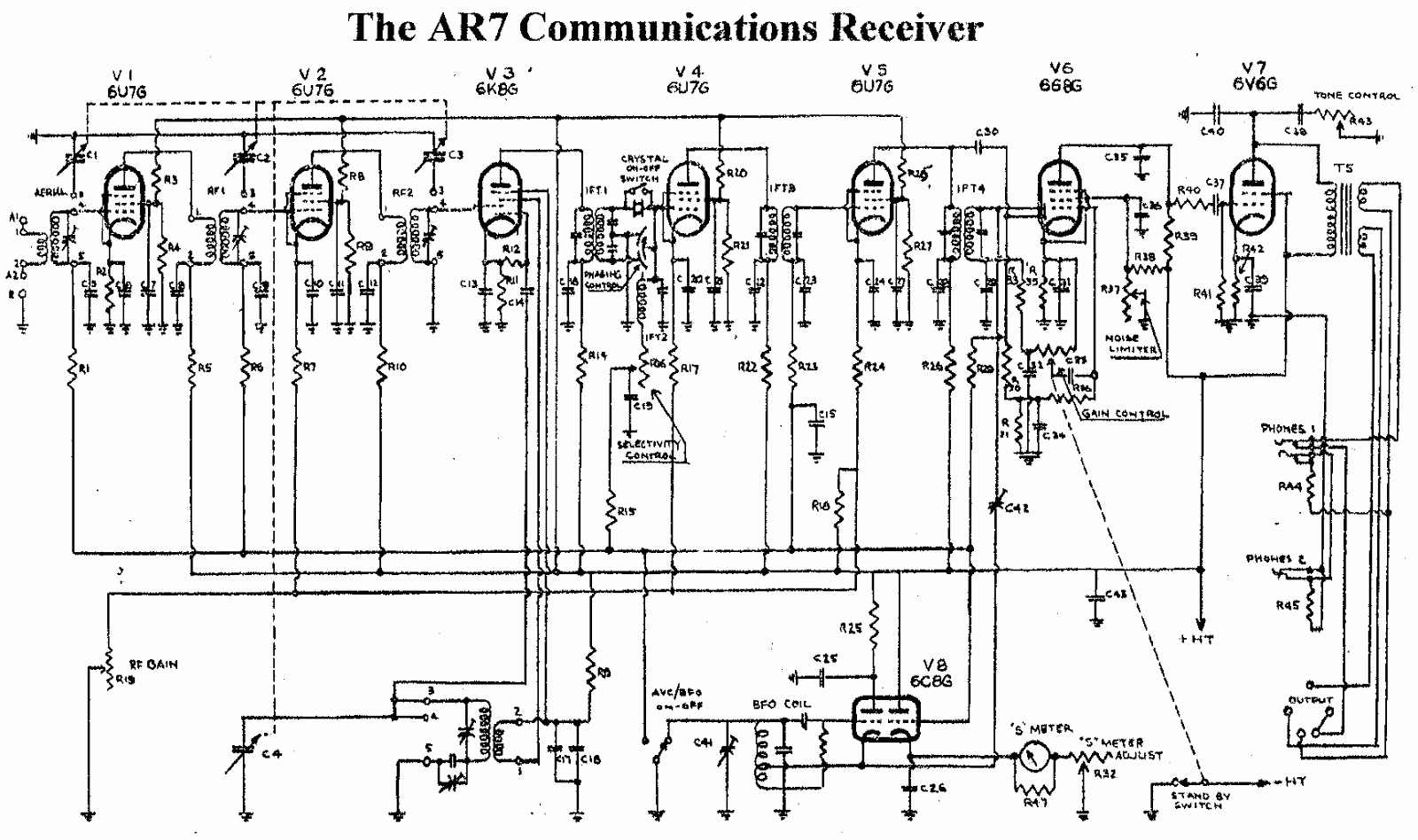
The AR7 is a communications receiver covering LF and HF bands. It was made in Australia during 1940 and bears an extremely close resemblance to the National HRO receiver. The receiver has a tuning range from 138 kcs to 25 mcs, with a gap of 45 kcs either side of the 455 kcs IF amplifier. The internal design is a single conversion superheterodyne receiver with 2 RF stages, 2 IF stages, a BFO and an “S” meter amplifier. The sensitivity is quoted as 1 microvolt. The front panel is stainless steel and it is a very distinctive looking receiver.
It is a good performer, sensitive, has a nice feel, is easy to tune, but hard to find the correct frequency, by reading the frequency from the dial number and coil box graph. It really needs a crystal calibrator. I use it for the weekly W.I.A. (Wireless Institute of Australia) broadcast, so it gets turned on once a week, and is so stable, than I don’t have to retune. It is very clear for AM but a bit fiddly for SSB.
The controls are: RF gain, BFO note, AVC/BFO switch, Adjust “S” meter, Tone, Tuning, Noise limiter, Selectivity, Crystal IN/OUT switch, Crystal Phasing, Audio gain. The Audio gain control has an OFF position which removes the HT so that the coil boxes can be changed.

It has two 6U7G RF stages, a 6K8G mixer, two 6U7G IF stages at 455 kcs, a 6G8G detector/AVC/audio preamplifier, and a 6V6G audio output amplifier. It has a 6C8G twin triode as a BFO and “S” meter amplifier. It also has a crystal filter. The IF alignment should be done very carefully, as any misalignment will reduce the effectiveness of the filter. It is best done with a sweep generator. The 6 volt valve heaters are connected in series, for 12 volt operation.
The external power supply and speaker, are usually mounted in a short 19″ rack, the AR7 at the bottom, the speaker in the middle, and the power supply at the top. The complete unit weighs about 118 pounds. The power supply was switchable between 12v and 240v.
The receiver was used as a ground monitoring receiver for aircraft. It was extremely stable. The model shown has an R.A.A.F. nameplate, and serial number 1786. The manual I have is a D.C.A. (Department of Civil Aviation) version and is a 1947 issue.
It has 5 plug in coil boxes. The coil boxes are: band A 140-405 kcs, band B 490-1430 kcs, band C 1.420-4.3 mcs, band D 4.25-12.5 mcs, band E 12.5-25 mcs. The Army version had an extra coil box covering 50-150 kcs. The large dial is a 20:1 reduction drive and has graduations from 0 to 500. It acts like a flywheel when tuning across the band, and has an effective scale length of 12 feet. The dial shaft goes into a right angle reduction gearbox and has 2 output shafts that drive 2 dual gang capacitors. The graph on the front of each coil box is used to covert the dial reading to frequency.

Via The Buro
 At our local radio club meeting this week, I did a presentation on amateur radio operating awards. The emphasis was on the most common awards: Worked All States (WAS), Worked All Continents (WAC), DX Century Club (DXCC) and VHF/UHF Century Club (VUCC).
I talked a bit about how to obtain a QSL card for written confirmation of a radio contact. As I discussed using the QSL Bureau, it became clear that this is the kind of thing that a new ham might not learn on their own. In fact, they might not know this even exists.
The “Buro”, as it is often called on CW, is really two separate systems: The Outgoing QSL Bureau and the Incoming QSL Bureau. To use the Outgoing QSL Bureau, you need to be an ARRL member and send your outgoing cards to ARRL HQ. They are forwarded on from there to the other country and ultimately to the other amateur. See the Outgoing QSL Bureau information on the ARRL web site for the full story.
The Incoming QSL Bureau delivers cards coming in from other countries. This work is handled by various radio clubs, organized by call area. You do not need to be an ARRL member to use the incoming service. You can find the incoming QSL bureau for your call area here on the ARRL web site. My callsign is KØNR, so I use the WØ QSL Bureau which has this web site: http://www.zeroburo.org/ The WØ QSL Bureau is operated by the Mississippi Valley DX/Contest Club. Thanks, Guys!
Now here is the important part:
If you have worked any DX stations, you may have QSL cards waiting for you at the buro. You should supply your QSL bureau a Self-Addressed Stamped Envelope, which they will use to send you any cards that are waiting.
Look up your Incoming QSL Bureau and follow their specific instructions concerning supplying them with envelopes.
73, Bob K0NR
Handiham World for 18 January 2012

Remember last week’s E-letter and podcast, when I mentioned that the number one priority here at Handihams would be to fix the website? That time has come, and here is the reason why:
Typically on Fridays I concentrate on producing new audio lectures for our licensing classes. Fridays are also a good time to catch up on loose ends that have collected during the week. Doing website updates is generally a little bit easier on Fridays because I know that I will be logging into FTP in order to put the audio I have produced onto the website anyway, so why not do other web updates while I am at it?
Well, last Friday proved to be a bit unnerving. As I had mentioned before, we had been having serious issues with the performance of the website Handiham.org that had caused pages to either be unavailable or load so slowly that many web browsers would simply timeout. Many of you could not reach our files or would only be able to download a partial file. Needless to say, this situation simply cannot go on. Not only is it bad service for our members, but it can eat up a lot of my time as I try to work my way through the many tech support complaints. Sometimes I have a way to work around it and help the person get the files they need and other times I don’t. In any case, Friday was not a good day for Handiham.org because it went down early in the morning and was off-line most of the day. I contacted the hosting service and they began to work on the problem which was on one particular machine in Utah.
Late on Friday the website did return to service. During the outage, it was difficult for me to work since I had to do everything that I could off-line and only later on plan to FTP the files to the website. Of course any members who needed files during the day were out of luck. Since we have had issues extending over months (though nothing quite this bad), we had already procured server space with Network Solutions, a respected company with which we already had a long-term relationship as our domain name registrar. I decided to start putting some serious effort into building a new beta website that would be the eventual replacement for the current one, but I had to step this effort up several notches over this past weekend.
When something like this happens, you really have two choices. You can either whine or complain about how awful things are and make excuses or you can look on circumstances as an opportunity to make something better. It is sort of like having your old fishing boat sink to the bottom of the lake. Yes, you miss your old fishing boat with all its dents and barnacles. On the other hand, you have an opportunity to get a new fishing boat and it can be exactly the kind of boat you have always wanted. A website is like that. We have had the old website for quite a few years now, and it has served us pretty well. However, over the years it has become cluttered with barnacles – too many links and just too much confusing stuff. It has become a little bit too dated and clunky to be useful, especially to newcomers who may be happening on it for the very first time.
Our opportunity is to build a new website that is easier to administer using Drupal 7, and to incorporate some much-needed changes. One new feature is the addition of a “Skip to Content” link near the top of the page so that blind users who are reading the page with screen reading software can skip listening to all of the menu links and go straight to the main page content. Another feature is a more pleasing view for sighted users without making the website inaccessible to blind users. And, of course, we are simplifying the menu structure to make the site less cluttered.
Our choice of Drupal for a content management system goes back quite a number of years when it was originally suggested by long-time Handiham volunteer Phil Temples, K9HI. We have been using Drupal 5.X and for the past few years 6.X. Drupal 7 has been under development for a couple of years and I have been testing it on my private website for quite a long time, watching as it matured. I feel that the time has come to make the change as long as we are redoing the website anyway. The new version of Drupal incorporates many features that had to be manually added to the old versions. Many administrative tasks are easier. We will eventually need to redirect Handiham.org to the new site, and, because of what we experienced last Friday, are going to try to do this as soon as possible.
As you might expect, there are going to be some problems. Any time you make a big website migration like this, coupled with a major redesign, there are going to be some things that might not work correctly or perhaps will be missing or not work at all. This will all take time to iron out. One thing that will have to be done is that we will have to re–register all of our users. I know this will be a major inconvenience for everyone, but it is really the only way to update the database on the new server with a clean installation. I think the strategy needs to be developed on exactly how we will do this, and I welcome user suggestions. I do have a data dump with e-mail addresses and usernames, so we could send out a blanket e-mail when the new site is ready. However, one concern I have about that strategy is that we may get an overwhelming number of hits on the new website as users try to create their new accounts. It may be better to use a targeted strategy of mailing perhaps 25 users at a time to even out the load. Anyone who has Drupal experience or who has administered a website is welcome to contact me directly with their comments.
The old website will still sit on the old server in Utah, but once the name Handiham.org is redirected, it will become unreachable. I will then take steps to reactivate our other Handiham domain name, Handiham.net. The old site would be available there for some period of time.
One problem that I anticipate is that the Handiham mailing lists with the Handiham.org domain name will cease to function. These two lists are the Handiham Radio Club list and the Handiham Volunteer Instructors list. The Wednesday E-letter list and the Friday New Audio Notification list will not be affected because they are hosted at Freelists. I may be able to reconfigure the club and volunteer lists with the.net address, but I would also welcome suggestions on how we should proceed with these lists.
Some of our users may be concerned about how this will affect the two Handiham Internet remote base stations. Neither station is connected in any way with the web hosting service and both are separately hosted on their own dedicated computers on Courage Center properties. Therefore, neither station will be affected in any way. We do update the remote base station status daily on the website, and this update will be continued on the new website as well.
Another change that will be implemented is the availability of more materials in DAISY format. This new format will replace some of the older MP3 audio for our blind members. This advancement will allow for easier navigation through the material for our blind Handiham members. This does not mean that we are moving away from human readers, so please don’t worry that you will never hear a human voice again on Handiham.org! Some materials, if they are available in computer text in the first place, are most easily converted to DAISY format that incorporates a voice produced by the computer software. Other materials are more properly and efficiently read by a human reader and can be imported into DAISY by special software. Our original production will still be done by Audacity so that we can more easily edit the audio and still produce four track cassette recordings for the Handiham members who need them during 2012. Of course Audacity remains our editor of choice for the Friday audio lectures and for the Wednesday podcast. As before, the free podcast will remain available to the general public in the iTunes store.
We are hoping that the transition will go smoothly, but you know as well as I do that a project like this is pretty complicated and there will always be some unforeseen problems. In fact, to me it sort of feels like planning for and setting up for Field Day. You always anticipate how much fun it is going to be and you have participated in the planning process for past years and like to think that you know you are not going to forget anything this year. Naturally, when you arrive at the Field Day site and start getting everything set up that is when you find out that no one packed Styrofoam cups for the coffee and the power supply cables are still sitting in one of the club member’s basement. That is how it will be for any new project and I am not going to be surprised when things don’t work on the website. What we can do is to work together to make the new website project successful by helpful suggestions that include specific recommendations on how to fix a problem whenever possible.
So, even though this is going to be a real roll-up-your-sleeves-and-get-to-work couple of weeks, I know that we are doing the right thing. I am encouraged by the American Council of the Blind website, which also uses Drupal 7 and the Bartik theme as its public portal. I also want to thank Handiham Radio Club members and Handiham volunteers who have visited the new beta website and given me suggestions and feedback. I really appreciate your help!
Handiham Manager

Hellschreiber and microprocessors – Bridging more than 80 years
ZL1HIT (Bryan Rentoul) has bridged a gap of more than 80 years by combining the text transmission system developed by Rudolf Hell in the late 1920’s with current microprocessor technology.
 |
| A sample of received Hellschreiber test from Bryan’s beacon |
Hellschreiber sends a line of text as a series of vertical columns. Each column is broken down vertically into a series of pixels, normally using a 7 by 7 pixel grid to represent characters. The data for a line is then sent as a series of on-off signals to the receiver, using a variety of formats depending on the medium, but normally at a rate of 112.5 baud.
This process was historically accomplished with mechanical equipment but there are very few examples of this equipment still in operation and it is now sent and received by computer. Hellschreiber is very tolerant of noise and interference and requires only simple transmitters and receivers to work effectively.
 |
| German Hellschreiber unit in operation |
With a microprocessor generating the digital on-off signals a simple crystal oscillator transmitter can be used to form a beacon station, one that transmits a call sign and perhaps some other information over and over. Changing the transmitted message is as simple as reprogramming the microprocessor or having it respond to a connected input, for Eg. A thermometer, light sensor, switch, etc.
Receiving the signal and decoding requires a radio receiver capable of CW reception and a computer running any of several free software packages like FLdigi or Digital Master 780.
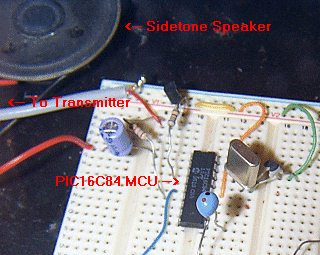 |
| The ZL1HIT beacon using a PIC microprocessor and a simple crystal oscillator transmitter. |
For more information and the PIC microprocessor source code please visit the web page of Bryan Rentoul here : ZL1HIT Hellschreiber / PIC Beacon
Technician License Class – April 2012
 Monument, Colorado
Saturday April 21 and Saturday April 28 (8 AM to 5 PM) 2012
Location: Tri-Lakes Monument Fire Station 1
Sponsored by the Tri-Lakes Monument Fire Radio Association
The Technician license is your gateway to the world-wide excitement of Amateur Radio…
- Earn your ham radio Technician class radio privileges
- Pass your FCC amateur radio license exam right in class on the second day
- Multiple-choice exam, No Morse Code Required
- Live equipment demonstrations
- Learn to operate on the ham bands, 10 Meters and higher
- Learn to use the many VHF/UHF FM repeaters in Colorado
- Find out how to participate in emergency communications
There is no cost for the class (donations accepted)
However, students must have the required study guide:
Gordon West Technician Class guide, 7th Edition $20.95
And pay the FCC Exam Fee: $15.00
Advance registration is required (no later than April 15th, earlier is better!)
To register for the class, contact: Bob Witte KØNR
Email: [email protected] or Phone: 719 659-3727
For more information on amateur (ham) radio visit www.arrl.org or www.wedothat-radio.org













