Archive for the ‘ham radio’ Category
 Handiham World for 15 February 2012
 February 15th, 2012 |
  Author:
For Handiham World, I’m…
Patrick Tice, [email protected]
Handiham Manager

Heathkit’s first amateur transmitter – Heathkit AT-1
The Heathkit AT-1 represents the commercial embodiment of the simple Master Oscillator Power Amplifier (MOPA) transmitter using a crystal controlled 6AG7 oscillator plus a 6L6 final output tube.
Although it was possible to design and build a simpler transmitter, the goals of output power and stability could become mutually exclusive when trying to operate with only one tube. For a novice class license holder of 1951 the Heathkit AT-1 represented a solid performing rig that would be relatively easy to construct and operate.
The Novice remained the primary entry license until the Morse code requirement was eliminated for Technician licenses in 1990. On HF it permitted code transmissions only, with a maximum power of 75 watts, (input to the transmitter’s final amplifier stage) on limited segments of the 80, 40 and 15 meter bands.
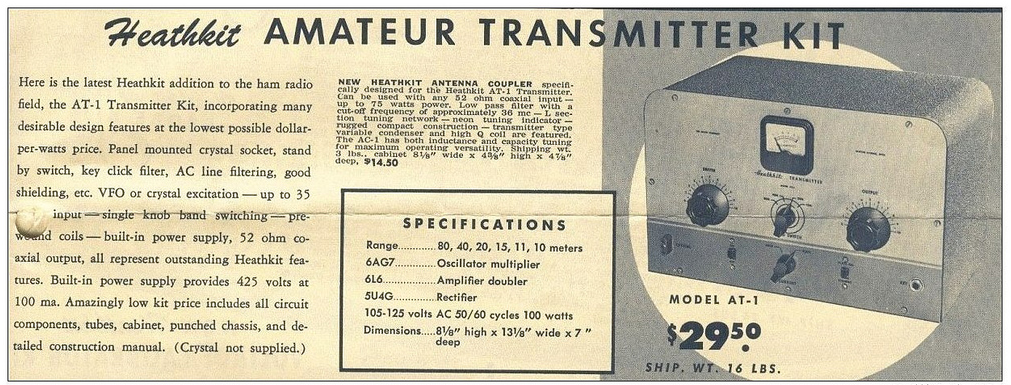 |
| For $29.50 and the loan of a few tools you could get some use out of that new novice license |
The earlier MOPA circuit from the ARRL handbook of 1941 below shows a layout remarkably similar to the circuit of the AT-1 although it is designed for plug in coils rather than the band-switching arrangement of the later Heathkit transmitter.
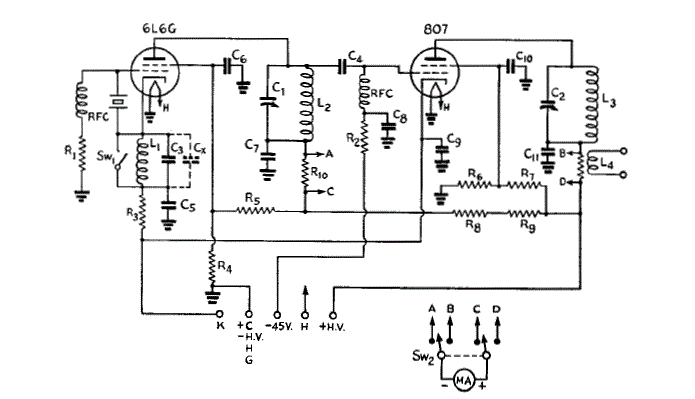 |
| MOPA transmitter using a 6L6 and an 807 as the power amplifier (ARRL Handbook 1941) |
For a little added complexity MOPA transmitters generally offered better stability of frequency and keying waveform than single tube crystal controlled or self exited rigs. The straight forward design of the AT-1 should have looked familiar to novice class hams after studying the ARRL handbook or other radio publications.
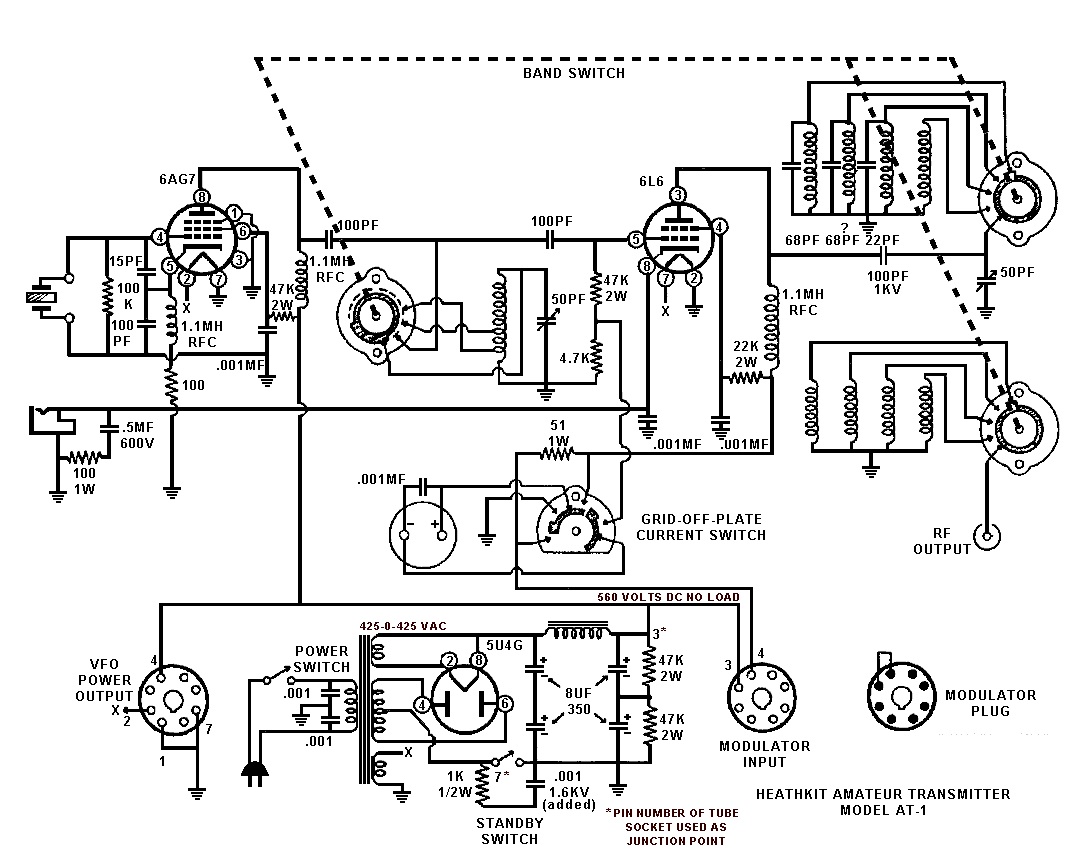 |
| Heathkit AT-1 Circuit diagram showing band-switching arrangement and link coupled output |
Once the novice had upgraded his license the AT-1 could be expanded by the addition of the Heathkit VF-1 variable frequency oscillator to allow transmission on any frequency within the allowed band.
 |
| The Heathkit VF-1 Variable Frequency Oscillator |
The VF-1 covered 160-80-40-20-15-11-10 meters and used an OA2 voltage regulator tube to provide a stable voltage for the oscillator. Ceramic coil forms, solid construction and high quality components were used to help increase stability.
 |
| The Heathkit AC-1 Antenna Coupler. Designed to attach to a single wire by the insulated post on the front panel. |
 |
| Heathkit AC-1 Antenna Coupler circuit diagram |
Although Heathkit did not produce a AM modulator for the AC-1 there is provision for modulator connection on the rear panel. The earlier ARRL manuals have several suitable circuits for modulators that would work with the AC-1. Most functioned by driving a modulation transformer with the output from an audio power amplifier. The secondary of the modulation transformer would be carrying the DC plate supply for the power amplifier tube plus or minus the instantaneous voltage of the audio waveform. By changing the plate voltage to the final amplifier tube the radio frequency output would be controlled by the amplified audio frequency resulting in amplitude modulation.
The Road Home and Other Ham Radio Novels
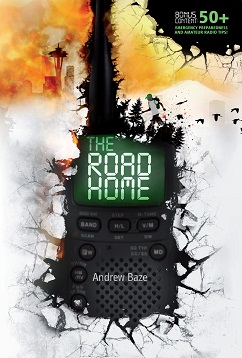

While this book is light reading, there is still some character development of the young man who is the main character of the story. Refreshingly, the boy’s father is his guide (rather than being marginalized or vilified as parents often are in teenage fiction). Not only does Mr. Baze inspire a young person to get a ham radio license, he succeeds in developing the moral imagination of his readers. The Road Home cultivates an affection for such admirable qualities as diligence, perseverance, courage, level-headedness, familial love, compassion, and a chivalric desire to avoid violence yet defend women from evil with deadly force when necessary.
You can read this book for free, if you have a Kindle and an Amazon Prime account, by borrowing it from the Kindle Owners’ Lending Library for Amazon Prime Members.
 Other novels that my children and I have enjoyed are those written by Cynthia Wall, KA7ITT: Night Signals, Hostage in the Woods, Firewatch!, Easy Target, Disappearing Act, and A Spark to the Past. These six books are a series chronicling the adventures of fictional characters Kim Stafford, KA7SJP, and her boyfriend Marc, KA7ITR. They are definitely aimed at children, but if you’re like me you’ll still read them — it’s so hard to find novels incorporating ham radio that you just can’t pass these up.
Another novel that incorporates ham radio is Cornbread Road, by Jeff Davis, KE9V. Mr. Davis released it as an audio-book in a series of podcasts in 2010-2011, and my wife and I enjoyed listening to it together. The podcast is not currently available but hopefully it will be back up soon. Cornbread Road is aimed at adults. The main character is a ham who gets involved with a secret society of ham radio operators led by a mysterious figure with a past, a ham who is an inventive genius and who is himself caught up in a web of international intrigue. While the plot may tax your ability to suspend disbelief, it is still an amusing story and throws in a little of everything in ham radio.
Do you have any ham radio novels to recommend? I dimly recall one or two that I nearly wore out as a child (back in the days when I would ride my bicycle to the local library and read my favorite books over and over), but I couldn’t tell you much about them now. If you know of any — and where to find them — please chime in with a comment!


This Spewed Out of the Internet #21
 There’s lots of information spewing forth from the interwebznet. Here are a few items of interest.
Dan KB6NU has started doing an Extra Class Question of the Day on his blog. I think this is a great idea. I may need to borrow steal reuse this idea on my blog.
The Fi-Ni Report did their usual outstanding job of educating the ham community, this time via A Short History of QSLing. Just because something is fictional,doesn’t mean that it’s not real.
The ARRL announced that the Logbook of the World is going to support the CQ Awards. This is great news for the ham community. The more awards that are supported, the more usage LoTW will get, making it more useful for additional awards.
Buried in the minutes of the July 2011 ARRL Board of Directors Meeting, the Board “authorizes staff to proceed with planning and negotiating a vendor agreement for a Digital QST edition, to be approved by the CEO, General Counsel and the Administration & Finance Committee.” So QST will be available in digital format soon.
You know, I think this internetz thing is starting to catch on!
73, Bob K0NR
Handiham World for 08 February 2012

A few days ago I spotted a story in a small town newspaper that turned out to be a letter to the editor. It was written by an amateur radio operator who was admonishing his fellow amateur radio operators to please monitor their local repeaters in case there would be an emergency. He had an example of an actual emergency when a call was sent out via a repeater but there were no responses.
I have lost count of the number of times I have driven cross country myself, monitoring the various repeaters along the way and throwing my call sign out here and there, but getting nothing but silence in return. Others have mentioned this phenomenon as well. Amateur radio repeaters are very, very, VERY quiet these days. I often wonder if any of them get used more than a few times a week.
Conventional wisdom about repeaters used to be that you wanted them to be available during the “drive time” rush hour traffic in case they might be needed to report some kind of emergency. These days, it is a rare motorist indeed who does not travel with a cell phone. The cell phone is much more likely to be a more efficient way to reach emergency service personnel quickly than the local amateur radio repeater system. Yes, it is nice to have the repeater system as a backup because cellular service as not always available and is prone to overloading and failure during emergencies. But on a typical day cell phones work as expected and do absolutely everything they are needed to do. In fact, I suspect that most amateur radio operators use their cell phones more regularly than VHF mobile radios.
While there may be exceptions to the quiet repeater phenomenon in a few areas, I have heard nothing in the past few years to change my belief that most amateur radio repeater systems in large metropolitan areas are grossly underutilized. As I have said in the past, if a repeater system is to remain healthy (an actively used system) it requires a critical mass of regular users. One or two voices crying in the wilderness is not enough to save a repeater system from oblivion. Successful repeater systems host scheduled net activities, have a cadre of informal users who meet on the frequency regularly, and are maintained to high engineering standards so that the user base can enjoy reasonable reliability.
One thing that a repeater owner can do to make sure that the system is used often and doesn’t fade into obscurity is to connect it to a VoIP system like EchoLink, IRLP, WIRES, or Allstar Link Network. Unfortunately, there are amateur radio operators out there who don’t understand this technology and fear that it will somehow ruin the repeater system or dominate it to the point that the repeater will be unavailable for local users.
This, my friends, is nonsense. All you have to do is listen on a connected repeater system on a regular basis and you will find out that the repeater is used much more often than an unconnected repeater system but not to the point of overuse. I have virtually abandoned repeater systems that are not VoIP connected because they have no activity. They sound exactly the same whether the radio is turned on or turned off! If your club’s repeater system is one of these dead zones, I urge you to bring up the possibility of connecting it to the world via VoIP. There may be a few old fogies who will fulminate and fuss, but unless they are regulars on your local repeater all day long and are leaders in keeping the system maintained and active, I think you can safely call their bluff.
For Handiham World, I’m…
Patrick Tice, [email protected]
Handiham Manager

Online Course: Introduction to Emergency Communication
As a pastor the months of December-January are the busiest of the year for me, so I haven’t done much with Ham Radio for weeks now. That is as it should be. As I’ve said before, we must keep our hobby in its proper place. But I haven’t let it completely die, and the hopper has slowly been filling up with things to share with you.
 One of those things is the ARRL’s online/mentored course, “Introduction to Emergency Communication.” I’ve registered for the next session of this course which begins on February 29 and runs through April 27. It cost me $50 as an ARRL member ($85 for non-members), but I think it’s worth the money in my situation.
Not that I have to go through this course to learn the material. Much of the material may well be common-sense or a review of what I already know after being a ham for so long. The rest I could pick up by simply reading this book or (probably better) this book. Or I could glean it all from the web or learn it from an experienced member of ARES. So why would it be worth $50 for me to go through a formal course of study?
The answer: for credibility with governmental agencies.
Like it or not, to gain respect from governmental agencies you need to prove that you’ve jumped through a few hoops — especially in a state like Minnesota. Several decades ago Minnesota figured out how important it is to train police officers well. As a former police trainer myself, I cringe when I see poorly-trained officers on COPS. Trust me — agencies that have invested in training are rarely interested in “help” from poorly-trained people, no matter how well intentioned.
So before we go to the local sheriff (who is in charge of emergency management for our county) and talk to him about ARES, we need to get our ducks in a row. Training is #1 — and to governmental workers, that means certification of some kind. Be ready to show Show them paperwork. Other things help too, like uniform vests, jackets, etc., but those things come second. (In fact, you can shoot yourself  in the foot with that stuff if you aren’t careful. Take it from me — as a former police officer I know what I’m talking about — if you overdo “the look” in your uniform, your amber light bars, etc. most cops will write you off as a wanna-be commando kid to be kept far away from the grown-ups. If you really want to impress them, wear a tie. Seriously!)
Furthermore, for certification to mean anything to governmental workers it needs to come from the biggest, most widely recognized institutions you can find. For ARES, that means FEMA and the ARRL. I know some hams don’t like the ARRL, and I may get pelted with comments about how terrible the ARRL is. But there it stands.
In order to register for this course you must first complete two free online courses offered by FEMA: IS-100.b, “Introduction to the Incident Command System (ICS 100)” and IS-700.A, “National Incident Management System (NIMS), An Introduction”. Whether or not you take ARRL’s course, you really ought to take these courses (especially the first one) if you ever want to participate in emergency services. I for one needed to brush-up on these things, and I appreciated how well they were done.
Once you successfully complete these online courses from FEMA (they don’t take long) you may register for the ARRL course on the ARRL website. Registration closes on Wednesday, February 15 for the session I’m enrolled in, and on Wednesday, March 15 for the session that begins on March 28. There is still plenty of room in my session — of the 30 seats available, only 21 have been taken as I write this on February 4.


2012 ARRL Field Day Information Packet Available
 ARRL Field Day is the single most popular on-the-air event held annually in the US and Canada. Each year over 35,000 amateurs gather with their clubs, friends or simply by themselves to operate.
The information packet for Field Day is now available on the ARRL web site.
- Bob K0NR













