Archive for the ‘ham radio’ Category

The Man Who Fishes For DX


I live on Anglesey, a mystical Celtic island steeped in the legends of the Druids and lapped by the misty waters of the Irish Sea. There was whispered talk amongst the old people of an elusive man who fished for DX and caught specimens from Borneo, Antarctica and other strange lands.

Actually, it’s only Dave.

Dave, GW4JKR, has an antenna system that you can’t buy from any supplier. He uses a carbon-fibre fishing pole on a metal spike and several acres of saltmarsh. The system is blindingly simple, takes minutes to erect and is devastatingly effective.

“I set up on the 20m band and all was quiet. I put out my first call (SSB) and you know what? I worked Borneo 5/9. Because he was an English ex-pat, I thought he was local until he gave his callsign for the second time! Other local stations here couldn’t even hear him.”

In a similar vein, Dave related how he’s had a 5/9 chat with a chap with a German accent. Only turned out he was on holiday in Guadalcanal. “You’re the only station in Europe I can hear,” he said from his sunny patio.

One of Dave's many QSL cards
The DX takes the bait each time. Reports come in from the Pacific islands, China, Japan, Korea, Antarctica and New Zealand. I think Dave’s witnessed more pile-ups than the M6 motorway.

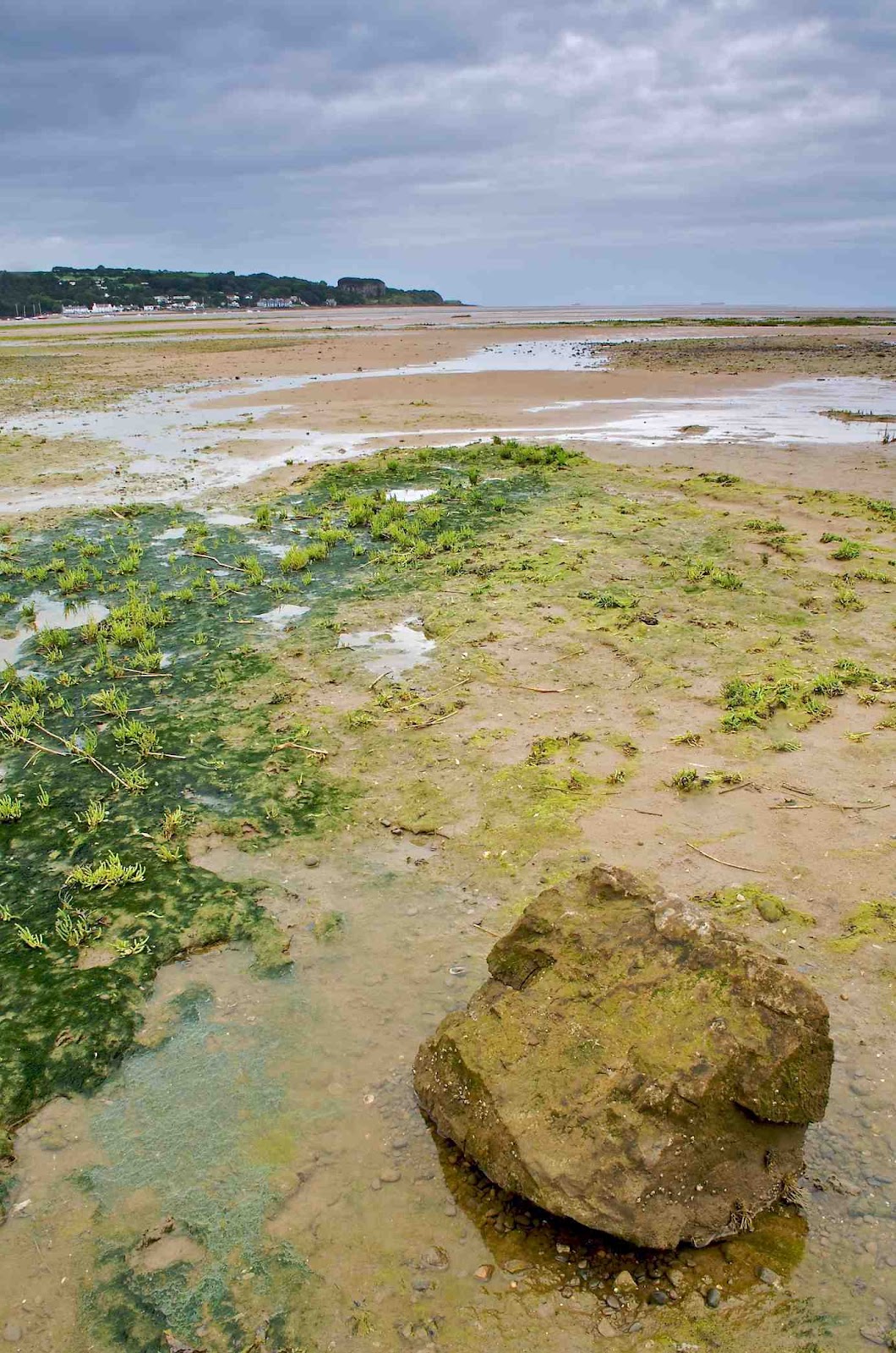
The antenna system comprises two ultra-efficient parts, making it a genuine ‘killer’ setup. For the antenna, Dave uses a carbon-fibre fishing pole, also known as a ‘roach pole’. He specifies the better quality versions that use high modulus carbon for optimum conductivity. The pole is approximately 12m in length, coming in seven sections. It is featherweight at under a kilogram. The base of the pole mates to a large ‘agricultural’ steel earth spike, which is actually a brutal pummelling device for digging holes in rocky ground. A plastic sleeve insulates the two components. Coax is easily attached by jubilee and croc clips. The second part of the antenna system is the saltmarsh on the edge of an expansive tidal sandy bay. The saltwater saturation, even at low tide, is high. Ask the shellfish.

Red Wharf Bay, Anglesey
Like a latter day St. George, Dave holds the spike aloft and plunges it deep into the salty mud where it stands at the ready. If there’s a small pool of salty water nearby, all the better – in it goes. Wet, sandy beaches work, but not nearly as well as dark, oozing mud it seems. Lovely.

Clearly the vertical radiator, wide open aspect, perfect electrical ground and ultra-low angle of radiation give the best start a radio signal could ever want in in its sinusoidal life. It’s as electrically quiet as a library down on the beach which makes for reception most of us can only dream of.
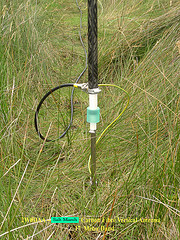
Base section of carbon fibre
vertical in situ

Follow Dave’s simple formula and you too can become a fisher of men and the stuff of legend.


SAFETY: Dave would like to warn all readers to exercise care when handling a carbon fibre pole in the open. Do NOT venture anywhere near power lines. You may render yourself permanently QRT.

More photos available on Dave’s Flickr site.

Neat Find in the QST Archives

When I was a boy my father paid for my membership in the ARRL, but when I got out on my own I let my membership lapse because of the cost. When I finally joined again last year, I mainly did it so I could use the outgoing QSL bureau. Since then, however, I have come to appreciate other benefits of membership. One of those benefits is full access to the QST Archives. They are a treasure-trove!

The other day while doing a little research for some blog posts that are in the hopper, on a whim I searched for “Granite Falls,” the small town where I live. Sure enough, I got a hit — from September, 1969. It’s just one photo and a caption, but it’s an eye-opener. It shows that once upon a time Amateur Radio was used in an emergency here. For sure I’ll be showing this to the Emergency Manager in our county:

September, 1969 issue of QST, p. 66. Copyright © 2012 American Radio Relay League, Inc. – All rights reserved.

Using QRZ.com I looked up the fellow on the right, WAØJRA, and sent him an email inquiring about Amateur Radio here in Granite Falls back in those days. I’m looking forward to his reply.

Have you searched the QST Archives for references to your own city? Try it!

New Categories for ARRL VHF Contests

The April 25th issue of Contest Update from the ARRL had this item:

The ARRL Programs and Services Committee has approved a rule change for ARRL VHF+ contests effective beginning in 2013 (not this year) to create a Single-Op FM-only category (100 W max, 50/144/222/440 MHz) and a three-band Single-Op category (100 W PEP on 50 and 144 MHz, 50 W PEP on 432 MHz). These changes will apply to the January, June, and September contests – again, beginning with the 2013 January VHF Sweepstakes.

I am always looking for ways to get more people involved in VHF contests and these two new categories may help. The basic idea is to create categories for simpler stations to participate in the contests without having to be in the same category as The Big Guns.

73, Bob K0NR

QRP TTF 2012

Great weather here in Orlando for a good afternoon of QRP Portable. The QRP To The Field contest is always a good time to get out and give out a few more points to the serious contesters. I enjoy the concentrated QRP contacts and hearing my virtual friends once again. Every QRP event has a few regulars that are almost always heard. This year the bands were only so-so in Florida with lots of QSB on 20m which was by far the best for the day. It was solid at times and then signals would suddenly drop to the noise level which made RST reporting fun!

Just above sea level

Mt. Cedar Tree: Just above sea level

Because of band conditions, I spent most of the 4 hours on 2om, but I did check 15 and 10m on an hourly basis. To do that, I pulled out my Ten Tec Argonaut 509 and used a Buddistick with the base up about 12 ft.  I called CQ about 50 times on 15 m but heard almost nothing on 10m all day. On 15m I heard a couple Eu  (IV4 and DK)  stations but was not getting a response to my calls and only heard 1 or 2 US stations so I assume the band conditions here weren’t quite right for those two bands.

Managed 18 QSO’s in 4 hrs of switching between my Wilderness Sierra to an EFHW, Delta Loop for 20m, and the Buddistick / Argonaut combo for 15 and 10m.  40 m was full of Florida QSO Party stations and a couple of nearby (within 4 miles) stations were pounding my receiver and causing the AGC to go nuts when I tuned across them so I only managed a single contact on 40 before retreating back to 20m.

I’ll be looking to give out more points in upcoming contests. So call CQ and I’ll be out there lookin’ fer ya!

72,

Kelly K4UPG

BS goin' up

Buddistick on the way up

RFinder for iOS now available in the App Store

20120428-073002.jpg

RFinder, the BEST repeater locator app on Android is now available in the iOS App Store. Bob has been working hard on getting approval for awhile now, and people like me who switched from Android to iOS have been waiting for this. If you’ve used any of the other available repeater apps and been disappointed, you really must try this one. Worth every penny at $9.99. If you’ve used Bob’s Android version you will be pleasantly surprised by the huge speed increase with the iOS release due to an upgrade to the database the app uses. Note to Android users: this will also speed up the original Android version on RFinder.

RFinder shows you all repeaters in your location in a selectable radius, or allows you to override the location for a custom search. Sorts by location, frequency, callsign, or displays on a map. Locates all repeaters in the database by band ( you choose which band or bands) 10M thru 1200. Corrections and additions can be submitted for paid users. Give it a try!

RFinder in the App Store. For iPhone and Ipad.

–Neil. W2NDG

DCS: Also Reflecting Our National Traits
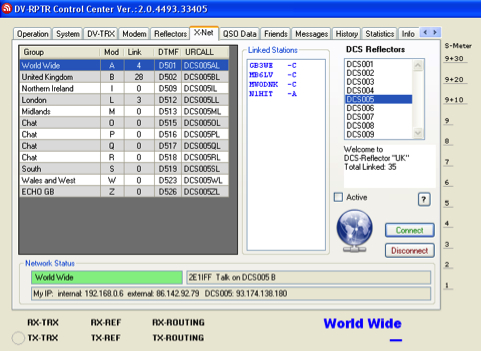
Sometimes I find how we use new technology is as interesting as the technology itself. You may not know or care what DCS reflectors are, but the way they’re developing tells us a little about ourselves, I think. DCS reflectors are basically a new generation of servers or chat rooms we use with digital amateur radio to link repeaters, nodes and individuals together. They were developed recently by some very clever enthusiasts in Germany and are growing in an organic way. A bit like dandelions. Each DCS reflector has modules from A to Z, which are a blank canvas. The way in which these are being filled is like a group of sugar drink-fueled children scrambling to choose their bunk-beds in a large dormitory at summer camp. Let me explain: The first two DCS reflectors, DCS001 and DCS002 were hosted by the Germans. They had neatly and orderly divided up the entire globe into modules. It was a good start. For their own country they had a national module of course, with additional modules for north, south, east and west Germany respectively. But anyone who knows a little about Germany should not be surprised to see that Bavaria has broken away and formed its own module. The states of Hessen and Baden-Wuettenberg followed suit, of course. The states of the former East remain quiet for the moment, it seems. There are now nine DCS reflectors at the time of writing, all now hosted by different countries who wanted their own national servers. The Dutch are fastidious in their egalitarianism. They’ve gone and divided their reflector into nation-wide, north, mid and south Netherlands as well as – wait for it - thirteen different regions including the colonies of the Dutch Antilles. The inhabitants of Flevoland must be ecstatic. The Swiss, however, have no national module at all. No, they’ve divided their piece of DCS cake in language-slices: German, French and Italian. I’m also sure it will be the most reliable DCS reflector ever known to man. The Italians seem a little less self-assured. They have a record number of four test channels, just in case. The US reflector is well-ordered, with a couple of the noisier states, like Texas, having their own module. Even the Canadians are accommodated. And as for my lot, the Brits? Well, we would have to be a little bit different, wouldn’t we? At the time of writing there is a national UK module, with a Northern Ireland, Wales & West, Midlands and South module. No Scotland so far. Maybe it’s the expense. And uniquely in the new DCS community, the city of London has decided that it is elevated enough among the great and good capitals of the world to merit its very own module. I think we can rightly take most pride in the four inconspicuous modules simply labelled as ‘chat’. You can transfer to these modules for your one-to-one conversation without tying up the repeaters of an entire small country. I have heard less-than-scintillating conversations occupy worldwide reflectors for some considerable periods. The pace of development is astonishing. An idea whispered in the ear of a developer is often embodied overnight. And we’re just one month into the story…..
UK DCS005 shown on he excellent (German) DV-RPTR Control Centre software

FT-790R, 1W of Forlorn Hope?

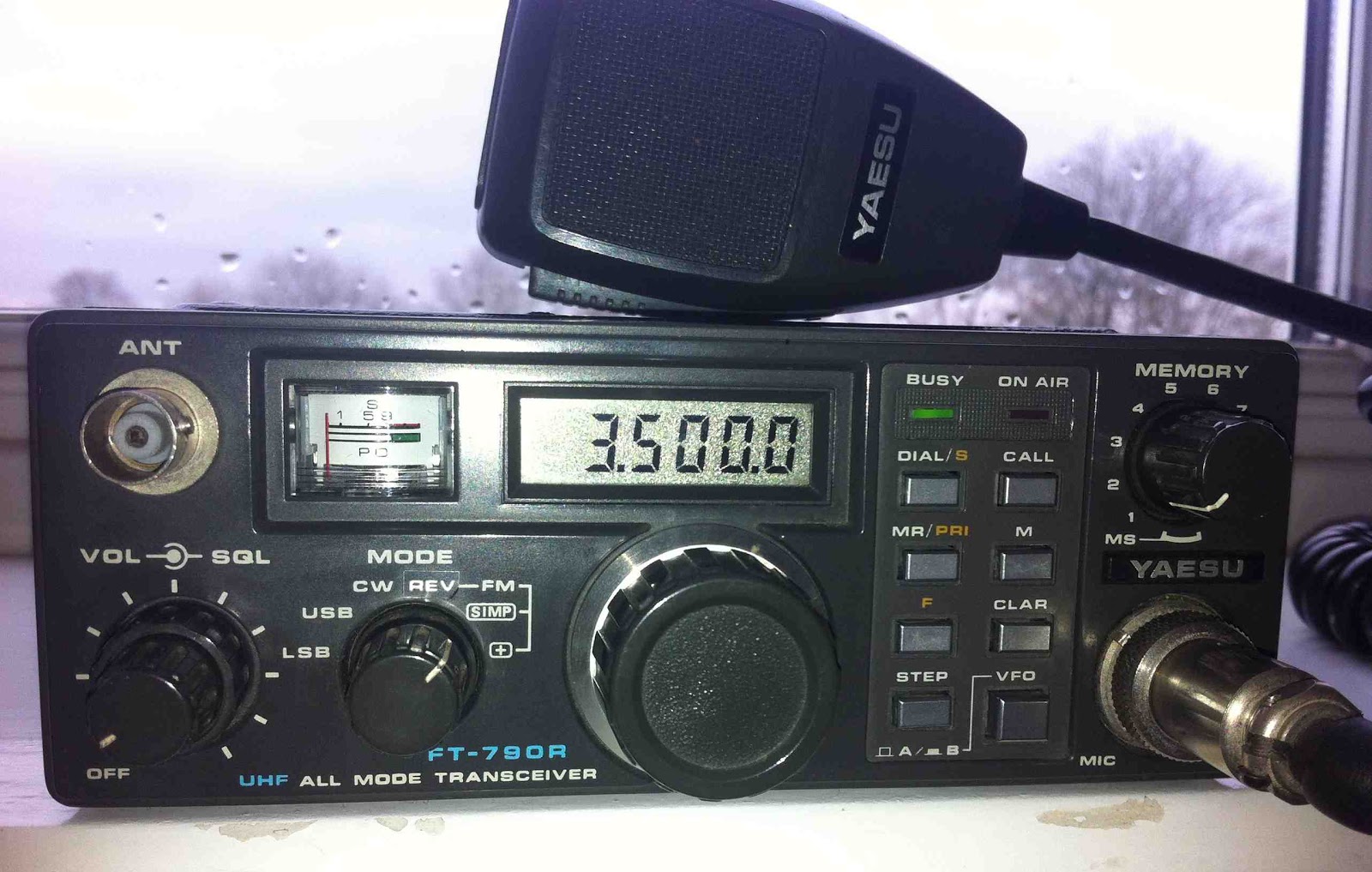
“One Watt! One Watt! What on earth bl***y use is that to you?! I don’t know… (sigh)” exclaimed one local straight-talking OM on 2m FM yesterday. His response to my acquisition of a rather dated Yaesu FT-790R ‘portable’ transceiver was less than encouraging. It’s just as well I’m an optimist then. With a maximum output of one Watt on one band (70cm) I think I’ll need to maintain an upward outlook. But here’s the thing – I always find myself drawn to obtaining the more elusive QSO. You need a certain amount of eccentricity and tendency to self-harm to stand on a hilltop for hours calling out on 23cm FM QRP, for example. I was the first in the area to start calling CQ on DV mode on 2m. It took months before my first simplex QSO and then very little since. The higher bands and modes have their rewards in spades, however. The rush of excitement when you finally make that new or distant contact. The perceived camaraderie knowing someone has gone to the same quirky lengths as you to operate on a lesser used band/mode or from an unusual location. You feel you have made a meaningful and personal connection, at least for the duration of the QSO. Oh, it’s such a far cry from exchanging reports of 5/9 with the fiftieth Italian station running 1kW on 20m you’ve spoken to in one morning. Better still, no QSL cards. Any why the FT-790? Well, at just over £100 it’s one of the few portable internal battery-powered transceivers you come across before taking the small fiscal leap to an FT-817, for example. Either way, it will hold its value if my 2m friend’s prophecy becomes true. Anyway, so far so good. It’s powered up and seems to be fully serviceable. I’ve even managed a short-distance QSO with John GW4ZPL over the Menai Strait in the Caernarfon direction, just a few miles away. I’ll be out and about when the weather improves and will post my experiences here. Will it be too futile, or with a bit of luck will I make that elusive QSO I’m after? Will my single sidebanded plaintive cries of CQ reach a caring ear? Maybe I’ll be happily shouting “One Watt! One Watt!” from a heathery Welsh hilltop.

FT-790, forlorn hope?


Subscribe FREE to AmateurRadio.com's
Amateur Radio Newsletter

 
We never share your e-mail address.


Do you like to write?
Interesting project to share?
Helpful tips and ideas for other hams?

Submit an article and we will review it for publication on AmateurRadio.com!

Have a ham radio product or service?
Consider advertising on our site.

Are you a reporter covering ham radio?
Find ham radio experts for your story.

How to Set Up a Ham Radio Blog
Get started in less than 15 minutes!


  • Matt W1MST, Managing Editor