Archive for the ‘ham radio’ Category
 His and Hers
 May 31st, 2012 |
  Author:
 I haven’t posted so much lately. Sinus issues have kept me from really spending the time on anything other than work and the necessities of life. There are some great goings-on here on Long Island though. My lovely and amazing fiance had been studying for her Technician license for the last month or so. Armed with a notebook, access to the QRZ.com practice tests, and Gordon West’s book, she finally took and passed the exam this past Saturday. Now we just need the callsign. A friend of ours once told us that there are two types of Ham Radio spouses. Ones that embrace the hobby, maybe not to the fullest, but will attend picnics and events, and there are the ones that run screaming from it. I have been blessed with a fiance who fell in love with the Ham Radio community, and the people we have met through it. I’m not sure that I’ll ever come home to find her staring at Smith Charts, but I think she and I might get to fight over the soldering iron a bit.

Fresh from Amazon
Well, anyway, on to the Baofengs you see here. She sort-of owed me a birthday gift for awhile, and I thought she needed a congratulatory gift for passing the exam, so we ordered his-n-hers Baofeng UV-3R Mark IIs. I know quite a few hams that have purchased these little gems and most are quite pleased. Now, I understand that I cannot expect the performance of a $300 Kenwood, or other similar HTs, but the value is quite amazing. Here in the NY Metro area, a small 2 watt HT is not a bad thing to have.
As I do with practically everything I own, I have started the process of learning all I can about getting the most out of these little radios. I will post the results as I experiment. So far so good though. Stay tuned, more to follow.
–Neil W2NDG
Handiham World for 30 May 2012
Welcome to Handiham World.

You can do it!
Listen to this podcast in its entirety here: http://handiham.org/audio/handiham053012.mp3
Today, just as we did last week, we are going to begin with Troubleshooting 101 as part of our initiative to help new ham radio operators (and even some of us older ones) learn how to do some basic troubleshooting for ourselves. Yes, it can be tempting to ask someone else to do things for us. This can become a bad habit when it keeps us from learning new things, especially things that we could – with a bit of practice – learn to do for ourselves. Knowing these basic things can serve us well in the future when no help is available.
Troubleshooting 101

Let’s get to today’s troubleshooting question:
Question: I carry my HT everywhere, and recently I was outdoors when it started to rain. Luckily I was close to a picnic shelter and was able to stay dry until the rain passed. It did get me thinking about what I would do if my radio did get wet though. Any ideas?
It is summertime, and we do want to be outdoors, and naturally we want to take ham radio along for the walk! Part of always carrying a radio is the possibility that you – and the radio – will get wet. But there is wet and then there is really soaked. The two are pretty different, but you are probably going to want to act quickly in either case to protect the radio.
Recently I read a story in WIRED about how some really high percentage of cell phone users drop their phones in the toilet. I think it was something like 25%! Unless you have a waterproof radio, you are probably not going to be able to fish it out of the bowl in time to avoid damage.
Let’s assume you have a typical HT that is not marketed as waterproof, submersible, or even water-resistant. It can likely survive a bit of surface moisture, such as getting caught in a rainstorm, as long as you act quickly to get it out of the direct rainfall, power it off, and dry the outside as quickly as possible. It might also be a good idea to remove the battery. If the radio falls into the water, it is a different ballgame. As soon as the radio begins to sink, water pressure increases and forces moisture into the radio’s case in a way that does not happen in a simple rainstorm. That means that you have to act very quickly to get the radio out of the water and remove the battery. The next step is to dry the outside of the radio as quickly as possible, then (with the battery still removed), place the radio and battery pack in a dry container with a desiccant, sealing the container so that the moisture is drawn out of the radio by the desiccant. Are you wondering what a desiccant is? I am sure you have run across those little packets of silica gel that are sometimes packed with electronic devices. They remove humidity that might damage the electronics. If you don’t have silica gel packets handy (most of us just throw them away because they have a finite life anyway), you can put the radio in a container with uncooked rice overnight. The rice will help to draw moisture out of the electronics. When you dig the HT out of the rice in the morning, put it on a nice, dry paper towel. Is there any sign of moisture still on the towel? If so, you might need to repeat the rice treatment. In any case, you will not be powering up the radio for days – that means keeping the battery out. You want to make sure that the radio is completely dry before putting the battery back in. If you can perform the drying out procedures in an environment with already low humidity, that is best. An air-conditioned, dehumidified house trumps a humid garage workbench. I would avoid using a hair drier to try to heat the radio. You do not want to add heat that can speed up chemical reactions or damage the electronics or even melt the case. I would not want to try the radio for at least a week so that I was darned sure all the water was out.
Let’s consider the best plan of all: prevention. It is much better not to have to dry out a wet radio, so we want to follow some basic procedures to keep our electronics dry, rain or shine. If you take your HT everywhere, always keep a small plastic bag in your pocket. The plastic bag can be used to stow your electronics should you get caught in a downpour. Since I have my little doggie Jasper with me when I am out walking, a dog waste bag does the job of radio protector in an emergency. These bags come in little rolls and are available anywhere pet supplies are sold, or you can just stuff a zip-style plastic food bag into a pocket. If you are boating or in a wet environment, you can just store the HT in a plastic bag when it is not in use.
You should also plan ahead, developing good habits when around water. Keep your HT in a case that will keep it from falling out. If you keep it in a pocket, be sure it is a pocket that is deep enough to keep it from working its way out when you sit down. One danger of using pockets instead of a belt clip and case is that you can forget your cell phone or HT in that pocket and run it through the washing machine. Don’t laugh – it happens! If you do use pants pockets for your radio and phone, get in the habit of quickly patting each pocket when changing clothes so that you will feel the HT or phone and remember to remove it. At Dayton earlier this month I was using the restroom in Hara Arena and there was some guy sitting in one of the stalls having a phone conversation on his cell phone. Not only is this kind of clueless socially, it is also the reason cell phones go for a swim in the toilet. Never use your HT or phone in the bathroom, because the bathroom has more water hazards than the golf course after a thunderstorm. Similarly, it is best to keep the HT somewhere away from the kitchen counter, another place where spills happen and are even expected.
Finally, there is the drenching in something other than plain water. I’m afraid there is not much you can do about a radio that takes a salt water swim or a hot coffee bath. If disaster happens, the procedure is the same: remove from the liquid as quickly as possible while watching out for your own safety, take out the battery, and dry out as quickly as possible with absorbent towels on the outside and the dry rice treatment. Hopefully salt has not penetrated the radio, but if it has there may not be much you can do. The salt deposits left behind can become conductive in high humidity conditions, causing shorts. I am not a fan of disassembling electronics to give them a cleaning with distilled water or solvent, as that is a job for trained bench technicians. Considering the cost of bench time, it is likely that a salt water swim will mean it is cheaper to buy a new radio. Similarly, a drenching with sugar-infused soft drinks can leave a real mess of residue behind. If this mess gets onto circuit boards it can also absorb moisture and cause shorts, even after the drying out process. It will also gum up push buttons on the HT’s keypad. The bottom line: Don’t have your HT anywhere near such possible spills in the first place. If one does occur, follow the emergency procedure:
- Remove the radio as quickly as possible from the spill.
- Remove the battery.
- Blot the surface with a fresh paper towel or other absorbent cloth.
- Dry in a container of uncooked rice.
While your gooped-up radio is drying out, you can start shopping for a new one. It never hurts to be prepared for the possibility that your old HT is down for the count.
Email me at [email protected] with your questions & comments.
Patrick Tice, WA0TDA
Handiham Manager
A dip in the pool

It’s time to test our knowledge by taking a dip in the pool – the question pool, that is!
Today we are busting our brains with a question from the Extra Class pool:
E5C16 asks: “In polar coordinates, what is the impedance of a circuit that has an admittance of 7.09 millisiemens at 45 degrees?”
Possible answers are:
A. 5.03 E-06 ohms at an angle of 45 degrees
B. 141 ohms at an angle of -45 degrees
C. 19,900 ohms at an angle of -45 degrees
D. 141 ohms at an angle of 45 degrees
Now, you may be asking yourself, “Why should I worry about this particular question when the current question pool is only good until the end of June?”
The answer about why you should understand this question (and more importantly the answer) is that it is exactly the same question, including the question number, that appears in both the current pool AND that brand-new pool!
We can’t go into super-detail about how to work these out, but you can find the process easily enough in the ARRL or Gordo books or in the Handiham audio lecture series.
Briefly, here is the skinny:o Ohms at such and such an angle. If you have forgotten what admittance is, it is simply the reciprocal of impedance. If you don’t know what impedance is, you need to go back and hit the books. Anyway, here is how such a conversion works:
- The absolute value of Z (the impedance) equals 1 over .00709 (which is the 7.09 milliseimens converted into seimens by moving the decimal point three places to the left. The “1 over” part comes from the fact that we are working with a reciprocal, which means we flip the numerator and the denominator to get “1 over some other number”, which is a reciprocal.
- With me so far?
- Good; so now you just divide 1 by .00709 using your calculator. You get 141.0437 etc., etc., so you round that to 141 ohms.
- You look at the question and the possible answers again. Hey, answers B & D each have 141 in them! Now you have a 50-50 chance of guessing which one is right!
- But the question specifies “…at 45 degrees”, and we have done nothing with that number yet. We need to consider that phase angle “theta” equals zero degrees minus the 45 degrees we have been given. So zero minus 45 equals minus 45 degrees.
- Now we look at our two possible choices. Answer B is the one that says 141 ohms at an angle of -45 degrees, while answer D says 141 ohms at an angle of 45 degrees. Because you have cleverly subtracted 45 from zero to get -45 degrees, you pick answer B, 141 ohms at an angle of -45 degrees.
Here is a little memory trick: Always remember that admittance questions involve a reciprocal, you you are going to be dividing some small number into one. It will be expressed as one over the other number. You need to remember to convert to seimens by moving the decimal point. Then if the angle you are given is positive, such as 45 degrees, the final answer will likely be negative, such as -45 in this case. The reason for all this angle stuff is that we are not dealing with direct current. We are dealing with alternating current, which is always changing, so we have to pick a point in its alternating cycle where our specifications can be listed numerically.

Have Handheld, Will Travel — Fourth Stop: The Wedding!
 I’m exhausted, so I’m going to make this quick. It’s been a full day! Today our dear friend Rachel got married to Wayne, a fine fellow, in the chapel of Wycliffe College at the University of Toronto. That of course was the highlight of the day, but what is of most interest on this blog is how ham radio played a small part.

Brent Marshall, K4EMC, Todd Mitchell, NØIP, and John Marshall, KI4JQB
Our good friends, the Marshalls, are staying at the same hotel as we are. Since roaming charges are so high up here in Canada, we all have our cell phones turned off. But two of the Marshalls are hams, and they also brought along an HT. Here is a picture of Brent Marshall, K4EMC, and his son John Marshall, KI4JQB, standing with me at the end of the day’s festivities.
Before splitting up this morning, we agreed upon a simplex frequency and a repeater: the one at the top of the CN tower, VE3TWR. My wife and I went on to Wycliffe College while the Marshalls took in the town for a couple of hours.  Thanks to our HT’s we stayed connected, and it’s good that we did. I radioed a subway route to them and, more importantly, passed a couple of messages back and forth between the mother of the bride and Mrs. Marshall, upon whom the harried mother was relying for help. When we were too far apart to use simplex, we used the tower repeater.
Nowadays we rely upon our cellphones so much that we forget sometimes how useful these radios can be. I brought my HT along on this trip for entertainment, but today it came in mighty handy.


Vacuum tubes could revolutionize computer chips?
No, I’m fairly sure I haven’t lost my mind … that really is the right headline.
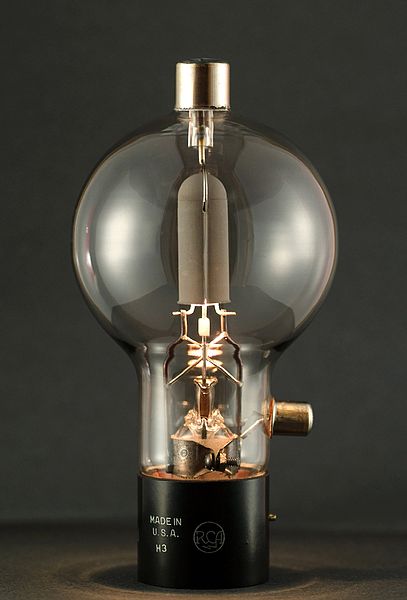 According to a resent paper published in the American Institute of Physics, nanoscale vacuum “tubes” manufactured using conventional chip making techniques have operated at frequencies as high as .46 THz.
Dr. Meyya Meyyappan, Director at the Center for Nanotechnology at the NASA Ames Research Center, has highlighted the advantages of nanoscale vacuum devices which include resistance to hard radiation and significantly improved operating frequencies.
.jpg) The increased operating frequency comes about because of the speed at which electrons travel through different materials. The speed of electron travel through silicon is comparatively slow, through graphine it is approximately 100 times faster and through a vacuum it approaches the speed of light.
The increased operating frequency comes about because of the speed at which electrons travel through different materials. The speed of electron travel through silicon is comparatively slow, through graphine it is approximately 100 times faster and through a vacuum it approaches the speed of light.
While the cavity is not technically a vacuum it contains so few atoms of any other material, such as oxygen, it is functionally the same. This also gives the vacuum nanoscale device an advantage in space where hard radiation can disrupt an electron’s travel through silicon leading to errors or sometimes permanent failure.
Dr Meyyappan estimates that vacuum nanoscale components will run ten times faster than the best conventional silicon chips and who knows what advances the future will hold. Faster chips will aid in signal processing and more capable software defined radios.
Do you want to monitor every CW & PSK31 transmission on the 40M band at once? With a vacuum “tube” rig you may be able to!
Have Handheld, Will Travel — Third Stop: VE3OSC!
This morning I once again brought my HT outside with me while I sipped my morning coffee. Don, VA3XFT, was my first contact. Don is a friendly, helpful fellow. The first time I met him was yesterday evening, when he heard me calling for Wade, VE3WGK — when Wade didn’t answer, Don called me and offered to call Wade on the telephone for me.  I didn’t take him up on it then, but this morning I did take him up on his offer to call and find out more about the amateur radio station at the Ontario Science Centre. When he came back on the air he said that the station is manned every day from 1000-1400 hrs. Thanks, Don!
After another contact with Steve, VA3SF (who, like Don, operated the repeater we were using), I prepared to go to the Ontario Science Centre.  My wife decided to come along, making it a grand adventure. We walked to the nearby subway terminal and soon were rumbling along. After transferring to a bus, we arrived at the Ontario Science Centre and made our way to amateur radio station VE3OSC on the fourth level.

Bill, VA3WTT, volunteering at VE3OSC
Bill, VA3WTT, was manning the station. This Scottish gentleman showed us the warmest hospitality, inviting me to come into the booth, sign the guestbook, and check in to a 2m ARES net that was in progress.

NØIP checking in to the Toronto ARES 11:00 daily 2m net
Ken, VA3KRS, was net control and gave me a warm welcome.
Bill also helped me get on 40m, where I tapped out a CQ with some Bencher paddles. For some reason the HF radio seemed deaf, so I’m not sure all was in order at the moment. But no matter! I thoroughly enjoyed seeing the station of the Ontario Science Centre Amateur Radio Club. It’s a great idea. I applaud the Ontario Science Centre for including this permanent display, and I applaud all the hams who man it every day.
Bill gave me a very nice QSL card, pictured above, and shook my hand. After saying farewell, my wife and I made our way to the OMNIMAX theater where we watched a documentary on the building of the Canadian Railroad through the Rocky Mountains. It was informative and full of amazing footage of a restored steam engine puffing through some sublimely scenic parts of Canada.
None of this would have happened had I not brought along my HT on this trip. Only because I happened to contact Wade, VE3WGK, did I learn about the station at the Ontario Science Centre. I’m glad I brought the HT, and I’m glad I met Wade and all these other fellows on the air. Maybe when I get back home I’ll even EchoLink back to Toronto and chat with them again on 2m and 70cm.
Here you can see some more photos of our trip to VE3OSC, the amateur radio station at the Ontario Science Centre.


Have Handheld, Will Travel — Second Stop: Toronto!

The view from Chinatown, Toronto.
You’ll have to imagine the siren.
One hour after finally rolling to a stop in Toronto yesterday, I felt like I had come home. Don’t get me wrong — there are all sorts of reasons I like living in the (relatively) small town of Granite Falls, MN. The congregation I pastor loves the Lord and loves one another, and the area is a beautiful part of the country. But I grew up in the big(ger) city, and I’ve come to appreciate things that for many years I took for granted (and that most of my country friends despise).
Mountain ranges of brick, concrete, steel and glass towering over concrete valleys. Endless streams of people flowing with a rush of different accents, different languages, different colors. Magical groves of old ivy-covered buildings. Flowery fields of shops, inns, and restaurants, some native grown, but even more transplanted from the four corners of the world. Toronto is all of these and more. It’s an unusually clean city, and friendly, too.
Not that it’s a perfect place. I have no doubt that there is a seamy side to Toronto like everywhere else. And let me tell you, the traffic is the worst I’ve seen anywhere. But as horrible as the traffic is, it brings out something great in this city: pedestrians, and a spectacular profusion of small shops that cater to pedestrians.

My daughter in Chinatown.
Cities like this are the last bastion of the small businessman, because the countryside is being has been taken over by big box stores. I shop at Walmart; these people shop at mom and pop stores. The industrial revolution may have begun in the big city, but it manifested itself most fully when it ravaged the countryside. The rural area I know is infinitely more industrialized than anything I’ve seen here.
Anyhow, yesterday evening after a cookout put on by the bride’s family I programmed my HT with a bunch of repeaters in the area. This morning I enjoyed my coffee outdoors, HT in hand. “NØIP portable VE3 listening,” I called. My first contact was on the VA3SF 70cm repeater with Jay, VE3EMP, a nice fellow who welcomed me to Toronto. Then I chatted at length with Wade, VE3WGK, on the 70cm VA3XPR repeater. Wade is the CANWARN coordinator here in central Ontario, and he is also a volunteer for the Ontario Science Centre where there is an operational Amateur Radio Station on display. He encouraged me to email him about visiting this station, and so I did. I’m hoping to visit the station tomorrow, but time will tell.

Here comes the bride!
Afterward we went to Chinatown, where the bride introduced us all to a delightful Chinese bakery. Even more exotic was the taro bubble tea she introduced me to a block down the street. Amazing!
Eventually the bride and her family departed, leaving my wife, daughter and I to stroll around Chinatown.

Who knew the Great White North could be so hot?!
Whew, was it hot! I bought some painted fans for the bride, for the bridesmaids and for my wife, and my wife also got a fancy hat to keep the sun off her fair red-headed skin. My daughter picked up a silk robe and a casual dress, and I bought myself a much-needed new watchband.

Strolling through Chinatown. That guy looks like he has spent too much time at the radio!
This evening, my wife and I went for another long walk. (Did I mention all the long walks I’ve been taking here in Toronto?) We had a late supper at a magnificent little Mediterranean restaurant. I haven’t had a felafel that good since I was in Israel! I was smiling so much and complimenting the fellow behind the counter so much that he gave us some baklava, refusing to let me pay him.
Ah, Toronto!
Photographs taken by my XYL. Thanks, Monica!


Handiham World for 23 May 2012
Welcome to Handiham World.
You can do it!
Today, just as we did last week, we are going to begin with Troubleshooting 101 as part of our initiative to help new ham radio operators (and even some of us older ones) learn how to do some basic troubleshooting for ourselves. Yes, it can be tempting to ask someone else to do things for us. This can become a bad habit when it keeps us from learning new things, especially things that we could – with a bit of practice – learn to do for ourselves. Knowing these basic things can serve us well in the future when no help is available.
Troubleshooting 101
Let’s get to today’s troubleshooting question:
Question: This question has to do with my workshop. Let me explain; over the years I have collected quite a few electronic parts and lots of hardware used in electronics and computers. While I have built some projects in the past and have done some repairs on various pieces of equipment, it seems like I seldom use many of these parts that I have saved up. My wife told me that the basement is getting to be kind of a mess and that I should clean out some of the “extra junk” from my shop. My question is, “How does one decide what to keep and what to throw away?”
Interestingly enough, I was just thinking about this very problem recently. It seems like whenever I have to work on something in my own shop, almost invariably I will have to go out and buy something to complete the repair or project. I am almost never able to pick something out of my junk box and make it work. Since I have been an amateur radio operator for decades, I have saved up a collection of really good stuff that I am possibly going to use some day – for something. The problem is that I have stuff that has been in the same place in the shop for 20 years and has never been touched. Now, you may be thinking that my workshop is such a mess that I just can’t find anything. That is not the case. I pretty much know where things are, but I just don’t seem to ever need them for a project or repair even though that is the reason I am keeping them.
Does any of this sound familiar?
I’ll bet it does; just about every other amateur radio operator does exactly the same thing. We might find an interesting treasure at a hamfest or swap meet, but we really don’t know what we would do with it other than use it for a project that never seems to materialize. So to answer the question, you need to come to terms with the reality of the situation. Let’s lay it out and be as honest as possible:
- Technology advancement: Technology has marched on, but your junk box collection has not. The fact of the matter is that most of the stuff you have collected might have been good for fixing electronic equipment that was in vogue 20 years ago or more. Today’s electronics use different kinds of parts and sometimes are not even user-repairable. Those vacuum tubes and wire wound resistors in that box underneath the workbench are probably not going to be much good to anyone but a person who restores old radios. If you are not such a person, then it is time to get rid of those kinds of parts. I could go on about other parts for radios and computers, but you get the general idea. If it is not likely to be used in current technology, get rid of it.
- Time is limited: Be honest about your time. You do not have unlimited time. You’re busy, perhaps busier than you have ever been, especially if you are still in your working years and are raising a family. Do you really have time to work on projects that will take many hours or even weeks or months to complete? It may be better to pare down your collection of project parts and keep only the most essential. Your reward for doing this is a tidier shop and less clutter. This will make it easier to do the projects that you do actually have time to complete.
- Your interests have changed: At one time you were interested in packet radio and by gosh, you still have that old terminal node controller on the shelf. Along with that, there is an old computer that used to run DOS and that would be “perfect” for your packet station. After seeing a club program about rhombic antennas, you decided to start collecting wire to make that rhombic antenna someday. Of course, you are also interested in getting several of those old computers you have saved back into service. Maybe you can put Linux on them. Well, guess what? If you haven’t done anything with these items for several years, your interests have probably changed and you are not likely to get around to any of these projects – ever. Give as much of this stuff away as possible and recycle the rest. Most counties and municipalities have some kind of recycling program for computers and electronics.
Just how honest can you be with yourself? After years of collecting all this junk, it can be difficult to admit that you are never going to get around to using any of it and that you are better off just getting the workshop cleaned out and tidied up so that you will have more space to work and less clutter.
Over the years I have seen some real junk collections. A few of them have been jaw-droppingly amazingly enormous collections worthy of being a swap meet in and of themselves. I could never imagine how anyone could have deluded themselves to the point that they actually believed all of this stuff would someday be useful! It would’ve been impossible for the person to use half of this stuff in two lifetimes, let alone one lifetime. One guy, an elderly gentleman, had a basement full of shelves arranged in rows, all stacked with equipment and parts at least 30 years old. Another had a basement and an additional storage building with row upon row of shelves holding old parts and radio gear. It is not as uncommon as you might think.
We have to face up to the fact that keeping things simple, actually expedites project-building and troubleshooting. When you have too much stuff, you waste time moving it around or digging through it to find some little part you think you might have. This is usually not worth the time and effort. You are better off buying a new part that will be exactly the right one when you need it. Furthermore, too much junk and clutter can make you prone to simply putting off a troubleshooting project because it is too much effort to work in your shop. If that is the case, you REALLY need to do some serious organizing.
At Radio Camp we will be talking about the essentials of a good, efficient home workbench. We won’t go into this lean and mean list of shop basics right now, but I will reveal that it is surprising how little one needs to have a really effective troubleshooting and project space.
Email me at [email protected] with your questions & comments.
Patrick Tice, WA0TDA
Handiham Manager
A dip in the pool
It’s time to test our knowledge by taking a dip in the pool – the question pool, that is!
Today we are taking a question from the Extra Class pool:
E4C09 asks: “Which of the following is most likely to be the limiting condition for sensitivity in a modern communications receiver operating at 14 MHz?”
Possible answers are:
A. The noise figure of the RF amplifier
B. Mixer noise
C. Conversion noise
D. Atmospheric noise
Long ago, when receivers used vacuum tubes and discrete components and when a VFO could drift like a rowboat in a hurricane, we reveled in the “good old days” of radio. Yes, these were the times when we sometimes listened with our hand on the tuning knob, either to follow a drifting signal or to try to find a sweet spot where we might hear a signal through all the noise. In retrospect, they were really “the bad old days”, because our equipment is so much better now. Receivers are so good that they have noise figures below noise that would occur naturally in the atmosphere and stability that rivals crystal control. Thanks to these advances atmospheric noise is now the biggest worry, so answer D is correct. In essence, engineers have done everything possible to the receiver itself to eliminate internally generated noise. It’s hard to do much about atmospheric noise, but now modes of operation have evolved to fight back against poor conditions. PSK-31, for example, is amazing – it works even on days when you would be hard pressed to hear a CW signal. As far as receivers go, if you are looking for the good old days, we are living in them right now!














