Archive for the ‘dx’ Category
 Piece o’ cake (almost)
 March 26th, 2013 |
  Author:
 I was fortunate enough to work both 40 Meter QRP-L Foxes tonight. Jimmy WA4ILO and Jerry N9AW are superb operators, both with good ears, so that had a lot to do with it. But I used the KX3 tonight and that made it all the easier.
The “Dual Watch” feature is something else, and makes working split a snap! You go into the KX3’s menu until you get to “Dual RX” and you turn it from “Off” to “Auto”. What happens next is that you hear your quarry on VFO A in your right earbud. VFO B is heard in your left earbud, so you can tune around VFO B until you hear the Hound the Fox is currently working. Once you know where the Fox is listening, it’s just a matter of time! The only caveat is that the Dual Watch feature will only work with splits less than 1.5 kHz.
Anyway, I nabbed Jerry N9AW at 0106 UTC, six minutes into the hunt, and Jimmy WA4ILO at 0139. For the last hour, I was just listening to the two Foxes work my friends.
The past few days, I have been getting very few e-mails. I subscribe to quite a few QRP e-mail reflectors and I was wondering what was up. I thought that maybe it had something to do with that Microsoft / arrl.net thing that was going on last week, as I always use my arrl.net address for e-mail.
This evening, I checked my Web-based Verizon e-mail page. Everything was in the spam, folder! All the spam was in there; but also a ton of good e-mails, too! For the longest time, Verizon’s e-mail spam filter was doing an excellent job and I never really had to give it a second thought. Looks like for the next while that I am going to have to regularly check the spam folder until the e-mail client “learns” what is spam and what is not.
I got an e-mail from my good friend Bob W3BBO, telling me that he was fortunate to work the Easter Island DXpedition on both 12 and 15 Meters today. I haven’t had much luck hearing them loud enough to work them, and when they have been loud enough – they have been calling for EU stations only. I don’t know how much longer they are going to be there; but I do have this Friday (Good Friday) off; so maybe when I’m not in church, I just may get an opportunity. I’ve worked Chile many times, both QRP and QRO, but I have NEVER worked Easter Island. It would be appropriate to work them this week, wouldn’t it?
72 de Larry W2LJ
QRP – When you care to send the very least!
6V7S
I managed to break the pileup on 40 Meters tonight to work Vlad in Senegal for a new band. This makes for contacts now on 40, 20, 17 and 12 Meters, all via QRP. I also worked Vlad once on 20 Meters with QRO power, think it was 85 Watts.
Spring must be on the way though, as the band was super noisy tonight. Lots of QRN made it tough for two QRP rag chews (2X KX3 QSOs, by the way) that I had earlier in the evening. There were static crashes galore! Someone must have been getting some pretty bad thunderstorms.
20 Meters was decent this afternoon, as I was able to work SP6CEW in my ancestral country, Poland. I was also able to work S57KW in Slovenia.
When I spoke with Bob W3BBO on Echo link this afternoon, he told me that he had pretty good success on 17 Meters today. When I was tuning the bands this afternoon, 17, 15 and 12 Meters sounded pretty sparse to me with very few loud signals.
Tomorrow, we are forecast for more snow. Hopefully, it won’t be much. In any event, the ground has had a chance to warm up, so any snow that falls should melt pretty quickly. Spring officially began a few days ago, but it sure hasn’t felt like it.
One of my first radio goals for 2013 is to get about another couple dozen radials down for the HF9V. My Butternut is my “go to” antenna, so it will not be wasted effort. I want to get them down early, so that come late May or early June, they will have disappeared into the grass.
72 de Larry W2LJ
QRP – When you care to send the very least!
Are you married ……..?
The other day, I received a request from Terry WA0ITP, to post the monthly Run For the Bacon announcements on the Four States QRP Group e-mail reflector. It would seem that quite a few “Four Stater’s” have built Pig Rigs and want to be kept abreast of when RFTB is held. So I went about the process of joining the Yahoo group and subscribing to the e-mail reflector. I was approved and started receiving e-mails yesterday.
Immediately, one hit my eye. It’s entitled “QRP till death do you part?”, and it was written by Gust ON6KE
The premise of the post is, that in addition to all your QRP only gear, you own a 100 Watt rig, or perhaps a barefoot rig and an amplifier. At the same time, a DXpedition is underway to Tromelin, Peter I, Kerguelen, or some other very exotic place that has not been on the air for years (and perhaps might not be on again for many more years). If you have never worked that entity before, do you:
1) Try to work them QRP until they’re just about ready to pack their bags, and then if unsuccessful, go all out with everything you have?
2) Try to work them QRP for a few days or a week perhaps, and then if unsuccessful, go QRO (well before the departure time draws near)?
Gust ends his post by saying, “I guess this question is about how “fanatic” one is about QRP”.
Interesting question to say the least! In my head, I guess I would add another possibility:
3) Try to work them QRO and get them in the log and THEN try to work them QRP at another time, before they leave?
Personally, my primary interest (my passion, if you will) in Amateur Radio is QRP and CW. If you’ve read this blog for any amount of time, you know that. I have been interested in and have dabbled in QRP since I was licensed as a Novice in 1978. I joined QRP ARCI back in 1979, back when QRP was considered to be 100 Watts or less. I became a “QRP only” station, under the current understanding of the term, in 2003. From 2003 to 2013 (Wow, 10 years!), I have not had a rig that was capable of going past QRP levels (OK, my K2 could go up to about 15-20 Watts – that’s technically not QRP, but it ain’t QRO, either!).
But since my Novice days, I have also been drawn to working DX. I’ve worked my share of DX with 5 Watts or less, enough to earn the ARRL’s QRP DXCC award. There have been many DXCC entities where the only way I have worked them is with QRP, but I’ve also had many, many disappointments. There have been many times during that ten year period where I limited myself to 5 Watts only, where I failed to get a DX station or a DXpedition in the log, even though I tried until the cows came home.
I would consider myself to be fan and aficionado of QRP, but not a foaming-at-the-mouth QRP “fanatic”, where it’s QRP and CW to the exclusion of everything else. I am enough of a DXer NOT to marry myself to the idea that using something more than 5 Watts is heresy. That’s why I went and sold my K2, so that I could purchase the KPA3, 100 Watt module for my K3. For the first time in a long time, I have been able to increase my power in order to work DXCC entities that I have never worked before. This just bore fruit a few weeks ago when I worked Egypt SU9VB for the very first time in my Amateur Radio career, and I did it using 85 Watts.
And that’s why I would subscribe to possibility number 3, above. For instance, if I’m fortunate enough to hear Spratly loud enough to even attempt to work them before they leave? Like any other DXer, I am going to be there with my 100 Watts trying to break that pileup and get them in the log, Baby! But once they’re in there – I just might try to work them again (not the same sitting) with 5 Watts only. I am also enough of a practical QRP DXer to want to be able to claim that I got them with low power, too.
In the end though, you have to go with what works for you. What works for me, may not work for you. Amateur Radio is a big enough tent where opposite slogans such as “Life’s too short for QRP” and “Quit Running Power” are cute; but really have no place. There’s room for every thing and every one. If there’s one bit of advice that I would subscribe to, it would be “Life is too short to pigeon hole yourself”. Or as Cicero said, ”Never go to excess, but let moderation be your guide”.
I have done QRP, I have done QRO, I have done CW, I have done SSB, I have done Digital, I have done HF, I have done VHF/UHF, I have done satellites – they were ALL fun.
I would still like to do more satellites and some PSK31, I would love to try meteor scatter and EME, someday. I would LOVE to have a tower and a yagi someday. There’s so much to try and do – don’t cheat yourself! Amateur Radio is like being at a sumptuous buffet, it’s perfectly fine to try a little bit of everything!
72 de Larry W2LJ
QRP – When you care to send the very least!
Decent DX Day
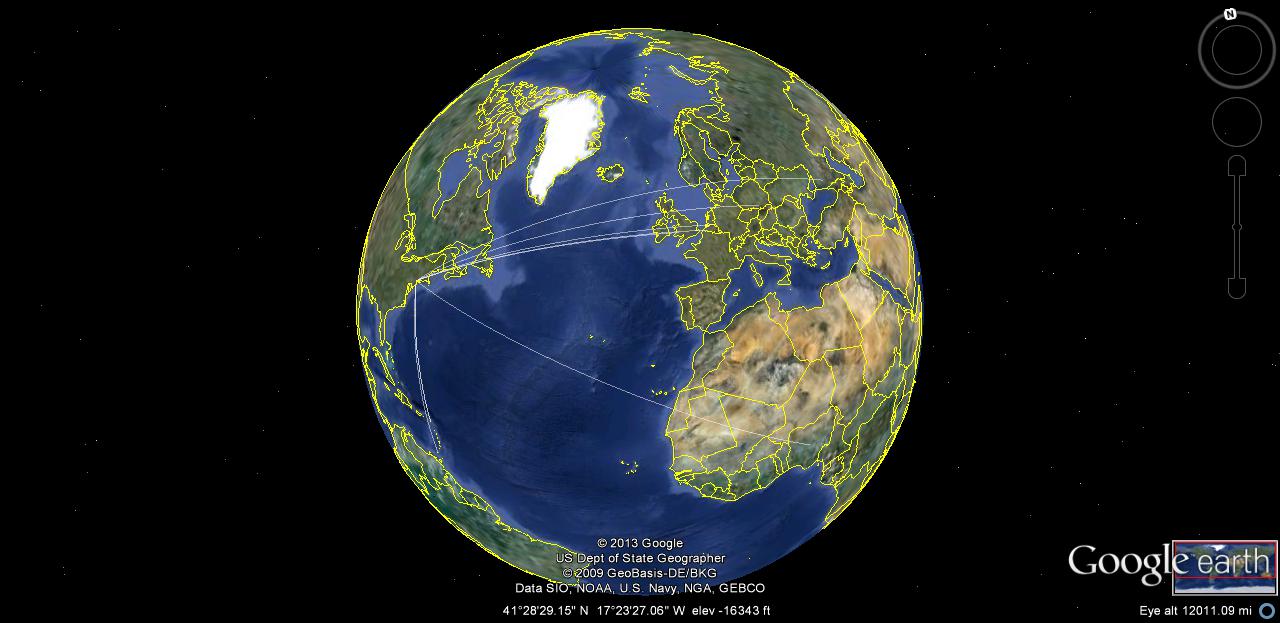
I was piddling around on the bands today. Since there were a lot of contests going on, and I did not feel like participating, I exiled myself to the WARC bands – 30, 17 and 12 Meters.
There was enough DX to be had and I worked just about all of it QRP.
On 12 Meters, I worked Andy SP9KR. There was a lot of QSB there, and I’m not 1000% that he got my call right. So at the very end, when I sent my call sign for the very last time, I bumped up my power to 55 Watts (for insurance) but I’m not sure that even then that I was heard correctly.
On 17 Meters I worked Serge R7AY in Russia. After our QSO and I got Serge’s info in my log, I heard him continue to call CQ. So I spotted him on the TelNet Cluster. Almost immediately, as he was working other stations I heard him send “W2LJ TNX SPOT”. I guess he had his computer on! I thought that was so cool. You’re very welcome Serge, I hope it brought you lots of DX!
I also worked OT4A in Belgium and GW100C in Wales. Of course the GW100C call stuck out like a sore thumb. After working him, I looked up the call on QRZ and it turns out that GW100C is one of several UK HQ team members of the RSGB. These calls, GW100C, GM100C, GD100C, G100C, GJ100C are meant to be used by the HQ members so that they get practice in learning how to handle pileups for when they are taking their turns as G100RSGB, GW100RSGB, GM100RSGB, etc – the RSGB Centennial Stations.
On 30 Meters, I was able to work PJ7/N0TG and PJ7AA, both on Sint Maarten. J34G in Grenada who has excellent ears – and as it turns out, an FOC member, so no surprise there.
The last station that I worked for the day was Ivin 5N7M in Nigeria. I ended up having to bump up the power to 85 Watts to work Ivin. I was getting nowhere with 5 Watts and it actually took a fair amount of doing to get noticed at 85 Watts. The pile up wasn’t fierce, so I have no idea what the problem was, although for this QSO, the EDZ ended up being the antenna that worked. I have worked Nigeria before with QRP power, but not on 30 Meters. Nigeria was new for me on that band.
Geez, it almost sounds like I’m starting to pay attention to 5BDXCC matters!
72 de Larry W2LJ
QRP – When you care to send the very least!
DX Code of Conduct
This post will deal with a phenomena that is occurring more and more frequently, I believe. But it hasn’t been noticed by me alone, it was also noticed by Jim K9JV, who posted about it on QRP-L this morning. I touched upon this in my recent post about pile up behavior; however, this is a very important topic, so here we go again.
Jim was trying to work both P29NO and 9M4SLL. The pileups were big and unruly. While it is the domain of the DX to try and control the pileups, it remains the responsibility of those trying to work the DX to do so in as “professional” a manner as possible. Jim pointed out that several stations continued to throw out their calls, even though the quarry was clearly calling for a station whose call was in no way similar to those of the perpetrators.
This is maddening! K9JV was furious (and justifiably so) that when P29NO was calling “K9?V”, a KØ, a VE and a W2 kept plaguing the aether with their calls. I had a similar experience a few years ago when I was trying to work an Iraqi station. I was one of those competing in the pileup, and the Iraqi station suddenly began sending “W2L?” He meant yours truly of course, yet I was obliterated by a W4 station, and no, it wasn’t a W4Lsomething (I could have accepted that) – the station didn’t even have an “L” in their call at all! Jim was lucky as he ended up working P29NO. In my case, the Iraqi station subsequently went QRT and I never got him in the log.
What causes this kind of behavior? Are people truly that stupid and discourteous? I don’t know the answer to that, although I am tempted to offer an unfounded and uncharitable guess.
But I think part of the problem may lay in the way that I think DX is encountered today. At the risk of sounding like a curmudgeon, in the days of old, we used to find DX by twiddling the dial and listening for it. You spun the dial knob, up and down – back and forth, straining your ears to find that foreign amateur radio op. If you were lucky, you were able to hear him, you worked him and you were good to go. Or you listened for a pileup, and you located the station they were all calling, determined if you needed him, and then you joined the fray. But in essence, YOU had to locate the DX station yourself, either by dial twiddling or by locating the goal of a pileup.
Today, things have gotten immensely easier; but at the same time, we have invoked “The Law of Unintended Consequences”. Allow me to explain with this scenario:
A station twiddles the dial – he finds and hears (for example, we’ll use a DXpedition that just concluded) TX5K. He works him. Then, proud of his accomplishment, he posts TX5K to the Internet (in the days of old, the PacketCluster), wishing to share the bounty. Immediately, on the screens of Amateur Ops the world over, it appears that TX5K has appeared on 18.073 MHz (for example).
Nowadays, with the myriad of the logging programs and rig control programs available, an Amateur Op can just point and click with his mouse and “Viola!” there they are, on TX5K’s frequency.
I think the problem is, that many (but by nowhere near all) ops don’t pause to listen to hear if they can actually hear TX5K. Or may be they can, but they hear him only marginally at best. In fact, they hear him so marginally that if they were tuning across the band on their own, they wouldn’t have been able to tell that it was TX5K in the first place – but hey, their computers tell them that he’s there, right? So what do they do? They start throwing out their calls in the hopes that somehow he’ll magically get louder and that they’ll be heard in return. Heck, in many cases they can’t even tell that he’s working split! So they call right on the listening frequency, which then invokes the ensuing cacophony of “UP”s and “LID”s being sent.
It gets to be one, big frustrating mess. And this doesn’t even take into account the zoo that can occur if some quack, who literally enjoys jamming DX operations, gets involved.
So what should be done about this? Closely and completely adhere to the “DX Code of Conduct” – that’s what!
The DX Code of Conduct was formulated by Randy Johnson W6SJ. You can read about it here.
I will listen, and listen, and then listen again before calling.
I will only call if I can copy the DX station properly.
I will not trust the DX cluster and will be sure of the DX station’s call sign before calling.
I will not interfere with the DX station nor anyone calling and will never tune up on the DX frequency or in the QSX slot.
I will wait for the DX station to end a contact before I call.
I will always send my full call sign.
I will call and then listen for a reasonable interval. I will not call continuously.
I will not transmit when the DX operator calls another call sign, not mine.
I will not transmit when the DX operator queries a call sign not like mine.
I will not transmit when the DX station requests geographic areas other than mine.
When the DX operator calls me, I will not repeat my call sign unless I think he has copied it incorrectly.
I will be thankful if and when I do make a contact.
I will respect my fellow hams and conduct myself so as to earn their respect.
Having wonderful tools at your disposal does not abrogate your responsibility to operate in an unselfish manner. You must still be courteous to your fellow Hams.
I am so taken by this credo, that I am posting the DX Code of Conduct badge on the side of this blog, to be a reminder to myself and others.
Oh, and QRP Fox hunters …… your situation is a bit different, so let’s adapt these:
I will listen, and listen, and then listen again before calling.
I will only call if I can copy the Fox station properly.
I will not interfere with the Fox station nor anyone calling and will never tune up on the Fox frequency or in the QSX slot.
I will use full break-in if at all possible.
I will wait for the Fox station to end a contact before I call.
I will always send my full call sign.
I will call and then listen for a reasonable interval. I will not call continuously.
I will not transmit when the Fox station calls another call sign, not mine.
I will not transmit when the Fox station queries a call sign not like mine.
When the Fox station calls me, I will send ONLY the required exchange of RST – S/P/C – Name – Power out
I will be thankful if and when I do make a contact.
I will resort to attempting duplicate contacts only if I am very certain that I was not heard the first time.
I will respect my fellow hams and conduct myself so as to earn their respect.
If we all do these things, life on the bands can be much more pleasant.
72 de Larry W2LJ
QRP – When you care to send the very least!
10 Meters was nice today
I got the chance to get on the air for a short time this afternoon. I took the opportunity to spin the dial around the 10 Meter band. Around the 28.200 MHz neighborhood, I heard beacons from Mexico, Brazil and British Columbia in Canada. Encouraged that the band might be open, I continued my spin.
In the CW portion of the band, I was able to work CT1IUA with 5 Watts. He was 599 and I received a 559 in return. After that, for the heck of it, I traveled all the way up to the SSB portion of the band. Here, I heard CT1EHI booming into NJ. Again, for the heck of it, I pumped up the power to 10 Watts and gave him a call. He answered me! When he found out that I was in New Jersey, Marco asked me if I knew where Flemington is. Heck, it’s about 10 – 15 miles down the highway from where I work. Marco informed me that he has some friends that live there, and in fact he’s gone to Dayton with them a few times.
I don’t do so much in the way of QRP SSB as CW has always been my first love. It’s gratifying, though, to make a SSB contact using only 10 Watts and it’s even more gratifying when that contact is overseas. Marco gave me a 5X7 signal report, too – not too shabby! You have to absolutely love 10 Meters when it’s open – pure magic!
15 Meters was also open and I had a nice “chew” with N5XE, Carl in Oklahoma who answered my CQ. I also had a quick QSO with OX3XR, David in Greenland. I’ve worked David twice before, once on 12 Meters and once on 20 Meters, so this was a new band for me for Greenland.
On 17 Meters (I was doing a bit of band hopping) I ran into and worked OJØH/MM again. Last time I worked them, they were travelling the Caribbean. I have no idea where they were located this time. They were not as strong as they were last time; but not sure whether that was due to location or just how the propagation was.
When the bands are open and propagation is good – the most fun hobby in the world becomes even more so.
72 de Larry W2LJ
QRP – When you care to send the very least!
The good and the not so good.
Last night, while hunting in the 80 Meter woods in the QRP-L Fox hunt, I continued to work on my PigRig. I came to the part where I am winding T1, and I guess I had a case of brain flatulence, because I just couldn’t figure out from the instructions, how the center tap was supposed to be done.
Before going to bed (late), I came up here and fired off an e-mail to the Flying Pigs e-mail reflector looking for some enlightenment. When I checked my e-mail this morning, there was an e-mail from the Head Honcho himself, Diz W8DIZ. He explained to me (very patiently) what should have been as obvious as the hand in front of my face.
Thanks, Diz for excellent customer service! And also thanks for being super courteous and patient with someone who seems to have had a “Senior Moment”.
On the other hand, last night I was fortunate to work an SU9 station from Egypt on 40 Meters. I was doing the “happy dance” as this was my first QSO with Egypt – ever. So I dutifully went to QRZ to look up QSL information, only to find that LOTW is not accepted (as it’s too cumbersome and difficult to figure out), that paper QSLs are not really wanted, but if you go to PayPal and enter this particular PayPal address (along with the appropriate “donation”) that a QSL card can be had.
What ?!? I mean, really …… what?
OK, I understand that Egypt is not the most commonly found country on the air; and I’m sure that QSLing is quite the tedious chore (if not a downright pain in the butt). But isn’t that what QSL managers are for? And really, I mean even I can figure out how to use Log of the World. You know, the guy who had trouble figuring out how to wind a simple toroidal transformer? …… Yes, me – even I figured out how to use Log of the World.
I hesitate to use that hackneyed expression, but if I can figure it out – you can figure it out.
Maybe I ought to quit my job, move to a “rare and exotic” locale, get on the air, make a couple hundred QSOs a day, and start charging a few bucks per QSL card.
But then I guess I’d have to figure out how to use PayPal. (Of course, I am being facetious, I already know how to use that. Learned how just around the same time I learned how to use LOTW).
72 de Larry W2LJ













