Archive for the ‘arrl’ Category
 Show Notes #117
 November 14th, 2013 |
  Author:
 Episode #117 Audio (Listen now!):
Topics
- demorse / xdemorse
- QRadioPredict
- Point Linux Review
- Voice mail from Rich, KD0RG
- Comment on the Web site from Yan, XV4Y
- Comment on the Web site from Johnny
- E-mail from Michael Aiello N2HTT
- Donations and Subscriptions
- Daryl O. (Yearly)
- Jonathan S. (Yearly)
- Walter J. (Yearly)
- Doug J. (Yearly)
- Brian S. (Yearly)
- Paul G. (Yearly)
- Special shout-out to the above subscribers because they got lost in the shuffle someplace. Member benefits have been added as of today.
- Jeremy H. (Monthly)
- Steve C. (Monthly)
- Nigel B. (CafePress)
- Rodney B. (CafePress)
- Patricia M. (CafePress)
- John J. (CafePress)
- Nyland P. (CafePress)
- Mark J. (CafePress)
- John R. (CafePress)
- Linda B. (CafePress)
- Elizabeth P. (CafePress)
- Ron E. (CafePress, also a subscriber!)
- James L. (CafePress)
- Greg A. (CafePress)
- Don H. (PrintFection)
- Scott H. (PrintFection)
- Steven P. (PrintFection)
- Gary U. (PrintFection)
- Thank you to all who subscribed, donated or bought merch!
- New subscribers to the website
- Mike N2HTT
- Social Media Roundup
- Google+
- Danny M.
- Elbennit T.
- Facebook
- Daniel F.
- Bob W.
- Rob H.
- Twitter
- @JackPrindle
- @7sicks
- What is Zazzle?
- Please check out our website: http://lhspodcast.info.
- Become an ambassador! Visit the Web site for upcoming events and information how you can represent Linux in the Ham Shack at a nearby Linux con or hamfest.
- You can e-mail us at [email protected] or leave a voice mail at 1-909-LHS-SHOW (547-7469).
- All hate mail is routed to Harrison at [email protected].
- Please subscribe to the mailing list. A link is on the Web site.
- Go to CafePress and Printfection and buy some of our show merchandise. Each purchase helps out the show. You can also help the show by clicking on the sponsored ads in the right-hand column of the homepage.
- http://www.cafepress.com/lhspodcast
- http://www.printfection.com/lhspodcast
- Listen live every every other Tuesday at 8:00pm Central time, or Wednesday at 0200z. Our recording schedule and countdown timer to the next episode is on the Web site.
- Thank you to all of our listeners, live and quasi-live.
- “Kannunkaataja” by White Owl from the album Pepper
- http://www.jamendo.com/en/track/35540/kannunkaataja
- To vote for this track at cchits.net go to: http://cchits.net/vote/1419/1697
- “Cunla” by White Owl from the album Pepper
- http://www.jamendo.com/en/track/35534/cunla
- To vote for this track at cchits.net go to http://cchits.net/vote/1420/1697
LHS Episode #117: On Point (For Once)
 Hello, podcast listeners! It's getting cold outside. Now would be a good time to curl up in your favorite chair with your media player, a warm fire and an episode of Linux in the Ham Shack. As it happens, we have a new one for you right now. Your hosts discuss some newly updated ham radio software for Linux, including a lightweight logging application, CW decoder and VHF propagation modeler. Then they give you an in-depth peek at the distribution known as Point Linux. All of that is followed by feedback and a few announcements that you really should stay tuned for. Please enjoy, and thanks for being a valued member of the Linux in the Ham Shack community.
73 de The LHS Guys
W5MPZ Field Day!
Our station was active for almost 24 hours, minus a lull at about 1:10 am Sunday morning. Our backup arrived at around 2 am, which included Brian (N5ZGT, Rocky Mtn Division Director), who just got back from a Turks and Caicos island vacation (or DXPedition, you might say), and Scott (N5SQR) who worked PSK and SSB.
Setup and Operation
Beam
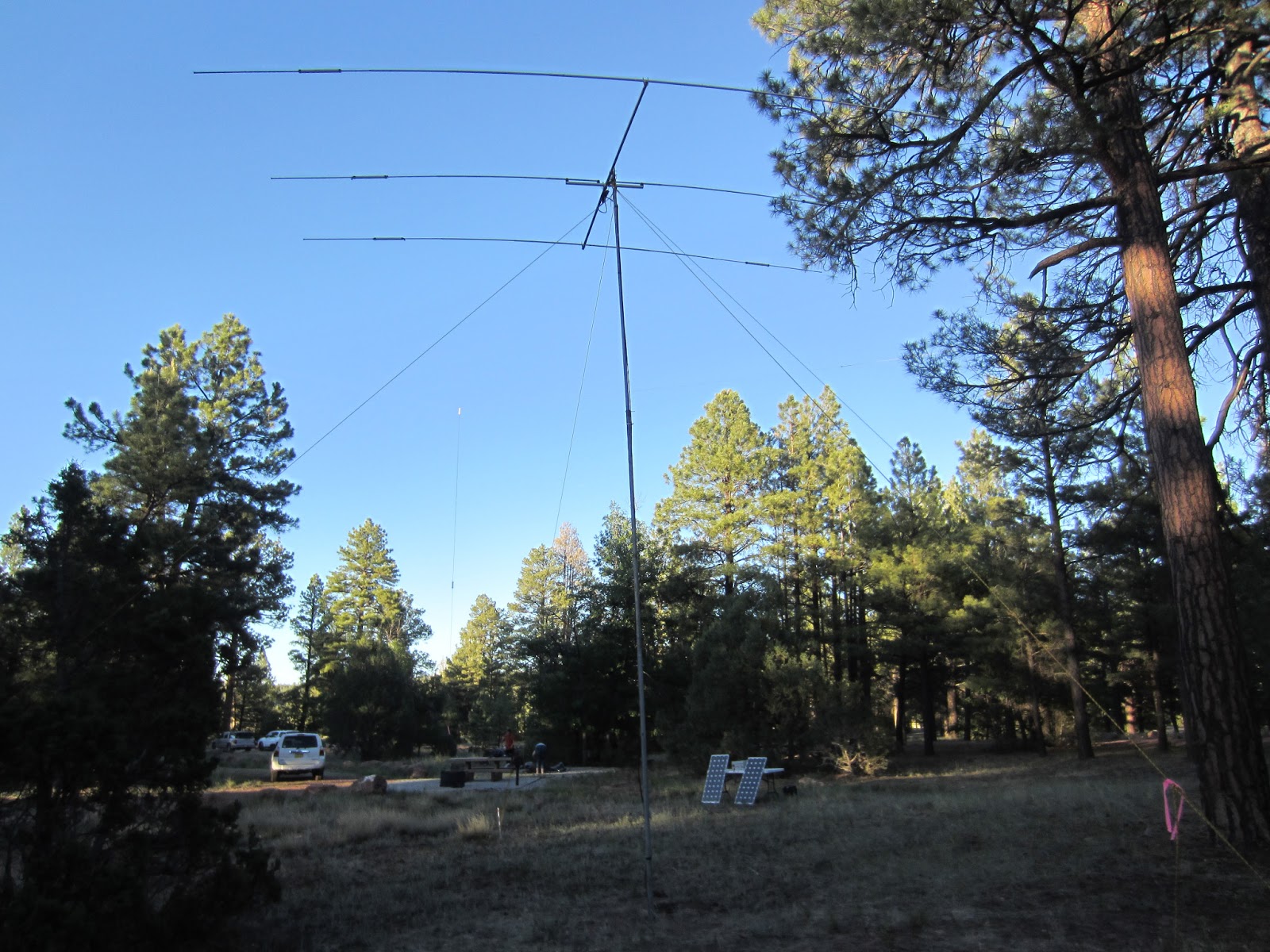 |
| TA-33 with the 80m windom in the background |
Dipoles
On my first shot, I got over this tree and the line sat perfectly on the brown number post.
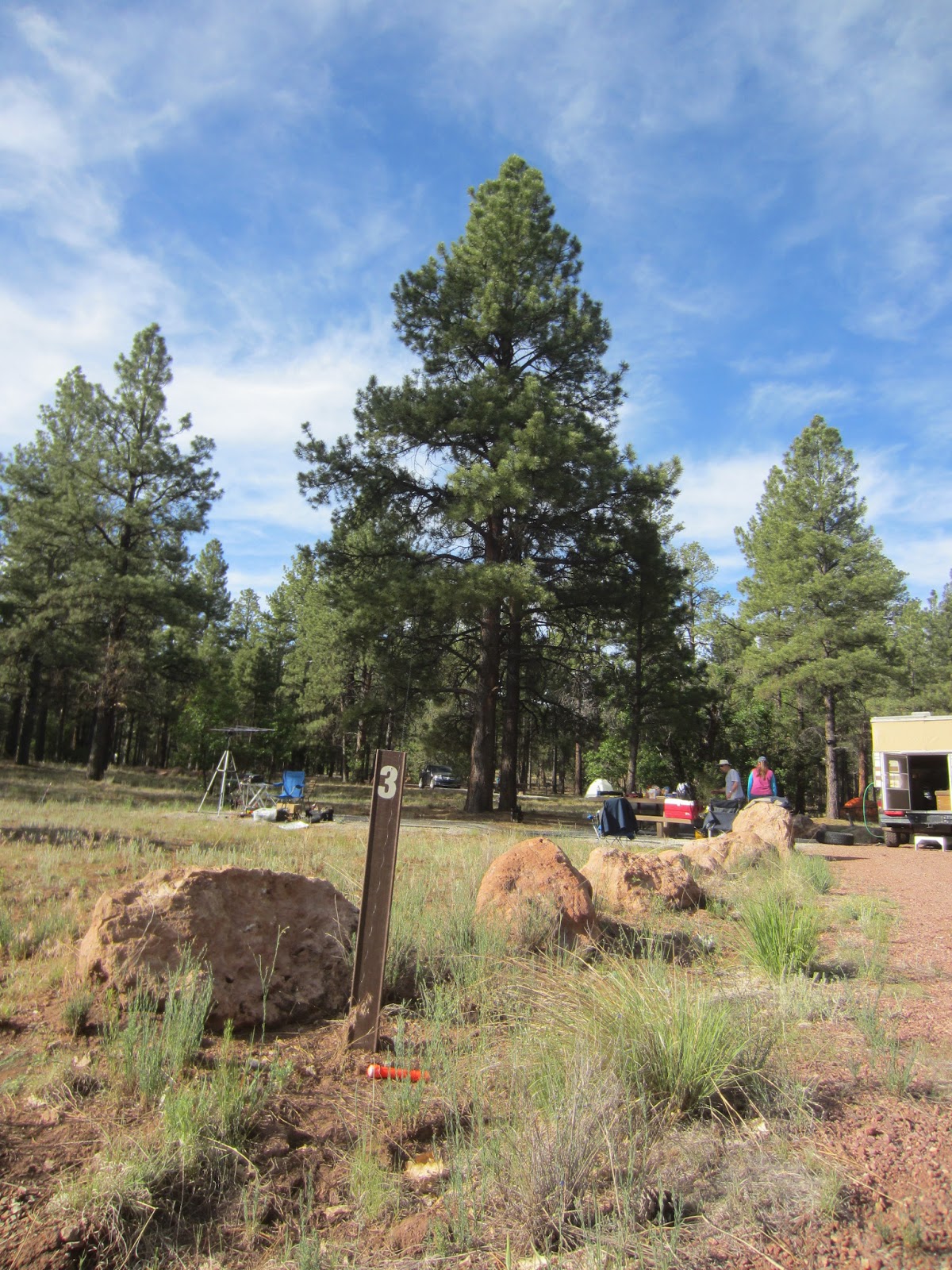 |
| The perfect shot. |
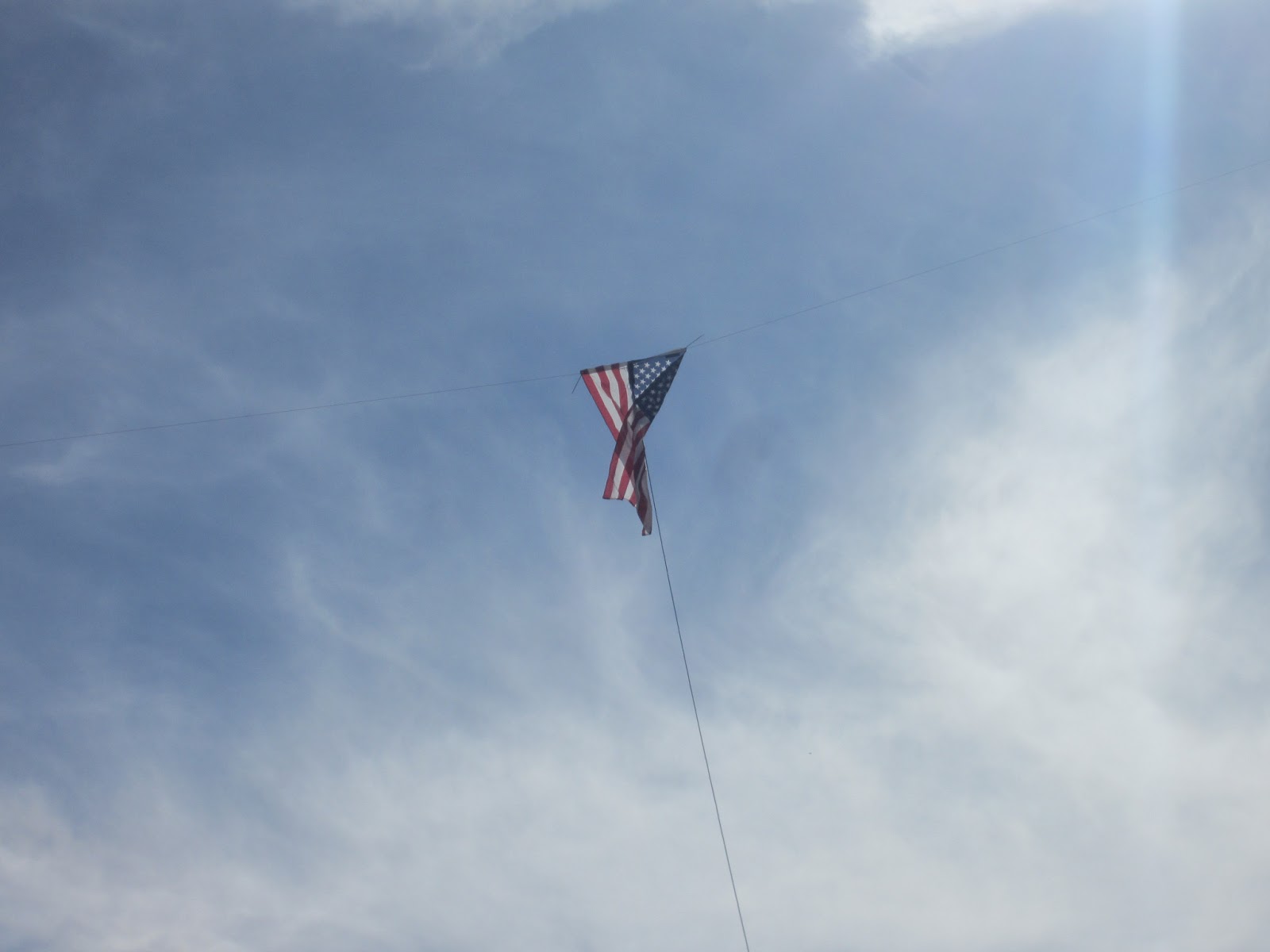 | ||
| Old Glory on our 80/40 trap dipole |
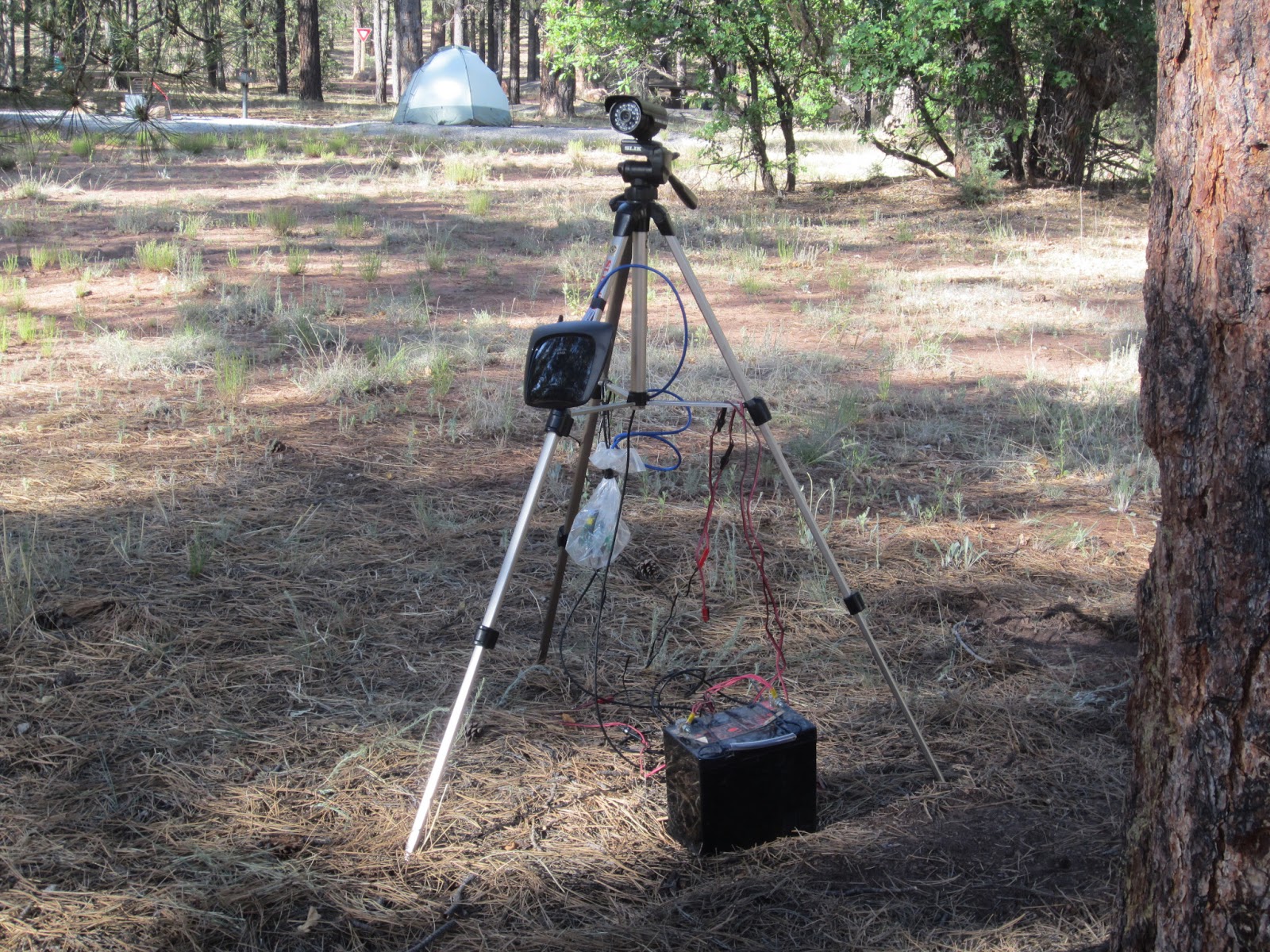
RPi camera
Operation
We were 2A, so we had 2 stations on the air, all supported by batteries. We operated SSB, CW and PSK31.
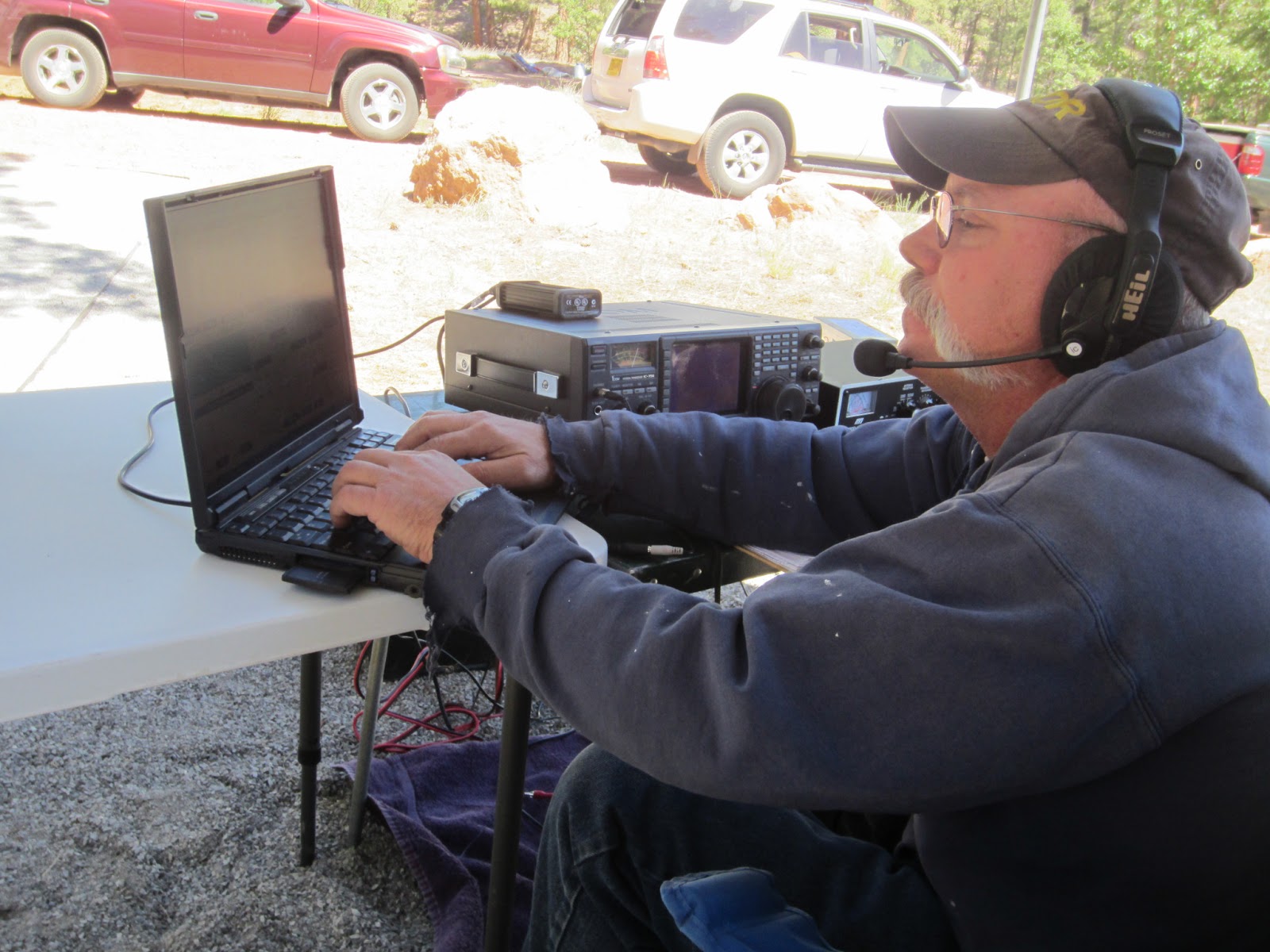 |
| Scott, N5SQR working SSB |
No field day station is without its problems. We were lucky to only have minor issues, like the logs not syncing or the digital station computer interface not working. These were easily and promptly fixed. Everything else (except for the band conditions) was perfect.
Our ops came from all areas of the hobby. Brian, for example, just got back from Turks & Caicos, and worked hordes of stations from VP5-land, while Seth never worked a contest before being a technician.
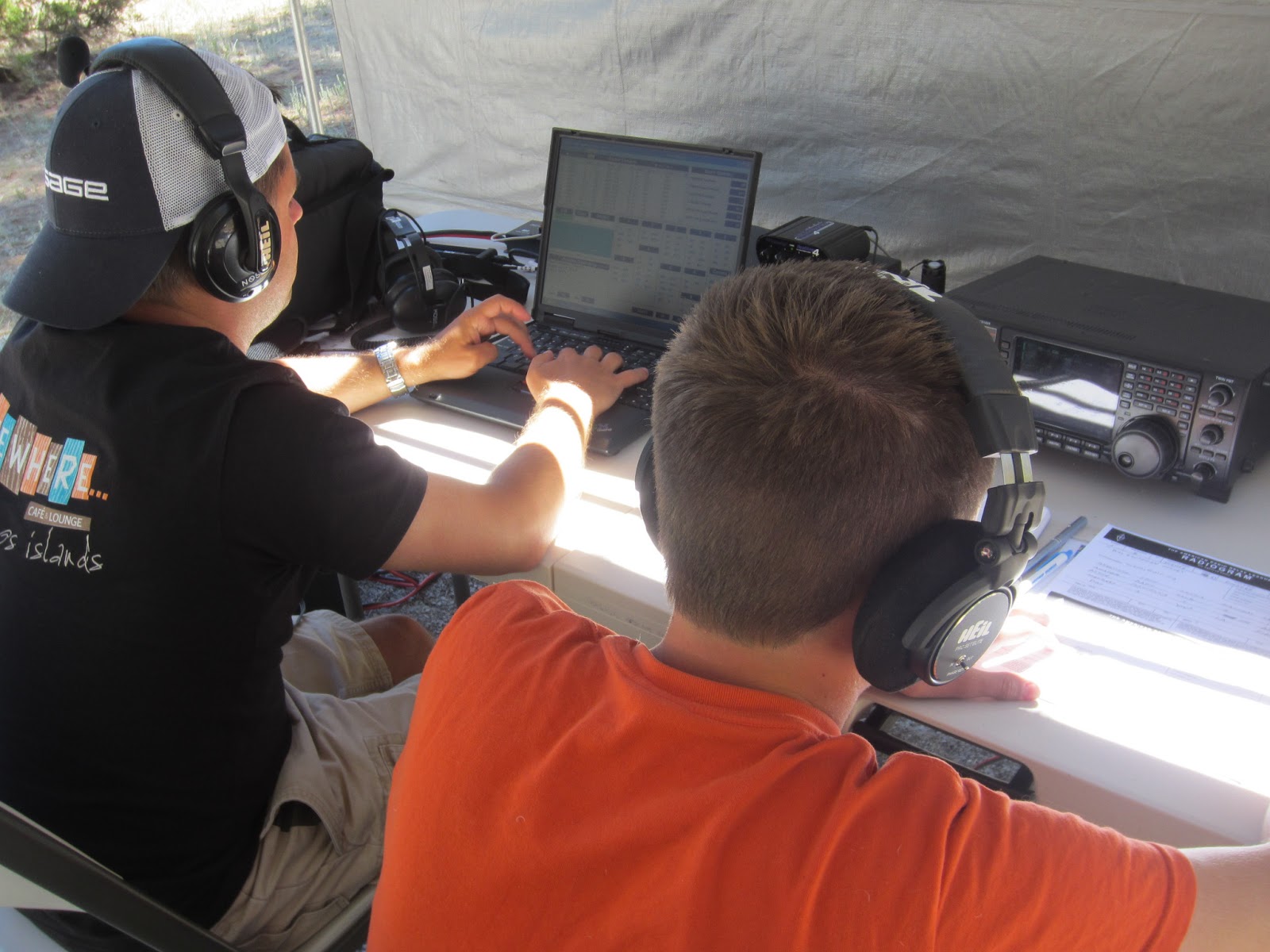 |
| Brian and Seth teaming up to send Radiograms for bonus points |
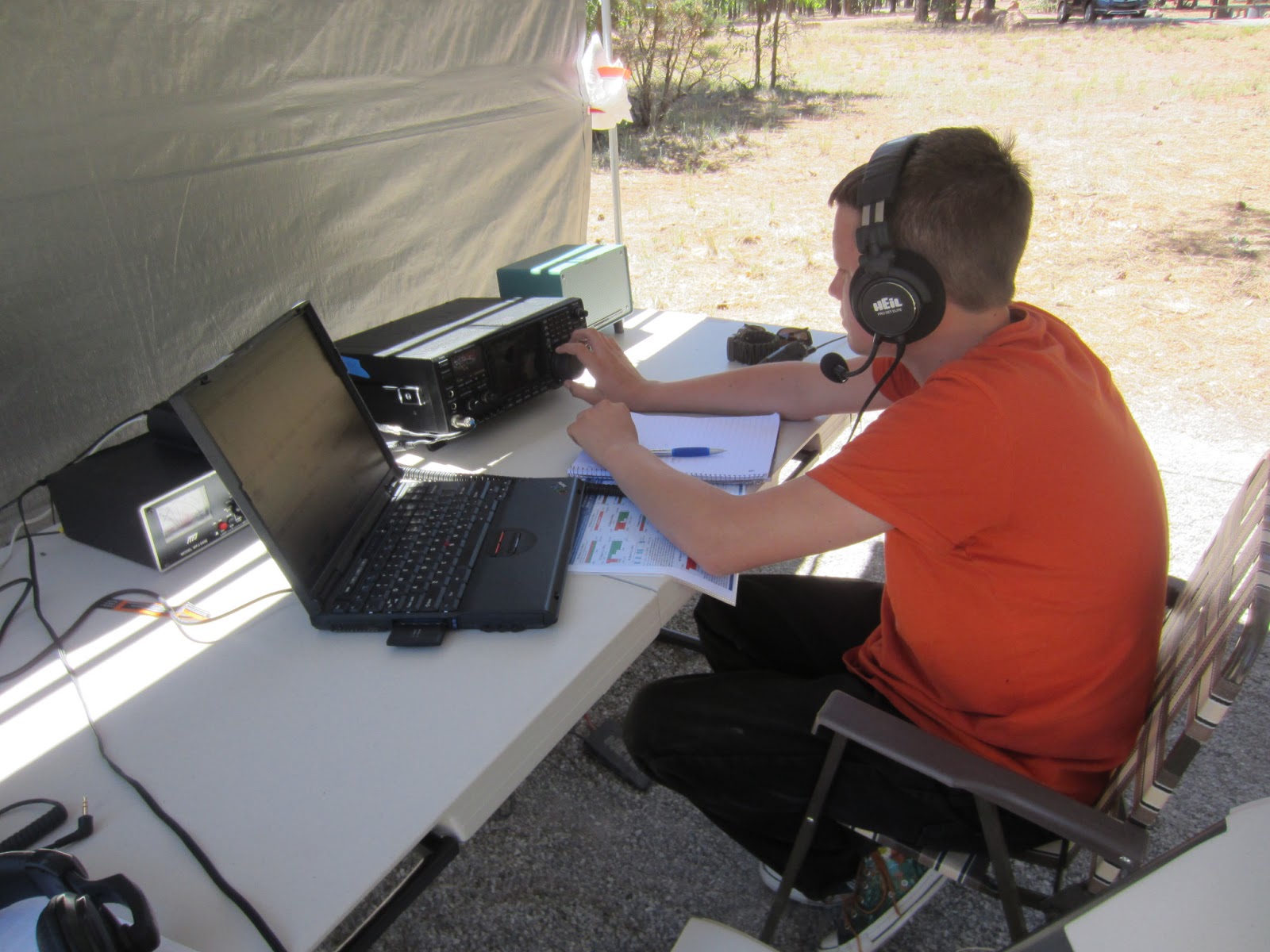 |
| Seth taking names and gettign mults on the voice station |
Seth quickly caught the Field Day bug and worked the 12-1am shift by storm, and eventually took both working and logging on the voice station on solo.
It was very cool to see him warm up to the air and get excited to work stations. It reminds me of my first Field Day, where I was thrown into the action and started racking up QSOs as fast as any other operator after only having a few hours to figure it out.
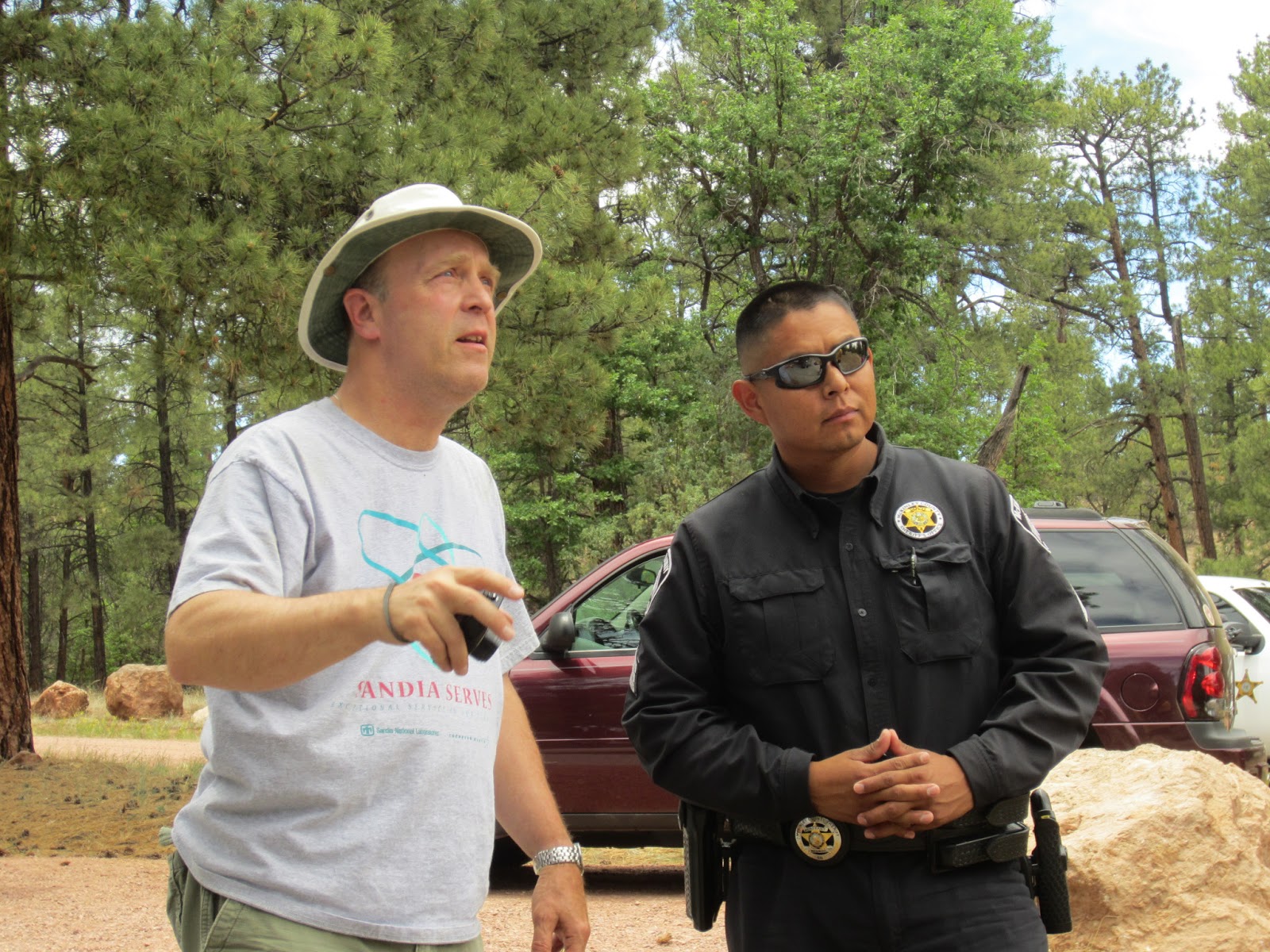 | |
| A visitation by the local sheriff |
Satellites
 |
| The Arrow LEO-SAT yagi and other antennas in the background |
 |
| Sat Station Setup — FT-817 for RX and an 897 for TX |
My job at W5MPZ was to bring a satellite QSO to the log for an extra 100 points. Unfortunately, this didn’t happen.
I had several attempts at SO-51 (the only FM satellite), VO-52, FO-29 and the zombie AO-7 (all SSB/CW transponders). I had most luck with the SSB satellites but had problems in being able to hear myself.
To work the SSB satellites (all but SO-51) you need to know where your signal ends up after it gets translated to the other band. For example, FO-29’s uplink band is 145.8-145.9 MHz, while the downlink is 435.9-436.0 MHz. One would think the 100 kHz passband would be linearly related, e.g. I transmit on 145.85, and hear myself on 435.95, but this isn’t the case. The doppler effect causes the frequency to differ by up to 500 kHz on UHF, so you need a way of calculating doppler, or simply finding yourself.
My technique was to spin a carrier through the passband until I heard it on the downlink, and switch to SSB to call CQ and tune into myself. Upon the switch, I lost myself.
I figured out the solution on the last pass of the weekend. The FT-897 has a feature in SSB mode that allows you to send CW at your tone frequency. So if I’m on 145.000 and have a 700 HZ CW pitch, it would send it at 145.000.70 MHz. Therefore, if you were tuned into 145 MHz on another rig, you’d hear that same pitch. All I had to do was zerobeat on the flipped bandpass, and call away. I finally heard myself repeated by the satellite, but didn’t have any replies within the last 5 minutes of the pass.
It was worth the effort (and in hindsight I should have just worked the ISS’s message system via packet)!
Summary
The underlying point of Field Day (aside from preparedness) is to have fun. W5MPZ did exactly that. Our support team of family members kept us well fed, watered, sheltered, and our batteries charged. One could not ask for a better place to set up and operate from, and the weather (despite being cold in the mornings) was amazing – not having wind and the 100°F temperatures to contend with was a huge relief.
I’m not sure of the final QSO count or score, but we only missed a few sections in Canada – NT, MAR, and ONN I believe — like we expected. Field Day isn’t a contest, so the score isn’t important to me or any of the operators aside from personal club goals and whatnot, so that wasn’t a worry. What matters is the coming together of like-minded people to getaway from the daily grind, have a ton of fun, share stories, and work stations.
ARRL Vintage Amateur Radio Equipment Exhibit
ARRL Vintage Amateur Radio Equipment Exhibit: While it’s important to look forward to tomorrow, it’s equally important to understand the evolution of radio equipment that was used on the Amateur Bands; from the earliest “spark days” to the dawn of digital technology. By delving into the past, one can learn to appreciate the hard work, determination and experimentation that brought us one step at a time, the technology we enjoy today.
73 from the Shell Beach shack.
Pacificon 2012 – Night of New Media Elmers
This coming weekend, October 12, 13 and 14 the ARRL National Convention at Pacificon will take place in Santa Clara, California. The organizers of the 2012 Pacificon event have worked hard to make this years event the best ever.

You’ll find all the usual activities you expect to see and hear at these types of events including top-notch forums, events, vendors and even an astronaut. How cool is that?
I’m especially excited and honored to be a part of a special Friday evening event titled “Pacificon Night of New Media Elmers”. This event brings together some of the most beloved podcasters in the world of amateur radio in what I believe is the first event of its kind.
I will join Randy Hall K7AGE, Chris Matthieu N7ICE and Gordon “Gordo” West WB6NOA through a Skype connection from Colorado for this very special night.
New Media is sort of the all encompassing term to describe podcasting (both audio and video) and blogging. I’m truly honored to share the ranks with dozens of audio and video podcasters and hundreds of bloggers who frequently write and record audio and video all in an effort to help Elmer and promote the hobby and service of amateur radio.
I’m sure Randy, Chris, Gordo and myself are not strangers to you. But perhaps if you are new to the hobby, a very brief introduction might be in order.
Randy Hall K7AGE resides in Grass Valley, CA and has been creating videos for YouTube since 2006. His most popular video content has been his complete instructional videos on the digital mode PSK-31 and how to work the amateur radio satellites. It was Randy’s YouTube video series on PSK-31 which inspired me to upgrade from technician to general so that I could use this wonderful digital mode.
Chris Matthieu N7ICE resides in Phoenix, AZ and is the founder of the first amateur radio social network and very popular 73s.com. Chris also creates instructional videos on his HamBrief.tv website. Chris has a level of enthusiasm and excitement in everything he does which is extremely contagious.
Gordon “Gordo” West WB6NOA resides in Costa Mesa, CA and has helped many get their start in amateur radio through his license study materials. Gordo also appears each week as co-host in the popular Ham Nation video podcast.
Jerry Taylor KD0BIK – Yep…that’s me! Realizing I had a face for radio, I have mostly stuck to an audio only format for my Practical Amateur Radio Podcast which I launched in 2008. I do from time to time post supplemental video material on my YouTube channel. Between the audio podcast and video content, I’ve created over 100 audio and video episodes in the past 4 years all in an effort to help entertain, encourage, educate and inspire others.
I’m told the “Pacificon Night of New Media Elmers” event will be recorded and just as soon as all the post production work can be completed and the finished product uploaded, I’ll be certain to pass along how you can watch this special presentation.
For now, please watch the promotional video below.
Until next time…
73 de KD0BIK
Show Notes #083
Introduction:
- Back from Dayton and ready to go.
Topics:
- Dayton Hamvention 2012
- LHS had the same booth as last year at North Hall #131. Estimated attendance was 25,000 individuals. Russ recounts the experience. Thanks to Matt, KC8BEW, who stopped by and helped out at the booth. The LowSWR podcasters stopped by, too.
- FCC Dismisses Texas Ham’s Fourth Petition, Calls it “Repetitive”
- Our hosts discuss.
- Contest logging for Linux.
- Several people at Hamvention asked about contest logging software for Linux, but Russ was at a loss for a recommendation. Upon his return, he discovered…
- SO2SDR Contest Logging Software
- Stefano, IZ3NVR/KD2BGM was trying to get so2sdr to work under Linux Mint and while it would compile, it did not run, so Russ set about trying to get it going.
- It’s not packaged for Debian or Fedora, so it must be built from source, available at the link above.
- The program is written in Qt, so it can be run on devices which support that environment, including Linux and Windows. Of course, Qt must be installed in order to compile so2sdr.
- Russ also had to install the following packages on his Linux Mint machine: portaudio19-dev (NOT libportaudio-dev; apparently, libportaudio-dev is too old), fftw3 and fftw3-dev
- The compilation procedure consists of:
qmake make sudo make install - so2sdr compiled and ran fine. It did complain that it wanted a parallel port for switching between radios, but you can ignore that if you don’t need to do that.
- Russ gives an overview of the features and capabilities.
- There are a few drawbacks:
- An apparent lack of SSB support? It seems to be CW-only.
- Frequency input checking is broken.
- Keystrokes are not intuitive, but are well-documented.
- However, the built-in help file is quite useful.
Feedback:
- E-mail from Larry, KG4Q, extolling fldigi and JT65-HF. He wishes there was a version of JT65-HF for Linux. Well, Larry, there is! You can download the source here. Also, WSJT does JT65, too.
- Chris, K4FH, caught up with Russ at Hamvention and talked about his Linux in the Ham Shack presentation. He managed to put together a fine bunch of slides completely without our help. Sorry, Chris!
Contact Info:
- Contact Richard at [email protected], Russ at [email protected], or both at the same time at [email protected].
- Listen to the live stream every other Tuesday at 8:00pm Central time. Check the LHS web site for dates.
- Leave us a voice mail at 1-909-LHS-SHOW (1-909-547-7469), or record an introduction to the podcast.
- Sign up for the LHS mailing list.
- Sign up for the MAGNetcon mailing list.
- LHS merchandise is available at the Merch link on Web site. Check out the Badgerwear or buy one of the other LHS-branded items at PrintFection.com/lhs or Cafe Press. Thanks!
- Thanks to Dave from Gamma Leonis for the theme music.
Music:
- “Down Today” by Jonathan Coulton from the album “Artificial Heart”.
- “Sucker Punch” by Jonathan Coulton from the album “Artificial Heart”.
LHS Episode #083: Smokey & The First Lady
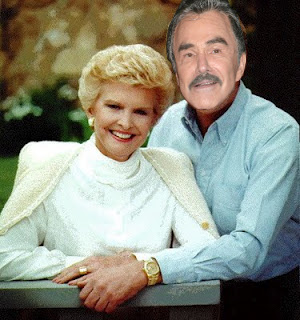 Welcome to the 83rdest episode of Linux in the Ham Shack. Freshly back from the Dayton Hamvention, Russ jumps in by telling everyone his experience at the show this year. The short version: It was great! From there, things move on to a question of FCC rules, at least in the mind of one ham.
One of the topics that kept repeating at Hamvention was: What is a good contest logger for Linux? Up until recently, it was hard to think of one. The ncurses-based application yfktest is out there, but thanks to IZ3NVR, our hosts discuss a new option. Tune in to find out what. There’s also some feedback, occasional rambling and hardcore lunacy. Everything you’ve come to expect from an episode of LHS.
73 de The LHS Guys













