Archive for the ‘antennas’ Category
 PAØRDT Miniwhip Shakedown
 February 1st, 2016 |
  Author:
A recent posting to Yahoo's 'NDB List Group' by Mike, an ardent NDB DXer in the UK (Sussex), announced the recent completion of his four-part video series describing the installation and testing of a new PAØRDT active antenna.
If you may be contemplating the installation of an active antenna such as this, or perhaps making a start at DXing the NDB band or listening on 630m, then you might enjoy following Mike's journey as he demonstrates that living in the noisy suburbs need not keep you from enjoying the LF/MF bands. Mike includes some interesting tests involving his grounding system versus noise ingress and the results of keeping the electrical main's ground isolated (or not) from the antenna cable's ground.
The PAØRDT active whip is available from PAØRDT himself or if you are handy with a soldering iron, you might choose to build the same antenna in your workshop. These simple yet highly effective receiving antennas are being used successfully by hundreds of listeners all over the world and for their size provide some pretty amazing performance.
Much more information on the PAØRDT e-probe antenna may be found here in a previous blog posting. To see more of Mike's videos, you can visit his interesting Youtube Channel here.
More Low Noise Vertical (LNV) Construction
 |
| New LNV At WG2XKA |
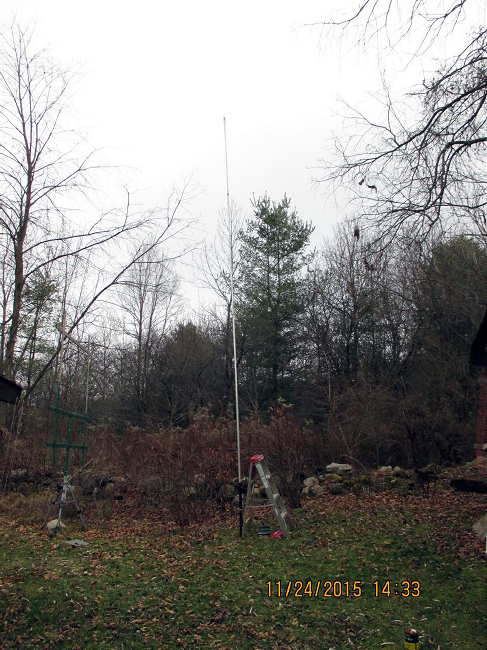
The low-noise vertical discussed here previously, has recently been implemented by at least three of the 630m experimental stations. John, WG2XKA / WA3ETD, along with Ken, WG2XXM / K5DNL and John, WG2XIQ / KB5NJD, have all constructed versions of this receiving antenna after reading about the details here.
John's antenna, pictured above, is described in more detail here, along with some nice pictures of his matching transformer.
All stations report good results with the antenna so it may be something you might want to consider if your present receiving antenna is a noise-collector.
For those interested in getting started on 630m, John (WG2XIQ), has a ton of inspiring information available on his website here as does John (WG2XKA) on his site here.
West Coast 630m Growth

The Canadian west coast contingent of stations on 630m continues to slowly expand, with Mark, VA7MM and Toby, VE7CNF now operational at 'DX capable' power levels.
Both Mark and Toby have been refining their antenna systems with an eye towards the upcoming winter season as well as the November 'crossband' activity weekend ... both stations were heard testing this week and are sounding very strong at my Mayne Island location.
Toby has sent a picture of his antenna loading coil and variometer scheme, shown below.
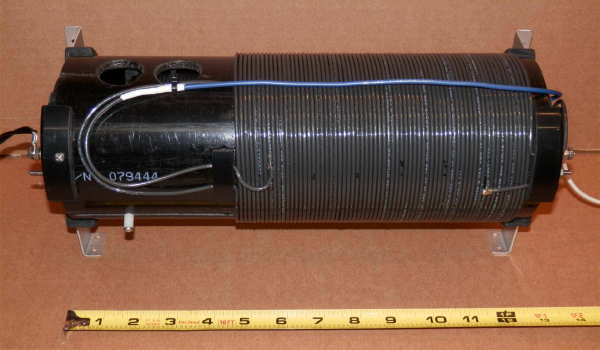
"You can see the white slider knob at the lower left, which goes through a slot in the outer pipe and screws into the end of the inner pipe. The white wire at the right goes to the matching transformer, and the black high-voltage wire at the left goes to the antenna. The coil is wound with #14 so it can handle some power. There are ventilation holes around the pipe and at the ends, but at 200W I did not notice any warming. A regular rotating variometer may have slightly lower losses, but it would be larger and I wanted to make my tuner box small so I can hide it near the trees."
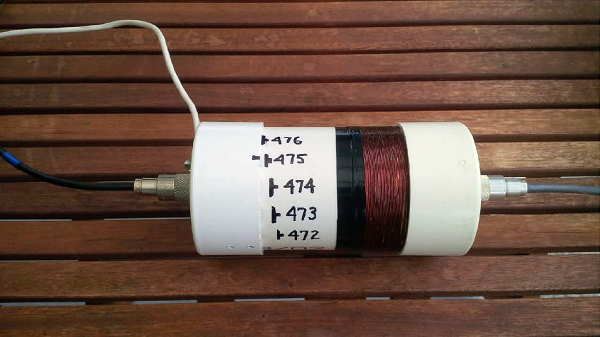 Mark also sent some pictures of his recent handiwork, showing the simple loading coil and tuning system presently in use at his station. His present plans call for something capable of handling power in the 100 watt range and, although using smaller gauge wire, the loading coil seems to handle it just fine. Like Toby, he is using a 'sliding variometer' and a toroidal autotransformer for impedance matching to 50 ohms. Mark will be running ~ 100 watts into a 100' vertical wire with top-loading.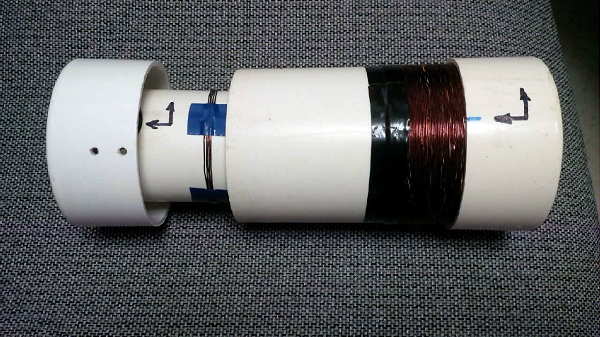
It is wonderful to see more new stations arriving on the band but the new activity seems to be coming from VE7 only ... how interesting it would be to have stations in VE6, the prairies and especially from Ontario, which has many more hams than any of the other provinces. The opportunities presented to Canadian amateurs by the new band are both boundless and challenging and there is so much that can be learned by 'jumping in'!
Another western amateur has caught the 630m bug, this one from the U.S.A. Steve, KK7UV, in Montana, has been busy building new antennas as well as a new GW3UEP transmitter. Operating with an experimental licence, WH2XNV, Steve has been putting a nice CW signal up this way during the evenings and is all set for the winter and, hopefully, for the fast-approaching day when the boys on the other side of the border get full access to 630m as a ham band. All of us up here very much look forward to working our U.S. counterparts very soon.
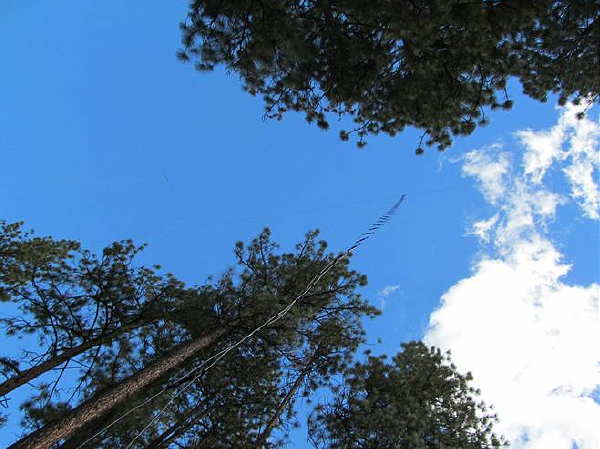
Steve's new antenna consists of an 81' vertical wire, top-loaded with a 3-wire 68' x 8' tophat. His ground system now has over 4,000' of radials, ranging in size from 40'-130'.

Steve also reports modifying his dual-FET (parallelled) GW3UEP transmitter from the original solenoid-wound coils to toroidal cores, increasing efficiency from 74% to 77%.

As well, he also went to a single-FET (per the original design) and garnered a further increase in efficiency, now at 86% and 82 watts out ... plenty of power to do some useful work on the band. It's wonderful to see how 630 meters brings out the 'experimenter' in all of us. He also reports that he's "having a bunch of fun at this ... "!
If homebrewing is your main interest, all of the 630m stations that I'm familiar with are using home-built transmitters. Maybe you like tinkering with antennas? This band is perfect for the design and development of small, yet effective, backyard antennas ... most will be surprised at how little is needed to radiate a usable signal on 630m. Perhaps propagation is your main interest? There is still much to be learned about the capabilities of our stations, operating at amateur radio power levels, in the MF band.
As mentioned before, we are really very fortunate here in Canada, to have this amazingly interesting part of the radio spectrum made available to us ... let's try and use it, from coast to coast and everywhere in between.
VE6, VE5, VE4, VE3, VE2 and VE1 ... the band needs you!
DX Spray …. it works!
Unlike the grand vistas that Jim W1PID encounters in the beautiful locales of New Hampshire, the views that I am afforded during my lunchtime QRP sessions are a bit more urbane. However, as the season changes along with the leaves, even in a suburban setting there is beauty to be found:
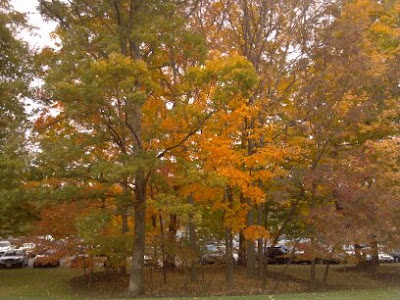

Not bad for a parking lot view, eh?
As I was setting up the station, I noticed that the "stick" part of my Buddistick was ......well, rather sticky. I happened to have a can of this in the trunk, so I applied a bit to the whip and then proceeded to rub it in using some 3" gauze bandage from my First Aid kit. Hey, you use what's on hand!
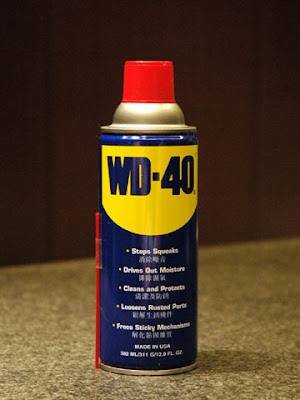
Little did I know that WD-40 actually stands for "Whopping DX - 40 Meters". I didn't get on 40 Meters, but the can didn't know that, and the DX Spray seemed to work equally well on 15 and 17 Meters. In short order, after applying this miracle spray to my Buddistick, I worked T47GDXC, SM3PZG, RA1AOB and TF4X all in the space of about 15 minutes.
Who knew? If I was aware of what WD-40 really stood for, I would have been applying it to my antennas years ago! Just think ..... all the wasted time, all the wasted opportunities! I could be on the DXCC Honor Roll by now.
Some would attribute my success today to the sun and something called "improved band conditions". But I, for one, know better. I have learned the secret of the magic "DX Spray".
Sob ....... weep!
72 de Larry W2LJ
QRP - When you care to send the very least!
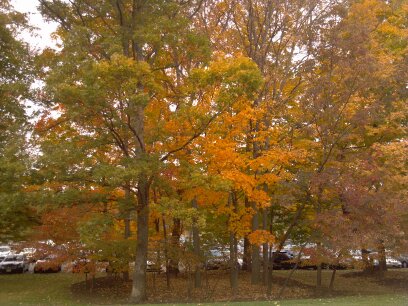

Not bad for a parking lot view, eh?
As I was setting up the station, I noticed that the "stick" part of my Buddistick was ......well, rather sticky. I happened to have a can of this in the trunk, so I applied a bit to the whip and then proceeded to rub it in using some 3" gauze bandage from my First Aid kit. Hey, you use what's on hand!
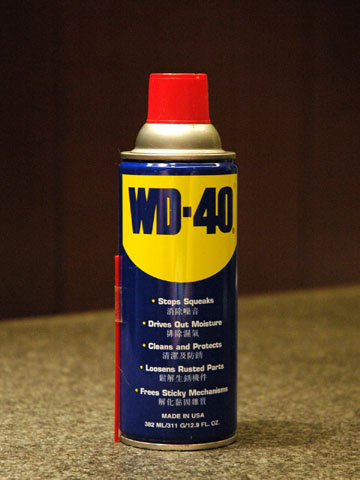
Little did I know that WD-40 actually stands for "Whopping DX - 40 Meters". I didn't get on 40 Meters, but the can didn't know that, and the DX Spray seemed to work equally well on 15 and 17 Meters. In short order, after applying this miracle spray to my Buddistick, I worked T47GDXC, SM3PZG, RA1AOB and TF4X all in the space of about 15 minutes.
Who knew? If I was aware of what WD-40 really stood for, I would have been applying it to my antennas years ago! Just think ..... all the wasted time, all the wasted opportunities! I could be on the DXCC Honor Roll by now.
Some would attribute my success today to the sun and something called "improved band conditions". But I, for one, know better. I have learned the secret of the magic "DX Spray".
Sob ....... weep!
72 de Larry W2LJ
QRP - When you care to send the very least!
Web designers of the world
you can sleep soundly tonight!
You have no competition from W2LJ - whatsoever. I have finished the 2015 Skeeter Hunt Soapbox and have posted it to the Web. A bona fide Web designer probably could have done in an hour what took me a lot longer to accomplish. And I bet it would look a lot better, too. Mr. Originality or Mr. Creativity, I am not!
In all their non-glory, they are there for your perusal. Just click and go!
2015 Scoreboard
2015 Soapbox
72 de Larry WLJ
QRP - When you care to send the very least!
You have no competition from W2LJ - whatsoever. I have finished the 2015 Skeeter Hunt Soapbox and have posted it to the Web. A bona fide Web designer probably could have done in an hour what took me a lot longer to accomplish. And I bet it would look a lot better, too. Mr. Originality or Mr. Creativity, I am not!
In all their non-glory, they are there for your perusal. Just click and go!
2015 Scoreboard
2015 Soapbox
72 de Larry WLJ
QRP - When you care to send the very least!
Sparking-Up On 2200m
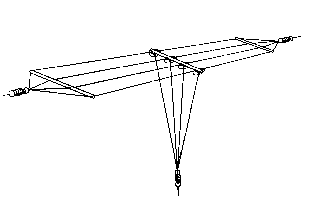
An e-mail alert from Toby, VE7CNF, on the other side of Georgia Strait, indicated that everything was ready for a two-way test on 2200m and he was looking for his initial contact on the band. Having not been on the band for such a long time, some review of my 'tune-up' procedures were in order as well as the need to burn out the spider webs in my outdoor loading coil.
Since being on 2200m, I had modified my 2200m kilowatt transmitter so that it could also be used on the new 630m band. To change bands from 630m back to 2200m, I needed to swap the frequency-sensitive power divider back to 2200m as well as re-set the DDS frequency.
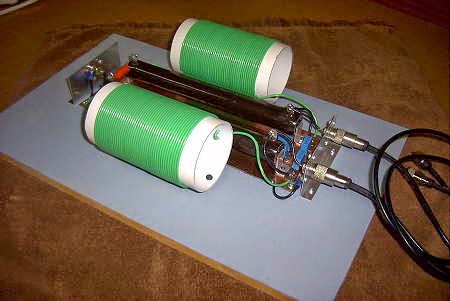 |
| 2200m Power Divider |
When modifying the transmitter, three years ago, I had also changed the transmitter's input frequency divider from a 'divide-by-four' to a 'divide-by-two' scheme. My original system on 137KHz started with a DDS frequency in the 5.48MHz range and then was divided by ten before being fed to the transmitter's input where the 548KHz signal was then divided by four. Using a higher DDS frequency allowed for greater frequency resolution at 2200m and allowed for very small frequency adjustments across the band. I would have kept the same system for 630m except that my 'divide-by-ten' chip was not very happy at 18MHz and refused to divide.The newer system now only allows me to move around the band in 4.5Hz steps. It's really not much of a problem as there is presently a minuscule amount of activity in Canada on 2200m, but as previously mentioned, this may change when U.S. amateurs gain access to the band.
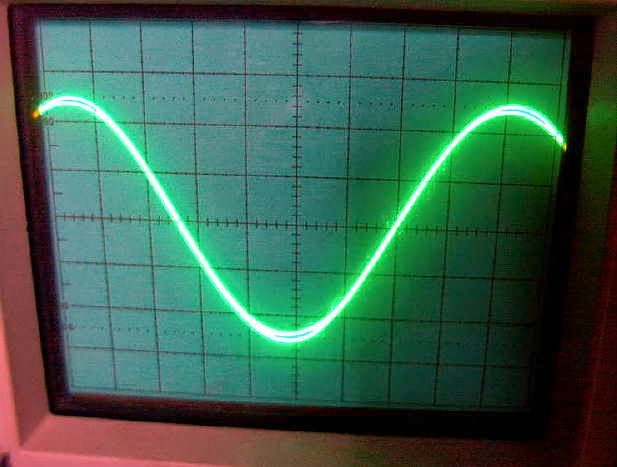
Having sorted out my transmitter problems and confirming that all was well, the next task was to check antenna resonance and impedance matching as it would more than likely not be the same as I had left it. A low-power check using the 'scopematch' indicated that both resonance and impedance were not optimized. Tapping down on the loading coil by one-turn took care of resonance while adjusting the impedance tap in my matching transformer to its lowest value (see matching scheme below) resulted in a near perfect match on the scope.
I'm guessing that the resonance change was due to the recent heavy trimming of the 80' Balsam that supports one end of my 'inverted-L' and large three-wire flatop.
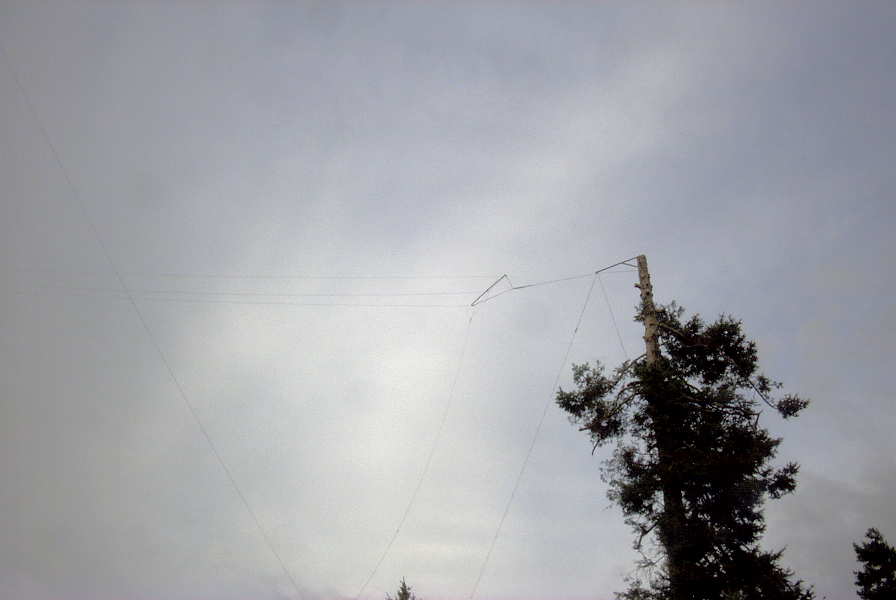
The tree's crown had previously been very dense and some of the branches were almost touching the flatop. The close proximity always made me worry about possible flashover at the antenna ends as voltages here would be several kilovolts. Removing much of the wet green tree branches directly beneath the flatop also likely contributed to the slight change in resonance.
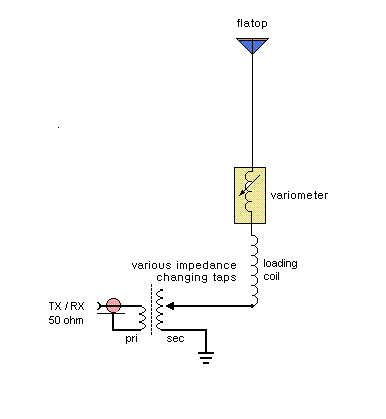
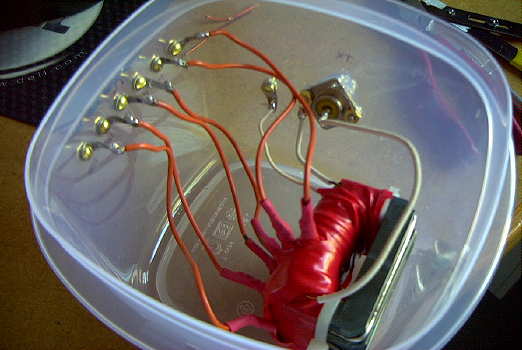 |
| Impedance Matching Transformer On TV Flyback Cores |
The sked with VE7CNF went smoothly and it was nice to see another new Canadian station taking an interest in the band, along with all of its challenges. Toby's 200W signal was a solid 559 here even with his small antenna system yet to be fully optimized. As well, he was bothered by heavy switching-power supply QRM from a nearby neighbour. Unfortunately, such noise sources seem to be increasing in numbers and are making operation on LF, already a big challenge, even more challenging. Toby has taken up the challenge with enthusiasm and has now had contacts on 2200m well as on 630m, adding to the ranks of active VE7's on LF and ... demonstrating yet again that amateurs can enjoy the LF bands with small 'backyard' antenna systems. Don't let living in the city be a reason to avoid our new LF bands.
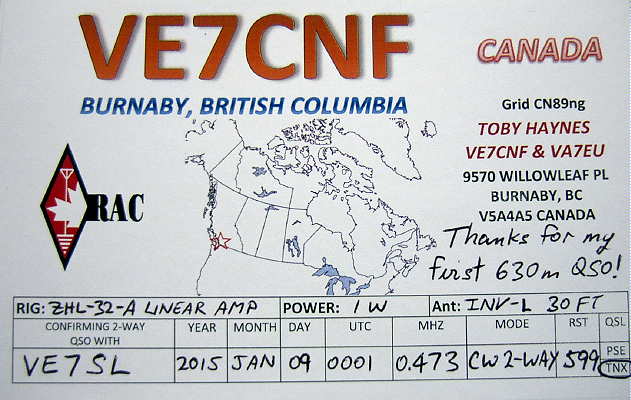
Wouldn't it be great to see some activity from our neighbours in VE6 or VE5, both easily workable on both bands from the west coast... maybe you're up to the challenge!
How I Worked VY0M From a Tent
In my last post I described my QSO with VK2SSI while experimenting with portable antennas in my backyard. Well the reason I was testing portable configurations is because I needed work Cezar, VY0M, from Melville Island, IOTA NA-248, located in the Canadian arctic. I knew that the scheduled expedition would occur during the week that I was at Philmont Scout Ranch in Cimarron, NM attending a training class and I would be sleeping in a tent for the week. New IOTA's are getting rare for me, with 1,050+ confirmed so I didn't want to miss this one.
I experimented with multiple antennas as I didn't know what I would be allowed to do at the camp. Would I be allowed to put up an antenna in camp? Would I have to find a remote location somewhere else? How long would my batteries last? So my plan was to try a Buddipole vertical first. It was relatively low profile and wouldn't attract a lot of attention. So I set up the station, in my tent, for a dry run.
As luck would have it, there was a 110v plug in my tent, the power intended to power a light and possibly a fan, so exit the batteries and in with the power supply. I set up the vertical and the antenna worked fine. I was using a Yaesu FT-857, which is a very capable radio, especially for portable use. With 70 watts I worked into Europe with good reports, so I was thinking that I might just get by with this set-up. However, the first day that VY0M came up, he was on SSB. I never heard a peep from him and decided it was time for plan B.
After erecting the vertical, a few around camp inquired about it and everyone thought the radio set-up was cool, so the next afternoon I decided to put up the bright orange Jacktite, 30 ft. collapsible pole with an end-fed long wire through a 9 to 1 balun. After I got everything connected, I turned on the radio and tuned the antenna with an LDG tuner. Everything looked good, so I checked the spots on my iPhone and Cezar had just moved to CW. I went to 14.040 and there he was with the fluttery signal common to stations in the far northern latitudes. After two or three calls I had him in the log, Victory dance. All the planning had paid off and I had another IOTA in the log.
What a blast ham radio is. Below is video of the set-up, right after I made the QSO. I didn't have the narrow CW filter on the FT-857, so the stations you hear are actually 1 KC up, but you can still hear Cezar's fluttery signal if you listen closely.
I experimented with multiple antennas as I didn't know what I would be allowed to do at the camp. Would I be allowed to put up an antenna in camp? Would I have to find a remote location somewhere else? How long would my batteries last? So my plan was to try a Buddipole vertical first. It was relatively low profile and wouldn't attract a lot of attention. So I set up the station, in my tent, for a dry run.
As luck would have it, there was a 110v plug in my tent, the power intended to power a light and possibly a fan, so exit the batteries and in with the power supply. I set up the vertical and the antenna worked fine. I was using a Yaesu FT-857, which is a very capable radio, especially for portable use. With 70 watts I worked into Europe with good reports, so I was thinking that I might just get by with this set-up. However, the first day that VY0M came up, he was on SSB. I never heard a peep from him and decided it was time for plan B.
After erecting the vertical, a few around camp inquired about it and everyone thought the radio set-up was cool, so the next afternoon I decided to put up the bright orange Jacktite, 30 ft. collapsible pole with an end-fed long wire through a 9 to 1 balun. After I got everything connected, I turned on the radio and tuned the antenna with an LDG tuner. Everything looked good, so I checked the spots on my iPhone and Cezar had just moved to CW. I went to 14.040 and there he was with the fluttery signal common to stations in the far northern latitudes. After two or three calls I had him in the log, Victory dance. All the planning had paid off and I had another IOTA in the log.
What a blast ham radio is. Below is video of the set-up, right after I made the QSO. I didn't have the narrow CW filter on the FT-857, so the stations you hear are actually 1 KC up, but you can still hear Cezar's fluttery signal if you listen closely.













