Archive for the ‘antennas’ Category
 Vote for the Best USA QTH for Ham Radio?
 September 7th, 2010 |
  Author:
 If there were no limits (job, family, taxes, spouse, etc.) on where you could set up your ideal ham shack here in the USA, where would you go?
Think for a minute where the propagation, weather and other conditions create the ideal spot to operate. Then leave your vote in the poll on my blog and write a comment if you’d like to let us know why…
Nice to dream a bit, isn’t it?
p.s. Sorry and deepest apologies to the great state of Arizona… must be AZ Brain Freeze at work, it is on the bottom of the list until I figure out how to move it up higher in the software.
72,
Kelly K4UPG PB #173
Orlando, FL btw
T Time
Labor Day here in the USA! So a day to play for most of us. Depending on the weather I may get a bit more on air time, but I have a project lined up too.
Some time ago I purchased a Deluxe Tuner kit from Dan’s Small Parts and Kits aka a QRP Mini Tuner by Mark L. Meyer as described in a 73 magazine article. It is a nice little set of parts and a schematic for the price.

QRP Mini Tuner Kit
So I’m thinking this holiday might be the time to build that little T tuner out and see if I can load up the downspout that runs down the side of my back porch. I’ll let you know how it works!
Hope the bands hold up. Tonight’s QRP-L has a message from N4QA about how nice 40m is sounding right now! Sure would be fun to have our bands back from the QRN and low sunspot streak of late!
Duh: Learning Curve #2
Sunday I got the itch to get online. That means backyard portable when you live in an antenna restricted condo. So I put a card table up in the back porch and my 20 ft Jackite and 20m End Fed Half Wave in between the buildings.
Doggone noise and weak band conditions ruined the day so I decided to experiment with the new C Pole antenna that Neil W0VLZ had suggested. To get rid of a hunk of fiberglass gel inside the barrel of one of the Black Widow Crappie poles I used my cheapo Harbor Freight rotary tool which is a lame imitation of a Dremel tool but gets the job done. A few minutes of fitting and I was good to go.
I’m pretty impressed with it though conditions did not allow for any QSO’s yet. I cut the wire a bit longer than Niel’s directions but it tuned up 1:1 at 13.889 on my MFJ 207 Analyzer. At 14.060 it was a bit over 1.4:1 which is plenty usable. Next time out I’ll do a bit of trimming and be right on the money! Compared to the EFHW in a 20 ft L configuration, it did seem a bit noisier but with condx so difficult it would be hard to tell without some instrumentation.
LESSON: The C Pole is a pretty fine design. I need to work on the physical setup to improve the way the antenna hangs. The crappie poles I used were a bit too flimsy on the top section and leaned inward from the weight of the wire. A better tippy top support system is needed.
LESSON: Niel’s C Pole base design and specs worked very well. Lacking an empty plastic coffee can, I used a quart diet soda bottle of the same dimension and it worked very well for the balun section. With winds of approximately 15 mph and gusts to 20+ the antenna was stable and I did not use the spikes for the outriggers that I had prepared. Great work Niel. The weight of the base makes it a good choice for backyard or campground use.
LESSON: The C Pole would be a fantastic portable antenna sans the earth side supports. Chuck Carpenter W5USJ has posted a picture of this configuration. Take a look. One point hanger and spreaders at the top and bottom and simple stake to the ground for anchoring it and you are good to go. I will be testing this next time out by the lake. Winner!
LESSON: The off center fed dipole folded like this and deployed vertically is a good compact option for antenna restricted hams. I bit more work on the frame and support system may pay good dividends in stability and efficiency.
Hope to fly this new antenna in its tree configuration this weekend. I’ll update my results then.
72,
Kelly K4UPG PB #173
What Happened?
Back in 1964 as a novice, it seemed like the strongest signals I heard in Central Indiana were the Florida stations. Man, seemed like they were always there, louder than anything else. As a new ham and teenager, I always thought how cool it would be to live in Florida, the land of fantastic propagation.

Memory Lane…The First Rig
Sure been disappointing lately… the bands are noisy, the thunderstorms consistent and sometimes it seems like no one else is on the air. What happened to my Florida ham radio paradise dream?
Are the bands working elsewhere? Boy, we have had some poor conditions lately. How about you?
On a high note (pun intended) it was pretty cool to watch QRPSPOTS.COM yesterday as lots of hams helped give signal reports to the Iowa High Altitude Balloon launched by W0OTM team! Congrats on creating some excitement and interesting reports. Now, if I can just get my antenna up to 30,000 feet or more, maybe my FL QTH will be ham radio paradise after all.
72,
Kelly K4UPG PB #173
Duh: Learning Curve #1
This is the first of a weekly (Lord willin’) post of some of the lessons learned in the last week of playing radio in the field and on the workbench. I will be sharing my good and some of the not so good lessons with ya so ya don’t fall into the same holes that I have.
Our monthly Polar Bear QRP Club outing was last weekend, and I hustled to put together a new C Pole antenna using Niel W0VLZ’s description. After gathering all the parts I set about preparing them. With the 100F temperatures and high humidity, that was a chore since I don’t have a garage with my condo and use my back porch as the workshop. I also have a less than full set of tools and to trim the 3/4 inch PVC pipe to fit the bases of the 16.5 ft Black Widow Crappie poles I had to resort to my Buck knife.
LESSON: Plan ahead and borrow the tools I need!!! YIKES.
I was a bit surprised how heavy the treated 1×4 lumber was. It certainly is not an antenna that is well suited to portable ops where it has to be carried very far.
LESSON: Think about how something is to be used BEFORE using it!
Got the C pole components loaded into the car and transported to the nearby lakeside park in our development. It is a nice quiet spot with towering pine trees and without too many curious visitors, so its a nice QRP portable site. Got my new Coleman shelter set up and went to work on the C Pole. Oops… another lesson. In preparing the PVC to fit into the crappie poles, I only tested the two pvc poles fit into ONE of the two crappie poles. After lugging the framework, antenna wire, coax, balun, and poles about 100 yds to my site, I discovered crappie pole #2 had a big drop of fiberglass inside the open end of the pole and the PVC would not fit at all.

K4UPG Polar Bear Site Aug 2010

C Pole Aborted Setup by Ninja wannabe K4UPG
LESSON: Check ALL the parts and do a trial setup BEFORE lugging the stuff across the wet grass and wasting time attempting to set it up.
LESSON: Don’t use a new antenna for the first time when the goal is get on the air and have fun!
For the Polar Bears, it was a frustrating weekend for most of us. Propagation was spotty and noise level was as high as the heat. At least I did reconnect with my antenna lovin’ PB friend Aaron, N9SKN/2 working from his hotel parking lot in NJ and had a couple nice ragchews including Julio NP3CW who was 599 and despite two guys calling CQ on top of us was able to be copied well. Great QRP signal Julio.
As you can see, I went ninja and tied a piece of old tee shirt around my head as a sweatband. Actually I was emulating our Alpha Bear, Ron WB3AAL after I read of his early Appalachian Trail exploits and saw a photo of him in his youth and ninja radio mode. Well I tied it TOO TIGHT and left it on TOO LONG and came home with a painful big red stripe on my forehead that lasted for several hours and hurt like all git out.

Ouch Head for the Web… Don't try this at home! Grrrrrrr!
LESSON: Baby Polar Bears should not try to be like the Alpha Bear and wear an unapproved homebrew sweatband. These can be hazardous to one’s health and well being. Don’t try this at home kids!

Beef n Pepper Jack Cheese Wrap K4UPG style
p. s. For our Summer Picnic Events, we are supposed to send a picture of our sammich that we have for lunch. So here is mine!
Until next time…
72,
Kelly K4UPG Polar Bear #173
Cannot Get Enough QRP Portable
Now into the third week of my sabbatical, I am surprised how much I want to get out and operate my QRP portable gear. Guess I have deprived myself over the years of being a confirmed workaholic and avoiding time off, vacations, and time for my favorite hobby.

Grrrrr! The Polar Bears Are On The Loose!
This should be a good weekend for QRP portable. The Polar Bear QRP Group will be out for another Polar Bear Summer Picnic Event and Polar Bears from Spain to the West Coast of the US will be out looking for BSO’s. Grrrrr! I am PB #173 and we’re over 200 members now. With the new Twitter and APRS connections to QRPSPOTS.COM which also point to the excellent spotting site of K3UK with a section for FISTS/QRP Ops to spot and sked one another, there are plenty of ways to use technology to help find each other. Add in a few other contests and state QSO parties, and there should be some buzzing going on this weekend. Makes me wonder when the FOBB results will be announced! Buzzzz Buzzzzz
I’ll be out and if all goes well I will be field testing a new C Pole antenna based on the suggestion I received from Neil W0LVZ. I added some switchable capacitance to my BLT+ and have rewound the main toroid to see if I can push the range a bit more with it so will have a delta loop and probably my W3EDP in the air too. I love playing with antennas and am still amazed when the ones I build actually make contacts!
Give a listen for me on the QRP watering holes on 40m, 30m and 20m Saturday morning. I’ll be self spotting on QRPSPOTS and the K3UK sites to make it easier for you to find me. Let me know how my newest antenna is workin’.
72,
Kelly K4UPG
PB #173
Nice Nagoya
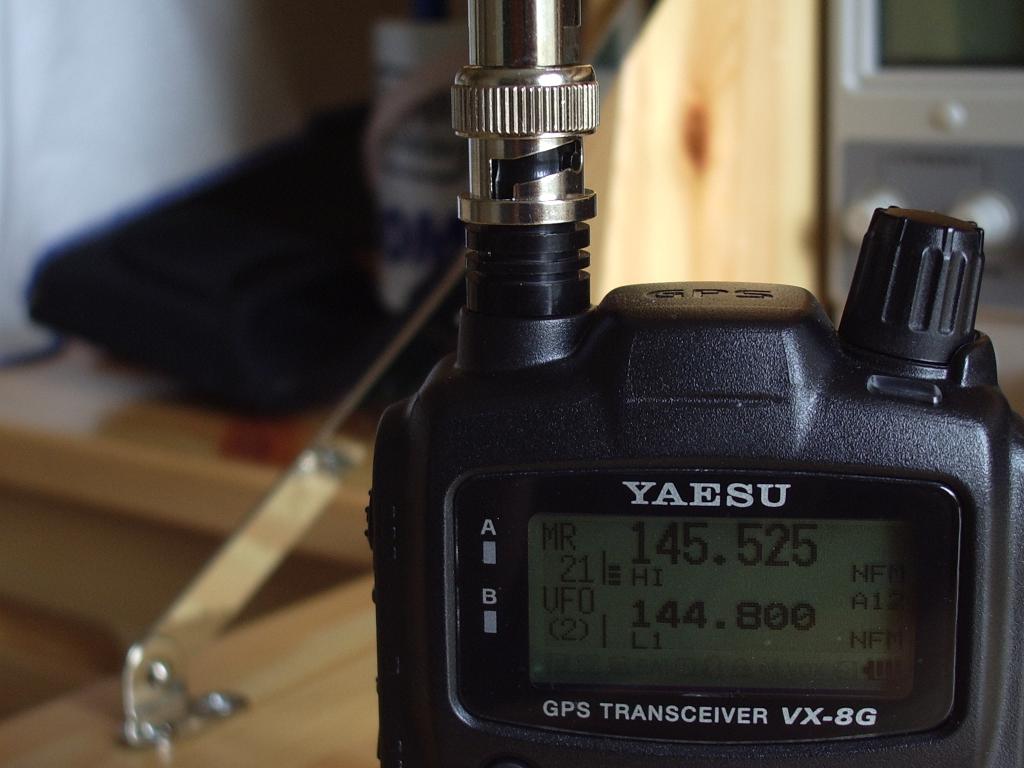
As regular readers may recall, I have a pathological hatred of SMA connectors when used as antenna connectors for hand-held radios, which has become even more entrenched since I had the centre pin of the TH-F7E stock antenna break off in the adapter I use for testing such antennas on my antenna analyzer. I now have an SMA to BNC adapter permanently installed on my VX-8GR. The picture on the right shows my latest adapter which is anodized black and looks like an integral part of the radio. The previous one I used was gold plated with a knurled body and whilst it worked perfectly and provided a robust fitting for the BNC antennas it looked a bit ugly.
If you never change the antenna on your HT then one of these adapters isn’t necessary, but SMA connectors were never designed for multiple connections and disconnections (in one email group I saw someone state they were rated for 100 disconnections) so if you want to change between a short stubby antenna for inconspicuous local use and one with more gain the BNC adapter is the way to go.

All of my BNC whips are 2m antennas, which is fine most of the time as almost all my operating is done on 2m, but there are rare occasions when I might want to use 70cm and removing the BNC adapter in order to attach the stock antenna kind of defeats the object of it. So I ordered from eBay a Nagoya NA-701 antenna which is a short dual band whip similar in size to the ones supplied with amateur dual band handhelds but with a BNC connector.
I tried it out on my antenna analyzer and it showed a nice sharp SWR curve with the minimum around 147MHz. It could be better, but it’s closer than some stock antennas I’ve tested. I couldn’t check it on 70cm as my antenna analyzer doesn’t go up that high.
I need to devise way to make comparative tests of all these HT antennas, because asking for signal reports or seeing if you can hit a repeater is a pretty crude measure of performance that won’t reveal small differences. This little antenna doesn’t perform as well as a six inch monoband helical on 2m, nor a quarter wave telescopic, but that is only to be expected. The beauty of the BNC adapter is that if you need a gain antenna you can easily whack on something like my 5/8 wave Black Whip, which you certainly couldn’t use with a standard SMA connector.














