Archive for the ‘antennas’ Category
 Antennas for portable QRP ops
 January 2nd, 2013 |
  Author:
 I seem to get requests from time to time, to bring up this topic on the blog. I can only speak for what has worked well for me. There are as many number of solutions to this as there are QRPers who like to go out into the field, and I have only tried a relatively minor few.
The first thing to consider is what kind of portable operator are you? Some of us are “Time is precious! Let’s get on the air and operate!” If you’re one of these (like me!) then you are interested in ease and quickness of deployment. The faster up, the faster I can get on the air. Although antenna efficiency is important to you, it is not your primary concern. You don’t want to be pumping RF into a string of wet pasta; but you want to spend your day outdoors operating – not finagling with antennas.
For this type of operator (and I belong to this species) I have two recommendations:
1 – EFHW antennas. Basically, a piece of wire that is a half wavelength of the band you intend to operate. A matching device or counterpoise is needed. There are oodles of articles on EFHW antennas. The best seem to be treatises by Steve Yates AA5TB and Joe Everhardt N2CX. Google “EFHW” along with their call signs and you will get there. If rolling your own doesn’t appeal to you, you can also purchase commercial versions. LNR Precision markets perhaps the best known models, the PAR ENDFEDZ series.
http://www.aa5tb.com/efha.html
http://www.njqrp.org/n2cxantennas/halfer/halfer.html
http://www.parelectronics.com/end-fedz.php
The name says it all – “End fed” – meaning needing only one support. Basically, you throw a bottle (or some other weighted object) into a tree to get a hoist line over a branch, attach one end of the wire to the hoist line and pull it up. The other end connects to the matching device or your radio and you are good to go. It’s simple, uncomplicated, and works well. If you read any of Jim W1PID’s blog posts on AmateurRadio.com, you will see the resounding success that this type of antenna can provide.
Personally, I use the PAR ENDFEDZ 10/20/40, which will allow me to operate on those three bands without changing radiators. If you want to operate on a different band, you can change the radiator wire. The PAR comes with a chart that tells you, for each band, how long a piece of wire to use with their match box
2 – Compact verticals. What do you do if there are no supports? A Buddistick or a PAC12 antenna could be the solution for you. Both of these are basically the same idea. A compact vertical which uses a tapped coil to make up for the fact that you are not deploying a full sized vertical. You will have to bring a ground spike or small tripod or some other self improvised arrangement to deploy one of these. You will need to use either radials (as recommended for the PAC12) or a counterpoise wire (as provided with the Buddistick). This is not a true counterpoise, per se, but is more the “other half” of the vertical dipole that you are using.
Set up is relatively quick; but not as quick as the EFHW, especially if you are good in tossing bottles over tree branches! It takes time to deploy the radials in the case of the PAC12 and the amount of “counterpoise wire” used with the Buddistick is critical. The length will affect the SWR of your installation. For both of these, it is handy to bring along a small antenna analyzer along (such as one of the Auteks) to help you tune the antenna rather quickly.
There is another way to deploy one of these compact verticals, which was brought to my attention by Bob W3BBO. It worked well for him when he was living in an apartment for a while, and I used it and in turn, discovered that it worked well for me, too. Instead of using a tripod, painter’s pole, ground spike, or whatever as a support for these compact verticals, you can instead attach the vertical to some kind of mount and attach it to your car. I use one of those Lakeview tri-mag mounts. Attach the vertical to that, pop it on the top of the car and go to town. Yes, you have to find the best place to tap the coil, but the car acts as a great groundplane and there’s no need to fuss with counterpoises or radials. It has worked well enough to garner DXCC and WAS for W3BBO while he was apartment living. I have used this arrangement during outdoor QRP sprints and while on vacation and have had surprisingly good results. This is NOT to be used while your vehicle is in motion however – strictly stationery mobile!
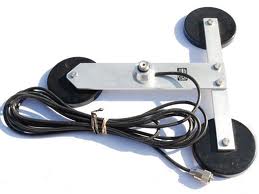
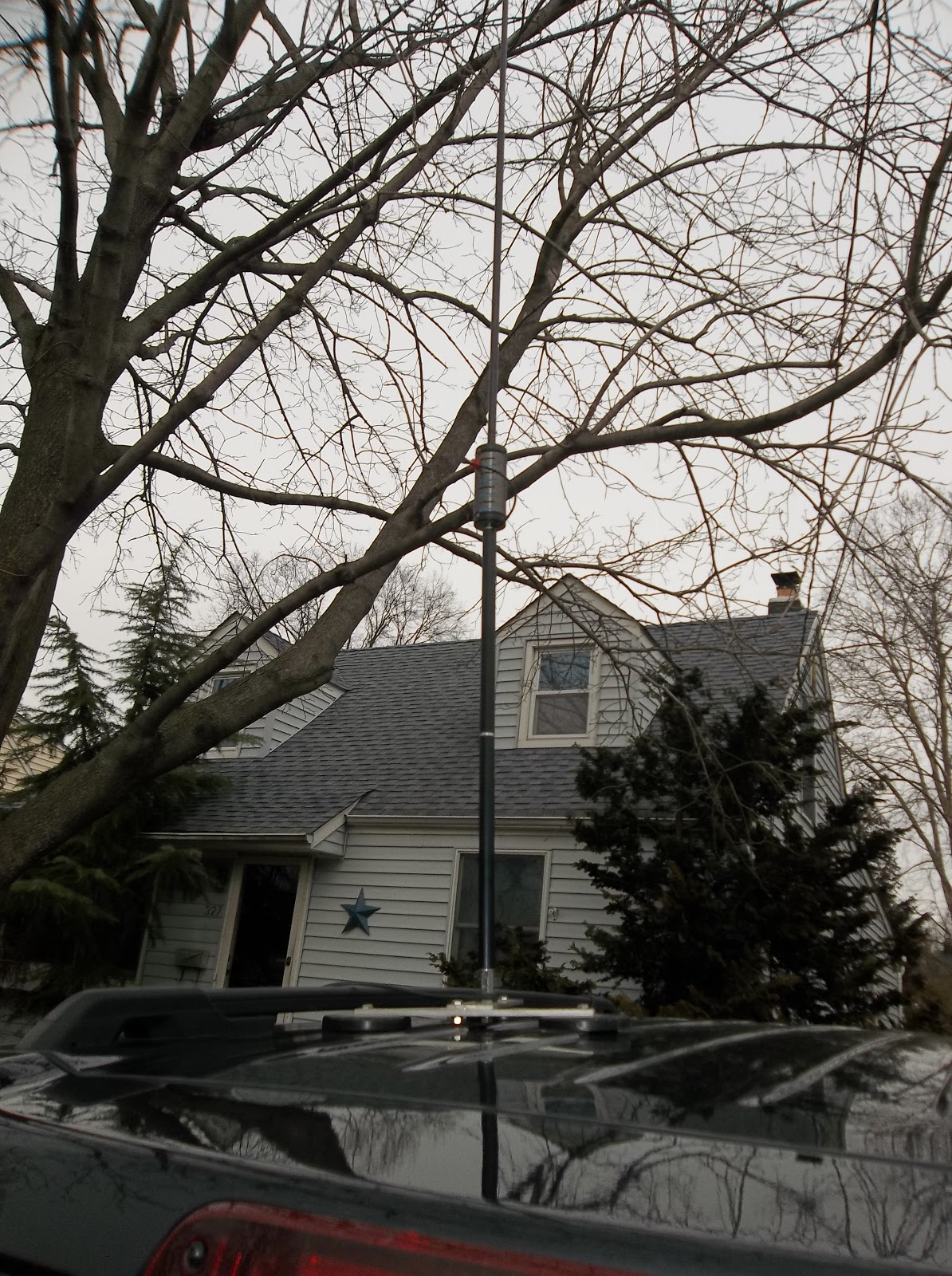
As a side note, I have used Hamsticks which are kind of related to this. They are quicker to deploy than either a Buddistick or PAC12 plunked on your car. However, you have to have a different radiator for each band that you intend to operate on. And my feeling (and I have no empirical proof to back this claim up, so take it with a grain of salt) is that Hamsticks are less efficient and even more of a compromise than a Buddistick or PAC12.
Now if you have a lot of time to operate, or if maximum efficiency is a concern to you, you have other solutions that you can pick from. In instances like these, you might want to use a dipole or doublet, made from lighter weight materials. Say you’re going camping for a week and there are plenty of tall trees available – why not? Even if you decide to use one of these as a sloper, you’ll need to keep the low end roughly six feet off the ground for safety reasons. You don’t want any unaware pedestrians walking into your wires! So you will need TWO supports – if you use heavier materials – then maybe even three.
I have made 44 and 88 foot versions of the Norcal Doublet. I have made them both out of ribbon cable and speaker wire. The ribbon cable is way lighter; but the speaker wire seems hardier. I have used the speaker wire just like the ribbon cable – that is, as feeder and radiator all-in-one. What can I tell you? They work well. Not as efficient as a dipole fed by open line wire or coax; but well enough for temporary operations. The only thing is that you need two trees, ideally, and you need to get the wire up as high as you can. Other than that, they will get you one the air.
http://www.norcalqrp.org/norcaldoublet.htm
There’s a good series on YouTube, by GB Hoyt on deploying W3EDP antennas. I have one of these as one of my permanent station antennas. There’s absolutely no reason that one can’t be made from light weight materials and taken out in the field. It is a great multiband antenna and requires a balun and a tuner; but it is an option.
http://www.youtube.com/watch?v=FGYqRJCNmuY&list=PL4131B8B79AA5C84F
This is by no means an exhaustive or authoritative list. I am sure there are many, many more options available to you – limited perhaps, only by your imagination. But what I have listed here is what I have tried and they have worked well for me.
Here is a good resource:
http://home.frognet.net/~mcfadden/wd8rif/field-antennas.htm
72 de Larry W2LJ
QRP – When you care to send the very least!
Taking stock
“It was the best of times, it was the worst of times ……”
Mr. Dickens could not have written more appropriate words to describe my 2012. I have never been a big reveler of the New Year holiday; but this year, I am quite eager and pleased to see the ushering in of a new year and with it, new beginnings and new possibilities.
2012 was not all depression, sadness and tears, however. It did have highlights, particularly with regard to Amateur Radio. The KX3, which I had so diligently saved up for, and ordered on the first night of availability in December of 2011, arrived at the end of May. For me, it has lived up to and has exceeded my expectations. I am quite happy with it and am so glad that it is an available part of the W2LJ “radio stable”. Quite unexpectedly, a K3/10 joined the ranks as well. I hadn’t dreamed of or intended purchasing one – but consider this to be my dear Mom’s last gift to me. It is an amazing radio; and I am so lucky and fortunate to have use of both of these fine pieces of gear.
The inaugural 2012 NJQRP Skeeter Hunt was an integral part of my year. Once again, so many thanks to George N2APB and Joe N2CX and the entire NJQRP Club for agreeing to sponsor this new operating event. Also thanks to Bob W3BBO who helped me ruminate and come up with some of the details for this new outdoor QRP sprint. I had such an enjoyable time assigning Skeeter numbers, actually operating in the event and then collecting and tabulating and posting the results. I am so happy that my fellow QRPers seemed to have as good a time as I did, and I eagerly look forward to the 2013 edition of the Skeeter Hunt.
I got two new antennas up in the air this year. My venerable G5RV finally made way, after a dozen or so years, for the 88’ EDZ antenna. Later in the year, post-Sandy, the W3EDP went up to join it in the W2LJ antenna garden. Too small to be a “farm”, the antenna garden consists of the Butternut HF9V and the two aforementioned wires. I pray these wires will last as long as the G5RV did. There were plenty of hurricanes and nasty winters and wind storms that the G5RV made it through – may these two new wires be as resilient.
I have to include as one of this year’s highlights, my decision to purchase the PAR END-FEDZ 10/20/40 antenna. This simple wire is a delight for portable QRP ops. It’s super easy to deploy as a sloper or inverted “L”. It tunes up with nary a problem and is neatly and easily storable in my “Go Bag”. I can’t think of any downsides to this antenna. It’s well worth the price and comes along with instructions on wire lengths to cut so that you can use it for other bands, if you so desire. This antenna, as well as my Buddistick have become my aerials of choice for portable QRP ops.
Due to all the unfortunate events which took place this year, and their aftermath, I was not able to actually get on the air nearly as much as I had intended. I actually had “a QSO a Day” going until the middle of February, when events started taking unexpected turns. From that point forward, “unexpected” became the norm for 2012, and as a result, severely curtailed my on-the-air time My major 2012 New Year’s Resolution, to complete the ARRL’s Diamond DXCC Challenge, didn’t even come close to happening. So as 2013 arrives, I am going to tempt fate once more, and will try for a QSO a Day in 2013. I am not so foolhardy as to think I will be able to pull it off, but I will do my best – hence my ever present New Year’s Resolution “To get on the air more”!
In addition to day-to-day operating, managing the Skeeter Hunt and sending out notices for The Run For The Bacon each month, this blog (which will be entering its 9th year in 2013) has become a huge part of my Amateur Radio experience. It is a most enjoyable part of Ham Radio for me, and I want to extend my deepest and most sincere thanks to all of you out there who take time out of your busy day to read this and share the Amateur Radio world with me. You are the best friends a Ham could ask for. You all have helped me to deal with what would have otherwise been a most sorrowful year. A very Happy, Blessed, Joyous and Prosperous New Year to all of you!
Lastly, I hope you all enjoy Straight Key Night tonight and tomorrow. W2LJ will be hanging out near and at the various QRP “Watering Holes” (I will spot myself on QRPSPOTS, so be sure to look out for me). I will be using my Vibroplex Original as my aging wrists just can’t stand up to a classic straight key any longer. If we have the good fortune to work each other, please excuse my less than stellar “Bug fist”. I haven’t had much practice lately!
72 de Larry W2LJ
QRP – When you care to send the very least!
Subscribe to the InnovAntennas News email List!
I am a partner in InnovAntennas, a company which designs and manufactures high performance antennas and accessories for the amateur, commercial, military, government, NGO and other markets. Stay in touch with our latest products and news by signing up to our mailing list. Select the link on right hand side of this page to go to the sign up page. Lots of new products on tap for 2013 – hear about them first here!

Cobwebb at a price
Lamco have added a new product to their range. A Cobwebb antenna. It goes under the name of a MyHam HF-7B and it is specified as an antenna with a useful range of 20/17/15/12/10/6/4m bands.
I noticed this in the latest Practical Wireless and thought I’d email a copy to Mike Corke, ZS1RJQ who has now made 6 of these. We are both users of the Cobwebb but both of us have homebrewed versions. I was interested to see how much his cost to make and like me, he spent about £40 making each of his. Mine was a little dearer on account of me making a few experiments along the way. We both had a little chuckle at the cost of this commercial version at £249.
If you need an HF antenna then it seems that the commercial versions are very expensive and homebrew antennas cost a bit in time but a lot less in terms of £. I buy my bits and pieces from all sorts of places but AMTools / Spratreader on eBay has all the bits you need for the hardware for a much lower price. If you don’t see what you need then just email him and I’m sure he’ll be able to help.
If homebrew isn’t your thing then there isn’t much of an option. But it seems it’ll cost you for a simple piece of hardware. I’m sure if I were to every build my own rig it’ll look like a dogs breakfast and perform in a similar fashion but simple bits of wire shouldn’t cost that much.
(Just to clarify I’m not singling out any one supplier, but just observing that off the shelf stuff can cost a fortune compared to home made stuff.)













