Archive for the ‘antennas’ Category
 A Versatile 630m Antenna
 April 1st, 2015 |
  Author:
Mark, VA7MM, had come up with a nicely-designed antenna that will serve as his main 630m radiator. Not only that but it can be used on 10m, 15m and 30m and 160m as well!
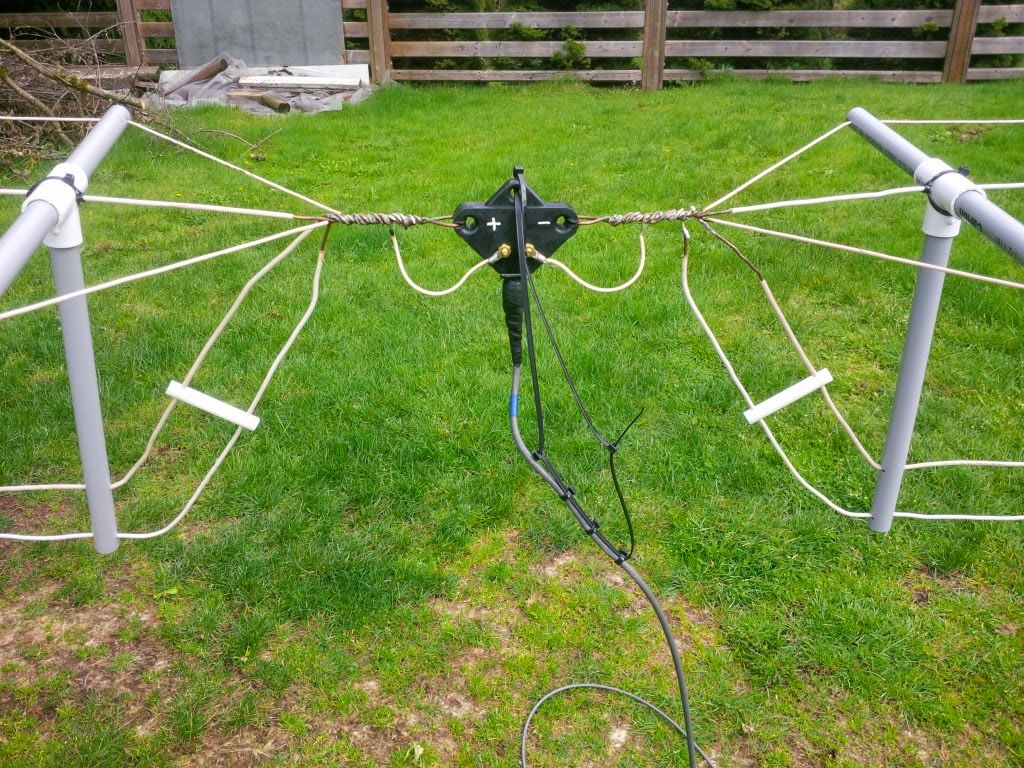
The antenna consists of a mini-flat top dipole, with three resonant dipole legs all terminating at a common feedpoint.

This can be used directly on any of the three high bands. Shorting the end of the coaxial cable, dropping vertically down from the feeedpoint, the dipole feedline becomes the vertical element of a top-loaded 630m 'T' antenna, 100' in the air.
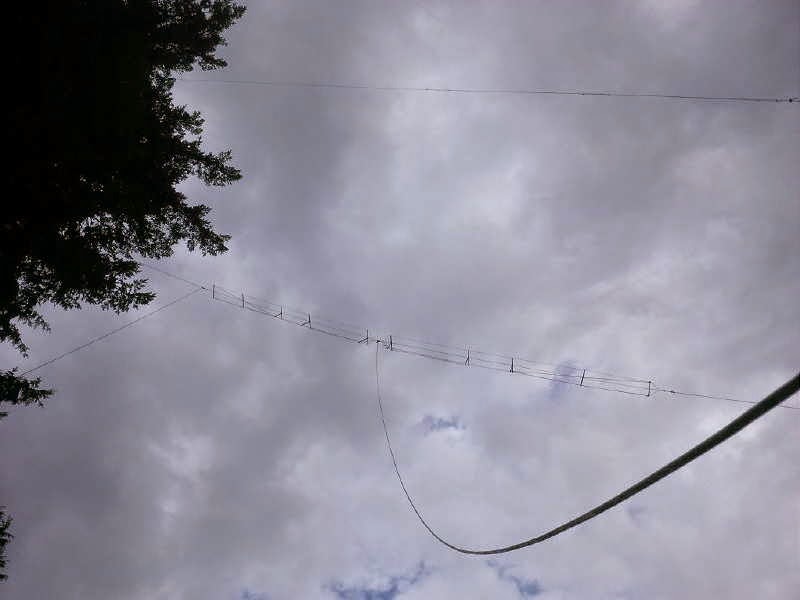
With suitable loading coils and appropriate switching, the 'T' will also be used on 160m, making the versatile antenna work on five different bands ... a nice demonstration of basic antenna principles put into real practice!
‘OO’ Oshawa NDB
You may recall my blog describing the recent reception of the Oshawa Municipal Airport's NDB, "OO" on 391KHz. The Nav Canada beacon maintenance man, Alex, (VE3GOP) also a Yahoo Group NDBlist member was able to pay a visit to the beacon on Friday and confirm the reported output power is indeed just 7.5 watts! He even snapped a picture of the power meter ... talk about service!
Little "OO" has also been reported in Europe by none other than Roelof, PAØRDT, while using one of his own small active whips. I think this illustrates the remarkable propagation that can, and often does, take place below the broadcast band, even with a less than optimum antenna system ... good news for those planning a 630m backyard antenna installation!
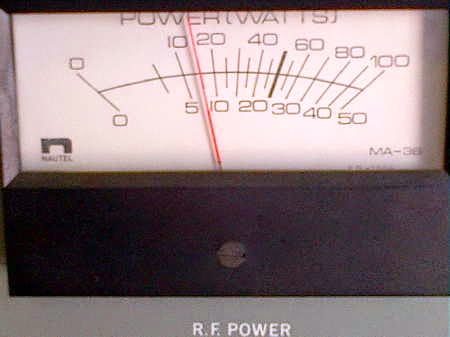 |
| courtesy: A. Wiecek, VE3GOP |
Little "OO" has also been reported in Europe by none other than Roelof, PAØRDT, while using one of his own small active whips. I think this illustrates the remarkable propagation that can, and often does, take place below the broadcast band, even with a less than optimum antenna system ... good news for those planning a 630m backyard antenna installation!
Yes, I am a bit of a wimp
It's raining outside, so I haven't gone to the Jeep for any lunch time QRP. In fact, I didn't bring the radio with me at all today. Yes, I will confess, I am a bit of a weather wimp. I hate setting up antennas (yes, even the Buddistick, which is a snap) this time of the year in the rain. Not a big issue for me in the late Spring or Summer, when it's warm. But when it's raining this time of year, it just feels raw - colder than it is, even if it's a bit warmer than it has been.
So I've been spending my lunch hour writing this post and Googling "Field Day Wire Antennas". Last year's EARCHI EFHW (Emergency Amateur Radio Communications Hawaii End Fed Half Wave) and G5RV both worked well, and more than likely, we are going to use them again. However, we have decided to add a digital station and a GOTA station, so we need to come up with two more wire configurations.
The digital station will be W2OU's FT-817 and I believe we are using KD2FSI's FT-897. Both W2OU and I have PAR END-FEDZ 10/20/40 antennas. While easy to deploy and use, they would prohibit us from getting on 80 Meters and 15 Meters. I am considering as possibilities, the G7FEK or perhaps the D3+ antenna. Both seem somewhat easy to construct. As the weather gets warmer, I may have to build one of each and then take them to the local park to see (in reality) how easy they are to set up and what kind of results I can garner.
K2VHW has a few disassembled multi band yagis in his garage. If he can determine that he has all the pieces and parts, we broached the concept of perhaps deploying one using an extension ladder as a "tower". That would make life a little easier for the QRP SSB guys.
My goal is to keep things as simple as possible while still allowing us to get credible results. After being out in the field for 24+ hours (if you include set up), no one really wants to face the prospect of spending an enormous amount of time tearing everything apart. Come 2:00 PM on Field Day Sunday, my mind is more on a good meal and a hot shower than worrying about packing and stowing.
We have ample time yet, so more investigation seems likely. Now if only I can find my copy of Bill Orr's "Simple Wire Antennas". That would help immensely!
72 de Larry W2LJ
QRP - When you care to send the very least!
So I've been spending my lunch hour writing this post and Googling "Field Day Wire Antennas". Last year's EARCHI EFHW (Emergency Amateur Radio Communications Hawaii End Fed Half Wave) and G5RV both worked well, and more than likely, we are going to use them again. However, we have decided to add a digital station and a GOTA station, so we need to come up with two more wire configurations.
The digital station will be W2OU's FT-817 and I believe we are using KD2FSI's FT-897. Both W2OU and I have PAR END-FEDZ 10/20/40 antennas. While easy to deploy and use, they would prohibit us from getting on 80 Meters and 15 Meters. I am considering as possibilities, the G7FEK or perhaps the D3+ antenna. Both seem somewhat easy to construct. As the weather gets warmer, I may have to build one of each and then take them to the local park to see (in reality) how easy they are to set up and what kind of results I can garner.
K2VHW has a few disassembled multi band yagis in his garage. If he can determine that he has all the pieces and parts, we broached the concept of perhaps deploying one using an extension ladder as a "tower". That would make life a little easier for the QRP SSB guys.
My goal is to keep things as simple as possible while still allowing us to get credible results. After being out in the field for 24+ hours (if you include set up), no one really wants to face the prospect of spending an enormous amount of time tearing everything apart. Come 2:00 PM on Field Day Sunday, my mind is more on a good meal and a hot shower than worrying about packing and stowing.
We have ample time yet, so more investigation seems likely. Now if only I can find my copy of Bill Orr's "Simple Wire Antennas". That would help immensely!
72 de Larry W2LJ
QRP - When you care to send the very least!
A 630m QRSS Test
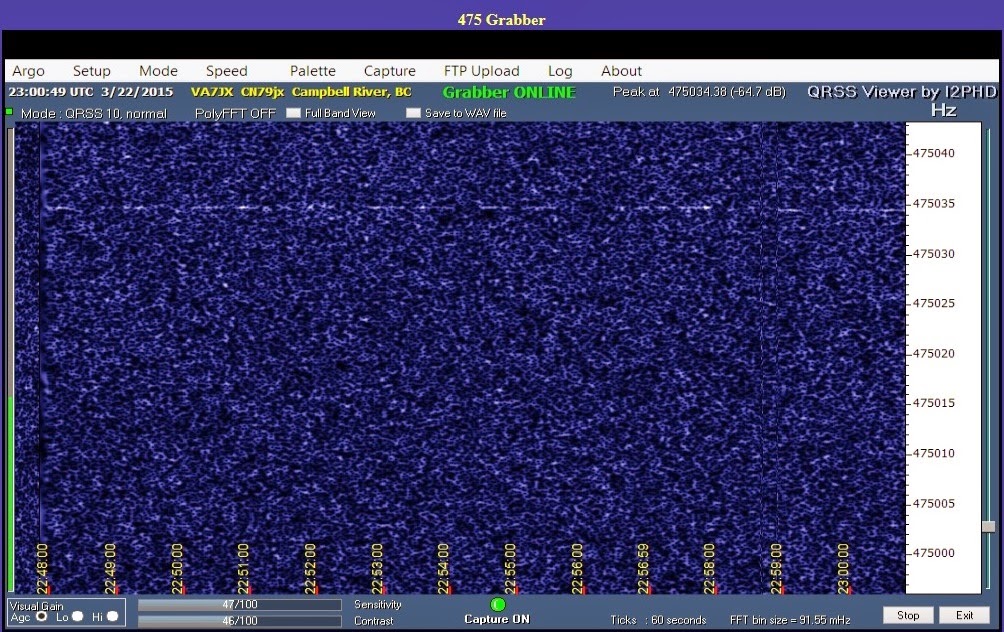
A few days ago, the power of the slow speed QRSS mode was nicely demonstrated by Mark, VA7MM (Coquitlam, BC) and Jack, VA7JX (Campbell River, BC, on Vancouver Island).
Mark was transmitting on 630m at a power of just 144mW output, while Jack was receiving on his normal 630m inverted 'L'. Mark tried various QRSS speeds ranging from QRSS3 (3 second 'dits') to QRSS60 (60 second 'dits'). One can clearly see the difference between the three speeds.
Going from the relatively slow CW rate of 6 WPM to just QRSS3 alone, produces a healthy 12db increase in signal level. Going from there to QRSS10 produces another 5db, while going all the way to QRSS60 produces a whopping 24.8db over 6 WPM CW! The trade off, of course, being the amount of time it takes to send the needed information.
In practical terms, contacts can be made relatively quickly at both QRSS3 and QRSS10. After that it becomes a bit of a chore as conditions need to be very stable for long periods of time ... as well, you'll need several hours to complete a two-way exchange.
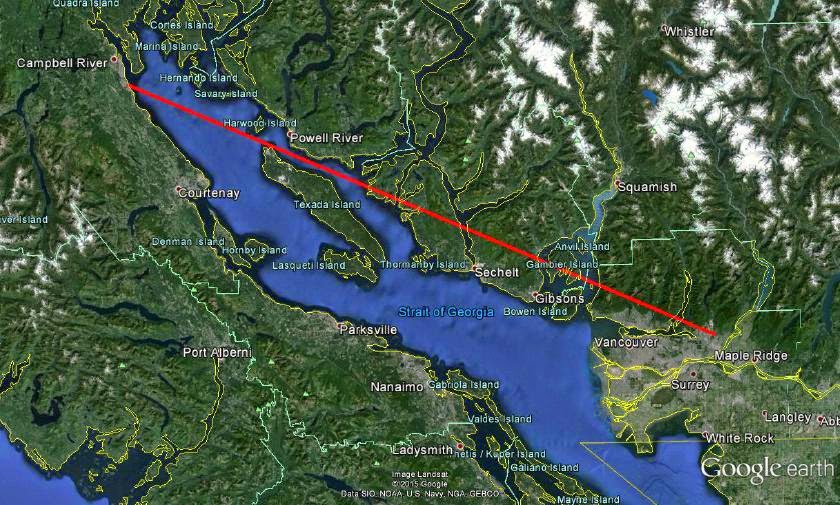
This is over a 120 mile (192km) path but what is remarkable is the rugged nature of the path as shown here:
Although mostly over water for the second portion, the initial launch of Mark's signal is into a hellish 60 mile path of rugged coastal mountain peaks, with most of them in the 3,000 - 4,000 foot range! If this is an all groundwave path, and I suspect that it may be, it surely demonstrates the amazing groundwave capability of 630m. If there were any skywave involved, I would expect to see some fading on the signal path ... but the QRSS60 signal looks rock-solid and fade-free.
I should add that Mark's transmitting antenna is very minimal at the moment, consisting of an 80m dipole fed as a vertical 'T', tuned but not impedance-matched and ... no ground radials. Pretty remarkable actually.
Mark was transmitting on 630m at a power of just 144mW output, while Jack was receiving on his normal 630m inverted 'L'. Mark tried various QRSS speeds ranging from QRSS3 (3 second 'dits') to QRSS60 (60 second 'dits'). One can clearly see the difference between the three speeds.
Going from the relatively slow CW rate of 6 WPM to just QRSS3 alone, produces a healthy 12db increase in signal level. Going from there to QRSS10 produces another 5db, while going all the way to QRSS60 produces a whopping 24.8db over 6 WPM CW! The trade off, of course, being the amount of time it takes to send the needed information.
In practical terms, contacts can be made relatively quickly at both QRSS3 and QRSS10. After that it becomes a bit of a chore as conditions need to be very stable for long periods of time ... as well, you'll need several hours to complete a two-way exchange.
 | |
| courtesy: https://www.google.com/earth/ |
 | ||||
| VA7MM - QRSS3 |
 |
| VA7MM - QRSS10 |
 |
| VA7MM - QRSS60 |
 |
| courtesy: http://www.heywhatsthat.com/profiler.html |
I should add that Mark's transmitting antenna is very minimal at the moment, consisting of an 80m dipole fed as a vertical 'T', tuned but not impedance-matched and ... no ground radials. Pretty remarkable actually.
My New Station
As I have blogged in past, I have a QTH in Santa Fe, NM. I have 5 acres, but according to the deed restrictions all I can do is look at it. No towers, no antennas, nothing. Since I spend most of my time here activating SOTA summits it's not that big of deal, however from time to time there is something I might miss because I have no HF capability, plus I like to chase SOTA peaks as well and I haven't been able to do that from here.
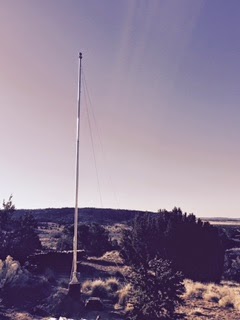
So with the help of Hector, XE2K, I am now able to work HF from here in a couple of ways. The first challenge was the antenna. While there is strict prohibitions against transmitting antennas, there is nothing prohibiting flagpoles. So I got permission to put up a flagpole. The flagpole I bought was from ZeroFive antennas. I bought the 20 ft. version. which is resonant on 20m with no tuning. I am using 16 43ft. radials However, I also put a SGC remote tuner at the base, which tunes all bands from 10m - 30m. Hector, who is very good at expanding the capabilities of any antenna, suggested we add a radiating wire to the mix. So we cut a 43 ft. piece of wire, attached it to the flag fastener and hoisted it to the top of the pole and tied off the end, in an inverted V configuration. the two antennas now are resonant, with the tuner, 10m - 80m. While it's not optimum, it is functional and now I'm on the air. In the photo below you can see the flagpole and the wire that makes 40m and 80m possible.
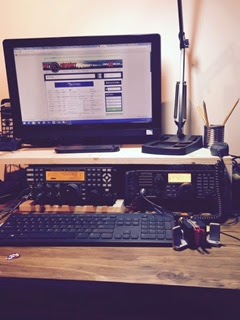
The next HF solution is to remote into my K3 at my home QTH in Texas. So I bought the K3/0 which is the remote radio device along with the RemoteRig interfaces. It is also now functional. So if I need a beam, I have access to that as well. So I am back in business on HF. Below is a look at the station. The K3/0 is on the left and an Icom 7200 on the right.
So with the help of Hector, XE2K, I am now able to work HF from here in a couple of ways. The first challenge was the antenna. While there is strict prohibitions against transmitting antennas, there is nothing prohibiting flagpoles. So I got permission to put up a flagpole. The flagpole I bought was from ZeroFive antennas. I bought the 20 ft. version. which is resonant on 20m with no tuning. I am using 16 43ft. radials However, I also put a SGC remote tuner at the base, which tunes all bands from 10m - 30m. Hector, who is very good at expanding the capabilities of any antenna, suggested we add a radiating wire to the mix. So we cut a 43 ft. piece of wire, attached it to the flag fastener and hoisted it to the top of the pole and tied off the end, in an inverted V configuration. the two antennas now are resonant, with the tuner, 10m - 80m. While it's not optimum, it is functional and now I'm on the air. In the photo below you can see the flagpole and the wire that makes 40m and 80m possible.
Flagpole Antenna
Station
Where there is a will, there is a way.
My New Station
As I have blogged in past, I have a QTH in Santa Fe, NM. I have 5 acres, but according to the deed restrictions all I can do is look at it. No towers, no antennas, nothing. Since I spend most of my time here activating SOTA summits it's not that big of deal, however from time to time there is something I might miss because I have no HF capability, plus I like to chase SOTA peaks as well and I haven't been able to do that from here.
So with the help of Hector, XE2K, I am now able to work HF from here in a couple of ways. The first challenge was the antenna. While there is strict prohibitions against transmitting antennas, there is nothing prohibiting flagpoles. So I got permission to put up a flagpole. The flagpole I bought was from ZeroFive antennas. I bought the 20 ft. version. which is resonant on 20m with no tuning. I am using 16 43ft. radials However, I also put a SGC remote tuner at the base, which tunes all bands from 10m - 30m. Hector, who is very good at expanding the capabilities of any antenna, suggested we add a radiating wire to the mix. So we cut a 43 ft. piece of wire, attached it to the flag fastener and hoisted it to the top of the pole and tied off the end, in an inverted V configuration. the two antennas now are resonant, with the tuner, 10m - 80m. While it's not optimum, it is functional and now I'm on the air. In the photo below you can see the flagpole and the wire that makes 40m and 80m possible.
The next HF solution is to remote into my K3 at my home QTH in Texas. So I bought the K3/0 which is the remote radio device along with the RemoteRig interfaces. It is also now functional. So if I need a beam, I have access to that as well. So I am back in business on HF. Below is a look at the station. The K3/0 is on the left and an Icom 7200 on the right.
So with the help of Hector, XE2K, I am now able to work HF from here in a couple of ways. The first challenge was the antenna. While there is strict prohibitions against transmitting antennas, there is nothing prohibiting flagpoles. So I got permission to put up a flagpole. The flagpole I bought was from ZeroFive antennas. I bought the 20 ft. version. which is resonant on 20m with no tuning. I am using 16 43ft. radials However, I also put a SGC remote tuner at the base, which tunes all bands from 10m - 30m. Hector, who is very good at expanding the capabilities of any antenna, suggested we add a radiating wire to the mix. So we cut a 43 ft. piece of wire, attached it to the flag fastener and hoisted it to the top of the pole and tied off the end, in an inverted V configuration. the two antennas now are resonant, with the tuner, 10m - 80m. While it's not optimum, it is functional and now I'm on the air. In the photo below you can see the flagpole and the wire that makes 40m and 80m possible.
Flagpole Antenna
Station
Where there is a will, there is a way.
Phasers On Medium Wave
A recent posting on the Yahoo ndblist Group page, by veteran LF/MW DXer and front-end guru, Steve Ratzlaff (AA7U) in Oregon, described his thoughts on LF/MW antennas and his experience with phasers:
Some years back at the other place, I experimented with phasers, trying
all the various ones I could find or build. I had a long term loan of
the DXE NCC phaser as well. I compared them mostly at MW where a phaser is generally most useful; but also at LF and HF. In all cases and all
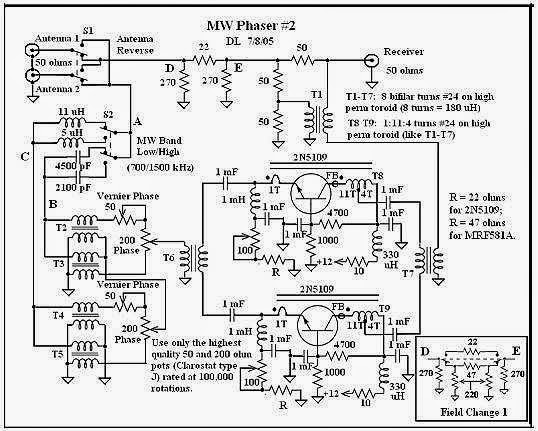
frequencies, without exception, the Dallas Lankford "MW Phaser #2" was
significantly better. I have placed that article in the ndblist Files,
under "Aerials and Technical Files" section should you have an interest
in looking at that article.
For LF use I never found any reason to use a phaser for trying to
optimize the level of a signal. Usually LF signals are short-lived and
often you only have a short time to catch an ident before it fades away.
You can easily waste 30 seconds or more just trying to optimize the
phaser; by that time the signal is usually gone. For those with a local
noise problem from a single general direction a phaser could be useful
in nulling out that noise, though of course you would lose the signals
from that direction too.
I also had room for antenna experiments, being able to compare them with
my longwire antennas. For those with the room, I believe it's hard to
beat an elevated longwire of approx. 400 feet or longer. I was very
fortunate to be able to string two E/W 1600 foot longwires, on either
side of the property about 400 feet apart and roughly parallel; and a
much shorter 400 foot N/S longwire. But even the N/S short one enabled
me to log a number of Greenland beacons (of course this was back when LF
conditions were still excellent, not like now).
Some folks have good results with the K9AY type antenna--Doug in TX has
good results using that antenna. But it's a ground-dependent antenna and
many areas don't have ground characteristics that support such antennas.
My area was one of those--the K9AY never worked very well for me. But an
elevated vertical loop worked very well, using the Wellbrook ALA100
preamp.
I had several rectangular loops up at one time, 120-150 foot
circumference using the ALA100, about 10 vertical feet distance between
the top and bottom wires to give a good capture area. These were very
sensitive at LF and a couple of times I was able to (barely) hear
distant South Pacific beacons that I was also hearing on the 1600 E/W
longwire. And of course the loop antenna is ground-independent so can be
used anywhere. It's bidirectional so can help in nulling noise too. And
such a loop doesn't take up much room as long as you can get it away
from local AC noise (which is true for all LF antennas, especially for
active whips).
Mark Connelly is a prominent east coast MW DXer and has a lot of info on
antennas and phasing on his webpage here. All his applications are primarily for MW DXing but the principles apply equally
well to LF.
The Dallas Lankford phaser article described by Steve, can also be downloaded from here.
LNV phaser, John Bellini in Colorado, also chimed-in with some additional thoughts based upon his own experience:
You do (ideally) need to have good antenna separation to have good/easy phasing of the two signals but you do not have to have two different antennas. If the antennas are too close, the noise fields can be too similar and you won't get good noise cancellation or if the antennas are too close the wavelengths of the signals compared to the antenna separation will be long and it will be a challenge to phase out a signal.
I have been using three, nearly identical, LNV antennas separated 85-110 ft, depending on which pair I use, and have had very good results using the Quantum Phaser.
A very informative discussion of backyard antennas (and phasers) suitable for LW/MWwork is described by Graham Maynard in this Medium Wave Circle article. In the author's own description:
Well, once again I say "That's it". This time my mind churning effort has been to understand and develop the results possible with simple, small back-garden, mixed loop-vertical antenna systems. It really is not as complicated as might first appear, and those willing to try could enjoy as I do, listening to other people's locals ··· Ontario ·· New York ···
These pages have been long in writing - they summarise many years of enquiring study and thoughtful co-ordination with determined and diligent empiric effort...
There's enough good bedtime reading for an evening or two here!













