Archive for the ‘amateur’ Category
 1920 film: How the Telephone Talks (A Silent Film)
 November 9th, 2013 |
  Author:
 This is for you vintage science film buffs: here is a circa 1920 film: How the Telephone Talks (A Silent Film).
This is an educational film from 1920 that explained the “modern” telephone. The concepts are still relevant to today’s modern versions, including the cell phone, which is both radio and telephone.
From Wiki:
A telephone, or phone, is a telecommunications device that permits two or more users to conduct a conversation when they are not in the same vicinity of each other to be heard directly. A telephone converts sound, typically and most efficiently the human voice, into electronic signals suitable for transmission via cables or other transmission media over long distances, and replays such signals simultaneously in audible form to its user. The word telephone has been adapted into the vocabulary of many languages. It is derived from the Greek: τῆλε, tēle, far and φωνή, phōnē, voice, together meaning distant voice.
First patented in 1876 by Alexander Graham Bell and further developed by many others, the telephone was the first device in history that enabled people to talk directly with each other across large distances. Telephones became rapidly indispensable to businesses, government, and households, and are today some of the most widely used small appliances.
The essential elements of a telephone are a microphone (transmitter) to speak into and an earphone (receiver) which reproduces the voice of the distant person. In addition, most telephones contain a ringer which produces a sound to announce an incoming telephone call, and a dial used to enter a telephone number when initiating a call to another telephone. Until approximately the 1970s most telephones used a rotary dial, which was superseded by the modern Touch-Tone push-button dial, first introduced by AT&T in 1963. The receiver and transmitter are usually built into a handset which is held up to the ear and mouth during conversation. The dial may be located either on the handset, or on a base unit to which the handset is connected by a cord containing wires. The transmitter converts the sound waves to electrical signals which are sent through the telephone network to the receiving phone. The receiving telephone converts the signals into audible sound in the receiver, or sometimes a loudspeaker. Telephones are a duplex communications medium, meaning they allow the people on both ends to talk simultaneously.
A landline telephone is connected by a pair of wires to the telephone network, while a mobile phone, such as a cellular phone, is portable and communicates with the telephone network by radio transmissions. A cordless telephone has a portable handset which communicates by radio transmission with the handset base station which is connected by wire to the telephone network.
The telephone network, consisting of a worldwide net of telephone lines, fiber optic cables, microwave transmission, cellular networks, communications satellites, and undersea telephone cables connected by switching centers, allows any telephone in the world to communicate with any other. Each telephone line has an identifying number called its telephone number. To initiate a telephone call the user enters the other telephone’s number into a numeric keypad on the phone.
Although originally designed for simple voice communications, most modern telephones have many additional capabilities. They may be able to record spoken messages, send and receive text messages, take and display photographs or video, play music, and surf the Internet. A current trend is phones that integrate all mobile communication and computing needs; these are called smartphones.
Expect Uptick in HF Propagation Even on 10m, This Week
New sunspot region, NOAA Active Sunspot Region Nr. 11890, far left on the solar disc, will produce flares, this week.
The Sun continues to produce sunspots, and this week looks active, too. Expect another uptick of activity on higher HF bands such as 10 meters, as a “new” sunspot region has now rotated into full view. It has a complex magnetic structure, so it could produce moderate and maybe strong x-ray flares. We expect flaring activity to pick up, as a result.

With all of the recent activity, and the continued train of spots, right now, it certainly appears to be a sign of a “second” peak in the cycle. Most cycles exhibit such double peaks. Is this one of them in this current Sunspot Cycle 24?
Enjoy the DX!
73 de NW7US (Your CQ Magazine and Popular Communications Magazine propagation columnist)
Off Topic – Going back to College
I was sitting in our Board Meeting for the NI4CE repeater system – http://ni4ce.org and realized that I have not been playing radio in quite some time. There is more than one reason. I have been extremely busy at work and due to that I have had no time for anything else.
One of those other life factors besides work, kids, family, and other hobbies is school. For many of you this might sound odd, but for others you will completely understand.
At this point in my life, even though I have been in computer industry for over 25 years, I have never had a college degree. My wife was starting her MBA and I said with her going to be taking on the stress and challenge of that maybe it’s something I should consider. I looked into what my company would help pay for, I looked into the time commitments, and I landed on University of Phoenix.
Online works great for me – I am a computer geek and live online. I thought this would be a great time in life and then I would finally not be the only person around the table that couldn’t talk about having their degree. It was just something that always has been in the back of my mind.
Well, I started and finished week 1 with all A’s in my two classes and I’m on my way. I understand that this isn’t Ham Radio specific but if you ever read my story about how Ham Radio helped put me on a better path you will understand why this ties back together. Ham Radio helped me get my 15-year-old head on straight; many people in the hobby-helped push me into computers. I have worked for one of the largest software companies for the last 18 years and been pretty lucky to still know the two guys that did it.
I am sure my story of going back and getting my college education will bring more bliss to a great story they had impact on.
I won’t post all of my weeks progress, but I thought I would start with week one:
http://nicktoday.com/week-one-officially-books-university-phoenix/
I am still active on the Board of Directors for NI4CE and I am going to do my best to get back into radio further. I promise J for not if you want to find me it will most likely be in the library.
Yagi-Uda the III.
No, this is not the name of another royal baby… it’s about my third attempt to build a 2m antenna for my SOTA activations. In my earlier iterations I was unable to strike the balance between size/weight and usability.
What happened so far:
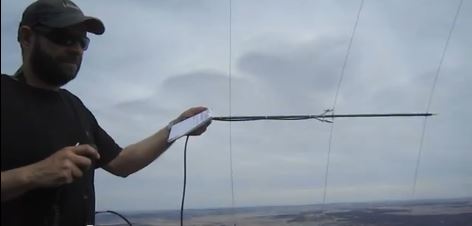 My first attempt to build a Yagi-Uda antenna was based on a design by Paul/KD5IVP. It worked, but had some crucial flaws for my endeavors. It was a 3-element antenna made out of piano wire and a carbon fiber arrow as a boom. Very small and lightweight indeed but in high winds/gusts the elements were flapping like a seagull during take-off. It’s demise came on it’s second outing… the arrow broke in half while bushwhacking up a mountain and I lost some of the piano wires in the woods. To read more about it and to see it in action check out this post.
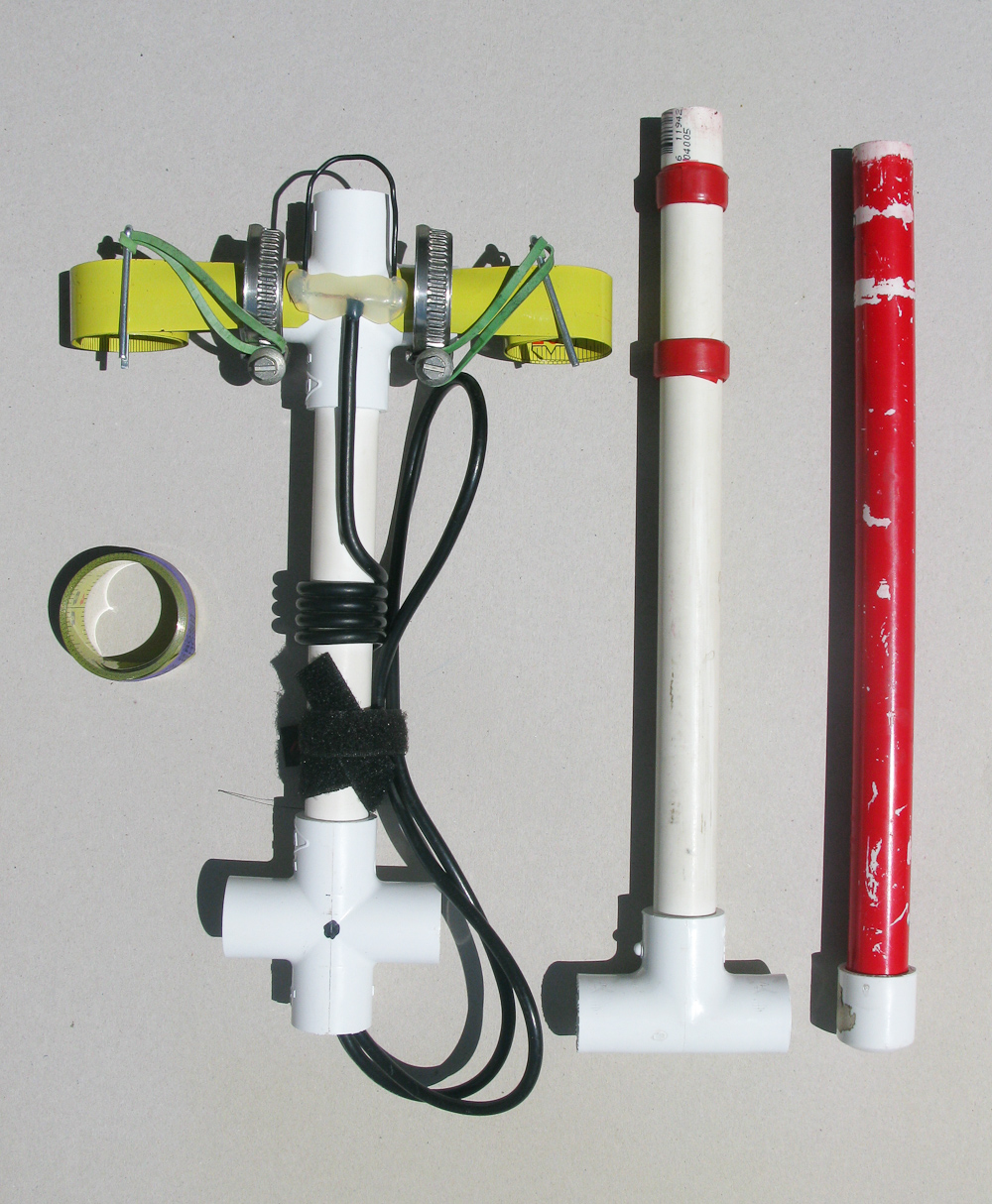 I then moved on to a tape measure 3-element antenna based on a design by Joe/WB2HOL. It worked well and accompanied me on several activations – even a few 14ers (Summits higher than 14’000 ft / 4267m). My main gripe with this antenna is that it is delicate to transport as well. The steel tape gets kinked easily since the antenna is strapped to the outside of my backpack. It’s rather easy to replace the director and reflector, but soldering the coax to the steel radiator is another story. It turned out that this design is also vulnerable to high winds and your arms start to feel the weight after a few minutes without support. You can see the antenna in action in this video, around 3:30 into the clip.
The one?
I continued my research for a suitable 2m Yagi-Uda which would fit my requirements:
- Lightweight (but sturdy enough to withstand high winds)
- Easy and save to transport
- Easy to build (even for me)
I eventually stumbled onto IZ2UUF’s Website – an Italian radio amateur who enjoys hiking and playing with radios as well. He designed an 4-element Yagi-Uda weighing only 80 grams (~2.9 ounces)!! All elements fit into the fiberglass boom (fishing rod) for easy transport with no matching network necessary. The description to build the antenna focused on the critical parts with excellent pictures to support the instructions.
Davide/IZ2UUF modeled the antenna with 4NEC2, a free antenna modeling software package. Since he shared his input file with me, I took the opportunity to download the free SW and to learn more about antenna modelling. After a few more e-mail exchanges with him I was convinced by his design and started to source all the parts.
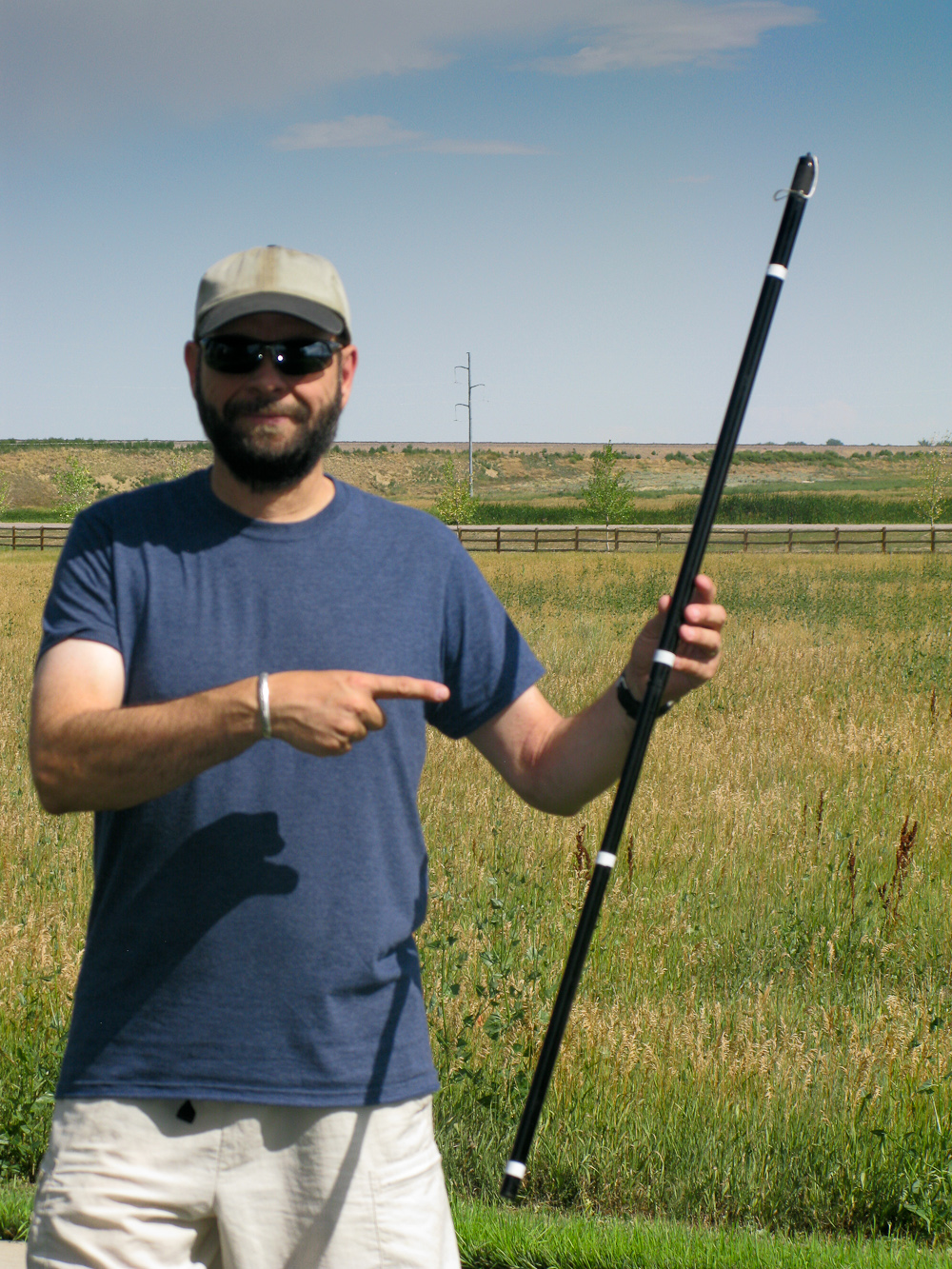 I did not have afiberglass fishing pole available and opted to use a plastic one I had lying around. Davide is using aluminum welding rods for his elements which I could not find at the desired length/diameter here in the US. I therefore ordered aluminum alloy 6061 rods instead (1/8″ x 6′ ) from a supplier in IL (for details see the resource section below). My build also differs in the connector (BNC instead SMA). All these changes resulted in a slightly heavier (194 g / 6.8 ounces) first version compared to Davide’s antenna. My boom alone is heavier than Davide’s complete antenna (96 g / 3.4 oz). However, I am planning to improve/reduce the weight in version two.
I had a chance to use the antenna over the week-end during the CO-14er event. All I can say so far is that it worked well and that the weight is not an issue at all… huge improvement to the tape-measure version.
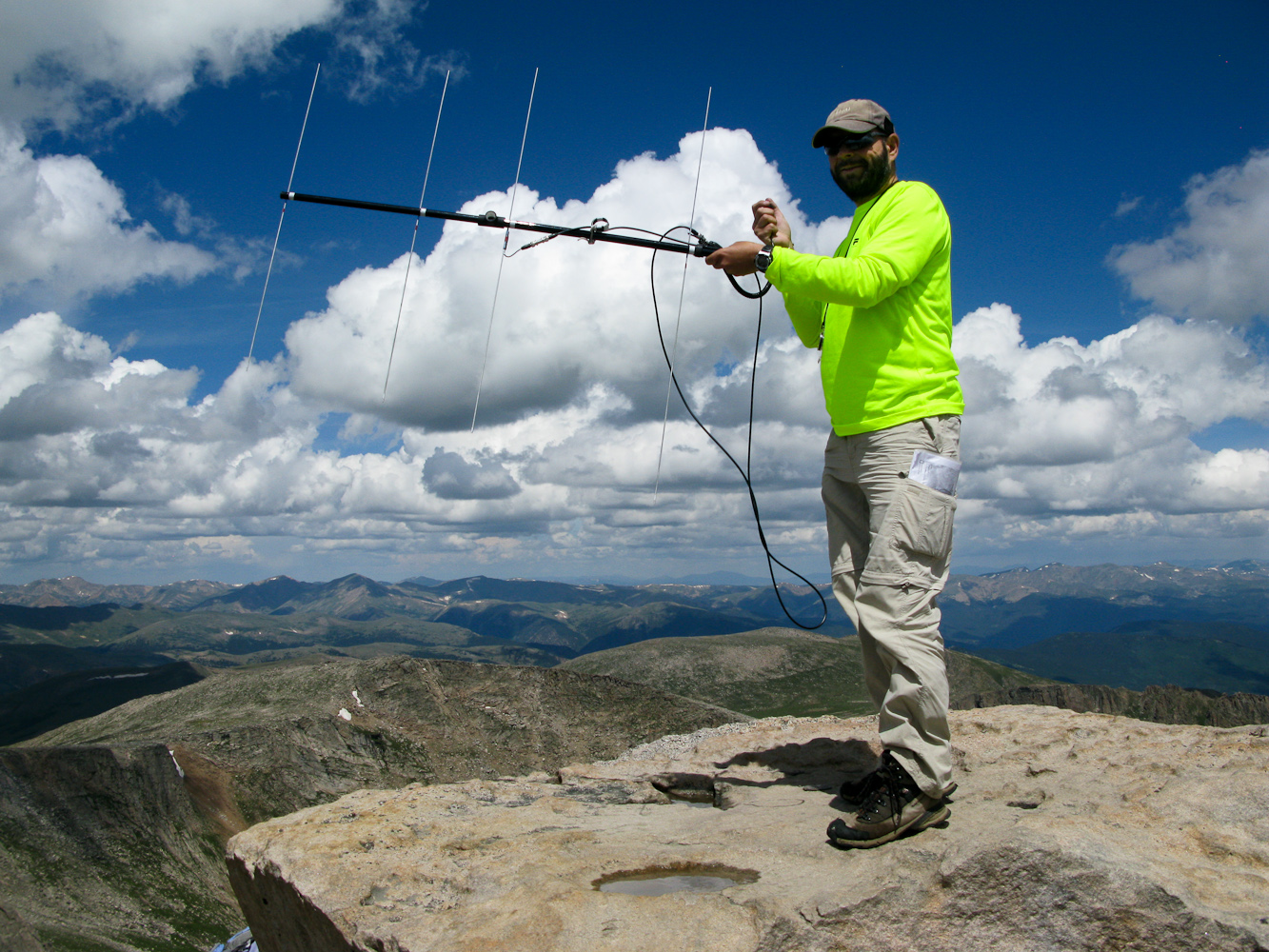
For more pictures, a weight comparison and resources head over to my blog.
73, Matt/KØMOS
A QRP Family Holiday on Prince Edward Island, Canada

VY2 portable K4SWL!
This year, during our family’s summer holiday, I’m enjoying the hospitality of Prince Edward Island, Canada (hence, the lack of recent posts). This is our family’s second visit to the maritime island, and each time we’ve been fortunate to stay at the same off-the-grid cabin on the eastern coast, less than twenty meters from the water.
Of course, staying in an off-grid cabin comes with its radio challenges—namely, supplying power—but also comes with one supreme advantage: no noise from the typical electrical devices that plague most of our homes. What’s more, this cabin sits on 60 acres, so not even a neighbor’s home appliances disturb my RX ears.
On our previous visit, I brought my (then) Yaesu FT-817, a 9aH gel cell, Micro M+ charge controller, 10W Solarex PV panel, some 300 ohm window line, loads of 22 AWG wire and an LDG ATU. Unfortunately, I found I had very little time for radio, and propagation was dismal. Indeed, it was during that trip that I discovered my FT-817’s finals had blown, so part of the time I was transmitting less than QRPpppp levels.
This year, since I knew the site well, I came better prepared.
My full 2012 setup consists of the following:
- An Elecraft K2/10
- An Elecraft KX1 (4 band w/built-in ATU)
- Elecraft T1 ATU
- LDG 4:1 Balun
- One 35 aH gel cell
- Two 9.5 aH gel cells
- Two PowerFilm Solar foldable 5 W PV panels
- My radio toolbox with various connectors, crimpers, cutters, wires, caps, multi-tester, etc.
- Enough wire and 300 ohm antenna line to make a couple of wire antennas
So…how’s it all working out? Brilliantly!
In the past few years I’ve done a lot of QRP CW—mainly rag-chews with some buddies on the lower bands. I’ve done less QRP SSB phone. When I first arrived at the cabin and began the process of unpacking, I couldn’t find the jumper cable to attach to my Vibroplex single-lever paddle (the paddle being a Dayton 2012 find, by the way). So, I plugged in a microphone and tuned to the phone portion of the 17 meter band.
Talk about radio fun!
I’ve once again re-discovered the joy of operating QRP SSB. It’s challenging to make those DX contacts and to transmit a long call sign (“VY2 portable K4SWL”) across the ether, but occasionally the propagation gods smile upon you, and you’re able to participate in a good rag-chew or quick DX with a 57 to 59 signal report.
Being 20 meters from the salt water is a bonus I don’t usually enjoy in my US hermitage. Due to its excellent propagation characteristics, despite my lower power set-up, I have easily worked stations from Russia to North Africa, from the Caribbean to Japan. I am thoroughly reveling in it, and the process has re-connected me with my ham radio roots.
As Gunter, VA3GA, told me in a recent Canadian rag-chew, “ham radio holidays give you a chance to explore areas of the hobby you don’t normally think to enjoy.”
So true, Gunter. That’s what I love about ham radio in general– the hobby is so broad, you constantly discover and re-discover favorite elements about it.
Solar Power for QRP
-

- 3.37 Amps in the Sun
-

- Brace Detail
-

- Close Up of Curved Leg End
-

- Close Up of Leg Braces
-

- Close Up of Leg Braces 2
-

- Close up of Solar panel controller
-

- Corner Detail of Leg Attachment
-

- Corner Detail of Leg Attachment For Other Leg
-

- Curved Leg Section Cut Away to Allow Legs to Swing Out, Avoiding Panel Damage
-

- Drilling to Set Legs in Place
-

- Go Box on the Left, 100 Watt 5 Amp Solar Panel on the Right
-

- Legs Attached to the Solar Panel Allows it to be Self Standing
-

- Legs Fold Into the Solar Panel Frame for Easy Storage
-

- Rear of Solar Panel, Controler is mounted with Velcro
-

- Right Leg Attached to Panel Frame
-

- Solar Panel Stored in its shipping case.
I’ve always wanted to operate my radio on Solar Power. This was a fun to do project. I can’t wait to bring it to a Field Day Event.
I bought the aluminum from Metals Depot in Kentucky. (link attached) They have lots of aluminum shapes and parts to choose from. The parts arrived via UPS. It nice to have a good source like this for ham radio projects.http://www.metalsdepot.com/
HQRP is a good company to buy solar panel parts and controlers from. The QRP part of their name is just coincidental to this being a QRP project. http://hqrp.com/
de AA1IK
Ernest Gregoire
72
His and Hers
I haven’t posted so much lately. Sinus issues have kept me from really spending the time on anything other than work and the necessities of life. There are some great goings-on here on Long Island though. My lovely and amazing fiance had been studying for her Technician license for the last month or so. Armed with a notebook, access to the QRZ.com practice tests, and Gordon West’s book, she finally took and passed the exam this past Saturday. Now we just need the callsign. A friend of ours once told us that there are two types of Ham Radio spouses. Ones that embrace the hobby, maybe not to the fullest, but will attend picnics and events, and there are the ones that run screaming from it. I have been blessed with a fiance who fell in love with the Ham Radio community, and the people we have met through it. I’m not sure that I’ll ever come home to find her staring at Smith Charts, but I think she and I might get to fight over the soldering iron a bit.

Fresh from Amazon
Well, anyway, on to the Baofengs you see here. She sort-of owed me a birthday gift for awhile, and I thought she needed a congratulatory gift for passing the exam, so we ordered his-n-hers Baofeng UV-3R Mark IIs. I know quite a few hams that have purchased these little gems and most are quite pleased. Now, I understand that I cannot expect the performance of a $300 Kenwood, or other similar HTs, but the value is quite amazing. Here in the NY Metro area, a small 2 watt HT is not a bad thing to have.
As I do with practically everything I own, I have started the process of learning all I can about getting the most out of these little radios. I will post the results as I experiment. So far so good though. Stay tuned, more to follow.
–Neil W2NDG













