Author Archive
 VE7BPO Homebuilder Web Files
 October 10th, 2014 |
  Author:
The recent closure of Todd's valuable site has resulted in the entire data from there now being mirrored at two locations in .pdf format. It's all there, complete with all the schematics and photographs from the original site ...and is very easily searched. The file is about 40Mb and consists of 945 pages!
- Jason, NT7S has posted the file here.
- Steve, VK2JA has posted the file here.
If you missed it earlier, Todd's new blog is slowly starting to take shape and by the looks of it will soon be running full-speed ahead.
Loop Listen
As Murphy would have it, and in spite of the low amount of solar activity, LF/MF propagation has been very poor since getting my new 10' x 20' loop in place. The few front-to-side nulling checks that I have done, have produced results varying from around 20db to 30db, depending upon the signal. I suspect the depth of null is also affected by the signal's arrival angle but there is still more to learn. The pattern seems to be very close to that of a typical circular loop...the classic figure-8 pattern illustrated below as shown on the Wellbrook data that came with my ALA100LN preamp.
More typically, the null is around 21-22 db as shown on this test while listening to the ground wave carrier of the YZA ndb (236kHz) located in Ashcroft, B.C., about 150 miles to the NE. As expected, the null is fairly sharp and the front / rear lobe, fairly broad.
One short check at dusk, produced nice signals from CJBC, the French-language station in Toronto. The past few nights it has been very strong but with a strong echo effect. I wonder if there is more than one CBC outlet here (860kHz), such as a low-power repeater, causing the echo.
At the same time, while still fairly light outside, WCCO in Minneapolis had a nice signal just before sunset.
No matter how poor conditions become, it seems that the Hinchinbrook (Alaska) ndb, 'ALJ' (233kHz), is always strong....looping north.
My apologies for the video quality. If you know of any software available for making full-screen Perseus video captures so that I might improve my technique, please let me know. Presently I am just capturing them on my I-Pad which leaves a lot of room for improvement.
Hopefully conditions will only get better as the season progresses and I am able to give the loop a good workout....before it gets too windy!
 |
| Courtesy: http://www.wellbrook.uk.com |
More typically, the null is around 21-22 db as shown on this test while listening to the ground wave carrier of the YZA ndb (236kHz) located in Ashcroft, B.C., about 150 miles to the NE. As expected, the null is fairly sharp and the front / rear lobe, fairly broad.
One short check at dusk, produced nice signals from CJBC, the French-language station in Toronto. The past few nights it has been very strong but with a strong echo effect. I wonder if there is more than one CBC outlet here (860kHz), such as a low-power repeater, causing the echo.
At the same time, while still fairly light outside, WCCO in Minneapolis had a nice signal just before sunset.
No matter how poor conditions become, it seems that the Hinchinbrook (Alaska) ndb, 'ALJ' (233kHz), is always strong....looping north.
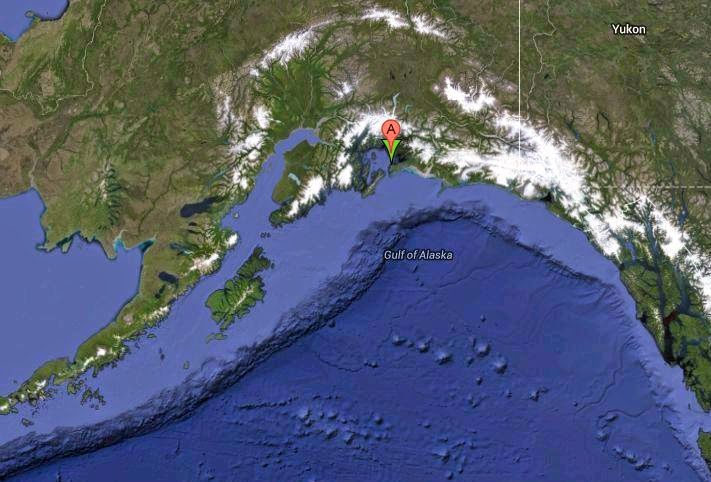 |
| Courtesy: https://www.google.ca/maps |
Hopefully conditions will only get better as the season progresses and I am able to give the loop a good workout....before it gets too windy!
VE7BPO ‘Popcorn’ QRP / Home Builder
“The emphasis is fun. The hope is that it will attract new people to electronic design, measurement and experimentation. Hopefully, this site stimulates interest in QRP homebrew electronics.”
That's how Todd Gale, VE7BPO, described his website. Up until this past weekend, Todd site was one of the Web's premier sources of inspiration, accumulated homebrew knowledge and hands-on experimental wisdom. I was shocked to receive an e-mail from Todd explaining that the site would be taken down because of continued bandwidth / network struggles with his one and only choice of providers. It truly was sad news for myself and the thousands that regularly visit his site for guidance. However, all is not lost as Todd went on to say:
"....I will convert all the site files into pdf files and stick them on a download site sometime in the future. I may re-emerge with a small-scale site or blog at some point, but don't really know for sure."
Happily, today Todd has informed me that he will indeed begin a new POPCORN QRP blog in which he hopes to update with his benchwork descriptions that we have all come to enjoy.
I have listed Todd's blog site on My Blog List to the right but you may prefer to set your bookmarks for his site. Don't expect too much until later in the month as he is still working his way up the blogger's learning curve....hopefully we will see him back soon. Best of luck with your new endeavour...and, like the original website, I'm sure it will be great!
 |
| Courtesy: VE7BPO |
New LF / MF Loop
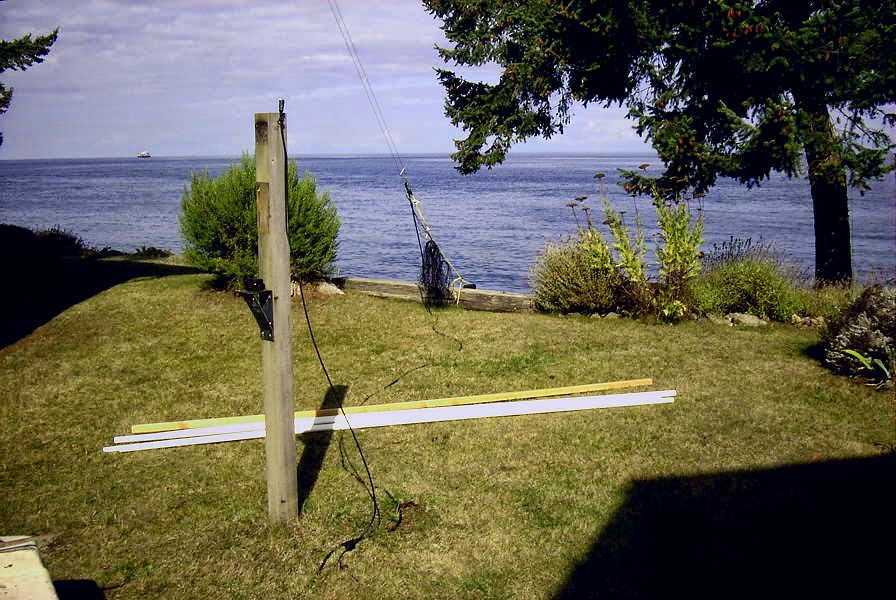
Some may recall my blog back in July (Wellbrook Loop Plans) describing a new loop that I had been thinking about as a possible replacement for my 10' shielded loop. I had been doodling various construction ideas using PVC tubing in an effort to keep it as light as possible, without introducing any metal near the loop. On Monday of this week, I dismantled the 10' loop in preparation for my new experimental rectangular loop.
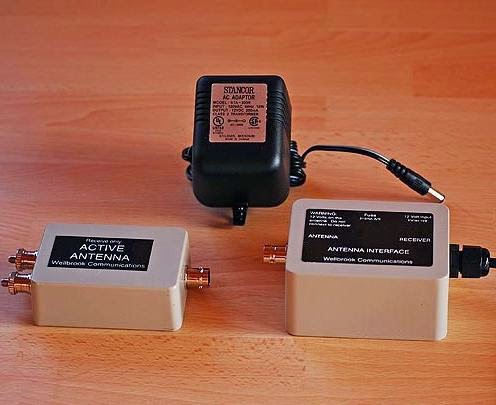 I've had the Wellbrook loop preamp here for a few months, so it was now or never, while the weather was still 'antenna-friendly'. Now I do understand that this goes against one of ham radio's long-standing traditions that dictates all antenna work must wait until the weather can't get any worse. Antennas built in the winter rain always work much better than ones put up in the summer. Hopefully it's not Wouff-Hong or Rettysnitch punishable but the fall DX season is almost upon us and I'm not waiting for the rain!
The new 'loop' is not really loop-shaped but is rectangular (10' x 20') and more like a Flag antenna shape. I considered a Flag but really don't need any back-end nulling capability since I'm mainly interested in listening to the east and to the north.
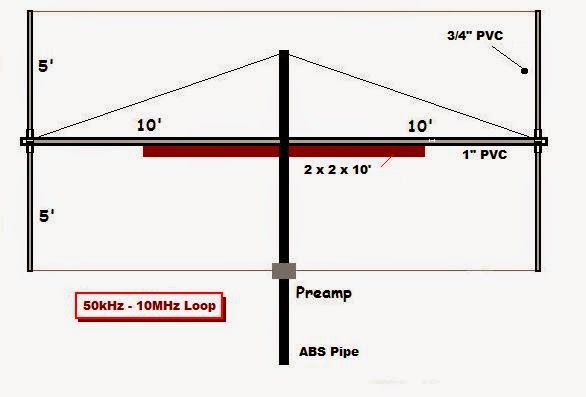
The main boom section is composed of two sections of 1" PVC thick-wall (Schedule 40) pipe joined at the center and reinforced with a 10' section of 2" x 2" Douglas Fir. In addition, the boom has a truss of 1/4" Dacron to take out any end-loading sag. The vertical end sections are 3/4" Schedule 40 PVC pipe, fastened with a T at the boom end. The center mast is made of 2" Schedule 40 ABS pipe with a long section of 1 1/2" ABS nested inside that telescopes upward to anchor the truss ropes and give some additional rigidity to the mast.
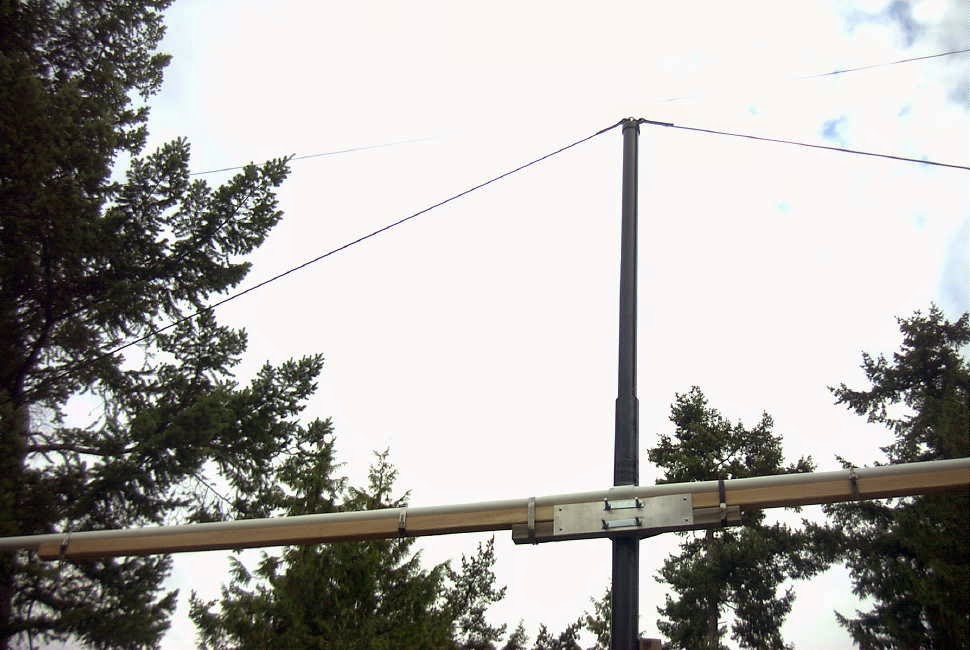 |
| Main boom and mast construction |
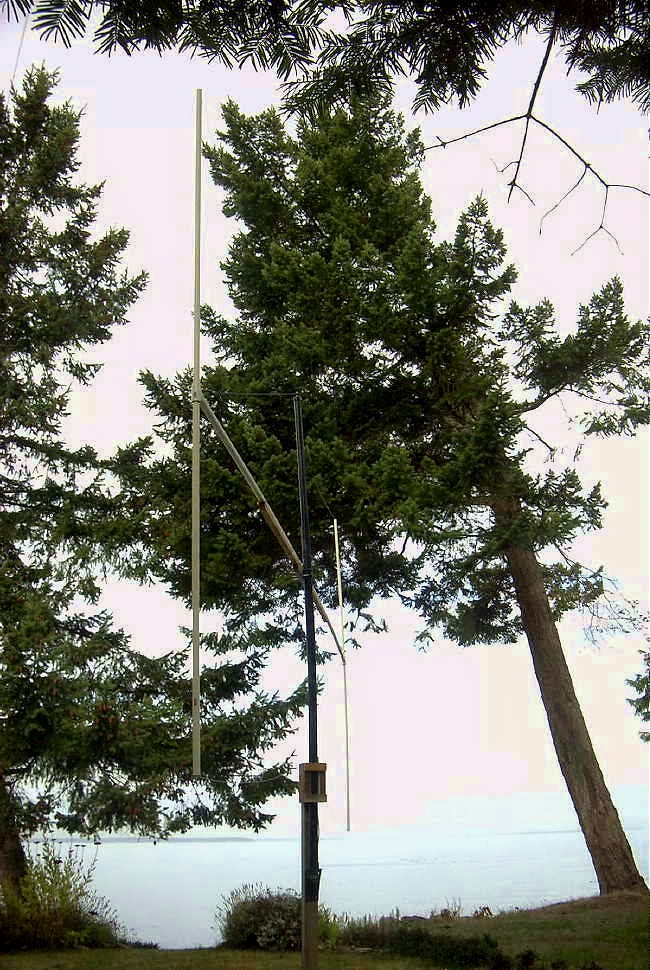 |
| Looping E/W |
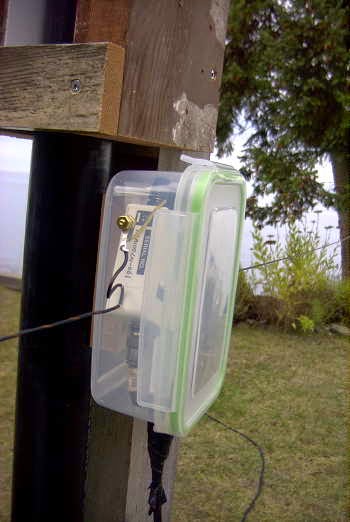
Although the preamp is completely sealed and weatherproofed, I still decided to mount it inside a container. The container also provided a convenient anchor to terminate the loop end wires (PVC-coated #18 stranded) without putting any tension on the soldered terminals.
Although I have not had much time to listen, and conditions are still in 'recovery' mode from earlier disturbances, initial indications are that everything is performing as well, if not better, than expected. It certainly outperforms my 10' active shielded loop by a large margin. I have yet to do any serious S/N comparisons between it and my primary LF receive antenna, a large inverted L, which must be tuned to resonance for the desired listening range. I believe that the very quiet loop / Wellbrook combination will provide an overall S/N improvement.
I have always believed that smaller loops provide deeper and sharper front-to-side nulls so I was pleasantly surprised to measure (using Perseus) null depths from 25-30db, on various groundwave signals....more than expected. Skywave signals also deliver sharp deep nulls in the order of 22 - 25db...again surprising, but I'll take them! A brief listen pointing S-E last evening turned up good signals from 1 kw'ers KYHN (1650kHz) in Fort Smith, Arkansas and KKGM (1630kHz) in Fort Worth, Texas. An early morning listen revealed good audio from JOIK (567) Sapporo, Japan and JOAK (595kHz) in Shobu. Down in the ndb band, little 25-watter 'IP' on 210kHz was an all-time new catch from Mobile, Arizona.
There is still much to learn from this new antenna system but the biggest challenge will be keeping it up all winter. I did lose one of my 10' loops after several years, due to wind when the main (un-reinforced) PVC mast eventually failed from flexing fatigue. I will tie the ends of the new antenna down when the winds get strong to reduce as much mast flexing as possible. I could however, run the risk of violating another long-standing radio tradition..."if your antenna stayed up all winter, it wasn't big enough". I just can't win.
Building For The ‘BK’
 It's almost that time of the year when, once again, the '29ers start preparing for the winter Bruce Kelley Party. In case you're not familiar with the 'BK', it's a winter event celebrating the transmitters of 1929 and earlier. Transmitters used for the event must be self-excited only...no crystals allowed...and the tube(s) used must be those that were available in 1929 or earlier. It's an eye-opener to hear how the band must have sounded in the early days of amateur radio CW...even better if you're making those sounds yourself. The 'BK' usually spawns a flurry of construction, so if you think it is something that might interest you, you have until early December to get ready! Unfortunately many aspiring 29ers always leave it too late and inevitably run out of time before all of the building challenges can be overcome.
Over the next few weeks I'll have more to say about the 'BK' and '29 style in general, since this year, I hope to add an amplifier to my self excited Hull Hartley, shown above.
For now, I'll tease you with the basic information regarding the QSO Party as published by the 'BK' sponsor...the "Antique Wireless Association"......just in case you want to start planning an entry (hopefully!).
The Bruce Kelly 1929 QSO Party is a yearly AWA sponsored event where participants build their own transmitters using the designs, techniques, and tubes that were available in 1929 and earlier, and then put those classic transmitters on the air and try to contact as many other 1929 stations as possible. Since they use early designs, it is a cacophony of whooping, chirping, buzzing, clicking, drifting, swishing, swaying, warbling, and other interesting signals. This is what ham radio sounded like in 1929 and for two weekends in December its 1929 again on the ham bands.
This year for the first time we are activating Bruce Kelley’s W2ICE call sign as a 1929 SPECIAL EVENT STATION! W2ICE hasn’t been heard on the 1929 QSO Party since Bruce’s passing so this will be a real treat to hear and work the namesake station of this event! A special event QSL card will be available for valid contacts with W2ICE. QSL information will be posted on the AWA website. W2ICE is operating as a 1929 station and contacts count just like any other station. The 1929 QSO Party was started in the early 1990’s and championed for many years by Bruce Kelly W2ICE, an AWA co-founder. Prior to Bruce’s passing, he asked his close friend John Rollins W1FPZ to keep the 29 QSO Party going. John Rollins managed the QSO party for many years and renamed it the Bruce Kelly 1929 QSO Party in honor of Bruce. Ten years ago John Rollins asked me to manage the 29 QSO Party for him and Bruce, and to keep the event alive because it meant so much to both of them.
Dates: Sat. Dec. 6, 2014 @ 2300 GMT to Sun. Dec. 7, 2014 @ 2300 GMT and Sat. Dec. 13, 2014 @ 2300 GMT to Sun. Dec. 14, 2014 @ 2300 GMT
Objective: Contact as many 1929 stations as possible. Contact exchange consists of RST, Name, QTH (State such as ME or MN or NY), last two digits of the year of the transmitters design or publication (such as 29 or 27 or 23), type of transmitter (such as TNT or TGTP or MOPA or COLPITTS), and power input (such as 6W or 9W).
Rules: Transmitters must be 1929 or earlier types of self oscillators such as the Hartley, TNT, PP tuned grid tuned plate, MOPA, Colpitts, etc. No crystal oscillators. Tubes must have been available during or before 1929. Typical tubes often used are type 10, 45, 27, 211, 71A. Individual stations can be worked only once on each band over the course of two weekends. You can use any vintage or modern receiver that you wish. The event is open to all 1929 stations including non-AWA members and AWA members. You are encouraged to join the AWA and support 1929 radio!
Input Power: Transmitters are limited to a power INPUT of 10 watts or less. However, to help make East-West contacts, power may be increased to 20 watts INPUT between the hours of 0500Z (12 Midnight EST) and 1300Z (8 AM EST). Note this is INPUT power. Power input is calculated by multiplying PA plate voltage x total PA plate current. Example: my plate voltage is 300 volts dc, and plate current is 30 ma, so total input power is 300 x 0.030 = 9 watts input. Stations running more power than this are considered “modern” for this event and do not count.
Frequencies: The QSO Party typically operates between 1800 to 1810 Kcs, 3550 to 3580 Kcs , 7100 to 7125 Kcs, plus or minus depending on QRM. 40 meter activity is up significantly because it offers both night time AND daytime propagation! So when 80 shuts down Sunday morning, I hope to see you on 40m. (Courtesy AWA)
Presently, almost all of the activity is from Minnesota and points eastward....the west is poorly represented for some reason but activity out this way has been slowly increasing over the past two years.
You don't need much in the way of power....every year I work several eastern 'BK' stations that are running just 2 or 3 watts, usually using receiving tubes pressed into RF oscillator service....much like the real boys of '29 likely did.
If you want to try something really different and relive the days of early amateur radio then you've still got time to get started. I have some helpful building hints on my VE7SL Radio Notebook site.
You don't need much in the way of power....every year I work several eastern 'BK' stations that are running just 2 or 3 watts, usually using receiving tubes pressed into RF oscillator service....much like the real boys of '29 likely did.
If you want to try something really different and relive the days of early amateur radio then you've still got time to get started. I have some helpful building hints on my VE7SL Radio Notebook site.
CLE186 – Perils of Perseus
 |
| ZVR - 368 Vancouver - Middle Marker Rnwy 08R - reported as far as California |
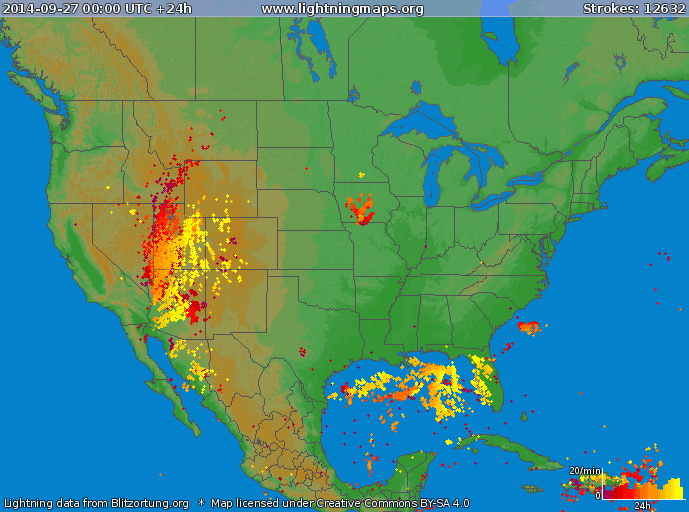
As is usually the case with CLE's, propagation conditions begin to deteriorate shortly after the announcement of the upcoming event. By the weekend's arrival, conditions are usually much worse than earlier in the week and such was the case once again! In North America, lightning activity and mediocre propagation dominated the three-night event, with the consensus of opinion giving the nod to Saturday night and early Sunday morning as being the best period.
 |
| Courtesy: http://www.lightningmaps.org/ |
Here on Mayne Island, Friday night was pretty much a wash and only the stronger signals made it through the din and into the log. A twilight check on Saturday evening indicated improving propagation and less lightning, renewing optimism that the entire weekend would not be a wipeout.
 Since purchasing the Perseus SDR earlier this year, I have been using it exclusively for the past few CLE's. I have been exploiting one of it's main features....the ability to record the entire band overnight and then tune through the band the next day, as in real time. I no longer had to prop my eyelids open until 0100 or later, or to leave a sound sleep to journey out to a cold shack to hunt the pre-sunrise band for anything new....yes, Perseus has made it possible to DX while I sleep!
Now the very concept of this horrifies many of the 'purists' and I myself held-out for several years before venturing over to the darkside...but...embracing new technology along with its associated new learning is what is important. If I get to sleep-in because of it, even better!
So....that's the way it is supposed to work, but due to operator error, Perseus failed to launch on Saturday night, and the best conditions of the CLE were missed altogether. Having seen the error in my ways, the perils of Perseus will, hopefully, not strike again!
Conditions on Sunday night were noisy once again, although not as bad as Friday, and the following log was gathered after parsing through my overnight recordings.
09 27 0400 350 NY Enderby, BC
09 29 0900 350 OKT Yoakum, TX - new catch
09 29 0700 350 RG Oklahoma City, OK
09 27 0400 350 SWU Idaho Falls, ID
09 29 0900 350 VTR McGrath, AK
09 29 0800 351 YKQ Wasaganish, QC
09 27 1330 353 AL Walla Walla, WA
09 29 0800 353 CY Cheyenne, WY
09 29 0800 353 DI Dickinson, ND
09 29 0800 353 IN International Falls, MN
09 27 1330 353 LLD Lanai, HI
09 29 0800 353 PG Portage, MB
09 27 0400 353 RNT Renton, WA
09 27 1330 353 ZXY Whitehorse, YT
09 29 1100 355 AUB King Salmon, AK
09 29 0800 355 YWP Webequie, ON
09 27 0700 356 MEF Medford, OR
09 29 0700 356 ODX Ord, NE
09 27 0700 356 ON Penticton, BC
09 27 1330 356 PND Portland, OR
09 27 0700 356 ZF Yellowknife, NT
09 29 0800 356 ZXE Saskatoon, SK
09 27 0400 358 SIT Sitka, AK
09 27 1300 359 BO Boise, ID
09 27 0500 359 SDY Sidney, MT
09 27 1300 359 YAZ Tofino, BC
09 29 0800 359 YQZ Quesnel, BC
09 29 0800 360 SW Warroad, MN
09 29 0900 361 E3 Wabasca, AB
09 29 0800 361 HI Holman, NT
09 29 1000 362 6T Foremost, AB
09 27 1300 362 BF Seattle, WA
09 29 0800 362 CD Chadron, NE
09 29 0600 362 RPX Roundup, MT
09 29 0800 362 YZS Coral Harbour, NU
09 29 0800 364 4D Helmet, BC
09 27 1100 365 AA Fargo, MN
09 29 0800 365 DPY Deer Park, WA
09 29 0800 365 HQG Hugoton, KS
09 29 0800 365 MA Mayo, YT
09 29 0800 366 YMW Maniwaki, QC
09 29 0800 368 ZP Sandspit, BC
09 27 1330 368 ZVR Vancouver, BC
09 29 0900 350 OKT Yoakum, TX - new catch
09 29 0700 350 RG Oklahoma City, OK
09 27 0400 350 SWU Idaho Falls, ID
09 29 0900 350 VTR McGrath, AK
09 29 0800 351 YKQ Wasaganish, QC
09 27 1330 353 AL Walla Walla, WA
09 29 0800 353 CY Cheyenne, WY
09 29 0800 353 DI Dickinson, ND
09 29 0800 353 IN International Falls, MN
09 27 1330 353 LLD Lanai, HI
09 29 0800 353 PG Portage, MB
09 27 0400 353 RNT Renton, WA
09 27 1330 353 ZXY Whitehorse, YT
09 29 1100 355 AUB King Salmon, AK
09 29 0800 355 YWP Webequie, ON
09 27 0700 356 MEF Medford, OR
09 29 0700 356 ODX Ord, NE
09 27 0700 356 ON Penticton, BC
09 27 1330 356 PND Portland, OR
09 27 0700 356 ZF Yellowknife, NT
09 29 0800 356 ZXE Saskatoon, SK
09 27 0400 358 SIT Sitka, AK
09 27 1300 359 BO Boise, ID
09 27 0500 359 SDY Sidney, MT
09 27 1300 359 YAZ Tofino, BC
09 29 0800 359 YQZ Quesnel, BC
09 29 0800 360 SW Warroad, MN
09 29 0900 361 E3 Wabasca, AB
09 29 0800 361 HI Holman, NT
09 29 1000 362 6T Foremost, AB
09 27 1300 362 BF Seattle, WA
09 29 0800 362 CD Chadron, NE
09 29 0600 362 RPX Roundup, MT
09 29 0800 362 YZS Coral Harbour, NU
09 29 0800 364 4D Helmet, BC
09 27 1100 365 AA Fargo, MN
09 29 0800 365 DPY Deer Park, WA
09 29 0800 365 HQG Hugoton, KS
09 29 0800 365 MA Mayo, YT
09 29 0800 366 YMW Maniwaki, QC
09 29 0800 368 ZP Sandspit, BC
09 27 1330 368 ZVR Vancouver, BC
I have, over the years, logged all of these beacons before, except for one..."OKT" in Yoakum, Texas...new catches are always nice and are harder to find it seems. The Google Map's 'street view' shows what appears to be a nice top-loaded "T" antenna at OKT:
 |
| Courtesy: https://www.google.ca/maps/ |
 |
| My CLE186 beacons - Courtesy: https://www.google.ca/maps/ |
It was nice to salvage Sunday night but I'm still a little bummed about missing the best night of the weekend...at least I had a good night's sleep.
The PAØRDT Active Whip….On LF
 |
| The Mini-Whip at University of Twente's (Netherlands) Remote Receiver |
I think many hams believe that they need big antennas and lots of space to operate on 630m or even to listen on the band. I can assure you that big antennas are definitely not needed to listen or for that matter, even to transmit effectively.
You might be surprised at just how well you can hear on 630m using one of your low band antennas, such as an 80m or 40m dipole. Best results will be had with the coaxial feed's shield lifted from ground and connected to the center pin. This, in effect, allows your dipole to act as a top-loaded 'T', with the coaxial feedline now acting as the vertical element and the dipole section as a capacitive tophat. With a few ground radials, such an antenna can even be used for transmitting, if suitably resonated, but that's another topic altogether. Even untuned, this system will allow you to receive suitably on 630m providing your location is not inundated with high noise levels. High noise levels can often be overcome by using loops, either resonated or broadband. Loops can be very effective at nulling noise, particularly if it is coming from one direction, and vastly improving LF receive-capabilities.
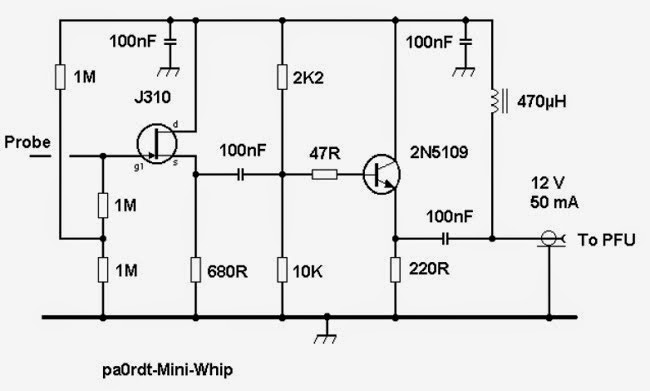
Another popular solution and one that can be quite effective at lowering noise levels and improving overall signal-to-noise is the use of a short active (amplified) whip antenna. One very popular and proven design is that of Roeloff Bakker, PAØRDT. His simple-to-build active whip has been employed around the world and is being used by many LF'rs for dependable reception on the NDB band as well as on 630m. Roeloff himself operates from a noisy urban area yet manages to hear amazingly well on LF and MF with this simple antenna. Unlike a much larger wire antenna or large loop, the small active whip can be easily positioned in the quietest part of your backyard or rooftop. Often just moving such an antenna a few feet one way or the other can make a huge change in the noise level if you are operating from a typical city or suburb location....the PAØRDT whip may be all that you really need for long-term, reliable LF reception.
 |
| Courtesy: PAØRDT |
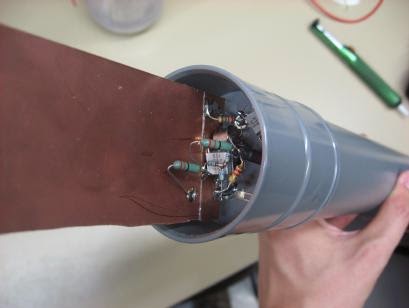
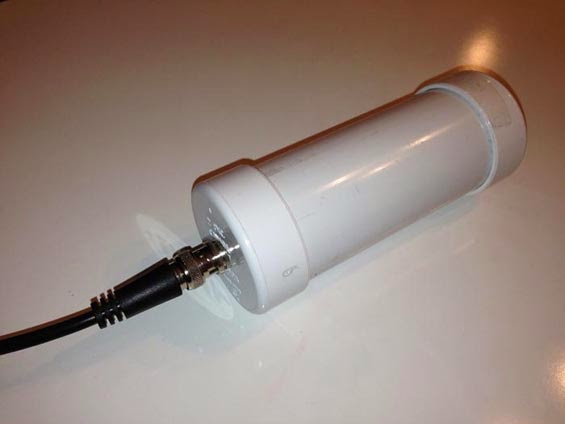
Common practice is to mount the PCB inside a small weather-sealed PVC pipe and erect it atop a mast, after taking the time to "sniff-out" the quietest location for its placement.
 |
| Courtesy: http://www.leeszuba.com/projects/ |
With very few parts needed, the whip can be built for just a few dollars...even less with a good junkbox and the needed transistors.
 |
| Courtesy: http://www.leeszuba.com/ |
You can read Roeloff's own information on construction of the active whip here, with additional information here.
I even see the parts and PCB available on e-bay. As well, Roeloff himself, can provide finished units ready to mount in the air.
 |
| Courtesy: http://countingradios.blogspot.ca/2014_01_01_archive.html |
There are plenty of informative Mini Whip articles and construction stories on the web should you wish to learn more:
- Fundamentals of the Mini Whip by PA3FWM
- The PAØRDT Mini Whip by DL1DBC
- The Mini Whip Antenna by Lee Szuba













