Author Archive
 Hunting For NDB’s In CLE190
 January 21st, 2015 |
 Author:
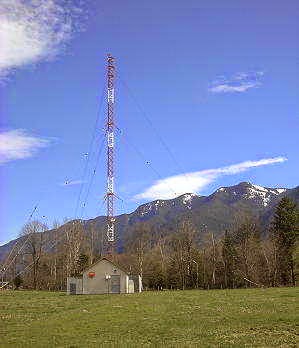 |
| LU-214KHz - Abbotsford, BC |
These listening events serve several purposes. They:
- determine, worldwide, which beacons are actually in service and on-the-air so the online database can be kept up-to-date
- determine, worldwide, which beacons are out-of-service or have gone silent since the last CLE covering this range
- will indicate the state of propagation conditions at the various participant locations
- will give you an indication of how well your LF/MF receiving system is working
- give participants a fun yet challenging activity to keep their listening skills honed
Our 190th Co-ordinated Listening Event is already less than a week away.
Do join in if you can. First-time CLE logs will also be very welcome.
Days: Fri. 23 - Mon. 26 January, Midday-Midday, your local time
Frequencies: NDBs from 190 - 239.9 kHz
PLUS Normal NDBs on 'half-way' frequencies nnn.5 kHz
(from 190.5 - 999.5 kHz)
Both halves are for everyone to try.
Away from Europe the frequencies below 240 kHz are mostly busy with
NDBs. In Europe there are very few but some DX ones might be heard
from North America and maybe a few other places.
The normal NDBs (no DGPS please) which have carriers on the 'half-way'
frequencies (e.g. 284.5 DY, 333.5 VOG, 359.5 CDN, 370.5 LB, 403.5 LNL)
are scattered across Europe but there are very few of them elsewhere.
Some 'hot spots' are ENG, FRA, ITA and XOE.
These half-frequencies give comfortable QRM-free listening and probably
some good catches as a result.
America has only one or two (e.g. 381.5 SJX) but East and West coasters
might hear some DX ones.
We last used these 'rules' for CLE174 in September 2013.
Good listening - enjoy the CLE
Brian
----------------------------------------------------------
From: Brian Keyte G3SIA ndbcle'at'gmail.com
Location: Surrey, SE England (CLE co-ordinator)
----------------------------------------------------------
(If you wish you could use any one remote receiver for your loggings,
stating the location and owner - with their permission if required.
A remote listener may NOT also use another receiver, local or remote,
to make further loggings for the same CLE).
Final details can be found at the NDB List website, and worldwide results, for every participant, will be posted there a few days after the event. If you are a member of the ndblist Group, results will also be e-mailed and posted there.
The very active Yahoo ndblist Group is a great place to learn more about the 'Art of NDB DXing' or to meet other listeners in your region. There is a lot of good information available there and new members are always very welcome.
If you are contemplating getting started on 630m, listening for NDBs is an excellent way to test out your receive capabilities as there are several NDBs located near this part of the spectrum.
You need not be an ndblist member to participate in the CLEs and all reports, no matter how small, are of much value to the organizers.
Reports may be sent to the ndblist or e-mailed to either myself or CLE co- ordinator, Brian Keyte (G3SIA), whose address appears above.
Please...do give the CLE a try....then let us know what NDB's can be heard from your location! Your report can then be added to the worldwide database to help keep it up-to-date.
The Low Noise Vertical
 There's been a lot of discussion lately on the Yahoo Groups ndblist regarding the "low-noise vertical" (LNV) and it's seemingly excellent performance. Originally described by Dallas Lankford as a good performer from LF to SW, ndblist member, Phil (KO6BB), recently refurbished his earlier built 'LNV', but this time with better feedline and appropriate ferrite cores for the antenna's matching transformers. Some of his description appears below.
To recap. I put the LNV up last spring to overcome the bad IMD products
from local BCB stations I was seeing in the LF region when using the
Roelof Active Whip located about 36 feet AGL. The low noise vertical is
... about 30 feet of antenna, set at roof-line level in this mobile home. As I wasn't sure how well the antenna would perform, I first made it a "Zero Dollar" project, using items I had on hand. Those items included two toroid cores salvaged from a defunct computer PS. I figured that since the supplies operate in the kHz range (as witness what a dirty supply will do to your LF reception), they would be suitable for at least a trial run of the antenna. The balanced feedline was some CAT6 cable I had on hand.
The antenna was a great success, because while it had much lower signal
output than the active whip, it also had ZERO IMD from the BCB stations,
and also less local 'junk' (read noise). The tunable pre-amp I use more
than made up for the lower output of the antenna, after all Signal/Noise
ratio is EVERYTHING in this hobby, NOT how high you can make the "S"
meter read.
The central valley summer heat (often in the 100's) took it's toll on
the CAT6 feedline outer jacket insulation, and while it still seemed to
work OK, I figured that it wouldn't be long before water started to get
into the line and probably degrade it in rainy/foggy weather.
Anyway, I went ahead and ordered the proper toroid coils I needed along
with 25 feet of nice 300 Ohm foam twinlead, and got a couple plastic
boxes to put it all in and made the toroid units. While I was at it ordered
two Amidon FT193-J toroid cores to complete the LNV the way I REALLY wanted to.
Today I installed it all, putting a heavy twist in the feedline to try
to reduce any stray noise pickup on the balanced feedline. I'd say
probably not likely but why take a chance.
OK, here are the results. I took signal level readings of eight 24/7
stations, both before and after changing out the wiring/baluns. The
bottom line is, the new antenna IS an improvement in the NDB range,
tapering off slightly at the high end of the broadcast band. Yeah, it's
'only' a couple "S" units at it's best, but when you're digging for that
weak NDB even 1 "S" unit is a LOT! I'm going to 'assume' 6dB per "S"
unit as I have calibrated the "S" meter of the R-71A receiver.
NOTE: This is 'fuzzy' math, don't take them as 'exact' on the dB readings.
FREQUENCY BEFORE AFTER DIFFERENCE
203 TCY S2 S4 2 S units (12dB)
205 COT S3 S5 2 S units (12dB?)
344 FCH S9+7 S9+15 (8dB)
374 LV S6 S7 1 S unit (6dB)
580 BCB Sta S9+35 S9+38 (3dB)
770 BCB Sta S9+32 S9+32 No Change
880 BCB Sta S9 S9 No Change
1450 BCB S9+10 S9+5 (-5dB)
SO, it looks like the antenna is definitely an improvement where I'm
REALLY interested in it (the NDB band). I could have probably tailored
the toroids for maximum performance, but just used the 81:9 turns ratio
on the outdoors (antenna) and 9:9 on the indoor unit as I'm FAR too lazy
to run up and down the ladder to remove the toroid box, change turns and
retry it again!!!
Some additional notes.
NOTE 1. I have three ground rods dedicated to just this antenna, two 8
footers and a 4 footer. While I was playing with the antenna taking
readings AFTER the work, I disconnected one of the 8 foot rods to see
what effect that had. Signal levels dropped approximately an "S" unit
across the board. So GOOD grounding on this antenna does make a difference!
NOTE 2. I'm NOT exactly sure why it happened, but after the antenna
work here, there was even LESS "local grunge" in the background than
before, even with the stronger signals, making for even better copy on
weak ones than I otherwise expected. . . It DOESN'T make sense to me,
but then, antennas ARE the magic art.
It appears that the grounding plays some importance in the performance of this "non-resonant" aperiodic antenna and the fact that it is non-resonant on the frequencies of interest likely also plays an important part in its good S/N performance.
Several years ago I noticed something similar. My own 10' tuned air-core loop made an excellent receive antenna on 160m, even though the loop was tuned to around 300KHz! Although signal strength was several S-units below my transmitting antenna, the loop was extremely quiet and weak signals were much easier to copy ... In fact I often heard signals on the mis-tuned loop that I could not hear on my resonant half-sloper radiator.
Another ndblist proponent of the low noise vertical is John, in Colorado, who employs three ... one of them a great-looking tilt-over version. The tilt-over is nicely demonstrated in his short you tube video below.
The antennas are also used in combination via his Quantum Phaser, when DXing the broadcast band. The excellent phasing results can also be seen in his short video, while using a wonderful, like new, Hammarlund SP-600 JX.
Dallas Lankford's original article may be found here, while an earlier more encompassing discussion will be found here. A third Lankford article, discussing 'Signal To Man Made Noise Ratios' and comparisons of various receiving antennas, also makes for interesting reading.
Perhaps the 'LNV' might be the antenna you're looking for to boost your LF/MW reception.
Yet More 630m Activity!
 Another VE7 has been bitten by the 630m bug ... well, intrigued enough to start building a station. On the weekend VA7MM (Mark), in Port Coquitlam, asked if I could take a listen for his low power signal. I'll let Mark describe his setup:
"My transmitter is a HP8640B signal generator. It is stable and has 1 Hz
frequency readout with maximum RF output of 20dBm. CW keying was done by latching the antenna on and off of the HP8640B. The latching relay was driven by the send relay in an IC-746Pro running with full break-in CW
turned on. A 1N914 switching diode was installed across the relay coil as
the back EMF from the relay was measured using my oscilloscope to be a +50V spike. This effectively attenuates the voltage spike. A good safety
precaution before installation.
A second HF radio, an IC-7600, was on a separate wire antenna for receive
only and with Spectran running for signal analysis.
In the final setup three series coils totalling 330 uH and a series of
parallel variable capacitors adjusted to about 1000 pf were installed in a
series resonance circuit outdoors at the base of a sloping dipole with the
apex at about 40 m. The antenna outside shielded and center conductor were connected effectively making the antenna a vertical. There was no impedance matching. One ground radial about 300' long was laid out laying on the surface of the ground. The resonance circuit was tuned using a combination of a Blackberry Z10 smart phone real time video chat link of Spectran from the ham shack in combination with a portable VHF audio feed to both visually and audibly tune the resonance circuit for maximum output. I tried a parallel resonance circuit but it did not work.
The straight line distances between QTHs from Google are:
VA7MM to VE7SL: 60 km
VA7MM to VE7CNF: 10 km
Amazing that a piece of lab equipment can be enabled with a few hours of
tinkering to transmit a signal on the 630 m band a distance of 60 km.
Thanks for the first 630 m band contacts. It was fun. Now I'm going to start planning a permanent capability on 630 m."
Mark's setup reminds me of a Rube Goldberg machine but it all worked well enough for him to put out a solid 559 signal at 60km distance and provide his first official 630m contact.
As of today, the following VE7 stations have now made two-way contacts on the new band:
VE7BDQ
VE7CNF
VE7SL
VA7JX
VA7MM
It would be great to see some activity from northern BC, VE6, VE5 and points further to the east. How about it fellas?
Lightwave Article From ‘TCA’
 |
| VE7SL Backyard Test |
Follow The Sun!
 |
| Courtesy: http://www.swpc.noaa.gov/ |
Where do you get your propagation information?
If you're anything like the rest of us, you probably have two or three favorite sites that you visit to collect the latest data. The news of NOAA's new solar page has been making the e-mail rounds of late and just in case you've missed it....the "Space Weather Enthusiasts Dashboard" (and what ham isn't a 'space weather enthusiast'?) can be found here.
The new site provides an all-in-one viewing experience, with up-to-the-minute reports on such things as the 'K' index, dynamic solar images from various satellites and at various wavelengths, auroral conditions, CME impact predictions (dynamic), a TEC (Total Electron Count) map, sunspot and Solar Cycle activity graphs and more. I didn't see anything showing the daily solar flux numbers (SFI) but it may be there. There is now a growing belief that the SFI value is not that great an indicator of what will or won't be happening, radio-wise, especially when it comes to 50MHz.
Another feature that would be nice, is a display of the latest DST index. This number, based upon equatorial ring currents, is a valuable indicator for the trend in LF propagation. I use the Kyoto site, which provides a real time look at the numbers. Anything positive, or a positive-going trend, is always a good thing to see.
 |
| Courtesy: http://wdc.kugi.kyoto-u.ac.jp/ |
If you haven't checked these three sites out, have a look...they're well worth a bookmark and a daily visit ... and, you won't have to go to Hawaii to follow the sun.
A New ‘VE’ on 630m!
 Interest in Canada's newest ham band, 630m, continues to slowly grow. Toby (VE7CNF) in Burnaby, BC, has made his first and second CW contacts on the new band!
Both myself and John (VE7BDQ) had the pleasure of working Toby on 473.000 CW on Thursday afternoon. Here is Toby's description of his station at present:
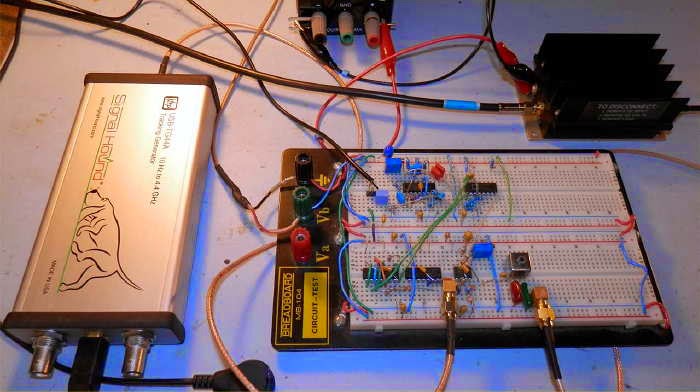
"I have put together a low-power 630m WSPR transmitter here. I have a USB-TG44A signal generator clocking a phasing-type SSB modulator with WSPR audio coming from a laptop. The modulator gives 45db suppression of the carrier and lower sideband. This drives a ZHL-32A 1-watt linear amplifier. I have a matching transformer and loading coil at the base of my 80-meter inverted-L antenna. Wire height is 10m.
John VE7BDQ has weakly received my WSPR signal. Are you able to receive WSPR?
The antenna series resistance is much higher than I expected, probably due to 10 year old antenna wire and only 4 ground radials. Right now the antenna match is poor and efficiency is very low. I may rewind the matching transformer tomorrow and gain a few dB. Maybe soon I’ll have enough signal to complete a 2-way CW QSO with you.
I have attached pictures of the hardware. After I determine the proper configuration I’ll make a more efficient loading coil."
 |
| Courtesy: VE7CNF |
 |
| Courtesy: VE7CNF |
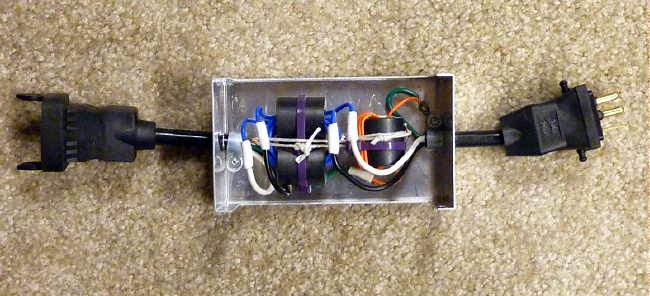
Grow Light Noise?
 |
| Courtesy: http://tomthompson.com/radio/projects.html |
Another type of noise problem was addressed in a posting to the topband reflector today by Don, WD8DSB.....the noise coming from a treadmill's, PWM speed-controlled DC motor.
" For many years my wife's treadmill caused strong interference on 160 meters when it was in use, and yesterday I was able to completely eliminate the RFI using a combination of two different filters (a commercial line filter that provides both common mode and differential mode filtering, and 14
turns of the power cord on a 2.4" OD Fair-Rite #31 mix toroid core based on
the K9YC hams guide to RFI document).
I created a simple website that documents my tests and the filters used,
and for those interested the website URL is:
http://sites.google.com/site/treadmillrfi/
The website contains a link to a video on youtube where you can actually
see the effectiveness of the filters. "
These two amateurs have developed slick solutions to their noise problems, but sadly, noise ingression is rising exponentially it seems and is becoming more and more challenging to mediate.