Author Archive
 Measuring The New Lenses
 February 1st, 2015 |
  Author:
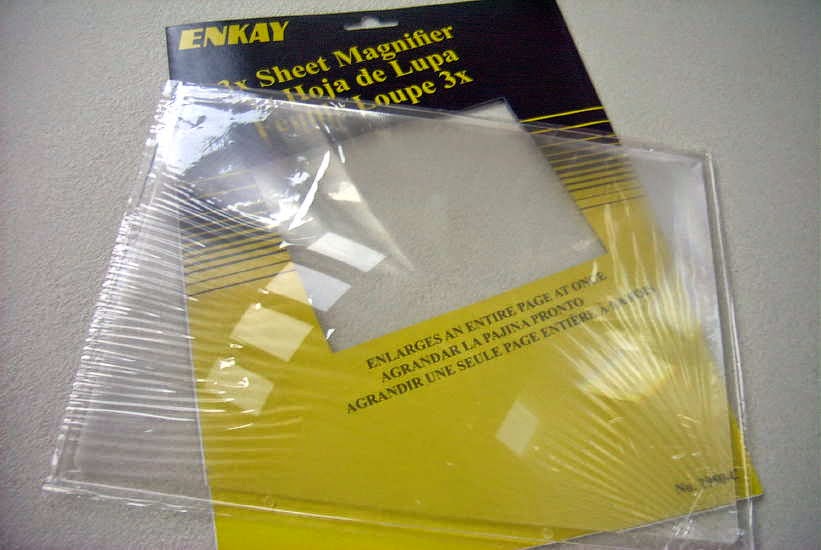
Yesterday I had the chance to have a closer look at the two lenses recently purchased for a new portable lightwave receiver. The initial testing procedure of the page-size fresnel (actual size is 200mm x 270mm) proved incorrect and required more space than the bench top could provide. Eventually the focal length was measured as ~ 368mm +/- for an f/d, or F number, of 1.36 ... a convenient value and much better than the 'other' common fresnel page reader focal length of ~ 600mm. This jibed nicely with the recommendations given in Clint's (KA7OEI) website optical information:
"For practical reasons, it is recommended that an optical system using Fresnel lenses be designed using lenses that have an F-number in the range of 0.5 to 1.5 - that is, around 1. Remember: The "F-number" is the focal length divided by the diameter of the lens, so for an F-number of unity or one, the diameter of the lens would be the same as its focal length."
The lens was able to bring a small LED flashlight (consisting of an array of 21 white LEDs) into surprisingly sharp focus although the shot below does not reflect that due to my camera's poor focus in the darkened room.
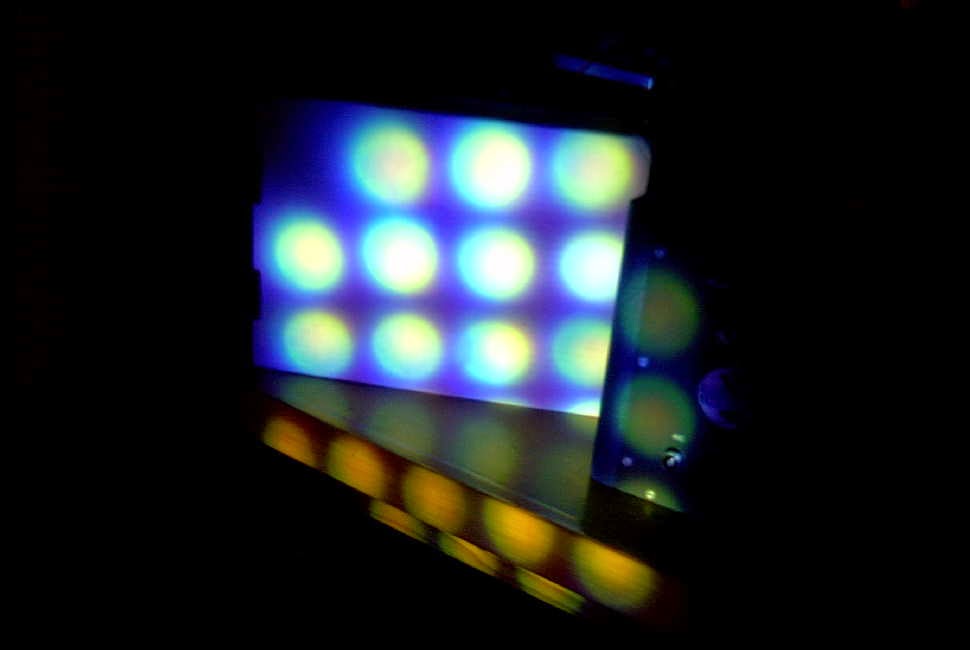
The glass 4.5" magnifying lens proved to have a focal point of 203mm for an F number of 1.8. This lense produced an even sharper image of the same light source and may be the best candidate for the portable receiver although the larger aperture of the fresnel might not be worth counting out at this point.
The fresnel may work well for a transmitter and will likely require a small (inexpensive) secondary focusing lens between the LED and the fresnel, in order to have the LED efficiently illuminate the fresnel. The secondary should effectively gather and focus as much of the emitted LED light to just within the boundaries of the fresnel without any wasted light energy being lost to spill-over at the edges.
It would be great to have a permanent lightwave 'beacon' that one could test various receiver lenses and combinations but at present there is very little activity here in VE7 land ... although that is changing, with the interest of another local, VE7IGH (Greg) near Vancouver and right across Georgia Strait from my location. Grant has already built a receiver and will soon start on transmitter construction ... way to go Greg!
’29 MOPA / NLOS Lightwave Progress
 |
| Courtesy: http://www.arrl.org/ |
I've now completed a set of tank coils for the new'29 MOPA project. These were wound with 3/16" copper tubing which has become very difficult to source. Luckily, after much searching, I was fortunate enough to find several rolls locally at a very attractive price. Although I do see it quite often on e-bay, sellers either refuse to ship to Canada or their shipping charges are far too high to make it worthwhile. The larger 1/4" rolls are still readily available, but for any given inductance, will take up a lot more room on the breadboard if space is an issue.
These coils cover the amplifier tank, the Hartley oscillator's tank, and the antenna coupling link. Respectively, the coils measure 4.9uH, 4.0uH and 1.9uH.
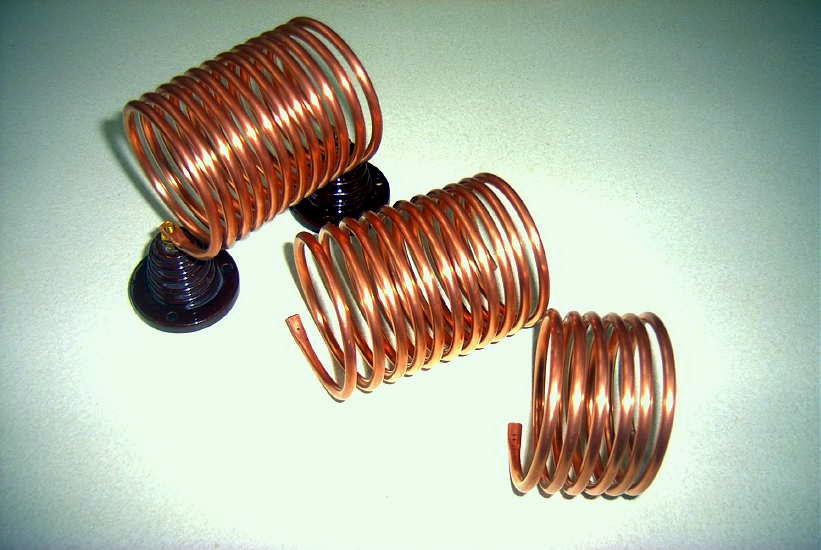
Winding these is always fun but the method used requires that the needed length be predetermined and cut from the roll beforehand. The first time I did this, when building my TNT transmitter, I learned the hard way to always add at least another foot to cover the additional length eaten-up by turn-spacing and for coil end flattening and mounting.
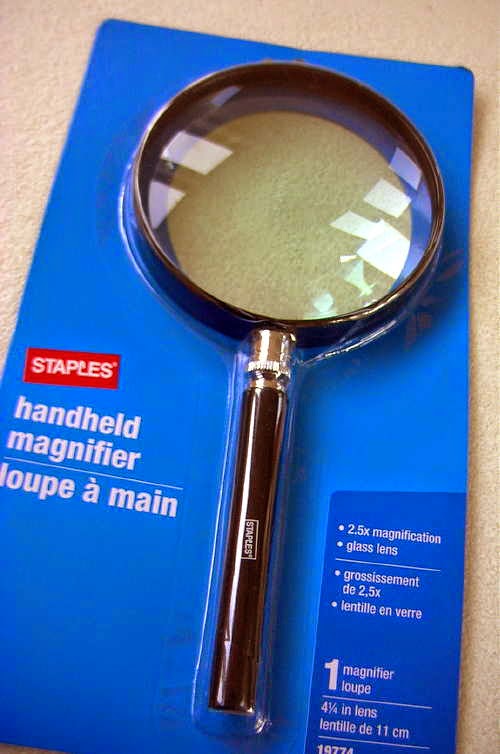
While visiting Vancouver for a few days I was able to find a couple of pieces needed for my non-line of sight (NLOS) lightwave experiments.
I purchased a nice 4.25" magnifier lens, with suitable focal length, as well as an inexpensive page-size fresnel magnifying lens. What is particularly pleasing is that the fresnel is a rigid lens, about 2 mm thick, unlike most page magnifiers that are thin and floppy. I have yet to test its blur circle or determine its focal length.
I plan to use one or the other of these lenses in a small, portable lightwave receiver module that I can carry to the other side of the island to listen for the main large transmitter, aimed slightly above the horizon, in beacon-mode. If the smaller fresnel does the job, it will be an inexpensive source for anyone else needing a simple lens for either transmitting or receiving.
If the deep-red light tests prove successful, I'll switch the system to IR light but at this stage I'm not sure how focusing and optimizing receivers and transmitters can be done with a light source that is essentially invisible? Perhaps using an IR source that is right on the edge of deep-red will still have enough visible light to allow finding the optimum focus more easily.
More information on NLOS experiments can be found in Yahoo's Optical DX Group as well is in G3XBM' s 481thz blogs.
As well, anyone in the Vancouver lower mainland (as far as the northern Sunshine Coast area) that might be considering lightwave ... I'd love to work you! Pretty well any high spot in this region is direct LOS for me.
’29 MOPA Progress
 |
| '29 MOPA Plan |
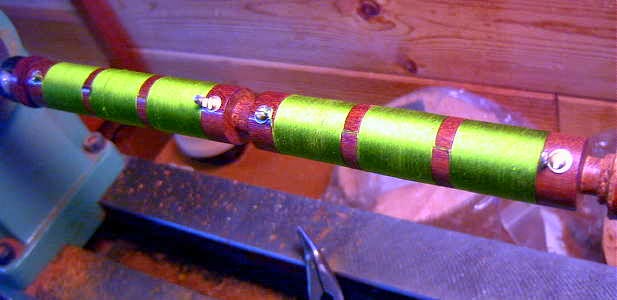
The choke forms were first turned on the wood lathe, using Mahogany hardwood scrap, to a diameter of 3/4", and then stepped down slightly, for the space occupied by the windings. The windings, using single silk enamel #31, were then done, still on the lathe, while rotating the spindle manually.
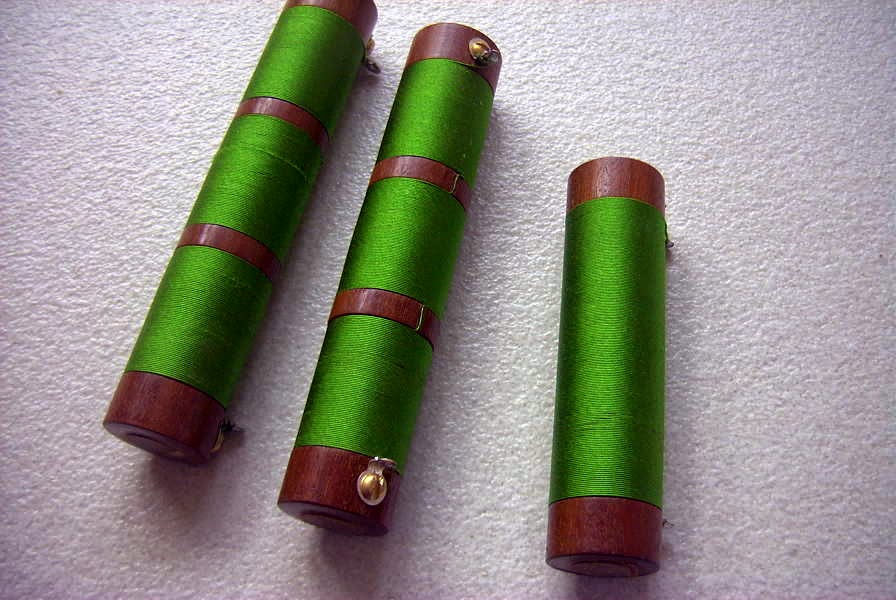
I've always been surprised at how little inductance is really needed for effective choking on HF and it would seem that the 'standard' 2.5mH is much more than is actually required. The single-ended version is just 190uH, while the three-section chokes measure just 240uH, about 10% of what normally might be specified today.
CLE190 Logs
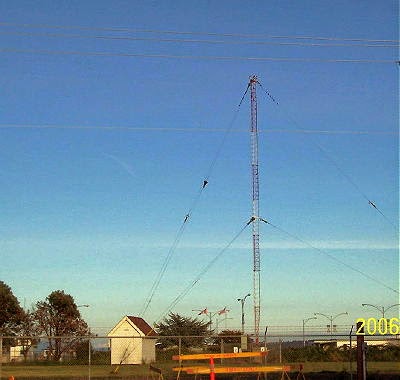 |
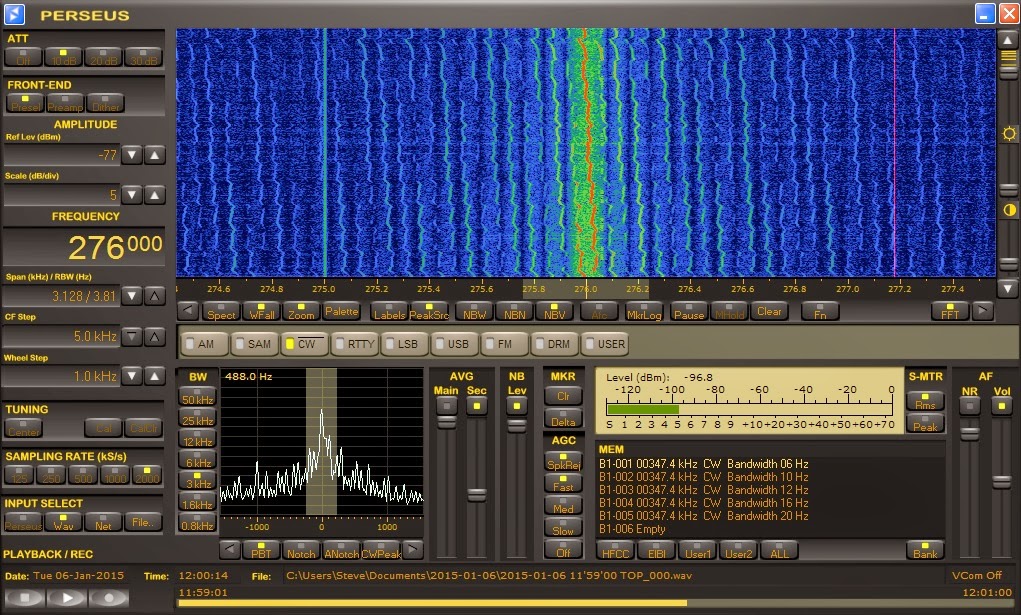
| YJ-200KHz - Victoria Int'l |
 |
| CFL Crud |
25 04:00 198 DIW Dixon, NC, USA
24 06:00 200 YJ Victoria - Sidney Island, BC, CAN
24 04:00 200 YDL Dease Lake, BC, CAN
25 07:00 200 UAB Anahim Lake, BC, CAN
24 04:00 201 ZWN Winnipeg, MB, CAN
24 12:00 201 IP Lufthansa, AZ, USA
24 07:00 201 GV Greenville, TX, USA
26 05:40 201 YVZ Deer Lake, ON, CA
24 06:00 203 ZKI Kitimat, BC, CAN
24 06:00 203 YBL Campbell River, BC, CAN
24 06:00 203 TCY Tracy Municipal Apt, CA, USA
24 04:00 204 ZQR Regina, SK, CAN
24 11:00 205 XZ Wawa, ON, CAN
24 04:00 205 COR Corcoran, CA, USA
24 04:00 206 SOW Show Low Regional Apt, AZ, USA
24 04:00 206 EF Castlegar, BC, CAN
24 04:00 207 YNE Norway House, MB, CAN
24 04:00 207 PY Fort Chipewyan, AB, CAN
24 07:00 209 ITR Burlington, CO, USA
24 04:00 209 IB Atikokan, ON, CAN
25 14:00 209 HGT Tusi AHP, CA, USA
24 04:00 209 CYT Yakataga Apt, ALS
24 04:00 211 HDG Gooding, ID, USA
24 04:00 212 YGX Gillam, MB, CAN
25 04:00 212 MPZ Mount Pleasant, IA, USA
24 04:00 212 CGL Juneau, ALS
24 07:00 212 CFV Coffeyville, KS, USA
24 04:00 214 LU Abbotsford, BC, CAN
24 04:00 215 ZAB Edmonton (Intl Apt), AB, CAN
24 11:00 215 TQH Tahlequah, OK, USA
24 04:00 216 GRF Fort Lewis, WA, USA
24 04:00 216 CLB Wilmington, NC, USA
24 04:00 217 EC Enoch, UT, USA
24 11:00 218 RL Red Lake, ON, CAN
24 04:00 218 PR Prince Rupert, BC, CAN
24 04:00 219 ZRS Regina, SK, CAN
24 07:00 220 HLE Hailey, ID, USA
24 04:00 221 QU Grande Prairie, AB, CAN
24 04:00 222 WY Wrigley, NT, CAN
24 04:00 223 YKA Kamloops, BC, CAN
24 04:00 223 AFE Kake Apt, ALS
25 11:00 224 MO Moosonee, ON, CAN
24 04:00 224 DN Dauphin, MB, CAN
25 04:00 225 X5 Vegreville, AB, CAN
24 04:00 225 LWG Lewisburg - Corvallis, OR, USA
25 04:00 227 YAC Cat Lake, ON, CAN
25 12:00 227 MHM Minchumina, ALS
24 04:00 227 CG Castlegar, BC, CAN
24 04:00 229 AKW Klawock, ALS
24 06:00 230 YD Smithers, BC, CAN
24 07:00 230 VG Vermilion, AB, CAN
24 11:00 230 NRN Norton, KS, USA
24 07:00 230 BI Bismarck, ND, USA
24 07:00 233 QN Nakina, ON, CAN
24 07:00 233 OKS Oshkosh, NE, USA
25 14:00 233 LG Seal Beach, CA, USA
24 04:00 233 BWP Breckenridge, ND, USA
24 04:00 233 BR Brandon, MB, CAN
25 12:00 233 AZN Amazon, MO, USA
24 04:00 233 ALJ Hinchinbrook Island, ALS
25 04:00 235 CN Cochrane, ON, CAN
25 04:00 236 ZRJ Round Lake, ON, CAN
24 04:00 236 YZA Ashcroft, BC, CAN
24 04:00 236 FOR Forsyth, MT, USA
24 04:00 238 MPA Nampa, ID, USA
24 04:00 239 OJ High Level, AB, CAN
25 04:00 381.5 SJX St James, MI, USA
Listening for NDBs is a practical way to check out your LF receive capability, should you be interested in developing a good 630m station or in following the nuances of night-to-night MF propagation.
Good TP On Medium Wave (BCB)
 Early morning (Jan 22) saw BCB conditions vastly improved over what they have been for most of the season. Because I am on the wrong (none-Pacific) side of Vancouver Island, as well as on the eastern shores of Mayne Island, I usually don't listen for Asian signals on my Perseus recordings but a quick check of Thursday's recordings revealed some very solid signals from many Japanese stations, as well as Korea. Most signals were strongest at around 1500Z (7 a.m. local) but were first audible from about 1200Z.
Three of the good performers are shown in the video below:
- JOBB 828KHz NHK2 Osaka
- JOAK 594KHz NHK1 Tokyo
- HLAZ 1566KHz Jeju, South Korea / Far Eastern Broadcasting Company
Numerous other signals, reaching similar strengths were audible throughout the broadcast band on their 9KHz-spaced channels. Interestingly, I had configured my LF inverted-L into a temporary version of a low noise vertical (LNV) by removing all of the loading coil and feeding with an isolating impedance matching transformer. I rather suspect that in this mode it is acting as a normal quarter-wave inverted-L however as its self-resonant frequency, without any loading, is around 1200KHz. Today's conditions were much poorer but several Asian signals were heard once again.
Should conditions improve, the next time I will use my large loop oriented to favor Japan and also take advantage of its ability to null many of the local blowtorch signals from Vancouver, off to the side.
Hunting For NDB’s In CLE190
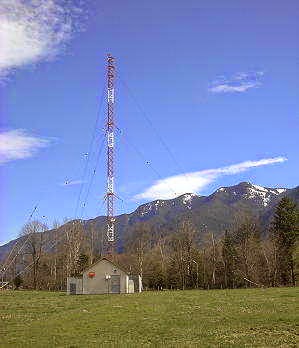 |
| LU-214KHz - Abbotsford, BC |
These listening events serve several purposes. They:
- determine, worldwide, which beacons are actually in service and on-the-air so the online database can be kept up-to-date
- determine, worldwide, which beacons are out-of-service or have gone silent since the last CLE covering this range
- will indicate the state of propagation conditions at the various participant locations
- will give you an indication of how well your LF/MF receiving system is working
- give participants a fun yet challenging activity to keep their listening skills honed
Our 190th Co-ordinated Listening Event is already less than a week away.
Do join in if you can. First-time CLE logs will also be very welcome.
Days: Fri. 23 - Mon. 26 January, Midday-Midday, your local time
Frequencies: NDBs from 190 - 239.9 kHz
PLUS Normal NDBs on 'half-way' frequencies nnn.5 kHz
(from 190.5 - 999.5 kHz)
Both halves are for everyone to try.
Away from Europe the frequencies below 240 kHz are mostly busy with
NDBs. In Europe there are very few but some DX ones might be heard
from North America and maybe a few other places.
The normal NDBs (no DGPS please) which have carriers on the 'half-way'
frequencies (e.g. 284.5 DY, 333.5 VOG, 359.5 CDN, 370.5 LB, 403.5 LNL)
are scattered across Europe but there are very few of them elsewhere.
Some 'hot spots' are ENG, FRA, ITA and XOE.
These half-frequencies give comfortable QRM-free listening and probably
some good catches as a result.
America has only one or two (e.g. 381.5 SJX) but East and West coasters
might hear some DX ones.
We last used these 'rules' for CLE174 in September 2013.
Good listening - enjoy the CLE
Brian
----------------------------------------------------------
From: Brian Keyte G3SIA ndbcle'at'gmail.com
Location: Surrey, SE England (CLE co-ordinator)
----------------------------------------------------------
(If you wish you could use any one remote receiver for your loggings,
stating the location and owner - with their permission if required.
A remote listener may NOT also use another receiver, local or remote,
to make further loggings for the same CLE).
Final details can be found at the NDB List website, and worldwide results, for every participant, will be posted there a few days after the event. If you are a member of the ndblist Group, results will also be e-mailed and posted there.
The very active Yahoo ndblist Group is a great place to learn more about the 'Art of NDB DXing' or to meet other listeners in your region. There is a lot of good information available there and new members are always very welcome.
If you are contemplating getting started on 630m, listening for NDBs is an excellent way to test out your receive capabilities as there are several NDBs located near this part of the spectrum.
You need not be an ndblist member to participate in the CLEs and all reports, no matter how small, are of much value to the organizers.
Reports may be sent to the ndblist or e-mailed to either myself or CLE co- ordinator, Brian Keyte (G3SIA), whose address appears above.
Please...do give the CLE a try....then let us know what NDB's can be heard from your location! Your report can then be added to the worldwide database to help keep it up-to-date.
The Low Noise Vertical
 There's been a lot of discussion lately on the Yahoo Groups ndblist regarding the "low-noise vertical" (LNV) and it's seemingly excellent performance. Originally described by Dallas Lankford as a good performer from LF to SW, ndblist member, Phil (KO6BB), recently refurbished his earlier built 'LNV', but this time with better feedline and appropriate ferrite cores for the antenna's matching transformers. Some of his description appears below.
To recap. I put the LNV up last spring to overcome the bad IMD products
from local BCB stations I was seeing in the LF region when using the
Roelof Active Whip located about 36 feet AGL. The low noise vertical is
... about 30 feet of antenna, set at roof-line level in this mobile home. As I wasn't sure how well the antenna would perform, I first made it a "Zero Dollar" project, using items I had on hand. Those items included two toroid cores salvaged from a defunct computer PS. I figured that since the supplies operate in the kHz range (as witness what a dirty supply will do to your LF reception), they would be suitable for at least a trial run of the antenna. The balanced feedline was some CAT6 cable I had on hand.
The antenna was a great success, because while it had much lower signal
output than the active whip, it also had ZERO IMD from the BCB stations,
and also less local 'junk' (read noise). The tunable pre-amp I use more
than made up for the lower output of the antenna, after all Signal/Noise
ratio is EVERYTHING in this hobby, NOT how high you can make the "S"
meter read.
The central valley summer heat (often in the 100's) took it's toll on
the CAT6 feedline outer jacket insulation, and while it still seemed to
work OK, I figured that it wouldn't be long before water started to get
into the line and probably degrade it in rainy/foggy weather.
Anyway, I went ahead and ordered the proper toroid coils I needed along
with 25 feet of nice 300 Ohm foam twinlead, and got a couple plastic
boxes to put it all in and made the toroid units. While I was at it ordered
two Amidon FT193-J toroid cores to complete the LNV the way I REALLY wanted to.
Today I installed it all, putting a heavy twist in the feedline to try
to reduce any stray noise pickup on the balanced feedline. I'd say
probably not likely but why take a chance.
OK, here are the results. I took signal level readings of eight 24/7
stations, both before and after changing out the wiring/baluns. The
bottom line is, the new antenna IS an improvement in the NDB range,
tapering off slightly at the high end of the broadcast band. Yeah, it's
'only' a couple "S" units at it's best, but when you're digging for that
weak NDB even 1 "S" unit is a LOT! I'm going to 'assume' 6dB per "S"
unit as I have calibrated the "S" meter of the R-71A receiver.
NOTE: This is 'fuzzy' math, don't take them as 'exact' on the dB readings.
FREQUENCY BEFORE AFTER DIFFERENCE
203 TCY S2 S4 2 S units (12dB)
205 COT S3 S5 2 S units (12dB?)
344 FCH S9+7 S9+15 (8dB)
374 LV S6 S7 1 S unit (6dB)
580 BCB Sta S9+35 S9+38 (3dB)
770 BCB Sta S9+32 S9+32 No Change
880 BCB Sta S9 S9 No Change
1450 BCB S9+10 S9+5 (-5dB)
SO, it looks like the antenna is definitely an improvement where I'm
REALLY interested in it (the NDB band). I could have probably tailored
the toroids for maximum performance, but just used the 81:9 turns ratio
on the outdoors (antenna) and 9:9 on the indoor unit as I'm FAR too lazy
to run up and down the ladder to remove the toroid box, change turns and
retry it again!!!
Some additional notes.
NOTE 1. I have three ground rods dedicated to just this antenna, two 8
footers and a 4 footer. While I was playing with the antenna taking
readings AFTER the work, I disconnected one of the 8 foot rods to see
what effect that had. Signal levels dropped approximately an "S" unit
across the board. So GOOD grounding on this antenna does make a difference!
NOTE 2. I'm NOT exactly sure why it happened, but after the antenna
work here, there was even LESS "local grunge" in the background than
before, even with the stronger signals, making for even better copy on
weak ones than I otherwise expected. . . It DOESN'T make sense to me,
but then, antennas ARE the magic art.
It appears that the grounding plays some importance in the performance of this "non-resonant" aperiodic antenna and the fact that it is non-resonant on the frequencies of interest likely also plays an important part in its good S/N performance.
Several years ago I noticed something similar. My own 10' tuned air-core loop made an excellent receive antenna on 160m, even though the loop was tuned to around 300KHz! Although signal strength was several S-units below my transmitting antenna, the loop was extremely quiet and weak signals were much easier to copy ... In fact I often heard signals on the mis-tuned loop that I could not hear on my resonant half-sloper radiator.
Another ndblist proponent of the low noise vertical is John, in Colorado, who employs three ... one of them a great-looking tilt-over version. The tilt-over is nicely demonstrated in his short you tube video below.
The antennas are also used in combination via his Quantum Phaser, when DXing the broadcast band. The excellent phasing results can also be seen in his short video, while using a wonderful, like new, Hammarlund SP-600 JX.
Dallas Lankford's original article may be found here, while an earlier more encompassing discussion will be found here. A third Lankford article, discussing 'Signal To Man Made Noise Ratios' and comparisons of various receiving antennas, also makes for interesting reading.
Perhaps the 'LNV' might be the antenna you're looking for to boost your LF/MW reception.













