Author Archive
 CLE191 Addendum
 February 20th, 2015 |
  Author:
 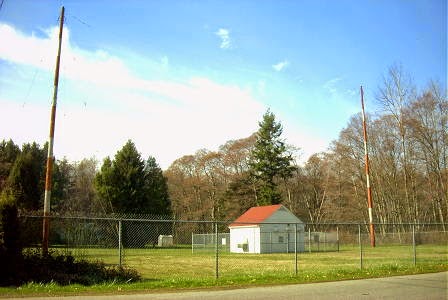 |
| WC-332KHz - White Rock, BC |
From Neil (WØYSE):
WG2XSV (experimental callsign) will be running a CW beacon on 475.475 kHz for this event.
(In fact it is already running as of 0001 UTC 20 Feb).
Power is ~1 watt ERP (+/- 1 dB) from SW Washington State.
Reports appreciated to wØyse [at] ARRL[dot] net
I'm sure Neil would be delighted to receive any heard reports from his weekend CW beacon. Remember that this CLE also covers the 630m band and CW beacons that may be operational there.
If you know of any other 630m CW beacons that will be activated, please let me know and I will post the information here.
Also, CLE reports may be mailed to either myself, the CLE Yahoo list or to Brain Keyte, CLE organizer. Brian's address is: [email protected]
Reports should include your exact location (Lat/Long preferred or exact Gridsquare), your full name and e-mail address in case Brian needs to send an enquiry regarding your log.
The finer-details of CLE191 may be found in Wednesday's blog.
Lets hope conditions stay nice and quiet as they appear to be doing.
Hunting For NDB’s In CLE191
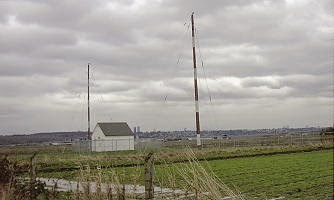 |
| One CLE Target - 'VR' 266KHz / Vancouver Int'l Approach |
How time flies. For you low-frequency buffs, another challenge awaits. From CLE coordinator Brian Keyte (G3SIA) comes the following reminder:
"Our February Co-ordinated Listening Event will soon be here.
We'll be hunting for normal beacons in two contrasting frequency ranges.
One range also gives the possibility of hearing several amateur beacons.
As always, first-time CLE logs will be extra welcome.
Days: Friday 20 February - Monday 23 February
Times: Start and end at midday, your local time
Frequencies: 260.0 - 269.9 kHz
plus: 440.0 - 1740.0 kHz
Many of us should be able to hear beacons in both ranges, though Europe
only has a handful in the '260s'. From 440 onwards, Eastern Europe and
North Africa have several beacons and some regular UNIDs and some NDBs
can be found among Europe's Medium Wave Broadcast Stations.
Many of us are within range of some of the amateur beacons on frequencies around 470 kHz and 500 kHz - we'll be listening for ANYTHING OPERATING IN BEACON MODE, preferably with normal speed Morse.
(We ask operators who sometimes use QRSS, PSK, WSPR, etc., which need
software to receive them, to PLEASE CHOOSE THE SIMPLER MODE during
the CLE so that we shall all be able to receive and report them).
Send your CLE log to the List, preferably as a plain text email
and not in an attachment, with CLE191 at the start of its title.
Please show on EVERY LINE of your log:
# The full Date (or Day no.) and UTC (the day changes at 00:00 UTC).
# kHz (the beacon's nominal published frequency, if you know it)
# The Call Ident.
Other optional details, Location, Distance, etc., go LATER in the same
line (or in footnotes). Any extra details about UNIDs, especially strong
ones that may be near to you (maybe their approximate direction, etc.)
will help us to discover more about them. As always, please make your
log useful to old and new members alike by including your own location
and brief details of the equipment and aerial(s) you were using.
I will send an 'Any More Logs?' email at about 18:00 UTC on Tuesday
evening. From it you can check that your log has been found OK.
Do make sure that your log has arrived at the very latest by 09:00 UTC
on Wednesday 25 February.
I hope to finish making the combined results on that day."
These listening events serve several purposes. They:
- determine, worldwide, which beacons are actually in service and on-the-air so the online database can be kept up-to-date
- determine, worldwide, which beacons are out-of-service or have gone silent since the last CLE covering this range
- will indicate the state of propagation conditions at the various participant locations
- will give you an indication of how well your LF/MF receiving system is working
- give participants a fun yet challenging activity to keep their listening skills honed
Final details can be found at the NDB List website, and worldwide results, for every participant, will be posted there a few days after the event. If you are a member of the ndblist Group, results will also be e-mailed and posted there.
The very active Yahoo ndblist Group is a great place to learn more about the 'Art of NDB DXing' or to meet other listeners in your region. There is a lot of good information available there and new members are always very welcome.
If you are contemplating getting started on 630m, listening for NDBs is an excellent way to test out your receive capabilities as there are several NDBs located near this part of the spectrum.
You need not be an ndblist member to participate in the CLEs and all reports, no matter how small, are of much value to the organizers. 'First-time' logs are always VERY welcome!
Reports may be sent to the ndblist or e-mailed to either myself or CLE co- ordinator, Brian Keyte (G3SIA), whose address appears above.
Please...do give the CLE a try....then let us know what NDB's can be heard from your location! Your report can then be added to the worldwide database to help keep it up-to-date.
630m Crossband Tonight!

Just a reminder about the 630m crossband activity night this evening. There have been two updates to the plan. VE7SL will start one hour later than originally planned and John, VE7BDQ, will be listening on both 160m and 80m QSX frequencies for callers.
The frequencies will be:
- VE7SL TX 473.00KHz QSX (listening) 1808KHz (160m) and 3535KHz (80m)
- VE7BDQ TX 474.00KHz QSX (listening) 1813KHz (160m) and 3532KHz (80m)
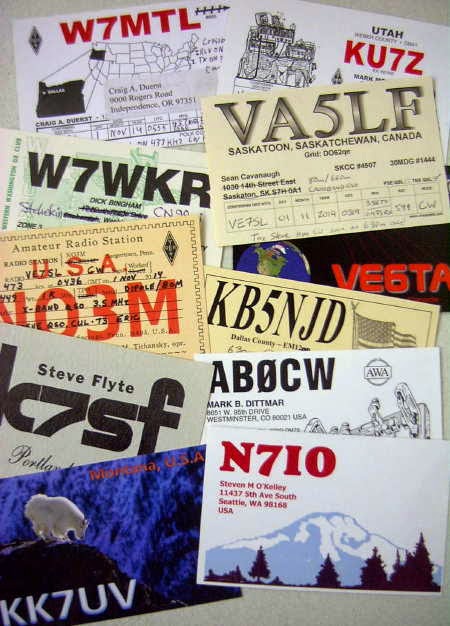
The last time this was done, transcontinental contacts were completed ... hopefully conditions will continue to co-operate and propagation will be good tonight.
The Boys of Summer
 This past week, Les Rayburn (N1LF), compared his yearn for the start of spring baseball to the late spring return of summer VHF openings, with this delightfully nostalgic post to the VHF reflector.
It occurred to me this morning that being a VHF operator is a lot like being a baseball fan. It was warm and sunny here yesterday, and this morning the air has that first touch of Spring in it.
Sure, there arestill cold days ahead--but you just have that feeling that we've turned the corner on Winter. The days are getting a bit longer, and the sun doesn't set quite so early anymore.
And like baseball fans, we start to look forward to those first
rumblings out of the Spring league.
For me, that means the confident voice of August, K5HCT. Nothing heralds
the arrival of the season like those first faint signals and the
familiar refrain..."Here Comes Texas!". This is nearly always the first
call I hear in the season, and the last remaining on the band at it's end.
In my boyhood days, I loved listening to baseball on the radio at night.
Those far away places, and the crack of the bat---mixed with the static
and pops of Summer storms. It was like a magic carpet that could
transport me thousands of miles away...The rest of the year, I still
enjoyed tuning the dial during the overnight hours--maybe listening to
the Herb Jepko Nightcap show from Salt Lake, or Larry King---but radio
wasn't the same without baseball. And those months between the World
Series and Opening Day were the longest of the year.
All these years later, things haven't changed much. I still love
listening to baseball on the radio---but now while waiting for opening
day, I find myself turning another dial...listening hard in the static
to see if I can hear that faint signal on the calling frequency. A deep,
rich, confident voice calling "This K5HCT, Here Comes Texas!".
Somebody press play on that MP3 player or I-Phone---cue up Don Henley's
"Boys of Summer"...I'll hum along and wait for Spring.
--
--
73,
Les Rayburn, N1LF
121 Mayfair Park
Maylene, AL 35114
EM63nf
630m Crossband Activity Night
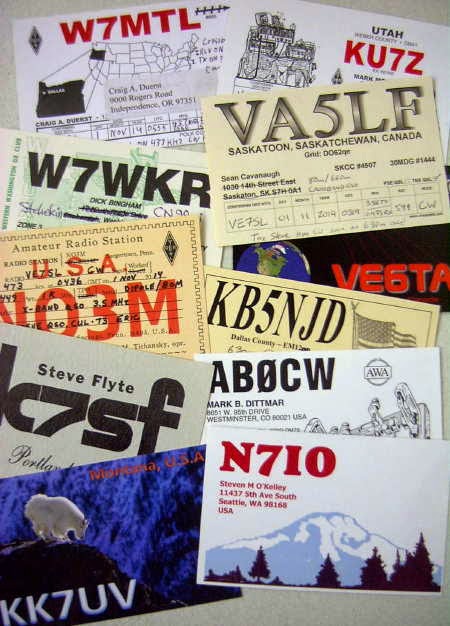 |
| 630m to HF Crossband |
Our plan is to operate from 0200Z through 0700Z, (1800-2300 PST Saturday). Beginning at the top of the hour, we will both be calling CQ on CW and listening for any callers on HF. CQ's will continue until there are no more callers and will begin again at the next top of hour time slot. This should allow for a wide variation in propagation and the possibility of eastern contacts as the evening progresses.
The frequencies will be:
- VE7SL TX 473.00KHz QSX (listening) 1808KHz (160m) and 3535KHz (80m)
- VE7BDQ TX 474.00KHz QSX (listening) 1813KHz (160m)
If you have not had a look for any 630m stations, hopefully you will take the opportunity this coming Saturday night ... you really do not need any special antennas for receiving on 630m. Many of the stations that I have worked on crossband have been using HF dipoles for low-noise reception.
I'll be promoting this event on several of the reflectors and groups that I regularly enjoy and I also invite you to pass the word on to others. Please watch the blog for further updates.
See you Saturday I hope!
House Number Four – Update
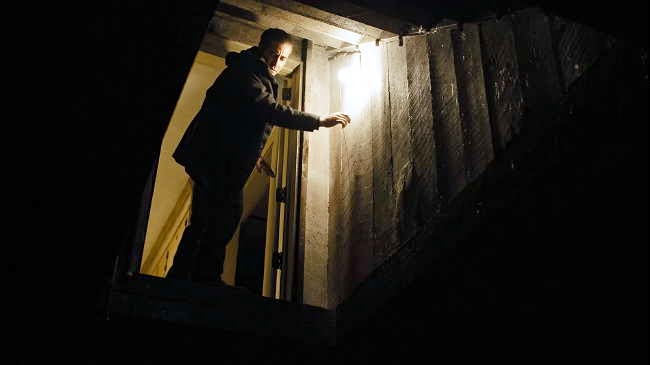
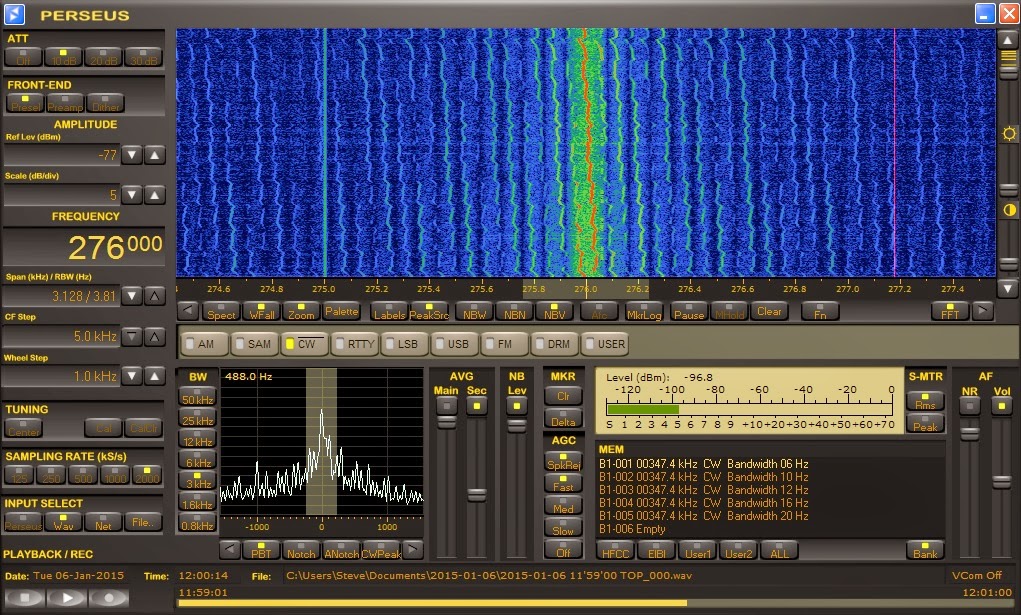
Regular readers will likely recall my early January blog describing the sudden and very unwelcome appearance of a severe noise problem badly affecting my LF reception. I had spent an afternoon D/F'ing the noise source (which was being radiated via the local power lines), only to discover that the residence in question was not occupied ... and has been vacant for the past seven weeks as the noise continued.
 |
| The culprit |
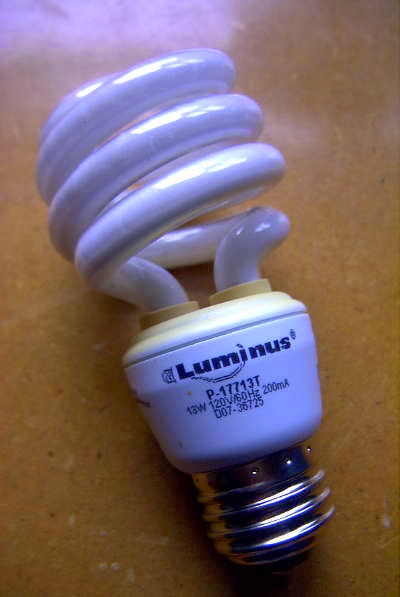
Yesterday I noticed that the home was once again occupied and this morning, with radio in hand, I paid visit. It seems that the part-time residents had been spending the past several weeks in Hawaii and had just returned to the house to check up on things. I explained to the owner what I believed to be the problem and, as suspected, it was a CFL light ... a particularly noisy one. Turning the light on and off quickly verified the culprit light and swapping the bulb out for a different one produced no observable noise, as was the case for one that had been left switched-on in the living room.
Whether the offending bulb was just a poorly designed one, a very early manufactured model or one that was about to fail, I do not know ... but I am amazed at the strength of the QRN (and QRM) that the bulb was able to produce at such a distance, about ten properties away!
 |
| CFL Crud on LF |
The owner was very concerned that he had unknowingly caused a problem and was very apologetic, as I have found with similar situations in the past.
One of the worst was also a CFL bulb that had actually burned-out and was located in a nearby (three properties away) crawl space. When finally traced, the bulb was heavily charred and had partially melted at the base, yet was still producing an ear-shattering level of crud right into the HF spectrum.
In cases like these, it is often difficult to get an accurate D/F on the signal through normal means since the signal is being propagated via the overhead powerlines. Attempts to D/F the signal almost always point to the closest powerline and not to the signal source. Usually such a noise generator will be confined to your local power grid ... that is, the homes that are powered between the two large power distribution transformers in your local neighborhood. In my case, this limits the search to about 15 homes.
I have found that the best way to tackle this is to make a 'noise map' and to try and measure the noise intensity at a similar point for each property - ie. directly beneath the powerline as it enters the property. This will usually put you at the same vertical distance from the line and will give you a better noise sample that is directly (or not) associated with that property. After mapping this out, if the culprit property is not obvious, then you will at least have narrowed it down to a very few choices. Other types of noise, that can be detected into the VHF range, are probably best detected using normal D/F methods.
After bringing the offending bulb home, I Google-searched the product name and number and came up with a 'product recall' for this particular model.
"According to a Health Canada and Electrical Safety report, the lamp may overheat and melt the enclosure exposing live parts, posing a risk of fire and/or electric shock."
Apparently they were indeed manufactured incorrectly and it's just as well that it was found and removed before causing serious damage!
Once again LF sounds as it should. Hopefully it can remain this way for a long time but with the proliferation on noise-making appliances and 'improvements', I have my doubts.
CLE ‘Listeners’ Survey
.jpg)
The following message was sent to Yahoo Group's ndblist members early this morning, from Brian Keyte (G3SIA), CLE activity co-ordinator. Perhaps you are a member that doesn't get the mail or maybe a non-member that occasionally reads the group postings but missed the message. In any event, this short survey would help Brian to keep up with your ideas and activity when it comes to CLE planning. All that is needed is to 'copy and paste' the questionnaire into an email and send it to Brian's address, listed in the message.
Hello
About 70 of our NDB List members have taken part in recent CLEs - and the other 550 members haven't. Only about 250 members have ever sent a CLE log (including all ex-members), so more than 300 current members haven't.
If you are one of the 300+, do you sometimes look at our monthly CLE results and maybe find bits of them interesting or useful?
This is NOT a sales pitch to try and make you take part, welcome though that would be! However, if several 'non-CLE' Members are finding the results helpful, I would like to know whether we might improve the way the results are presented to make them more understandable and more useful to our members generally?
If you are interested, it would help me if you could please reply DIRECT TO ME at [email protected]
Please just edit the 7 questions below to show your answers.
It will only take a few minutes.
I will keep your reply confidential and I will try to acknowledge all replies individually - there may be just yours or there might be 100 of them !!
(No replies from regular CLE-ers, please - many of them commented individually about CLEs generally in a recent Survey. Any changes would not devalue the results for CLE-ers themselves, of course)
1. How often have you found any individual listener's CLE log of interest?
Never
Once or twice
Sometimes
Often
2. How often have you looked at any of the CLE combined results?
Never
Once or twiceSometimes
Often
3. (if any) Which results were of interest?
Tables, etc. in the emails sending the results
Tables, etc. in the Excel attachments Tables, etc. in the CLE Archives
(accessed via our CLE Page http://www.ndblist.info/cle.htm )
Things in the 'Co-ordinator's Comments' emails after the events.
Things in the 'Co-ordinator's Comments' emails after the events.
4. Did you find that the results needed further explanation?
No
Yes, sometimesYes, often
Yes, always
5. If 'Yes' how could they, or anything else, be improved?
6. Have you sent your own listening log(s) to NDB List?
Never
Once or twice
Sometimes
Often
7. Finally, please confirm that you are one of the 300+
I've never sent a CLE log
I've only sent 1 or 2 CLE logs Thank-you
Brian Keyte
(CLE Co-ordinator)
(I'll have your email address to reply - no need to give your name or country if you'd rather not)













