Author Archive
 New 530KHz Catch
 March 8th, 2015 |
  Author:
  |
| CIAO Antenna courtesy: https://maps.google.ca/ |
In spite of the high K index, the broadcast band was in good shape Friday night, with a nice signal from CIAO in Brampton, Ontario. Like many of the new stations out on the west coast, this is a multi-lingual broadcaster, with most programming in Punjabi or Hindi.
 |
| Courtesy: https://maps.google.ca/ |
It is supposedly limited to 250 watts at night but from the sound of their signal, this regulation may not be being followed ... either that or conditions were even better than I thought.
My recording was made at 0600z (10PM local time) while looping E-W with the 10'x20' loop and the Perseus SDR.
See if you can detect the telephone numbers being given. All have an area code assigned to the Toronto region. As well, there is a second station riding beneath. I suspect one of the Cubans, Radio Reloje or Radio Enciclopedia, both on 530. There also appears to be a top-of-hour short time 'pip' ...either from the Cuban or from CIAO.
Perhaps some more experienced readers can help fill-in the blanks for me.
Phasers On Medium Wave

A recent posting on the Yahoo ndblist Group page, by veteran LF/MW DXer and front-end guru, Steve Ratzlaff (AA7U) in Oregon, described his thoughts on LF/MW antennas and his experience with phasers:
Some years back at the other place, I experimented with phasers, trying
all the various ones I could find or build. I had a long term loan of
the DXE NCC phaser as well. I compared them mostly at MW where a phaser is generally most useful; but also at LF and HF. In all cases and all
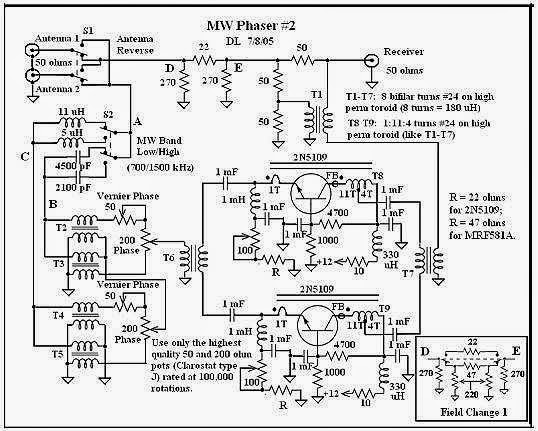
frequencies, without exception, the Dallas Lankford "MW Phaser #2" was
significantly better. I have placed that article in the ndblist Files,
under "Aerials and Technical Files" section should you have an interest
in looking at that article.
For LF use I never found any reason to use a phaser for trying to
optimize the level of a signal. Usually LF signals are short-lived and
often you only have a short time to catch an ident before it fades away.
You can easily waste 30 seconds or more just trying to optimize the
phaser; by that time the signal is usually gone. For those with a local
noise problem from a single general direction a phaser could be useful
in nulling out that noise, though of course you would lose the signals
from that direction too.
I also had room for antenna experiments, being able to compare them with
my longwire antennas. For those with the room, I believe it's hard to
beat an elevated longwire of approx. 400 feet or longer. I was very
fortunate to be able to string two E/W 1600 foot longwires, on either
side of the property about 400 feet apart and roughly parallel; and a
much shorter 400 foot N/S longwire. But even the N/S short one enabled
me to log a number of Greenland beacons (of course this was back when LF
conditions were still excellent, not like now).
Some folks have good results with the K9AY type antenna--Doug in TX has
good results using that antenna. But it's a ground-dependent antenna and
many areas don't have ground characteristics that support such antennas.
My area was one of those--the K9AY never worked very well for me. But an
elevated vertical loop worked very well, using the Wellbrook ALA100
preamp.
I had several rectangular loops up at one time, 120-150 foot
circumference using the ALA100, about 10 vertical feet distance between
the top and bottom wires to give a good capture area. These were very
sensitive at LF and a couple of times I was able to (barely) hear
distant South Pacific beacons that I was also hearing on the 1600 E/W
longwire. And of course the loop antenna is ground-independent so can be
used anywhere. It's bidirectional so can help in nulling noise too. And
such a loop doesn't take up much room as long as you can get it away
from local AC noise (which is true for all LF antennas, especially for
active whips).
Mark Connelly is a prominent east coast MW DXer and has a lot of info on
antennas and phasing on his webpage here. All his applications are primarily for MW DXing but the principles apply equally
well to LF.
The Dallas Lankford phaser article described by Steve, can also be downloaded from here.
LNV phaser, John Bellini in Colorado, also chimed-in with some additional thoughts based upon his own experience:
You do (ideally) need to have good antenna separation to have good/easy phasing of the two signals but you do not have to have two different antennas. If the antennas are too close, the noise fields can be too similar and you won't get good noise cancellation or if the antennas are too close the wavelengths of the signals compared to the antenna separation will be long and it will be a challenge to phase out a signal.
I have been using three, nearly identical, LNV antennas separated 85-110 ft, depending on which pair I use, and have had very good results using the Quantum Phaser.
A very informative discussion of backyard antennas (and phasers) suitable for LW/MWwork is described by Graham Maynard in this Medium Wave Circle article. In the author's own description:
Well, once again I say "That's it". This time my mind churning effort has been to understand and develop the results possible with simple, small back-garden, mixed loop-vertical antenna systems. It really is not as complicated as might first appear, and those willing to try could enjoy as I do, listening to other people's locals ··· Ontario ·· New York ···
These pages have been long in writing - they summarise many years of enquiring study and thoughtful co-ordination with determined and diligent empiric effort...
There's enough good bedtime reading for an evening or two here!
More Low Noise Vertical Info
MW DXer, John Bellini in Colorado, has recently posted another interesting set of YouTube videos describing the mechanical construction and operation of his cool, and somewhat stealthy, Low Noise Vertical (LNV) as well as his phaser in action against some IBOC and local blowtorch signals.
His use of the phaser is particulary interesting. Here he demonstrates what two LNV's can do when phased correctly. The second antenna being used is one of his wire LNV's located further back in the yard.
The first video shows phasing against local IBOC crud.
The second video shows the phaser in use to knock down the sideband hash from a strong local (KOA) signal, 25 miles away.
For those that like to DX in real time (unlike those using SDR overnight samplings), the phaser has much to offer.
The one being used in the videos is the Quantum Phaser and more information about it may be found here.
More on phasers next time.
The first video shows phasing against local IBOC crud.
The second video shows the phaser in use to knock down the sideband hash from a strong local (KOA) signal, 25 miles away.
For those that like to DX in real time (unlike those using SDR overnight samplings), the phaser has much to offer.
The one being used in the videos is the Quantum Phaser and more information about it may be found here.
More on phasers next time.
More e-Bay
This week, three items for the workbench arrived...one of them the wrong item, but instead of complaining, I'll keep it.
First off were some 40-pin male pc board breadboard header strips, standard spacing. These will come in handy for making connections to both pc boards or to perfboard. At a cost of ~8 cents per strip and free delivery, hard to beat.

Next were some 2-pin screw terminal block connectors ... nice for a finished-look on a pc board or perfboard power connection. These came in at ~12 cents per connector.

The third item I had ordered was a small pre-built LM317 regulator board as I hate building these and they do come in handy.

However, this was not what I received (a first!). Instead I received a similar-looking AF amplifier board. It is easy to see why they might get easily mixed up by someone quickly throwing orders together for shipping. The AF board was about twice the cost of the $1.43 LM317 board and I can probably use at least one of them in my next lightwave receiver project.

A final item was ordered, from the U.K., some 250 solder lugs for just under 6-cents each, including shipping.

These are becoming very pricey domestically and are even difficult to find at a good price on e-Bay. With the Canadian dollar taking a big hit lately, bargains are even harder to find ... but I think I did OK.
First off were some 40-pin male pc board breadboard header strips, standard spacing. These will come in handy for making connections to both pc boards or to perfboard. At a cost of ~8 cents per strip and free delivery, hard to beat.
Next were some 2-pin screw terminal block connectors ... nice for a finished-look on a pc board or perfboard power connection. These came in at ~12 cents per connector.
The third item I had ordered was a small pre-built LM317 regulator board as I hate building these and they do come in handy.
However, this was not what I received (a first!). Instead I received a similar-looking AF amplifier board. It is easy to see why they might get easily mixed up by someone quickly throwing orders together for shipping. The AF board was about twice the cost of the $1.43 LM317 board and I can probably use at least one of them in my next lightwave receiver project.
A final item was ordered, from the U.K., some 250 solder lugs for just under 6-cents each, including shipping.
These are becoming very pricey domestically and are even difficult to find at a good price on e-Bay. With the Canadian dollar taking a big hit lately, bargains are even harder to find ... but I think I did OK.
BCB DX – Two New States
With the recent quieting of the geomagnetic field, resulting in K values of 0's and 1's, along with a positive-going DST value, the broadcast band on Wednesday and Thursday night was much more vibrant than it has been in several weeks.
Being located on the eastern shoreline of Mayne Island, the direction towards all of the U.S.A. is over many miles of saltwater, so my main interest is in domestic / U.S.A. DX.
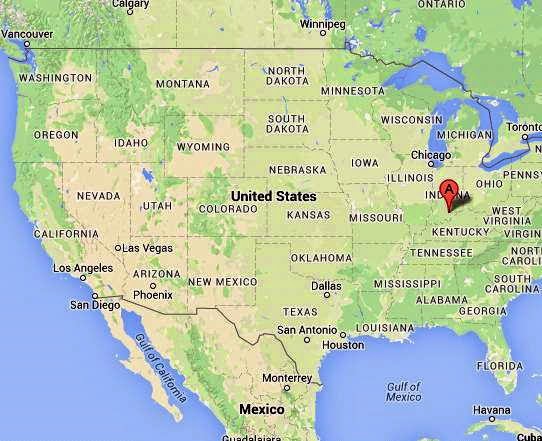
Wednesday evening netted two new states on the BCB ... Kansas and Indiana, for states #27 and #28 respectively, both heard on the Perseus SDR and my 10' x 20' amplified loop.
KWOD, on 1660KHz, identifying as "The Business Channel", was logged during a short top-of-the-hour fade-up at 0600z (10PM local time). Their night power is listed as 1,000 watts while their day power is 10,000 watts.
The transmitter site is located in the middle of a quiet residential district of older homes ... on all four sides.
I shudder to think what RFI problems those living in the adjacent homes must suffer when they are on daytime power!
WSLM, on 1220KHz, was also logged at 0600z, during a two-minute fade-up and in the middle of the local weather report.
Interestingly, the station's night-power is listed as "82 watts", which, judging by the readability of their signal, was not the case. Perhaps the engineer just 'forgot' to switch from their daylight power of 5,000 watts!
Their phased antenna array puts their main lobes, due east and west, so evidently I was catching the northern edge of their pattern.
See what you can hear their during the short recording made of the "Country WSLM" weather report

I have yet to check last night's recordings to see if conditions have held-up for two night's running ... more later if so.
Being located on the eastern shoreline of Mayne Island, the direction towards all of the U.S.A. is over many miles of saltwater, so my main interest is in domestic / U.S.A. DX.
Wednesday evening netted two new states on the BCB ... Kansas and Indiana, for states #27 and #28 respectively, both heard on the Perseus SDR and my 10' x 20' amplified loop.
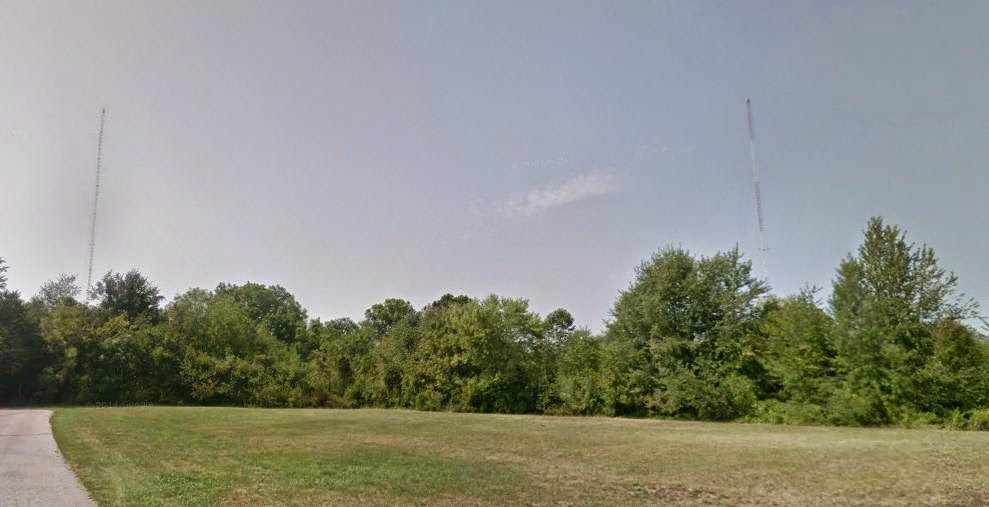
KWOD, on 1660KHz, identifying as "The Business Channel", was logged during a short top-of-the-hour fade-up at 0600z (10PM local time). Their night power is listed as 1,000 watts while their day power is 10,000 watts.
 |
| KWOD - Kansas courtesy: https://www.google.ca/maps |
 |
| KWOD Towers courtesy https://www.google.ca/maps |
The transmitter site is located in the middle of a quiet residential district of older homes ... on all four sides.
I shudder to think what RFI problems those living in the adjacent homes must suffer when they are on daytime power!
 |
| WSLM - Indiana courtesy :https://www.google.ca/maps |
Their phased antenna array puts their main lobes, due east and west, so evidently I was catching the northern edge of their pattern.
 |
| courtesy: https://www.google.ca/maps |
See what you can hear their during the short recording made of the "Country WSLM" weather report
I have yet to check last night's recordings to see if conditions have held-up for two night's running ... more later if so.
’29 MOPA – Small Step
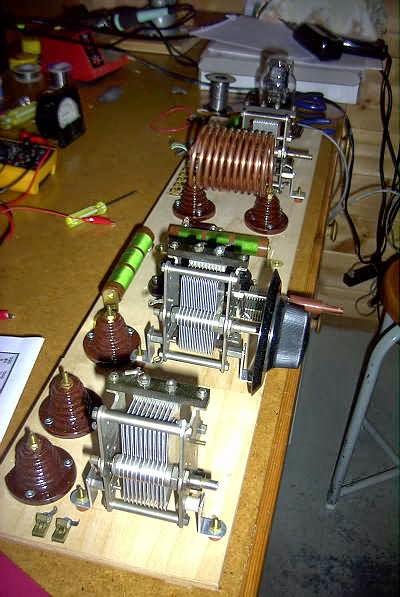 This morning I completed the wiring of the test-bed MOPA's Hartley oscillator circuit. I was using the 80m tank at the time, wound with 3/16" copper tubing. Oscillator keying is about what I expected ... stable but with some ripple on the note. Even with DC on the filaments, many of these open-breadboard oscillators suffer from RF-modulated notes. Sometime wrapping the power supply or keying leads in a ferrite toroid help or eliminate the slight rasp. On the other hand, some builders prefer to have a note that sounds more '29-like, as in all likelihood, not many notes sounded like pure DC back in the day.
I'm really having second thoughts about my construction method and may just jump to the next (final) construction phase rather than slog through completion of the test-bed model. I've already learned much about the layout by getting to this stage and the extra work involved in completing the test-bed model may not tell me anything new.
I'm using a VT-25 version of the somewhat pricey and hard-to-find type '10' tube. The final version will be built in a similar fashion to my Tri-Tet-Ten, on an aluminum sheet atop the breadboard. Hopefully having the groundplane and shorter leads, will lead to a cleaner note in the final version.
I'm rather dreading this next final phase as there is little room for error. The aluminum sheet must be precisely pre-drilled, as well as the breadboard, and protected at all times (especially when making soldered connections) to prevent any finger marks or scratching on the aluminum sheet. There are still several drilling details to be worked out before I can move forward.
CLE191 Results
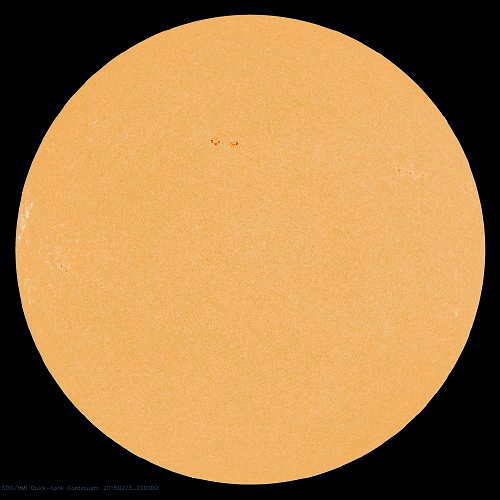 |
| http://helios.gsfc.nasa.gov/chole.html |
With my Perseus SDR taking 2-minute spectrum captures once per hour, from dusk through dawn, the short propagation lifts become quickly evident ... the majority of my loggings were made during these short windows of propagation:
21 04:00 260 ZXS Prince George, BC, CAN
21 02:00 260 YSQ Atlin, BC, CAN
22 07:00 260 AVZ Terrell, TX, USA
21 02:00 260 AP Sedalia, CO, USA
21 13:00 261 D6 Fairmont Hot Springs Apt, BC, CAN
22 09:00 263 ZQT Thunder Bay, ON, CAN
21 09:00 263 YGK Kingston, ON, CAN
21 09:00 263 YBB Kugaaruk, NU, CAN
21 13:00 263 JDN Jordan, MT, USA
21 08:00 263 3Z Russell Apt, MB, CAN
21 08:00 264 ZPB Sachigo Lake, ON, CAN
21 08:00 266 XD Edmonton, AB, CAN
21 02:00 266 VR Vancouver, BC, CAN
21 08:00 266 SL Turner, OR, USA
21 08:00 266 SAA Saratoga, WY, USA
21 08:00 266 ICK Annette Island, ALS
21 08:00 266 BZ Bozeman, MT, USA
21 13:00 268 ZWL Wollaston Lake, SK, CAN
21 08:00 269 ZW Teslin, YT, CAN
21 04:00 269 YK Castlegar, BC, CAN
21 08:00 269 UDE Delta Beach, MB, CAN
22 09:00 269 SWT Seward, NE, USA
22 09:00 269 PK Park Rapids, MN, USA
22 09:00 269 ISB Sibley Municipal Apt, IA, USA
21 08:00 269 CII Choteau Apt, MT, USA
23 08:00 510 OF Madison, NE, USA
21 10:00 512 HMY Lexington, OK, USA
21 10:00 515 SAK Kalispell, MT, USA
23 08:00 515 PN Ponca City, OK, USA
23 08:00 515 OS Columbus, OH, USA
21 10:00 515 CL Cresent Beach, WA, USA
22 09:00 516 YWA Petawawa, ON, CAN
23 08:00 521 TO Topeka, KS, USA
22 08:00 521 ORC Orange City, IA, USA
21 10:00 521 INE Missoula, MT, USA
23 08:00 524 HRD Hawthorne, TX, USA
21 09:00 525 ICW Nenana, ALS
21 09:00 529 SQM Big Level Isl, ALS
21 08:00 1725 WH2XDE/3 MA
21 08:00 472.4 VE7CNF BC
21 06:00 474 VE7BDQ BC
21 08:00 475.5 WG2XSV WA
In just a few years the Sun should be very very quiet for several winters, offering some superb LF listening once again.













