Author Archive
 More Magic
 April 20th, 2015 |
  Author:
  |
| LU6QI |
For the third day in a row, someone has sprinkled 6m magic-dust over the Pacific Northwest with more long-haul propagation into southern South America. The openings have been characterized by their very small footprints and today, unlike the previous two days, the footprint locked-in on my own QTH for over an hour.
For the most part, signals were in the 559 range but at times would build up to true 599 levels, reminiscent of the previous cycle's F2 north-south openings in the afternoon.
During the entire opening, strong sporadic -e signals from California, Arizona and Nevada were present so I suspect that the propagation mode was Es to TEP and from there to southern SA who knows! I doubt there was any F2 involved (unless it was ver SA) as the solar flux just doesn't seem to be high enough to support that mode. In all likelihood, the present coronal hole stream that is impacting the ionosphere has been the trigger for these unheralded openings.
 |
| courtesy: https://maps.google.ca/ |
During the opening, the following stations were worked, mostly on CW but some on SSB as their signals were very loud at times:
CX90IARU, LW6DG, LU6QI, CE2AWW, CX3AL, LU5FF, CX1DDO, LU4FPZ, CX6DRA and CE3SX.
As mentioned in my last blog ... who knows what this cycle will do next as the surprises just keep coming!
Is there enough dust left for a fourth day in a row?
Persistent Cycle 24
If you've wondered why the bands have been so volatile of late, it's because Cycle 24 just won't go away quietly. It seems that for the past several months, our planet has been besieged by one solar bombardment after another. Most of it seems to be coming via Coronal Hole Streams.
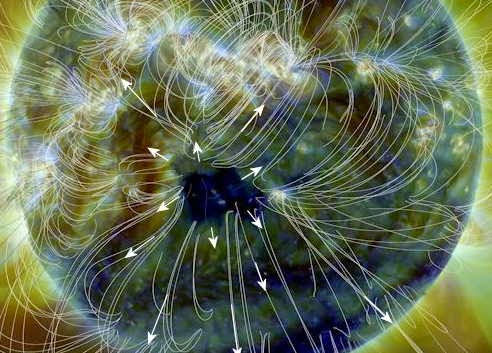
This UV image from NASA's Solar Dynamics Observatory satellite clearly shows the large coronal hole presently facing earth. The arrowed vectors represent material spewing from the hole, with much of it earth-bound. The material from this hole is expected to arrive between April 21-22, possibly causing more auroral activity.
Our Sun's latest rotation is showing several new large sunspot groupings, all very capable of unleashing a new round of solar flares and associated disruption ... if nothing else, Cycle 24 is persistent!
Peeks at the geomagnetic activity for April 16th illustrate just how active things have been of late ... making the high HF bands sound like the middle of the night as well as making LF and MW propagation depressing.

The software gurus at NOAA have been busy once again, this time revamping several of their visual models to an 'animated' mode. The Ovation Auroral map is particularly interesting when run in this mode as it shows the auroral field's activity visually over the past 24 hours. The display gives one a new appreciation for the dynamics of such large scale events:
An auroral event on Thursday evening gave 6m conditions a bit of a kick in the backside on Friday afternoon with signals from southern South America making it into various regions of the U.S. including the PNW, usually left out of such affairs. At one point, CE2AWW was hearing / working both the west coast (W7's) and the east coast (VO1's). Sporadic-e was definitely involved on the west coast end as the band was open to California / Nevada for most of the day.
No one can be certain of what lies ahead for Cycle 24 but it's certainly not going away with a whimper!
 |
| courtesy: http://sdo.gsfc.nasa.gov/ |
Our Sun's latest rotation is showing several new large sunspot groupings, all very capable of unleashing a new round of solar flares and associated disruption ... if nothing else, Cycle 24 is persistent!
 |
| courtesy: http://sdo.gsfc.nasa.gov/data/ |
 |
| courtesy: http://www.swpc.noaa.gov/ |
The software gurus at NOAA have been busy once again, this time revamping several of their visual models to an 'animated' mode. The Ovation Auroral map is particularly interesting when run in this mode as it shows the auroral field's activity visually over the past 24 hours. The display gives one a new appreciation for the dynamics of such large scale events:
 |
| courtesy: http://www.swpc.noaa.gov/communities/radio-communications |
 |
| courtesy: http://www.dxmaps.com/ |
The Lonely 49 Meter Canadians
It's been many years since I've cruised through the SW broadcast bands but of late I've had a yen to tune through some of the low band frequencies ... 5-6MHz. In searching some of the helpful online frequency references, the Short- wave info site in particular, I was reminded of Canada's tiny voice still whispering away on shortwave, even after the demise of Radio Canada's shortwave presence in 2012.
Apparently there is still activity coming from CKZU (6160KHz), CKZN (also on 6160KHz), CFVP (6030KHz) and CFRX (6070KHz). These are all low-powered (100-1000W) relays of local AM station content and make for interesting DX targets for listeners.
The nearest to me, CKZU, is directly across Georgia Straight and line-of-sight from me. It relays the local AM-band powerhouse, CBU-690. Needless to say its signal is very strong.
With its antenna system located on the mudflats of Richmond (Steveston), near Vancouver, it should get out pretty well despite its 500W power limit.
The antenna system, I am told, consists of a four pole (wood) support for a two-element wire beam of sorts ... one element being the dipole driven-element and the other a reflector. From the looks of the orientation I would say that it is beaming south-east towards the central USA.
Are you able to here CKZU on 6160 from your location? Its overwhelming strength here blocks any chance for me to hear its east-coast cousin, CKZN in St. John's, Newfoundland, rebroadcasting local CBN. If you are in the eastern half of the continent, perhaps you are able to here CKZN's 300W signal?
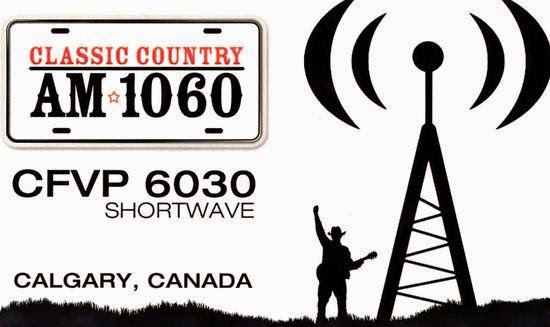
CFVP is in Calgary and relays local CKMX on 6030 at just 100W. I can hear a carrier there in the daytime but long before my local sunset the frequency becomes dominated by Radio Marti (in Spanish) from Florida ... perhaps you can do better from your location.
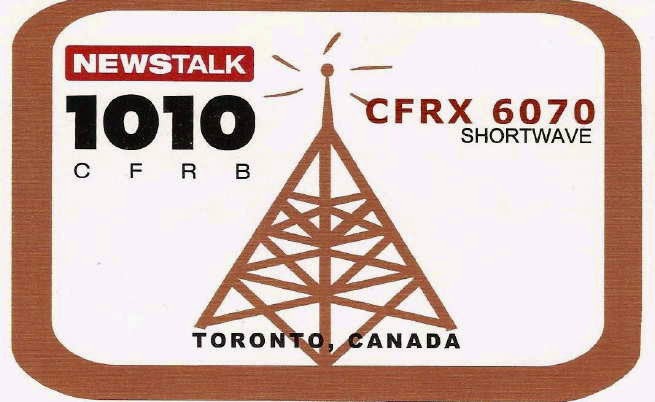
Lastly is CFRX, relaying CFRB from the city of Toronto, on 6070. This gets out well and is heard here even before local sunset at 1000W.
It appears that most of these stations have, at one time or another, been slated for decommissioning, and have only been saved by the dedication of station engineers who basically maintain these on their own time, with station owners paying the rent and electricity bills.
Please let me know if you are able to hear any of the 'lonely' Canadians on 49 meters.
Apparently there is still activity coming from CKZU (6160KHz), CKZN (also on 6160KHz), CFVP (6030KHz) and CFRX (6070KHz). These are all low-powered (100-1000W) relays of local AM station content and make for interesting DX targets for listeners.
The nearest to me, CKZU, is directly across Georgia Straight and line-of-sight from me. It relays the local AM-band powerhouse, CBU-690. Needless to say its signal is very strong.
 |
| courtesy: https://maps.google.ca/ |
With its antenna system located on the mudflats of Richmond (Steveston), near Vancouver, it should get out pretty well despite its 500W power limit.
 | |||||
| courtesy: https://maps.google.ca/ |
The antenna system, I am told, consists of a four pole (wood) support for a two-element wire beam of sorts ... one element being the dipole driven-element and the other a reflector. From the looks of the orientation I would say that it is beaming south-east towards the central USA.
Are you able to here CKZU on 6160 from your location? Its overwhelming strength here blocks any chance for me to hear its east-coast cousin, CKZN in St. John's, Newfoundland, rebroadcasting local CBN. If you are in the eastern half of the continent, perhaps you are able to here CKZN's 300W signal?
CFVP is in Calgary and relays local CKMX on 6030 at just 100W. I can hear a carrier there in the daytime but long before my local sunset the frequency becomes dominated by Radio Marti (in Spanish) from Florida ... perhaps you can do better from your location.
Lastly is CFRX, relaying CFRB from the city of Toronto, on 6070. This gets out well and is heard here even before local sunset at 1000W.
It appears that most of these stations have, at one time or another, been slated for decommissioning, and have only been saved by the dedication of station engineers who basically maintain these on their own time, with station owners paying the rent and electricity bills.
Please let me know if you are able to hear any of the 'lonely' Canadians on 49 meters.
Latest ARRL Band Plan Updates Proposed
The ARRL is presently seeking membership input on proposed band plan adjustments for many of our HF bands. According to their recent announcement, these changes are due to "concerns pertaining to the increasing popularity of data modes, and ... to use spectrum so that these data modes may compatibly coexist with each other."
As is often the case, it appears that CW will suffer once again. Of particular interest is the widening of the 40m band plan for digital modes at the expense of the ever-shrinking CW segments.
Those of you that have been haunting 40m CW for some time will well-remember that 7040kHz was once the watering-hole for most QRP and ragchew CW activity. Several years ago, this section of the band became flooded with RTTY and other data modes that made a pleasant CW QSO much harder to come by. CW ragchewers and newcomers then found solace in the region above 7100, near the old Novice band. Over time, the RTTY and digital-moders have gradually moved into this region as well and now the ARRL wants to make it official.
A look at the 40m plan (above) is somewhat misleading as everyone that operates on 40m CW knows that the 7025-7080 'CW' segment is already dominated by digital activity ... most of us know what it is like to have a bone-crushing digital station suddenly open up on top of the frequency with seemingly no regard for the CW stations already there. It would appear that there will now be not much room for the casual CW operator to call home ... no watering hole frequency around which to congregate as in the past.
Many might say that this is all for the better and that CW has passed its 'best-before' date while others would see it as another nail in CW's coffin.
The proposed changes have spawned numerous discussions on various e-mail reflectors. One of the more interesting comments on the plan was posted by 'wireless-girl' (Janis, AB2RA) and may be read here.
Changes for several HF bands are proposed so if 40m is not one of your main interests, maybe your favorite band will be adversely affected as well.
Whatever your opinion is, the ARRL would like membership input and have published an online-form for you to fill in and make your wishes known.
The comment deadline is April 19, 2015 after which the HF Band Planning Committee will prepare its final report. If you are an ARRL member, please take a couple of minutes to fill-out their questionnaire.
 |
| courtesy: http://www.arrl.org/bandplan |
As is often the case, it appears that CW will suffer once again. Of particular interest is the widening of the 40m band plan for digital modes at the expense of the ever-shrinking CW segments.
Those of you that have been haunting 40m CW for some time will well-remember that 7040kHz was once the watering-hole for most QRP and ragchew CW activity. Several years ago, this section of the band became flooded with RTTY and other data modes that made a pleasant CW QSO much harder to come by. CW ragchewers and newcomers then found solace in the region above 7100, near the old Novice band. Over time, the RTTY and digital-moders have gradually moved into this region as well and now the ARRL wants to make it official.
A look at the 40m plan (above) is somewhat misleading as everyone that operates on 40m CW knows that the 7025-7080 'CW' segment is already dominated by digital activity ... most of us know what it is like to have a bone-crushing digital station suddenly open up on top of the frequency with seemingly no regard for the CW stations already there. It would appear that there will now be not much room for the casual CW operator to call home ... no watering hole frequency around which to congregate as in the past.
Many might say that this is all for the better and that CW has passed its 'best-before' date while others would see it as another nail in CW's coffin.
The proposed changes have spawned numerous discussions on various e-mail reflectors. One of the more interesting comments on the plan was posted by 'wireless-girl' (Janis, AB2RA) and may be read here.
Changes for several HF bands are proposed so if 40m is not one of your main interests, maybe your favorite band will be adversely affected as well.
Whatever your opinion is, the ARRL would like membership input and have published an online-form for you to fill in and make your wishes known.
The comment deadline is April 19, 2015 after which the HF Band Planning Committee will prepare its final report. If you are an ARRL member, please take a couple of minutes to fill-out their questionnaire.
The W6FSM Bug Roundup!
It's time to dust-off that precious old Vibroplex, or any other type of bug, and give it a work out! The W6FSM Bug Roundup will take place on Saturday, May 16th at 1400Z through 1400Z (Sunday). This is 0700 PDT to 1900 PDST ... a full 12 hours of old-time CW delight.
Sponsoring the event is the Samuel F. Morse Amateur Radio Club (W6SFM) of Sacramento, CA. Detailed information may be found at their website, located here.
The club page describes the event as :
"a special time to bring bug operators together on the air. In the same spirit as ARRL's Straight Key Night, participants are encouraged to make simple, conversational, “chewing-the-fat” QSOs using their bug type key. This is an opportunity to exercise, share and exhibit your personalized fist. This is NOT a contest. Call "CQ BR" so folks know you are a Bug Roundup Participant."
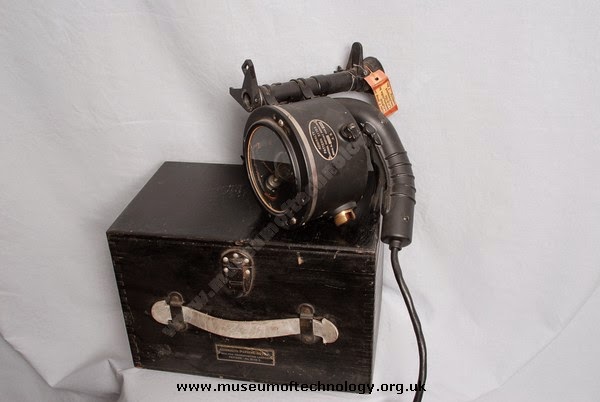
You may have guessed by now that I love CW and always have, since learning the 'code' as an eleven-year old in Scouts! Our Scoutmaster had procured several sets of beautiful boxed Aldis signalling lamps, the same as shown below:
As it turned out, I was the only one in the group that stuck it out long enough to learn any code and was thusly appointed the 'chief operator' of the lamp. Unfortunately, learning the code visually with flashcards, made it even harder to later learn CW by sound as, for many months, I had to convert the sound of the CW back to the picture of it in my head, before identifying the letter...thankfully my brain was still empty enough at the time, that I was able to overcome the unintended curve-ball.
Our leader worked in the Marine Building, the tallest building at the time, in downtown Vancouver.
The extra sets were distributed to several of the other local troops and numerous evenings were spent, at the very top of the building, working all of the other stations. It was usually cold and windy and most of the guys just wanted to go home but I loved it and could have stayed all night....it seems that there was little hope for me, even at that age! When it came to CW I was hooked and even today, almost 100% of my operating is on CW.
It's nice to see events like this and the ARRL's "Straight Key Night" along with clubs like the, "SKCC" , "FISTS", "FOC" and "The CW Operators' Club", all doing their best to keep CW alive.
Hopefully you will have some time to play in the coming "BR".
Sponsoring the event is the Samuel F. Morse Amateur Radio Club (W6SFM) of Sacramento, CA. Detailed information may be found at their website, located here.
The club page describes the event as :
"a special time to bring bug operators together on the air. In the same spirit as ARRL's Straight Key Night, participants are encouraged to make simple, conversational, “chewing-the-fat” QSOs using their bug type key. This is an opportunity to exercise, share and exhibit your personalized fist. This is NOT a contest. Call "CQ BR" so folks know you are a Bug Roundup Participant."
You may have guessed by now that I love CW and always have, since learning the 'code' as an eleven-year old in Scouts! Our Scoutmaster had procured several sets of beautiful boxed Aldis signalling lamps, the same as shown below:
 |
| Image Courtesy: http://www.museumoftechnology.org.uk |
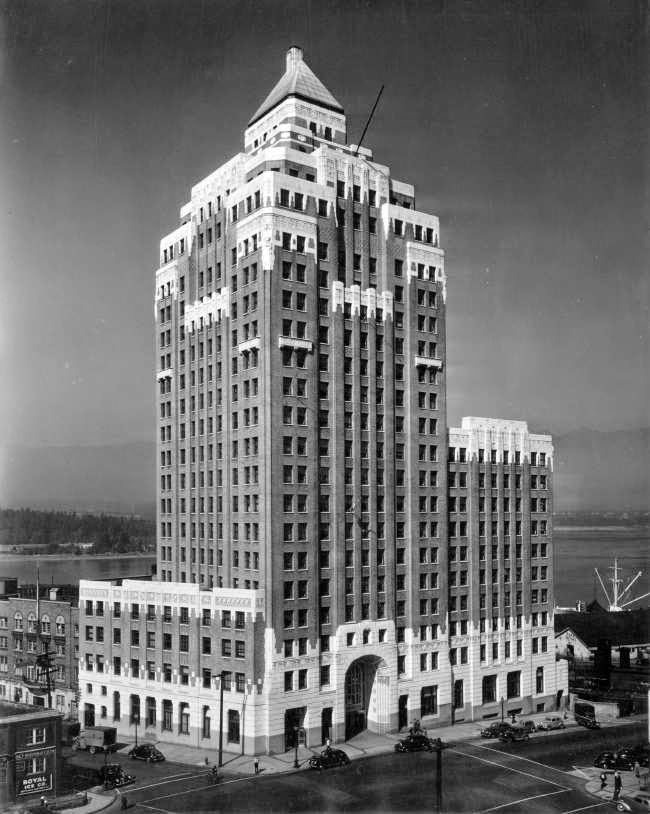
Our leader worked in the Marine Building, the tallest building at the time, in downtown Vancouver.
 |
| Marine Building circa 1947. Courtesy: http://searcharchives.vancouver.ca/ |
It's nice to see events like this and the ARRL's "Straight Key Night" along with clubs like the, "SKCC" , "FISTS", "FOC" and "The CW Operators' Club", all doing their best to keep CW alive.
Hopefully you will have some time to play in the coming "BR".
VE7SKA’s New Skywire
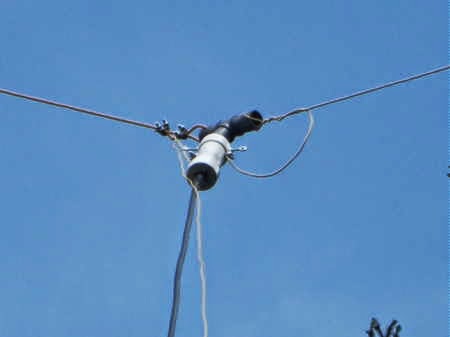
Mike, VE7SKA, AM/FM DXer from Saltspring Island, a nearby island here in the oceans of south-west BC, has sent me a description of his latest doings. Mike took advantage of the recent warm sunny weather to do some antenna work.
Mike calls his new antenna the SDSS (Super Drooper Sleuther Sloper)! It is 110' long, made of #18 wire and hangs from near the top of his 48' tower, drooping to a low sturdy Fir branch, about 10' high.
Using a section of Belden 9913 that was already on the tower (it used to feed his 6m array), Mike feeds the 'drooper' via a 9:1 balun / matching transformer... with the antenna feeding one leg of the transformer and the other side going to a section of #18 wire dropping straight down and terminated in a small ground system at the base of the tower.
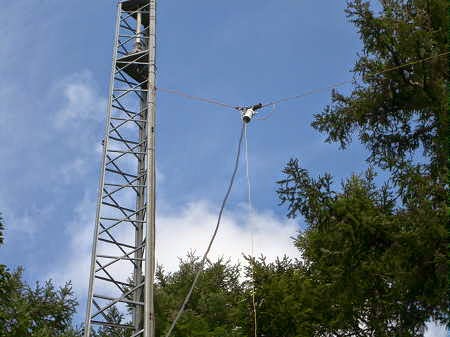
The antenna runs ESE at 112 degrees by WNW at 292 degrees ... the bread and butter direction from SW Canada. For phasing and comparison, Mike uses a much lower wire, 30' long x 7' above ground level, running SE at 140 degrees by 320 degrees NW.
Mike reports: "An immediate test done after launch at 3pm logged a new 10 watt TIS on 1630kHz from just north of Marysville, WA on I-5 freeway. Little daytimer KBRD 680 Lacey, WA with 250 watts wasn't even audible on the Quantum QX Pro v3 amplified loop ... recent MW condx have been favorable ... a sunset tentative of 1460 KLTC N.Dakota (5kW); logging rarity 930 KTKN AK (1kW) on a very busy frequency ... new logging 1580 KKTS WY at 220 watts, phasing out pests KGAL and KMIK."
Mike goes on to say that phasing the new antenna against its smaller and lower little cousin allowed him to log several of the stations noted above, although the lower antenna picks up more noise.
This is really the key to any antenna system and one of the reasons we were always taught to get antennas as high as possible ... to get away from those nasty noise sources in or near the house.
With several antennas to play with now, Mike is looking forward to some interesting work on both the BCB, the beacon band and the lower SW bands but plans to get the antenna up much higher in some of his tall Firs before too long. As well, a high Low Noise Vertical is also on the 'to build' list.
So far the SDSS is proving the old myth wrong ... that antennas put up in anything less than the foulest of weather just don't work.
New Band For ZS Hams
 Sharp-eyed Roger, G3XBM, has brought attention to the recent news of a new amateur allocation granted to South Africa's amateur radio community! It's just a small slice of a band but in an exceptionally interesting part of the spectrum ... 40MHz!
 Amateurs have been given 'propagation studies' permission to transmit between 40.675MHz and 40.685MHz as 'primary users' and use up to 26dBW (400Watts) of power ... a healthy assignment.
I'm not sure where the push for this new band has risen from but no doubt from within the amateur radio community of South Africa ... and kudos to the SA radio authority for establishing this unique amateur band.
Myself and others, have often stated that an amateur allocation in the 40MHz region would be a wonderful part of the spectrum in which to experiment. Almost midway between the two "magic bands" (10m and 6m), the propagation opportunities of 40MHz would be most unique and abundant.
With Solar Cycle 24 being such a weak cycle, most of North America and particularly the western half, saw almost no F2 openings of any significance. Absent were the all-day long bone-crushing signals from the east coast, followed by the spotlight propagation-sweep down to South and Central America and finally over to Japan for another few hours of ear-shattering JA signals ... none of this for Cycle 24. Yet, in spite of the lower MUF's, I noted dozens and dozens of days when the F2 MUF would shoot up to the high 43MHz region and hang in for hours and hours ... just as it did on 6m in previous cycles.
Having even a small slice of spectrum at 40MHz would give amateurs a golden opportunity to follow some exceptionally interesting propagation trends during the next few cycles ... all predicted to be stinkers, some saying even worse than '24'. With 40MHz supporting the F2, Es, TEP and Auroral modes, there would be much exciting propagation to support activity in this region.
Maybe it's time North American amateur's start talking about a new slice of the 40MHz pie ... surely there is enough space to share.













