Author Archive
 LF / MF – Next Step For U.S. Amateurs (Part 3)
 May 4th, 2015 |
  Author:
Continuing with the important sections of NPRM (FCC 15-50) affecting the future of LF/MF assignments in the U.S.A. ...
174.
We also seek comment on the applicability of IEEE 1613-2009 – IEEE Standard Environmental and Testing Requirements for Communications Networking Devices Installed in Electric Power Substations ... ARRL claims that PLC systems complying with IEEE-1613 “would virtually guarantee that there would be no interaction between amateur stations and PLC systems,” and that compliance with the standard has been required by the Commission’s since 2002. As background, the Commission’s rules require that PLC systems conform to engineering standards promulgated by the Commission and adhere to industry approved standards designed to enhance the use of PLC systems. Is compliance with this IEEE standard required by the Commission’s rules (i.e. is this an industry approved standard designed to enhance the use of PLC systems)? Would compliance of PLC systems with this standard facilitate the sharing of these bands between amateur stations and PLC systems? Are there PLC systems deployed that do not comply with this standard?
Would compliance with this standard obviate the need for amateur stations to maintain a specific separation distance from transmission lines?
175.
We recognize that the separation distance required for PLC systems and amateur stations to coexist will depend on the power at which the amateur stations are permitted to transmit. We propose that amateur stations in the 135.7-137.8 kHz band be limited to a maximum EIRP of 1 W, as is required by footnote RR 5.67A, and which we adopted in the WRC-07 R&O. Is this EIRP limit appropriate for facilitating sharing between PLC systems and amateur stations? For the 472-479 kHz band, we propose to adopt transmitted power limits consistent with RR 5.80A. Amateur stations will be limited to an EIRP of 1 W in the portion of Alaska within 800 km of the Russian Federation and will be permitted to transmit at up to 5 W EIRP elsewhere. Is this EIRP limit appropriate for PLC systems and amateur stations to share this band? Should amateur stations be required to reduce their EIRP below 5 W when close to transmission lines and at what distances? We seek comment on these proposals.
176.
We also seek comment on the practical application of a separation distance requirement, and, specifically, what resources and information amateur radio operators will need to comply with our rules. Amateur licensees will have to determine the location of transmission lines in their vicinity to determine if they are permitted to operate stations using these frequency bands. The amateur licensees will need to differentiate transmission lines from the electric distribution lines that connect distribution substations to customer or house wiring. High voltage transmission lines are typically attached to large steel towers that are easy to identity. However, lower voltage transmission lines are typically attached to wooden poles. Although the wooden poles used for transmission lines are usually taller than the wooden poles used for distribution lines, we recognize that distinguishing the two types may not always be straightforward. We seek comment on whether amateur licensees will be able to identify the transmission lines in their locality. If amateur licensees are not able to reliably identify transmission lines, should we require amateurs or ARRL to affirmatively verify the locations of transmission lines with utilities or UTC before an amateur station begins transmitting?
178.
Lastly, we seek comment on additional service and operational rules that would be appropriate for amateur operations in these bands. According to ARRL, the tallest antenna that should reasonably be considered for an amateur station is 200 feet, because antennas with greater heights would
be required to obtain prior FAA approval and have to comply with FAA painting and lighting requirements. We note that adopting a maximum antenna height for amateur stations in these bands will aid in sharing of the spectrum with PLC systems by limiting the number of transmission lines that would potentially be in direct line-of-sight of amateur station antennas. We seek comment on what maximum antenna height, if any, we should adopt for amateur stations in these bands.
179.
We also invite comment on whether to adopt transmitter power limits for amateur stations, in addition to the EIRP limits we are proposing. If so, we seek comment on what the power limits should be. We observe that, in the 2002 Amateur Radio NPRM, the Commission proposed to limit the maximum transmitter power in the 135.7-137.8 kHz band to 100 W PEP because of the possible difficulty of measuring the EIRP of an amateur station in this frequency range. Also, in 1998, ARRL submitted data for the 135.7-137.8 kHz band showing that relatively short antennas can only produce ranges of EIRP that are well below the ITU’s 1 W EIRP limit (i.e., 10-40 mW for a 100 foot antenna and 1-4 mW for a 50 foot antenna) with a transmitter power output of 200 W PEP. The Commission did not consider either power limit at that time, because, as noted above, it decided not to adopt an allocation for amateur operations in this band. Given that we have adopted such an allocation in the WRC-07 R&O above, do either the 2002 Amateur Radio NPRM or ARRL’s 1998 study provide a basis for determining transmitter power limits now? Should these transmitter power limits vary depending on antenna height – e.g. we could allow a 200 W PEP limit for antenna heights not exceeding 30.5 meters while permitting only 100 W PEP for taller antennas. Should the transmitter power limits differ between the 135.7-137.8 kHz band and the 472-479 kHz bands?
180.
In response to the WRC-07 NPRM, commenters addressed a number of steps that could facilitate amateur use of the 135.7-137.8 kHz band. Amateur operator John H. Davis (Davis) proposed that no amateur station should be automatically controlled to ensure that the amateur operator is able to quickly terminate transmissions if necessary. Davis also suggested that it may be appropriate to also prohibit software-driven modes that determine their own operating frequency without human intervention.
Should we adopt Davis’s suggestions? ARRL’s states that there is no rationale for limiting the occupied bandwidth in the 135.7-137.8 kHz band to less than the full 2.1 kilohertz, and that a stricter limit would not be conducive to experimentation with narrowband data emission modes in the future. Should we adopt any bandwidth limitation for either of the frequency bands? In the WRC-07 NPRM, the Commission requested comment on whether it should limit operating privileges in the 135.7-137.8 kHz band, e.g., to Amateur Extra Class licensees. None of the commenters believe that such a restriction would better facilitate Amateur/PLC sharing of the band. In particular, we note that ARRL states that it would be consistent with Commission policy to make this frequency band available to Amateur Extra, Advanced, and General Class licensees. Should we limit operating privileges for these bands in accordance with ARRL’s statement? Should we propose to authorize CW (international Morse code telegraphy), RTTY (narrow-band direct-printing telegraphy), and data emissions throughout the 630 and 2200 meter bands as we did for our 2200 meter band proposal in 2002? We also seek comment on amending Section 97.3 by adding definitions for the terms effective radiated power, isotropically radiated power, and LF.
181.
Other Allocated Uses. Other radio services use the 135.7-137.8 kHz band. In the U.S. Table, the 130-160 kHz band is allocated to the fixed service (FS) and maritime mobile service (MMS) on a primary basis for Federal and non-Federal use ... The 126.7-141.7 kHz band is also used to track tagged salmon in the Pacific watershed. We seek comment on whether we need
to adopt exclusion zones or use other methods to protect these Federal uses of the band. Should we delete the unused non-Federal allocations from this band? To be consistent with the International Table, we also propose to require that amateur fixed stations operating in the 2200 meter band not cause harmful interference to stations in the FS and MMS that are authorized by other nations and require that these amateur stations take any and all corrective action, if harmful interference is reported to us. We seek comment on these proposals.
It would appear that the nature of enquiry is extensive but it is the next step needed before the LF / MF bands will become a reality in the U.S.
Following publication of the NPRM in the Federal Register (see daily updates here to see when it appears), stakeholders will have 60 days to make comments. Comments can be written or posted via their online comment page once it is opened. A thirty-day reply-to-comments period then ensues.
One source that I have read indicates that there is usually about 12-18 months before NPRM publication and rule enactment, should there be no major stumbling blocks. Whenever the final decision to implement comes will depend on how the enquiry proceeds.
I would urge all those interested in seeing these band become a reality to file comments when the opportunity becomes available, following the Federal Register posting. Comments could include your opinions on power levels, methods of stating / measuring power levels, restrictions on operating near power transmission lines, modes allowed, etc. It is particularly important for U.S. experimental stations to file a detailed report on their operations, including accurate descriptions of antenna systems and transmitter details. As well, I would urge Canadian amateurs that have had experience operating on either of these two bands, to file comments regarding your experiences, with particular emphasis on the lack of interference caused to PLC signals and the lack of interference caused by PLC signals to your own operation. Rest assured that U.S. power authorities will be putting their resources ($$) into one last lobby for as many restrictions as possible and it is not in our interest for the NPRM comments to be one-sided in their favor.
Lets all hope for a swift outcome to something that has been taking far too long.
LF / MF – Next Step For U.S. Amateurs (Part 2)
With the release this week of NPRM (FCC 15-50), U.S. amateurs have moved one small-step closer to seeing the 2200m and 630m bands become a thing of reality.The NPRM seeks input on a number of questions that rulemakers are still pondering when it comes to implementation of the new bands. Stakeholders are requested to submit comments on a number of issues addressed in the document and have 60 days to do so once the document has been published in the Federal Register which is updated daily.
Following submission of comments, a number of options still remain open for FCC rulemakers and I rather suspect, from the vast scope of the NPRM's inquiry, that the process could drag on for some length of time yet. Take solace in the fact that the NPRM is indeed a necessary step in the right direction and shows that the proposals are moving forward, finally!
The major focus of the NPRM appears to be centered around determining appropriate levels of power and the viability of amateurs coexisting on the frequencies shared with Power Line Carrier (PLC) systems. Indeed the major stumbling block, at least as far as 2200m is concerned, has always been the strong objection from power authorities that amateur signals will interfere with their control signals. PLC interference as well as possible interference to the Maritime Mobile Service (MMS) is also cited as a concern for the 630m proposal. One might argue that lumping these two bands together in a single NPRM is the best way to go while others might say that chance of success would be much better by treating them separately ... time will eventually tell.
Getting into more detail, the NPRM commentary specifically affecting our LF/MF interests, address the following critical points (and present stumbling blocks):
167.
Service Rules for the 135.7-137.8 kHz and 472-479 kHz bands. We are proposing service rules for the amateur service in the 135.7-137.8 kHz and 472-479 kHz bands with the principal goal of enabling sharing of this spectrum among licensed amateur stations and unlicensed PLC systems.
As the demand for radio spectrum has continued to increase, we have sought to make more efficient use of spectrum by providing for sharing of frequency bands for multiple purposes.While we recognize the importance of PLC systems to the functioning of the electric power grid, we also believe that there are benefits to providing amateurs access to these bands, including providing amateurs with new opportunities for experimentation. Moreover PLC systems and the expected amateur use of these bands have characteristics which make coexistence possible. PLC systems are limited to use on transmissions lines and, consequently, are not present in most residential neighborhoods where amateur licensees live.
The amateur service is expected to use the band mainly for experimental purposes and not for routine and widespread communications activities common in other bands. These attributes give us confidence that,
along with appropriate technical rules, amateur stations can harmoniously operate on the same frequency bands as PLC systems.
168.
The cornerstone of the technical rules we are proposing is physical separation between amateur stations and the transmission lines upon which PLC systems may be present. We propose that amateur stations be permitted to operate in these bands when separated from transmission lines by a specified distance. Such a separation, in conjunction with limits on the amateur stations’ transmitted EIRP and antenna heights, will enable PLC systems and amateur stations to coexist in these bands. In addition, we propose to limit amateur stations to operations at fixed locations only to ensure that this separation distance can be maintained reliably. We seek comment on this overall framework.
169.
In order to develop the necessary and appropriate service rules to meet our goal of providing for the coexistence of amateur services and PLC systems in these bands, we seek detailed comment on the technical characteristics of both the PLC systems and the amateur stations. This information will allow us to set an appropriate separation distance. Although the Commission in the WRC-07 NPRM inquired into the technical rules and methods that would assure coexistence, commenters provided little in the way of concrete information. ARRL submitted a technical analysis based on an NTIA technical report supporting an assertion that PLC systems in the 135.7-137.8 KHz band will be sufficiently protected from amateur stations transmitting at an EIRP of 1 W with a separation distance of 1 km from the transmission lines carrying the PLC signals. However, this NTIA technical report is from 1985 and therefore may not account for any subsequent developments.
170.
To assist us in determining the optimal separation distance, we invite commenters to submit information on the technical characteristics of PLC systems that are currently being operated by utilities or likely to be deployed in the future. How tolerant are these PLC systems of signals received from other stations transmitting in the same band? What electric field strength at the location of a transmission line will cause a PLC system operating on that line to malfunction? What types of malfunctions would the electric power grid experience from electrical interference? How many PLC systems are currently operating in the 2200 and 630 Meter bands? Can these existing PLC systems be modified and could new PLC systems be designed to operate in other portions of the 9-490 kHz band, thus avoiding co-channel operation with amateur services? At what power do these PLC systems operate and how long are the transmission lines over which they send signals? At what voltage level do the transmission lines upon which these PLC systems are deployed operate and how does the PLC systems’ tolerance of other signals depend on the voltage level? What electric field strengths are produced in the vicinity of transmission lines by the PLC signals travelling over the transmission lines?
171.
We likewise invite information on the technical characteristics of amateur stations that are likely to be deployed or have operated under experimental licenses in these two bands. What electric field strength generated by PLC systems operating on transmission lines would impede the operation of
amateur stations? A study conducted on a PLC system operating at 1 W at 152 kHz found that the PLC system generated an electric field strengths of 20 dbμV/m at 1 km. Would a signal with this field strength interfere with the operation of amateur stations? Given that high-voltage transmission lines generate a significant level of noise at this frequency range, how close to high-voltage transmission lines can amateur stations realistically operate? In recent years amateur stations have operated in these bands
under experimental licenses with most licenses permitting powers of between 1 to 20 watts ERP. How close did these amateur stations operate to transmission lines? Did any of these amateur stations receive
signals from PLC systems operating on transmission lines? Do the experiences of amateur stations and utilities in other countries and along the United States border with Canada yield any useful information?
172.
If we were to adopt our proposal to permit amateur operations only when separated by a specified distance from transmission lines, when a new transmission line is built close by an amateur station, the station either would have to relocate farther away from the transmission line or cease
operating. How should our rules address the potential for new transmission lines to be constructed closer than the specified distance to pre-existing amateur stations? We do not want to inhibit the ability of either PLC systems or amateur services to grow and expand without imposing unnecessary burdens on either. Is it possible for utilities to refrain from geographically expanding their PLC operations within the relatively small portion of the 9-490 kHz band that we are making available for amateur operations, and is this something utilities would do on their own accord, given the Part 15 status of PLC systems? Should our rules explicitly prohibit utilities from deploying new PLC systems in these bands?
....to be cont'd
LF / MF – Next Step For U.S. Amateurs (Part 1)
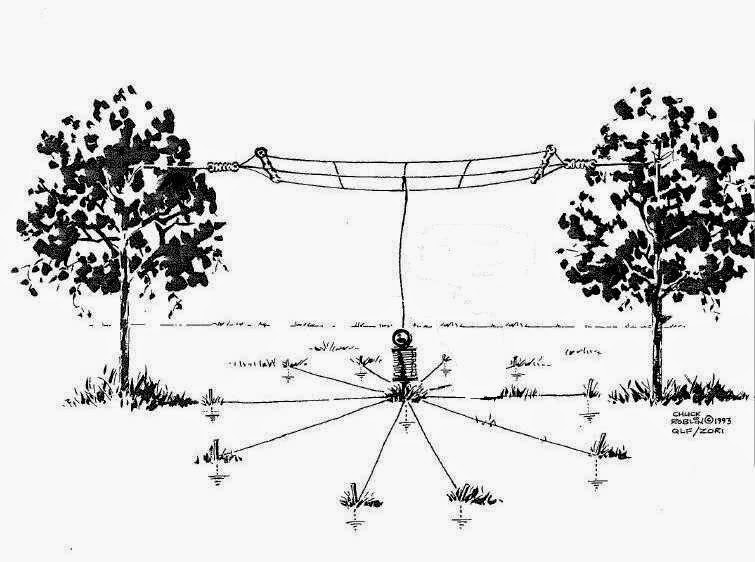 The ARRL's 600 Meter Experiment Coordinator, Fritz Raab (W1FR) recently released a statement urging that the program be renewed. According to Raab, all of the WD2XSH licences will expire in August. Citing a quarterly report prepared by John Langbridge (KB5NJD) and Warren Ziegler (K2ORS), two very active participants in the program, Raab says that the program has demonstrated that the Amateur Radio community is interested in MF operation.
 “Amateurs with ordinary facilities can use the band; exotic antennas are not required,” the report said, adding “QSOs from 500 to 1000 miles are routinely achieved, and longer distances are possible.”
As described in the ARRL News, "The FCC has yet to act on the ARRL’s 2012 Petition for Rulemaking asking it to create a domestic Amateur Radio allocation at 472-479 kHz, known variously as 600 meters and 630 meters. Delegates to the 2012 World Radiocommunication Conference (WRC-12), approved a 7-kilohertz-wide secondary Amateur Radio allocation at 472-479 kHz, with a power limit of 5 W EIRP (or 1 W EIRP, depending on location). Radio amateurs in Canada and in several other countries already have allocations there. Canadian 630 meter operators held a cross-band event on February 14, listening on 160 and 80 meters for US stations."
“Following the WRC-12 decision to create an amateur 630-meter band, most of us expected the FCC to approve access for US amateurs,” Raab’s report said. “Had this happened, there would not be further need for the WD2XSH license. Over 2 years have passed since the ARRL petitioned the FCC to consider this band, and the FCC does not appear to be in any hurry to do so.”
As amateurs here in Canada have discovered, the U.S. experimenters have demonstrated reliable regional ground-wave communications is readily achievable in this part of the spectrum, making reliance on ionospheric conditions a none-issue. The report also addressed the question of interference, a possible long-standing reason cited in reasons for not giving LF bands to amateurs.
" ... in 179,000 hours of operation, “there has not been one complaint of harmful interference from either other radio services or utility power-line communications.” The FCC cited concerns about possible interference to utility power-line carrier (PLC) systems in deciding not to adopt its own 2002 proposal for an LF allocation in the vicinity of 137 kHz. The WD2XSH status report noted that the radiated power from some WD2XSH stations and of other experimental stations working at 630 meters, “is well above the 5 W EIRP of the WRC-12 authorisation.”
Raab goes on to suggest that the ARRL "should have a continued presence in our quest for a 630 meter amateur band” and recommended renewing the license.
MF operators in Canada are also anxiously awaiting the appearance of their southern-neighbours, which would likely result in a large spike in new Canadian activity.
The experimental program has done the heavy lifting and demonstrated that amateurs can operate in this part of the spectrum, at moderate to high power levels, without causing interference. Remember that even though the 5W EIRP limit seems low, due to antenna inefficiencies at this frequencies, transmitters typical are required to generate several hundreds of watts to reach the 5W EIRP limitations.
With all of the above in mind, it seems that indeed the next steps to making these two bands available to U.S. amateurs has drawn one-step closer to reality.
On April 26th, two weeks after Raab's somewhat downcast report, the FCC announced the NPRM (Notice of Proposed Rulememaking) which included the proposals for both 2200m and 630m. NPRM's provided stakeholders the opportunity to file comments as well as provide the filer (FCC in this case) a final opportunity to gather information which will help them form future policy ... in this case, what the rules for the new bands might look like, should they proceed with implementation.
A closer look at the NPRM will be of interest to amateurs who have been waiting for some action ...
(... cont'd)
CLE 193 Results
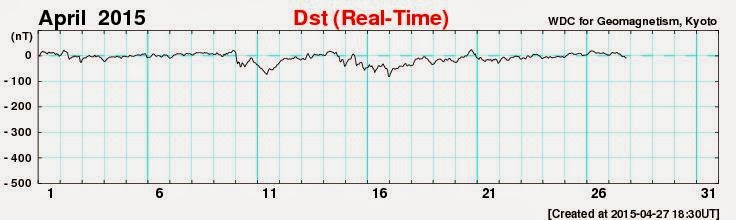 |
| http://wdc.kugi.kyoto-u.ac.jp/dst_realtime/presentmonth/index.html |
DD UTC kHz Call mi Location
-----------------------------------------
27 09:00 400 TRX 1572 Trenton Municipal Apt, MO, USA
25 07:00 400 QQ 97 Comox, BC, CAN
26 10:00 400 PPI 1449 Hopey - Cottage Grove-St Paul, MN, USA
25 09:00 400 FN 1071 COLLN - Fort Collins, CO, USA
27 09:00 400 ENS 1230 Ensenada Apt, MEX
25 07:00 400 CKN 1220 Crookston, MN, USA
26 10:00 400 AHQ 1396 Wahoo, NE, USA
25 07:00 401 YPO 1644 Peawanuck Apt, ON, CAN
25 07:00 402 M3 649 Kindersley Apt, SK, CAN
25 07:00 402 L4 888 Nipawin, SK, CAN
27 07:00 403 AZC 971 Colorado City Municipal Apt, AZ, USA
25 07:00 404 OLF 809 Wolf Point - L M Clayton Apt, MT, USA
25 07:00 404 MOG 495 Montegue, CA, USA
25 12:00 404 GCR 1185 Glacier River - Cordova Apt, ALS
25 07:00 405 9G 429 Sundre Municipal Apt, AB, CAN
25 07:00 405 2K 538 Camrose, AB, CAN
25 07:00 406 YLJ 725 Meadow Lake, SK, CAN
27 08:00 407 CHD 1230 Chandler, AZ, USA
27 09:00 407 PLT 1352 Platte Center - Columbus, NE, USA
27 07:00 407 HRU 1485 Herington, KS, USA
26 10:00 407 CO 1157 PETEY - Fountain, CO, USA
25 07:00 408 Z7 440 Claresholm, AB, CAN
25 07:00 408 MW 221 PELLY - Moses Lake, WA, USA
26 11:00 408 JDM 1270 Wheatfield - Colby, KS, USA
25 07:00 410 GDV 860 Glendive - Dawson Comm Apt, MT, USA
26 10:00 410 EGQ 1419 Emmetsburg, IA, USA
26 10:00 410 DAO 1371 Dragoo - Sierra Vista Muni Apt, AZ, USA
25 07:00 410 6Z 781 La Loche, SK, CAN
25 11:00 411 SDA 1466 Shenandoah Municipal Apt, IA, USA
26 11:00 411 ILI 1459 Iliamna Apt, ALS
25 07:00 412 1W 996 Sandy Bay, SK, CAN
25 07:00 413 YHD 1361 Dryden Regional, ON, CAN
25 07:00 414 YZK 186 Harper Ranch, BC, CAN
26 10:00 414 SU 1372 SALIX - Salix, IA, USA
25 07:00 414 LYI 357 Libby, MT, USA
25 12:00 414 IME 754 Mount Edgecumbe - Sitka Apt, ALS
26 10:00 414 GRN 1094 Gordon, NE, USA
27 09:00 414 8M 640 Elk Point Municipal Apt, AB, CAN
25 07:00 415 CBC 3129 Cayman Brac - West End, CYM
26 10:00 416 LB 1228 PANBE - North Platte, NE, USA
25 09:00 417 IY 1508 CHUKK - Floyd, IA, USA
27 07:00 418 CW 2029 MOSSY - Moss Bluff, LA, USA
26 09:00 419 RYS 1975 'Grosse Ile' Detroit / Grosse Ile, MI, USA
As usual, the equipment used was the Perseus SDR along with my 10' x 20' loop and Wellbrook preamp.
The Dreaded Wall Wart
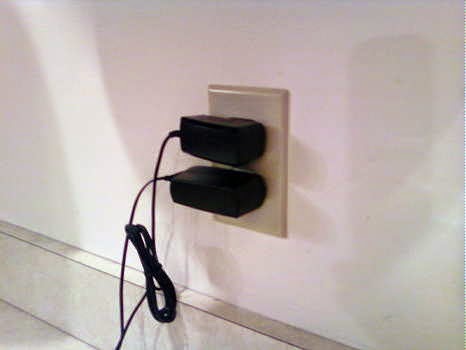
It seems that the ARRL has made it official ... well, maybe not, but at least Ed Hare, W1RFI has. In a recent interview on the HamRadioNow webcast, Hare said that he believed that switching-mode power supplies are a more common source of QRN than noisy power lines ... and I believe him. I have heard countless horror stories of amateurs having to go QRT for good (at least on HF) because of issues with neighbourhood switching supplies. It's one thing to be able to hunt these things down and remediate the problem within your own home but when it comes to the whole neighbourhood, it's an awfully large challenge. And it's not as if there's just the odd one around, here and there ... they are everywhere.
In Ed's own words:
“The old days of those iron transformers are gone,” Hare said. “Every single one of these is a switcher. We’re also seeing noise from pulse-width control motors.” Hare said the big culprits are “little wall warts,” not switching supplies designed to power Amateur Radio gear. “Every TV you own has a built-in switcher, almost every device has a wall-wart, and a lot of these are imported, not necessarily meeting the FCC rules, so we’re seeing more reports involving those.”
I've never personally had a problem with a wall wart, other than a cheap charger for my I-Pad, but that's not to say I haven't run into switchers. The charger emitted a low-level hash that I could hear only on a very quiet 6m band, not much of a real problem considering that I could unplug it at any time. A couple of problems here in the neighbourhood were eventually traced to the poorly designed or faulty switchers inside some CFL bulbs. These were emitting signals via the powerlines and being picked up by my antennas almost two blocks away. This was a problem only on LF however, where the powerlines make pretty efficient antennas.
Hare went on to say that some of the new LED-type lightbulbs have proven to be noisy as well. Not hard to understand when each one has its own low voltage switching power supply. What is hard to understand is why these device are even allowed on the market without having to undergo some type of noise-testing for approval. Another 'growing' threat are the lights used by neighbourhood grow-ops, legal or otherwise.
Hare also indicated that the ARRL lab can work with manufacturers to correct problems but that they need to know specific model numbers and information about the problems you are experiencing with the device.
Apparently, according to Hare, many issues can be resolved without involving enforcement from the FCC, the last step, should issues not be resolved by other methods.
You may be able to help by sending the needed information to the ARRL Laboratory for this and other types of RFI. Both Ed Hare and ARRL EMC Specialist Mike Gruber, should be contacted if you can supply information or have an unresolved problem.
The excellent 11-minute interview (Episode 196 'W1RFI's Tall Tales from the ARRL Lab') can be watched here, with thanks to HamRadioNow TV and to Gary Pearce, KN4AQ of HamRadioNow.
Hooked On QSLs
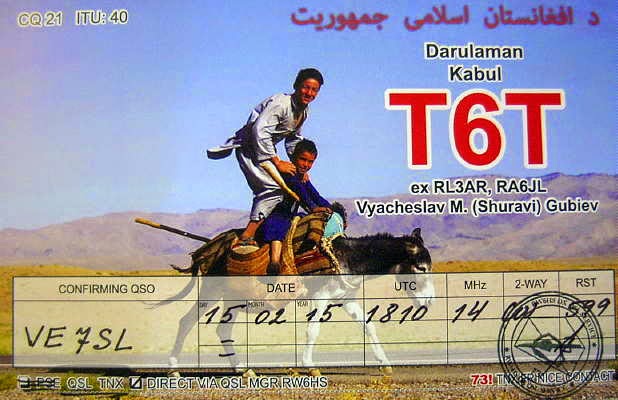
Ever since receiving my first QSL in the mail, as an 11 year-old SWL in Cycle 19, I've always loved getting new cards. Strange as it sounds, I can still recall the fresh ink smell and the brown manila envelope that arrived from "Switzerland Calling". In those days the world was a much larger place and Switzerland may as well have been on the moon. It was a world away ... and the envelope was addressed just to me!
I had a similar thrill this week, when my rural mailbox revealed a much-needed card from Afghanistan. It was from Shuravi, T6T, worked a few weeks ago on 20m ... surprising, as he was using just a low wire dipole supported with bamboo poles.
The card confirmed DXCC country #335 for me with most of them, like T6T, being on CW.
I keep a separate country count, and albums, for my two favorite bands ...160m and 6m, where it seems that new ones come either very slowly or in bunches.
As of today, my 160m total stands at 154 worked and confirmed while my total on the magic band stands at 86 worked and 85 confirmed ... proof of the Pacific Northwest's 6m black hole phenomenon. Sadly I neglected to quickly post a card to 4U1UN for a Saturday morning F2 QSO during Cycle 21. Later attempts proved futile as the logs were subsequently destroyed in a small fire.
The nine remaining DXCC countries will be tough, as, from what I can determine, there is little or no regular amateur radio activity from most of them:
H40 Temotu Province
FT/TO Glorioso Island
HK0 Malpelo Island
KP5 Descecheo Island
P5 DPR of Korea
SV/A Mt. Athos
VP8 South Sandwich Islands
Z8 Southern Sudan
ZL9 Auckland / Campbell Island
I've stayed away from e-QSLing as the look and the feel of a written paper card, was one of the first things that attracted me to the hobby and it seems, to me anyway, an important ham radio tradition to keep alive as long as possible. After all these years, I'm still hooked on QSLs.

Hunting For NDB’s In CLE193
 |
| SN-408 courtesy: Alex Wiecek |
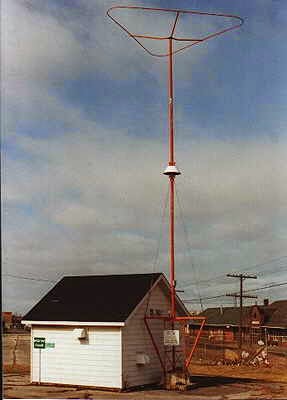
It's CLE time once again! For you low-frequency buffs, another challenge awaits. This months frequency range covers the high end, 400-419.9 kHz. Perhaps you can log little 13-watt SN (St. Catherines, Ontario) on 408kHz, last logged here in February 2014.
Conditions have been up and down so lets keep our fingers crossed for some good propagation.
From CLE coordinator Brian Keyte (G3SIA) comes the following reminder:
"Our 193rd co-ordinated listening event starts on Friday. After the Navtex
CLE last month, this is a gentle return for us to normal NDB listening.
Do join in even if you only have an hour or so to spare over the weekend.
Days: Friday 24 - Monday 27 April 2015
Times: Start and end at midday your LOCAL time
Range: 400 - 419.9 kHz
Just log all the NDBs you can identify with nominal (listed)
frequencies in the range - it includes 400 kHz, but not 420 kHz -
plus any UNIDs that you come across there.
Please send your CLE log to the List (no attachments and ideally in a
plain text email) with CLE193 at the start of its title. Show on each line:
# The Date (or Day No: 24 to 27)
# The Time in UTC (the day changes at 00:00 UTC).
# kHz - the nominal published frequency, if known.
# The Call Ident.
Please show those main items FIRST. Any other optional details such
as Location and Distance go LATER in the same line.
If you send any interim logs, please also send a 'Final' (complete) one.
And, of course, tell us your own location and brief details of the
equipment that you were using during the Event.
I will send the usual 'Any More Logs?' email soon after 17:00 UTC
on Tuesday so that you can check that your log has been found OK.
Do make sure that your log has arrived on the List by 08:00 UTC
on Wednesday 29 April at the very latest.
The combined results should be completed on that day.
You can find full details about current and past CLEs from the CLE page
http://www.ndblist.info/cle.htm including access to the CLE193 seeklists
for your part of the World prepared from the loggings on Rxx.
Good listening - enjoy the CLE.
Brian
----------------------------------------------------------
From: Brian Keyte G3SIA: <ndbcle'at'gmail.com>
Location: Surrey, SE England (CLE co-ordinator)
----------------------------------------------------------
(If you would like to listen remotely you could use any one remote
receiver such as http://websdr.ewi.utwente.nl:8901/ for your
loggings, stating its location and owner and with their permission
if required. A remote listener may NOT also use another receiver,
local or remote, to make further loggings for the same CLE)"
Do join in even if you only have an hour or so to spare over the weekend.
Days: Friday 24 - Monday 27 April 2015
Times: Start and end at midday your LOCAL time
Range: 400 - 419.9 kHz
Just log all the NDBs you can identify with nominal (listed)
frequencies in the range - it includes 400 kHz, but not 420 kHz -
plus any UNIDs that you come across there.
Please send your CLE log to the List (no attachments and ideally in a
plain text email) with CLE193 at the start of its title. Show on each line:
# The Date (or Day No: 24 to 27)
# The Time in UTC (the day changes at 00:00 UTC).
# kHz - the nominal published frequency, if known.
# The Call Ident.
Please show those main items FIRST. Any other optional details such
as Location and Distance go LATER in the same line.
If you send any interim logs, please also send a 'Final' (complete) one.
And, of course, tell us your own location and brief details of the
equipment that you were using during the Event.
I will send the usual 'Any More Logs?' email soon after 17:00 UTC
on Tuesday so that you can check that your log has been found OK.
Do make sure that your log has arrived on the List by 08:00 UTC
on Wednesday 29 April at the very latest.
The combined results should be completed on that day.
You can find full details about current and past CLEs from the CLE page
http://www.ndblist.info/cle.htm including access to the CLE193 seeklists
for your part of the World prepared from the loggings on Rxx.
Good listening - enjoy the CLE.
Brian
----------------------------------------------------------
From: Brian Keyte G3SIA: <ndbcle'at'gmail.com>
Location: Surrey, SE England (CLE co-ordinator)
----------------------------------------------------------
(If you would like to listen remotely you could use any one remote
receiver such as http://websdr.ewi.utwente.nl:8901/ for your
loggings, stating its location and owner and with their permission
if required. A remote listener may NOT also use another receiver,
local or remote, to make further loggings for the same CLE)"
__._,_.___
These listening events serve several purposes. They:
- determine, worldwide, which beacons are actually in service and on-the-air so the online database can be kept up-to-date
- determine, worldwide, which beacons are out-of-service or have gone silent since the last CLE covering this range
- will indicate the state of propagation conditions at the various participant locations
- will give you an indication of how well your LF/MF receiving system is working
- give participants a fun yet challenging activity to keep their listening skills honed
Final details can be found at the NDB List website, and worldwide results, for every participant, will be posted there a few days after the event. If you are a member of the ndblist Group, results will also be e-mailed and posted there.
The very active Yahoo ndblist Group is a great place to learn more about the 'Art of NDB DXing' or to meet other listeners in your region. There is a lot of good information available there and new members are always very welcome.
If you are contemplating getting started on 630m, listening for NDBs is an excellent way to test out your receive capabilities as there are several NDBs located near this part of the spectrum.
You need not be an ndblist member to participate in the CLEs and all reports, no matter how small, are of much value to the organizers. 'First-time' logs are always VERY welcome!
Reports may be sent to the ndblist or e-mailed to either myself or CLE co- ordinator, Brian Keyte (G3SIA), whose address appears above.
Please...do give the CLE a try....then let us know what NDB's can be heard from your location! Your report can then be added to the worldwide database to help keep it up-to-date.













