Author Archive
 U.S. LF Bands – Rulemaking Ruminations (Part 2)
 June 4th, 2015 |
  Author:
  (...cont'd)
* TWO: We need more technical showings this time, with as many solid
details as possible. I hope the Part 5 licensees are prepared to crunch
numbers, but those of us who only monitored are also able to contribute.
(Much more on this in future correspondence, I expect.) In par. 169. the FCC enquires: "to meet our goal of providing for the coexistence of amateur services and PLC systems in these bands, we seek detailed comment on the technical characteristics of both the PLC systems and the amateur stations.
This information will allow us to set an appropriate separation distance."
The very next sentence, though, I recognize as a somewhat worrisome bit of FCC-speak: "Although the Commission in the WRC-07 NPRM inquired into the technical rules and methods that would assure coexistence, commenters provided little in the way of concrete information." Read that as said with a slightly scolding tone, but with a facial expression that says they're keeping an open mind.
The utilities, IMO, provided no concrete technical information at all. ARRL
cited the 1985 NTIA study on which the 1 W EIRP and 1 km separation idea is based, but the FCC is concerned whether that's still valid. Well, one would hope that any changes made to PLCs over the past 30 years would be toward making the system more robust, not more vulnerable to evildoers, accidents, and natural disasters, but this could prove an area of contention. That may be something the big guys have to fight out; I don't know how much we as individual licensees or observers can contribute. But there ARE other technical matters the FCC needs and wants to know, which we may be able to furnish.
For instance, what sort of PLC signal levels have we actually experienced in the proposed bands? How serious were their impact on licensed activity, and how have PLCs been coped with in actual operation? Also at paragraphs 171, 178, and 178, the FCC is asking for some really fundamental, crucial data.
Namely: What sort of power levels have the Part 5 licensees actually
radiated, and at what actual separations from transmission lines? What
maximum size should an amateur antenna be, and--the biggie, in my view--what is the efficiency of both "typical" and potential amateur antenna systems?
(The Commission would like us to include information from Canadian and
European hams on these issues as well. Details of amateur practice in the
rest of the world could be very helpful in formulating rules here.)
Those operators who have the capability of measuring their true field
strength are in an especially excellent position to help quantify current
practice. Those who can't do that, but are able to measure their ground
losses accurately, can make reasonable calculations to show the maximum
efficiency possible with antennas of various heights. That's likely
preferable to doing it all in NEC modeling, since not all such software is
really good at predicting ground system losses, especially at LF. I'll
gladly offer my own ground system's resistance numbers to anyone who wants to do the math, for instance, as its 32 radials of 104 to 135 ft length in 15 mS/m soil are probably representative of a fairly decent ground for
antennas up to 100 feet high...and I'll be doing another set of readings
very soon, which can include measurements at 2200 m this year in addition to the runs I routinely do at 1750 m.
* THREE: At 172, the FCC observes: "If we were to adopt our proposal to
permit amateur operations only when separated by a specified distance from transmission lines, when a new transmission line is built close by an
amateur station, the station either would have to relocate farther away from the transmission line or cease operating." Scary, huh. But they go on to ask: "How should our rules address the potential for new transmission lines to be constructed closer than the specified distance to pre-existing amateur stations? We do not want to inhibit the ability of either PLC systems or amateur services to grow and expand without imposing unnecessary burdens on either. Is it possible for utilities to refrain from geographically expanding their PLC operations within the relatively small portion of the 9-490 kHz band that we are making available for amateur operations, and is this something utilities would do on their own accord, given the Part 15 status of PLC systems? Should our rules explicitly prohibit utilities from deploying new PLC systems in these bands?"
My answer: yes, please. Look back at par. 26, in the WRC-07 R&O section
where the Commission explains their basis for adding the 2200 m allocation:
"We intend to structure these service rules to promote shared use of the
band among amateurs and PLC systems. Amateurs will not be able to use their allocation status to force unlicensed PLC operations out of the band, and utilities will have no cause to abandon or incur large costs to modify
existing PLC systems." Read that again: "Amateurs will not be able to use
their allocation status to force unlicensed PLC operations out of the band."
That's the reality of the matter, and yet I think it also works in our
favor.
So far as I know, this situation is unique in the history of radio regulation. I can't think of another example where an incumbent, but unlicensed and unallocated, user of radio spectrum has been afforded such protection from any allocated and licensed service. However, most of us who commented in the 2013 proceeding DID AGREE with the Commission that PLC technology has been a special case for a long time, and most recognized that acceptance of its existence was the only way to move the discussion off dead center and get to the point where we are now.
But I maintain this coin has two sides. If we in a licensed, allocated service are willing to accept that we cannot displace existing PLCs now or in the future, then it is ONLY FAIR that the unlicensed, unallocated users should not be able to displace the licensed users, either, now or in the future. Otherwise, it is not truly sharing.
The only way I can see to guarantee protection to licensed users, comparable to what the unlicensed ones will have, is to incorporate within Part 15 a prohibition on any changes in power, transmission mode, and route of existing PLC systems, or installation of new ones, within a reasonable band centered on the new amateur allocations. That achieves the stated goal of not displacing existing systems or burdening the utlities by forcing any changes to them, while only removing two small slices of spectrum from consideration for future installations. That seems an entirely reasonable compromise to me.
Your comments are welcome--and essential!
73
John Davis
You can view comments as well as file your own, via the link from this page:
http://apps.fcc.gov/ecfs/proceeding/view?name=15-99
U.S. LF Bands – Rulemaking Ruminations (Part 1)

John Davis of the Longwave Club of America has been doing a good job of keeping us informed of the present 2200/630m application status for U.S. amateurs. It seems that although the NPRM has not yet been published in the Federal Register, the FCC website is open for comments on this issue. I would urge all amateurs with an interest in LF operation to file comments that address the FCC's Notice Of Inquiry (NOI), particularly if you have been operating an experimental station. As well, Canadian LFers operating on either band should consider filing comments as well, describing your system and overall operating results. You can read a full review of the FCC's concerns in three of my earlier blogs:
http://ve7sl.blogspot.ca/2015/04/lf-mf-next-step-for-us-amateurs-part-1.html
http://ve7sl.blogspot.ca/2015/05/lf-mf-next-step-for-us-amateurs-part-2.html
http://ve7sl.blogspot.ca/2015/05/lf-mf-next-step-for-us-amateurs-part-3.html
John's latest information points out what he believes are three crucial points that deserve serious thought. As he indicates, if we don't 'get it right' the first time, it might be very difficult to make any changes after the fact. Please give serious thought to John's information and to filing your own comments at the link provided.
In John's own words:
Rulemaking Ruminations
This is probably a good time to get discussion reactivated on the MF and LF ham proposals. Although I continue not to see publication of the NPRM in the Federal Register as yet, the FCC EFCS Web page for the proceeding is open and accepting filings. Until FR publication, we won't know the closing dates for comments and replies, but you can see what's already been going on at:
http://apps.fcc.gov/ecfs/proceeding/view?name=15-99
While I've been awfully tied up with other things recently, my reading of
the proposal thus far brings to mind three points I believe we earnestly
need to address with the Commission. This proceeding will set the exact US
rules for 2200 m, and very probably also 630 m, so it behooves us to make
the best case we can, now, right up front. If the initial rules are too
restrictive on amateur activity, it could be very difficult and time
consuming to get them changed. Here are my present concerns.
* ONE: In paragraph 168, the FCC states that in addition to separation
distances and power limits, "we propose to limit amateur stations to
operations at fixed locations only to ensure that this separation distance
can be maintained reliably." That's stricter than it may first sound. The
FCC's actual proposed wording for § 97.303(g)(1), for both 2200 and 630 m,
is: "Amateur stations are restricted to use at permanent fixed locations."
Permanent fixed locations. That goes way beyond my suggestion that mobile operation be prohibited. It precludes temporary fixed operation, such as Field Day activities, or tests of ground characteristics for future potential antenna sites, or other legitimate short-term experiments. In my view, this is needlessly restrictive, and could also open the door to more rigid coordination requirements that might paint us into a corner, figuratively and literally, at our original QTHes.
We need to make a strong case that hams are able to identify electric
transmission lines and maintain 1 km separation (or other specified
distance) from them. This further relates to comments the FCC seeks in par. 176: "Amateur licensees will have to determine the location of transmission lines in their vicinity to determine if they are permitted to operate stations using these frequency bands. .... High voltage transmission lines are typically attached to large steel towers that are easy to identity.
However, lower voltage transmission lines are typically attached to wooden poles. Although the wooden poles used for transmission lines are usually taller than the wooden poles used for distribution lines, we recognize that distinguishing the two types may not always be straightforward. We seek comment on whether amateur licensees will be able to identify the transmission lines in their locality."
Obviously, just glancing around a proposed operating site and saying "nope, I don't see a transmission line" is not enough. But I think we're smart enough to do responsible surveys of all lines within a mile or so in all directions, identify any substation locations, and determine which sets of poles have customer connections (practically the definition of distribution lines) and which don't (therefore assumed to be transmission lines). We need to convince the FCC that we can tell the difference.
... to be cont'd
Where’s The Magic?
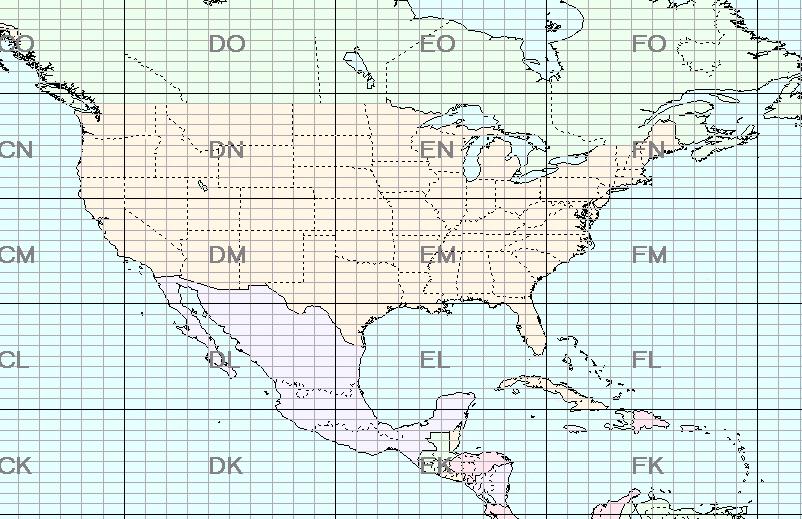 |
| courtesy: http://www.dxmaps.com/ |
Most 6m diehards understand that the cause of summer Es is high-speed wind shear events, way up in the E layer region but a new theory suggests otherwise:
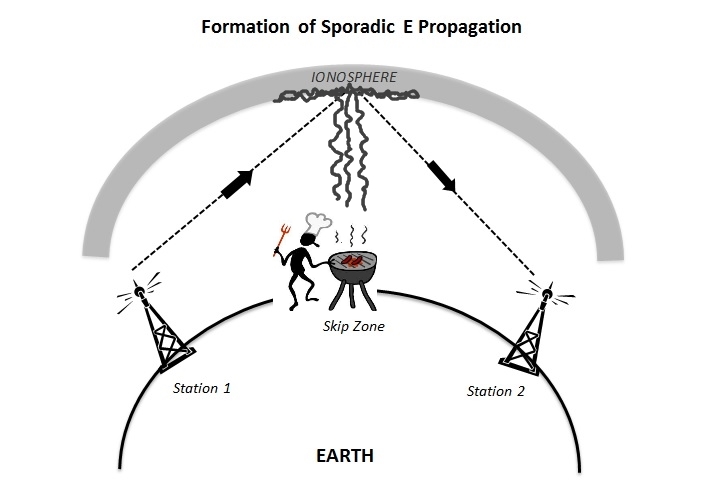 |
| courtesy: nz3m.com |
Do You Have ‘It’ ?
I wonder how many of you see yourselves in this short video ... I know that I do.
As a kid, I always loved to take things apart to see how they worked. Although building wasn't the driving-force to get my ticket as a teenager, I soon became an ardent homebrewer and have loved building radio gear all of my life. When in high school my favorite classes, and teachers, were the shop courses which led me to become a Tech-Ed teacher at 21 years of age. I think it all started with an early case of the ' knack'.
As a kid, I always loved to take things apart to see how they worked. Although building wasn't the driving-force to get my ticket as a teenager, I soon became an ardent homebrewer and have loved building radio gear all of my life. When in high school my favorite classes, and teachers, were the shop courses which led me to become a Tech-Ed teacher at 21 years of age. I think it all started with an early case of the ' knack'.
49’er & Fake Transistors
 A recent posting to Yahoo's 'GQRP' reflector spurred discussion of the growing number of fake transistors being seen on e-bay. A builder enquired about the low efficiency noted in his recently built Chinese '49er' kit.
I recently bought one of the Chinese Forty-9er transceiver kits off ebay and on receive it works well. It certainly transmits, but the power is down to 800mW and the driver transistor is getting very hot. I'm not expecting a lot of power from it, but power claims are 1.8W to 3W. I'm more concerned about the hot driver transistor. The following link shows the circuit diagram.
http://www.ebay.com/itm/DIY-kits-Frog-Sounds-HAM-Radio-QRP1-8W-CW-Transceiver-Receiver-7-023MHz-/121507448525
I've checked for spurious oscillation (a problem I've had before), but can find nothing. Does anyone have any ideas for why the transistor is getting hot?
It was suggested that the transistor in the PA may not be up to specs and even be a 'fake' as these types are commonly noted on e-bay, selling for prices that are too good to be true.
Without taking a close look at your built kit, my suspicion would be the PA transistor. The schematic provided in the listing to which you provided a link shows a D882 as the PA transistor. This is a 2SD882 transistor is a garden variety audio amplifier transistor at best. Some data sheets show a fT of 100 MHz. These 2SD882 transistors are listed and sold by the handful on eBay for a couple of dollars for a dozen (plus and minus). Perhaps substituting a good quality better suited to RF duty transistor would be the ticket. Perhaps something like a 2SC1971. But before you start looking for listings for a 2SC1971 be aware of the fake ones that also quite prominent on eBay and sell for only a few dollars. On eBay search for "eleflow" this is brand name of a manufacturer who is making good quality substitute devices for a number of the popular CB and HAM radio PA transistors - user name on eBay is weazle66. His listing for this particular device is 27187465609 BUT you will pay as much for this replacement PA transistor as you did for the kit ... To find out more about some of these fake replacement transistors, search for "FAKE 2SC1969 RF transistor" or "FAKE NEC & MITSUBISHI RF TRANSISTORS" on youtube. The poster has a number of such video postings. Searching Google for "fake transistors" or such will turn up much interesting.
The problem was eventually sorted out by exchanging transistors:
Firstly, thanks for all your help. Initially, I replaced the Chinese PA transistor with a BD139 and that increased power output to 1.2W and reduced the heating of the driver. Key down and it took perhaps 20s to get "finger hot", rather than 10s. Tonight I changed the driver transistor to a 2N3904 as used in the original Forty-9er and the driver heating seems to have gone away. A small heatsink on the PA transistor allows it to run at 1.4W output for 30s of keydown without any drop in power or the heatsink getting any more than warm.
Thanks for all your help and I hope this helps someone else.
A search of Youtube videos shows several builders that have split some of the RF devices open in order to compare die sizes of suspected fakes with the real thing:
Earl Andrews, VE3GTC, has gone to considerable effort to test and compare many of his transistor purchases and indicates that there are a lot of devices coming out of China that are outright fakes and have no hope of meeting the specs that you might expect. His interesting website has a lot of details about testing as well as a very comprehensive 'for sale' list of reliable devices. Earl also suggests using caution when buying e-bay Chinese electrolytics as his measurements of ESR values indicate that many do not pass specs.
The problem was eventually sorted out by exchanging transistors:
Firstly, thanks for all your help. Initially, I replaced the Chinese PA transistor with a BD139 and that increased power output to 1.2W and reduced the heating of the driver. Key down and it took perhaps 20s to get "finger hot", rather than 10s. Tonight I changed the driver transistor to a 2N3904 as used in the original Forty-9er and the driver heating seems to have gone away. A small heatsink on the PA transistor allows it to run at 1.4W output for 30s of keydown without any drop in power or the heatsink getting any more than warm.
Thanks for all your help and I hope this helps someone else.
A search of Youtube videos shows several builders that have split some of the RF devices open in order to compare die sizes of suspected fakes with the real thing:
Earl Andrews, VE3GTC, has gone to considerable effort to test and compare many of his transistor purchases and indicates that there are a lot of devices coming out of China that are outright fakes and have no hope of meeting the specs that you might expect. His interesting website has a lot of details about testing as well as a very comprehensive 'for sale' list of reliable devices. Earl also suggests using caution when buying e-bay Chinese electrolytics as his measurements of ESR values indicate that many do not pass specs.
If you have purchased fakes or have found a Chinese source of the real thing, please let us know ... I'm sure there are plenty of dealers selling the real thing out there.
49m Canadians QSL’d
My recent interest in the remaining Canadian shortwave broadcasters (see The Lonely 49m Canadians), led me to try and QSL a couple of the stations. Seeing as how the CBC outlet on 6160, CKZU-Vancouver, is almost line-of-sight and just on the other side of Georgia Straight, I haven't yet worked up enough nerve to send a reception report describing their S9+40db signal!
When initially listening for the station in Calgary, CFVP on 6030, I was never able to detect more than a weak, watery carrier. Conditions must have been much worse than I had suspected as normally this path is an easy one. A few weeks later, when I started looking for them again, I found their 100 watt signal to be quite robust, several days in a row. In the early afternoon, their signal was peaking 5x7 and continued to build until Radio Marti in Florida signed on a few hours before sunset and dominated the frequency for the rest of the night.An e- mail report to long-time veri-signer and Ontario DX Association mainstay, Harold Sellers, brought a quick e-mail verification. I was hoping that CFVP would still be issuing a paper QSL but nowadays that is getting to be a rarer and rarer policy.
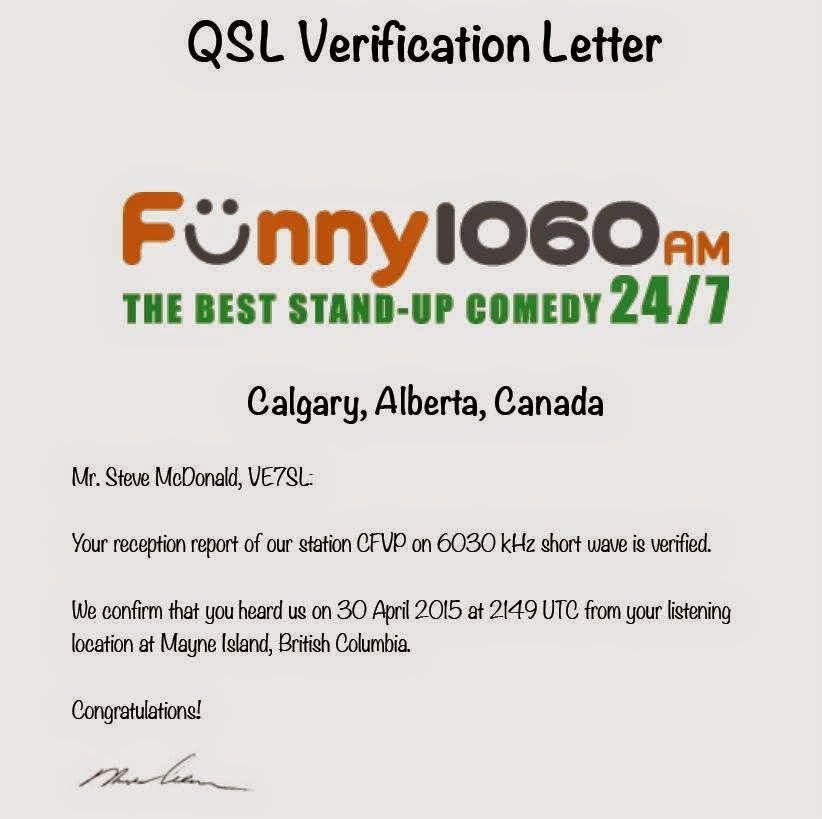
Harold also reports the following details about CFVP:
CFVP broadcasts the programming of AM 10-60, CKMX, 1060 kHz. The transmitter site is located east of Calgary, just off Highway 22X Marquis of Lorne Trail, on Range Road 290. The Google Earth coordinates are 50 54’02”N 113 52’26”W.
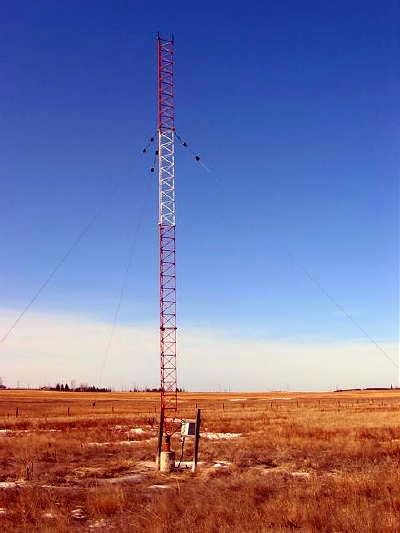 |
| CFVP Tower courtesy: Harold Sellers |
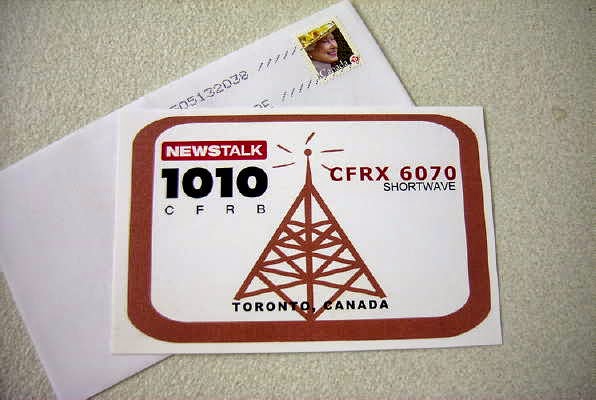
Steve reports that CFRX is simulcasting CFRB (1010kHz) using 1000 watts into an omnidirectional vertical antenna. They have received several reports from Europe over the many years that he has been sending verifications.
Now to tackle CKZU!
CLE 194 Results
 |
| JT-Stephenville, NL courtesy: www.google.ca/maps/ |
Conditions this past weekend were surprisingly good, considering the time of year. I must admit that I was expecting three nights of summer thunderstorm QRN combined with summer-like propagation. Happily I encountered neither.
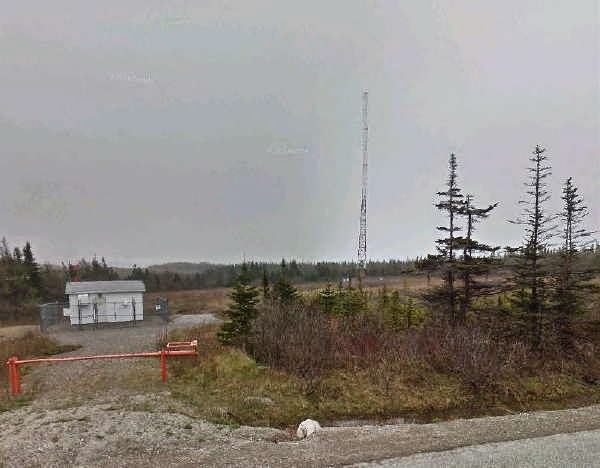
The sun has been very quiet for the past couple of weeks, leading to low K and A indices and favorable DST numbers. Best catch was 'JT-390' in Stephanville, Newfoundland.
DD UTC kHz Call Location
--------------------------------------------------------------
23 08:00 385 WL Williams Lake, BC, CAN
23 08:00 385 UWL New Castle, IN, USA
23 08:00 385 QV Yorkton, SK, CAN
23 07:00 385 OCC Yakutat, ALS
23 08:00 385 MR Pacific Grove, CA, USA
23 10:00 385 EHM Cape Newenham LRRS Apt, ALS
24 07:00 385 3M Drayton Valley Industrial, AB, CAN
23 08:00 386 SYF St. Francis, KS, USA
23 06:00 386 HAU Helena, MT, USA
24 08:00 388 MM Fort Mc Murray, AB, CAN
23 08:00 388 JW Pigeon, AB, CAN
24 07:00 388 GLY Clinton, MO, USA
23 08:00 388 CRK Spokane, WA, USA
23 08:00 389 YWB Kelowna, BC, CAN
23 06:00 389 TW Twin Falls, ID, USA
24 08:00 389 CSB Cambridge Muni, NE, USA
24 06:00 390 JT Stephenville, NL, CAN
23 08:00 390 HBT Sand Point Apt, ALS
23 10:00 390 AES Northway, ALS
23 08:00 391 EEF Sisters Island, ALS
23 08:00 391 DDP Vega Baja, PTR
23 08:00 391 4W Kelsey, MB, CAN
23 08:00 392 ZFN Tulita, NT, CAN
23 08:00 392 PNA Ralph Wenz Field Apt, WY, USA
25 08:00 392 ML Charlevoix, QC, CAN
23 11:00 392 BAJ Sterling, CO, USA
24 08:00 392 AGZ Wagner, SD, USA
25 10:00 392 XVG Longville, MN, USA
25 10:00 393 TOG Togiak Village Apt, ALS
23 08:00 394 RWO Kodiak, ALS
23 08:00 394 DQ Dawson Creek, BC, CAN
23 08:00 395 YL Lynn Lake, MB, CAN
23 08:00 395 ULS Ulysses Apt, KS, USA
23 08:00 395 L7 Estevan, SK, CAN
23 08:00 396 YPH Inukjuak Apt, QC, CAN
23 08:00 396 CMJ Clam Cove - Ketchikan IAP, ALS
23 08:00 397 ZSS Yellowhead (Saskatoon), SK, CAN
23 08:00 397 SB Petis - San Bernardino, CA, USA
23 08:00 398 YOD Cold Lake, AB, CAN
23 08:00 398 3D Cumberland House, SK, CAN
23 05:00 399 ZHD Dryden, ON, CAN
23 05:00 399 SRI St George, ALS













