Author Archive
 New Life For The Tri-Tet-Ten
 June 18th, 2015 |
  Author: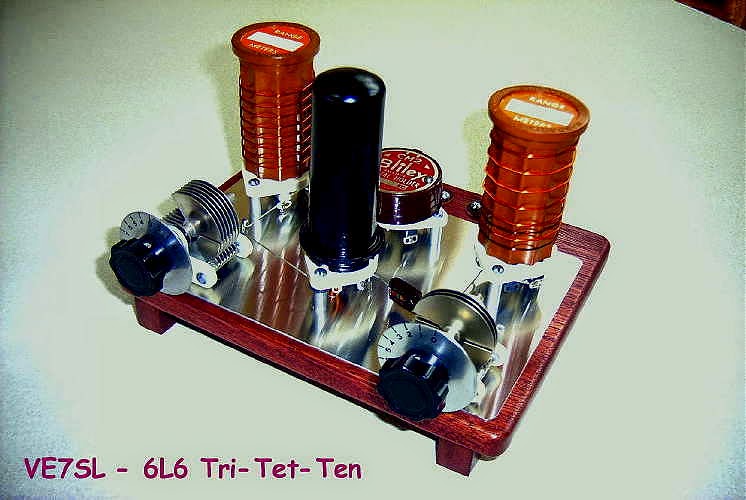
Sadly, I fear that my Tri-Tet-Ten has likely seen the last of its glory days of European 10m DX. It has been sitting, forlornly, on it's operating shelf beside my main station, for a few years now and has always been ready to spring into action whenever the winter F2 on 10m rolled-in. Although I anticipate more 10m F2 this coming fall, I don't think we'll get any barn-burner European openings as I have seen in the past. Conditions really need to be very good for the 6L6's 4 1/2 watts of 10m output to make it over the pole but over the past four winters, the one-lunger has worked over 100 Europeans on 10m F2.
Not being quite ready to throw in the towel on one of my favorite ever projects, over the past two nights I have sparked-up the tritet on 20m, which has been like the good old days in the evening ... strong signals over the pole peaking around 2130 local time.
As it did on 10m, the tritet did not disappoint! My first CQ (crystal controlled on 14031 kHz) was a pounced upon by two Europeans, eager to work a VE7. Over the two evenings, contacts were enjoyed with the following stations:
OE5FBL Haid, Austria
RV3LK Smolensk, Russia
UA2FT Polessk, Russia
RA2FAC Kaliningrad, Russia
RA1OD Kotlas, Russia
R3RR Tambov, Russia
DL1SXB Schwerin, Germany
UR5LCZ Pivdenne, Ukraine
MD0CCE Ramsey, Isle of Man
OK1KTI Huntirov, Czech Republic
IK1XPP Crescentino, Italy
All of the stations were worked on my crystal frequency (a very old 40m xtal doubling to 20m) of 14031 kHz and answered my CQ. At just under 10 watts output, the average signal report received was 579.
Interestingly, two stations gave me 'T' reports of less than 9 to (incorrectly) describe the slight chirp on the oscillator. In the RST system, anything less than a 'T9' should actually describe the degree of undesired modulation (usually A.C. ripple) and not chirp. The proper way of indicating chirp is to append the report with a 'C'. Since chirp is rarely heard on the airwaves anymore, it's understandable that some might not properly understand the 'T' part of 'RST'.
So it looks as though the Tri-Tet-Ten has earned the right to stay on the side operating shelf a bit longer ... but I'm not renaming it the 'Tri-Tet-Twenty' just yet!
Hunting For NDBs in CLE195
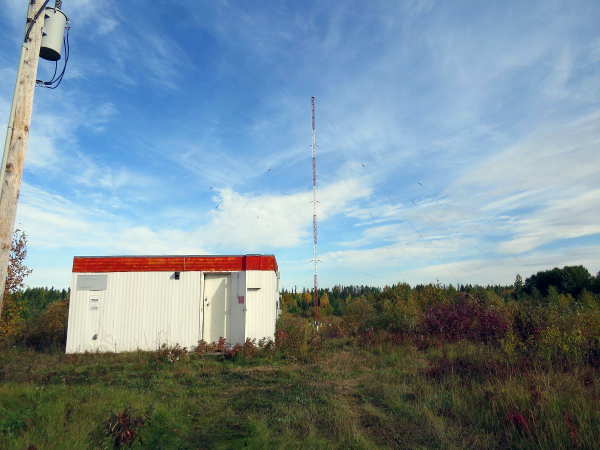 |
| 'YPM' - 274kHz courtesy: Alex - VE3GOP |
A list of all of the North American targets in this range can be found in the RNA database, while targets for European DXers will be found here... specify the frequency range wanted and check 'show all results'.
An excellent target for this CLE is 'YPM' in Pikangikum, Ontario, on 274kHz. Its 25 watts and big antenna are heard well throughout North America
From CLE coordinator Brian Keyte (G3SIA) comes the following reminder:
Hi all.
Have you tried one of our Co-ordinated Listening Events yet?
CLEs are NOT contests - they allow us to share the same listening
challenge and in the process to learn more about our great hobby.
Short logs or long ones, everyone who enjoys taking part is a winner!
Since early in 2001 over 250 different NDB List members have taken
part in a CLE for the first time - and over four in every five came back
for more.
Fourteen members have come back over 100 times, 44 over 50 times.
Our 195th Co-ordinated Listening Event, coming in a few days, will be
rather a challenge (we like those, don't we?)!
Days: Friday 19 June - Monday 22 June (a week early)
Times: Start and end at midday, your LOCAL time
Range: 270.0 - 319.9 kHz (NOT DGPS beacons)
Yes - it does include most of the DGPS frequencies, but it is 50 kHz wide,
about three times more than usual. We shall be listening only for the
'NORMAL' NDBs.
We last searched for NDBs on these frequencies in CLE180 (March 2014).
We shall all have at least one end of the range for some comfortable
listening, but the main challenge will be to find the Morse signals among
all the DGPS noises. REU and RNA show that, since the start of last year,
about 270 and 200 normal NDBs respectively have been reported there.
There are several to be heard by our members 'down under' as well.
Please look out for the 'Final Details', which as usual will follow about
two days before the start.
73
Brian
----------------------------------------------------------
From: Brian Keyte G3SIA ndbcle'at'gmail.com
Location: Surrey, SE England (CLE co-ordinator)
----------------------------------------------------------
These listening events serve several purposes. They:
Final details can be found at the NDB List website, and worldwide results, for every participant, will be posted there a few days after the event. If you are a member of the ndblist Group, results will also be e-mailed and posted there.
The very active Yahoo ndblist Group is a great place to learn more about the 'Art of NDB DXing' or to meet other listeners in your region. There is a lot of good information available there and new members are always very welcome.
If you are contemplating getting started on 630m, listening for NDBs is an excellent way to test out your receive capabilities as there are several NDBs located near this part of the spectrum.
You need not be an ndblist member to participate in the CLEs and all reports, no matter how small, are of much value to the organizers. 'First-time' logs are always VERY welcome!
Reports may be sent to the ndblist or e-mailed to either myself or CLE co- ordinator, Brian Keyte (G3SIA), whose address appears above.
Please...do give the CLE a try....then let us know what NDB's can be heard from your location! Your report can then be added to the worldwide database to help keep it up-to-date.
Have you tried one of our Co-ordinated Listening Events yet?
CLEs are NOT contests - they allow us to share the same listening
challenge and in the process to learn more about our great hobby.
Short logs or long ones, everyone who enjoys taking part is a winner!
Since early in 2001 over 250 different NDB List members have taken
part in a CLE for the first time - and over four in every five came back
for more.
Fourteen members have come back over 100 times, 44 over 50 times.
Our 195th Co-ordinated Listening Event, coming in a few days, will be
rather a challenge (we like those, don't we?)!
Days: Friday 19 June - Monday 22 June (a week early)
Times: Start and end at midday, your LOCAL time
Range: 270.0 - 319.9 kHz (NOT DGPS beacons)
Yes - it does include most of the DGPS frequencies, but it is 50 kHz wide,
about three times more than usual. We shall be listening only for the
'NORMAL' NDBs.
We last searched for NDBs on these frequencies in CLE180 (March 2014).
We shall all have at least one end of the range for some comfortable
listening, but the main challenge will be to find the Morse signals among
all the DGPS noises. REU and RNA show that, since the start of last year,
about 270 and 200 normal NDBs respectively have been reported there.
There are several to be heard by our members 'down under' as well.
Please look out for the 'Final Details', which as usual will follow about
two days before the start.
73
Brian
----------------------------------------------------------
From: Brian Keyte G3SIA ndbcle'at'gmail.com
Location: Surrey, SE England (CLE co-ordinator)
----------------------------------------------------------
These listening events serve several purposes. They:
- determine, worldwide, which beacons are actually in service and on-the-air so the online database can be kept up-to-date
- determine, worldwide, which beacons are out-of-service or have gone silent since the last CLE covering this range
- will indicate the state of propagation conditions at the various participant locations
- will give you an indication of how well your LF/MF receiving system is working
- give participants a fun yet challenging activity to keep their listening skills honed
Final details can be found at the NDB List website, and worldwide results, for every participant, will be posted there a few days after the event. If you are a member of the ndblist Group, results will also be e-mailed and posted there.
The very active Yahoo ndblist Group is a great place to learn more about the 'Art of NDB DXing' or to meet other listeners in your region. There is a lot of good information available there and new members are always very welcome.
If you are contemplating getting started on 630m, listening for NDBs is an excellent way to test out your receive capabilities as there are several NDBs located near this part of the spectrum.
You need not be an ndblist member to participate in the CLEs and all reports, no matter how small, are of much value to the organizers. 'First-time' logs are always VERY welcome!
Reports may be sent to the ndblist or e-mailed to either myself or CLE co- ordinator, Brian Keyte (G3SIA), whose address appears above.
Please...do give the CLE a try....then let us know what NDB's can be heard from your location! Your report can then be added to the worldwide database to help keep it up-to-date.
Fluorescent Light QRN

A recent posting on the ON4KST 6m Chat page brought up the question of QRN coming from fluorescent lighting.
Lefty, K1TOL, had a lot of QRN coming from his neighbour's garage, about 1,000 feet away. He solved the problem by changing the ballasts, purchased at Home Depot. This is the ballast that solved his problem, so if you are having similar difficulty, perhaps this will be of benefit.
Sometimes just changing to a different bulb type (manufacturer) will solve the problem as well but from what I have read, you get what you pay for and likely the bargain-bin bulbs are not the quietest.
Summertime CBer
As much as I hate to admit it, for a few short weeks every summer, I become ... get ready for it now ... a CBer! Now I'm not talking about what might typically come to mind when thinking about CBers ... for me it's more of a love-hate relationship. You see, the 27MHz CB band, and 27.385MHz in particular, happens to make one of the best indicators of Sporadic-e openings on the face of the planet. Unlike the vast empty wasteland that 10m becomes during the summer, the 11 meter band is jam-packed full, with thousands of operators ... and some days it seems as if they are all on the 27.385 MHz (LSB) calling frequency.
With my receiver quietly running in the shack, the frequency can suddenly jump to life, with hundreds of stations calling each other in a matter of seconds. Sometimes it's like a switch has suddenly been thrown to 'ON'. This is not too hard to understand as the present suspected cause of Es is sudden high speed wind-shear within the E-layer. Have a quick listen to what the calling frequency can suddenly sound like:
Now the beautiful thing is that strong Es on 11 meters usually heralds the possibility of 6m also opening via the same mode ... usually 30 minutes or so later if it's going to happen. Often a CQ on a seemingly 'dead' 6m band in the direction of the 11m Es, will produce a response from an equally surprised operator at the other end.
I don't think I've ever heard Es on the 6m calling frequency without hearing Es on 11 meters beforehand. It's been my experience that the band always opens from low to high, in terms of frequency, so it just makes sense to listen lower (11m) to get a heads-up for what is likely soon to follow on the magic band. As well, knowing that there is 'zero' Es on 11m, can let you rest assured that nothing will be happening on 6m via Es ... at least for the time being.
If you haven't already tried it and have a second receiver that can be put to use as an 'Es-monitor', you might be pleasantly rewarded. Even though knowing that the band will soon open might rub a bit of the magic away, I think it's still well worth it!
LDE’s – Really Long Ones!
 |
| courtesy: https://openclipart.org |
Tommy happened upon the LDE when tuning around the band one December evening. He heard a weak, warbly ... "CQ CQ CQ de VE7BLF VE7BLF K". A chill went up his spine as he had actually called CQ about 30 minutes earlier, and was answered by a K7. Sure enough, the phantom LDE soon came back to the K7 while Tommy listened to himself send the report, name and his QTH information on the next transmission! Listening to his own signals, 30 minutes later, really shook my friend up as he had no idea what to make of the incident.
Over the next few weeks, Tommy heard several LDEs, some with separations as much as 3 or 4 days and during this time made several recordings of the events. He made a copy of the recordings for me to listen to and the sound of the signal really did send shivers up my back. It was tormented, warbly, with a bit of flutter and very weak. It sounded as though the signal had been ripped apart on a trip to hell and back, adding further to the mystery.
The LDEs stopped as quickly as they had begun and were never heard again but in the meantime, Tommy and I speculated on what might be the cause. Were they genuine LDEs? ... they certainly sounded as if they had been on a very long trip ... or was the explanation something far less sinister? We never did solve the mystery but I had suggested that one likely explanation might be a faulty (or normally operating) VCR, somewhere in the neighborhood. Someone that happened to record at around the same time that Tommy was operating and playing the program back when Tommy happened to be listening. It seemed a far-shot and one that we never tested, preferring to think of it as another one of the mysteries of radio. Unfortunately Tommy became an SK several years ago, never knowing the cause of his mystery signals.
During a recent discussion with Tony (VE7CNF) and Mark (VA7MM) about the newly imagined plasma tubes, the subject of their possible link to LDEs also emerged. I related the above story and Toby immediately went to work with his old VCR! In his own words:
Yes, old VHS recorders could cause long delay echoes. When Steve mentioned it, I had to try it. I attached a photo and some recordings.
I hooked up my old VHS recorder with BNC video and audio cables in and out. I pulled out the video cables a bit to disconnect the shields, so RF could leak into and out of the video ports. My IC7410 was connected to a dummy load and split, through a T connector, to a whip antenna on top of the VHS.Transmit power was 100W to the dummy load.
I transmitted while recording video. When I played it back I could hear the CW signal pretty much on frequency. I tried this at 1820 kHz and the signal had a lot of frequency flutter. At 3510 kHz the playback signal was stable enough for SSB.
So, RF leaking into and out of the video cables of a nearby VHS recorder could explain LDE's where the delay is hours or days.
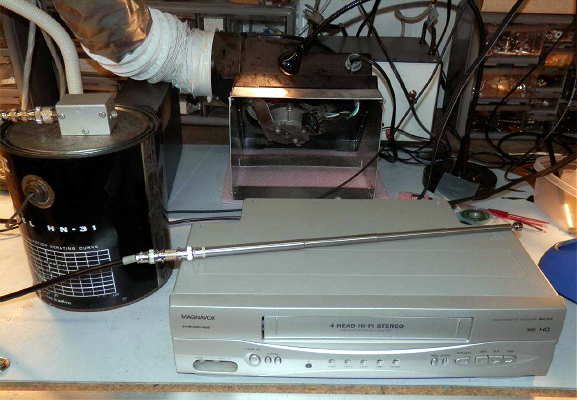
Mystery solved ... the signals that Toby reproduced had the exact same characteristics as I recall from Tommy's old tape recordings although his signals were much weaker, making them seem as if they had been on a very long journey.
I wonder how many others have run into this same situation over the years?
Since getting on the air as a teenager in 1963, and thousand of hours of operating, I have never heard an LDE, or at least nothing longer than a keying echo on a longpath reflection. How about you?
CKZU – 6160 Close-Up
 |
| courtesy: googlemaps.ca |
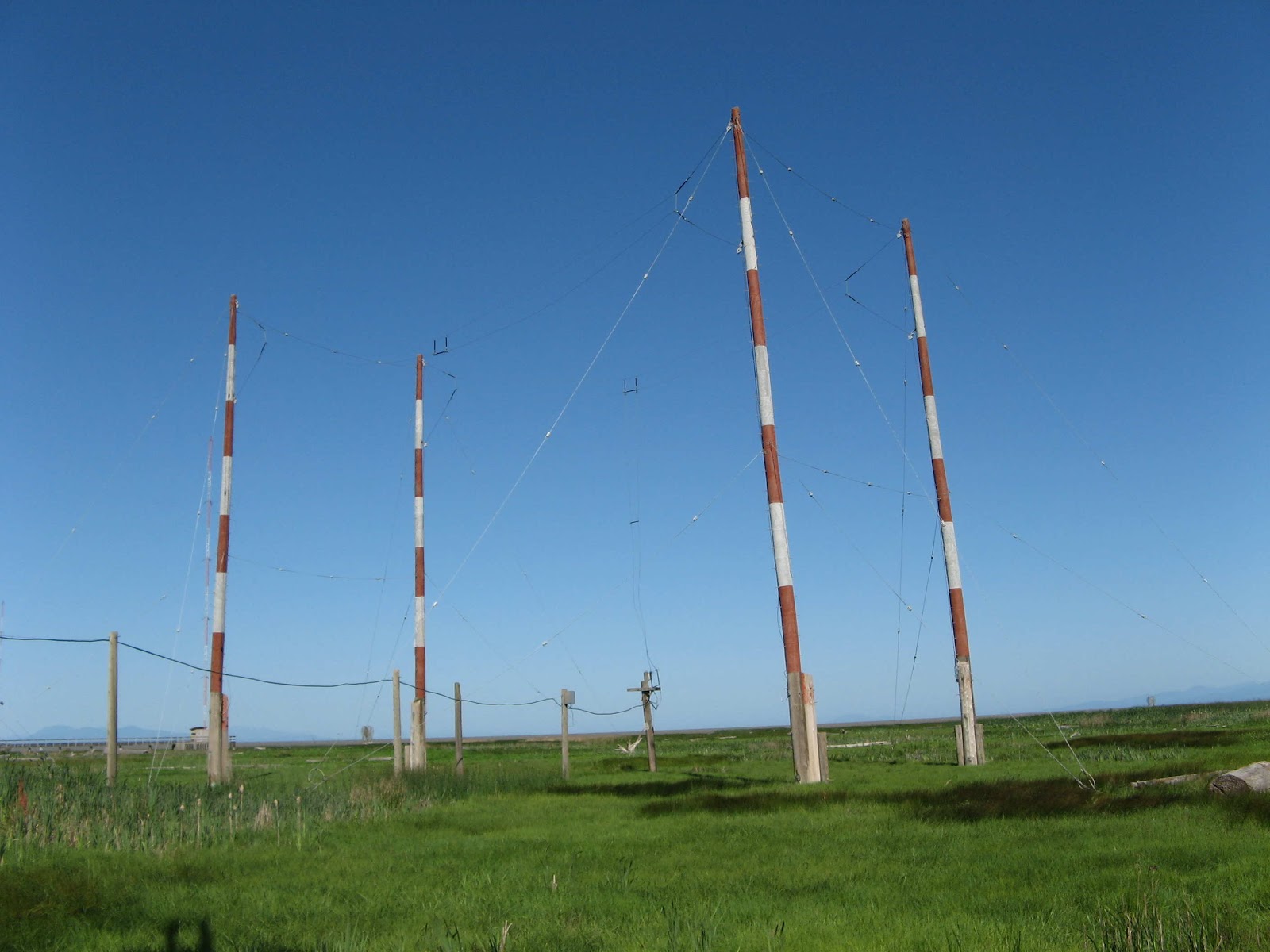
On a weekend bike ride along the West Richmond dyke, Mark (VA7MM) snapped this wonderful close-up view of the system:
 | ||||
| courtesy: VA7MM |
So the next time you are tuning around 40m, drop down a bit and see how their signal sounds at your location ... you may be pleasantly surprised.
Earth-Shrouding Plasma Tubes
If you haven't seen this by now, you'll want to check it out! It seems that the world of astrophysics has been set all agog by a brilliant Australian undergraduate student's recent discovery. Cleo Loi from the University of Sydney has used a combination of radio telescopes to prove the existence of earth-surrounding tubular plasma ducts. Travelling from the ionosphere to the edges of space, these multi-layered plasma tubes were believed to exist but were never proven ... until Ms. Loi and her team managed to image them:
What the implications might be when it comes to their influence on radio propagation, if any, remains to be seen but I suspect that astrophysicists all over the world are having a close examination of long-held theories and the implications on their own fields of study.
You can read more details about this exciting discovery here.
What the implications might be when it comes to their influence on radio propagation, if any, remains to be seen but I suspect that astrophysicists all over the world are having a close examination of long-held theories and the implications on their own fields of study.
You can read more details about this exciting discovery here.













