Author Archive
 Summer Es
 July 17th, 2015 |
  Author:
  |
| courtesy: http://www.dxmaps.com/ |
There is no doubt about it.
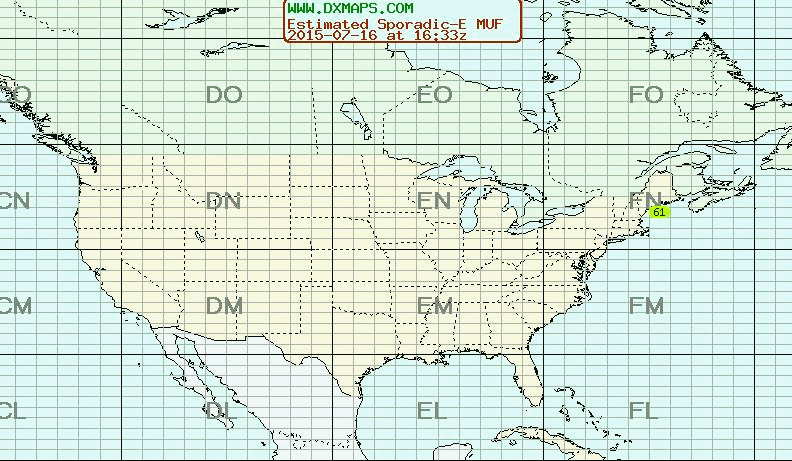
This summer's Sporadic-E season has been the worst in memory, for myself and for most North American six-meter fans. My last log entry, and the last time that I heard a signal on 6m, was on July 7th. During a 'normal' season, rarely a day goes by without an opening in some direction. Often, the band will be open for several days in a row. It was only a few summers ago that the PNW region had propagation to Europe (extremely rare) for three days in succession!
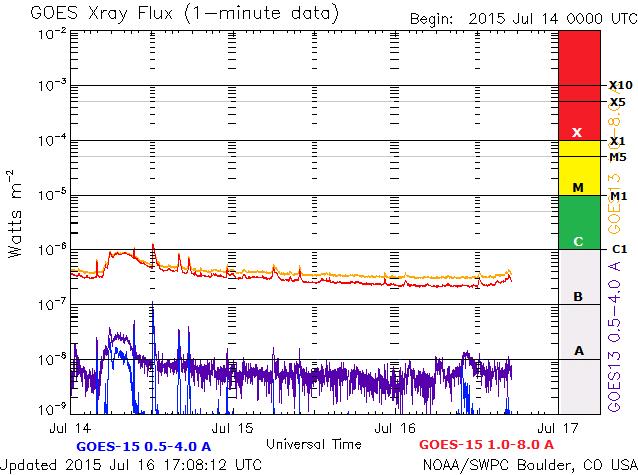
There has been much speculation as to why this season is particularly poor. Is it the early higher-than-normal temperatures being experienced this summer? Is it the constant bombardment from the sun, with several solar flares during the prime weeks as well as an almost continuous coronal hole streaming? Is it all just a normal part of the cyclical behavior of most natural phenomena? Whatever the reason, time is running out for this year.
After operating on 6m for over 40 years, the peak conditions always seem to happen during or close to the first week of July ... but, living up to its 'sporadic' classification, I have seen some spectacular openings right up until early August. In fact, my longest 2m Es contact (Oklahoma) was made on July 24, so there is still some time left for the band to exonerate itself.
 |
| courtesy: http://www.swpc.noaa.gov/ |
One great opening over the pole will make the poor conditions just a distant memory!
A More Optimistic Cycle 25
 |
| courtesy: http://www.solen.info/solar/ |
With all of the doom and gloom forecasts for the upcoming solar cycles, I was reminded of the various prognostications that were made for our present Cycle 24. I recall one in particular, made in the winter of 2006 ...
Solar cycle 24, due to peak in 2010 or 2011 "looks like its going to be one of the most intense cycles since record-keeping began almost 400 years ago," says solar physicist David Hathaway of the Marshall Space Flight Center. He and colleague Robert Wilson presented this conclusion last week at the American Geophysical Union meeting in San Francisco.
So much for that prediction!
It seems that at least one group, led by Leif Svalgaard, got it right, as W4ZV recently reminded us on the Topband reflector ...
I had to do a memory refresh but finally recalled that Leif Svalgaard, et.al.
accurately predicted Cycle 24 in October 2004. He did not use conveyor
belt theory but polar field measurements:
"Using direct polar field measurements, now available for four solar
cycles, we predict that the approaching solar cycle 24 ( 2011 maximum) will
have a peak smoothed monthly sunspot number of 75 ± 8, making it
potentially the smallest cycle in the last 100 years."
http://www.leif.org/research/Cycle%2024%20Smallest%20100%20years.pdf
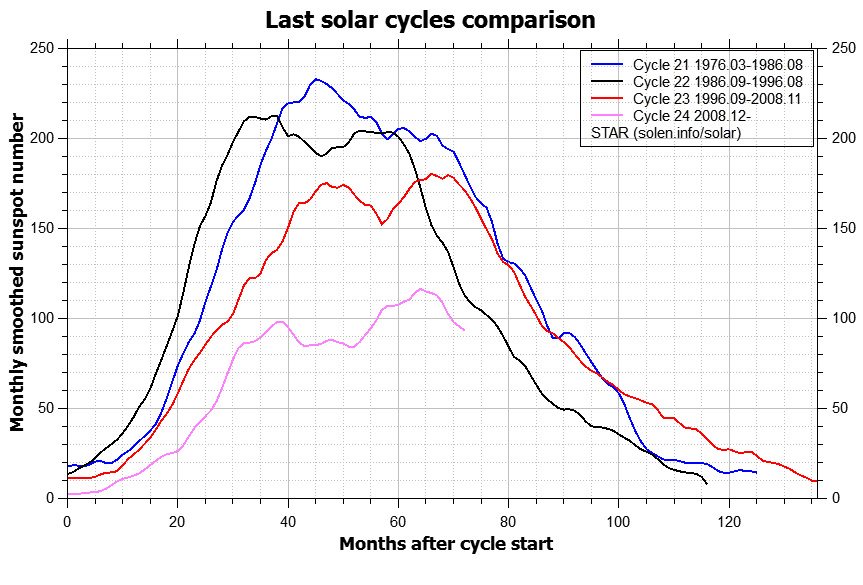
The actual smoothed sunspot peak for Cycle 24 was around 82 in early 2014
(blue line on the graph below). He missed the peak date because it
occurred during the cycle's second peak.
http://www.swpc.noaa.gov/products/solar-cycle-progression
73, Bill W4ZV
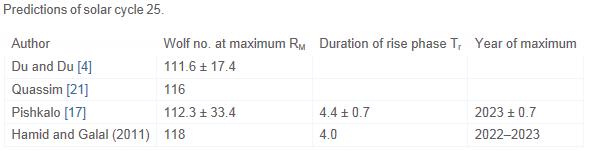
But Svalgaard wasn't the only one with an accurate forecast. Searching for a less-gloomy outlook for upcoming Cycle 25, I happened upon a paper by Hamid Helal and A.A. Galal of the National Research Institute of Astronomy and Geophysics, in Cairo. In "An early prediction of the maximum amplitude of the solar cycle 25", the authors cite a methodology that was bang-on for the last three cycles and gives a very optimistic outlook for Cycle 25.
Table 2 gives our prediction for cycle 25 in comparison with the published predictions of other authors in chronologic alphabetic order. It is obvious that our results agree with some contributions and disagree with others. In fact the differences of the predicted strengths by different authors may be attributed to the variety of the used techniques and methodology. Although some authors think that cycle 25 could be one of the weakest in centuries, in contrast, we think that the next cycle will be relatively stronger than cycle 24 and it will have nearly the same strength of cycle 23, i.e. the sunspot maximum may rebound in the near future.
 |
| courtesy: http://www.sciencedirect.com |
If Cycle 25 is comparable to Cycle 23 it will be happy days again ... it was a very robust cycle and provided several winters of high F2 MUFs, leading to day after day of amazing 50MHz propagation!
I'm somewhat vexed about which scenario I'd prefer, being both an LF'er (quiet, weak cycle) and a diehard 6m guy (chaotic, strong cycle). In any event, Cycle 25 will likely be the last one of any interest to me. I was born at the peak of Cycle 18 ... you do the math!
Obviously it will be a few years yet before we see who is right, but I'm kind of pulling for Helal and Galal's big numbers for one last 6m hoorah!
Solar Cycle 25 and Beyond
 |
| courtesy: SOHO (ESA & NASA) |
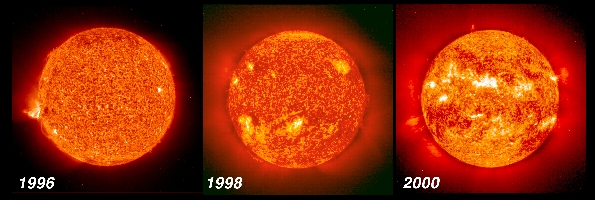
If the model is correct, the outlook for the next several cycles does not look good. The modelling describes the interaction of two levels of the sun ... one near the surface and one much deeper.
Prof Valentina Zharkova and her colleagues, of Northumbria University, have:
"... found magnetic wave components appearing in pairs, originating in two different layers in the Sun's interior. They both have a frequency of approximately 11 years, although this frequency is slightly different, and they are offset in time. Over the cycle, the waves fluctuate between the northern and southern hemispheres of the Sun. Combining both waves together and comparing to real data for the current solar cycle, we found that our predictions showed an accuracy of 97%."
Zharkova's team analyzed data from California's Wilcox Solar Observatory, covering three solar cycles worth of activity from 1976-2008. All of their modelling predictions and observations were closely matched.
"Looking ahead to the next solar cycles, the model predicts that the pair of waves become increasingly offset during Cycle 25, which peaks in 2022. During Cycle 26, which covers the decade from 2030-2040, the two waves will become exactly out of synch and this will cause a significant reduction in solar activity."
This is not great news for HF DXers and 6 meter diehards as it sounds like the present wimpy cycle (Cycle 24) may have been a monster in comparison to what lies ahead. The one bright light is the likelihood of amazingly good low band (160, 80, 40m) conditions for many, many winters.
I recall just how good conditions became on 160m during the solar-quiet winters between Cycle 23 and the eventual late start of Cycle 24. Night after night, the band opened to Europe like clockwork. Many nights the skip was so long that no signals from the U.S. could be heard at all ... just Europeans, often reaching 599 on my FT-1000's S-meter. At times I had to shake my head and double check that it was really 160m that I was listening to.
LF and MF conditions were equally enhanced as the lack of D-layer absorption from a very quiet sun made tuning through the NDB band sound like 20m CW during the Sweepstakes Contest ... truly once-in-a-lifetime conditions ... but maybe not if Zharkova's model is as accurate as she claims.
I guess we'll just have to wait a few more years to find out.
Sunspot Numbering System Revised
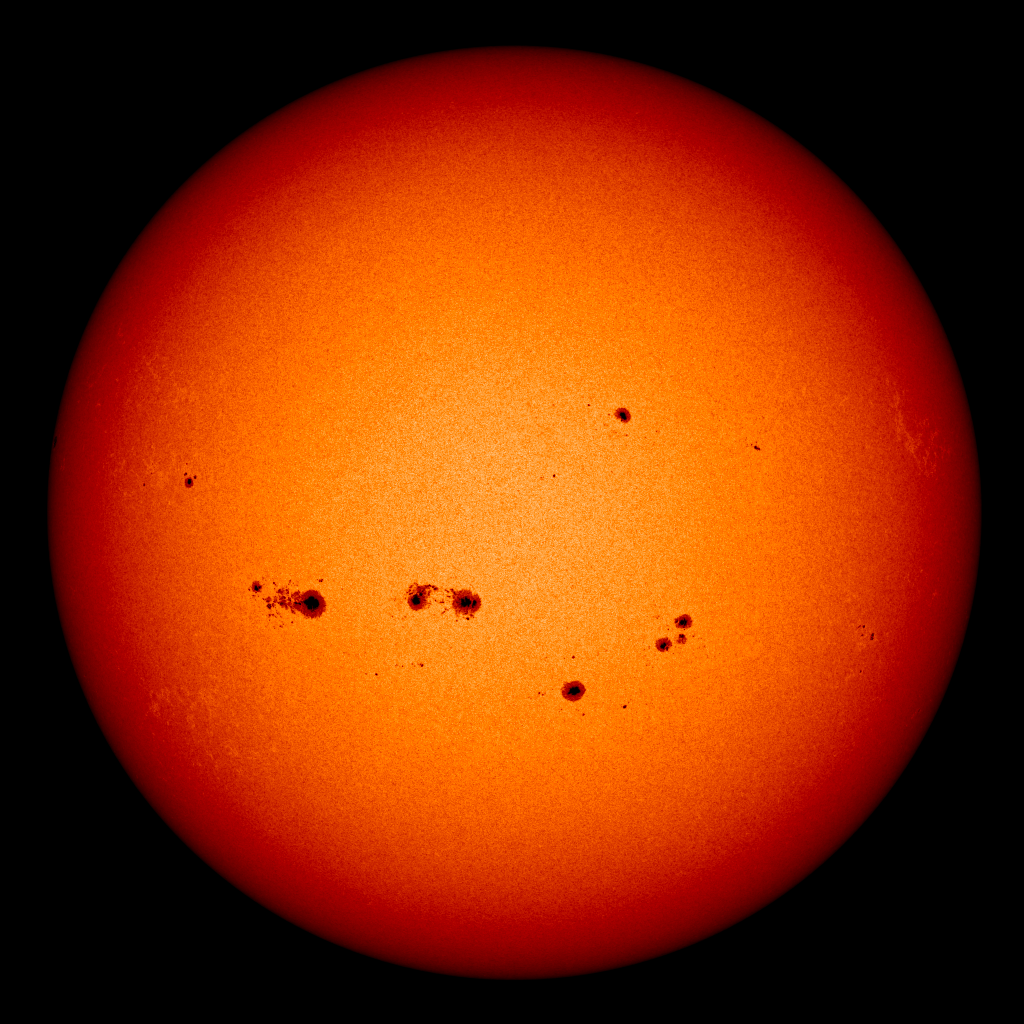
Although sunspot data has been recorded in one form or another for over 400 years, there have been few changes in the counting system since the introduction of the 'Wolf Number' in 1849. Recording of the sunspot 'Group Number' came into existence in 1998. It seems there were some strong differences in the two parallel series of systems and in 2011 a group of 40 experts undertook a full examination and revision of both systems in order to identify and fix the defects.
The new system, which became effective on July 1st, has brought both systems into alignment, with the most notable correction being in the lowering, by about 18%, of all numbers after 1947. The new Group Number has been corrected for a large underestimate of all values before the 20th century and has resulted in a fully reconstructed series of Group Numbers.
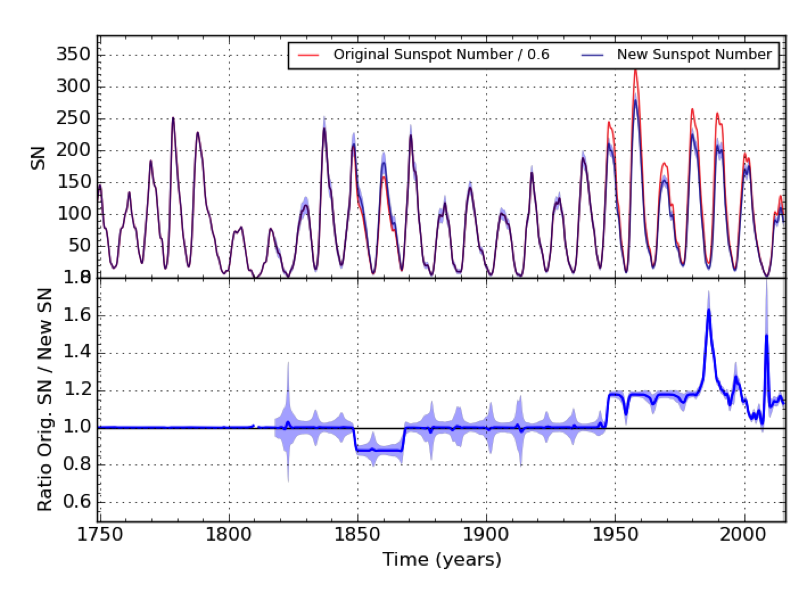 | |
| courtesy: http://www.sidc.be/ |
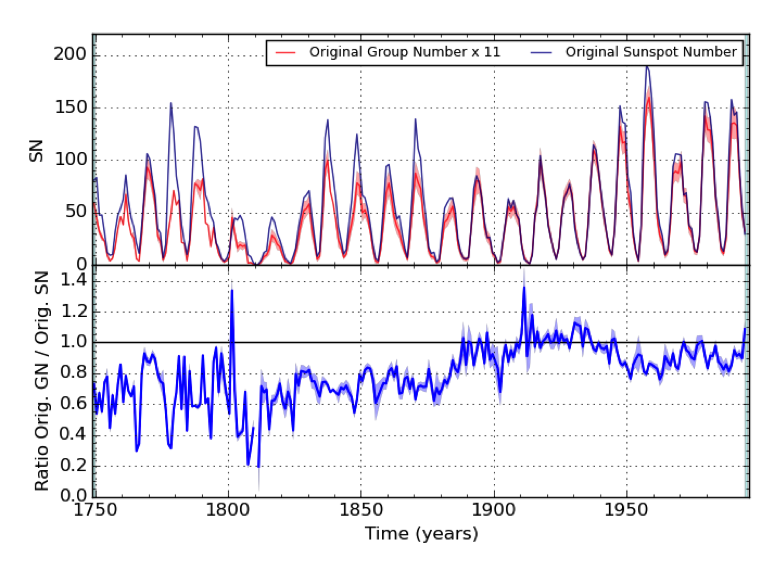
The graphic of Group Numbers shows significant increases for cycles up until the 1900's.
 |
| courtesy: http://www.sidc.be/ |
The new system brings the correlation of Group Numbers and Sunspot Numbers into harmony, unlike before.
 |
| courtesy: http://www.sidc.be/ |
Although these changes became effective on July 1st, the work is far from complete. According to the folks at SILSO (Sunspot Index and Long-term Solar Observations):
Still, as can be seen, significant deviations remain, mainly before 1825, when the observations become scarce and in periods of activity minima (low counts). So, more work definitely remains to be done for many years to come, but given the major improvements harvested at this stage, the WDC - SILSO is now going to proceed with the public release of this new version.
The preparation of this major operation is now almost completed. It required a huge organizational and programming work from the small SILSO team. Indeed, the release of the new past Sunspot series is just a starting point for the WDC-SILSO. Indeed, it requires a deep reworking of the operational software that will process the data from our worldwide network on July 1st and in the future. Indeed, various data products must be made seamlessly compatible with the new base total Sunspot Number series: the hemispheric Sunspot Numbers, the daily Estimated Sunspot Number, the 12-month solar-cycle forecasts, all data plots and the derivation of personal k coefficients for all stations of the network.
After a rather uneventful life over the past 166 years, the Sunspot Number will thus be reborn in a new incarnation on Wednesday July 1st. We hope that the science community will welcome this revived data set and will appreciate the considerable community effort accomplished over the past four years to produce a better reference for long-term solar and Sun-Earth studies.
A New Country and Some 2m Es
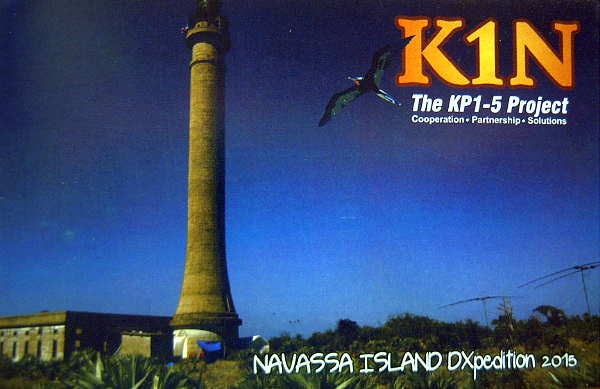
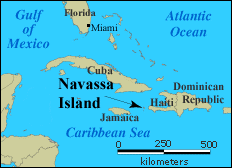
The summer propagation doldrums, as well as my roof reshingling projects, received a short respite this week with the arrival of a new DXCC QSL for 160m. The K1N card (Navassa Island Expedition) was received for my CW QSO this past winter. The card brought my 160m DXCC total to 155 worked and confirmed while adding one more to my overall all-band total of 336 / 336.
Sunday afternoon brought a rare and welcome 2m sporadic-E opening. Signals on 6m towards Colorado quickly rose from a normal 'S9' to ear-shattering S9 + 30-40db with one signal putting the S-meter of my IC-756PROIII hard against the right pin and completely blanking the bandscope's lower regions ... I have only seen this happen once before, when beaming semi-local VE7XF while he is running high-power.
I immediately activated my Es MUF receiver (Icom R-7000), tuned to an empty FM frequency and squelched. Not long after, the squelch broke with a strong signal also from Colorado and several more throughout the band. It is difficult to ID FM signals as they rarely identify except at the top of the hour.
After several CQ's on 144.200 (9el yagi and 150 watts) aimed to the SE, W9RM in Colorado popped-up briefly with an S9 signal and was quickly worked before he faded. Unfortunately, either due to lack of activity or fast-deteriorating conditions, his was the only signal heard. In terms of 'quality' of the opening, it was poor, but any 2m Es is always exciting.
I once had a two-hour 2m Es opening to southern California and worked 32 Californians on 2m SSB before conditions faded ... it would be nice to see that once again. One of the fellows I worked that night had just set up his new 2m transceiver and, not being familiar with 2m propagation, told me 'I'll look for you again tomorrow night'. I told him that he could look for me for the next 20 years and he'd likely not hear me ... that opening was 32 years ago!
Let's hope we get some more 2m Es before the season ends as it is one of the most exciting propagation experiences there is.
Andy’s Balloons
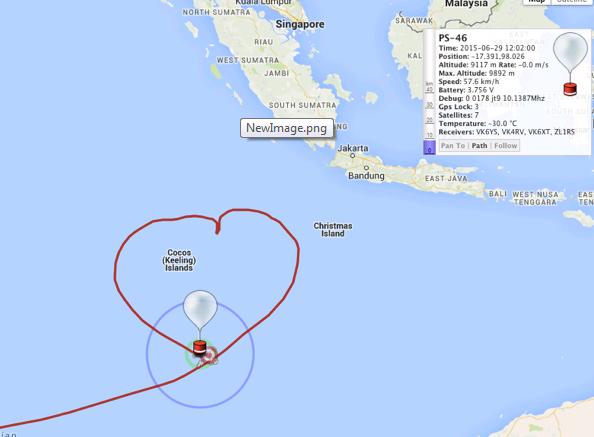
 Like Timex watches, the incredible Picosat balloons of Andy, VK3YT, 'take a licking and keep on ticking'. On May 23rd, Andy launched his PS-46 HF Pico balloon and on June 4th it had arrived back home, completing the circumnavigation of the earth in just 12 days ... but it kept on going. Although taking a little longer this time 'round, PS-46 arrived back over its starting longitude exactly one month later, on July 4th, completing its second circumnavigation of the planet! It slowed briefly enough over the Indian Ocean to trace out this interesting ground track.
 |
| courtesy: http://picospace.net/ |
PS-46 can be tracked via HF packets delivered via JT-9 and WSPR. Frequency information and tracking notes can be found on Andy's website for those interested in tracking the balloon themselves. As well, its track (and other balloons) can be followed on the Spacenear.us website. I think Andy's balloons are very cool and demonstrate a new aspect of amateur radio that was completely unheard of just a few years ago.
Go PS-46!
LF / MF – Time To File

The FCC is now officially inviting comment on its proposal to establish two new amateur bands ... the 2200m LF band (135.7kHz - 137.8kHz) and the 630m MF band (472 - 479kHz).
The detailed proposal was published in the Federal Registry on July 2, thus establishing the comment deadline as August 31st and a deadline of September 30th for 'comments on the comments'.
It is proposed that the Amateur Radio service would be 'secondary users' of this slice of the spectrum. Secondary users must not cause interference to the Primary users and also be willing to accept interference from the Primary users as conditions of operating. In reality, the only primary use of these bands in North America is for hydro distribution control (PLC) signals. Over several years of maximum ERP amateur experimental work, both here in Canada as well as in the U.S.A., there has been no documented interference to these signals nor have the well-shielded PLC signals been a problem for amateurs ... it seems that co-existence is readily attainable.
Whether you have operated on these bands or not (but especially if you have), I would urge you to file a comment expressing your opinions on any of the critical concerns (antenna height, power etc.) expressed by the FCC. All of these were listed in a previous three-part blog, starting here.
If you think that you might like to operate or experiment on either of these bands in the future, then just tell them that as well ... the more interest from the amateur radio world shown, the better.
For those of you that might think that this part of the spectrum has little to offer the amateur, I can assure you that such is not the case. Coast-to-coast propagation has been demonstrated on numerous occasions (on both bands). Both bands offer wide opportunities for experimental work dealing with antennas, modes and propagation as well as providing an abundance of homebrewing opportunities for builders.
Comments may be filed, identified by ET Docket No 15-99 (proceeding number), via the FCC Electronic Comment Filing System (ECFS). As well, you can read all of the comments that have been filed here.
U.S. amateurs have been waiting long enough (since 2007) for an opportunity to use these bands ... let's show the FCC that we really want them by filing your comments before August 31st!













