Author Archive
 The Best Laid Plans …
 August 16th, 2015 |
  Author:
  |
| courtesy: www.kcj-cw.com/ |
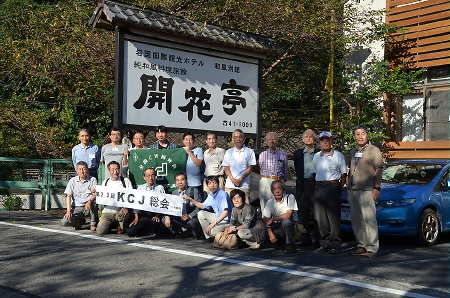
Hoping to enjoy some further contest work and improve my ear-brain-keyboarding skills, I had prepared everything for this Saturday's 24-hour 'KCJ' Contest. The 'Keymen's Club of Japan' is an annual affair that seems to attract a lot of domestic JA activity, with bonus points when they work any DX stations. I checked my N1MM Logger software but it didn't seem to have the contest. I did find it in the program's UDC (User Defined Contests) section but had to download and install a unique 'Sections' file from a Japanese website, as the contest requires the Japanese to exchange their Prefecture abbreviations. I eventually had N1MM working perfectly for the KCJ contest and with the contest starting at 0500 locally, I tuned up everything for the normally excellent 40m path to Japan in the morning and went to bed.
 |
| courtesy: http://www.swpc.noaa.gov/ |
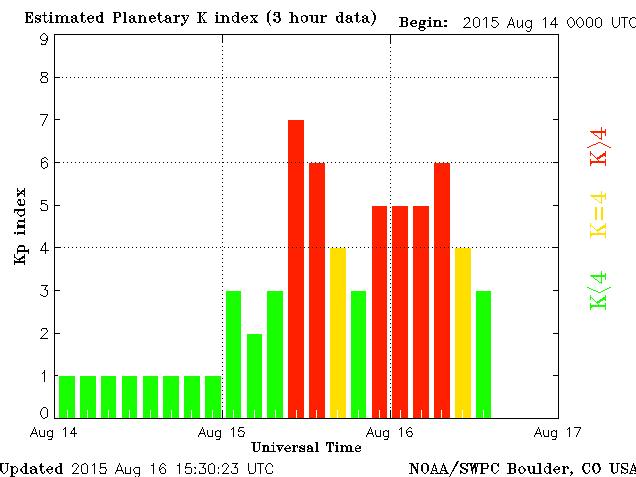
The afternoon path never really materialized either. Normally, propagation between the west coast and Japan is very good, with lots of strong signals being the norm ... but not today. Over the course of several hours, only four JA stations found their way into my log, and they were all a struggle.
 |
| courtesy: http://wdc.kugi.kyoto-u.ac.jp/dstdir/index.html |
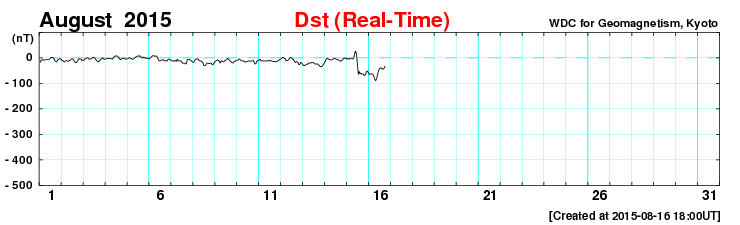
The earth had been hit, rather unexpectedly, by another whopping 'coronal hole stream' and propagation was truly dismal. With only a smidgen of keyboarding practice, I had to admit defeat ... the Sun had messed things up once again, as it has been doing for the past year as Cycle 24 slowly slides downhill. Unfortunately there is always a lot more flaring and streaming on the way down than on the way up. Hopefully the Sun will soon get this out of its system and radio conditions will quiet down and stabilize for the upcoming fall and winter DX season.
There is one more chance left, this evening, to get in some more keyboarding practice. The 'Flying Pigs QRP Group' holds their monthly 'Run For The Bacon' CW QSO party, starting at 0100Z tonight. Non-members may also join in the fun by sending their 'power' level instead of a membership number ... so maybe I'll run into you tonight.

Canadian 630m Ops Meet

 |
| Hakuna Matata under sail |
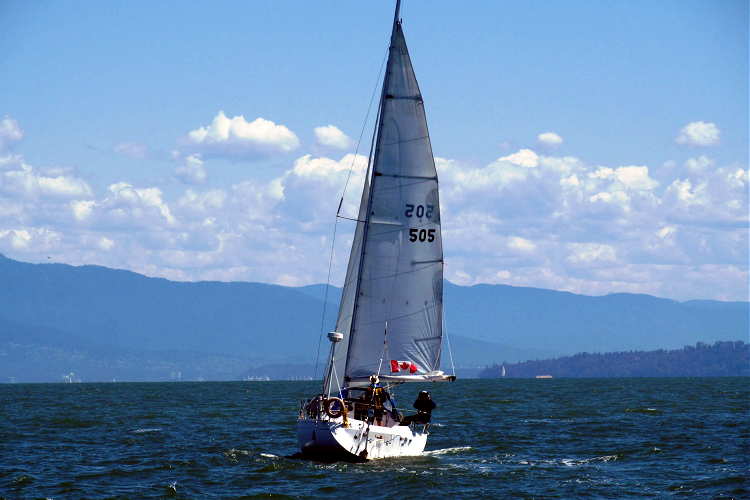
After a visit to the boat, a magnificent fractionally sloop-rigged 32' Beneteau, the Hakuna Matata, we all returned here to the house for refreshments, dinner and a station / antenna inspection. Part way through the visit I realized that our group contained 50% of Canada's active 630m operators, a rather sorry but true fact. In actuality, five out of the six Canadian 630m ops are VE7's! With such a special occurrence, a picture of the somewhat motley but enthusiastic crew was in order, with arms appropriately folded for the formal occasion.
 |
| Mark (VA7MM), myself and Toby (VE7CNF) |
Canadian amateurs have been fortunate enough to gain operating privileges in this very interesting part of the spectrum (472-479KHz) where surprisingly good results can be had with small backyard antenna systems. Hopefully with more activity from the west coast, amateurs in the prairie provinces and further east ... especially in highly-populated VE3, will take more interest in the band as two-way communications between the provinces can readily be done during the quiet winter nights.
With the USA well on its way to getting 630m operating privileges as well, it would be nice to see more Canadians on the band to take advantage of what is bound to be a flurry of activity from our southern neighbours ... there are already a dozen or more experimental stations there, just waiting to make the switch when the word comes.
More information on 630m operating and equipment see three related blogs:
630m Resources - Part 1
630m Resources - Part 2
630m Resources - Part 3
For a listing of all 630m-related blogs, click here.
Perseids Peaking
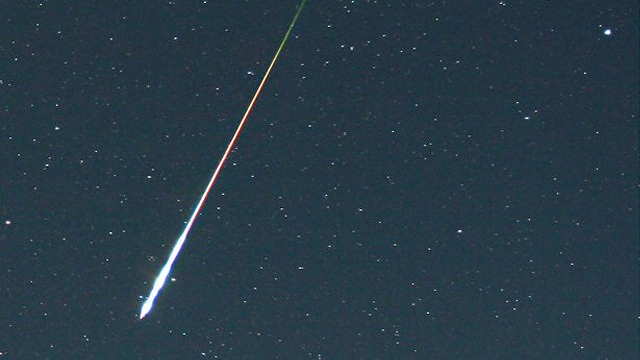
Nowadays, using FSK441 WSJT software, a lot of good fun can be had most non-shower mornings on meteor scatter, just using random meteors. My experience when using the same software during an actual shower has been disappointing, as often the signals are too strong or too long for the software which is looking for shorter, weaker signals. During a large shower such as the Perseids, where typical burns can be quite lengthy, my own experience has given better results with good old SSB or fast CW.
I clearly recall my first-ever meteor scatter QSO, made during the May Aquarids, back in the early 70's. I had arranged a sked with Ken, W7JRG, in Montana. I had grown up reading about Ken's VHF exploits in both QST and CQ as a teenager and was excited about the possibility of finally possibly working him. My station was homebuilt, using a 6360 transverter driven from my Heath HW-100, and feeding a homebrew 5894 amplifier with 1/4" copper tube plate lines. The amplifier produced just a shade over 100W output. My antenna, also homebrew, was a 24-foot 13 element Yagi ... probably not the best for meteor scatter although it worked well enough for me to ragchew every night with stations in Portland, Oregon on SSB.
A few minutes before our sked, I decided to make one final check of my system. Our sked was to be on SSB, using 15 second sequences. I keyed down at full-power and did a final tweaking of plate tuning and antenna loading, and unkeyed, back to receive mode after about 30 seconds of tuning up. My receiver immediately sprung to life with a very loud SSB signal, slightly off-tune. Thinking it was my local buddy, VE7BLF, calling me before the sked, I was surprised to hear a different voice ... it was Ken in Montana at S9++ ..."I've been holding my breath waiting for you to unkey there Steve ... thought you would never finish!"
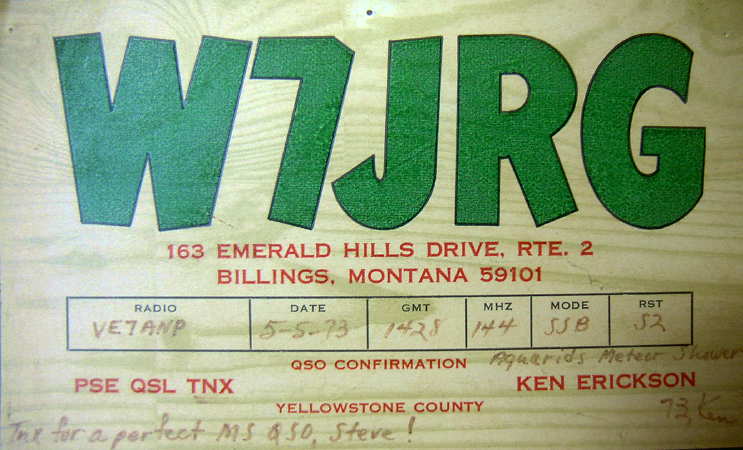
Needless to say I was just as surprised as he was. We talked back and forth for about another 60 seconds before the burn finally dissipated and signals were gone. What a great introduction to meteor scatter, with the QSO completed before the sked even started! Ken later told me that of all of the meteor contacts he had made, it was one of his best ... I guess we just hit it right.
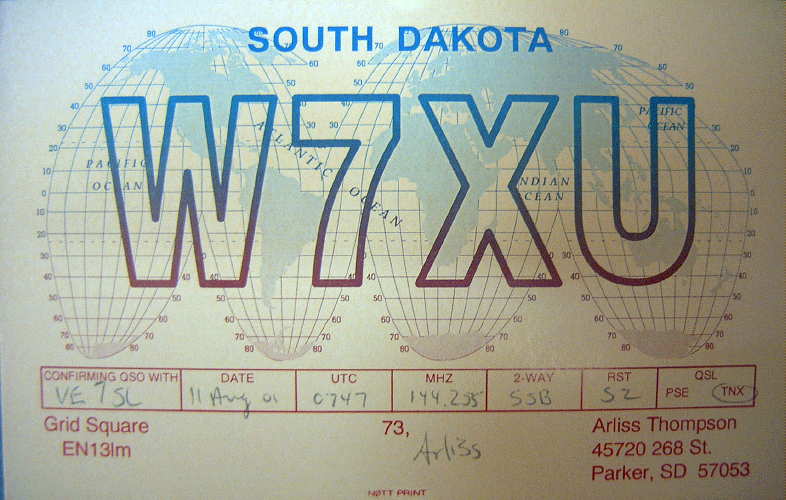
Of all the showers, I always found that the December Geminids was the best, even better than the August Perseids, at least for the North-South path. Having said that, my longest meteor contact was made during the Perseids, with Arliss W7XU in South Dakota ... just a shade over 1300 miles while running just 40W SSB to a 9el Yagi.
Good luck if you are doing some meteor scatter tomorrow or even if you are just watching the shower visually ... conditions should be ideal, if the skies are clear, as the very new moon's sliver does not rise until near dawn.
SKCC Sprint
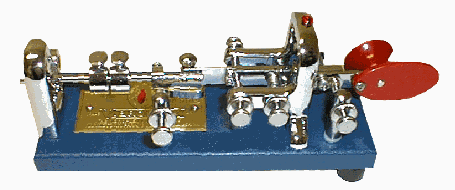
 I've spent a couple of hours this weekend (so far mainly on Saturday), playing in the SKCC Sprintathon CW contest ... the rules demand that only hand keys, including bugs, be used. I hauled out my original gray Vibroplex, purchased back in 1964, when I decided that using a straight key was just too slow. I was doing a lot of DXing and contesting back then, with my trusty DX-20, VF-1 VFO and assorted groundplanes on top of my parents three-story house in the middle of Vancouver ... it's hard to believe that it was quiet enough there but those were the days before computers, switching power supplies and and so many other noise-making devices that we have today. They truly were the 'good old (quiet) days' of radio. My favorite contests back then were the 'W-VE', where any 'VE' became instant DX and the subject of good-sized pileups and the CW 'Sweepstakes' ... back when the exchange was, if I recall correctly, just NR, RST and QTH.
 My antenna farm sat on our high, peaked roof and consisted of groundplanes for 40m, 20m and 15m ... these were made of inexpensive galvanized drain pipe, about three or four inches in diameter. The 40m one was guyed and also had one end of my 80m dipole attached to it, which ran out across the yard and across the back lane, terminating on one of BC Hydro's wooden (telephone) poles. Every once in a while the telephone guys would take it off and toss it over the fence whereupon I would get out the ladder and re-attach it, where it would stay for another year or so.
For this weekend's CW party, I have put my 'Tri-Tet-Ten' on 20m, doubling from a 40m crystal to 14051.5, placing me pretty close to the Sprint's watering-hole QRG of 14050. I have had way too much fun with this simple one-tube radio since building it, mainly for 10m CW, in anticipation of the present solar cycle's peak years. Although it puts out almost 5W when quadrupling to 10m, I can get a whopping 13W from it on 20m, which is plenty of power to have some fun.
So far I've worked about 40 stations, all on CQ's, since I can't really QSY to answer others ... so if you are around this afternoon, please give me a call should you hear my little rig. It's a real nice change to hear non-machine sent CW for a change and fists ranging from one end of the scale to the other ... really a nice reminder of what the bands used to sound like when I first got on the air.
Straight Key Century Club’s Weekend Sprintathon
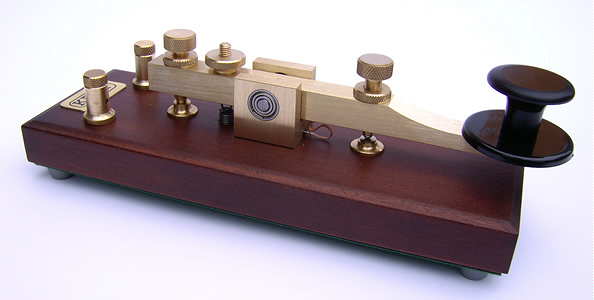 Can't wait 'til New Year's Eve's Straight Key Night? Enjoy CW as it has been sent since the earliest days of Amateur Radio in the SKCC Weekend Sprintathon! The SKCC regularly celebrates the joy of CW ... sent by either hand key or by bug:
The SKCC WES aims to bring together operators with different skill levels in a regularly scheduled, informal operating event lasting 36 hours. The event starts at 1200 UTC on the Saturday following the 6th of each month and ends at 2359 UTC on Sunday. Participants can operate for a total of no more than 24 hours. This event runs from 1200 UTC Aug. 8 to 23:59 UTC Aug. 9.
Non-members are encouraged to join in on the fun and, better yet, get an SKCC number by signing-up. Most of the action will congregate around the SKCC watering-hole frequencies:
Participants may sprint on 160-6 meters, excluding the WARC bands (60, 30, 17, and 12 meters). Suggested frequencies are on or around the SKCC calling frequencies: 1.820, 3.550, 7.055 and 7.114, 14.050, 21.050 and 21.114, 28.050 and 28.114, and 50.090 Mhz. K3UK's sked page or other spotting tools are permitted for this event.
I'll be on 20m for a few hours with my single 6L6 Tri-tet crystal oscillator running about 10 watts ... hopefully within a few KHz of 14.050, doubling from a 40m crystal along with my faithful Vibroplex, purchased as a teenager back in the early 60's.
For all of the details, visit the SKCC WES Rules page here ... so put away your keyers and have some real old fashioned radio fun.
1933 Regen Project
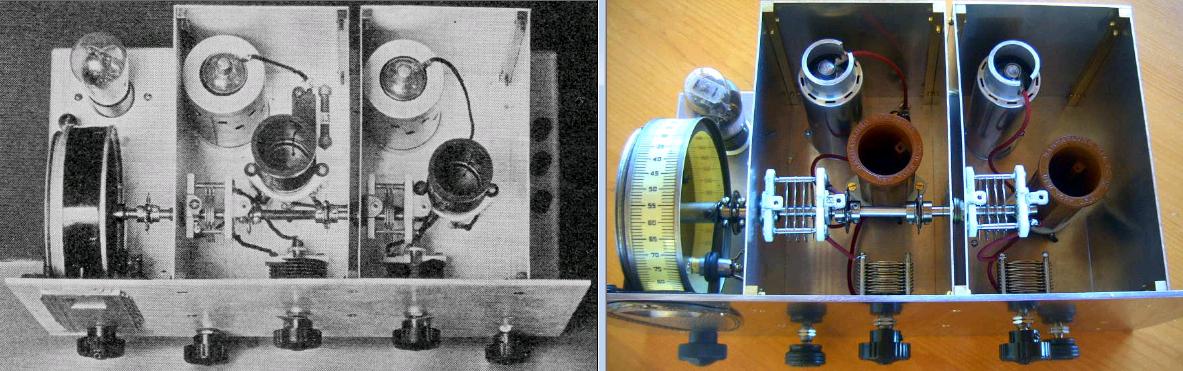
 Monday was spent finishing the coil winding for my present bench project, a 3-tube regenerative receiver. The receiver first appeared in the January '33 QST article, "Rationalizing The Autodyne", by George Grammer. I tried to stay true to the original design, both physically and electrically, as much as possible. Where period components were not available, they were manufactured. Several capacitor are 're-stuffed' cases and some resistors have been physically altered to resemble era-appropriate styles. The one deviation I made from the original circuit was to remove the B+ (200VDC) from the headphones by going to impedance-coupled audio, which blocks DC from the headphone circuit. After finishing the coils and doing a quick re-check of the wiring, I held my breath and applied the power.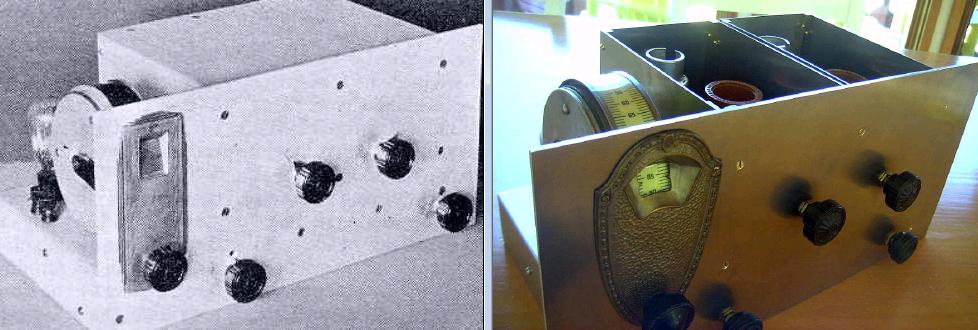
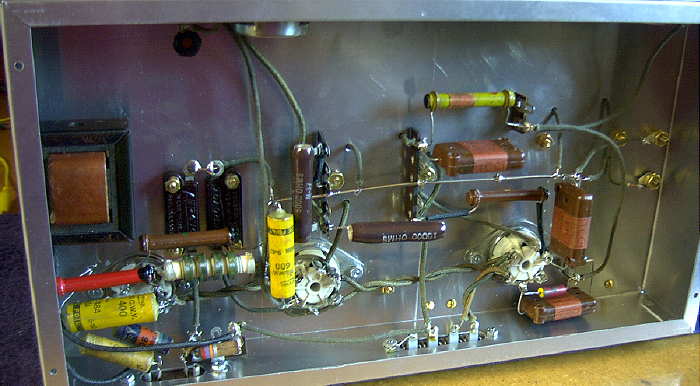
Much to my surprise and delight, the receiver worked immediately. It took me some time to find the correct control settings and combinations that seemed best but eventually its operation became familiar. Here are a couple of short recordings, crudely made via connecting the computer across the high-impedance headphones, as I tuned across a somewhat noisy 40m band in the evening.

Now although the receiver appears to be working, I'm not 100% convinced that it is working as well as it should. It's difficult to know exactly how it should perform when at its best as it really can't be compared to any of our modern-day receiving systems. Just what did 'good performance' sound like in 1933?
I have some reservations about one of my tubes. It's a '78' from my junk-box stash and has a large red '?' inked across the glass envelope. I may order some NOS '78's or even some more modern '6D6's, to see how they perform. On the plus side, the oscillator seems very stable and there is absolutely no 'hand-effect' on tuning, a common problem with many regens. Peaking up the RF stage tuning causes no pulling of the oscillator but the '78', although a hot-performer in 1933, provides plenty of tube noise as well, if the gain is set too high. I think the main advantage of having the tuned RF stage is to add RF selectivity and eliminate any bleed-through from some of the blowtorch shortwave signals just up the band. Tuning seems best when its gain is set between fifty and seventy-five percent of maximum. The large drum dial, in combination with the small bandspread capacitor, spreads 40m across most of the dial and makes for easy tuning although there is a small amount of backlash.
Another thing I noticed is that it seems to be very receptive to spurious computer birdies, with the laptop sitting just a foot away. Perhaps its unshielded top and bottom are the cause of this as I don't hear any of the signals on my main station receiver.
Comparing it to the two-tube regen in my Paraset, the Paraset sounds much quieter and generally sounds more sensitive ... but it uses more modern tubes, '6SK7's, first introduced in 1938, five years after the '78'. The selectivity seems as good, if not better, than the Paraset, which I consider an excellent performer. The Paraset also sounds just as good as my National SW-3, which was produced in the early 30's ... so the new regen is likely not as quiet nor as sensitive as the SW-3, probably the best simple regen of its day.
Perhaps some newer tubes will make a difference in performance and maybe my expectations are too high. In any event, the closing paragraph of Grammer's article may be more telling that I originally thought:
"The set as it stands is not perfect, of course; nothing ever is."
CW Contesting
 |
| courtesy: http://k1el.tripod.com/ |
It's been a few years since I've done any CW contesting, mainly because the laptop I have always used became slow and sluggish as well as developing a keying glitch when keying was done via the serial port connection. Apparently it is, or was, a fairly common problem with some operating systems when serial port keying was employed.
Last year I purchased and built the WinKeyer USB keyer, mainly to use as a USB keying interface, and hopefully kill the keying stutter. The stutter would manifest itself in the form of delayed element spacing. For example, the 'C' in a 'CQ' would sound like 'NN'- every once in awhile ... not every time, but often enough to drive me crazy. From lots of 'Googling', I learned that USB keying should solve the problem.
The first thing I did was to download and run 'CCleaner' to scrub the computer of unused files and clean up the registry. My contesting laptop uses Windows XP, which I've always liked but my old system was taking about eight minutes to boot-up from a cold start! Following the CCleaner run, I did a hard drive defragmentation, shut the system down, and pressed the 'on' button. This time the system booted completely in less than two minutes, the fastest in several years!
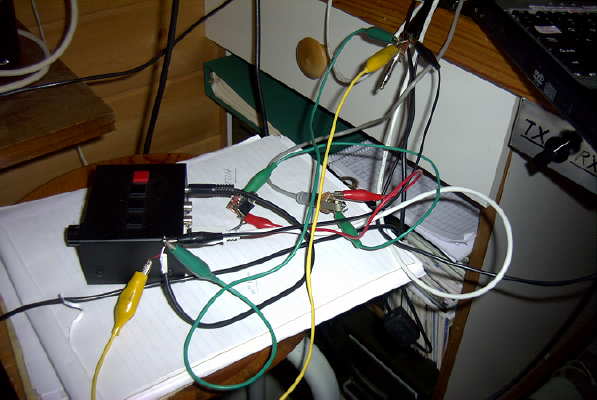
After, interfacing everything with a half-dozen clip leads (I didn't have the required cables), configuring the WinKeyer and setting up the N1MM logging software for this weekend's NA CW QSO Party, I cautiously waded into the fray.
 |
| Yikes! |
Like riding a bicycle, it all came back to me quickly. The NA guys are hardcore CW fans and send fast, typically 30WPM or better. I started in the 'Search & Pounce' (S&P) mode to ease into the logging software's required keystrokes but soon felt comfortable enough to change to the 'Run' mode.
Handling the pileups and typing fast enough to keep up was challenging yet exhilarating ... it had been a few years since my last test, the 160m Stew Perry Contest, my favorite. I could only take the heat for so long and after about two hours of steady operating decided to call it a day. It was nice to shake out the new interface and also test my own skills once again. I completed my short test with 137 QSO's and 5891 points ... not much by 'NA' standards but still, for me, a ton of fun and a good 'back-in-the-saddle' re-start.
Now that the software is working well (there were zero keying glitches during the test), I'm looking forward to getting back into some CW contesting again and to improve my ear-brain-computer skills.
Time to get busy and build some interfacing cables and get rid of the clip-lead rat's nest for the next exercise.
Contesting events can be found at WA7BNM's excellent WA7BNM Contest Calender website














