Author Archive
 LF Improving
 October 10th, 2015 |
  Author:
  |
| courtesy: http://sdo.gsfc.nasa.gov/ |
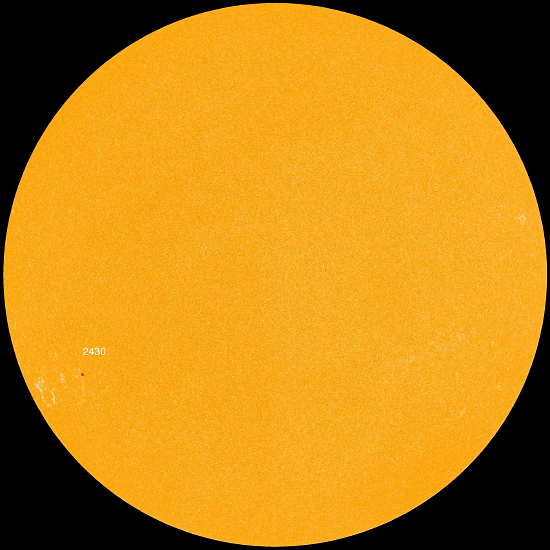
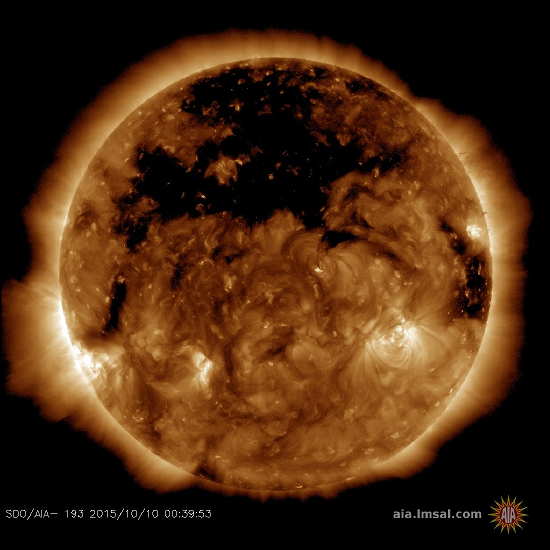
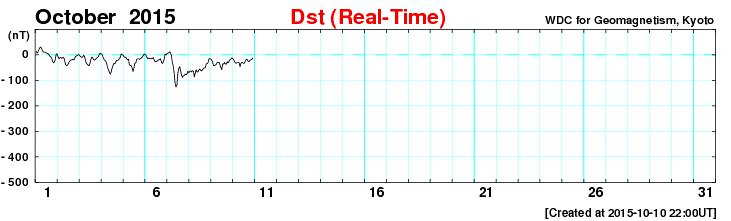
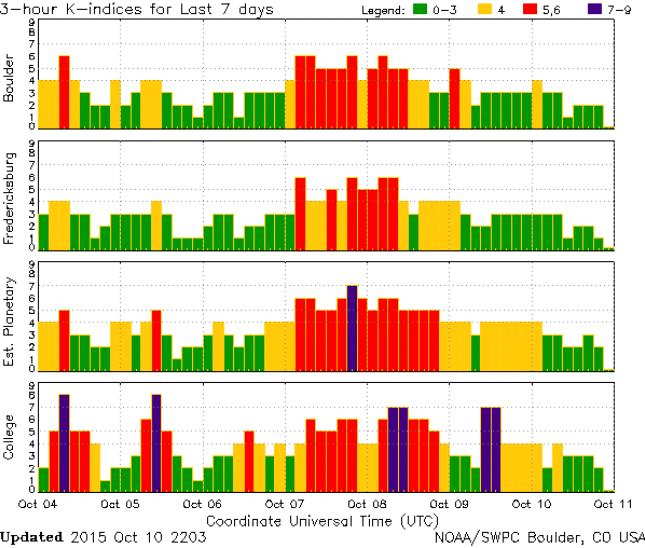
After more than a week of horrendous geomagnetic activity, due mainly to coronal-hole streaming, it looks as if things are starting to settle down once again. One would never know it from looking at the sun's image as the source of the streaming is largely invisible in the visible light spectrum. Viewing at a different wavelength however, reveals the source of the disruption, now about to rotate out of view for a few weeks.
 |
| courtesy: http://sdo.gsfc.nasa.gov/ |
 |
| courtesy: http://wdc.kugi.kyoto-u.ac.jp/dst_realtime/presentmonth/index.html |
 |
| courtesy: http://www.noaa.gov/ |
More VE7 Lightwave Activity
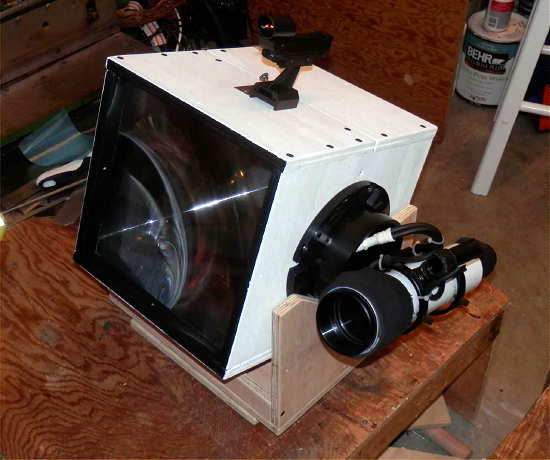
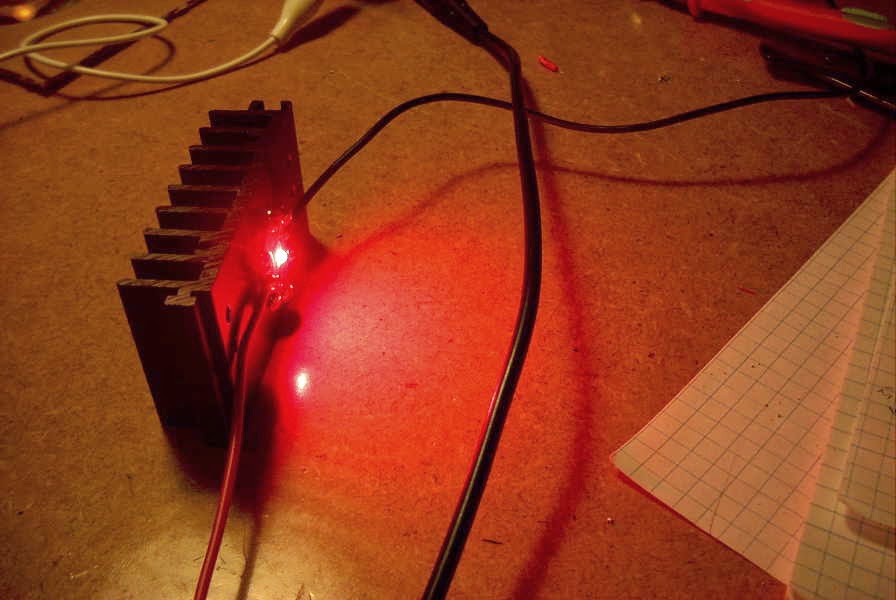 Two more VE7's are well on their way to getting in on the lightwave fun in the Vancouver lower mainland region. Toby, VE7CNF, and Mark, VA7MM, are constructing stations similar to the ones built by myself and Markus, VE7CA.
Toby and Mark live close enough that a clear-air scatter QSO between them might also be a possibility. Having another near-by amateur, or even in the same city, is a great source of motivation ... not to mention having someone else to actually talk to, once the system has been built.
Except for the LED focusing sled, Toby's fine-looking transmitter box and LED driver / modulator, are now complete. The receiver is next on the list. I believe this will use one of the inexpensive ($5) fresnels lenses, purchased locally at Princess Auto, that seems to work very well for the price.
 |
| photos courtesy VE7CNF |
Clear Air Scatter Tests On 458THz
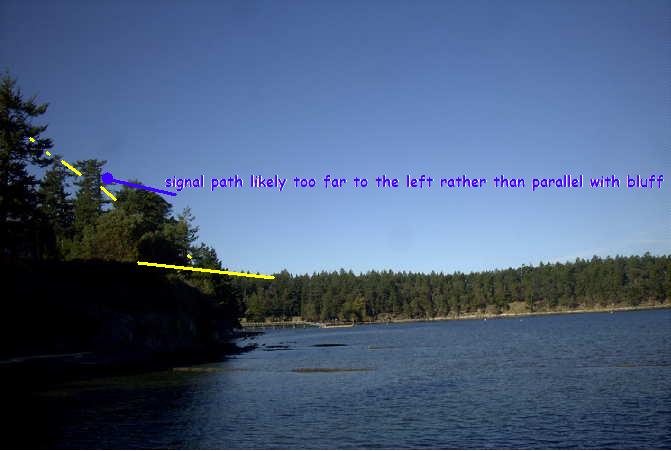
 After patiently waiting for the bright moon to clear the early evening skies, I was finally able to venture out for my first clear-air scatter test this past Sunday night. I had plotted the path on my Mayne Island map and determined bearings as best I could, but the path was going to be very tight. If the path plan was right, my signal should just clear the high beachfront bluffs at the chosen sea-level receiving site.
After carefully aiming the light, I set off for the receive site at around 7:45PM and was all set up with the new lightwave receiver about 30 minutes later. The site appeared fairly quiet and the Argo screen confirmed that there was little QRN coming from the local houses up on the bluff. I listened for over an hour, trying various slow changes in pointing ... varying the azimuth a few degrees at a time, and then the elevation. Unfortunately not the slightest indication of my ~549Hz tone was seen. I was confident that the system was working as several strobes were heard from distant aircraft (near Vancouver), as their flashing lamps skimmed the edge of the far treeline.

It seems likely that either my aiming or bearing calculations (or both) were off and that the signal was probably slightly to the west of me, with the bluff blocking any hope of reception ... I knew it was going to be close but was hoping for a little luck.
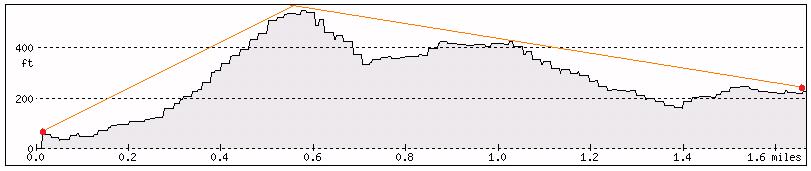
I left the transmitter outside overnight (it was set up two properties to the SE) and decided to try a second shot on Monday night. This path, although shorter by a mile, would require the signal to pass over two high hills ... the first topping out at 667' and the second at 567'. The overall direct-path distance was 1.7 miles (2.7 km). A cross-section of the signal path is shown below as it hugged the edges a little lower than the peaks:
 |
| courtesy: http://www.heywhatsthat.com/profiler.html |
I have been using a 'compass' app on my I-Pad to determine directions when aligning the transmitter and receiver setups. I'm not 100% convinced of its accuracy at all times, as readings can sometimes be a bit flaky. Before doing any more testing, I'll need to solve this, either with a better app or with a real compass.
The transmitter was set up just before darkness, pointing right at the edge of the treeline along the 667' ridge and elevated at a 28 degree takeoff angle. The deep-red, 640mw LED, was switched-on just before departure at around 8:30PM.

It didn't take long to get set up in the back of the CRV, with the receiver temporarily set in no particular direction and plugged into the computer.
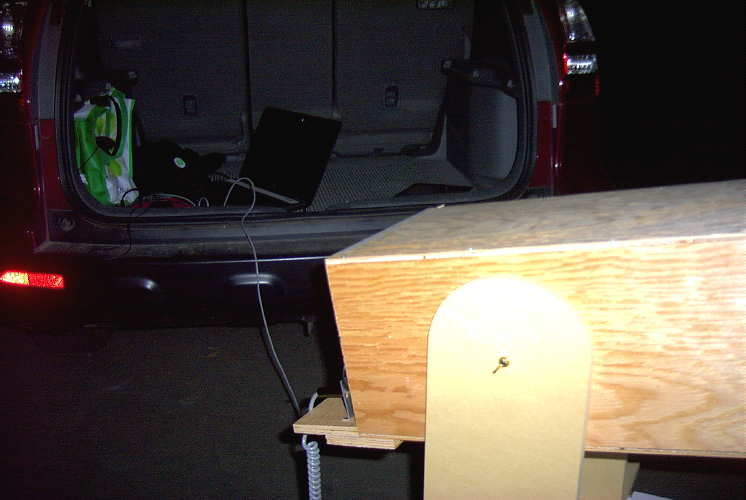
When Argo came to life, I went to the front of the car to grab the I-Pad so that the receiver could be aligned but was surprised to see a bright line at 549Hz when I came back! It seems that my 'rough' placement of the receiver was spot-on, and not exactly where I had originally intended. In fact, there appeared to be about a 10 degree error in where I had planned to point. I later traced the error to my path drawn on the paper map as it was difficult to determine my exact receiving location on the older map, which didn't show the new road where I had set up on.
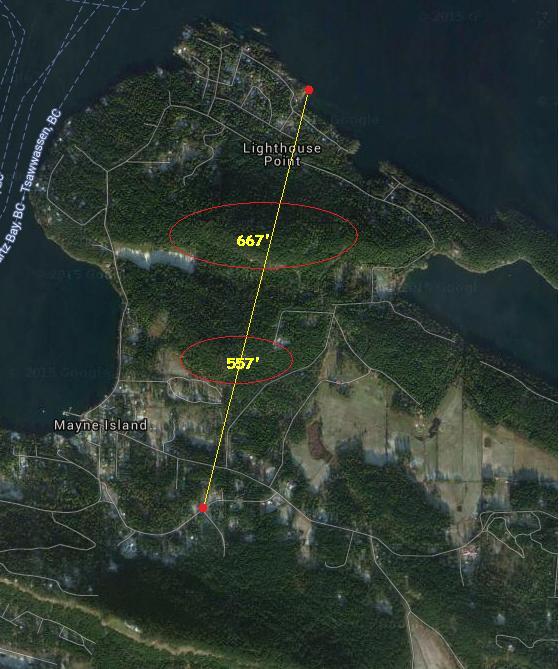 |
| Monday night's path |
With the strength of signals recovered on this path, two-way communication could have easily been established on any of the CW QRSS modes ... if quieter, probably on normal audible CW. Signal strength indicated that there was still plenty 'left in the bucket' for greater distance paths, probably much further than I am able to test here on the island.
This was the first thing I saw, at the QRSS60 mode in Argo ... a fairly narrow passband and a ~25+ db dig into the noise.
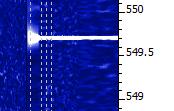
Backing off to a wider bandpass (less sensitive) but faster QRSS10 mode showed the signal still very apparent:

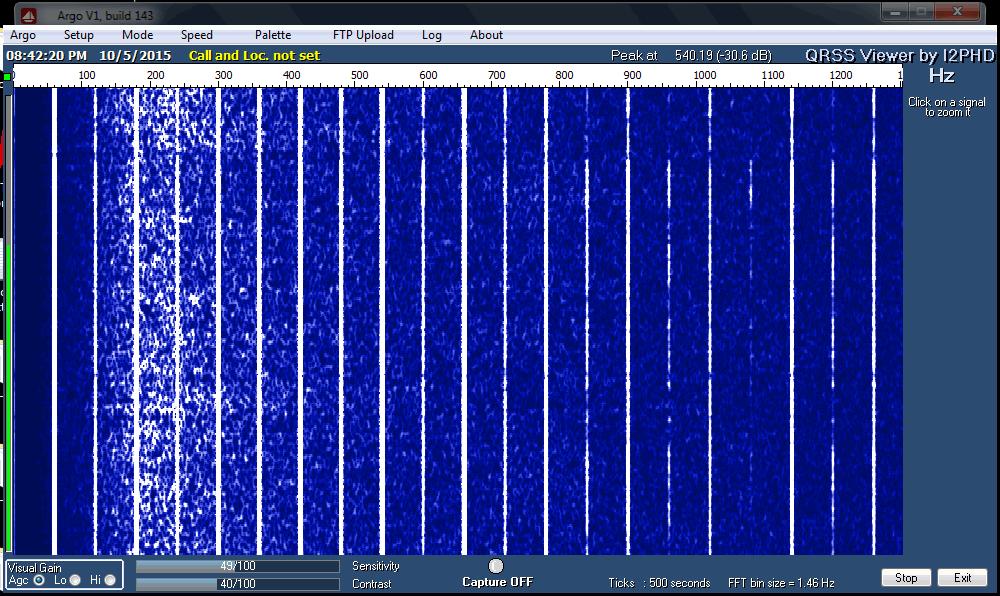
The almost 'real time' QRSS3 mode, although showing a much weaker signal, indicated that the signal would have been almost audible had it not been for the high level of background noise at this site. Don't confuse the lightwave signal with the much stronger 9th harmonic of 60Hz on 540Hz!

The ferry terminal was just down the hill about 1/2 mile and with several kilowatts of spectrum-polluting 60Hz sodium vapor lighting, the cloudy skies were a sea of bright-pink. There was a high level of audible hum in the phones, right from the start, that unfortunately, masked any hope of an audible detection. The waterfall screen capture shown below, illustrates the massive QRM at this otherwise nice site!
The night was not going to be complete without a strobe signature, captured on Argo from a high passing jet aircraft:
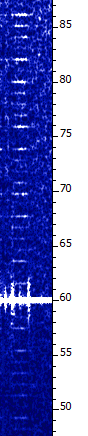 | |
| strobes |
All-in-all, it was a very successful outing, considering the obstructed path and the $5 fresnel lens used in the portable receiver! I've examined the island map for any other possibilities and there are not many suitable candidates. I had hoped for one other possibility towards the west, which would stretch the path by almost another mile, but I'm not really sure that I can get a clear shot without hitting the very close treeline at this end.
I think the next round of testing will be in the other direction ... across Georgia Strait, with John, VE7BDQ, who has expressed interest in doing some deep overnight Argo searches for my signal in the clouds.
I'm not sure which mode would offer the best chance ... 'clear air scatter' or 'cloudbounce'. John has a very good receiver, with a slightly larger and better-quality fresnel than the one used in these tests. Working from his suburban backyard, directly across the strait at 13 miles (21 km) distant, his direct path to me is somewhat obstructed and will require an elevation angle of around 30 degrees at his end. I think, ideally, we would both like to be skimming just above the ocean, with only a slight elevation. A lower and less obstructed shot from his yard would mean an oblique path so this also remains a possibility. We will play with what we have and hope for the best ... even just a trace of signal would be a measured success.
I think that a non-line-of-sight (NLOS) contact would make an exciting challenge and a great project for two amateurs living in the same city or town, and ... you really don't even need a ticket!
For more technical details on the equipment used in this test, see "A West Coast Lightwave Project" describing the activities between here and Markus, VE7CA. We have just learned that this article will be published in the 2016 Radio Amateur's Handbook ... hopefully inspiring more new lightwave activity!
More Manhattan Building Tips
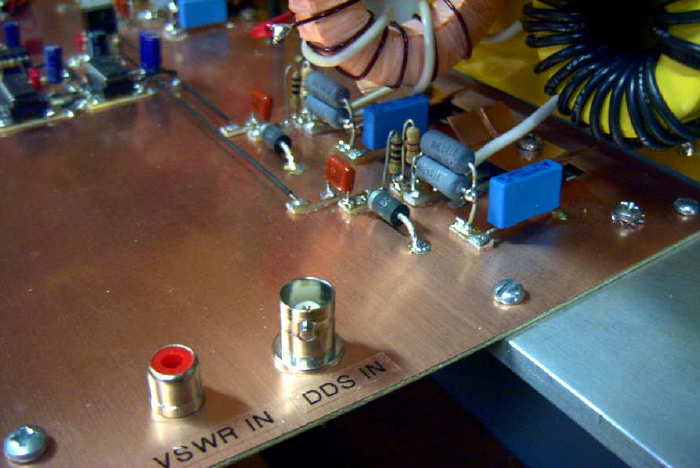 |
| 2200m kW Transmitter |
One of my early blogs described how I make the pads needed for Manhattan style. It can pretty much be used for any modern project and has been used here for countless circuits ... from a 1W LF tranmsitter to my 2200m/630m kilowatt.
 |
| 1W LF Transmitter |
I found these hints from Bob about pads and soldering components particularly helpful for anyone making a start in Manhattan style building:
Round pads require only placing in proper X and Y coordinates. A rectangular or square pad also requires proper rotation. A rectangular pad placed cockeyed doesn't look good.
I've had good luck with pads made from .032 double sided board. Solder surface tension prevents shorts with this pad thickness. My experiments making pads from thinner .010 thick flexible board often resulted in shorts.
A clean surface is needed for good pad adhesion to the board. I polish the pad board on both sides to a shine and then punch out the pads.
Pads can take up a lot of solder so I prefer to use 1/8th inch (.125) diameter pads.
Some of my Manhattan projects have failed because pads have loosened from the board. Cheap, discount super glue was my mistake. I now use Loctite Super Glue Gel. Of the hundreds of pads I've applied, I've never had one loosen.
If a punch is used to make pads each pad will have a rounded side and concave side. My pads are applied rounded side up. Using tweezers, I pick up a pad, place a small dab of glue on the punch mark and drop the pad in place. Light tweezer pressure is used to set the pad. Too much pressure squeezes out the glue leaving a weak joint. I Use enough glue so it squeezes out around the bottom edge of the pad.
Disaster occurs if glue gets on the tweezers. Pads stick to tweezers and won't stick to the board. If this happens, I stop and wipe off the tweezers with a cloth. I also use an Exacto knife to remove any hardened glue on the tweezer tips.
I try not to put too many leads to a pad. For example, its common for a transistor base lead to connect to two resistors and two capacitors. If this happens I extend the transistor base lead across two adjacent pads ans share the connections between the two pads.
I take time to shape my component leads. I make certain I don't have to flex a lead, like a spring, to solder it in place. Improper technique means the next component soldered to the pad may spring loose the earlier lead.
I put a bend in the component lead so the lead sets level on the pad. But the bend doesn't need to be long. A bend a 1/16th inch long, or half the diameter of the pad works well. This also means multiple leads can attach to a pad, each pointing toward the pad center.
My Hakko 936 soldering station is rated for 50 watts. I use a wide tip to get that power to the pads. I'm surprised how much power is required to do Manhattan construction. This is especially true when soldering component ground leads to the project board.
It is very easy to come away with cold solder joints. After all the leads are attached to a pad I Heat all the solder on the pad to liquid state. My ground connections take 1-2 seconds and pad connections take about 1 second. I've had no damage to components due to the heat I apply.
I prefer to use .032 leaded solder for my pad connections. But I use .062 solder for ground connections or to fill in a heavily populated pad.
I offer these ideas for what they are worth to you.
bob-N7SUR
Bob also mentioned that he prefers to tape down a full size plan of his component layout as an aid in placing his pads ... a light punch mark through the paper layout, marking the pad's location. I haven't gone this far with any of mine, preferring to place pads as I build, giving flexibility to component placement.
There are lots of good online references for Manhattan-style building but be warned ... some of them, particularly the pages of Dave, AA7EE, will have you making plans and reaching for the soldering iron before you know what's happened!
Plans At VY1JA
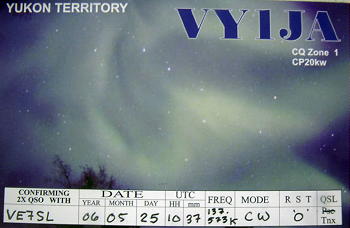 In the midst of this weekend's California QSO Party, I heard VY1JA calling CQ, looking for the Californians. It had been several years since I last heard VY1JA and the last time that we worked was on 137kHz on the 2200m band.
 The CQs continued without much luck as the Californians just didn't appear to be hearing (or looking) to the north ... missing one of the rarest multipliers in North American contests.
Now, I had recently read that the VY1 station had been experimenting with remote operation, so that hard core, experienced contesters, could have the opportunity to hand out the rare 'NT' (Northern Territories) multiplier in future contests ... especially in the popular November ARRL Sweepstakes. I assumed that the station was likely being remotely operated.
After listening to a lot of CQ's going unanswered, I swung the beam towards Whitehorse and sent, "ur 599 down in VE7 land" and sent my call. Much to my surprise, it was my dear old friend 'J' himself, operating the station. What followed was a 10-minute catch-up on what he had been doing over the past few years and his plans for the future.
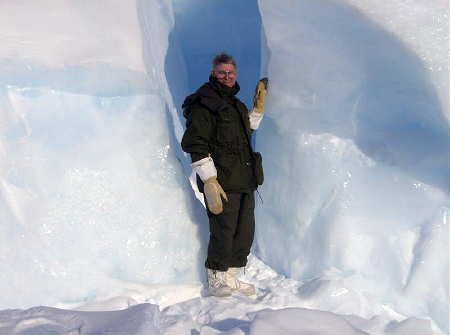 |
| J in Nunavut as VYØJA |
Future plans, now well underway, call for multiband V-beams (520' legs) at 70' aligned to the SE and NW and some high metal on a pair of 100' towers for the HF bands. As well, a new K-3 will drive an Alpha 9500 amplifier on all bands.
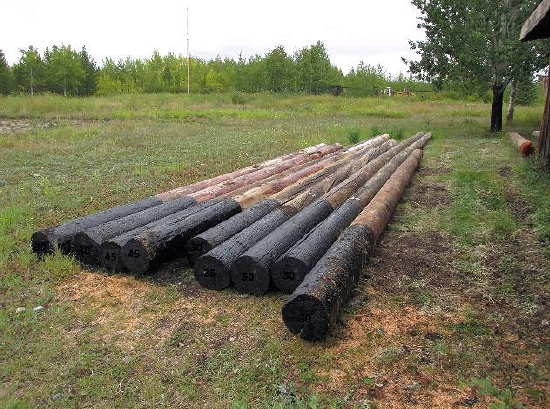
A few of the 20 poles, ranging from 70' to 30', that will be used to support V-beam legs and elevated groundplanes for the low bands.
I've saved the best news for last. J told me that he really wants to get going on 630m as well! His signal will be a wonderful addition to the band as he should be workable by most of the western provinces on nights of normal propagation. I am very much looking forward to working J again on the LF bands, recalling how strong his 100W signal could get during several of our early-morning 2200m CW ragchews.
Welcome back J!
Alaskan NDBs Awaken

Good geomagnetically-quiet conditions continued into Tuesday morning, with the 'K' index hitting '0' just before dawn here on the west coast. A two-minute Perseus recording of the NDB band revealed good propagation towards Alaska, the first of the season.
The first good opening of the new DX season always provides an opportunity to see which NDB's have survived the summer and have not been closed down by the FAA bean counters. Every year, a few more of the Alaskan NDBs go quiet, with no new ones being added to the list.
The situation is certainly not confined to Alaska. The growing reliance on GPS and RNAV procedures is gradually making the reliance on NDBs a thing of the past. Frankly I'm astounded, yet grateful, that there are many hundreds of NDBs still in use and I'll really miss chasing the low-powered DX targets when they are all eventually decommissioned.
The following Alaskans were heard on Tuesday morning at 1300Z, about one hour before my local sunrise:
9/30/15 1300 529 SQM Level Island AK CO36
9/30/15 1300 396 CMJ Ketchikan AK CO45
9/30/15 1300 391 EEF Sisters Island AK CO28
9/30/15 1300 372 FPN Fredericks Point AK CO36
9/30/15 1300 266 ICK Annette Island AK CO45
9/30/15 1300 414 IME Mt. Edgecumbe AK CO27
9/30/15 1300 394 RWO Kodiak AK BO37
9/30/15 1300 209 CYT Yakataga AK BP80
9/30/15 1300 390 HBT Sand Point AK AO95
9/30/15 1300 358 SIT Sitka AK CO26
9/30/15 1300 350 VTR McGrath AK BP22
9/30/15 1300 338 CMQ Campbell Lake AK BP41
9/30/15 1300 429 BTS Dillingham AK BO08
9/30/15 1300 233 ALJ Johnstone Point AK BP60
9/30/15 1300 212 CGL Coghlan Island AK CO28
9/30/15 1300 223 AFE Kake AK CO36
9/30/15 1300 229 AKW Klawock AK CO35
9/30/15 1300 283 DUT Dutch Harbor AK AO63
9/30/15 1300 245 HNS Haines AK CO29
9/30/15 1300 347 DJN Delta Junction AK BP74
9/30/15 1300 411 ILI Iliama AK BO29
9/30/15 1300 277 ACE Homer AK BO49
9/30/15 1300 355 AUB King Salmon AK BO18
9/30/15 1300 524 MNL Valdez AK BP61
9/30/15 1300 382 JNR Unalakleet AK AP93
9/30/15 1300 281 CRN Cairn Mountain AK BP21
9/30/15 1300 385 EHM Cape Newenham AK AO88
9/30/15 1300 385 OCC Yakutat AK CO09
9/30/15 1300 263 OAY Norton Bay AK AP84
9/30/15 1300 390 AES Northway AK BP29
9/30/15 1300 404 GCR Cordova AK BP70
9/30/15 1300 525 ICW Nenana AK BP54
9/30/15 1300 251 OSE Bethel AK AP90
9/30/15 1300 341 ELF Cold Bay AK AO85
9/30/15 1300 248 GLA Gulkana AK BP72
9/30/15 1300 376 PVQ Deadhorse AK BQ50
9/30/15 1300 379 IWW Kenai AK BP40
9/30/15 1300 399 SRI St. George AK AO56
9/30/15 1300 359 ANI Aniak AK BP01
9/30/15 1300 272 UTO Utopia Creek AK BP35
9/30/15 1300 275 CZF Cape Romanzof AK AP61
9/30/15 1300 529 FDV Nome AK AP74
9/30/15 1300 391 EAV Bettles AK BP46
9/30/15 1300 346 OLT Soldotna AK BP40
9/30/15 1300 347 TNC Tin City AK AP65
There were several missing from the list ... but I classify them as 'third-tier' beacons since propagation needs to be even better than it was on Tuesday to hear them. These are beacons that are either suffering from terrible locations, small inefficient antenna / ground systems or in need of maintenance. I also have a list of Alaskans that have never been heard at all outside of Alaska but are known to be on the air according to recent FAA online information. It is these last two groups that keep me watching and waiting ... for those magic mornings that happen only once or twice per year.
From what I can surmise by scouring the FAA information, there are presently 77 active NDBs in Alaska, including the ones not heard down here. If you live in Alaska, and can take a listen on the NDB band, I'll send you the ones I'm not sure about. If anyone else wants a list of all of the beacons up there, with detailed frequency information, drop me an e-mail and I will send you a three-page pdf.
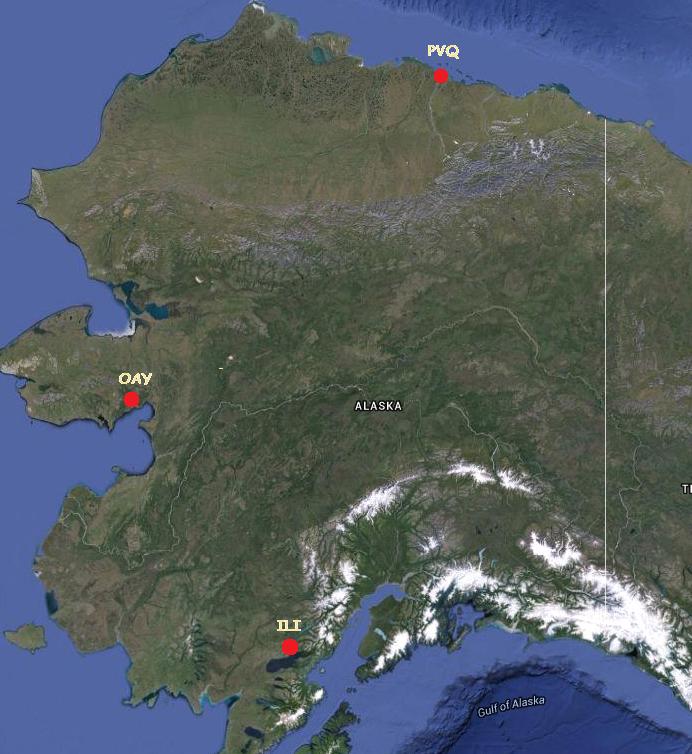
Here are some signal samples, recorded on Tuesday morning, of some of the 'second-tier' (not heard every morning) signals from Alaska.
 |
| courtesy: https://www.google.ca/maps |

PVQ - 376 kHz Put River (Deadhorse), Alaska

OAY - 263 kHz Norton Bay (Moses Point), Alaska
ILI - 411 kHz Iliamna, Alaska
With the sun getting quieter and quieter, conditions on the NDB band should continue to get better and better over the next several years ... let's just hope that the NDBs are still around long enough to enjoy the solar-quiet benefits.
Conditions Rising
Conditions towards the east on LF as well as on the broadcast band (BCB) have taken a positive leap forward over the past few days. Last night, 160m was open to Europe from here, the first opening of the season as far as I am aware. I also spent some time listening to a dozen or more TA (Trans-Atlantic) carriers on the broadcast band, signalling good conditions over the pole finally.The polar skip also extended down into the LF band, as it did the previous night.
In the afternoon hours I started watching for Europe1 on 183kHz, transmitting from western Germany, and was able to see its weak carrier on the Perseus SDR's waterfall display several hours before sunset. Twilight here brought a dramatic improvement in signal strength as shown below.
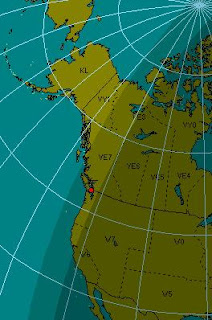

As daylight approached the transmitter site in Germany, the 183kHz signal provided a good visual example of 'dawn-enhancement', with the signal showing a dramatic flare on the waterfall indicating its build-up in strength.


Once dawn arrived, it was interesting to see that the signal was able to hang-on for over an hour with reasonable strength before fading out rather quickly. Even though the transmitter site was in full daylight, the dark skies to the west were able to sustain propagation for some time before it all came crashing down.
Of late, the pre-dawn hours here have also been providing some exceptionally strong signals from Asia on the BCB. These are often enhanced at sunrise as well, as the strength often takes a short fast peak, before fading out for the day.
One of the loudest this week was from JOAK (NHK1) in Tokyo on 594 kHz ... listen ...
This was heard on the Perseus SDR and inverted-L antenna. The LF polar signals shown above, were recorded with the 10' X 20' loop and Wellbrook preamp while looping towards Europe at 030 degrees.
With the DST going positive, hopefully these good conditions will continue to build over the next few weeks. October is often one of the best months of the year for LF/MF DX.
In the afternoon hours I started watching for Europe1 on 183kHz, transmitting from western Germany, and was able to see its weak carrier on the Perseus SDR's waterfall display several hours before sunset. Twilight here brought a dramatic improvement in signal strength as shown below.
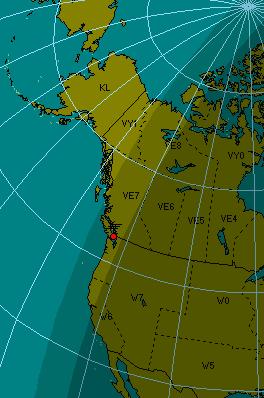

As daylight approached the transmitter site in Germany, the 183kHz signal provided a good visual example of 'dawn-enhancement', with the signal showing a dramatic flare on the waterfall indicating its build-up in strength.
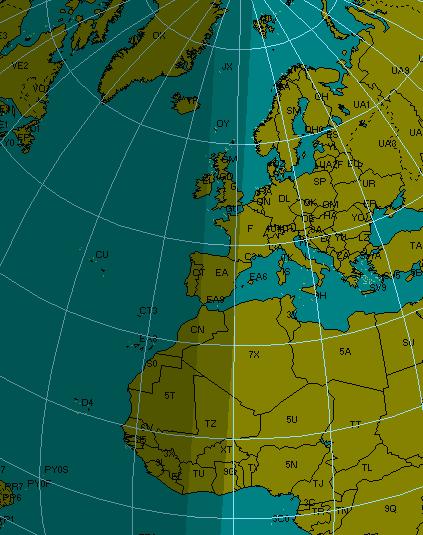
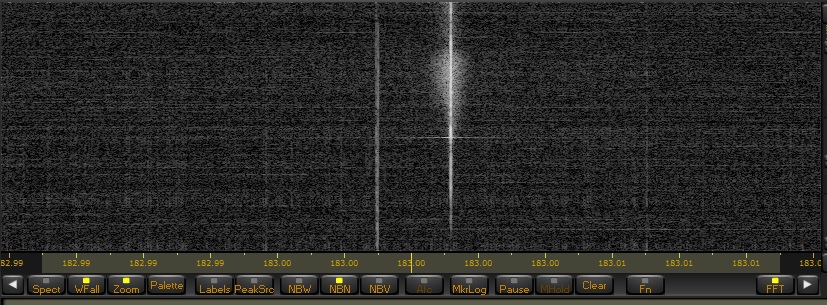
Once dawn arrived, it was interesting to see that the signal was able to hang-on for over an hour with reasonable strength before fading out rather quickly. Even though the transmitter site was in full daylight, the dark skies to the west were able to sustain propagation for some time before it all came crashing down.
Of late, the pre-dawn hours here have also been providing some exceptionally strong signals from Asia on the BCB. These are often enhanced at sunrise as well, as the strength often takes a short fast peak, before fading out for the day.
One of the loudest this week was from JOAK (NHK1) in Tokyo on 594 kHz ... listen ...
This was heard on the Perseus SDR and inverted-L antenna. The LF polar signals shown above, were recorded with the 10' X 20' loop and Wellbrook preamp while looping towards Europe at 030 degrees.
With the DST going positive, hopefully these good conditions will continue to build over the next few weeks. October is often one of the best months of the year for LF/MF DX.
 |
| courtesy: http://wdc.kugi.kyoto-u.ac.jp/dst_realtime/presentmonth/index.html |













