Author Archive
 PAØRDT Miniwhip Shakedown
 February 1st, 2016 |
  Author:
A recent posting to Yahoo's 'NDB List Group' by Mike, an ardent NDB DXer in the UK (Sussex), announced the recent completion of his four-part video series describing the installation and testing of a new PAØRDT active antenna.
If you may be contemplating the installation of an active antenna such as this, or perhaps making a start at DXing the NDB band or listening on 630m, then you might enjoy following Mike's journey as he demonstrates that living in the noisy suburbs need not keep you from enjoying the LF/MF bands. Mike includes some interesting tests involving his grounding system versus noise ingress and the results of keeping the electrical main's ground isolated (or not) from the antenna cable's ground.
The PAØRDT active whip is available from PAØRDT himself or if you are handy with a soldering iron, you might choose to build the same antenna in your workshop. These simple yet highly effective receiving antennas are being used successfully by hundreds of listeners all over the world and for their size provide some pretty amazing performance.
Much more information on the PAØRDT e-probe antenna may be found here in a previous blog posting. To see more of Mike's videos, you can visit his interesting Youtube Channel here.
VP8STI Excitement
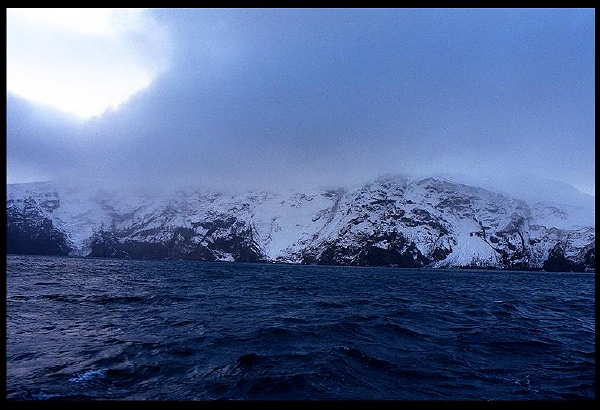 |
| S.Thule Island - courtesy: k5tr |
Operations from the South Sandwich Islands (Thule) has caused a lot of excitement on the bands over the past ten days ... but for myself, it was more of a last-minute frenzy, which I'll elaborate on later.
The expedition, composed of a crew of 14 operators from the 'Intrepid DX Group', left Port Stanley in the Falkland Islands aboard the MV Braveheart, on a 38-day roundtrip to South Sandwich and then to South Georgia ... two of the rarest DX entities on the planet, and by any standard, not the easiest places to reach!
South Sandwich was on-the-air from January 18th to the 25th, when a sudden turn of events put an end to the operation from the island. Not long after they suddenly disappeared from the air, this bulletin appeared on the DX newswebsite:
Today at 21:20 UTC, Nigel Jolly, Braveheart owner, declared an emergency and ordered to VP8STI team to cease all operations and return to the ship.
A large ice flow that had broken away due last nights storm starts to block the entrance to the Bay where they were camped. There was strong potential for the ice flow to prevent Braveheart to get them.
Team is now safely aboard the Braveheart and they are moving away from Southern Thule Is. All the equipment and personal gear is still on the island. They hope to return to camp site during next good weather window.
Once they retrieve their equipment, they could make a determination as to whether they can proceed to South Georgia to do VP8SGI as planned.
The latest word sounds very hopeful:
Finally yesterday, team was able to collect all gear from Thule Is.
All team members are OK and they are on the way to South Georgia where they will arrive after three days sailing.
They will try to be on the air during eight days as VP8SGI.
Personally, I want to thanks to all who send support messages to us, expressing their concerns about VP8STI team situation.
Delorme tracker is working, you can see Braveheart progress at: http://www.intrepid-dx.com/vp8/location.php
 |
| RV Braveheart |
I soon realized that operations on South Sandwich would be coming to a screeching halt at any moment and scrambled to see where they were presently operating. Unfortunately they seemed to spend most of the day (25th) on the WARC bands, for which I have no antennas ... I really need to hang a 30m dipole up in the trees one of these days for situations just like this.
As darkness approached VE7 land, I began seeing a few spots for them on 20m phone, not my favorite mode, nor the most efficient for working pileups.
Zeroing-in on their frequency found them with a nice 5x7 signal on 14.180kHz and listening from 14.235 - 14.245kHz. The operator was working North America by call districts and when I tuned-in, was working "Ø" 's. He would work ten stations and then change. He started on down the list, calling for "9" 's and then "8" 's but when he had finished with them, he called for "1" 's ... hmm. Perhaps he had started with "7" 's before I arrived and was working his way through the list once again.
It seemed to take forever when he had finally finished with the "6" 's and his signal was now considerably weaker ... "7" 's should be next. But no ... it was even better!
Luckily I had been following his tuning technique as he worked through the pileup and was able to track his listening frequency as he worked his way from 14.235 to 14.245 and back again. I had my transmit frequency already set on the frequency of the last "6" that he had worked ... when he called for "any VE's?" ... as luck would have it, he came back on my first call, not only making my day but making my week!
After a bit of a scare, I was very fortunate to work them on what turned out to be their last full day of operation, as they left the air, and South Sandwich, after only a few more hours of operation.
From now on I'll be checking my list much more carefully.
CLE 203 Results
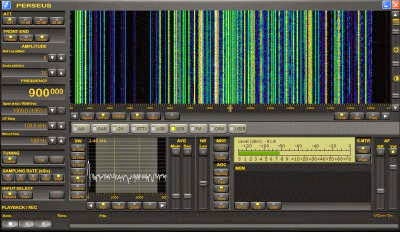
As has been the case for much of this winter's DX season, LF conditions were very erratic during this past weekend's CLE NDB-listening event.
Geomagnetic activity fluctuated wildly from hour to hour, gradually settling down for Sunday night's last opportunity, with K-indices dropping to 1's or Ø's.
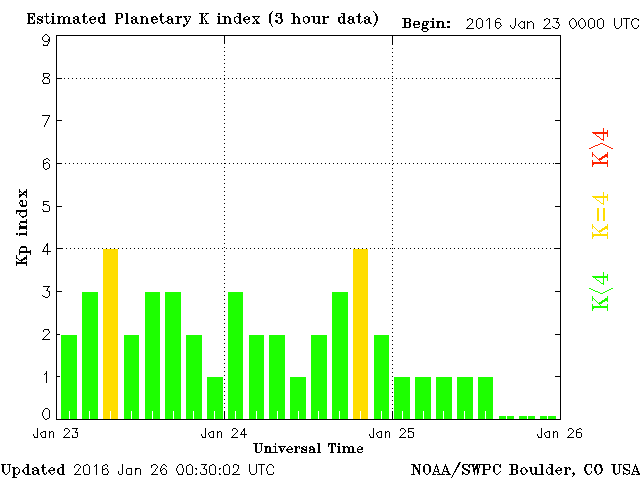 |
| courtesy: http://www.solarham.net/planetk.htm |
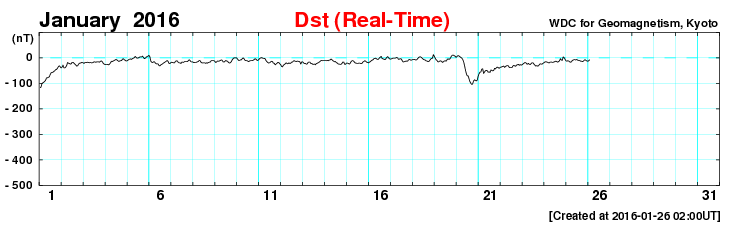 |
| courtesy: http://wdc.kugi.kyoto-u.ac.jp/dst_realtime/presentmonth/index.html |
Participants in the central and southern states noted excellent conditions and were not as badly affected as listeners to the north, where the effects of any auroral activity are sudden and much more severe ... I'm always surprised at just how much difference one or two hundred miles further to the south can make.
The following NDB's were heard over the course of the weekend, all using the Perseus SDR to record two-minute grabs, every hour, from dusk through dawn. Going over the recordings takes some time but being able to, in effect, listen all night, readilly illustrates how much the band conditions on LF can change so drastically from hour-to-hour ... sometimes for better and sometimes for worse.
25 11:00 350 VTR McGrath, ALS
23 05:00 350 SWU Id Falls, ID, USA
23 05:00 350 RG Oklahoma City, OK, USA
25 10:00 350 RB Resolute Bay, NU, CAN
23 05:00 350 ON Agate, OR, USA
23 05:00 350 NY Enderby, BC, CAN
24 13:00 350 DNS Denison, IA, USA
24 10:00 351 YKQ Waskaganish, QC, CAN
23 05:00 351 AE Paradise Hills, NM, USA
23 09:00 352 RG Rarotonga, CKS
25 10:00 353 ZXY Whitehorse, YT, CAN
23 05:00 353 RNT Renton, WA, USA
23 04:00 353 PG Portage La Prairie, MB, CAN
23 08:00 353 LLD Lanai, HWA
24 09:00 353 IN Ericsburg, MN, USA
23 08:00 353 DI Dickinson, ND, USA
23 05:00 353 CY Cheyenne, WY, USA
23 05:00 353 AL Dixie, WA, USA
23 08:00 353 5F Chevron, AB, CAN
24 07:00 355 YWP Webequie, ON, CAN
25 14:30 355 AUB King Salmon, ALS
23 08:00 356 ZXE Saskatoon, SK, CAN
23 08:00 356 ZF Yellowknife, NT, CAN
23 11:00 356 PND Portland, OR, USA
23 08:00 356 ON Penticton, BC, CAN
25 11:00 356 ODX Ord, NE, USA
23 08:00 356 MEF Medford, OR, USA
24 11:00 358 YKG Kangiqsujuaq, QC, CAN
23 05:00 359 YQZ Quesnel, BC, CAN
23 05:00 359 YAZ Tofino, BC, CAN
23 05:00 359 SDY Sidney, MT, USA
24 13:00 359 GGF Grant, NE, USA
23 05:00 359 BO Ustick, ID, USA
24 11:00 360 SW Warroad, MN, USA
25 13:00 361 HI Holman, NT, CAN
23 08:00 361 E3 Wabasca, AB, CAN
25 10:30 362 YZS Coral Harbour, NU, CAN
23 08:00 362 RPX Roundup, MT, USA
23 09:00 362 OWP Sand Springs, OK, USA
23 08:00 362 BF Seattle, WA, USA
23 08:00 362 6T Foremost, AB, CAN
23 10:00 364 4D Helmet, BC, CAN
25 07:00 365 PAL Palma, EQA
23 05:00 365 MA Mayo, YT, CAN
23 05:00 365 HQG Hugoton, KS, USA
23 05:00 365 DPY Deer Park, WA, USA
23 06:00 365 AA Harwood, MN, USA
25 10:00 366 YMW Maniwaki, QC, CAN
25 11:00 366 PNI Pohnpei, FSM
25 10:00 366 EOK Keokuk, IA, USA
25 11:30 367 R5 Pukatawagan, MB, CAN
23 08:00 368 ZP Sandspit, BC, CAN
23 08:00 368 VX Dafoe, SK, CAN
23 08:00 368 SX Cranbrook, BC, CAN
25 11:00 368 SOY Sioux, IA, USA
It will be nice to see a 'quiet sun' once again, hopefully sooner than later. For such a wimpy solar cycle, this one is not going down without a valiant fight, as it continues to mess-up LF and MF propagation, with an almost non-stop bombardment of coronal hole streams.
What Mode Is That?
 |
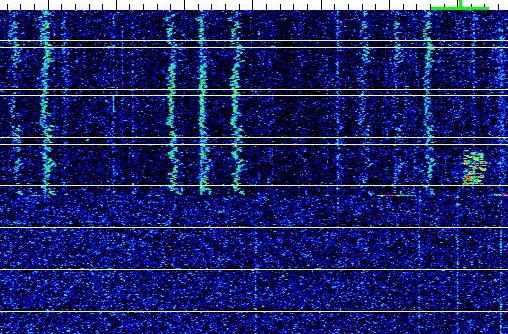
| 'JT-9' - courtesy: http://www.sigidwiki.com/ |
A recent link posted on the ON4KST 2200/630m chat page brought up a very helpful web site.
The Sigidwiki site lists examples of the various transmission modes being used from LF to UHF, along with examples of what these signals look like on a waterfall display.
With the proliferation of digital modes found on-the-air today, it's often fairly baffling, trying to figure out what you are hearing. The main database page contains a staggering 272 different identified modes of transmitting information, in one way or another ... no wonder it's hard to keep track!
Clicking on any of the modes will bring up more details about the mode, sometimes with links to the decoding software and further reading.
 |
| 'PICCOLO' - courtesy: http://www.sigidwiki.com/ |
I'm sure there are more that aren't on the list (is WSPR there or did I just miss it?) but it's still an impressive and helpful collection for those that use a waterfall display on their receivers.
Hunting For NDBs In CLE 203
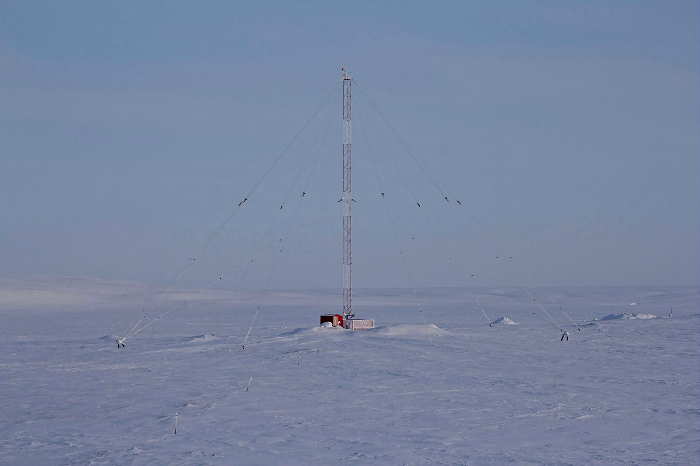 |
| RB-350kHz - courtesy: http://www.ve3gop.com/pict.htm |
This coming weekend will see another CLE challenge, this time in the 20 kHz slice from 350.0 - 369.9 kHz.
A nice catch for North American listeners, as well as for over-the-pole Europeans, is 'RB' - 350kHz, in Resolute By, Nunavut. Its big 3,000-watt signal has been heard all over Europe and in NA from Hawaii to New England. If you haven't participated in one of the monthly CLE activities before, this midwinter event might be just the right time to get started ... the low geomagnetic activity of late looks very encouraging.
From CLE coordinator Brian Keyte (G3SIA), comes the following reminder:
Hi all:
No Specials - just an ordinary Listening Event is only a week away:
Days: Friday 22 January - Monday 25 January
Times: Start and End at midday, your LOCAL time
Range: 350.0 - 369.9 kHz
Just log the NDBs that you can identify having their nominal (published)
frequencies in that range, plus any UNIDs that you come across there.
We last concentrated on these frequencies during CLE186 in Sept 2014.
Please send your CLE log to the List (no attachments and ideally in a
plain text email) with CLE203 at the start of its title. Show on each line:
# The Date (or Day No: 27 to 30)
# The Time in UTC
# kHz - the nominal published frequency, if known.
# The Call Ident.
Please show those main items FIRST. Any other optional details such
as Location and Distance go LATER in the same line.
If you send any interim logs, please also send a 'Final' (complete) one.
And, of course, tell us your own location and brief details of the
equipment that you were using during the Event.
You can find full details about current and past CLEs from the CLE page
http://www.ndblist.info/cle.htm including access to the CLE203 seeklists (soon) for your part of the World prepared from the loggings on Rxx.
Good listening - enjoy the CLE.
Brian
----------------------------------------------------------
From: Brian Keyte G3SIA: <ndbcle'at'gmail.com>
Location: Surrey, SE England (CLE co-ordinator)
----------------------------------------------------------
(If you would like to listen remotely you could use any one remote
receiver such as http://websdr.ewi.utwente.nl:8901/ for your
loggings, stating its location and owner and with their permission
if required. A remote listener may NOT also use another receiver,
local or remote, to make further loggings for the same CLE)
__._,_.___
These listening events serve several purposes. They:
- determine, worldwide, which beacons are actually in service and on-the-air so the online database can be kept up-to-date
- determine, worldwide, which beacons are out-of-service or have gone silent since the last CLE covering this range
- will indicate the state of propagation conditions at the various participant locations
- will give you an indication of how well your LF/MF receiving system is working
- give participants a fun yet challenging activity to keep their listening skills honed
Final details can be found at the NDB List website, and worldwide results, for every participant, will be posted there a few days after the event. If you are a member of the ndblist Group, results will also be e-mailed and posted there.
The very active Yahoo ndblist Group is a great place to learn more about the 'Art of NDB DXing' or to meet other listeners in your region. There is a lot of good information available there and new members are always very welcome.
If you are contemplating getting started on 630m, listening for NDBs is an excellent way to test out your receive capabilities as there are several NDBs located near this part of the spectrum.
You need not be an ndblist member to participate in the CLEs and all reports, no matter how small, are of much value to the organizers. 'First-time' logs are always VERY welcome!
Reports may be sent to the ndblist or e-mailed to either myself or CLE co- ordinator, Brian Keyte (G3SIA), whose address appears above.
Please ... give the CLE a try ... then let us know what NDB's can be heard from your location! Your report can then be added to the worldwide database to help keep it up-to-date.
__._,_.___
Making Weak Signal QSO’s On 630m
As much as I love CW and try and promote its use on 630m, one cannot deny the growing interest and use of the WSPR mode on our newest ham band.
Its ability to dig deep into the noise and successfully decode signals as weak as -30db makes it an attractive method of watching the night-to-night and hour-to-hour propagation magic.
One only needs to check the number of stations logged into the WSPRnet Activity-page, uploading 630m spots each night ... a typical evening will see 60-80 calls listed.
The main problem with WSPR is that it's a one-way, beacon-only mode and it's not possible to utilize it for a valid two-way contact. It's nice to know that station 'A' is able to hear station 'B', and vice-versa, but the only way for both stations to know this is for them to both be monitoring the internet uploads ... if both stations were able to confirm their respective receptions all via radio, then a two-way contact could be claimed. Thankfully, there is another mode that solves this dilemma, without internet intervention and that's JT9.
JT9, developed by K1JT, is a spin off from his JT65 weak signal QSO-mode software developed for EME. JT9 has been tailored for the noisier HF and MF bands and is apparently, about 2db more sensitive than JT65. In the past, I have made several single-yagi EME contacts on 2m using JT65, with many of these QSO's being in the -27 to -29 db range. This would suggest that 630m JT9 contacts could be made at signal levels as weak as -30db!
A recent "630m Activity Weekend" in Europe turned out be a "630m JT9 QSO Party" with dozens of Europeans working each other throughout the event using this weak signal mode with great success. It looks very much as if JT9 may now be the go-to mode for two-way work on 630m when, as is often the case, signals can be easily seen on a visual waterfall display, but are too weak to be heard on CW.
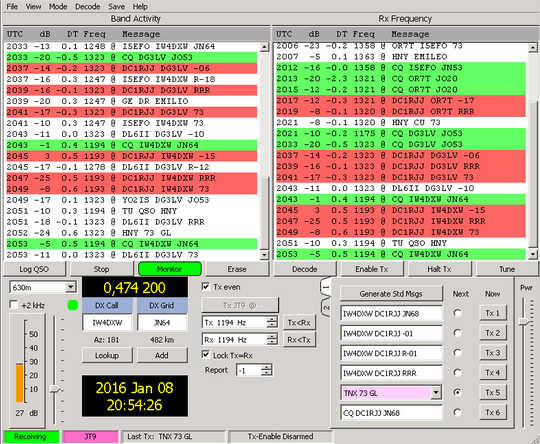 |
| DC1RJJ's 630m JT9 action courtesy: KB5NJD |
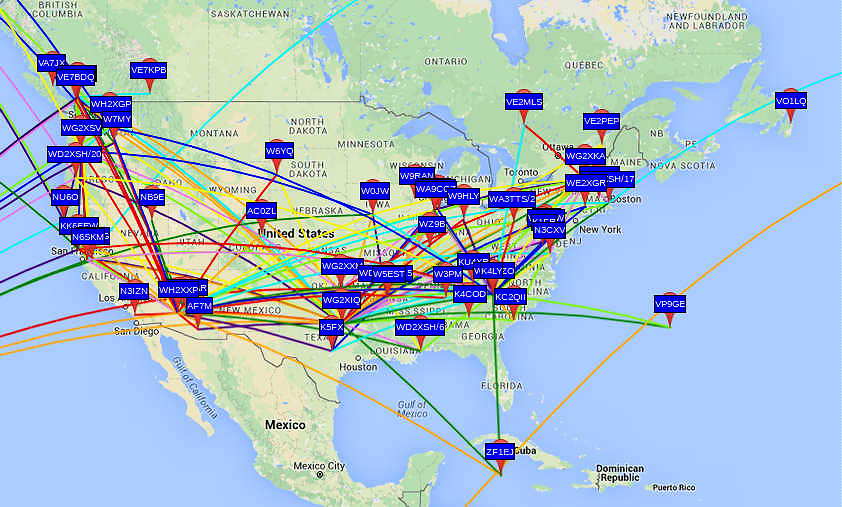
On this side of the Atlantic, recent JT9 contacts have been made between several of the U.S. experimental stations. WH2XCR in Hawaii (K9FD/KH6) and WG2XIQ in Texas (KB5NJD) worked on Dec 9th, while WH2XGP (W7IUV), WG2XSV (W0YSE/7) and others have been exploiting the power of JT9 to work around the country.
Such has been the case for me recently, with the arrival of VE3OT on 630m. Since beginning his nightly slow speed CW, QRSS6 beaconing, his signals have been easily visible here every night but only strong enough to hear aurally, on two occasions. It is likely that we could work each other fairly routinely on JT9 but will need to wait for very good conditions to work on CW.
The good thing about modes such as WSPR and JT9 is that they can be used without the need for linear amplifiers in the PA ... class D or E amplifiers, fairly universal in the LF/MF world, can be employed. The most popular route at present seems to be via a homebrew transverter that will allow the use of the station's main HF transceiver (using the tone-generating JT9 / WSPR software) to generate the required 630m RF.
I've been looking for a new radio workbench project to catch my interest and building a 630m transmitting converter is beginning to look more attractive, now that we have another DX target in VE3 land ... of course, if and when the U.S.A. gets the band, there will be an entire new crew of stations spread across the continent to keep the transverter busy!
The 1st Annual Midwinter 630m Activity Weekend
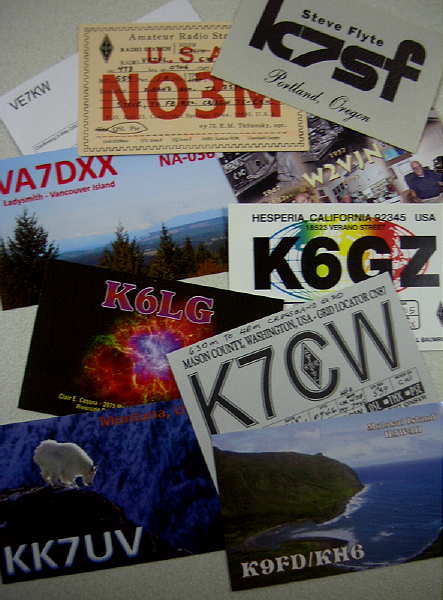
Following late fall's very successful 630m Activity / CW Crossband Weekend in November, several enquiries were soon received asking "when's the next one?" I'm happy to announce that the 'next one' will be held on the first weekend of February and will follow a similar format.
Here is the formal press release describing the event published in the ARRL News:
*****************************************
US and Canadian radio amateurs and experimenters will join forces in February for the first Midwinter 630 Meter Activity Weekend. The event will get under way on February 6 at 0000 UTC (Friday, February 5, in US time zones) and run through 2359 UTC on February 7.
“This event is being undertaken because of the new and quickly growing interest in present 630 meter activities, both in the US and Canada,” said ARRL 600 Meter Experimental Group (WD2XSH) Experiment Coordinator Fritz Raab, W1FR. “Much of the interest is in response to the strong likelihood of US amateurs receiving access to the band in the near future, while Canadian hams are eager to learn more about the present level of Amateur Radio activity on their newest ham band.” The activity weekend comes on the heels of a special event operation over the November 13-14 weekend that included participation by US and Canadian radio amateurs.and the Maritime Radio Historical Society (MRHS).
Raab said the two activity nights will offer interested amateurs in both countries an opportunity to experience the 630 meter band and, through cross-band activity with Canadian amateurs, to take part in activity in the MF spectrum. “Our hope is to see this activity become an annual operating event, to be held very winter on the 630 meter band,” Raab said. “For those who may be building for future 630 meter operation, this event will provide an opportunity to test your ‘receive’ capabilities on MF.”
Operation will be from 472 kHz to 479kHz in various modes. The two-way crossband work will be undertaken by several Canadian stations, all on CW. Canadians will operate on a schedule and listen for callers on specific QSX frequencies in the US ham allocations.
Station: VO1NA(Joe) GN37 Torbay, Newfoundland
Time: 2130Z - 0130Z both Friday night (Feb 5 - 6Z) / Saturday night (Feb 6 - 7Z) plus QRSS3 / 12 WPM Beacon from 0130 – 1000Z
TX Frequency: 477.7 kHz
RX (QSX) Frequency: 3562 kHz
Station: VE7SL (Steve) CN88 Mayne Island, B.C.
Time: 0200Z - 0700Z both Friday night (Feb 6Z) / Saturday night (Feb 7Z)
TX Frequency: 473.0 kHz
RX (QSX) Frequency: 3566 / 7066 kHz
Station: VE7BDQ (John) CN89 Delta, B.C.
Time: 0330Z - 0700Z both Friday night (Feb 6Z) / Saturday night (Feb 7Z)
TX Frequency: 474.0 kHz
RX (QSX) Frequency: 3555 kHz
Station: VA7MM (Mark) CN89 Coquitlam, B.C.
Time: 0500Z - 0700Z Friday night (Feb 6Z)
0400Z - 0800Z Saturday night (Feb 7Z)
TX Frequency: 475.0 kHz
RX (QSX) Frequency: 1801 kHz / 3574 kHz / 7062 kHz
Time: 2130Z - 0130Z both Friday night (Feb 5 - 6Z) / Saturday night (Feb 6 - 7Z) plus QRSS3 / 12 WPM Beacon from 0130 – 1000Z
TX Frequency: 477.7 kHz
RX (QSX) Frequency: 3562 kHz
Station: VE7SL (Steve) CN88 Mayne Island, B.C.
Time: 0200Z - 0700Z both Friday night (Feb 6Z) / Saturday night (Feb 7Z)
TX Frequency: 473.0 kHz
RX (QSX) Frequency: 3566 / 7066 kHz
Station: VE7BDQ (John) CN89 Delta, B.C.
Time: 0330Z - 0700Z both Friday night (Feb 6Z) / Saturday night (Feb 7Z)
TX Frequency: 474.0 kHz
RX (QSX) Frequency: 3555 kHz
Station: VA7MM (Mark) CN89 Coquitlam, B.C.
Time: 0500Z - 0700Z Friday night (Feb 6Z)
0400Z - 0800Z Saturday night (Feb 7Z)
TX Frequency: 475.0 kHz
RX (QSX) Frequency: 1801 kHz / 3574 kHz / 7062 kHz
Station: VE7CNF(Toby) CN89 Burnaby, B.C.
Time: 0300Z - 0700Z both Friday night (Feb 6Z) / Saturday night (Feb 7Z)
TX Frequency: 476.5 kHz
RX (QSX) Frequency: 1836 kHz / 3558 kHz / 7031 kHz
Time: 0300Z - 0700Z both Friday night (Feb 6Z) / Saturday night (Feb 7Z)
TX Frequency: 476.5 kHz
RX (QSX) Frequency: 1836 kHz / 3558 kHz / 7031 kHz
Station: VE3OT (Mitch) EN92 London, ON.
Time: 0000Z - 0400Z both Friday night (Feb 6Z) / Saturday night (Feb 7Z)
TX Frequency: 477.0 kHz
RX (QSX) Frequency: 3563 kHz / 7058 kHz
Time: 0000Z - 0400Z both Friday night (Feb 6Z) / Saturday night (Feb 7Z)
TX Frequency: 477.0 kHz
RX (QSX) Frequency: 3563 kHz / 7058 kHz
“The success of this event largely depends upon the participation of as many amateurs as possible,” Raab said. “We hope that you can find a few hours to participate in this unique midwinter event.” Submit reception reports via e-mail to the respective operators or via the ARRL 600 Meter Experiment website.
*************************************
Hopefully you will be able to participate in the crossband activity by being able to listen on 630m and then able to switch over to HF to transmit. This could involve the use of a separate receiver / transmitter or can often be easily implemented via your transceiver's 'A/B' switch.
No antenna for receiving on 630m? Surprisingly good results can often be had by using a low band wire antenna such as a dipole or inverted-L for listening on 630m ... the antenna does not necessarily need to be resonant. In fact, often times, a non-resonant receiving antenna can provide a better overall S/N ratio than one which is resonant, as these often gather more noise along with signals.
You may want to experiment before hand by listening to many of the numerous U.S. experimental stations operating nightly, mostly in the WSPR mode, between 475.6 and 475.8kHz. Most operators provide a CW identifier following their WSPR transmission but a better way to decode these signals is by installing the latest WSPR software, WSJT-X (freeware), at K1JT's website here. The software works extremely well and is easy to install and get working. If you set the software to 'upload spots', you can share your nightly catches with dozens of other listeners throughout the continent on the WSPRnet website.
 |
| courtesy: KB5NJD's 630m Daily Blog |













