Author Archive
 Just One More db …
 March 10th, 2016 |
  Author:
How often have you struggled to pull a weak signal out of the noise? "Just give me one more db", you tell yourself.
A recent posting to the Topband reflector by Frank, W3LPL, sent me to the interesting webpage of Dave, AB7E. Dave had been pondering two antenna systems, one of which would provide a 2db improvement in forward gain but at a much higher cost ... he wondered if the extra expense would be worthwhile and could he even hear the difference that 2db would make? He created a series of CW files, incrementing the signal level in 1db steps to see for himself!
Now I've always been told that you need to increase signal strength by at least 3db before your ears can detect any difference ... but listen carefully and you may be in for a surprise, as AB7E discovered.
It's probably best to listen to this signal with headphones but, even on my I-Pad's tiny speaker, the demonstration is clear. The first recording starts at "zero db", which is sent twice while the next signal is "one db", sent twice. See if you can hear the difference between each 1 db increment as he steps up to "six db":

Lastly, AB7E demonstrates the problem with sending too fast when conditions are very marginal. Here, several signals are sent at 20, 25, 30 and 35 WPM. Sending calls at high speed can often seem effective, even under poor conditions but this seems to demonstrate that slowing down just a bit would make it somewhat easier:
One of the more interesting comments posted regarding these recordings was from Bob, N6RW who cited his work in satellite communications:
"I spent part of my engineering career designing satellite command FSK
demodulators - including the deep space Pioneer Venus orbiter. To test
the performance of them, we would mix the test signal with white noise.
When you look at the FSK Bit-Error-Rate (BER) curve (bit errors versus
signal to noise ratio in a bandwidth equal to the bit rate), you can see
the BER improves by a factor of 10 to 1 for every dB in S/N ratio. In
other words, for every dB improvement, you get one tenth the errors."
Now Dave never did tell us if he bought the bigger antenna or not but I'm betting that he did ... it looks like "just one more db" may really be just enough after all.
The Boys Of ’25
 |
| "6BHH" - Ray Thomas courtesy: SCARA |
Knowing of my interest in early radio, Paul, K7CW, recently sent me a link to a truly delightful piece of old 16mm 'home movie' style film. The footage appears on the Santa Clara County Amateur Radio Association's website where a description of the film places it in or around San Jose, California and likely filmed over a number of months from early 1925 to 1926.
These were the very early days of ham radio ... the 'wild-west' in terms of rules, frequency allocations and enforcement. Hams operated throughout the LF / MF spectrum and it would not be unusual to find them working ships at sea or trying to work the latest geographical expedition to the Arctic or to some other far away place. It was also the transition period from spark to carrier-based communications, with RF generated by tubes and not with rotary high-voltage generators.
The film shows the radio 'boys of '25' (and girls!), now all so long gone, when they were young and full of life. We see them meeting, playing in the California sun and proudly showing off their shacks and equipment ... occasionally mocking those 'new-fangled' transmitting tubes, soon to replace their much-loved spark generators.
I hope you enjoy this treasure from the past ... I'm sure the 'boys of '25' would be delighted if you do.
CLE 204 Results
With a very quiet sun for the entire week, this past weekend's CLE proved to have much better conditions than normally experienced.
Conditions were 'good' but not 'great'. Really 'great' nights are few and far between but with the rapidly declining solar cycle, we should see more and more of these over the next few winters.
Most listeners around the world reported good conditions, with the nod going to Friday night as being the best. I thought that all three nights were good, but heard nothing new on night number three.
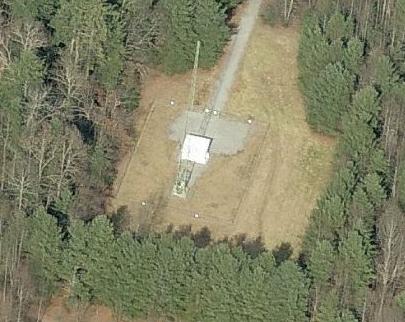
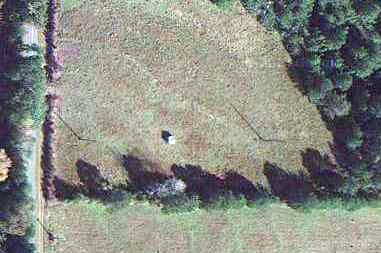
A surprise catch, with a good signal, was 'BRA -379' in Asheville, North Carolina. It's classified as an 'H-class' NDB and is an outer marker locator. I believe the H-class indicates a 400W transmitter and with the large vertical antenna, seems to get out very well.
 |
| courtesy: http://www.bing.com/maps |
 |
| courtesy: http://www.bing.com/maps |
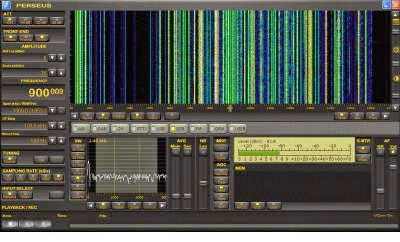
Fortunately, Perseus has an extremely effective 'notch' filter, and this, along with putting 'AP' in my LF loop's null, allowed me to hear two other NDB's beneath it ... 'ZFA' (Faro, Yukon) and 'UX' (Hall Beach, Nunavut).
The following 44 stations were heard on the Perseus SDR while using either the LF loop or my inverted 'L', tuned to 370 kHz.
27 06:00 370.0 YBV Berens River, MB, CAN
27 06:00 370.0 PAI Whiteman, CA, USA
27 06:00 371.0 YK Yakima, WA, USA
27 11:00 371.0 UK Laughlin, CA, USA
27 06:00 371.0 PUR Marshall, MO, USA
27 06:00 371.0 ITU Great Falls, MT, USA
27 05:00 371.0 GW Kuujjuarapik, QC, CAN
27 06:00 372.0 ZPA Prince Albert, SK, CAN
27 08:00 372.0 YCO Kugluktuk, NU, CAN
27 05:00 373.0 MF Table Rock, OR, USA
27 06:00 374.0 LV Livermore, CA, USA
28 09:00 374.0 HY Hays, KS, USA
27 05:00 374.0 EX Kelowna, BC, CAN
27 08:00 374.0 EE Forada, MN, USA
28 09:30 375.0 SPH Springhill, LA, USA
27 05:00 375.0 FS Fort Simpson, NT, CAN
27 07:00 375.0 CP Casper, WY, USA
27 08:00 375.0 BM Balmoral, MB, CAN
27 08:00 375.0 BD Moose Jaw, SK, CAN
27 08:30 376.0 ZIN Matthew Town, BAH
27 07:00 376.0 YAG Fort Frances, ON, CAN
27 05:00 376.0 PVQ Deadhorse, ALS
27 07:00 376.0 LC Columbus, OH, USA
27 09:00 377.0 EHA Elkhart, KS, USA
27 08:00 377.0 BUB Burwell, NE, USA
27 08:00 378.0 ZFA Faro, YT, CAN
27 05:00 378.0 UX Hall Beach, NU, CAN
27 07:00 378.0 OT North Bend, OR, USA
27 05:00 378.0 AP Mayne Island, BC, CAN
27 08:00 379.0 ZEG Edmonton, AB, CAN
28 11:00 379.0 IWW Kenai, ALS
27 07:00 379.0 DL Duluth, MN, USA
27 08:00 379.0 BRA Asheville, NC, USA
27 10:00 380.0 OEL Oakley, KS, USA
27 08:00 380.0 GC Gillette, WY, USA
27 05:00 380.0 BBD Brady, TX, USA
27 08:00 381.5 SJX St James, MI, USA
27 10:00 382.0 YPW Powell River, BC, CAN
27 10:00 382.0 YE Fort Nelson, BC, CAN
27 06:00 382.0 SP Springfield, IL, USA
27 08:00 382.0 JNR Unalakleet, ALS
27 08:00 382.0 AW Marysville, WA, USA
27 10:00 383.0 PI Pocatello, ID, USA
27 07:00 383.0 CNP Chappell, NE, USA
27 10:00 384.0 3F Ile-a-la-crosse, SK, CAN
The listening results for all North American listeners and those outside of Europe can be found here.
Single Yagi Moonbounce
 |
| courtesy: JPL/NASA |
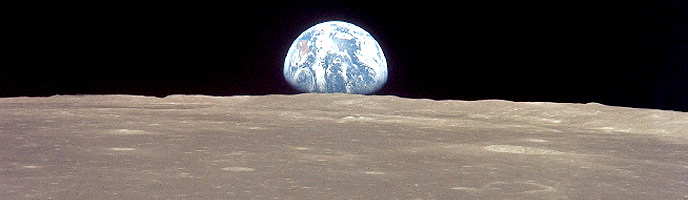
In early 2007, I decided to try 2m moonbounce using WSJT's JT65B digital mode. Over the years, moonbounce has gradually drifted away from CW to the much less demanding weak signal digital mode, allowing smaller stations to still explore the excitement of exchanging signals via reflection from the lunar surface. I am fortunate to have an excellent QTH for such an endeavour, being located beside the ocean with a saltwater horizon favoring moonrises, especially during the winter months of more northerly lunar declinations.
 |
| Moonrise from front yard |
I soon realized that the actual numbers appeared very close to predicted values and using an inexpensive 2m FM/SSB 'brick amplifier' (with built-in GasFet preamp) delivering approximately 140 watts, I was able to work 54 different stations over the next twelve months. All of the stations worked were doing the heavy lifting, with the majority running typical 4-yagi H-frame arrays using yagis from 6 to 17 elements each. I did work one station that was using two small yagis during a period of excellent conditions. Somewhat surprisingly, a large majority of the stations I worked were strong enough to be heard audibly from the transceiver's speaker.
I'm always amazed at the truly small amount of RF energy that is actually left, after the round trip to the moon ... yet information can still be exchanged. On 144MHz, the round trip losses are a minimum of 250db. Factoring-in my antenna's gain and ignoring the coaxial losses in 70' of RG213, there is a scant 1.56 x10^-9 W arriving at the moon ... that's .00000000156 W! Considering how much RF is absorbed in the lunar dirt and what's left over for the -125db home trip, it's a miracle that some signals are loud enough to be heard by ear at all. EME is really one of ham radio's most fascinating activities.
Reacquainting myself with the newer version of the JT65B software, and testing out the system, I was ready to go on the next evening's moonrise. Unfortunately the moon was rising just a little too far south to give me a really clear shot and I would be pointing into the next door neighbour's trees. Being unable to track the elevation, my operating time is limited to about two hours per session, over a period of several successive days (or nights).
Almost coincidental with the night's moonrise, I heard the strong signals of RX1AS (Alex) in St. Petersburg, calling CQ. I called him and he came right back with my signal report. His station is shown below, along with his large homebuilt strip-line amplifier.
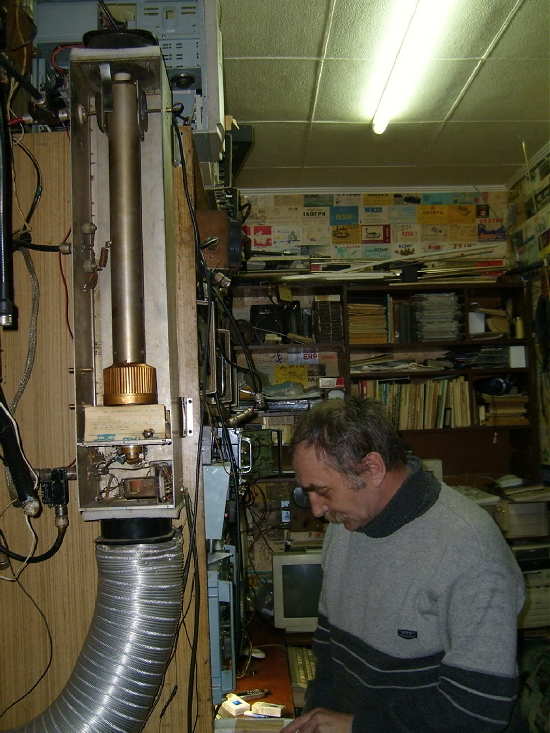 |
| RX1AS |
The following evening, the moon was buried even deeper into the trees but initials #56 and #57 were worked ... YL2GD (Gunars), in northern Latvia and RX3A (Nikolay), in Moscow city.
 |
| YL2GD and his EME station |
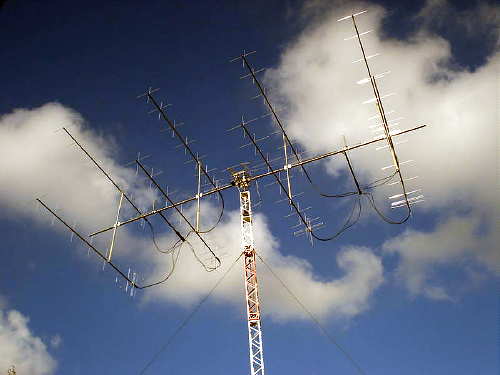 |
| RX3A's 2m EME array |
Nikolay was worked with the moon at 11 degrees above the horizon. I'm not sure just what my upper limit for lunar elevation might be with this small antenna but the highest elevation I have worked anyone was at 18 degrees.
The third night found less activity on the band as well as a more southerly moonrise, burying my target even further into the neighbour's trees. Few signal were heard but one contact was easily completed with I3MEK (Mario), near Venice ... initial #58.
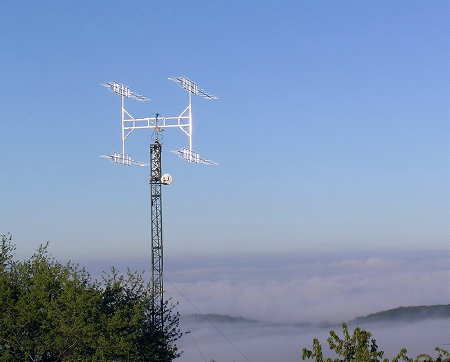 |
| I3MEK's 4-yagi 2m EME array |
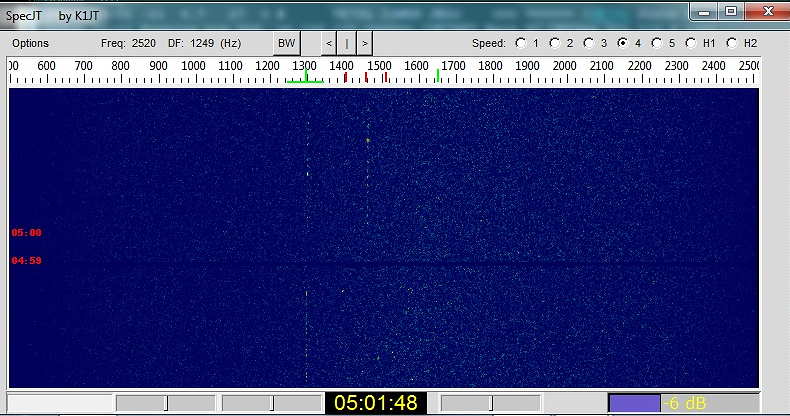 |
| I3MEK's 2m JT65b signal |
With so many larger (four or more yagis) stations around the world, a huge antenna is not needed to have success on 2m JT65B moonbounce ... nor is an over-the-ocean moonrise. I've also been able to work stations on moonset where I am pointing over hilly terrain and trees, nowhere near the ocean.
The WSJT (JT65B mode) software is freely available and very easy to implement, but spend some time reading the manual and playing with the software first, perhaps getting used to QSO procedures on 20m.
If you are running a small FM/SSB amplifier on 2m, such as the typical 'brick' I have been using, make sure to add a blower to keep the heatsink cool, as JT65 has a 100% duty cycle and these small amplifiers can get hot pretty fast. I use a small squirrel-cage blower from an old microwave oven to direct a blast of air onto the cooling fins.
Wondering where to point your antenna? One handy site that will provide the moon's position in the sky, for any time and any location, is the U.S. Naval Observatory's 'Sun or Moon Altitude/Azimuth Table'. As well, you can keep abreast of real-time activity or set up skeds, via NØUR's Ping Jockey JT65 EME page.
If you do decide to give this a shot, I'd be interested to hear how you do ... maybe your system is big enough already to let us work each other via the moon.
USB PTT Line Keying

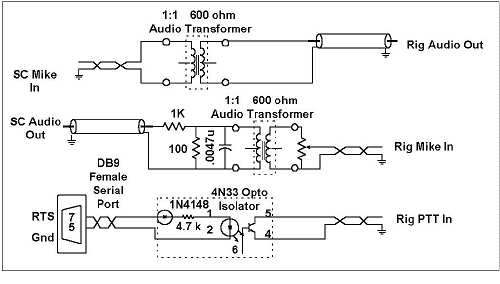
Back in 2007, when I first experimented with single-yagi 2m moonbounce, I constructed an interface that would allow my aging laptop to communicate with my equally aging Icom 821 transceiver.
Back then, the shack's old Toshiba laptop (running Win98SE) had a serial (RS-232) communications port and my homebrew interface would let the WSJT software key the PTT line, as well as handle the required 'in' and 'out' audio.
 |
| My Homebrew Radio-Computer Interface |
 |
| Courtesy: KK7UQ |
The 2m Icom has no audio VOX , so to key the radio via the WSJT audio tones, I would need to build a simple VOX system that would key the PTT-line. All things being equal, I didn't really like this idea since it would likely result in 'hot-switching' of the changeover relays and eventually lead to problems.
I investigated the alternative method of hard keying the PTT via the USB port, using a USB-to-serial port adapter, but these were not entirely without problems either. It seems that certain chipsets were worse than others but the FTDI style were less prone to compatibility problems.
I also considered purchasing a Signalink USB interface which would take care of the PTT keying as well as the audio. After researching the Signalink, I found some disturbing reviews that indicated the onboard sound card could create some significant signal-to-noise degradation when used for weak-signal work ... such as EME. The generated noise would likely never be noticed when used on the noisy HF bands, which probably accounts for most Signalink applications, but on weak-signal moonbounce, every db is precious and an elevated noise floor from the sound card would definitely not be helpful.
Further research indicated a really nice line of interfaces being built by Johnny, G3LIV. He offers several models to suit various needs and none seem to include a sound card, which would eliminate the possibility of unwanted noise being introduced ... but before making a decision, I made one final attempt at finding a cheaper solution.
An E-Bay search for an FTDI USB serial port adapter brought up several offerings worldwide, with the majority being in the far east. I found one promising looking low-volume dealer in China, that not only offered the device for $11.99 with free-shipping, but also had a 100% feedback rating and no complaints, ever! What the heck. It was the right chipset, assuming it wasn't counterfeit, the price was right and the dealer looked to be doing his best to offer a good product ... I placed the order and three weeks later the adapter arrived.
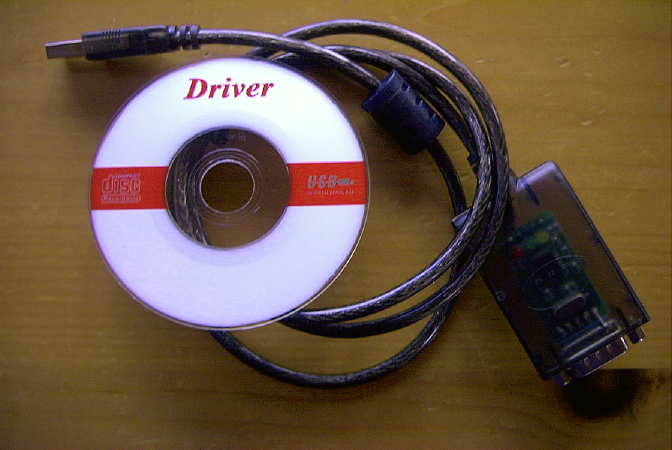
The adapter was well packaged and included a small CD containing the necessary USB drivers for several different operating systems, including my newer laptop's Windows 7.

I plugged the adapter into an empty USB2 port and sent the device manager to search the CD for the needed files, which it quickly found and installed. The software created a virtual serial port, assigning the adapter to COM port 3. I then set the WSJT switching tasks to COM3 and connected my homebrew interface to the adapter via its DB9 serial connector. To see if the new adapter would really work, I instructed WSJT's JT65B software to turn on the transmitter before sending a test tone, which hopefully would key the PTT line ... and it did! It seemed that my $11.99 investment was doing the job perfectly. Thankfully, none of the online horror stories that I had encountered regarding USB serial port adapters, had been encountered.
If you need something of this sort, I can recommend this particular product as well as the E-Bay seller. If you are starting from scratch, the entire interface could be easily built, using new parts, including the USB adapter, for just a few dollars and I may, in fact, re-package everything into one compact box, USB adapter and all.
But hold on ... I think I see a big bright moon rising at the moment ... (cont'd)
Hunting For NDBs In CLE 204
 |
| 'AP - 378' - Mayne Island, BC |
This coming weekend will see another CLE challenge, this time in the 15 kHz slice from 370.0 - 384.9 kHz.
'CLE's are 'Co-ordinated Listening Events, and NDB DXers around the world focus their listening time on one small slice of the NDB spectrum.
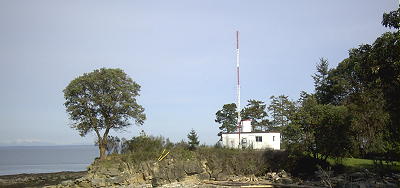
This is a somewhat dreaded range for me since my local blowtorch NDB, 'AP' (378 kHz), sits right in the middle of the range. 'AP' is located at the entrance to Active Pass, the main ferry route to Vancouver Island, and the antenna is about 3/4 of a mile from my location. Needless to say, the beacon is about 40db over S9! With careful loop nulling, I can reduce this by about 25db but it's still an enormous signal to deal with.
Hopefully you can put 'AP' in your own log this weekend but its 25-watt signal will be much weaker for you. It's been logged as far east as Illinois and with your receiver in the CW mode, can be found on 378.399 kHz.
From CLE coordinator Brian Keyte (G3SIA), comes the following reminder:
Hi all,
Please join us in our 204th Co-ordinated Listening Event which starts
this Friday. All are very welcome.
CLEs are not contests - if you enjoy taking part you will be a winner!
51 of us from 31 radio countries joined in CLE188 back in Nov. 2014
when we listened on these same frequencies.
Days: Friday 26th - Monday 29th February
Times: Start and end at midday, your LOCAL TIME
Range: 370 - 384.9 kHz
Just log all the NDBs that you can identify with their nominal (listed)
frequencies in the range (it includes 370 kHz, but not 385 kHz)
plus any UNIDs that you come across there.
Please send your CLE log to the List in a plain text email if possible
(not in an attachment) with 'CLE204' at the start of its title.
Show on each log line:
# The date (e.g. 2016-02-26, etc., or just 26) and UTC.
(the date changes at 00:00 UTC)
# kHz (the nominal published frequency, if known)
# The Call Ident.
Show those main items FIRST - other optional details such as Location
and Distance go LATER in the same line.
If you send interim logs, please also send a 'Final' (complete) log.
As always, tell us your own location and brief details of the equipment
that you were using during the weekend.
I'll send the usual 'Any More Logs?' email at about 18:00 UTC on
Tuesday - you can check from it that your log has been found OK.
All logs must arrive on the list by 09:00 UTC on Wednesday 2nd
March at the very latest.
I hope the combined results will be completed on that day.
To help your listening, seeklists are available via the CLE page
http://www.ndblist.info/cle.htm
Good listening - enjoy the CLE
Brian
----------------------------------------------------------
From: Brian Keyte G3SIA ndbcle'at'gmail.com
Location: Surrey, SE England (CLE co-ordinator)
----------------------------------------------------------
(If you wish you could use any one remote receiver for your loggings,
stating the location and owner - with their permission if required.
A remote listener may NOT also use another receiver, local or remote,
to make further loggings for the same CLE).
These listening events serve several purposes. They:
- determine, worldwide, which beacons are actually in service and on-the-air so the online database can be kept up-to-date
- determine, worldwide, which beacons are out-of-service or have gone silent since the last CLE covering this range
- will indicate the state of propagation conditions at the various participant locations
- will give you an indication of how well your LF/MF receiving system is working
- give participants a fun yet challenging activity to keep their listening skills honed
Final details can be found at the NDB List website, and worldwide results, for every participant, will be posted there a few days after the event. If you are a member of the ndblist Group, results will also be e-mailed and posted there.
The very active Yahoo ndblist Group is a great place to learn more about the 'Art of NDB DXing' or to meet other listeners in your region. There is a lot of good information available there and new members are always very welcome.
If you are contemplating getting started on 630m, listening for NDBs is an excellent way to test out your receive capabilities as there are several NDBs located near this part of the spectrum.
You need not be an ndblist member to participate in the CLEs and all reports, no matter how small, are of much value to the organizers. 'First-time' logs are always VERY welcome!
Reports may be sent to the ndblist or e-mailed to either myself or CLE co- ordinator, Brian Keyte (G3SIA), whose address appears above.
Please ... give the CLE a try ... then let us know what NDB's can be heard from your location! Your report can then be added to the worldwide database to help keep it up-to-date.
An RF-Quiet Light Dimmer?

I admit it. I have an extraordinarily kind next door neighbour!
Ever since erecting a new, much bigger LF antenna several years ago, she has allowed me to run its large, three-wire 100' tophat, directly over the top of her house to a tree on the far edge of her property. As well, she removed her only light dimmer, knowing that it was creating a LOT of nasty RF 'hash' throughout the LF / MF spectrum, seriously degrading my LF reception. To hear the RF noise-signature of a typical light dimmer, listen here, on the ARRL's helpful page of 'household' RFI recordings ... that's just how it sounded here as well!
She recently did a major renovation, which included a new multi-light dining-room fixture and expressed to me a desire to be able to dim it ... oh-oh, I was definitely not looking forward to this.
I did a little web-research and soon learned that some of the most RF-quiet dimmers were being produced by Lutron. One model in particular, claimed to pay special attention to RF noise-filtering and that was the "Centurion", whose smallest model is a 600 watt-capable unit, with a large finned heatsink front plate ... model #C-600P-WH.
I decided to order one from the only dealer I could find in Vancouver that seemed to carry this line of dimmers. The cost was just a little over $40 Canadian (sells for about $25 in the U.S.A.) ... cheap enough if it would do the job!
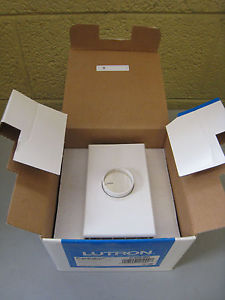
When the unit came in, I picked it up on my next ferry trip to the city and upon my return, installed it the following afternoon. Before doing the installation, I fired-up the receiving system, tuned to 300kHz, and with the baby monitor set up beside the speaker, took the portable monitor with me.
After installing the new dimmer, I turned on the baby monitor, held my breath ... and turned on the light fixture. Wow ... not a trace of hash could be heard! Adjusting the dimmer from high to low produced no difference in the noise level. I later did a more thorough bandscan and could find no evidence of RFI, on any frequency. The only RFI that I could detect was when placing my Sony ICF-2010 close to the actual dimmer. I was unable to detect any noise further than 6" away from the lights or the dimmer!
So it seems that this model can be highly recommended, for your own home or if you have a next door neighbour 'light-dimmer problem'.













