Author Archive
 Hunting For NDBs In CLE 223
 September 20th, 2017 |
  Author:
  |
| SN-408 courtesy: www.ve3gop.com |
This coming weekend will see another CLE challenge. This time the hunting grounds will be: 400.0 - 419.9 kHz.
For those unfamiliar with this monthly activity, a 'CLE' is a 'Co-ordinated Listening Event', as NDB DXers around the world focus their listening time on one small slice of the NDB spectrum.
A nice challenge in this one is to hear the Saint Catharines (Ontario) NDB, 'SN', on 408 kHz. 'SN' is a 15-watter and is well heard, having been logged from coast-to-coast. Look for 'SN's CW identifier, repeated every 10.5 seconds, on 408.398 kHz with your receiver in the CW mode.
Late summer CLEs can often be challenging, not because of poor propagation but more likely, lingering summer lightning storms ... hopefully it will be quiet for your location.
When tuning for NDBs, put your receiver in the CW mode and listen for the NDB's CW identifier, repeated every few seconds. Listen for U.S. NDB identifiers approximately 1 kHz higher or lower than the published transmitted frequency since these beacons are modulated with a 1020 Hz tone approximately.
For example, 'AA' in Fargo transmits on 365 kHz and its upper sideband CW identifier is tuned at 366.025 kHz while its lower sideband CW ident can be tuned at 363.946 kHz. Its USB tone is actually 1025 Hz while its LSB tone is 1054 Hz.
Often, one sideband will be much stronger than the other so if you don't hear the first one, try listening on the other sideband.
Canadian NDBs normally have an USB tone only, usually very close to 400 Hz. They also have a long dash (keydown) following the CW identifier.
All NDBs heard in North America will be listed in the RNA database (updated daily) while those heard in Europe may be found in the REU database. Beacons heard outside of these regions will be found in the RWW database.
From CLE organizer Brian Keyte, G3SIA, comes the usual 'heads-up':
Hi all,
Here is your Early Advice of our next Co-ordinated Listening Event.
We are back to a normal event looking for the NDBs in a narrow
frequency range - and celebrating the equinox on 22nd Sept.
All beginners, occasionals and regulars are very welcome to join in.
Days: Friday 22 Sept - Monday 25 Sept 2017
Times: Start and end at midday your LOCAL time
Range: 400 - 419.9 kHz
Just log all NDBs you can identify that are listed in the range (it includes
400 kHz but not 420 kHz) plus any UNIDs that you come across there.
We last had a close look at this frequency range in CLE208 at the
start of July 2016.
From the Ministry of Useless Information comes the advice that in CLE208
Europe listeners and Rest of the World listeners each heard 107 different
NDBs.
Please look out for the Final Details on Wednesday.
73
Brian
----------------------------------------------------------
From: Brian Keyte G3SIA ndbcle'at'gmail.com
Location: Surrey, SE England (CLE coordinator)
----------------------------------------------------------
These listening events serve several purposes. They:Here is your Early Advice of our next Co-ordinated Listening Event.
We are back to a normal event looking for the NDBs in a narrow
frequency range - and celebrating the equinox on 22nd Sept.
All beginners, occasionals and regulars are very welcome to join in.
Days: Friday 22 Sept - Monday 25 Sept 2017
Times: Start and end at midday your LOCAL time
Range: 400 - 419.9 kHz
Just log all NDBs you can identify that are listed in the range (it includes
400 kHz but not 420 kHz) plus any UNIDs that you come across there.
We last had a close look at this frequency range in CLE208 at the
start of July 2016.
From the Ministry of Useless Information comes the advice that in CLE208
Europe listeners and Rest of the World listeners each heard 107 different
NDBs.
Please look out for the Final Details on Wednesday.
73
Brian
----------------------------------------------------------
From: Brian Keyte G3SIA ndbcle'at'gmail.com
Location: Surrey, SE England (CLE coordinator)
----------------------------------------------------------
- determine, worldwide, which beacons are actually in service and on-the-air so the online database can be kept up-to-date
- determine, worldwide, which beacons are out-of-service or have gone silent since the last CLE covering this range
- will indicate the state of propagation conditions at the various participant locations
- will give you an indication of how well your LF/MF receiving system is working
- give participants a fun yet challenging activity to keep their listening skills honed
Final details can be found at the NDB List website, and worldwide results, for every participant, will be posted there a few days after the event. If you are a member of the ndblist Group, results will also be e-mailed and posted there.
The very active Yahoo ndblist Group is a great place to learn more about the 'Art of NDB DXing' or to meet other listeners in your region. There is a lot of good information available there and new members are always very welcome. As well, you can follow the results of other CLE participants from night to night as propagation is always an active topic of discussion.
If you are contemplating getting started on 630m, listening for NDBs is an excellent way to test out your receive capabilities as there are several NDBs located near this part of the spectrum.
You need not be an ndblist member to participate in the CLEs and all reports, no matter how small, are of much value to the organizers.
'First-time' logs are always VERY welcome!
Reports may be sent to the ndblist or e-mailed to either myself or CLE co-ordinator, Brian Keyte (G3SIA), whose address appears above.
Please ... give the CLE a try ... then let us know what NDB's can be heard from your location! Your report can then be added to the worldwide database to help keep it up-to-date.
Have fun and good hunting!
Drake 2NT And The Novice Rig Roundup (NRR)
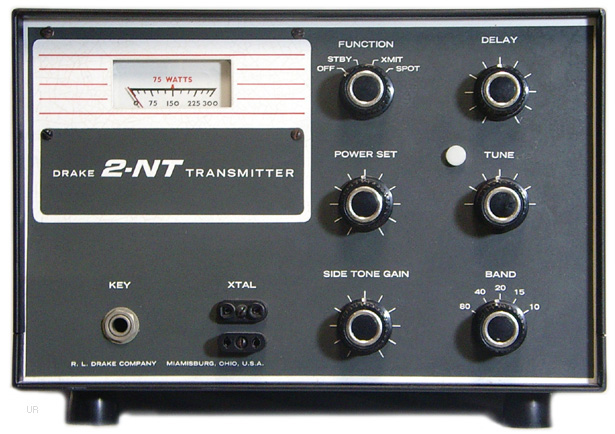
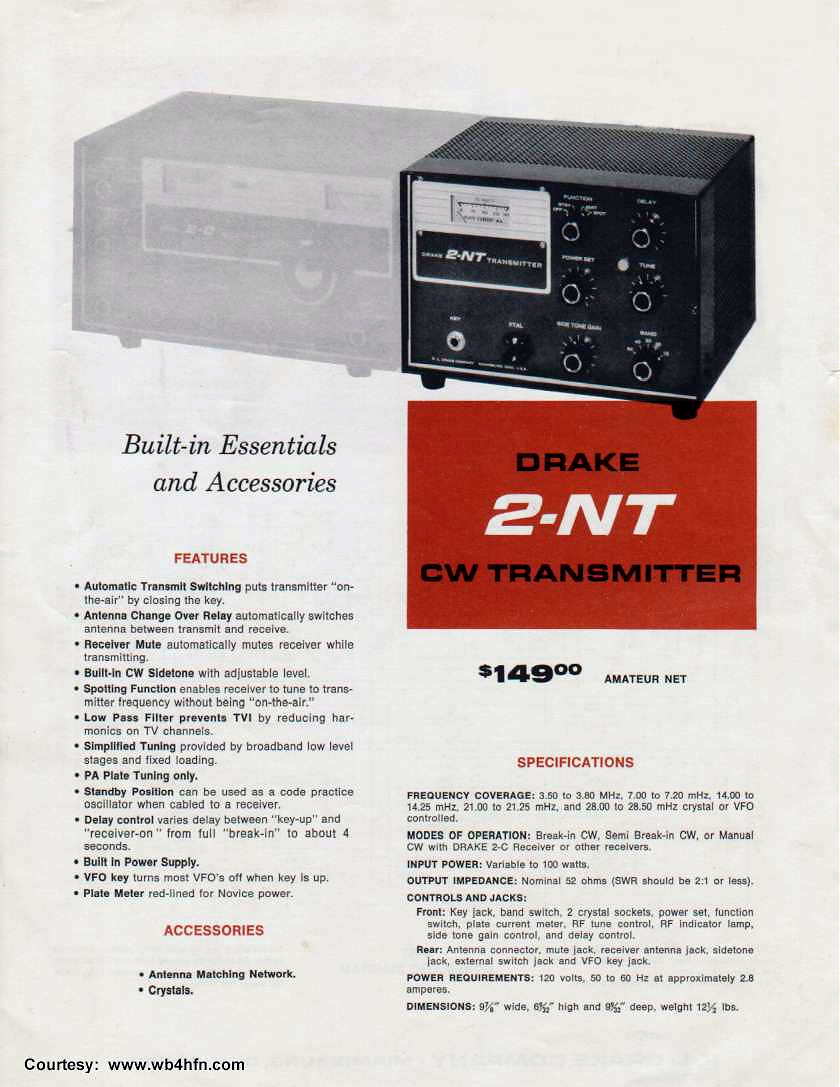
One of this summer's radio workbench projects was to refurbish my Drake 2NT transmitter for this winter's NRR event. The 2NT was introduced in 1966 with the 'novice' ticket-holder in mind, selling for $129. It was the first and only CW-only transmitter produced by R.L. Drake.
As novice transmitters go, the 2NT was a cut above some of the others out there, boasting interesting features such as a built-in antenna changeover relay, sidetone oscillator, grid-block keying and built-in low pass filter.
The tune-up procedure was simplified as well and with Drake's reputation for quality construction, the 2NT became a popular choice for Novices and Generals alike.
My own 2NT was purchased, along with the matching 2C receiver and speaker/Q-multiplier combo over 25 years ago at a Washington state ham fleamarket. Ever since then they have been patiently sitting on the shelf, trying to catch my attention.
The motivation and much-deserved attention finally arrived this year after enjoying last winter's NRR and hearing several great-sounding 2NT's on 80, 40 and 15m CW. I operated the week-long Roundup with my homebrew 'Longfeller' at 5W output, in order to qualify for the QRP category.
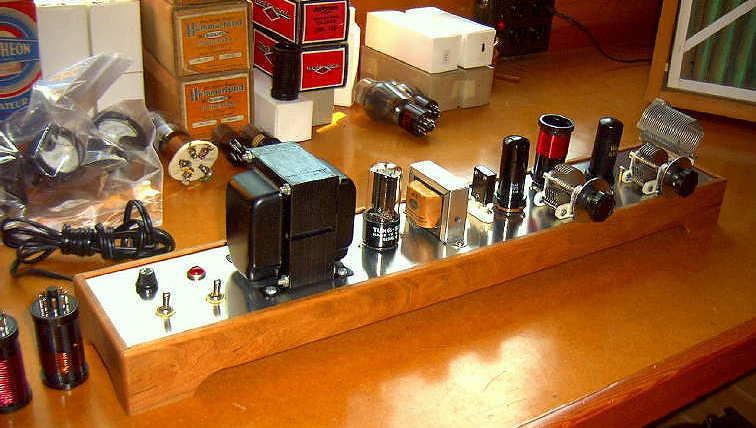 |
| 6AG7 - 6V6 'Longfeller' |
I eventually ended up with 68 contacts, but at 5W, it was a challenge ... most of my many 'CQ NRR' offerings were unanswered, so it was mostly a 'search and pounce' operation. With this in mind, I soon decided that next time, I'll get the 2NT ready to go and hopefully, with a little more oomph, can attract some callers.
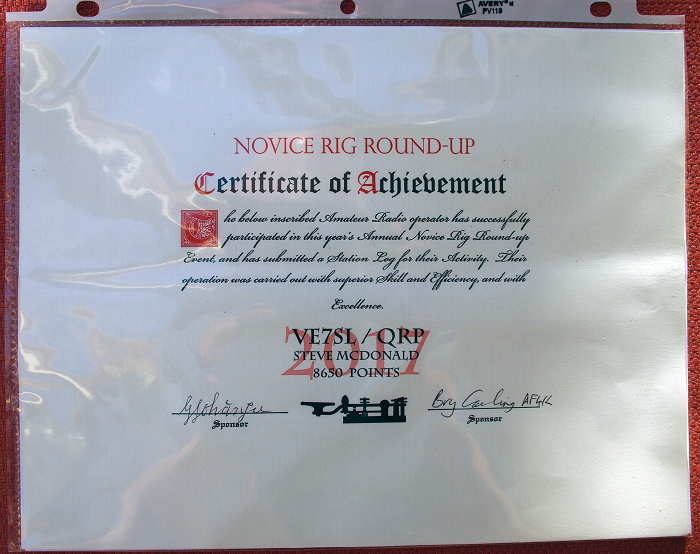 |
| Each entrant received an NRR certificate - a nice touch |
Rather than hunt down and purchase the individual replacement electrolytics, especially the multi-unit can capacitor which was impossible to source, I ordered the '2NT re-cap kit' from Hayseed Electronics. They supply replacement kits for several boatanchors and are able to make and stuff multi-section can capacitors to match the original size and specs ... and all at affordable prices.
After cleaning the chassis and all of the switches, re-tubing with new tubes and removing / replacing all of the electrolytics, the 2NT was ready to go. Using a crystal for excitation, the following results were obtained:
80m 103W input 75W output efficiency = 73%
40m 92W input 65W output efficiency = 71%
20m 92W input 65W output efficiency = 71%
15m 92W input 55W output efficiency = 58%
10m 92W input 50W output efficiency = 54%
Keydown voltages averaged ~520V while plate current ranged from 170-200ma. All-in-all, right on target and not bad for a 51 year old transmitter!
The 6EA8 modified Pierce oscillator in the 2NT seems particularly 'crystal-friendly', as every old style FT-243 style crystal that I tried sounded great. Even the newer ones from AF4K using a modern HC-49 crystal slab mounted inside a vintage FT-243 holder sounded great and worked perfectly.
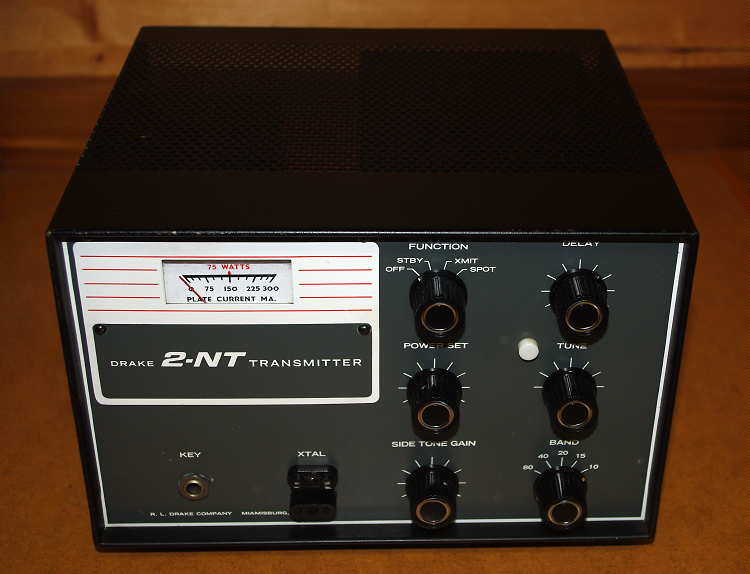 |
| My newly refurbished 2NT - ready to go |
A couple of days later, I returned to the bench to take some blog photos of the rig delivering power into the wattmeter. When I turned the 'stby' switch to 'transmit', the plate current suddenly shot up (with no keying) and the meter on my Variac supply indicated over an amp being drawn by the power transformer ... all with zero output and no crystal plugged-in!
A look at the schematic diagram revealed that with the grid-block keying system, the final amplifier's cathode is always grounded and a low voltage negative bias applied to the grid keeps the plate current cut-off until being keyed ... with cut-off bias missing, plate current will soar, along with transformer primary current. I suspected that something had gone haywire with the bias supply.
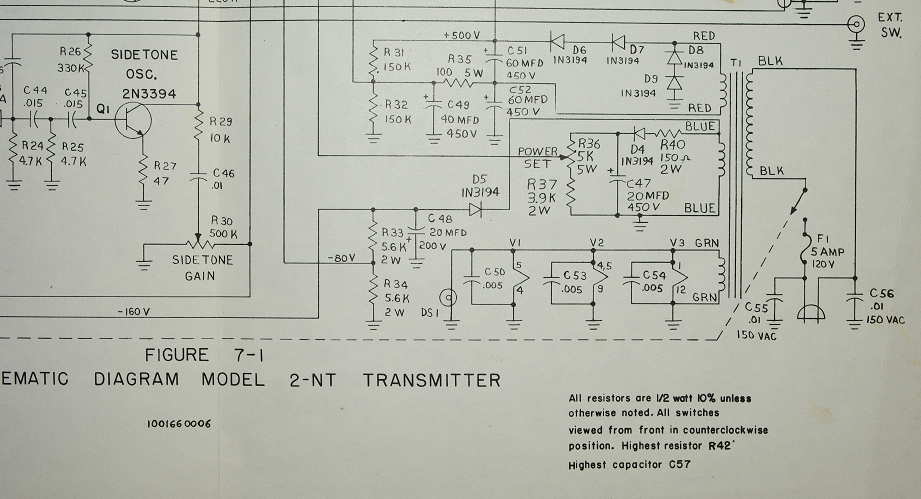
A quick check of the 2NT's printed circuit board containing the bias system components among others, indicated a discolored silicon rectifier (D5) in the bias supply. An in-circuit measurement revealed that it was indeed shorted, basically supplying raw AC across the filter capacitor and shorting out the transformer winding, quickly elevating the transformer's temperature in the bargain ... not good.
Although the diode only has to handle a small amount of current, it was mounted with a heat-producing 2W resistor straddling its top surface. As well, the phenolic circuit board was noticeably discoloured from the heat. I suspect this was the main reason that D5 eventually failed.
My 2NT was an early one, serial #670, so perhaps this parts-arrangement was re-engineered in later models. Once the diode was replaced with a much smaller modern one, of twice the rating, everything returned to normal. The last thing I would want to do at this stage is to burn out the transmitter's unique power transformer, undoubtedly impossible to replace nowadays.
The next bench project will be to refurbish and improve the stability of my Heathkit VF-1 VFO and to mate it with the 2NT.
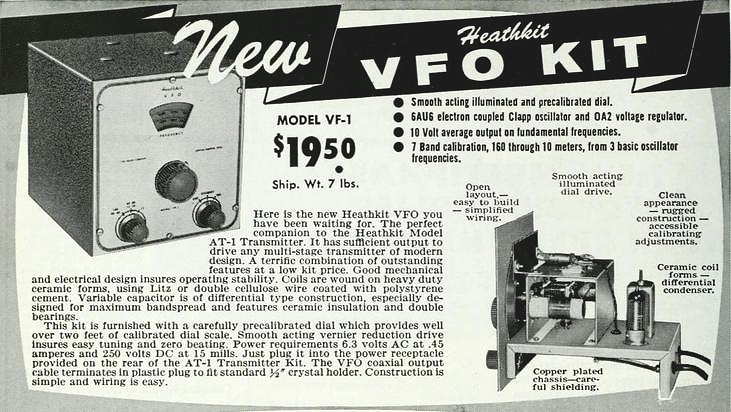 |
| '55 QST VF-1 ad |
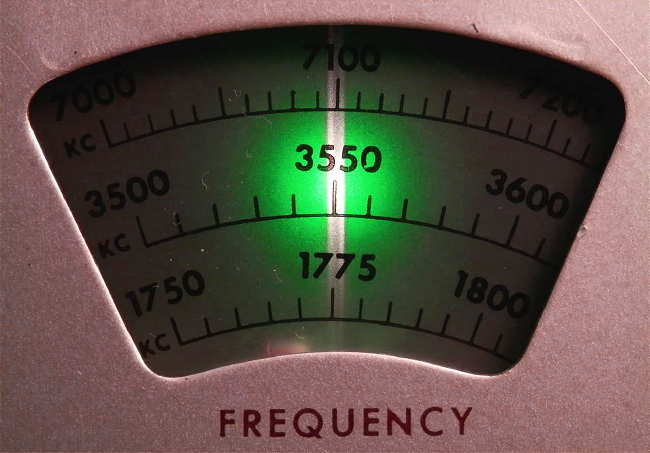
Another small quirk noticed on my 2NT is the meter mount. My early model has the meter mounted so low that the silk-screened 'PLATE CURRENT MA.' label is not clearly visible when looking straight-on.
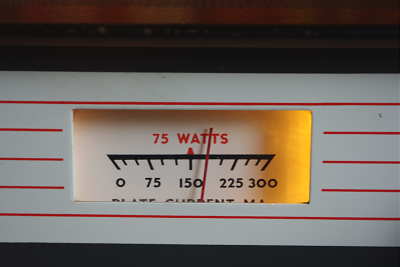 |
| My #670 |
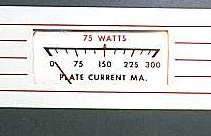 |
| Later models |
You can read many interesting soapbox comments and see some nice NRR station photos from the previous two events here and here, but read with caution as you could easily get hooked. I find pages like this very inspiring and they remind me of the days when QST would publish photos, soapbox comments and exacting equipment descriptions used by each section winner in the annual November Sweepstakes contest.
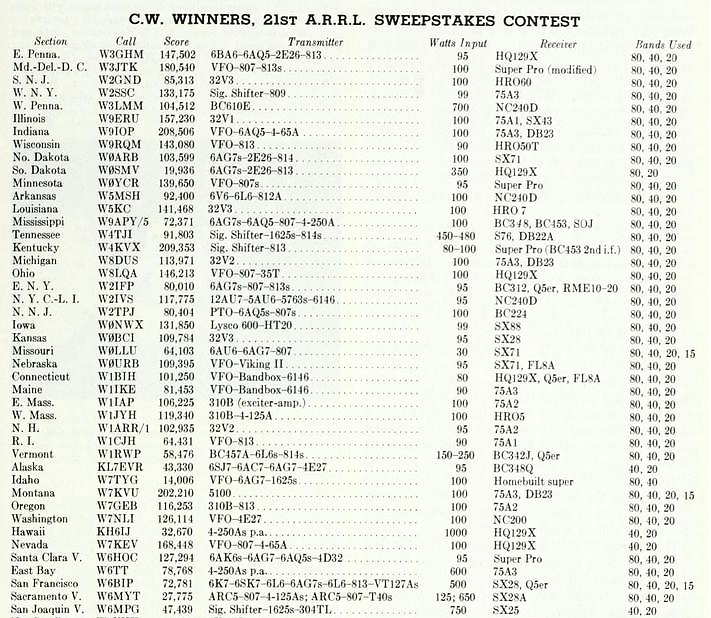 |
| Winner's gear in '55 CW SS - remember these? |
Cycle 24 – Still Kicking
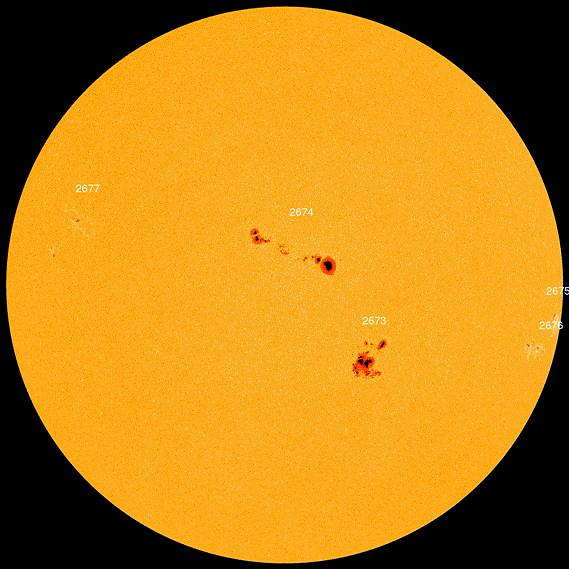 |
| This week's Sun |
Well, just when the sun was showing some nice signs of growing quiet for the upcoming winter, Cycle 24 has once again demonstrated that it's not going down without a fight.
For the past few weeks of quiet solar conditions, low band propagation, in spite of the time of year, had been performing well, with both 40 and 80m having a nice level of evening CW activity stretching out to the central states and to the east coast.
That all changed this week when the Sun let loose with a series of powerful flares, one of which was the strongest in a decade ... all very surprising for a Sun that has already shown us many days of spotless conditions as it winds its way to the bottom of the cycle.
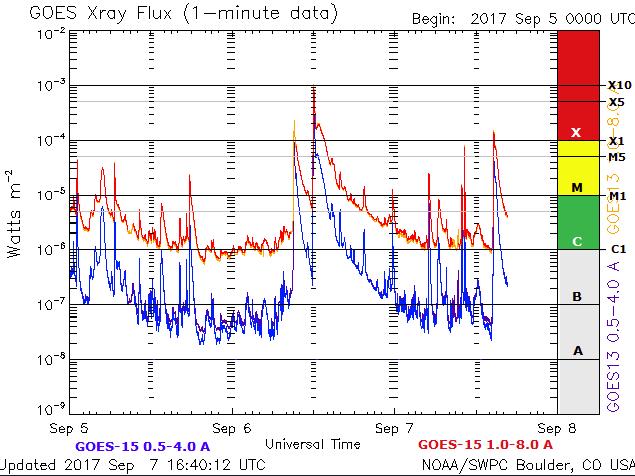
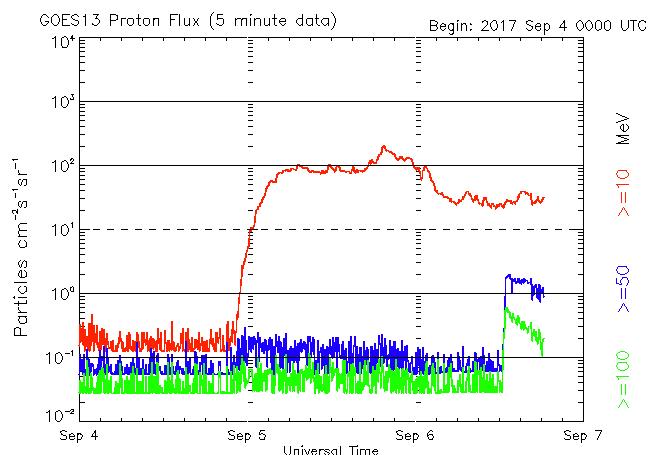
With Solar Cycle 24 being one of the weakest on record, it has shown levels of activity on the way down that could rival the past few much stronger cycles in their waning years. Another oddity for this cycle was its 'double-peak', not unusual per se except that 24's second peak was the stronger of the two.
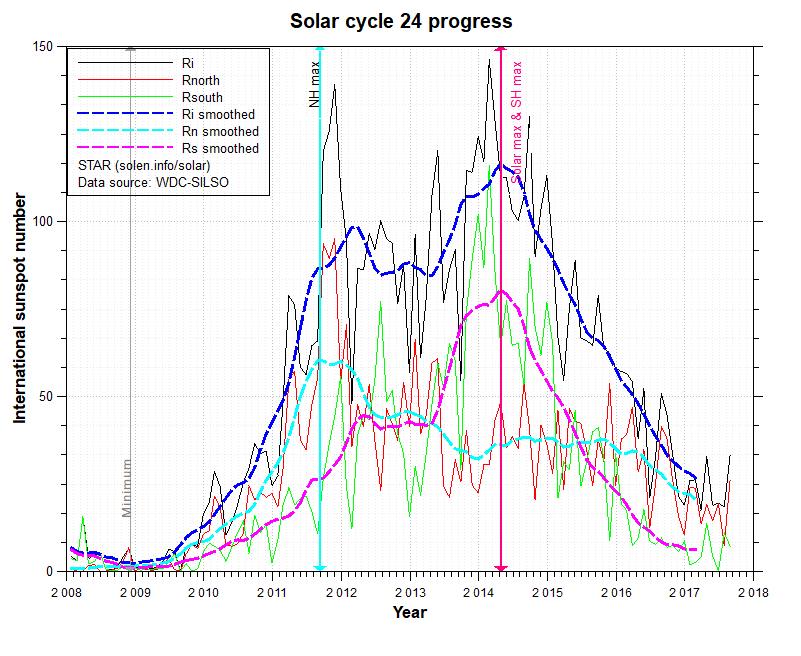 |
| courtesy: http://www.solen.info/solar/ |
With the recent flaring and accompanying radio blackouts, HF propagation has been poor and with auroral conditions forecast for the arriving CMEs, it may take some time to recover, especially on LF and MF. But it may not be all bad.
Disturbances like this will normally affect E-W, polar and Trans-Atlantic paths more than N-S paths. Oftentimes, paths to South America on MF and HF will be enhanced as will the Trans-Pacific path, so all is not lost.
There are many websites devoted to providing a 'heads-up' to what might be coming geomagnetically-speaking. Two of my favorites are here and here.
The more northerly you are, the more disruption you will notice and for some reason, VE7 land seems particularly in-tune with solar perturbations as the slightest hiccup on the Sun seems to immediately wreak havoc here. Even amateurs a hundred miles to the south or southeast, enjoy markedly less disruption than us out here on Canada's western edge ... for some reason, we seem more tied-in to the auroral zone activity than we should, given our westerly location. Perhaps the zone dips lower in this region than it does further east but it is something I have observed on LF and MF for decades now.
It seems as though the first hit has just arrived so hold on to your hats:
Space Weather News for Sept. 7, 2017
http://spaceweather.com
https://www.facebook.com/spaceweatherdotcom
GEOMAGNETIC STORM WARNING: A CME has just hit Earth's magnetic field
(Sept. 7th at ~2300 UT). This is the debris from Wednesday's
decade-class X9 solar flare. It arrived earlier than expected,
confirming that the solar storm cloud is both fast and potent. The
CME appears to contain strong south-pointing magnetic fields that
typically do a good job of igniting geomagnetic storms. High-latitude
sky watchers should be alert for auroras in bright moonlight. Visit
Spaceweather.com for updates and more information about this developing event.
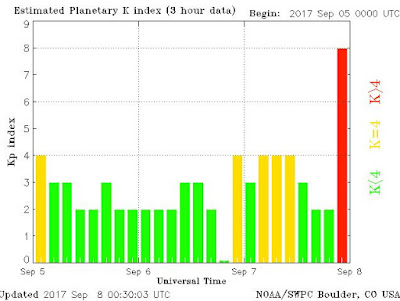
Hopefully the sun will outgrow its latest temper tantrum and get back to normal quickly so that this fall and winter will be one of the best for low band and MF work in the past decade ... with a quiet Sun, these frequencies can perform amazing magic at times.
http://spaceweather.com
https://www.facebook.com/spaceweatherdotcom
GEOMAGNETIC STORM WARNING: A CME has just hit Earth's magnetic field
(Sept. 7th at ~2300 UT). This is the debris from Wednesday's
decade-class X9 solar flare. It arrived earlier than expected,
confirming that the solar storm cloud is both fast and potent. The
CME appears to contain strong south-pointing magnetic fields that
typically do a good job of igniting geomagnetic storms. High-latitude
sky watchers should be alert for auroras in bright moonlight. Visit
Spaceweather.com for updates and more information about this developing event.
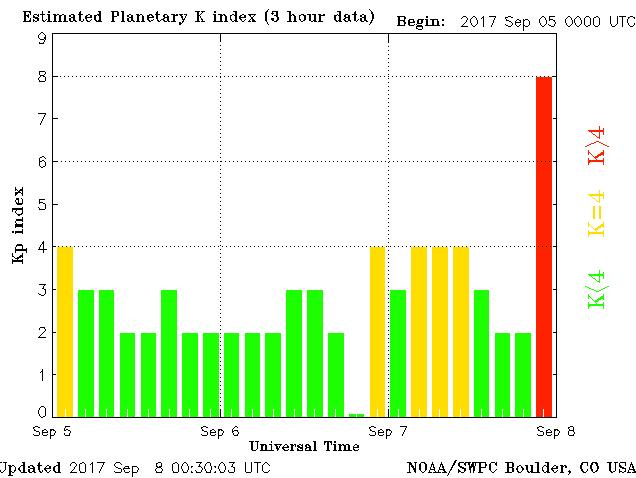
Hopefully the sun will outgrow its latest temper tantrum and get back to normal quickly so that this fall and winter will be one of the best for low band and MF work in the past decade ... with a quiet Sun, these frequencies can perform amazing magic at times.
VE7CNF / 630m Mobile … almost.
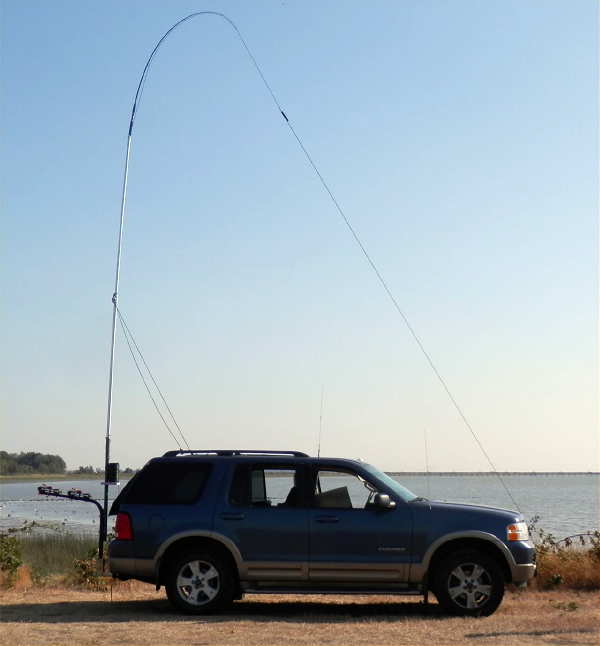 |
| If you think 160m mobile is a challenge... |
Hot on the heels of his recent 630m maritime adventure, Toby (VE7CNF), continued to demonstrate the flexibility of his small 20W 630m portable system with an afternoon of fixed 'mobile' activity from his vehicle.
Local 630m op's in-boxes received a surprise alert on Tuesday:
"Are any of you available on Tuedsay for a 630m land mobile test with VE7CNF/7?"
Toby set things up at Sea Island's Iona Regional Park, situated on the ocean's edge just north of Vancouver International Airport. This gave him a good shot to several of the local 630m ops around the local region.
When Canadian amateurs first approached RAC and Industry Canada for a slice of spectrum near 500KHz, the main goal was to secure a frequency range that would support excellent groundwave propagation for a possible future emergency data network. Whether this will ever happen or not remains to be seen, but Toby's afternoon outing, along with the recent 630 marine mobile activity certainly helps to demonstrate the potential for the band to provide reliable signals with relatively small antennas and low erp.
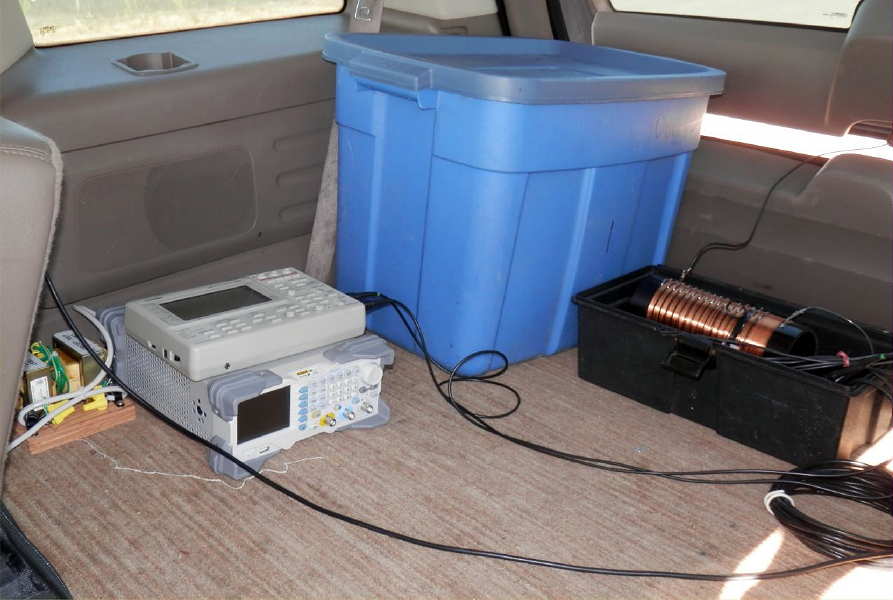
Toby's basic transverter is rather unique in that the transmitter's FET power mixer also passes signals backwards to function in the receive mode:
"I’ve developed a 630m band linear transverter that produces 30W of transmitter power. It has no power amplifier and draws only 175 mA from a 12V power supply. It works for both transmit and receive with no T/R antenna relays or switching circuits.
I’ve used a bidirectional high-power mixer circuit to directly take 100W of power from a 160m band transceiver and produce useful output power on 630m. For receive, 630m signals can pass backwards through the circuit and are up-converted to 160m.
My transverter is actually the small box on the dash above the steering wheel. The gear in the back near the variometer is used only during setup to resonate the antenna. It's a signal generator and oscilloscope. The AC transformers are just an isolation transformer that I need to make the test equipment work with my 12V-to-AC inverter."
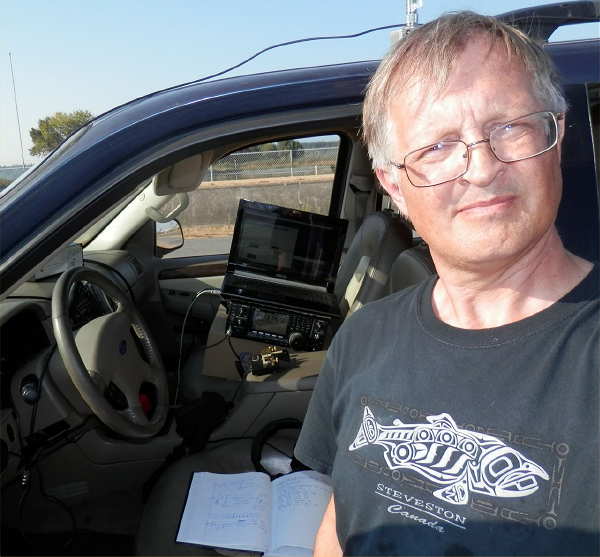 |
| Toby VE7CNF/7 at Iona |
"VE7CNF/7 Operation was from the Iona Beach area near Vancouver, grid CN89jf. The location is right beside salt water. There are no nearby power lines so rx noise was S0. Operation was in daylight, around 4 pm local time. Signals were excellent and all CW was easy copy.
On 475.0 kHz CW I managed to work Roger VE7VV (CN88il, him 529, me 579) and Jack VA7JX (CN79kv, him 569, me 579). I heard Steve VE7SL (CN88iu) at 599 briefly, then he had a problem and we didn't complete a QSO. He gave me 599 later by email.
The antenna is about 24 ft high and the fishing-rod-and-wire top load is pulled forward about 8 ft. The matching circuit is a loading coil, variometer, and autotransformer. My Tx power was 20W TPO and estimated EIRP 75 mW. The rig was my home brew transverter with an IC-7410."
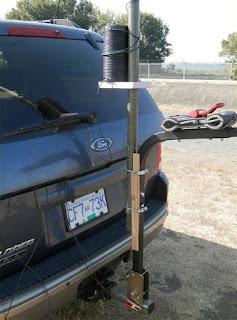
"After CW I ran WSPR for a while, 23:42 to 00:08 UTC (4:42 to 5:08 pm local). WSPRnet lists my spots as my home QTH CN89ng, but I did have CN89jf entered in WSJT-X. I got spots from WI2XJQ -17, VE7BDQ +14, VE7AB +6, VE7VV +1, W7IUV -26, WH2XGP -30 dB. I also decoded WSPR from VE7VV +7 and VA7JX +9 dB."
On 475.0 kHz CW I managed to work Roger VE7VV (CN88il, him 529, me 579) and Jack VA7JX (CN79kv, him 569, me 579). I heard Steve VE7SL (CN88iu) at 599 briefly, then he had a problem and we didn't complete a QSO. He gave me 599 later by email.
The antenna is about 24 ft high and the fishing-rod-and-wire top load is pulled forward about 8 ft. The matching circuit is a loading coil, variometer, and autotransformer. My Tx power was 20W TPO and estimated EIRP 75 mW. The rig was my home brew transverter with an IC-7410."

"After CW I ran WSPR for a while, 23:42 to 00:08 UTC (4:42 to 5:08 pm local). WSPRnet lists my spots as my home QTH CN89ng, but I did have CN89jf entered in WSJT-X. I got spots from WI2XJQ -17, VE7BDQ +14, VE7AB +6, VE7VV +1, W7IUV -26, WH2XGP -30 dB. I also decoded WSPR from VE7VV +7 and VA7JX +9 dB."
"This was great fun. I'll have to try more locations, and see if I can improve the equipment for easier setup. I had great copy on Roger 529 and Jack 569. Working Jack was a surprise, and his signal was excellent. Being beside salt water is magic. Rx noise was so low at that location, near Iona Beach CN89jf."
Our 'new' band continues to demonstrate its ability to offer exciting opportunities to experimenters, home-brewers and DXers alike and for those with the creative imagination to push new boundaries, who knows where one of the first frequency ranges to be used by amateurs back in the 20's might eventually take us.
I can visualize, at some point in the future, the usefulness of a province-wide 630m emergency comms network utilizing a basic 'grab and go' system based on much of Toby's demonstrated work.
If you are a Canadian amateur why not join the fun on 630m now? U.S. amateurs will be arriving shortly and when they do, things should be getting even more exciting on the new band!
Building For The BK Party?
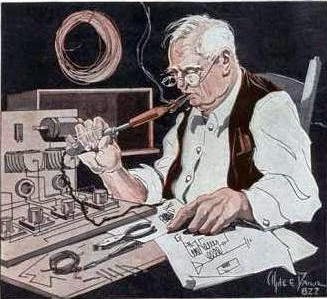
It's almost that time of the year when, once again, the '29ers start preparing for the winter Bruce Kelley 1929 CW Party. A recent posting on the Yahoo AWA (Builder's) Group by Lou, VE3AWA, reminded everyone that there were only 108 more sleeps before this year's Party.
In case you're not familiar with the 'BK', it's a winter CW event celebrating the early days of amateur radio.
Transmitters used for the event must be self-excited only ... no crystals are allowed ... and the tube(s) used must be those that were available in 1929 or earlier. It's an eye-opener to hear how the band must have sounded in the early days of amateur radio CW... even better if you're making those beautiful sounds yourself.
The 'BK' usually spawns a flurry of construction, so if you think it is something that might interest you, you have until December to get ready! Unfortunately many aspiring '29ers always leave it too late and inevitably run out of time before any last glitches can be overcome.
For many builders of '29-style gear, especially transmitters, the two-weekend December event is the highlight of the year as it gives them the opportunity to get on the air with their early-style rigs and work as many other '29ers as they can.
Every year there are numerous transcontinental CW contacts made with the simple, usually single-tube, self-excited oscillators that look as if they would have difficulty just being heard across town! Tuning in to the BK Party may be the closest thing you can find to a 'time machine' these days, as a small section of the CW bands (160-40m) take on the same sounds you would have heard when tuning across these bands in the late '20s.
When I first listened to a BK Party several years ago, I was surprised at the wide range of signal quality coming from these faithfully reproduced exhalers, running the gamut from the 'almost Collins-like' MOPAs to the unique sounding raw-AC notes coming from some of the one-lungers.
Most of the stations I have worked in past BK events were running less than 10W input yet, even with the terrible conditions experienced in the last two events, their signals were making it across the continent on the low bands ... and all were having a great time doing it!
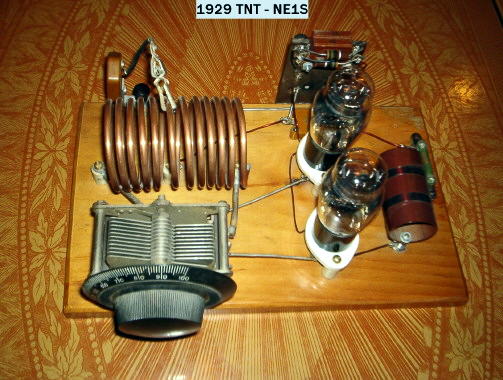
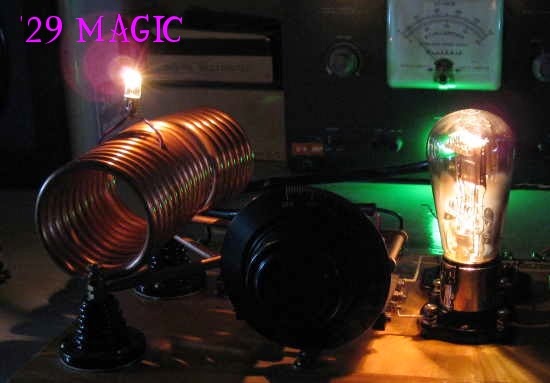
Larry's (NE1S) TNT makes it back to the west coast every year in the BK Party.

Shown above is a fine little TNT built by Kevin, WB2QMY, in New York. It uses a very affordable UX-201A triode, originally manufactured in 1925 for radio receivers. Although Kevin's TNT puts out barely 2 watts on 80m CW, we had no trouble working each other in the BK QSO Party. If you build it, they will come!
If you've ever entertained thoughts of wanting to participate in the '29 QSO Party, this late-summer 'heads-up', could be just what you need to make it happen ... there is still plenty of time to put something together for this year's event. Here is the specific information for this year's BK Party.
There is plenty of information available right here on my blog that will answer many of your initial concerns surrounding tubes, circuits and components:
An Introduction To Building ... '29-Style
'29-Style Transmitters ... What To Build? - Part 1
'29-Style Transmitters ... What To Build? - Part 2
As well, my own website contains several detailed construction procedures on various transmitter styles used back in the day ... and an inspirational 'Gallery of '29-Style Transmitters' from other builders. In addition, there is a lot more '29-specific information in this blog, all of which can be found here, for several nights of bedtime reading!
Should you decide to take on a simple transmitter for this year's party (and there are dozens of participants hoping that you will), here are a few things to keep in mind:
You don't need much power to make contacts ... just a few watts will do it. If your antenna system is efficient and you can hear reasonably well, expect to work '29ers all across the continent.
Your transmitter does not have to 'look pretty'! You can breadboard up something with modern components and as long as the tube-year qualifies, you're good to go. Too many get bogged-down with making a showpiece ... that can always come later.
I, and others, have found Hartley oscillators to be the easiest to get going and often produce the best notes. Although the power limit this year has been increased to 25 watts DC input, just 2 or 3 watts coming from a simple Hartley will guarantee you a ticket on the BK time machine.
A wonderful source of advice, inspiration and even help with parts, can be had by joining the AWA (Builders) Group.
For now, I'll tempt you with the basic information regarding the QSO Party as published by the 'BK' sponsor...the AWA.
The Bruce Kelly 1929 QSO Party is a yearly AWA sponsored event where participants build their own transmitters using the designs, techniques, and tubes that were available in 1929 and earlier, and then put those classic transmitters on the air and try to contact as many other 1929 stations as possible. Since they use early designs, it is a cacophony of whooping, chirping, buzzing, clicking, drifting, swishing, swaying, warbling, and other interesting signals. This is what ham radio sounded like in 1929 and for two weekends in December its 1929 again on the ham bands.
Rules: Transmitters must be 1929 or earlier types of self oscillators such as the Hartley, TNT, PP tuned grid tuned plate, MOPA, Colpitts, etc. No crystal oscillators. Tubes must have been available during or before 1929. Typical tubes often used are type 10, 45, 27, 211, 71A. Individual stations can be worked only once on each band over the course of two weekends. You can use any vintage or modern receiver that you wish. The event is open to all 1929 stations including non-AWA members and AWA members.
Input Power: Transmitters are limited to a power INPUT of 25 watts or less.
Frequencies: The QSO Party typically operates between 1800 to 1810 Kcs, 3550 to 3580 Kcs , 7100 to 7125 Kcs, plus or minus depending on QRM. 40 meter activity is up significantly because it offers both night time AND daytime propagation!
Presently, a large percentage of the activity is from Minnesota and points eastward ... the west is poorly represented for some reason but activity out this way has been slowly increasing over the past few years.
You don't need much in the way of power ... every year I work several eastern 'BK' stations that are running just 2 or 3 watts, usually using receiver tubes pressed into RF oscillator service ... much like the original 'boys of '29' probably had to do.
With the solar cycle winding-down and the expected return of undisturbed great winter conditions, this year's BK Party should be better than ever ... especially with even more new clunkers chirping away in the night.
Should you join the fun, there will be many '29ers looking for you I can guarantee!
 |
| courtesy:VE3AWA |
Building For The BK Party?
It's almost that time of the year when, once again, the '29ers start preparing for the winter Bruce Kelley 1929 CW Party. A recent posting on the Yahoo AWA (Builder's) Group by Lou, VE3AWA, reminded everyone that there were only 108 more sleeps before this year's Party.
In case you're not familiar with the 'BK', it's a winter CW event celebrating the early days of amateur radio.
Transmitters used for the event must be self-excited only ... no crystals are allowed ... and the tube(s) used must be those that were available in 1929 or earlier. It's an eye-opener to hear how the band must have sounded in the early days of amateur radio CW... even better if you're making those beautiful sounds yourself.
The 'BK' usually spawns a flurry of construction, so if you think it is something that might interest you, you have until December to get ready! Unfortunately many aspiring '29ers always leave it too late and inevitably run out of time before any last glitches can be overcome.
For many builders of '29-style gear, especially transmitters, the two-weekend December event is the highlight of the year as it gives them the opportunity to get on the air with their early-style rigs and work as many other '29ers as they can.
Every year there are numerous transcontinental CW contacts made with the simple, usually single-tube, self-excited oscillators that look as if they would have difficulty just being heard across town! Tuning in to the BK Party may be the closest thing you can find to a 'time machine' these days, as a small section of the CW bands (160-40m) take on the same sounds you would have heard when tuning across these bands in the late '20s.
When I first listened to a BK Party several years ago, I was surprised at the wide range of signal quality coming from these faithfully reproduced exhalers, running the gamut from the 'almost Collins-like' MOPAs to the unique sounding raw-AC notes coming from some of the one-lungers.
Most of the stations I have worked in past BK events were running less than 10W input yet, even with the terrible conditions experienced in the last two events, their signals were making it across the continent on the low bands ... and all were having a great time doing it!
Larry's (NE1S) TNT makes it back to the west coast every year in the BK Party.
Shown above is a fine little TNT built by Kevin, WB2QMY, in New York. It uses a very affordable UX-201A triode, originally manufactured in 1925 for radio receivers. Although Kevin's TNT puts out barely 2 watts on 80m CW, we had no trouble working each other in the BK QSO Party. If you build it, they will come!
If you've ever entertained thoughts of wanting to participate in the '29 QSO Party, this late-summer 'heads-up', could be just what you need to make it happen ... there is still plenty of time to put something together for this year's event. Here is the specific information for this year's BK Party.
There is plenty of information available right here on my blog that will answer many of your initial concerns surrounding tubes, circuits and components:
An Introduction To Building ... '29-Style
'29-Style Transmitters ... What To Build? - Part 1
'29-Style Transmitters ... What To Build? - Part 2
As well, my own website contains several detailed construction procedures on various transmitter styles used back in the day ... and an inspirational 'Gallery of '29-Style Transmitters' from other builders. In addition, there is a lot more '29-specific information in this blog, all of which can be found here, for several nights of bedtime reading!
Should you decide to take on a simple transmitter for this year's party (and there are dozens of participants hoping that you will), here are a few things to keep in mind:
You don't need much power to make contacts ... just a few watts will do it. If your antenna system is efficient and you can hear reasonably well, expect to work '29ers all across the continent.
Your transmitter does not have to 'look pretty'! You can breadboard up something with modern components and as long as the tube-year qualifies, you're good to go. Too many get bogged-down with making a showpiece ... that can always come later.
I, and others, have found Hartley oscillators to be the easiest to get going and often produce the best notes. Although the power limit this year has been increased to 25 watts DC input, just 2 or 3 watts coming from a simple Hartley will guarantee you a ticket on the BK time machine.
A wonderful source of advice, inspiration and even help with parts, can be had by joining the AWA (Builders) Group.
For now, I'll tempt you with the basic information regarding the QSO Party as published by the 'BK' sponsor...the AWA.
The Bruce Kelly 1929 QSO Party is a yearly AWA sponsored event where participants build their own transmitters using the designs, techniques, and tubes that were available in 1929 and earlier, and then put those classic transmitters on the air and try to contact as many other 1929 stations as possible. Since they use early designs, it is a cacophony of whooping, chirping, buzzing, clicking, drifting, swishing, swaying, warbling, and other interesting signals. This is what ham radio sounded like in 1929 and for two weekends in December its 1929 again on the ham bands.
Rules: Transmitters must be 1929 or earlier types of self oscillators such as the Hartley, TNT, PP tuned grid tuned plate, MOPA, Colpitts, etc. No crystal oscillators. Tubes must have been available during or before 1929. Typical tubes often used are type 10, 45, 27, 211, 71A. Individual stations can be worked only once on each band over the course of two weekends. You can use any vintage or modern receiver that you wish. The event is open to all 1929 stations including non-AWA members and AWA members.
Input Power: Transmitters are limited to a power INPUT of 25 watts or less.
Frequencies: The QSO Party typically operates between 1800 to 1810 Kcs, 3550 to 3580 Kcs , 7100 to 7125 Kcs, plus or minus depending on QRM. 40 meter activity is up significantly because it offers both night time AND daytime propagation!
Presently, a large percentage of the activity is from Minnesota and points eastward ... the west is poorly represented for some reason but activity out this way has been slowly increasing over the past few years.
You don't need much in the way of power ... every year I work several eastern 'BK' stations that are running just 2 or 3 watts, usually using receiver tubes pressed into RF oscillator service ... much like the original 'boys of '29' probably had to do.
With the solar cycle winding-down and the expected return of undisturbed great winter conditions, this year's BK Party should be better than ever ... especially with even more new clunkers chirping away in the night.
Should you join the fun, there will be many '29ers looking for you I can guarantee!
|
| courtesy:VE3AWA |
Hunting For NDBs In CLE 222
 |
| HM - 221 kHz Hamilton, Ontario |
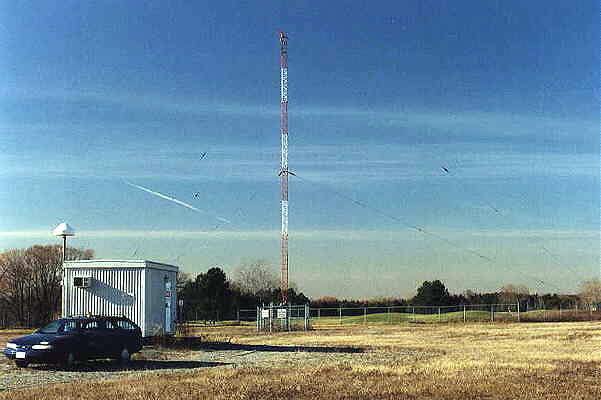
This coming weekend will see another CLE challenge. This time the hunting grounds will be all inclusive: 190-1740 kHz. As well, there are two options, HOME and DX as explained below.
For those unfamiliar with this monthly activity, a 'CLE' is a 'Co-ordinated Listening Event', as NDB DXers around the world focus their listening time (usually) on one small slice of the NDB spectrum.
Summertime CLEs can often be challenging, not because of poor propagation but more likely, summer lightning storms ... hopefully it will be quiet for your location.
When tuning for NDBs, put your receiver in the CW mode and listen for the NDB's CW identifier, repeated every few seconds. Listen for U.S. NDB identifiers approximately 1 kHz higher or lower than the published transmitted frequency since these beacons are modulated with a 1020 Hz tone approximately.
For example, 'AA' (Fargo - ND) transmits on 365 kHz and its upper sideband CW identifier is tuned at 366.025 kHz while its lower sideband CW ident can be tuned at 363.946 kHz. Its USB tone is actually 1025 Hz while its LSB tone is 1054 Hz.
Often, one sideband will be much stronger than the other so if you don't hear the first one, try listening on the other sideband.
Canadian NDBs normally have an USB tone only, usually very close to 400 Hz. They also have a long dash (keydown) following the CW identifier.
All NDBs heard in North America will be listed in the RNA database (updated daily) while those heard in Europe may be found in the REU database. Beacons heard outside of these regions will be found in the RWW database.
From CLE organizer Brian Keyte, G3SIA, comes the usual 'heads-up':
Hi all
Our 222nd Co-ordinated Listening Event, 'DX and HOME', starts on Friday
and runs for an extra day. First-time CLE logs will also be very welcome
of course.
Days: Friday 25th August - TUESDAY 29th August
Times: Midday on Friday to Midday on Tuesday, your LOCAL time
QRG: Normal LF/MF frequencies (190 - 1740 kHz)
NDBs: Normal DX and 'HOME' ones (not DGPS, Navtex or Amateur)
There are two parts (you can listen for either or both of them):
DX:
Please try to log NDBs that are over 2,000 km / 1,250 miles from you.
(If you don't have details of the distances of NDBs from you, please see
the end of this email)
HOME:
If you have any, please log the NDBs in YOUR OWN radio country.
For listeners in AUS, CAN and USA, that means your State or Province.
Our full list of radio countries can be found at:
http://www.ndblist.info/ndbinfo/countrylist.pdf
(If you also mention any of your home regulars NOT heard, it will help
others to know about NDBs, maybe DX to them, that may not be active)
Please post your CLE log to the List in a plain text email if possible,
with 'CLE222' at the start of its title and showing on each log line:
The full Date ( e.g. 2017-08-25 or just the day number 25 )
UTC (the day changes at 00:00 UTC).
kHz - the nominal published frequency
The Call Ident.
Please put those four main log items FIRST, with any other optional
details such as location and distance LATER in the same line.
Your log will be more interesting if you keep the two parts, DX and HOME,
separate in it. Any UNIDs that you come across will also be of interest -
in a separate, third, part of your log please.
If you send interim logs, please make sure that you also send a 'Final' log
showing ALL your loggings for the CLE.
I will send the usual 'Any More Logs?' email at about 17:00 UTC on
WEDNESDAY so you can check that your log has been found OK.
Do make sure that your Final log has arrived on the list by 08:00 UTC
on Friday 1st September at the very latest.
Joachim hopes to complete the combined results on the Saturday.
Good listening
Brian
----------------------------------------------------------
From: Brian Keyte G3SIA ndbcle'at'gmail.com
Location: Surrey, SE England (CLE coordinator)
----------------------------------------------------------
(If you wish you could use a remote receiver for your loggings,
stating its location and owner - with permission if required.
A remote listener may NOT also use another receiver, whether
local or remote, to obtain further loggings for the same CLE.
The HOME radio country and the distances would be based on
where the receiving equipment is located)
DISTANCES TO NDBs FROM YOUR LOCATION
The Great Circle program GcmWin by SM3GSJ can produce a nice great circle
map centred on your location - see http://www.qsl.net/sm3gsj/
Users of Michael's NDB Handbooks will already have their distances and
bearings to the NDBs.
Alex's WWSU program has a facility to create a map showing the areas
inside the 2000 km circle.
To create this,
click on 'Tools'
click on 'Station Radar'
select Range from “2000” to “10000” km
select “show NDB stations”
click on “Generate Image”
click on “Save To File”
That will create a text-file containing information on the selected NDBs.
The REU/RNA/RWW Database provides a powerful way of finding which
NDBs to search for:
1) Go to the signals screen using -
http://www.classaxe.com/dx/ndb/reu?mode=signals
If you are in North America, replace the reu above with rna
If you are not in Europe or North America, replace the reu with rww
2) On the Range line, put your *Locator in the 'From GSQ' box (e.g. mine
is IO91tg) The DX fields become enabled when a GSQ is entered.
3) Enter 2000 in the first DX field, leave the second blank and leave the
units as 'km' (or use 1250 and 'miles', if you prefer)
4) Select 'Only Active' and press 'Go'.
Now you only see NDBs that are over 2000 km from you.
Change 'Show' in the top line to 'All Results'.
The other fields are also active - e.g. you could enter specific States or
Countries in the Location line to limit the search to the NDBs there.
And/or you could click on 'Map', then on 'Go' and uncheck 'Clustering'
*If you do not know your Locator you can quickly find it from your
Latitude/Longitude (and vice versa) by using:
wingrid.exe V4.1 - freeware from W4SM
These listening events serve several purposes. They:
- determine, worldwide, which beacons are actually in service and on-the-air so the online database can be kept up-to-date
- determine, worldwide, which beacons are out-of-service or have gone silent since the last CLE covering this range
- will indicate the state of propagation conditions at the various participant locations
- will give you an indication of how well your LF/MF receiving system is working
- give participants a fun yet challenging activity to keep their listening skills honed
Final details can be found at the NDB List website, and worldwide results, for every participant, will be posted there a few days after the event. If you are a member of the ndblist Group, results will also be e-mailed and posted there.
The very active Yahoo ndblist Group is a great place to learn more about the 'Art of NDB DXing' or to meet other listeners in your region. There is a lot of good information available there and new members are always very welcome. As well, you can follow the results of other CLE participants from night to night as propagation is always an active topic of discussion.
If you are contemplating getting started on 630m, listening for NDBs is an excellent way to test out your receive capabilities as there are several NDBs located near this part of the spectrum.
You need not be an ndblist member to participate in the CLEs and all reports, no matter how small, are of much value to the organizers.
'First-time' logs are always VERY welcome!
Reports may be sent to the ndblist or e-mailed to either myself or CLE co-ordinator, Brian Keyte (G3SIA), whose address appears above.
Please ... give the CLE a try ... then let us know what NDB's can be heard from your location! Your report can then be added to the worldwide database to help keep it up-to-date.
Good hunting!














