Author Archive
 Some 6m Summer Excitement
 August 13th, 2020 |
  Author:
With three seasons of FT8 under its belt, there’s no doubt that it's taken over as the number-one mode for the 6m band ... there are very few traces of CW or SSB to be found.
What it hasn’t taken away, is the magic!
For the most part, this summer’s conditions from the west coast were pretty normal, except for when they weren’t ... and when they weren’t, they were pretty spectacular!
The spectacular parts were highlighted by one particularly unique contact that can only be attributed to some heads-up operating skills, a little help from FT8 ... and the unpredictability of Sporadic-E.
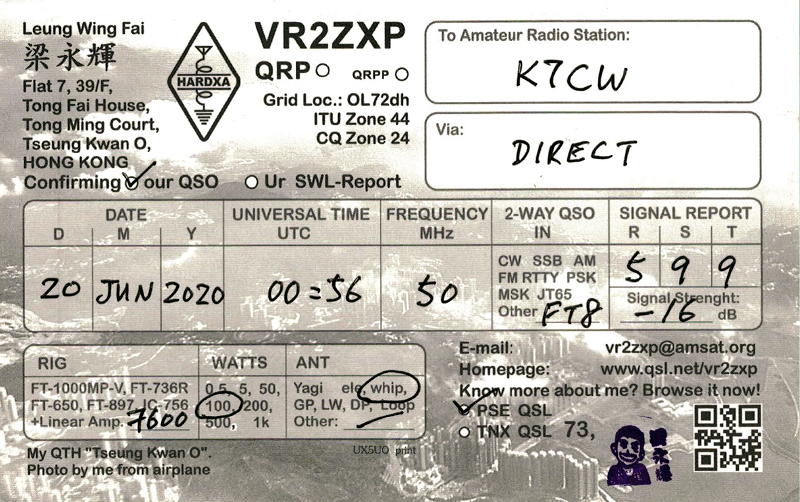
On June 20, at 0056Z, K7CW (Paul), south-west of Seattle, nudged his signal all the way to Hong Kong, more specifically, to VR2ZXP’s crowded apartment building. But that’s not the incredible part. That happened when Paul heard and exchanged signal reports with Alfred’s tiny station!
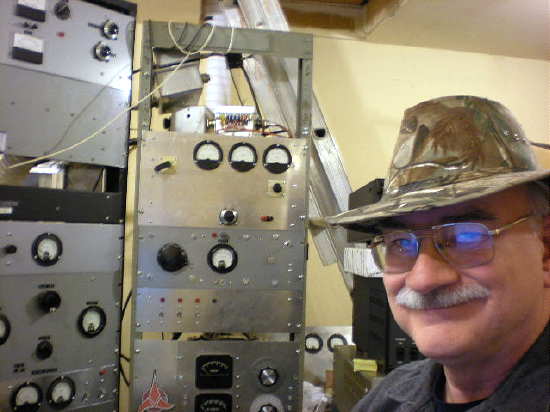 |
| Paul, K7CW |
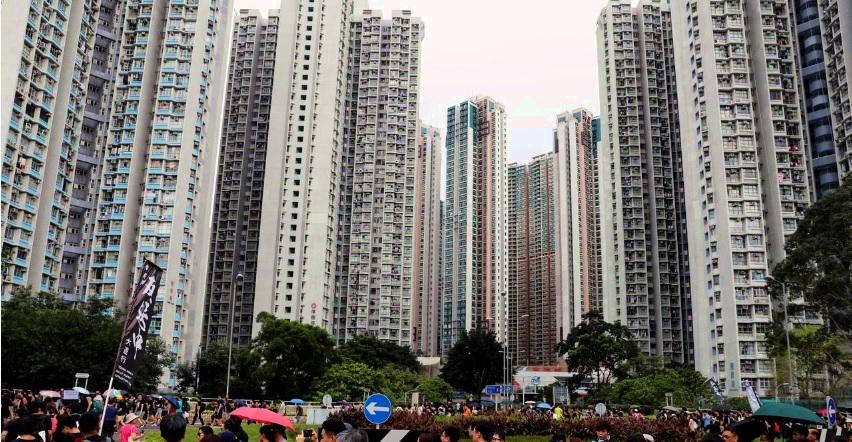 |
| Not the best location for weak signal 50MHz DX! |
"As I told to Paul, it’s a hard job to be a ham in VR2 Hong Kong especially for the DX. Hong Kong is a high density population city. 99% people are living in apartment only. The housing price here is crazy around US$1800 per sq. feet. Neighborhoods always complain why we setup antennas out of our windows and produce radiation to affect their health. So, what we just can do is to use a small whip with QRO for the QSO. Besides, interference is also serious. Thousands of air conditioner is surrounding me and a power station 132kV to 11kV is just faced to me in 1km away. Here the noise level on low HF band at night is S9."
As indicated above, Alfred’s station is located in a typical high-rise apartment, surrounded by numerous others, with no room for antennas. His solution is to clip a short (60”) whip antenna, horizontally mounted on his balcony railing, similar to this one from 20 years ago ... before being surrounded by noisy high-rise apartment buildings!
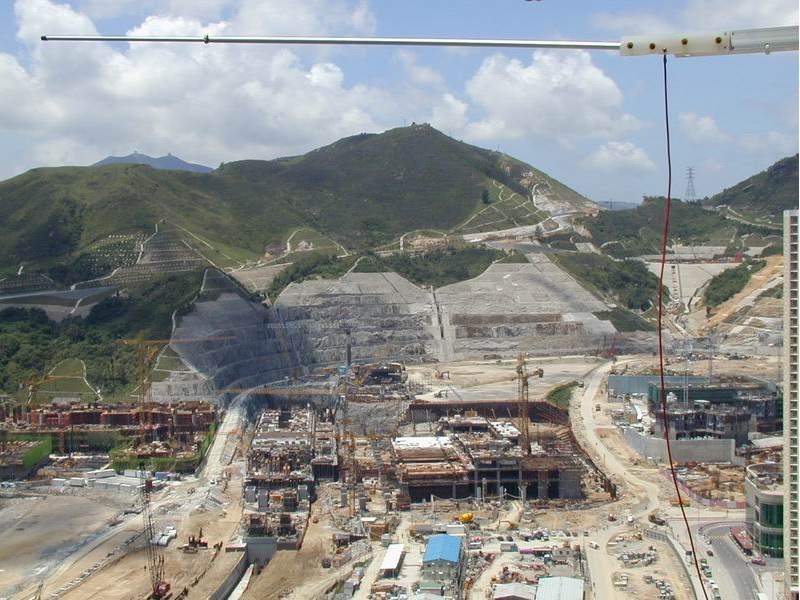
I’m not sure which is the most spectacular part of this contact ... that Alfred could detect Paul’s signal in such a noisy environment using such a small makeshift antenna or that Paul was able to copy the tiny signal coming from uptown Hong Kong.

 |
 |
| K7CW's 9el - 50' Yagi at 80' |
Long openings like this occur very rarely, making them even more thrilling and can cause even the most experienced 6m DXer’s mouse-hand to tremble with excitement!
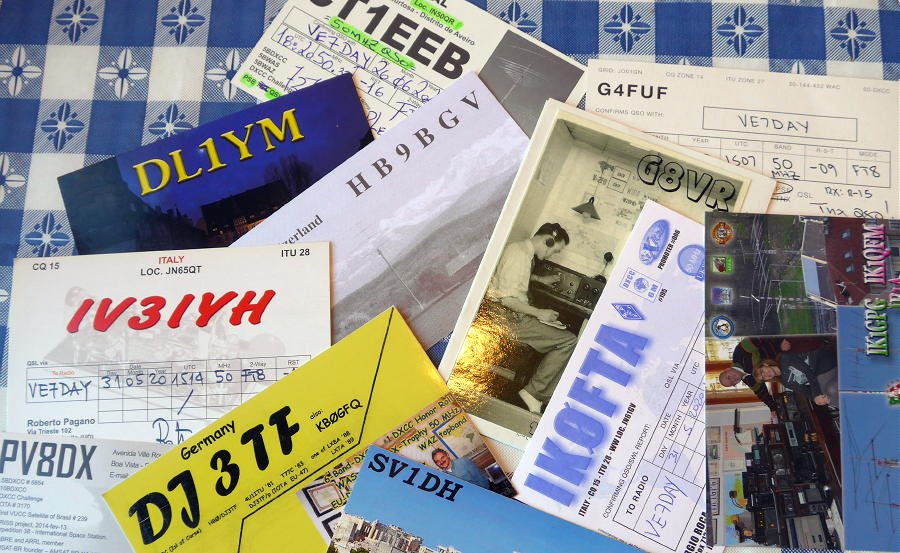 |
| Some of VE7DAY's wallpaper from the May 31st opening. |
Others up and down the west coast also filled their log pages with ‘new ones’ ... unfortunately my exciter was on the workbench while replacing the screen so I never knew what I had missed until some time later ... probably just as well. I guess I must have been pretty naughty at some point, as the 6m gods definitely singled me out for special punishment that morning.
Once the exciter was back together I was able to catch a few good openings myself, the best of which was early on the morning of June 23 when I was able to work SV9CVY (Crete), SV1DH (Greece) and IS0AWZ (Sardinia).

Crete and Sardinia gave me DXCC #89 and #90. Three days later, during a nice opening to the southern states, J68HZ in St. Lucia snuck through the QRM for #91. After a further three days, on June 29, another very early opening put 8 more Europeans in the log including HA8CE (Hungary) and YU7EF (Yugoslavia) for #92 and #93 respectively.
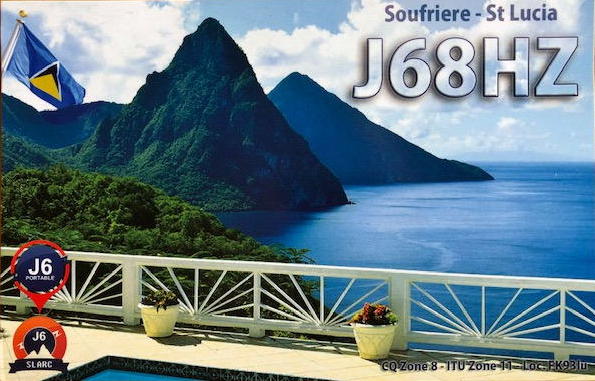
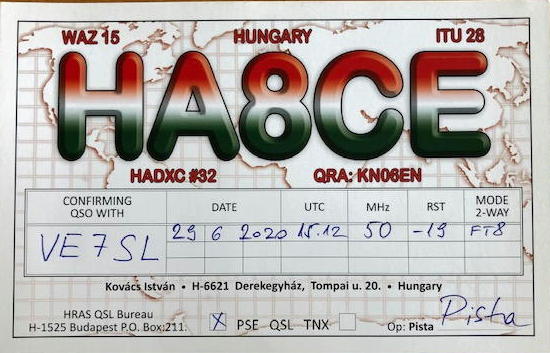
The band also produced several long openings to Asia, usually in the late afternoon hours. Several contacts were made with South Korean stations, China and dozens with Japan.
All told, the band produced some exciting activity this summer. Countries worked here were:
JA, JW, TG, V31, J68, LA, SM, SV9, SV, IS0, EA, HA, YU, F, 9A5, BG, HL, EA8. Certainly FT8 had much to do with a good portion of the action but it is difficult to say just how much. Many of the Europeans were very strong and could have easily been worked on CW in a matter of a few seconds, rather than the 60 - 75 seconds required for a valid FT8 exchange, assuming there are no repeats. But it's contacts like Paul and Alfred's that continue to validate the special name given to the band ... you just never know what might tricks will be next.
New Hope For Cycle 25!
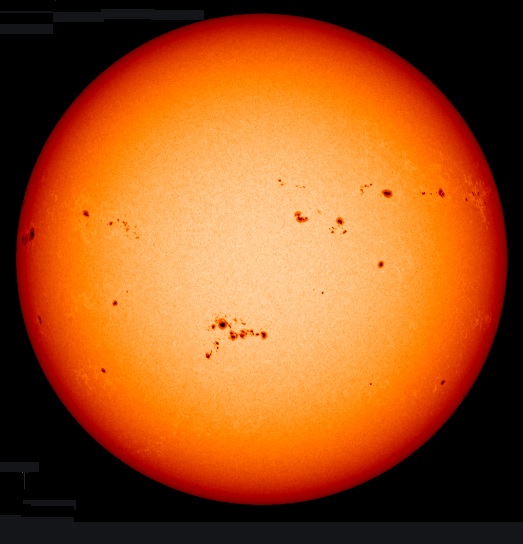
Unlike most forecasts for solar Cycle 25, a recently released paper from five solar scientists (1) has given many 6m diehards new reasons to hope!
After countless dire predictions for the upcoming cycle indicating similar or even poorer activity levels than the disappointing Cycle 24, the new paper suggests just the opposite!
In fact, the group of scientists predict that "Cycle 25 will probably be among the strongest solar cycles ever observed, and that it will almost certainly be stronger than present SC24 (116 spots) and most likely stronger than the previous cycle 23 (180 spots)." The possibility of a smoothed sunspot number (SSN) reaching as high as 305 is in the prediction!
Solar Cycle 19 was a monster, reaching a SSN level of 285 ... to imagine the possibility of something even stronger is truly exciting. The just-ending Cycle 24 was one of the weakest on record, reaching an SSN of just 116.
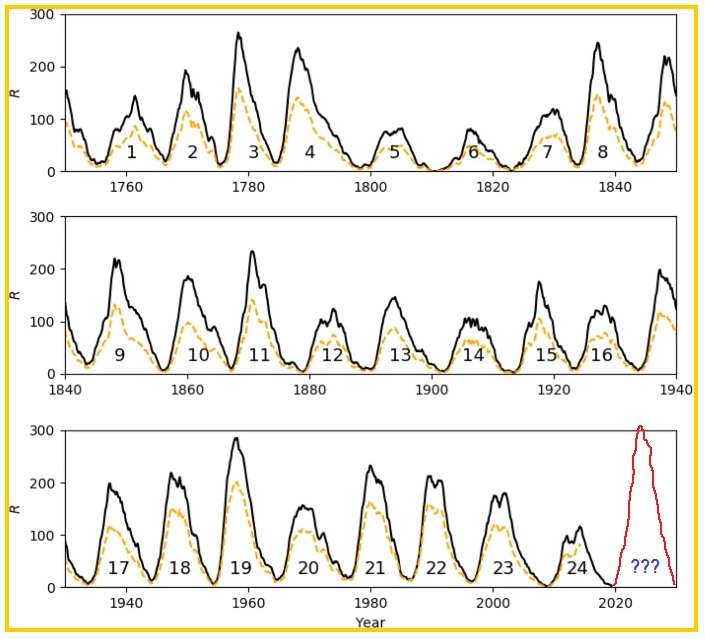 |
| Will Cycle 25 replace Cycle 19 as #1? Image source with my addition in RED. |
During Cycle 24, maximum usable frequencies (MUF) for F2 propagation often struggled just to reach 28MHz, and except for the peak year, the worldwide propagation conditions that amateurs had come to expect were often absent.
Should these new optimistic predictions come to pass, 6m operators can look forward to some truly, never-before-seen, fall and winter propagation ... for at least three or more winters.
With SSN values reaching the high two-hundreds or beyond, west coast operators can expect to see the 6m band often open before sunrise, most likely favoring Europe via the polar path or towards Africa via the trans-Atlantic path. Unlike 20m, there will be little to no ‘polar flutter’ and since signals propagating near the F2 MUF suffer very little path loss, they will probably be very strong.
Later in the day, propagation will shift south towards Central and South America before moving to the west. Depending on the time of year, the propagation will favor Asia, with signals from Japan, China and other far-eastern exotica in the early fall through the New Year. As well, the band will often stay open for some time after local sunset. Late winter and spring will see the western path favour signals from down under, and stretch out to the southern far east regions towards the Indian Ocean. These were the propagation patterns noted from here during Cycles 21-23, when SSNs reached 233, 214 and 180 respectively.
With much gratitude to Mark (VA7MM) for converting my old analog tapes to mp3, here is a recording I made on the morning of November 7, 1979, at the height of Cycle 21. It will give you a taste of what could be in store. On that Wednesday morning, the band opened around 0800 and continued through to sunset, closing with a three-hour opening to the Pacific and Japan. Like many other 6m operators, I had taken the day off work with a case of the 'F2 flu' that was very prevalent that winter! The recording begins with a short exchange between VE1ASJ and VE1AVX, while trying to work their first KL7 ...
The graph of Cycle 21 shows when the recording was made. Although not known at the time, it was very close to the peak of the cycle.
 |
| courtesy: http://www.solen.info/solar/ |
 |
| courtesy: http://www.solen.info/solar/ |
A record-busting Cycle 25 will be like these previous cycles only on steroids! With such a cycle, 10m will follow a similar pattern but will likely be open 24/7 as I recall listening to VKs and ZLs on 10m AM well after midnight during the downward climb of Cycle 19 ... and this was on a very '10m-deaf' Hallicrafters S-38 and a short wire out the attic window!
For those wanting to read the fascinating paper (Overlapping Magnetic Activity Cycles and the Sunspot Number: Forecasting Sunspot Cycle 25 Amplitude), you can find a pdf here. As well, you can read the ARRL’s own announcement of this exciting possibility here.
One certainty is, that if FT8 is still around by then, it and your soundcard will fold up quickly once the band opens with wall-to-wall S9++ signals. It may be useful during the first early minutes or during marginal openings, but knowing the signal levels that 6m F2 can produce, it will be like trying to use FT8 with dozens of new neighbors operating on your own block ... and you can easily guess how well that might work! As we’ve come to understand, FT8 is a wonderful weak-signal mode, but throw just one bone-crushing signal into the waterfall and it’s game-over ... on F2, there will be dozens of these!
Such stellar conditions on 6m are ideally suited to CW or SSB and I think there will be a fast exodus from FT8 back to the traditional modes very early ... those that aren’t prepared for this, relying only on FT8, will most likely be in for a rude awakening. If you’re a 6m “no-coder”, now’s the time to hunker-down and learn CW ... by the time Cycle 25 becomes productive, you won’t be left out of the many CW DX opportunities that will surely be available on this much quicker QSO mode.
We will no doubt be reading more about this as Cycle 25 begins to grow. As in almost all stronger than normal cycles, growth from the start to the peak is much shorter than normal so I’ll be watching for a fast rise in sunspot numbers once we are really underway.
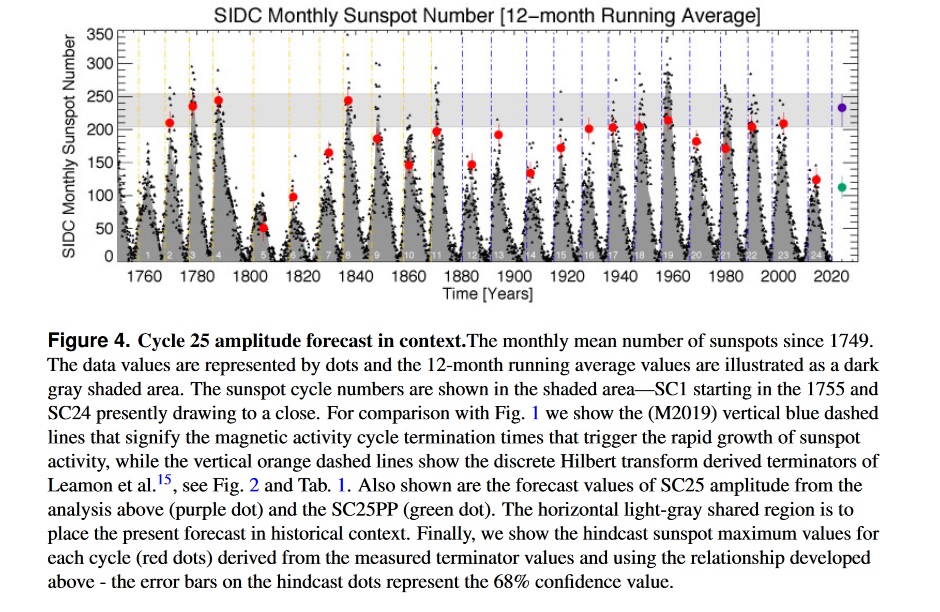
Hindcast modelling (backtesting) of the data derived from previous cycles going back to the 1700s using the paper’s prediction methodology, shows an accurate alignment with what actually occurred. The red dots in the graph above indicate the model’s predicted peak superimposed on the actual peak. In some cases, the peaks were even higher than the modelling suggested.
The predictions identify the so-called “termination” events, landmarks marking the start and end of sunspot and magnetic activity cycles, extracting a relationship between the temporal spacing of terminators and the magnitude of sunspot cycles. The success of these predictions will depend upon an upcoming terminator event before the end of 2020. Should it occur on time, the predictions will be given a much greater chance of coming to fruition ... "with a terminator event in 2020, we deduce that sunspot cycle 25 will have a magnitude that rivals the top few since records began. This outcome would be in stark contrast to the community consensus estimate of sunspot cycle 25 magnitude."
More interesting discussions of the paper can be found here and here.
This week's high-latitude Cycle 25 sunspots are a great sign. When the terminator event occurs, solar activity will ramp-up very quickly, within one 27 day solar rotation. Let's hope we're getting close.
As noted in the paper, "Very early indications of the spot pattern are appearing at higher than average latitudes. Historically, high latitude spot emergence has been associated with the development of large amplitude sunspot cycles — only time will tell."
Hopefully we’ll all need to hold on to our hats ... it just might just be the ride of our lives!
(1) Scott W. McIntosh (1), Sandra C. Chapman (2), Robert J. Leamon (3,4), Ricky Egeland (1), and Nicholas W. Watkins (2,5,6)
1 National Center for Atmospheric Research, P.O. Box 3000, Boulder, CO 80307, USA.
2 Centre for Fusion, Space and Astrophysics, University of Warwick, Coventry CV4 7AL, UK
3 University of Maryland, Department of Astronomy, College Park, MD 20742, USA.
4 NASA Goddard Space Flight Center, Code 672, Greenbelt, MD 20771, USA.
5 Centre for the Analysis of Time Series, London School of Economics and Political Science, London WC2A 2AZ, UK
6 School of Engineering and Innovation, STEM Faculty, The Open University, Milton Keynes, UK
Hunting For NDBs In CLE258 – Pick Five!

Next weekend's CLE is something a little different. Listeners are asked to pick five frequencies only, to listen on, and then find as many beacons as they can!
During these stressful times, CLE258 might provide some much needed distraction for you.
I'm sure most listeners will find their own strategy for picking their five frequencies. Will it be the five that have given you the most loggings? The five that have provided the most loggings in North America or Europe? Will it be the five that are not being bothered by your stronger pest signals? Choose wisely and enjoy the challenge.
From CLE coordinator Brian Keyte (G3SIA), comes the following CLE info:
-----------------------------------------------------------------------
- determine, worldwide, which beacons are actually in service and on-the-air so the online database can be kept up-to-date
- determine, worldwide, which beacons are out-of-service or have gone silent since the last CLE covering this range
- will indicate the state of propagation conditions at the various participant locations
- will give you an indication of how well your LF/MF receiving system is working
- give participants a fun yet challenging activity to keep their listening skills honed
The NDB List Group is a great place to learn more about the 'Art of NDB DXing' or to meet other listeners in your region. There is a lot of good information available there and new members are always very welcome. As well, you can follow the results of other CLE participants from night to night as propagation is always an active topic of discussion.
You need not be an NDB List member to participate in the CLEs and all reports, no matter how small, are of much value to the organizers.
Remember - 'First-time' logs are always VERY welcome!
Reports may be sent to the NDB List Group or e-mailed to CLE co-ordinator, Brian Keyte (G3SIA), whose address appears above. If you are a member of the group, all final results will also be e-mailed and posted there.
Please ... give the CLE a try ... then let us know what NDB's can be heard from your location! Your report can then be added to the worldwide database to help keep it up-to-date.
Have fun and good hunting!
NEOPHYTE Adventures

I've just added a new page to my website, The VE7SL Radio Notebook, that describes my NEOPHYTE 1 regenerative receiver spring construction project. The new page can be found here.
Like most simple regens, its performance far exceeds its simple circuit expectations. My listening adventures with it continue during The Radio Board's annual Homebrew DX Contest which runs from July 11 - 24th. You may want to give it a try, after of course, you've checked-out my new web page!
FT8 And The Magic Band
Today’s blog is directed to those that may be new to 6m or new to using FT8 on 6m. Some of the things discussed will make your experience on the magic band better for you and better for your neigbours.
Unlike using FT8 on the HF bands, 6m presents some different challenges, especially if you operate in a region where there may be a lot of other locals also using the band at the same time.
Although the weak-signal capability of FT8 has made it possible for many smaller stations or those with makeshift antennas to take advantage of the unique propagation 6m has to offer, it also can create problems for other users of the band when used inappropriately. In regions of dense population, even small stations can create very high local signal levels, often making it impossible for their neighbours to hear weak signals. This is not deliberately-caused QRM but arises when some operators operate 'against the flow’ and transmit on the opposite ‘sequence’ to everyone else in their local area.
On HF, one can transmit or listen on whatever time sequence they wish. Chosing ‘TX 1st’ or ‘TX 2nd’ is usually determined by who you hear calling CQ or who you wish to work. On 6m however, in a densely-populated region of local operators, chosing to transmit whenever you want to is a luxury that can create big problems for your neighbour who may be trying to hear that weak DX signal while you are transmitting!
These problem will not occur if everybody in the region uses and follows the same transmit-receive periods, so that everyone is listening or everyone is transmitting at the same time ... one or the other. Unfortunately, this ‘ideal’ system falls apart easily when one or more of your neighbours is not using the same sequence as everyone else.
For the past few years, a protocol that seeks to alleviate this problem has become popular and well accepted by those familiar with it. Those new to 6m may not know about it or understand the reasoning behind it.
Above all, I would urge new users of the band, or to the FT8 mode, to first listen carefully for a few minutes, before beginning operation, to determine what the majority of stations in their local region are using for sequencing. If they are using ‘TX 1st’, then your choice of ‘TX 2nd’ will likely cause hearing difficulty for many others, as well as for yourself.
Although there are no strict rules, there is a very successful and well-practiced protocol, and that is that the ‘easternmost’ station transmits on ‘1st’ while the ‘western end’ goes 2nd’. This is why you will hear most eastern stations in the morning hours transmitting ‘2nd’, as they are usually calling or looking for Europeans to their east, who are transmitting ‘1st’. By the same token, you will also hear western stations transmitting on '2nd', who are also looking for Europe to their east, transmitting on ‘1st’.
This sequencing protocol usually reverses later in the day when signals from Asia become a possibility, and all North Americans then become the ‘easternmost’ stations and will transmit on the ‘1st’ sequence ... unlike in the morning. I can easily see how newcomers to the band could become confused, when they hear both sequences being used! The best thing, once again, is to listen carefully first and then ‘go with the flow’.
You can read about the UK's Six Metre Group's initiatives regarding these protocols HERE.
OK... so you’re not interested in EU or Asia? Then it shouldn’t matter to you which sequence that you use and best operating practice would again be to ‘go with the flow’ in consideration of other users.
A few days ago I saw a prime example of exactly what not to do, in too many respects. I made a posting on the ON4KST 6m chat page that VE1SKY in NS (Nova Scotia) was being decoded here, mainly to alert others in my region that European signals might be coming next, as hearing the VE1s in BC is often an indicator that the European path is building.
In less than a minute, an S9+ local began calling ‘CQ NS’ on the exact opposite sequence of all others ... effectively blocking the waterfall and any possible hope of hearing weak EU signals. I’m sorry, but this is just terrible operating procedure, with almost zero chance of success, while showing no consideration for nearby users.
Just like working DX on CW or on phone, the best way, as it always has been, is to ‘listen, listen and then listen some more’. You will work FAR more DX by listening and calling at the right time, than you will by calling CQ.
I also see some local stations everyday, calling endless CQs, often for over 60 minutes straight and often with many replies that go unnoticed. With FT8, one can check ‘work 1st’, go away, and return later to see who they might have ‘worked’. Perhaps this is what these operators are doing, but they should understand that they are also creating non-stop QRM for other users ... those that choose to listen carefully to the band rather than to endlessly CQ. Once again, this is just poor practice.
You may argue that if nobody called CQ, then there would be no contacts made. There is nothing wrong with a few CQs but CQing for an hour? And don’t worry, there will always be other stations CQing endlessly for you to hear, even if it’s not a great way to operate.
With a little pre-planning for sequencing and consideration for your neighbours, everyone can and should be able to enjoy 6m FT8 with very few problems ... and that is my hope for all of us.
After forty-eight summers of CW and phone on 6m and two summers on FT8, these are some of my initial thoughts on how to best operate for maximum success and consideration for other band-users.
The latter is part of the basic framework upon which amateur radio was originally established, when back in 1914, the ARRL described in their 'Code of Conduct' for amateurs ... "The Amateur is Gentlemanly. He never knowingly uses the air for his own amusement in such a way as to lessen the pleasure of others."
Now, let the magic, and the pleasure, continue!
Hunting For NDBs In CLE257
 |
| courtesy: http://www.ve3gop.com |
This time the hunting ground is the 50kHz slice from 190 - 239.9 kHz as well as any beacons on 'half-way' frequencies (see below for more info).
From CLE coordinator Brian Keyte (G3SIA), comes the following CLE info:
Hello all,
Do try not to miss our 257th co-ordinated listening event - it starts this Friday at midday. This should be an ideal CLE to try out for the first time, but everyone is welcome of course.
Days: Fri. 26th - Mon. 29th June, Midday-Midday, your local time
Frequencies: NDBs from 190 - 239.9 kHz
PLUS: Normal NDBs with carriers on 'half-way' frequencies nnn.5 kHz
from 190.5 - 999.5 kHz (some ‘gentle’ listening!)
So for all of us it is a CLE in two parts - the first part is hunting for the NDBs whose published frequencies are lower than 240 kHz.
The second part is hunting for the NDBs whose carrier frequencies are 'half-way'. E.g. 267.5 OPW, 333.5 VOG, 370.5 LB, 377.5 MO (in OCE), 381.5 SJX (in Ml), 390.5 ITR and 433.5 HEN 'Normal' NDBs - no DGPS, please.
(Most Europe listeners will hear few or none from part 1, while
listeners away from Europe will hear few or none from part 2)
The seeklists from REU/RNA/RWW will help you - you will find them from the CLE SEEKLIST link on the CLE page http://www.ndblist.info/cle.htm
Please send your final CLE log to the List, if possible as a plain text email and not in an attachment, showing 'CLE257' and 'FINAL' in its title.
(Loggings from both parts can be shown in the same list)
Please include on EVERY line of your log:
# The date (or just the day 'dd') and UTC (days change at 00:00 UTC).
# kHz - the beacon's nominal frequency.
# The Call Ident.
It is important to show those main items FIRST - any other optional details such as Location, Distance, etc. go LATER in the same line.
Don't forget to give your OWN location and details of your receiver and aerial(s), etc. Others will be interested to know, especially new members - and old ones with failing memories like mine!
Listening on the 'half-way' frequencies means we might also catch some interesting non-CLE beacons - please tell us about those too, but in a separate list. If any of them are UNIDs whose carriers seem to be on 'half-way' frequencies include them in your main list of course.
Joachim and I will be processing the incoming logs as usual - please look out for our 'Any More Logs?' email at about 19:00 UTC on Tuesday evening, with a list to let you check that your own log has been found OK.
Do make sure that your log has arrived on the NDB List at the very latest by 08:00 UTC on Wednesday 1 July.
Good listening
Brian
---------------------------------------------------------------------------
From: Brian Keyte G3SIA ndbcle'at'gmail.com
Location: Surrey, SE England (CLE Coordinator)
---------------------------------------------------------------------------
(If you wish you could use any one remote receiver for your loggings,
stating the location and owner - and with their permission if required.
A remote listener may NOT also use another receiver, local or remote,
to make further loggings for the same CLE)
--------------------------------------------------------------------------------------------------------------
- determine, worldwide, which beacons are actually in service and on-the-air so the online database can be kept up-to-date
- determine, worldwide, which beacons are out-of-service or have gone silent since the last CLE covering this range
- will indicate the state of propagation conditions at the various participant locations
- will give you an indication of how well your LF/MF receiving system is working
- give participants a fun yet challenging activity to keep their listening skills honed
The NDB List Group is a great place to learn more about the 'Art of NDB DXing' or to meet other listeners in your region. There is a lot of good information available there and new members are always very welcome. As well, you can follow the results of other CLE participants from night to night as propagation is always an active topic of discussion.
You need not be an NDB List member to participate in the CLEs and all reports, no matter how small, are of much value to the organizers.
Remember - 'First-time' logs are always VERY welcome!
Reports may be sent to the NDB List Group or e-mailed to CLE co-ordinator, Brian Keyte (G3SIA), whose address appears above. If you are a member of the group, all final results will also be e-mailed and posted there.
Please ... give the CLE a try ... then let us know what NDB's can be heard from your location! Your report can then be added to the worldwide database to help keep it up-to-date.
Have fun and good hunting!
The Joys Of ERP
The following blog was originally published four years ago and with the ever-growing number of new 630m stations, some may find the information helpful.
****************************************
Amateurs and and U.S. experimental licence holders operating on the LF and MF bands, are limited in the amount of power they are legally able to run. Unlike the HF bands, where maximum power limits are expressed in either DC power input or PEP output, LF and MF operators are required to observe ERP or EIRP limitations. Canadians operating on 2200m are limited to 1W EIRP and to 5W EIRP on 630m.
Although this doesn't sound like much, mustering this amount of effective power can be quite a task on either band, especially on 2200m. This is due to the very poor efficiencies encountered when using antennas that are so small in size compared with what would be considered 'normal'. For example, a typical 1/4 wave vertical used on 40m is about 33' high and with a good radial system can achieve efficiencies in the 80% range, while the equivalent antenna for 2200m would be 550m or about 1800' high ... a little large for most suburban backyards!
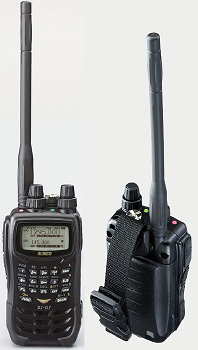
The equivalent of a normal 2m 'rubber-ducky' antenna when built for 2200m would be over 600' tall, while one designed for 630m would be around 170' high! A 2" stub used on your 2m hand-held would be the same as a 56' vertical on 630m. Consequently, most LF / MF backyard antennas will realize efficiencies of less than 1% and likely, quite a bit less.
In order to reach the maximum radiated power levels allowed usually requires several hundreds of watts, especially on 2200m, where near kilowatt levels are needed. These small radiated power levels might seem discouraging but they don't account for radio's great equalizer ... propagation. More than anything else, RF loves to radiate, and at times, what can be achieved on these bands with such low effective radiated powers is stunning
It would seem that Industry Canada did us no favors when they stipulated LF / MF power levels to be measured in EIRP and not the, much easier to calculate, DC power input level ... or perhaps they did. I think that, unlike on HF, imposing EIRP rather than DC input power limits puts everyone on an even playing field. Amateurs with lots of real estate and room for a larger, more efficient LF antenna, will be required to run much less power to reach the allowable EIRP and 'stay legal', compared to someone with a small backyard in the suburbs ... the latter can legally generate the higher level of DC input power required to reach the EIRP limits since their smaller antenna is operating at less efficiency. However, determining EIRP is not as cut and dried as measuring input power.
With some fairly sophisticated (ie. expensive) field strength measuring equipment, not typically found in amateur radio operations, ERP / EIRP can be readily determined. This means that for most amateurs, alternate methods must be used.
Neil, WØYSE in Vancouver, Washington, who runs an experimental 630m station under the call of WG2XSV, has produced an excellent treatise on calculating your station's EIRP level, providing a step-by-step procedure to follow.
In order to determine your ERP / EIRP, you must first determine your antenna's radiation resistance. Two methods of calculating the antenna's radiation resistance for both verticals and top-loaded verticals (inverted L's or T's) are demonstrated, using the physical size of the antenna in relation to the frequency of operation. Once this value is known, the antenna current is measured while transmitting. These two values allow the Total Radiated Power (TRP) to be calculated. The TRP is then multiplied by 3 to yield the EIRP or by 1.82 for ERP. Roughly speaking, 5W EIRP is the equivalent of 3W ERP. Thanks to Neil for this helpful resource.
An alternate method of roughly determining ERP / EIRP values is an interesting new online 'antenna simulator' at the 472kHz.org site. Using known physical sizes along with your ground quality description, the calculator will indicate what total power output is required to produce various levels of ERP and EIRP as well as expected antenna currents, at 472kHz. It's a good starting point if you are either planning a new antenna system or perhaps, repurposing an HF antenna such as an 80m inverted-L or an HF center-fed dipole for use on 630m.
Neil has also sent the following comments that will be of interest to those planning a sloping-wire tophat:
Hi Steve,
I'm sure there will be a lot more information and discussion about this topic once the LF and MF bands are released in the U.S.A. but in the meantime, calculating your ERP / EIRP levels is not as hard as it might initially seem ... and is likely accurate enough for most agencies overseeing amateur radio activities.













