Author Archive
 Listening to Moonbounce on 1296MHz with your browser
 January 16th, 2011 |
  Author:
 I noticed today that the PI9CAM group who use a huge 25m diameter dish for 1296MHz moonbounce would be active. The great thing about these guys is that you can listen to their receiver using a WEBSDR receiver at http://websdr.camras.nl:8901/
I took a very quick video – which isn’t great quality, but you’ll hear PI9CAM working a JA station. Remember the signals are bounced off the moon – a round trip around around 500,000 miles! You get a demonstration of the speed that radio signals travel at (the speed of light!) by listening to the echo from PI9CAM. You’ll hear him stop transmitting and then after a pause, you’ll hear the echo as it comes back from the moon.
A lot of EME takes place using the WSJT modes, but the contact on the video is in SSB – testament to the great equipment in use at PI9CAM! As I write this, I’m listening to LX1DB on SSB too – so I highly recommend you have a listen next time the group is active – check their webpage for details.

Monitoring the Graves transmitter (143.049) using the Easygram software
Since I discovered the Graves transmitter on 143.049 a week or so ago, I have been listening quite a lot. There are plenty of meteor reflections to listen to and it’s also interesting to note that there are some weak but steady signals audible in addition to the meteor reflections. My guess is that these are reflections from aircraft – after all there are plenty in the air between here and Dijon.
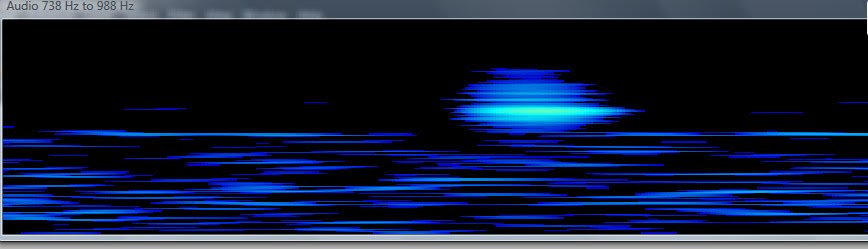
Today, I installed the Easygram software on my laptop. I have used this software previously for beacon monitoring and other analysis. I quickly configured up the software and was able to see consistent traces from the transmitter. I can’t see any evidence of Doppler shift on the ‘steady, constant’ signal, which I would expect to see if an aircraft was involved – so perhaps it is tropo after all (Having said all of that, I am listening to the transmitter whilst writing this, and I can distinctly hear aircraft scatter on it!).
Here’s an example of an image from Easygram which shows a meteor ping from the transmitter. If you look closely at the image, there is a faint trace line towards the centre of the screen – this is the weak, steady signal, probably the tropo signal from the transmitter.
Here is the location of the transmitter shown on Google Maps

How WW2R does WSPR
I’ve known Dave Robinson, WW2R/G4FRE for very many years. He’s one of the most enthusiastic and innovative radio amateurs I know. Talking to Dave is to be inspired about some project or another.
I was just looking on Dave’s website to catch up on something completely unrelated to this post, when I found Dave’s page on how he tackled operating on 7 and 10MHz WSPR with a homebrew station. I’m sure you’ll find it as fascinating as I did.
» Read about WW2R’s WSPR station

Tracking the ISS
Perhaps like me, you enjoy watching the International Space Station pass overhead. It’s wonderful to see – a testament to humankind’s ingenuity. If you look carefully, even with the naked eye you can discern the shape of the massive solar panels that look like ‘wings’ on the side of the spacecraft.
As radio amateurs, we can listen for radio operation from space. Voice contacts have been heard over the last few days, so you may want to listen on 145.800MHz when the spacecraft is in range.
When is it in range? I just noticed this handy Google ‘Gadget’ which shows when the ISS is passing over a particular area!

Interesting Meteor Scatter article – Geminids 2010
Through a link on the Southgate Amateur Radio blog, I found an interesting article written by Dr David Knight of the Norman Lockyer Observatory radio club at Sidmouth. The article details experiments that David performed during the Geminids meteor shower in December 2010 on a frequency close to 144MHz.
David monitors a high-power transmitter close to the Alps on 143.049.
I’m very interested to read about this transmitter and of David’s experiments. It sounds as if the transmitter he uses could be a useful propagation monitor for me. I’ll have a listen and see what can be heard in ‘flat conditions’.
Have a read of David’s paper here
One trace is annotated with a suggestion that the reflected signal is from a satellite in low earth orbit. I was intrigued by this. I’ve heard many reflections from meteors and of course aircraft. I wonder if a satellite or the ISS could reflect sufficient signal?

What do I want to achieve in amateur radio this year?
At the beginning of each year I always think it’s fun to try and set some goals for the year. Sometimes I find my focus changes and I end up not doing them, but it’s always interesting to look back on
Here’s what I’m thinking of at the moment:
1 – Activity. Try to maintain my rule of calling CQ each day on one band or another and to let no CQ call go unsanswered – even if it’s just a quick hello.
2 – 70MHz. I seem to have spent more time on 70MHz than ever before in the last year. I’m currently enjoying 70MHz FM, but I hope to focus on CW/SSB during the Sporadic E season. Although the FT847 gives me some CW/SSB capability at low power and a poor receiver. I want to improve on that. It may involve a transverter driven from the FT817, or perhaps modifying the FT847. Keen to do *SOMETHING* to improve what I can hear on 70MHz.
3 – 50/144/432MHz. I’m keen to install a collinear antenna for these three bands. The intention is to erect a small mast on the house which will also support a TV antenna for the boys’ TV. On top of the mast can go a collinear for 50/144/432 MHz. I’m hoping that I can use this antenna for Sporadic E on 50MHz as well as regular FM operation on 144 and 432MHz. Currently I have no vertically polarised antenna for 144 and 432MHz and it would be useful to be able to scan the FM channels to monitor propagation more closely, as the repeater channels very often show hints of openings before there is adequate activity on SSB.
4 – 1296MHz. I’m getting more intrigued by 1296MHz and would like to get some sort of capability on the band in the year. Not sure whether this may just be simple 1296MHz FM from a handheld or something else. We’ll see. I can do so simple 1297MHz receive using a scanner, so it will be interesting to see if that yields any results.

ZS6DJM’s modified FT897 including 70MHz transverter
I was just chatting to Dave, G4AQK on 70MHz and he mentioned that he’d seen a video on YouTube showing how ZS6DJM had modified an FT897 to include a Spectrum 70MHz transverter.
Interesting! The transverter is located in the battery compartment and a switch has been added to the top of the rig to switch the transverter on and off. Very neat














