Author Archive
 GB3WGI transatlantic beacon update
 July 12th, 2012 |
  Author:
 Great to hear from John, G4BAO today regarding the new beacon which is planned for installation in Northern Ireland to facilitate research into the transatlantic path on 144MHz.
John says, ‘Over in the US, Brian, WA1ZMS, is making the final preparations to ship the beacon transmitter over to Northern Ireland.
Thanks to the kind donation of antenna parts and clamps from G4CQM at Powabeam Antennas, beacon keeper, Gordon GI6ATZ, is in the process of building the antenna system for the beacon, and installing the emergency shutdown system.
We are aiming to have the beacon up and running before the year end.’

RTLSDR help? RTL2838U and SDR?
Buyer beware! David, G4ASR reports that he ordered the same USB stick using the details in my previous post and when he installed his device, it shows up as an RTLSDR/RTL2838U which SDRSHARP does not recognise. We can see some references to this chip working under Linux, but not under Windows.
Does anyone know if this can be made to work with SDRSHARP or indeed any other SDR software working under Windows?

First results with the £13 SDR
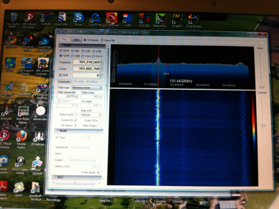
The digital TV card arrived yesterday and of course, I couldn’t resist getting it going straight away. I followed Richard, G4WFR’s instructions and all went very well. There was a slight issue getting the USB driver installed with ZADIG.EXE. The problem wasn’t the program but no doubt my VISTA laptop! Anyway, after an initial failure to install the driver, I rebooted the laptop, tried again and it all worked well.
The first experiments have just been using an internal antenna. However, I’ve been able to receive a number of Band II FM stations, some in stereo, my own transmissions on 70, 144 and 432MHz on a variety of modes as well as some aircraft on AM around 120MHz and weather stations in the 433MHz band.
What I need to do is to pop into Maplins, hopefully tomorrow lunchtime and grab some plugs to make up an adapter, so I can plug the various external antennas into the receiver. I’m hoping we’ll see some good results.

Six days off – fun with sporadic E on 50 and 70MHz
Last Tuesday I decided I’d had enough! Well not quite, but I did feel the need for some holiday. I booked last Thursday, Friday and this Monday and Tuesday off, to try and climb some hills and sit by rivers. I’ve managed both of those and feel a little more human again. I don’t suppose it will last when I go back to work, but what can you do….
Anyway, a real pleasure has been to spend some time keeping an eye on 50 and 70MHz and trying to work some Es QSOs. It’s worked out quite well. There haven’t been huge openings with lots of QSOs, but I have been content to keep a close eye on the bands and try and work people as they come up – even if it’s only for a few minutes. Very satisfying and great fun.
The new 70MHz transverter is working out well – I’m delighted with what I’ve been able to work. Over the last few days I’ve worked IW4BIF, IS0AWZ, EA1KV, OM3CLS, TF3ML, SP3RNZ, SP9HWY, SP2FH, IK7LMX, ES1CW and 9A2006R. A gotaway was SV8CS who I heard weakly, but propagation wasn’t quite right – interestingly the SV8FOUR beacon was louder than Spiros, who has a great station, so the heavens were just not quite aligned!
50MHz has been good fun too, with plenty of ‘bread and butter’ contacts of interest including ZB2EO, EA6BB, TF/VE3IKV, TF8GX, 1A0C with a couple of very welcome North American contacts today; W1MU and N3DB. Always a thrill to work the US on six with the vertical antenna – which really isn’t built for DX,
Back to work tomorrow.

An APRS handheld to play with….a look at the Kenwood TH-D72E
A few weeks ago, I mentioned when I was talking about how you couldn’t really have too many handheld radios, I said that I would like to have a play with one of the GPS equipped, APRS handhelds. I didn’t say so at the time, but very shortly after that, I did have that chance!
I was doing some work on some APRS equipment for a review for Practical Wireless that you’ll be seeing soon in the magazine. However, along with what I was reviewing, David Wilkins G5HY of Kenwood Electronics very kindly popped a TH-D72E into the box of gear to look at. David said it was partly a safety net to be sure that I could do some full tests on the other equipment, but very kindly that he’d also seen my blog!
Well! I can now admit that the TH-D72E was the very first thing unboxed! It’s a nicely sized handheld and I found it easy to use. I used it mostly in its’ APRS capacity, although I did play around a little with it as a regular handheld and used it through the GB3UK repeater on Cleeve Hill. That worked fine and I found I was able to get a good solid signal into the repeater at 5W.
What I was really intrigued about was whether the MB7UC APRS digipeater on Cleeve Hill on 144.800 would hear my packets. I was pleased to find that the GPS locked up pretty quickly and established my position, even inside, though some times it would take a minute or more which was no big deal. I set the beacon so that it would be transmitted once every half hour (that felt right for this experiment).I left the handheld on the upstairs windowsill that ‘sees’ towards Cleeve Hill. Although I received the odd packet from MB7UC and it received the odd packet from me, there was not much. This illustrated the difference between a handheld antenna and having a collinear at 30 feet – on which the digipeater is very loud indeed.
I took the TH-D72E over to Cheltenham when visiting my Mum and was excited to get lots of packets through the handheld, digipeated through MB7UC including some from a Search and Rescue boat in the Severn Estuary! Very cool! And of course, being closer to the digipeater it happily heard my APRS packets and digipeated them.
How could I make it better from home and get a bit more coverage? Well, I then setup the Kenwood TM-D710E which I had as part of the review work as a digipeater and connected it up to the collinear. Now when I went out for a walk with the TH-D72E and it sent an APRS packet, the digipeater at home would repeat it and it could then be heard by the digipeater on Cleeve Hill – and a couple of others too! It was good to hear the satisfying beep of the handheld as it saw My Position being digipeated through other APRS digipeaters. Fun to come back and look on APRS.FI and see where I had been!
The Smart Beaconing feature on the TH-D72E was good and sent a beacon at appropriate intervals depending on how fast I was moving (on foot or on the bike – don’t worry, David – it was a mountain bike – not a motorbike!).
Lots of fun! The only thing that was slightly disappointing was the lack of a good APRS digipeater in this area – which would make the experience even better! But that’s hardly the fault of the TH-D72E! I also experimented with sending messages to and from other APRS stations which was good – and even sent a message to my pal Steve, WG0AT in Colorado – and his goats, Peanut and Rooster of course!
Battery life was pretty good, although not as good as some of my other handhelds. It was in line with the manual though and I think the reason for the relatively short time (between 5 and 10 hours between charges when APRS beaconing) was not only the regular beacon, but also the GPS which are pretty notorious for sapping battery life (the iPhone comes to mind!).
The TH-D72E is a ‘substantial purchase’ at over £400 – but there is a lot of additional technology compared to a more standard handheld – the packet TNC and the GPS all built into a small package that will easily fit in your pocket. This is surely how the mainstream manufacturers can compete, by putting extra value technology such as APRS/GPS or Digital modes like DSTAR – into their products. At £400 you really have to want to play APRS and have a nice GPS on your radio – but I can certainly recommend the TH-D72E – I thoroughly enjoyed playing with it and I’m sorry to have to give it back! Thank you, David!
Now what should I casually mention that I’d like to play with next……

Software Defined Radio receiver for £13? Why yes, I will?
I’d been peripherally aware for a few weeks that some people had been doing clever things turning USB TV sticks into Software Defined Radios, but other than mentally noting it as something to look into when I got a moment, I’d done no more.
The critical moment came this afternoon when Richard G4WFR tweeted that he’d been having some fun over the weekend with one of the sticks. I quickly asked him which USB stick he’d used, which he told me was a Newsky TV DVB stick (eBay number 110898287043). The critical thing is that the USB stick must have the RTL2832U chip & E4000 tuner in it. Managed to order one of those sticks for £13 including postage, so I’m looking forward to it arriving.
Richard is using the SDRSharp (SDR#) software which can be downloaded at http://www.sdrsharp.com/index.php/downloads – although I think I have seen people using other software. Richard mentions that a special driver for the USB stick is required, which can be downloaded from this site, rather than the supplier USB driver.
Richard mentions that he is getting coverage between about 60MHz and 1.7GHz with useful sensitivity. If I can do the same, I’ll be happy. Once it arrives, I’ll have a go at hooking it up and see what mischief I can get up to with it.
More soon.
Richard G4WFR has just put together some notes on his experiments so far, which look very useful

Portable on White Horse Hill (Simplex DSTAR QSOs)
In the middle of last week, I thought it would be nice to have some time off, climb some hills and sit by some rivers. These sorts of places help me to relax.
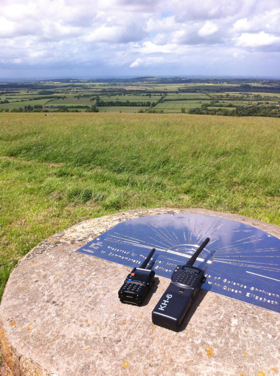
Yesterday, I went up White Horse Hill which is located on the Ridgeway and about 10 miles or so south east of Swindon or around 12 miles from here. I took the UV-5R and also the Palstar KH-6 50MHz portable. Sadly nothing was heard on the KH-6. I think without a proper 50MHz antenna it is rather deaf! A few CQ calls on 145MHz didn’t yield any contacts although I heard GB6AFD a special station for Armed Forces Day in Nuneaton, an M6 in Frankley (Birmingham) and a GW6 who was on a hilltop – sadly I couldn’t attract his attention before he packed up and went home!
On 433MHz though, I called CQ on 433.500 and was surprised to be called by Stewart G0LGS in Cheltenham. We had a nice QSO although being a blustery day, I could not face the correct direction and avoid wind noise! Once I’d worked Stewart I signed and tuned around a little and came across Des G0RBD in Chippenham. We were able to have a QSO. Des asked if I had my D-STAR radio as he wondered if it would be possible to work. I didn’t have it, but promised that if I had the chance to go up the hill the next day (Sunday) then I would.
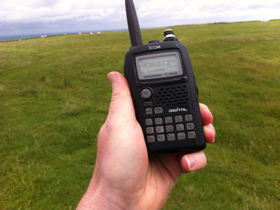
I got my jobs out of the way and set off for the hill around 1115 this morning. As I was driving to the hill, I spoke with Des on GB3TD our local 433MHz repeater. I parked up and started to climb the hill. I quickly heard Des calling CQ on 144.6125 the DSTAR simplex frequency. I responded straight away but he didn’t seem to copy. I was conscious that he was running more power than me, so to get a better signal I needed more height!
Once I had climbed about 30 feet or so, Des started to hear me with some digital breakup (R2D2). We exchanged reports but I kept climbing. As I approached the ramparts of Uffington Castle Des report that my signal was solid with no breakup. Once I got to the very top, Des was end stop and he reported me as S6-7. Signals were good enough that we thought we would try 430MHz. Des called me on 438.6125 the DSTAR simplex frequency. Signals were excellent and perhaps a little stronger than on 144MHz. We then thought we would reduce power. I could hear Des with solid signals with him running the lowest power his IC9100 would go, around 2W and he was able to hear me with just a little R2D2 on the SuperLow setting on the E92.
Fascinating results and we are now keen to try over some longer paths on DSTAR and see what we can do. Thanks Des for the suggestion and a lot of fun!
Before coming down the hill, I tried a CQ on 145.500 FM and was called by Paul G6UAJ in West Swindon. We had an interesting QSO and Paul mentioned that he was returning to the hobby after about a 12 year break. His prime interest is microwaves and in particular 10 and 24GHz. I promised I would try and put him in touch with people active on the higher bands.
A nice couple of portable sessions and it was great to watch the views across the valley and the rainclouds scurrying by to the north.














