Author Archive
 QRP HF portable with the FT817 and MP-1 antenna
 July 28th, 2012 |
  Author: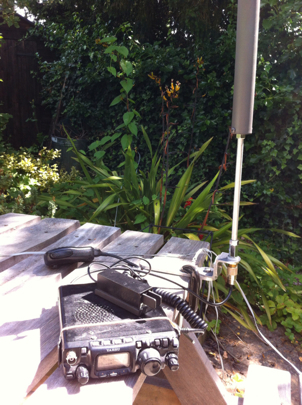
When I’m out and about, I often pop the FT-817 and a couple of antennas in a bag. For 50MHz, I use the ATX-Walkabout antenna, although I noticed today that the SWR is a bit high on the band and I’m not sure why. It’s usable though, particularly if there is Es around.
The other antenna I use quite a bit is the MP-1 antenna. I use it with the FT-817, mostly on CW from 7MHz up to 28MHz. I mentioned on Twitter this morning that I used it and immediately got a couple of ‘what do you think of the MP-1’ comments, seemingly with the subtext of ‘I have one but I don’t get on with it’.
I’m sure a dipole would work better but the MP-1 is very convenient and goes together quickly and seems to me to perform well. It’s essentially a ‘screwdriver’ style antenna. I’ve had my MP-1 for around 10 years now and perhaps the connection onto the coil is not so great now. I sometimes have to fiddle with it a bit to get a good connection, but it’s easily sorted. On 7 MHz with the ribbon radials, it’s quite tricky to tune up, but once you get it into the zone, it’s fine. I worked MM0CPS/P on Tiree this morning running 3W CW to the MP-1. On the higher bands, tuning is easy.
I don’t have the tripod kit, so I usually clamp the antenna to a bench or table. There’s usually something around. I keep meaning to try a photographic tripod, but haven’t checked the fittings yet to see if they are compatible.
The FT-817 is quite heavy on batteries, so if I plan to operate for more than a half our or so, I use my Pentaflex power station (high capacity 12v supply). This is very useful which I actually got to power my telescope, but use it more often for radio and other purposes. I did notice that the PSU made a bit of interference on 28MHz, but moving the PSU away from the antenna solved that.
As I’ve reflected before, contacts with this sort of equipment feels more of an achievement than with bigger equipment and is, therefore, more satisfying I think.
Happy portable operating!

How the £13 SDR project became the £26 SDR project
I mentioned that I had a suspicion that I’d blown the first SDR dongle up as it wasn’t hearing much. I ordered another one last weekend and it arrived in mid week. Certainly the new one is behaving much better! No handhelds or across the shack transmissions have been made with the SDR on – just in case! I have connected the dongle up to the 50/144/432MHz collinear using the adapter I built last weekend and it seems to be working fine. I’ve heard GB3WH and plenty of stuff on airband including aircraft, ground and ACARS. On airband – the panadapter approach was excellent for determining the frequencies to listen to. The most fun I ever had with a scanner was with my old Yaesu FRG9600 with Ray Withers HF mods when I lived back in Cheltenham. Heard loads on that thing. I think the SDR dongle is easily the most cost effective scanner I have ever had. Wondering if I can use the dongle to decode ADS-B on 1090MHz. I can see some software to do it running under Linux. But I really don’t want to go there! I have to play enough computers at work – at home I want computing to be as simple as possible! Yes, I could make Linux work, but….

Anyone for 10m AM?
By way of something different, I listened to AM CB on the way home. It’s always interesting to hear signals fading up and down and to work out where they’re from. This, for me, is all about DXing – regardless of band or mode.
I’m not sure I have ever listened to AM before – at least narrowband AM! What great quality – almost melodious.
So, does anyone operate 29MHz AM? It could be fun 🙂

Map your grid squares worked using WG7J Gridmapper
Somewhere over the last few days, I saw something somewhere about the WG7J GridMapper and how you can use it to map the locator squares (grids) that you’ve worked.

No software to install, it’s a webpage (http://wg7j.reinalda.net/gridmapper/gridmapper.php).
All you need to do is to use your logging program to create an ADIF file of your contacts and then you can use the WG7J GridMapper to create some nice maps. You can select the band you want to map – in my case I chose 50MHz since 1st January (I limited the date range in my logging program) – change the appearance of the map and decide whether to send the output to Google Maps – or if you have Google Earth – you can produce a KML extract that Google Earth will read. I tried both. The Google Maps is the first one to play with.
I liked the output to KML option better, but you have to download the file that the page produces and open it in Google Earth – easy enough if you are confident with Google Earth, KML and so on.


My first auroral QSOs in about 15 years
For one reason or another, I’ve not heard an aurora for ages! Being in the south of the country with fairly little aerials means that it’s not a particularly productive propagation mode for me. However, if a big one comes along and I hear something….
Like this afternoon! I knew there was an aurora going on – but hadn’t really worried about it much. I tuned across 144MHz and to my surprise there were some auroral signals. GM4BYF was loudest and I was delighted to work him. Other G stations were heard tone-A including G0CUZ, G7RAU and G3LTF none of whom are very far from me! Missed Clive GM4VVX who it would have been nice to work. GM0HTT on Orkney was a decent signal on SSB, but had quite a pileip, so I didn’t get involved.
I heard GM3WUX weakly on 50MHz also, but he didn’t come back to a couple of calls. An hour or two later, I tuned across 50MHz and found PA2M calling CQ with an Auroral tone. Despite my little signal from the vertical – not ideal for an Auroral QSO – we completed the QSO. Good ears, Frank – thank you!
I wonder if the Aurora will be visible this evening.

Mixed SDR news!
The bits to make up the adapter between the the SDR dongle and the external antennas here were all in place by Friday evening, so I did a hasty bit of construction on Saturday morning. Tested the adapter and it was fine. Unfortunately though, hooking up the SDR to the external antenna revealed very little activity. I have a feeling that in some of my tests, transmitting physically close to the dongle, I’ve blown the front end up! Ooops!
However, great to hear from David G4ASR who has been getting on really well with his. He hooked the SDR up during yesterday’s excellent Es opening on 70MHz and was hearing a number of stations including an Estonian on FM. It’s working well on 144MHz too and Dave was getting good results from the GB3VHF beacon. Sean, G4UCJ was also doing well with his and receiving stations on 70MHz – including the wideband FM which was very strong yesterday. Dave reckoned that his dongle was about 7KHz off ‘calibration’ on 70MHz. I found mine was about 20KHz off at 145MHz. You can cope with this using the ‘shift’ feature in SDRSharp.
Given that it’s only £11, I’ve ordered another dongle and hopefully that will behave better if I don’t transmit close by!

SDR results update
The initial results on the SDR are good – I’ve used the setup on an internal antenna and it’s received Band II FM stations, my own transmissions on 70, 144 and 432MHz as well as aircraft and various ‘utility’ transmissions around 433MHz.
I’m just awaiting some hardware to arrive so that I can connect the receiver up to the external antennas such as the triband vertical for 50/144/432MHz and see what I can hear.
You may have seen a post indicating that Dave, G4ASR had some problems with his dongle showing up as a different device. Happily that has been resolved – Dave took the IT professional’s approach, deleted all the files, started again and it worked fine. And no, I’m not being sarcastic! Glad it worked – I was feeling guilty that it hadn’t been straightforward.














