Author Archive
 Max says it’s time to look at 50MHz again
 May 6th, 2013 |
  Author: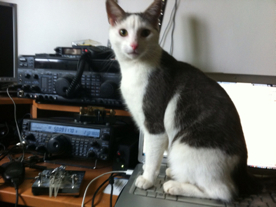
The 50MHz and higher Es season seems to have taken a while to get started this year. For the last week or so, there have been some openings, but I’ve missed them.
This weekend, I’ve at least managed a couple of contacts. The first, yesterday, with Max the cat’s help was a local one; M0RSE. A special call to promote morse code operated by members of FOC. Yesterday afternoon and evening there was some Es, but I didn’t get on until later. I was pleased to work CT1BXT for my first Es of the year.
You may remember that MW0IAN very kindly gave me a portable whip to work with the Palstar 50MHz handheld. It occurred to me this morning that it should work very well with the FT817, so I will try that on bike portable expeditions this summer. Thanks Ian!
A new dual band multimode radio for 50 and 70MHz: Noble Radio NR6N4
Earlier in the week, via the Southgate Amateur Radio feed, I saw details of a rig I’d heard rumoured for some time – a dual band 50 and 70MHz multimode. The manufacturer is a new name, Noble Radio.

Technical specs, provided by the Noble Radio website are as follows:
1. RECEIVER SPECIFICATIONS
Frequency Coverage: 4M: 69.9 MHz to 70.5 MHz
6M: 50.0 MHz to 52.0 MHz
Modes: SSB (USB & LSB) and CW
Circuit Type:
Downconverting Design
Dual Converesion: 1st IF: 10.7 MHz 2nd IF: 25 kHz
Sideband elimination using phasing techniques with digitally generated Quadrature carriers and Image Reject Mixers preceeded by 15 kHz crystal roofing filters
Ultimate receiver bandwidth set by adjustable SCAF filters (two 8th order filters used. One for High Cut and one for Low cut)
Sensitivity: MDS = -130 dbm
Dynamic Range Figures:
Blocking: 110 db
IMD (3rd Order) = 95 db
Selectivity:
500 Hz to 4 kHz adjustable with the SCAF filters
Ultimate attenuation of filters are 55db or better
2. TRANSMITTER SPECIFICATIONS
Frequency Coverage: 4M: 69.9 MHz to 70.5 MHz
6M: 50.0 MHz to 52.0 MHz
Modes: SSB (USB & LSB) and CW
OUTPUT POWER: 20 Watts CW or PEP SSB
SCAF Filters can be used to tailor SSB Transmit audio.
3. GENERAL SPECIFICATIONS
SYNTHESIZER: DDS/PLL synthesizer with 10 Hz minimum step size. Tuning rate is variable depending on the Tuning Knob speed (Variable Speed Tuning – VST)
MEMORIES: 10 Memories per band
ANTENNA IMPEDANCE: 50 ohms unbalanced
SUPPLY VOLTAGE: 11.5 to 14 Volts Regulated DC (Negative Ground) at approximately 3.6 Amps at full output power.
DIMENSIONS: 8 in (203 mm)W x 12 in (305 mm) D- including knob and heatsink x 3.75 in (95 mm) H – including feet
WEIGHT: Approximately 4 lbs (1.8 kg)
4. SPECIAL FEATURES
The NR-6N4 has the capability of being controlled by a standard PC type keyboard that plugs into a rear connector. Once a keyboard is interfaced to the radio, it can be used to directly enter a frequency, skip directly to various functions by a single press of a function key without having to navigate the menus from the front panel buttons as well as being used to send CW via the keyboard. There is also a built in keyer function that operates with a standard keyer paddle for CW operation with or without a keyboard connection.
The low level 10.7 MHz IF signal is also brought out to a rear connector so that it may be used for panadapter or SDR applications.
* All specifications in this document may be subject to change without notice or obligation
No details of availability are provided as yet – no doubt the CE approval hoops will have to be jumped through.
This is sure to be a popular rig. A commercial 70MHz multimode has been long awaited. The fact that it is a dual bander including 50MHz will no doubt add interest, although I guess the majority of people that want 50MHz radios probably have one. Is the power level right? 20W is certainly useful – though 50W would be better still for tropo contacts, I feel. Hopefully datamodes interfacing (JT65A/JT6M/JT9 etc) will be straightforward – I haven’t yet seen a photo of the back of the rig!
Exciting news for 50 and 70MHz enthusiasts!
JT9 and the FT817
It occurred to me the other evening that it might be fun to get the FT817 going on JT9. Many of my QSOs using the FT847 have been made using 5 watts or so, really there shouldn’t be much difference.
It was a case of ordering an interface lead from my G4ZLP interface unit to the data socket on the FT817 which was a modest amount.
After the lead arrived today, I connected it up and the rig would switch to transmit, but the tones were not transmitted. I soon found that I had to change menu 26 on the 817 to User-U from the default. Also in menu 38 on the rig, I turned off the filtering.
That was all that was required. I tried a test transmission from the FT817 and monitored it on the 847 – it sounded good. I’ve already some JT9 QSOs in the log and the 5W signal has been heard in North America.
JT9 and the FT817 ought to be a very good combination indeed.
Life of my PI and low budget SDR experiments: presentation slides
Back at the end of last year, Malcolm G8NRP, secretary of the Harwell Amateur Radio club asked me if I’d be willing to give a talk there. Of course, I said, but at the time I had no idea what I might speak about it. Of course, it didn’t get much more brain time until a few weeks ago when Malcolm contacted me again…
“Did you decide what you were going to talk about -as we need to put it into GB2RS news”! Ah…
So, a quick decision was needed. I’d been playing with my Raspberry Pi computer a lot at the time and also with the USB receiver dongle for SDR applications. I thought I could probably put together a talk along those lines.
Earlier this month I gave the talk. I think it was ok. I think I was better on the SDR stuff than the Pi stuff, but anyway, it seemed to go down ok.
I promised the Harwell club a link to the slides which is here
As ever, I’d do it slightly differently next time!
Hints of Sporadic E and a QSO with a Ham Radio Hero!
Over the last few days there’s been a sense that a few Es openings have taken place. Last Saturday, some people caught an opening on 50MHz, but there was nothing here. It’s always nice to get the first 50MHz Es opening of the year in the log – a feeling that Summer is on the way!
This evening when I got back to the car at Didcot, I popped the 28MHz rig on and had a scan around. The EA4Q beacon from Madrid was coming through nicely and down on 27MHz, there were Spanish CBers coming in.
Changing the subject, last night I was on 14MHz JT9, using the WSJT-X program (which has become a firm favourite here). I was really delighted to work the Father of WSJT, WSPR and WSJT-X, Joe Taylor K1JT. Joe’s software is in virtually constant use here, so it was a pleasure and an honour to work him for the first time in a two way contact. Joe’s definitely one of my Ham Radio Heroes!
EME with the washing line – maybe?
A few weeks ago, Julie bought a new rotary washing line. Our old one was almost 10 years old and had seen better days. At the time I eyed it up and decided it ought to be good for making into some sort of antenna, although I didn’t work out quite what – so I stored it down at the bottom of the garden.
When this month’s Practical Wireless arrived through the door, I laughed. For there in Bob G3NRT’s Antenna Workshop was the tale of how he’d turned a rotary washing line into an antenna support – and another one into an antenna.
Well, after I’d finished some of my garden work today I decided to take Bob’s lead and fashion it into a tripod. It’s nice to be able to try out antennas in the back garden without too much hassle and I’d always fancied having a tripod.
And here it is!
.JPG)
EME with the washing line? Maybe not yet, but I have an idea….!!
JT9 first impressions
Since the breakthrough last week in getting WSJT-X to work by switching the output audio device to ‘Direct-X’ I have been quite active on the mode, mostly on 14MHz. Incidentally, it appears that the ‘Direct-X’ isn’t necessary for all systems. Dave G4FRE reported that it worked fine without for him – I’m guessing it is something specific to my configuration.
Results so far have been good and I have been amazed to receive reports from the other side of the world at the 5W power level or less. Last night, was a nice example – as I worked K0KC and W8BB at around 2130z, it was great to get a report from VK2AJF via the PSK Reporter website.
The new WSJT-X release has a pleasing interface – I like the way Band Activity is split out from the details of the QSO you are having.
This is a good mode and overtime I can see activity switching from JT65 to JT9-1.













