Author Archive
 An interesting week at G4VXE (VHF Tropo, RTTY and Bad DVAP Data)
 September 30th, 2013 |
  Author:
 In my last post, the week had started well with some good tropo. That continued on Tuesday, when rather splendidly, I was able to work from home. Although I was busy, I was able to keep an ear on things. Around lunchtime, I just flicked up the volume on 432.200 which had been pretty quiet as I saw the meter flicker. I only caught the tail end and waited….
It was OE2CAL calling CQ at around S7! He worked a GW and I called and was very pleased to be able to make a QSO at around 1120km. Not bad at all. Signals dropped with me just after I worked him, although I suspect he turned his beam. I continued to hear him at good strength throughout the afternoon, sometimes stronger, sometimes weaker. On the vertical, I was hearing the DB0FT repeater on 145MHz from JO40 – not a bad distance.
Later in the week and over the weekend, tropo conditions were still good – although not over such great distances. I was able to work through an ON repeater on 145.6875 on Saturday and on Sunday morning, I had a nice simplex QSO with Ken, G3UDA in Shropshire.
With the CQWW RTTY contest over the weekend, any thought of JT65 or JT9 was off! No matter, I looked to see what RTTY signals were coming through on 28MHz.. Nothing amazing, but logged a few US, Asian and African stations. High power (100W) RTTY feels pretty unsubtle compared to JT65 and JT9 – but very different beasts, I suppose. It was nice to use PZTLog on RTTY for a change.
I also played a little on DSTAR, naturally whilst I was in the garden on Sunday morning, when it’s nice to listen to what’s coming through and have the odd QSO whilst working in the garden and the henhouse. The Raspberry Pi/DVAP combination works well, although I sometimes see an issue when I boot up, with the DVAPNode software reporting Bad DVAP Data and then resynchronising DVAP Stream. This seems to leave the CPU at 100% and so far, I’ve rebooted and it generally comes up ok next time. Not always and on Saturday it took a couple of goes. I’ll have to see if I can avoid rebooting and work out what process I have to kill and then restart. Nice QSO with Wis, YB0AZ from Jakarta, who told me there were two DSTAR users on his repeater in Jakarta. Him and his wife!
Finally, two of my favourite amateur radio bloggers are missing at the moment. Julian, G4ILO is taking a bit of a break on health grounds, as is Roger G3XBM who is also not well. Wishing you both the very best – hope to see you writing again very soon – I miss what you do.
TV-SHARP Analogue TV with an RTLSDR dongle
It’s always nice to find a new website where someone’s interested in the same sorts of things that you’re interested in. Yesterday, I saw a tweet go by, linking to Ivo, I6IBE’s site– where he was recovering DSTAR text data using a program and a RTLSDR dongle. I haven’t tried that yet.
However, looking around Ivo’s site, which is in his mother tongue, Italian I found lots of interesting things. Unfortunately, my Italian is very basic, so I was pleased to use the auto translate features of Chrome to turn the site into English. It’s a real joy of the internet that language ceases to be a barrier, in a context like this.
I was intrigued by a posting about TV-SHARP which is a program based on ADSBSharp, to be used with an RTLSDR dongle, which will decode PAL and NTSC TV signals. Note that the program only works with Analogue TV signals.
I was interested in the program for a couple of reasons. Firstly, during the Es season, it should be possible to use the program to receive any Band I TV that is still around. Secondly, if you are in range of an amateur TV repeater, it can be used to receive those signals.

Because the RTLSDR dongle can only deal with a 2Mb bandwidth, you cannot receive full colour signals, but it appears that you can receive black and white signals. You can see some example’s on I6IBE’s site.
The closest ATV repeater to me here appears to be on Dunstable Downs. I am not sure how well at 50/144/432MHz collinear will work on 1318MHz! I will give it a go though. If anyone else is in range of a ATV repeater and feels like trying this, I’ll be interested to hear how you get on.
You can download TV-Sharp here
Autumn tropo
On the first day of autumn, we were treated to some nice VHF/UHF tropo. I was alerted to it on Twitter, by Rob, MW0DNK saying that he was going portable and then later on, saying that he had worked some nice DX from Anglesey on 144/432MHz.
Driving home from the station, on 145.650, when GB3WH was not transmitting, I heard a French repeater in Limoges, JN05. Not bad, considering I was only using the Moonraker MD-7400 antenna in 1/4 wave configuration.
Once I was home, I had a quick look on 432MHz and heard John G3WZT calling CQ on CW on 432.200. To my surprise, I was able to hear DL5MAE come back to him. I waited for the QSO to finish and then called DL5MAE a couple of khz higher than their QSO frequency. Often this doesn’t work, but this time it did! I was thrilled to work Wolfgang, who was one of my 144MHz meteor scatter pals back in the 1980s – a nice distance to JN58.
Other stations popped up on 432Mhz during the evening, a couple of DLs, LX1DB, who I didn’t manage to work and French station in JN27. Closer to home I worked F5MFO in JN19, also on CW.
I’m not on 144MHz CW.SSB currently, but I listened on FM, where there were lots of French voices and some repeaters from interesting locations coming through. Listening on 145.725, there was a particularly loud signal. I was just scanning the French repeater list to see what it was likely to be, when it IDed on CW; HB9G!
OK! I waited for the QSO to finish, turned my CTCSS off, so as to try and avoid bringing closer repeaters and called F6BPZ. I think Jean was surprised to be called by a G station and I was surprised that he heard me! We had a pleasant, brief QSO, before the repeater dived in fading, though it came up again later.
Although this morning dawned foggy and there is some good enhancement on UK signals, I’ve not heard anything more distant so far.
Quiet satellite weekend
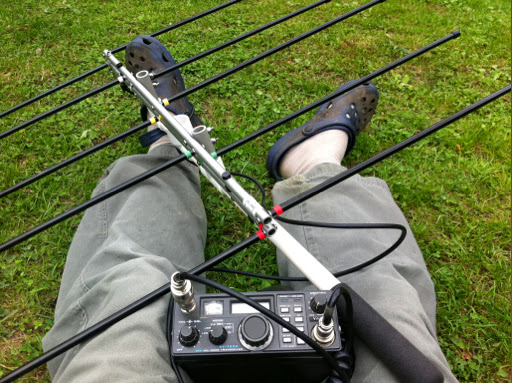
With the weather being a little better today, in between the chores, I put the Elk log periodic yagi together. SO-50 had just finished its’ last pass for about 13 hours, so I decided to get the FT790 out and have a listen for FO-29.
There was a nice overhead pass, so I had a listen around. Signals were pretty good and I heard IZ8IBC, UR3CTB, SP6ASD, SQ9MEH, ON2VHF, EA7AHG, 9A5YY and others. A next pass was much closer to the horizon and the best DX at the start of the pass was UA9CS on CW with a few other closer stations about.
Keen to be QRV on the satellite. I was thinking that over the winter, I might try some ‘mobile’ with the FT847 and the Elk antenna from a decent spot. Should work fine!
Updating the DSTAR Raspberry Pi – dealing with a missing libwiringpi.so
Over the summer, having been busy with 50 and 70MHz, I’ve had very few DSTAR QSOs, other than a quick chat with MM6KSJ the other day. I decided that I should make sure it was all working today.
I fired the Raspberry Pi/DVAP up and was pleased to find that all was ok. Since it was a few months since I updated the G4KLX DVAPNode and ircDDBGateway software. I thought I would get that done.
I ran the klxupdate utilities for both repeater and gateway software and then when I rebooted, I found thaqt although the ircDDBGateway software started, the DVAPNode software didn’t! First of all, I couldn’t see why, but then I tried
sudo dvapnode
which returned a error message saying that libwiringpi.so could not be found
Initially, I thought perhaps I just needed to upgrade the OS, so tried the standard
sudo apt-get update
sudo apt-get upgrade
The upgrade took around an hour, but after that was completed, I tried to start dvapnode – still the same error!
Whilst the Pi was upgrading, I had plenty of time to research the issue a little more and found a page which described installing the WiringPi library
This was the solution! Following this, the DVAPNode software started just fine.
To my amusement, when the software started up, REF001C was very busy with a DSTAR contest!
Keeping it fresh
I believe that all radio amateurs should buy a new radio once every few years. New toy renews interest and enriches learning process.
— Nigel Booth (@m0cvo) September 14, 2013
Last night I saw a tweet from Nigel M0CVO saying that he thought that every ham should buy (or build) a new rig every few years. When questioned, he said that he thought that it provided a fresh injection of enthusiasm and perhaps ‘freshened’ up interest in the hobby.
In an ideal world, I’m sure we’d all like to have the latest rig every year or so, but for all but the lucky few, that’s simply not realistic. However, I can see what Nigel means and I think there is something in what he says.
Happily though, it doesn’t take a new rig to keep it fresh! I found that it might be as simple as a new piece of software (possibly free!), a new aerial, trying a mode you’ve not experimented with before. The hobby is so broad, there are always new things to look at.
I found when I didn’t read an amateur radio magazine regularly, my interest was diminished – simply because I wasn’t reading articles about what other people were doing and thinking, ‘Hey, I could do that – that sounds interesting’.
So whilst I couldn’t agree that you need an expensive new rig every year or so, keeping trying new things and experimenting – that, after all, is the whole point!
First WSPR in a while on 472khz
Having seen some interesting tweets from Colin G6AVK about some good activity on 472khz WSPR over the last couple of days, I thought I would leave my receiver running overnight.
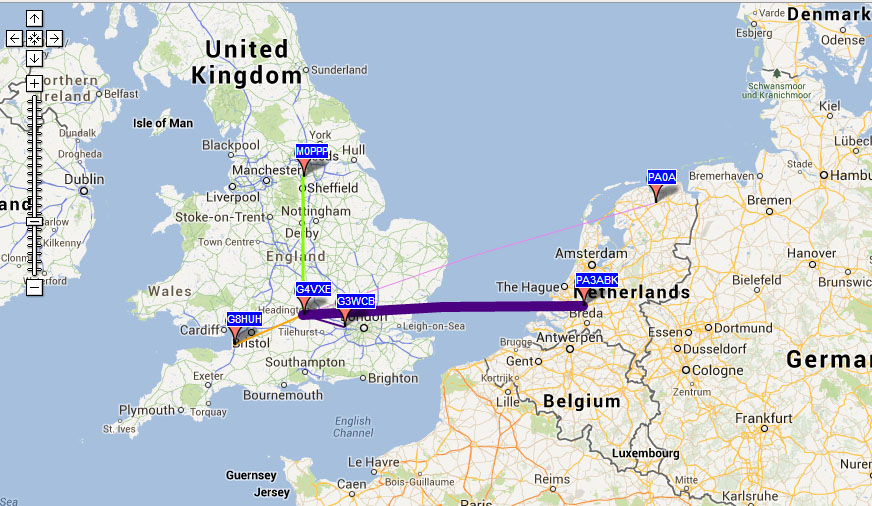
The results are not bad, although I’ve done better. I don’t think I’ve heard G3WCB before, so nice to hear a new station and always good to hear the Dutch stations.