Author Archive
 Migrating to Linux (Again)
 February 20th, 2013 |
  Author:
 I’m no stranger to Linux. I’ve run numerous distributions since about 1995, even venturing into BSD territory, running FreeBSD and some other Berkeley variants. I’ve also used Linux quite a bit in my professional life for servers. However, I’ve never made the jump to using it as my primary desktop operating system at home; it’s always been a novelty to play with and never a desktop workhorse that I would use to actually get things done.
Linux Mint is a Linux distribution that has become more popular recently. It’s based on the venerable Ubuntu distribution and appears to be taking some market share from Ubuntu. Ubuntu in my opinion went off the tracks with its migration to the Unity desktop. For the first time recently I hit a brick wall trying to install the latest Ubuntu within a virtual machine. While Ubuntu was quite polished and arguably had the best usability in the Linux world, I still felt that I was often fighting the operating system to make it work.
 Linux Mint seems to have taken care of those issues. Last night I made the plunge and partitioned off some space on my hard disk and installed it so I could dual boot between Windows and Linux. The installation went extremely well and within two hours I was able to browse the web, play videos and hear sound, send email, work on Kicad schematics, compile Arduino code, open Excel and Word docs, do my banking with the same program I used on Windows, and I had amateur radio logging and digital programs installed. The only speed bump was getting my wireless working. I was able to fix that in five minutes after Googling and finding one command line to run. On previous distributions, items like this would take hours to resolve and there would be several of them to deal with. For the first time I feel I have something equivalent to what I had on Windows, and it doesn’t look goofy and didn’t require days of tweaking with arcane command line syntax to make it acceptable. The browser actually renders things like they look on Windows. You install a program and it actually appears in the menu. Quite simply, Linux Mint isn’t a compromise like previous desktop installations.
I’ve often complained about the state of amateur radio open source software. I stand by my previous statements as I think we still don’t have a suite of amateur radio open source software that compares with offerings in Windows, mainly in the areas of logging and contest programs. However, CQRLog has evolved quite a bit and I’ve decided to take a more minimalist approach and see if I can make it work. I still think Ham Radio Deluxe is the gold standard, but lately I’ve become annoyed with its bloat and the commercialization and marketing of it.
I’m still keeping my Windows partition, mainly to run one particular contest program and store my documents (which I access from Linux), but I may eventually run Virtual Box on Linux and have a small Windows installation virtualized to run the contest program rather than booting back into Linux.
Will this be the time I finally run my shack on Linux? I hope.

I Was A Radio Pirate
 Back when I was a young radio artisan I would eagerly await my monthly copy of Popular Communications to arrive. My favorite column was Pirates Den which covered the latest happenings in pirate radio such as new stations, signal reports, programming, and stations shutting down, either voluntarily or involuntarily at the hands of FCC enforcement. The often grainy black and white images of stations with masked DJs seemed like a glamorous and exciting thing at the time. Back then you couldn’t just setup your own audio stream on the Internet and broadcast to the world. As a pirate you could say whatever you wanted, play whatever music you liked, and all the while stick it to the “man”, the brutal, authoritarian FCC. Fines at the time were only a few hundred dollars, paltry by today’s standards.
There were basically two pirate “worlds”, local broadcast and shortwave. Shortwave stations would operate just above the 40m amateur band. In later years the pirate band moved to below 40m. Other frequencies on other international shortwave bands were used, but the neighborhood around 40m seemed to have the most action. Local broadcast would be done mainly on FM radio. I actually can’t recall a report of an AM broadcast pirate, but I assume there were a few out there. But considering the effort and equipment one had to put into an AM broadcast band operation, those people with the skills and inclination to go to that effort probably did shortwave pirating.
I had dreams of becoming a real DJ and perhaps owning my own commercial FM station one day, but luckily I realized that the broadcast industry had a rather low pay to frustration ratio and steered clear of it professionally. In college I finally got the gumption to attempt to become a radio pirate. I didn’t have two nickels to rub together at the time, so any purchase was a big decision. I sent away for a mail order FM radio kit. It was mono, not stereo, but it boasted a phase-locked loop (PLL) and a clean 1 watt output. Paradoxically, being a licensed radio amateur I wanted a very clean and professional pirate FM signal. I assembled the kit, however, much to my dismay after weeks of trying to get the PLL to lock up, I gave up and tossed the unit in the closet.
Two years later I was working professionally in the RF world, working on TV transmitters around the globe. I learned a lot in this new world. Being a field engineer in the middle of nowhere like South America or the Middle East with a minimal assortment of parts and people staring over your shoulder expecting you to fix their only transmitter in the village makes you learn quickly and think on your feet. This is something they don’t teach in college or outline in an ARRL Handbook. It was a rough job that no one wanted but I came into the company bright eyed and bushy-tailed and commanded more pay than some of the travel-adverse bench techs with years of experience under their belts.
One day I got bit by the pirate bug again and snuck a spectrum analyzer out of work to my bachelor pad. I got the bright idea of bypassing the PLL and just driving the voltage controlled oscillator with a multi-turn pot, also borrowed from work. The unit would drift but after a few hours warmup it didn’t require much adjustment to stay on frequency. Later I found an old low band VHF TV amplifier rated for 25 watts at work. It was a design that apparently was a bit unstable, but we had several of them lying around at work, destined for the dumpster. I took one home and tweaked it up and found I could get 40 watts cleanly out of the unit. Now I was in business.
I assembled a station, acquiring an audio mixing board and other components. I built a ground plane antenna and got four 5′ Radio Shack masts to elevate it. My third floor apartment was in a great location, in the middle of a nine mile long heavily populated valley in northeastern PA.
A college friend would come over Friday night and stay over for a pirate broadcast weekend. We would do a few two hour shows and identify as WMRX, “the station jamming the nation.” Though a bit kooky now, it sounded pretty cool back then. We spun mostly records and a few CDs, and we augmented our programming with supermixes or song medleys recorded from a commercial station in Philadelphia. We even did a ten minute fake news report with some comedy thrown in. For a phone line we announced the phone number of the pay telephone across the street. One of us would stand at the phone while the other announced the number on the air. We never did have anyone call in.
One show ended early when my co-host got intoxicated and fell over. Another show had to be cut short when a guest DJ announced my name over the air. After each broadcast we disassembled everything, including the antenna and mast and hid it, naively assuming this would minimize our chances of getting caught. Eventually work and life got too busy and complicated and the pirate operation stopped. Every few years I fired up the transmitter, put a CD on, and just drove around to hear the signal and admire the coverage. Although it wasn’t stereo and it didn’t fill every nook and cranny in the valley with RF, it was my signal, my station, built with my own hands, and to me it sounded wonderful.
Today FM pirate broadcasting lives on, as regular reports of FCC enforcement would attest with fines in the neighborhood of $10K to $20K. It’s hard to tell if shortwave pirating is still alive. It’s certainly not at the level it was in the 80s. I get the feeling anyone with a desire to get a message out rather than just spin records or taunt the FCC has moved to Internet broadcasting or perhaps uses a blog to get their message out, though it lacks the mystique and excitement that pirate radio once had.

Review: Hamshop.cz Open Keyer
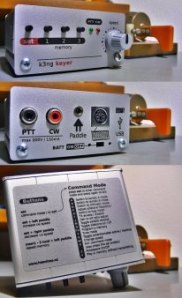
The Hamshop.cz Open Keyer is a cute little keyer kit that is Arduino based and runs my open source keyer software. It features a menu button, three memory buttons, a speed control, a PS2 keyboard connector, and a USB port. The unit can be powered either through the USB connector or an internal 3 AAA battery pack. A 1/8″ (3.5 mm) stereo jack is provided to connect your paddle and two phono connectors are for keying your transmitter key and PTT lines.
The brains inside the box is an Atmel ATMega chip running the Arduino bootloader, along with a USB chip. Essentially it’s an Arduino and the normal Arduino development IDE can talk to it and program it. As mentioned before it’s intended to run my open source keyer code, but it can be used with any Arduino code including your own keyer implementation. If you don’t need a PTT line for your transmitter, you can easily modify the source code to use the PTT port and a second transmitter keying port.
Most of the circuit is surface mount technology (SMT). I hadn’t soldered SMT components for several years. Last year I got my first set of reading glasses, and I found myself cursing the little parts, which in my more youthful years I’d have no problem working with. This is no fault of Hamshop, just me whining about my age. Luckily Hamshop pre-installs the ATMega and USB chips, so the most difficult components are taken care of for you. The enclosure is a very simple but effective extruded aluminum two-piece clamshell or channel with two end pieces for the front and back. Vinyl decals are provided for the front and back, and an instruction decal is provided for the top. (Although my callsign is on the front of the unit, note that I did not design the hardware or kit.)
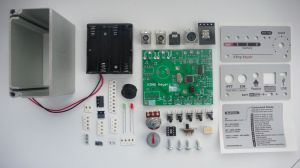
The unit performs well, though I accidentally left it on battery power for a few days and totally drained the batteries. This prompted me to add a sleep mode feature to my code which is in beta testing and should solve this problem. One minor issue with the Open Keyer kit is the front speed knob. On my unit it does not fit well, with not enough of the potentiometer shaft exposed for the knob to grab on to. Ondra, OK1CDJ, at Hamshop tells me that they’re adjusting the alignment of the potentiometer in the next revision to address this problem.
I won’t review the actual keyer software as the documentation for this is here, and naturally I’m a bit biased about it, but it does about anything a CW aficionado would want to do. All in all the Hamshop Open Keyer is a nice little kit that can be assembled in an evening or two, and is reasonably priced.
(Full disclosure / disclaimer: I do not have a financial interest in Hamshop, and I can’t provide support for this keyer hardware. Support for the open source code is available on the Radio Artisan discussion group.)

Obligatory New Years Post
Greetings and Happy New Year! Our celebration last night was one that married 40-somethings with kids often have — a night spent at home watching Dick Clark’s New Years Rockin’ Eve.
On the amateur radio front, this past weekend I participated in the Stew Perry Challenge, a 160m all CW contest. I debated whether to go QRP or 100 watts and decided to go with 100 watts. Although I can’t brag about the amazing performance that QRP and a rather modest inverted L would have given, I certainly had as much if not more fun than last year’s event. I netted over 180 contacts in my casual operating effort, even bagging about six west coast stations. I think the Stew Perry Challenge is a cool little contest, perhaps underrated. Its uncommon exchange for an HF contest, grid squares, and its unique scoring that takes into account distance and worked station transmitter power makes for an interesting contest. I wrote in my notes for 2013 that I have make a serious effort and do all 14 hours in the test next year.
I can’t say I have any hardcore amateur radio News Years resolutions, other than “do what I like and like what I do”. I started following this mantra three years ago and it has served me well. I tend to avoid getting into rituals but one I do want to start after authoring one last year is getting at least one amateur radio article published each year in a mainstream magazine (i.e. QST or CQ). I also tend to avoid competition, but I want to “up my game” in the PA QSO Party and also make more than a casual effort in one of the big contests.
In the Radio Artisan lab there are two main projects in progress. I have a working prototype of the Arduino based balanced antenna tuner. It’s been a technically challenging project, but very interesting. I still need to improve the SWR sensor performance and develop some shortcuts in the tuning algorithm to lessen the tune time. The other project is learning KiCad, an open source EDA program for developing schematics and PC boards. In the next week or two I will publish a post on my experiences. It’s not perfect but it’s definitely a viable replacement for the venerable and popular Eagle program.
Here’s to a healthy and prosperous 2013. Work, eat, sleep, and play radio.














