Author Archive
 The N3ZN Iambic CW Paddle
 March 4th, 2016 |
  Author:
 Behold… mechanical beauty
 |
| N3ZN ZN-QRP Iambic Paddle (sporting my new call sign) |
I re-entered the amateur radio hobby in the summer of 2015 after a bit of a hiatus. To get my General license in 1996 a Morse code proficiency test was required. At that time I had purchased a cheap MFJ practice key and a used version of the ubiquitous Bencher BY-1 paddle. My Bencher was in reasonable shape but I just never became comfortable with it. It always felt a bit imprecise to me and I wasn’t happy with the width and size of its paddles.
The Grand Illusion
Five by Nine... QRP... How can it be?
What does an S-Unit really mean and how can a QRP station sound like a 500w station?
 |
| The real gain doesn't come from transmitter watts |
I rarely go up to the phone portion of the bands. Since I started doing QRP and CW last summer I think I've only made two SSB contacts just because my focus has been CW. But last night I was working on a bench project and tuned the Elecraft KX3 up to the phone portion of 40m for some entertainment.
A station in Rhode Island was testing his amp with a new antenna and was getting reports from various stateside operators. There was a lull where no one was answering his CQ so I thought I'd give him a call. He was peaking at S9 on my KX3's meter and he also sent me a signal report of S9 with some 10 over peaks. I then told him I was a QRP station running 10 watts and heard the usual surprised reaction from a QRO station.
I gave him reports as he switched back and forth from running barefoot ~75w to his amp ~500w. With his amp on he was an S9, running barefoot he was S8. So the amp gave him one additional S unit. In terms of hearing him I would have been hard pressed to tell much difference simply by volume. He was perfectly copyable without noise with the amp off.
We also did some tests with my station at reduced power (as if...) At 10w-12w output I received a S9 to S9+10. Reducing output to 5 watts netted me a S8 report and when I reduced to 1 watt (one watt) he was still able to comfortably copy me and I received an S5. So with my station at 1 watt and his running 500 watts we could still converse via SSB. Ladies and Gentlemen you don't need as much output wattage as you think you do.
He was running through a newly constructed homebrewed vertical while I was using my 80m OCF Dipole. We didn't discuss what sort of radial system he had installed, but the difference in antennas was likely the deciding difference in our stations. We were about 500 miles apart and his vertical probably had more low-takeoff gain than my dipole, or possibly more ground loss so I probably had better high angle gain on him for the short 500 mile skip. I think the take-away from this exercise is that the antenna is generally the key rather than transmitter power. If I can get 6 dB of gain from my antenna I have in essence quadrupled my effective radiated power. Quadrupled? Yes, Quadrupled effective output power.
Power and S-Units
You've probably heard it before but it's worth a refresher... Our radio's meter display a measurement in "S-Unit". To move the meter up one S-Unit the receiver must hear 6 more dB (decibels). So one S-Unit is 6 dB.
A decibel is:
- A Power Ratio: dB = 10 Log P2/P1
- A Voltage Ratio: dB = 20 Log V2/V1
You increase 3dB each time you DOUBLE your power
That's worth repeating...
You increase 3dB each time you DOUBLE your power. So to gain one S-Unit you must quadruple your power.
So if you are running 100 watts, to gain one S-Unit using the same antenna system you must increase your power to 400 watts. If you are running QRP SSB (10 watts) that is only 1.5 S-Units down from 100 watts. 100w / 2 (-3dB) = 50w / 2 (another -3dB or 1 S-Unit) = 25w... etc.
We have a great hobby, but there are so many aspects of it that sound like common sense when they really are not... like increase your power.
Increasing power gains you very little compared to a better antenna systems. Put that in your 811A amplifier tube and smoke it !
That's all for now.
So lower your power and raise your expectations (or your antennas)
72/73 (Note: 72 is a common substitute for 73 among QRPers... as in "not enough power for 73")
Richard, N4PBQ
Antennas offer the cheapest increase in dB
Note the statement above "using the same antenna system". That's the key then isn't it? It's easier to get 6 dB of gain from an antenna than from wattage. A 40m doublet can offer significant directional gain especially when operated on higher bands. Now unless it's rotatable you will be at the mercy of the directionality of its lobes but if you have trees or tall structures you can very cheaply string up a few dipoles oriented in different directions and for far less money that a 500 watt amp (6 dB). If you can only have one wire antenna you may miss out on some DX in the antenna's nulls but you will have some stellar gain in the direction of the lobes. Of course rotatable yagis and beams are the best but now we are talking about real money again. I'm talking bang for the penny. You don't have to buy a wire antenna. Some Dacron rope or weed-eater line and some surplus insulated wire is all you need. You can even make your own feedline cheaply from electric fence wire and insulators.We have a great hobby, but there are so many aspects of it that sound like common sense when they really are not... like increase your power.
Increasing power gains you very little compared to a better antenna systems. Put that in your 811A amplifier tube and smoke it !
That's all for now.
So lower your power and raise your expectations (or your antennas)
72/73 (Note: 72 is a common substitute for 73 among QRPers... as in "not enough power for 73")
Richard, N4PBQ
1 Watt and a Wire… in the Attic
You can't always get what you want, but you try sometimes...
Recently I've dialed my normal 5 watts down to 1watt (one watt, singular) for all my contacts. To throw some water on the fire I've decided to use my attic antenna which weaves all around my metal ductwork and electrical wiring. Mostly this was to prove a point to myself but it may be enlightening to deed restricted hams that they can use a qrp radio and an attic antenna successfully.
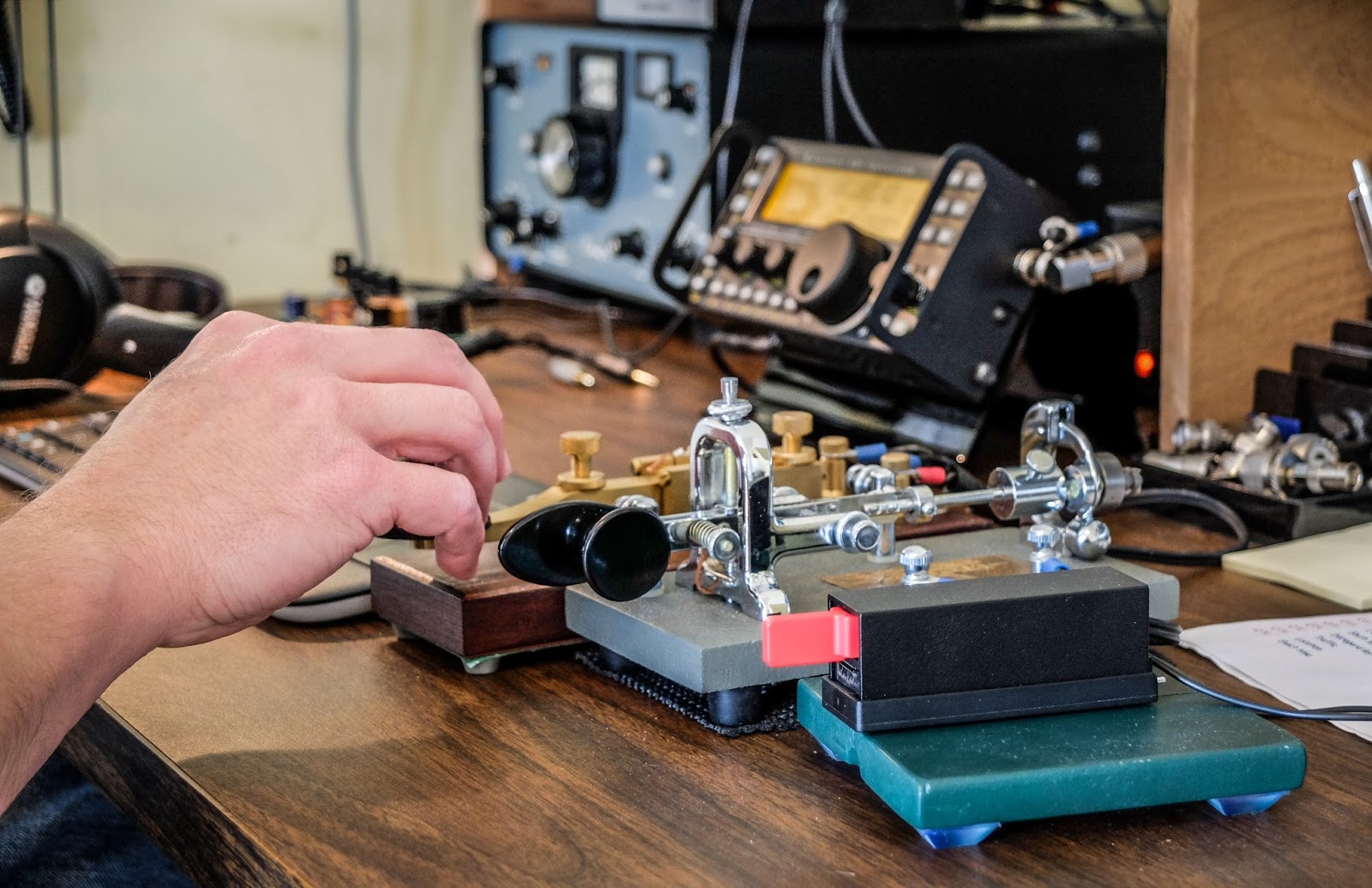 |
| Key lineup... Palm Single (paddle), Vibroplex Bug (circa 1970s), Kent Hand key |
It only seems pointless until you try
Calling CQ with 1w QRPp into a poor attic antenna isn't as pointless as it would seem. I didn't have to wait long when calling CQ before I got an answer most of the time.
Now am I going to bust a pileup with 1 watt ? Possibly not but I think that my assumptions about both how much power I need and how big an antenna I need are usually out of proportion with reality.
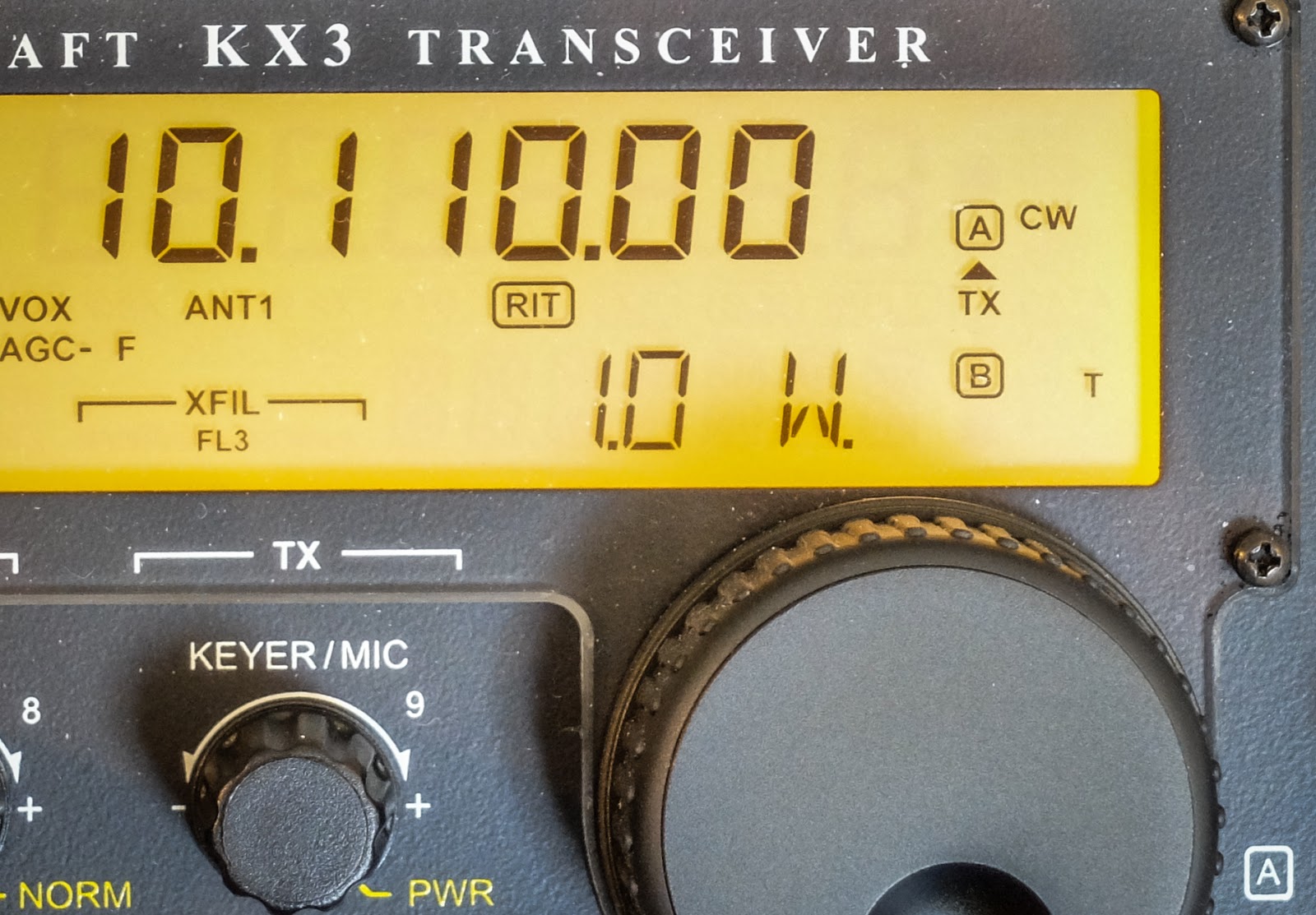 |
| 1 mighty watt |
My assumptions are often incorrect
I made QSOs on 30m, 20m, 17m and 10m this morning all at 1 watt. The solar conditions report was not really fantastic, especially for 10m. Yet 1 watt through the attic antenna bagged the only DX I heard on 10m. I had a couple of other multiple exchange contacts on 20m, 17m and one good old fashioned 25 minute long ragchew on 30m where I received a 599 report for my one watt from Bob (NR8M) in Ohio. Admittedly, Bob was booming in and we had good propagation to each other.
 |
| http://www.hamqsl.com/solar.html |
Video
The recording below was number 4 or 5 this morning. I wanted to post this one because I was working another QRP station in Arkansas (K5EDM) and we did NOT have great propagation to each other. He was running 5w while I was running 1w so it was QRP to QRPp. In the video you can see that I'm using some of the KX3's tricks to pull the signal up because there was a lot of QSB and noise (note the GEOMAGNETIC FIELD UNSETTLED in the solar report).
I had the volume maxed and was using the RF gain control mostly. I eventually had to turn on the preamp which really washed me in noise but I dropped the RF gain more and eventually switched in the APF (audio peaking filter) which performed magic on this contact. Often I find that APF doesn't help but this time it made a big difference.
That's all for now
So lower your power and raise your expectations
72/73
Richard N4PBQ
The need for speed in CW
CW QSO speed statistics...
As I continue on my Morse Code Journey I have been using a desktop application called Morse News to work on my code comprehension of natural language sentences for ragchew training. I set the program to send at speeds higher than I can copy to stretch me. Presently I have it set at 26wpm character speed and 23wpm Code speed. I can usually figure out what the news story is talking about but I miss a lot of the specifics.
 |
| I was a kid in the 1970s when Speed Racer was a popular cartoon |
The need for speed
Currently I'm OK working up to 20wpm qsos as long as the other station has good spacing. Sometimes I lose the thread or the specifics in a ragchew at 20wpm and I just ask them PSE AGN?
In sprints I can copy a callsign sent at 25wpm to 30wpm if I hear it a few times but that's no good for real contests where you need to catch that call sent at 30-40wpm sent the first time. My friend AA4XX has asked me to help him in multi-op contests but I know he is sending around 30wpm and I just can't hang there at this stage in my Morse Code journey.
Statistics show 25wpm is the magic number
So it got me to wondering what was the actual "average" qso speed. I downloaded days of raw data from Reverse Beacon Network. RBN collects the call sign, the SNR and the SPEED. The raw files contained between 40 to 50 thousand CW CQ calls logged each day after I filtered out other modes.
The average speed from RBN CW logs worked out to exactly 25wpm. The standard deviation was 5.34wpm which would mean most of the time you would expect to work stations between 20wpm and 30wpm. That seems reasonable and matches what I seem to hear on air. These numbers are from the CQ calls themselves and are only measuring character spacing speed so the code spacing is likely a bit lower in most cases and for ragchews is likely averaging 2 to 5 wpm lower than the actual sent character speed. Since I am not much interested in serious contesting at this stage in my hobby going over 30wpm isn't on my radar.
So based on those calculated CW speed statistics from RBN data if I can reach the point where I am comfortable in a 25wpm ragchew I should be content (for a while)
That's all for now.
So lower your power and raise your speed.... err expectations
72/73
Richard, N4PBQ
Making use of Elecraft Mini-module Kits
Connecting the bits and bobs
I have enjoyed building Elecraft Mini-Module kits. Now to put them to use...
 |
| Elecraft Mini-Module Kits |
What to do?
I built the kits as part of my learning adventure and to improve my soldering skills. It's also helped me learn to follow instructions better (my wife says I need to work on learning to follow instructions). But ultimately these modules are intended to be useful, and in my case they work nicely to when operating my old Ten-Tec Century/21.
My Ten Tec Century/21 is a 1970s CW-only, low(ish) power rig originally intended for Novice license holders of the time. It has no RF output meter or SWR meter. It has poor filtering/selectivity compared to modern radios and its analog tuning dial is a bit vague so you generally only know your frequency within 5 kHz.
The mini-module kits prove useful. I employ the W1 Wattmeter to determine my power output and SWR; the CP1 directional coupler is used to send a 20db attenuated signal to a frequency counter to determine operating frequency, and the AF1 Audio Filter makes operating near adjacent CW signals more pleasant by providing a narrow audio-band-pass filter. The result signal can be transmitted through a LDG tuner into the BL2 switchable balun connected to my attic Doublet.
Bring out your cables
All these independent modules need to be connected, so tying the bits and bobs together requires a few coax jumpers to route the RF around:
- UHF to BNC from the radio to the W1 Power meter
- BNC to BNC From the W1 Power meter to the CP1 coupler
- BNC to UHF From the CP1 coupler J1 input to switched T1 output to frequency counter
- BNC to UHF From the CP1 coupler J2 output to the tuner
And other cables:
- Serial cable from the W1 Power meter to the computer
- 12v power cables for the W1 and AF1 (unless I want to use 9V batteries)
- Audio cable from the TenTec C21 to the AF1
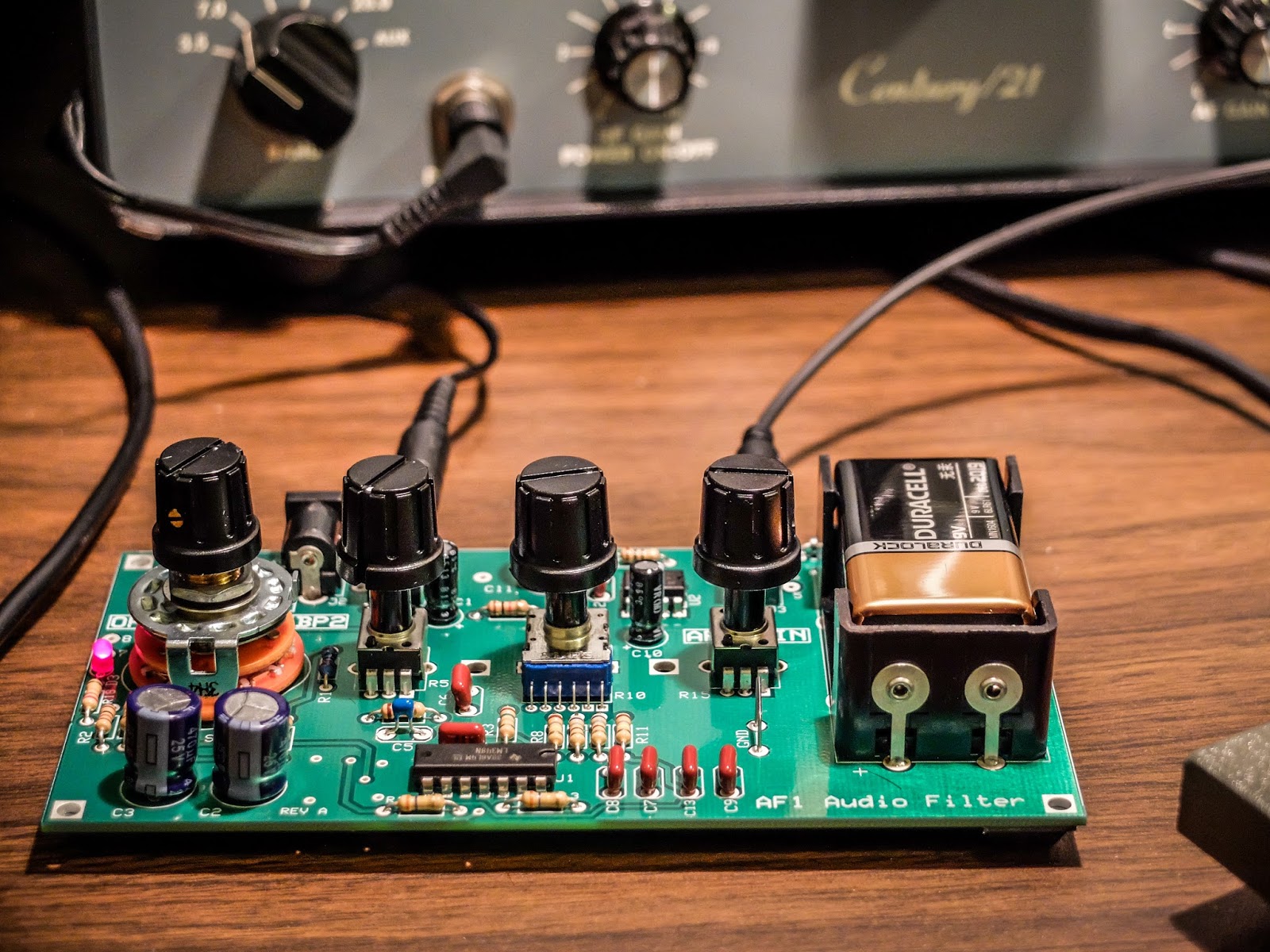 |
| AF1 Audio Filter making crowded band operations pleasurable |
 |
| CP1 Directional Coupler sending off 20dB attenuated signal to the frequency counter |
 |
| Frequency Counter fed by the CP1 directional coupler. |
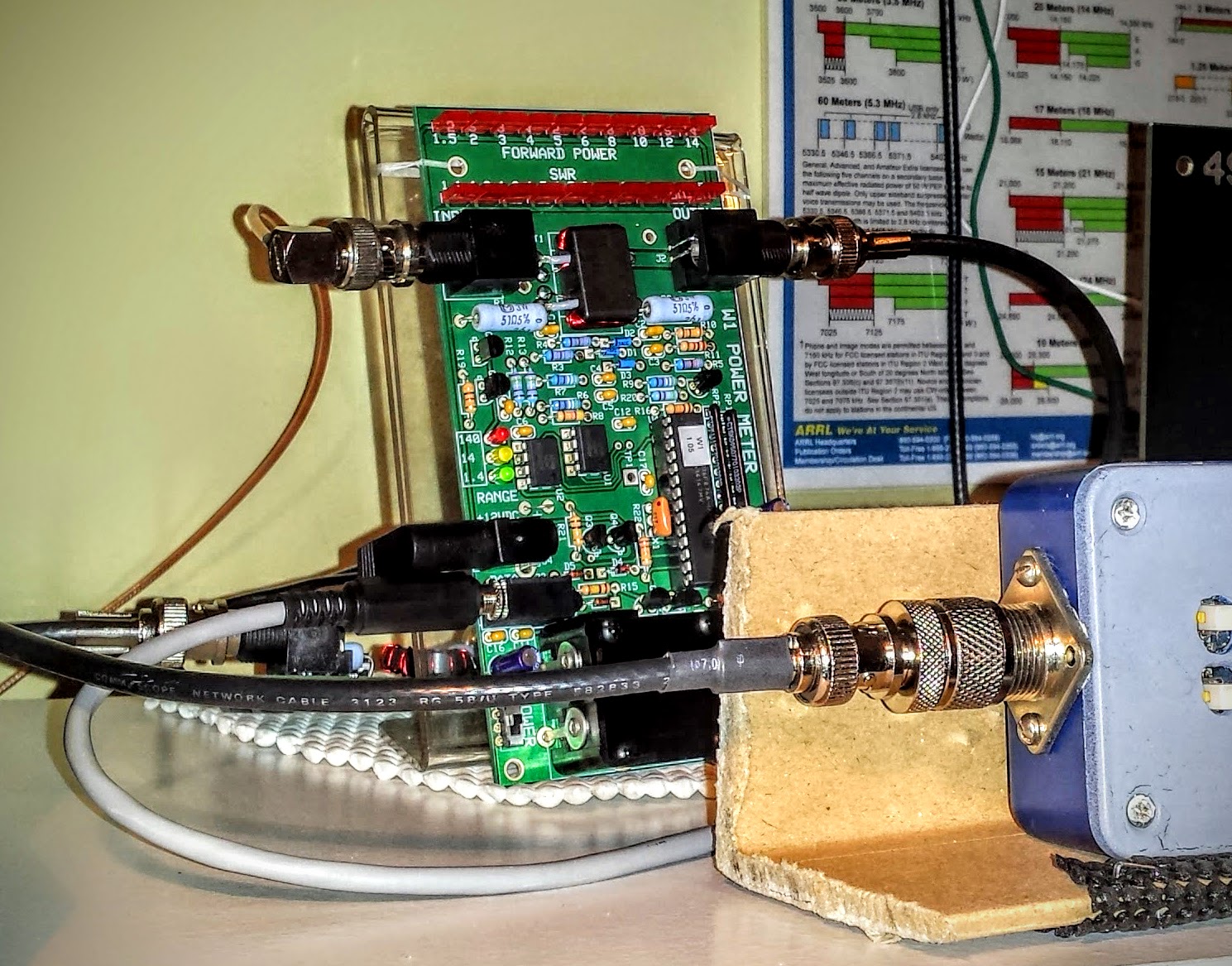 |
| W1 Power Meter sending its measurement off to the computer |
W1 Power Meter Output to Computer
The W1 has a serial output to a PC for use with the Elecraft W1 software. The software can both configure the meter and display more detail than can be determined from the LEDs. Source code is supplied and the command set is documented so it would be easy to write your own software for this.
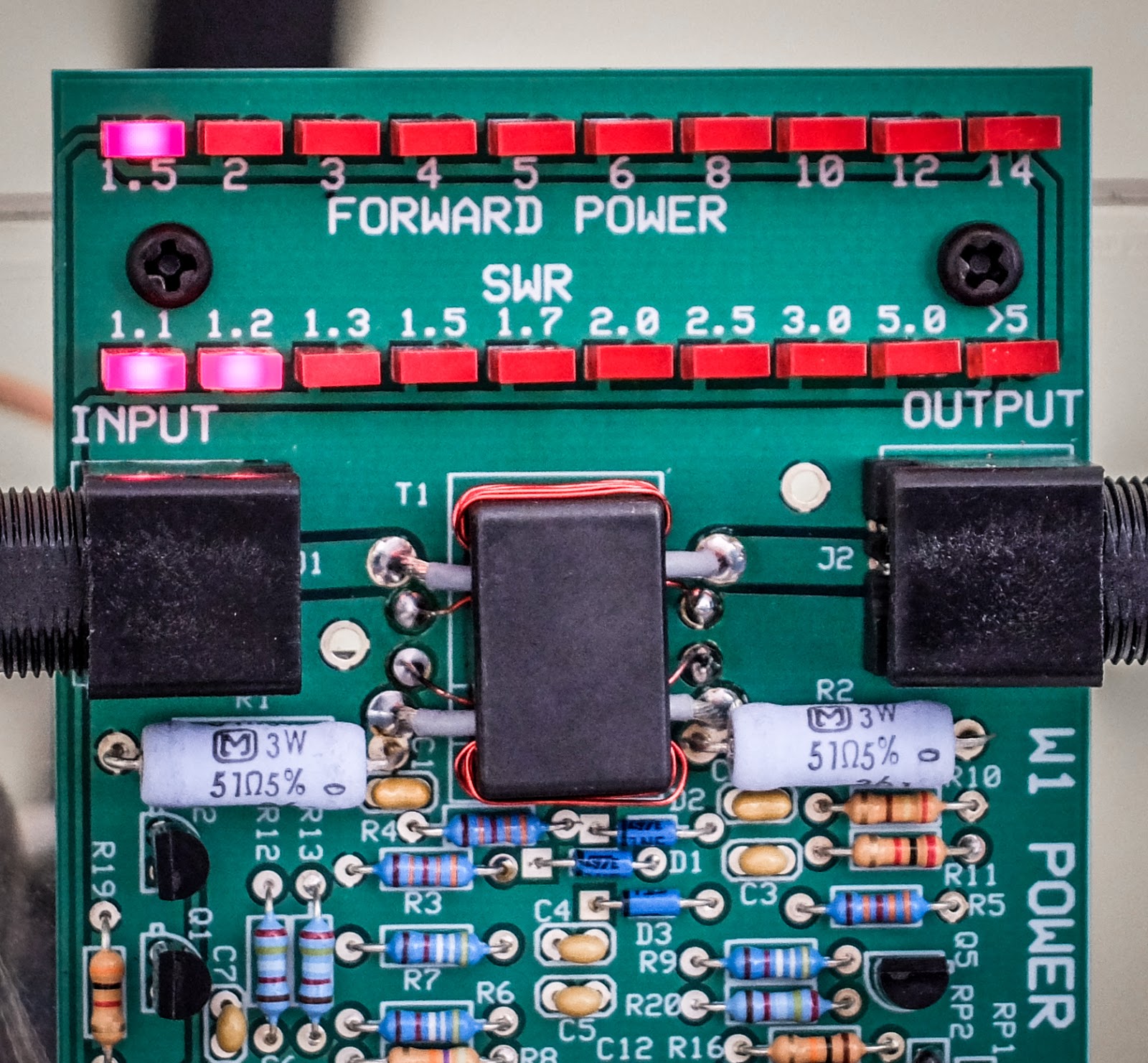
The W1 power meter LEDs give you relatively discrete output information for the lower two ranges (0.1w to 1.4w) and (1.5w to 14w). But in the high range (over 14w) the LEDs are only displaying 10 watt intervals. For instance in the high range, when the second LED is lit you don't know if your operating just 20 watts or 29 watts. It won't trip the next LED until it crosses the 10 watt boundary in the high range so it can be useful to look at the measurement on the computer if you are operating QRO. I'm not complaining. I understand that the meter is primarily intended as a QRP meter and for QRP power (less than 15 watts) it offers plenty of information.
Here I brought the TenTec Century/21 up to nearly full input drive (55-60 watts) to see what it could output. The rig probably had a few more watts left in there but I didn't want to push it because I haven't gotten around to replacing some of the out of spec components in the internal power supply. I normally use this radio under 10 watts (I look for about 30 watts input on the drive meter) but I was curious to see what the old girl could do since I had the meter hooked up to the computer display.
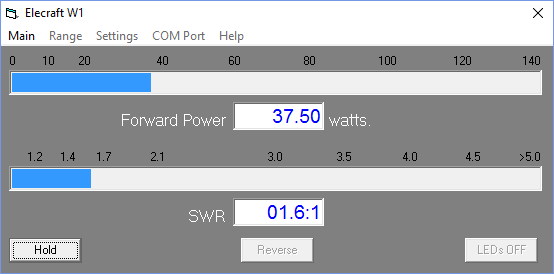 |
| Measuring maximum RF output from the Ten Tec Century/21 |
Nits and Quibbles
My antenna's native SWR at 15m (~21.08MHz) is around 2.5 so it requires tuning (impedance matching). After my LDG auto tuner spends a ridiculous amount of time trying to find a match it settles at 1.7 SWR according to the W1 Wattmeter, while the indication on the Autotuner is that it believes the SWR is 1.5 or better, while the radio on the other side of the W1 meter sees a SWR over 2.5. I only see this behavior on 15m so I think there is some strange impedance reaction occurring in the W1 wattmeter that is changing the reactance on the jumper to the radio. I've tried a few different jumpers, swapping jumpers, etc. But it always presents an abnormally high SWR to the radio at 15m. Now when I transmit into a dummy load I don't see this behavior, so it is some combination of SWR / reactance present at W1 that causes a impedance mismatch downstream toward the radio. I have more investigating to do but for now I am choosing to not use the W1 Wattmeter in-line when operating on 15m.
The CP1 directional coupler is not entirely transparent and raises the SWR by a bit as signal passes through it. You would expect there to be losses according to the -20 db taps (one forward and one reverse). This should work out to about 0.08% loss but I wouldn't expect it to raise the SWR. It adds about 0.1 to your SWR and occurs even if the forward and reverse couplers are switched "off" and shunt their respective loads to the on-board 50 ohm resistors. I'm unsure what accounts for that slight SWR bump but be aware that CP1 contributes some very small losses.
Summary
So the Elecraft Mini-modules are fun to build; and with enough jumper cables, can be combined for experiments and general augmentation of other equipment in your shack. So go out there, build some kits and experiment. It's a rewarding experience.
I'm trying to decide what I'm going to build next.
That's all for now...
So lower your power and raise your expectations
73/72
Richard, N4PBQ
I’ve Got the Power
Elecraft W1 Power Meter
The Elecraft W1 is another fine mini-module kit from Elecraft. It is an auto-ranging power meter measuring as little as 150mw up to 140w. The 150 milliwatt to 1.4 watt range is an especially nice feature for QRP'ers.
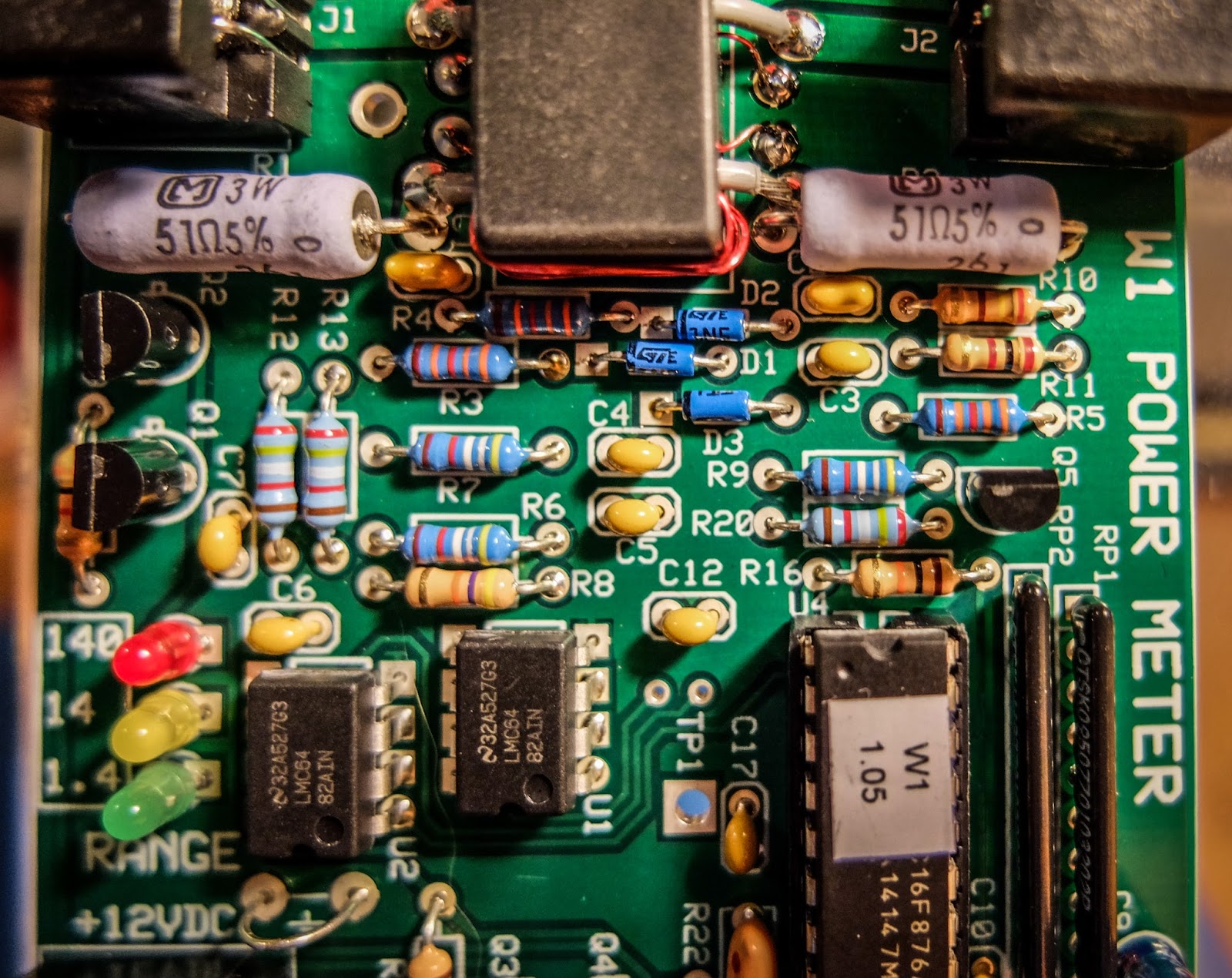 |
| Elecraft W1 Power Meter |
Building
I am new to building kits. My first kit was from 4-State QRP (Regen Receiver). This is my 4th Elecraft kit. The instructions are very detailed and easy to follow and I especially like that they give you the resistor color and capacitor identification right there in the instructions without having to refer to a data sheet somewhere else in the documentation.
All the parts come in a single bag so there is a bit of sorting that you need to do when you receive it. I use a big egg carton to sort and inventory the parts so that I can find them more easily.
This kit was a bit more involved than the other kits I've built from Elecraft. It has a binocular toroid which is fiddly to wind, 3 ICs and a couple of resistor packs. Lots of soldering. The most tedious parts to solder are the tiny transistors. Those solder pads are really close together for someone new to soldering like me, but I took my time and everything turned out ok. I worked on this kit a little at a time over 3 nights. If you can follow instructions and have a steady hand you should be fine.
The kit has some ESD sensitive parts so you'll want to be able to properly ground yourself and your equipment. Make sure your soldering iron is ESD safe and that you are grounded.
Lastly, final calibration is performed using just a multi-meter.
Build options
The meter can be built in a number of different configurations depending on how you plan to use it. The battery holder and BNC connectors can be installed on the top or bottom of the board and the BNC connectors can even be oriented vertically on the back side of the board. If you plan to use it in an enclosure give some thought to the location of the battery holder and BNC connectors before you get to that part of the build.
I plan to use some stand-offs to mount it to the front of an acrylic photo frame that I already had.
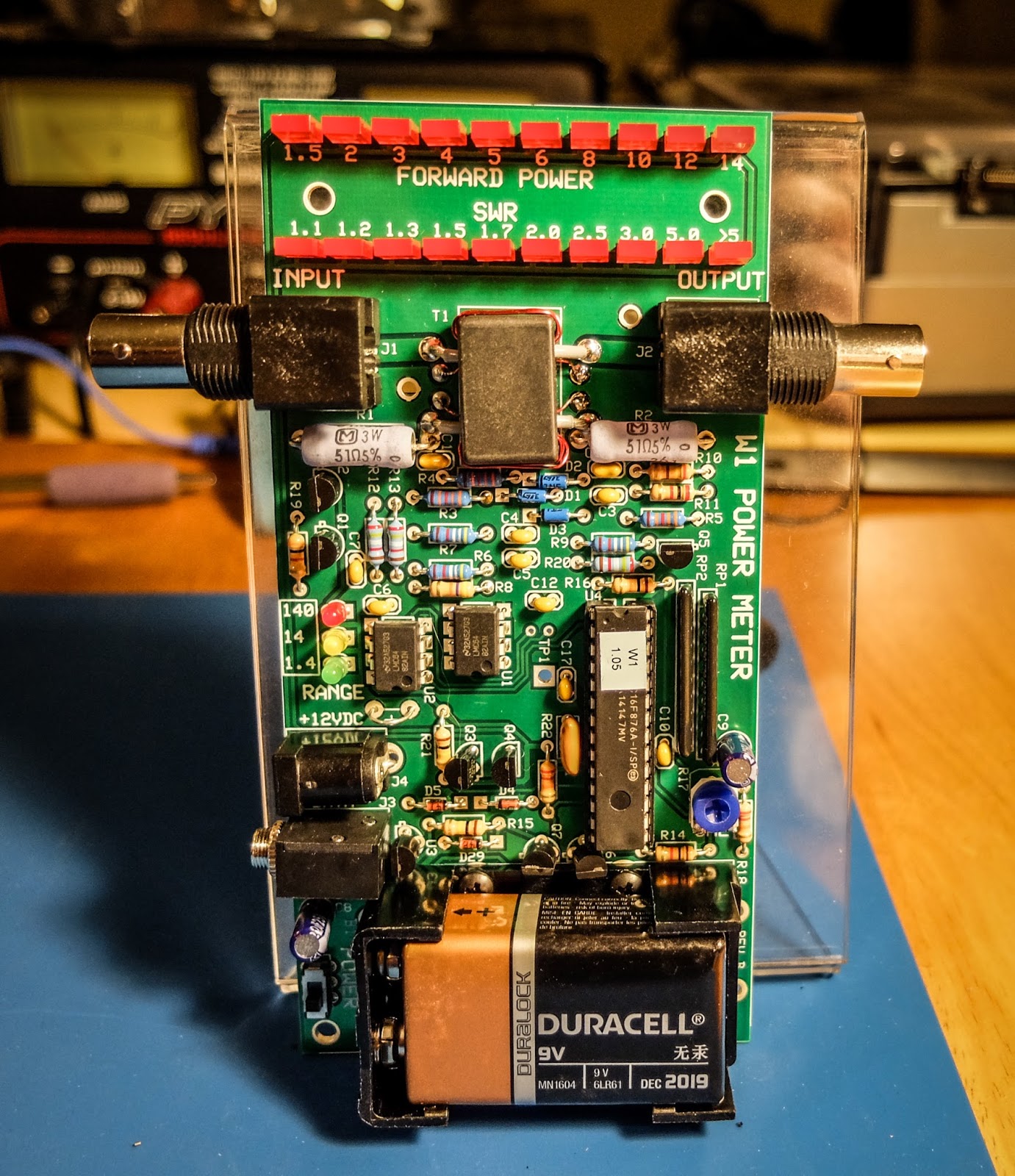 |
| An acrylic-angled photo frame can make a homebrew stand |
Operation
The meter can operate from a 9V battery or from an external power supply via the barrel connector on the side. There is a small power switch at the bottom left of the board.
The top row of LEDs indicate power for a given range. The 3 LEDs mid way down the board to the left indicate the current power range. The range can be automatic or set via a command through the serial interface.
The ranges are:
- 150 milliwatts to 1.4 watts -- Green LED
- 1.5 watts to 14 watts -- Yellow LED
- 15 watts to 140 watts -- Red LED
Computer interface
There is a 1/8" stereo jack below the power connector that provides a serial interface to a computer. There is a command set for interacting with the meter as well as a sample application available on Elecraft's site that allows a number of settings to be modified such as peak hold and saved to the meter.Elecraft sells a $15 serial interface cable kit. What they don't tell you is that it has a DB-9 connector rather than a USB connector. I don't even have a computer with a DB-9 serial port so buyer beware. You may want to skip their kit and build your own. I happened to already have a DB-9 to USB converter but I'd preferred their kit to provide a USB connector.
Demonstration
Photos
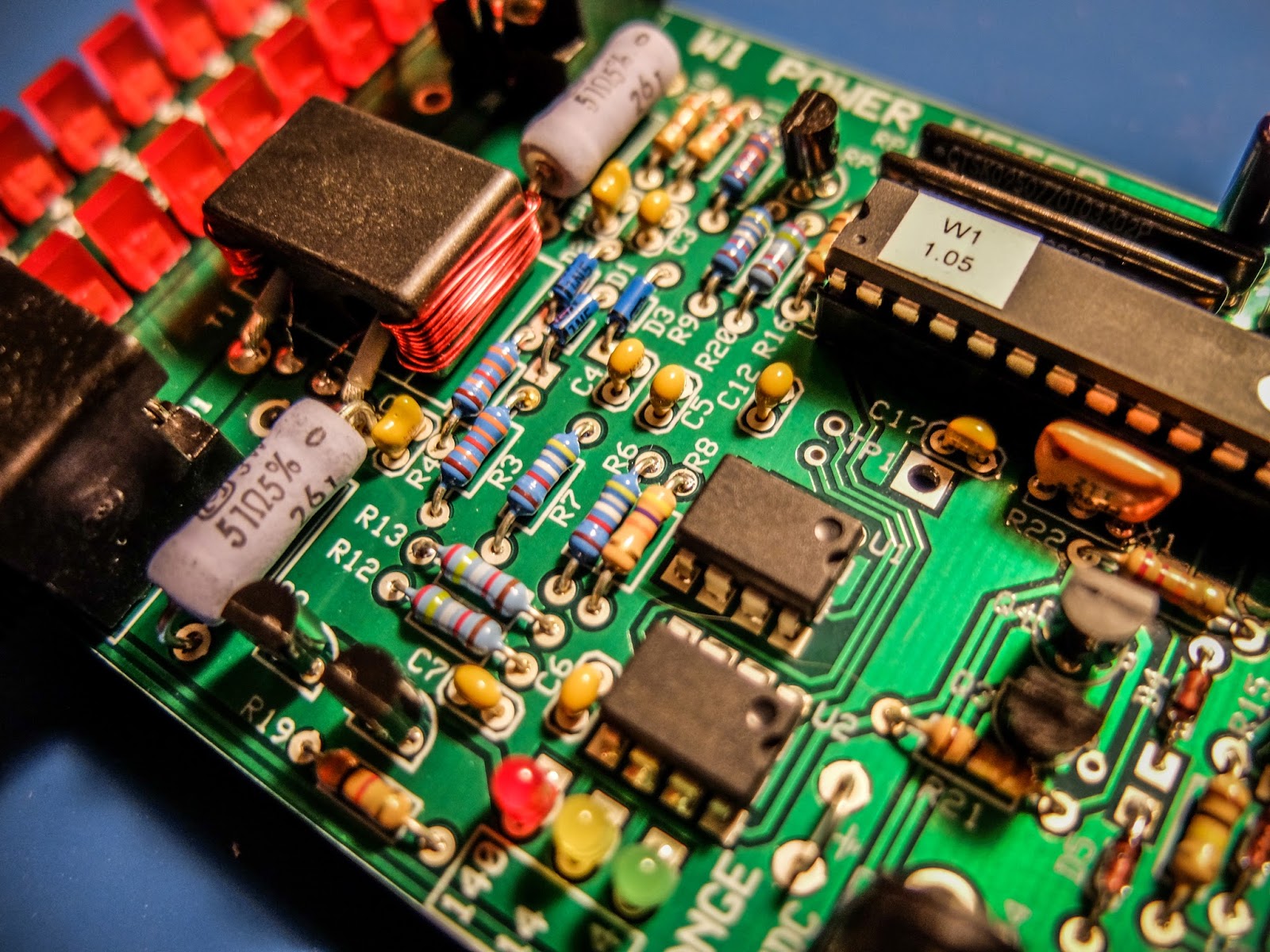 |
| 3 ICs to solder and toroid winding... lots of fun |
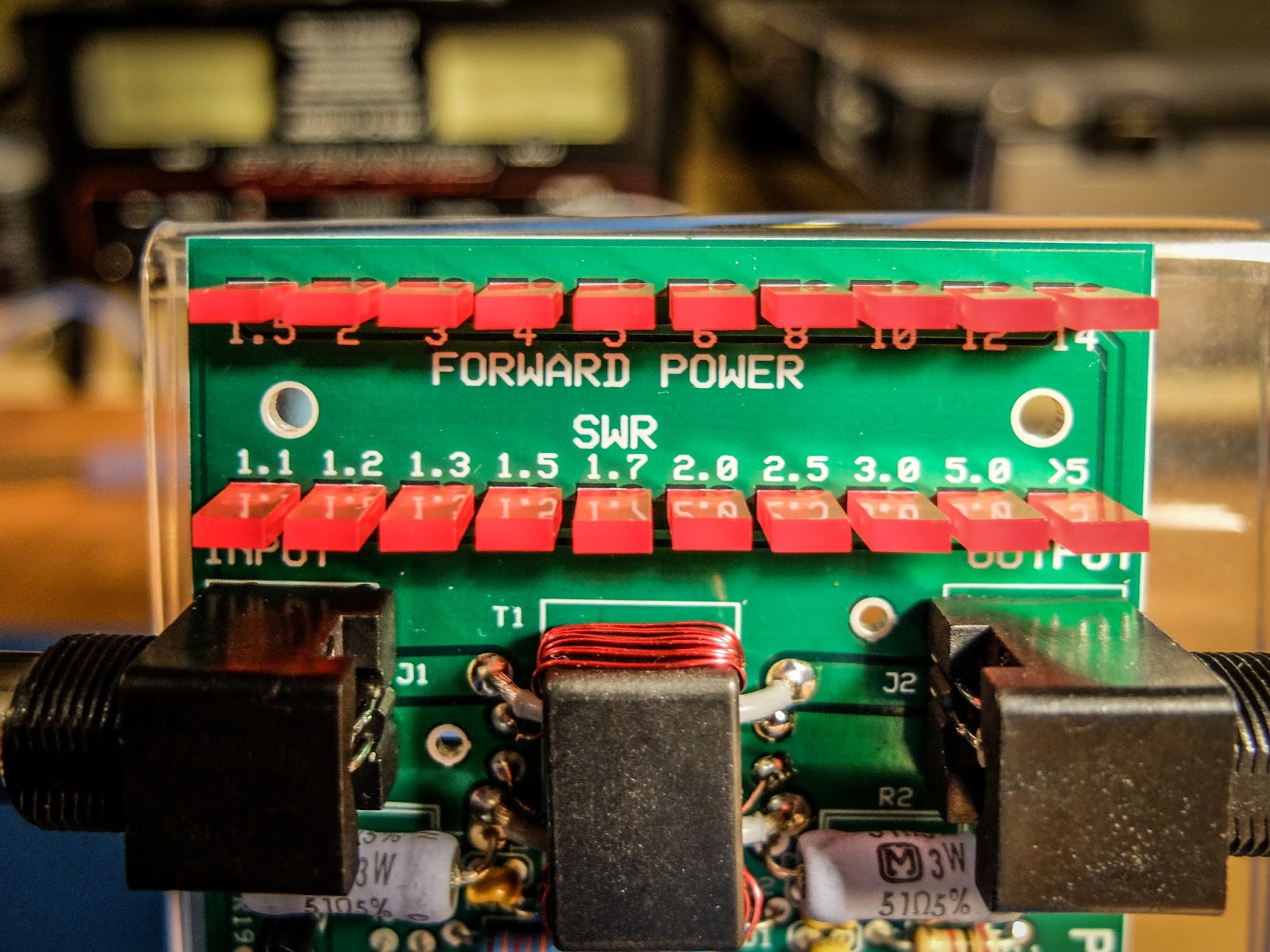 |
| LEDs indicate power in each range and SWR |
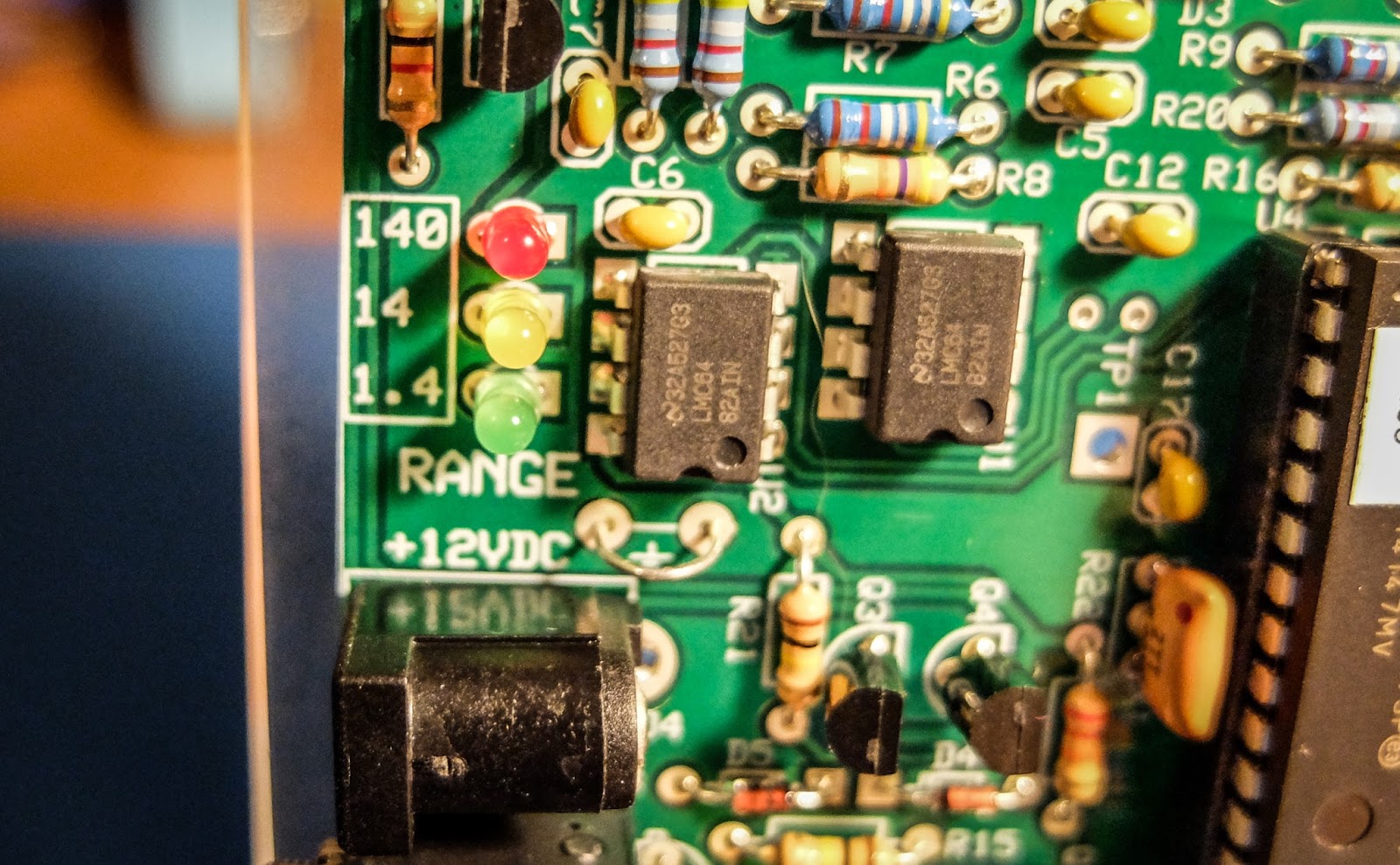 |
| LEDs indicate the power range being displayed |
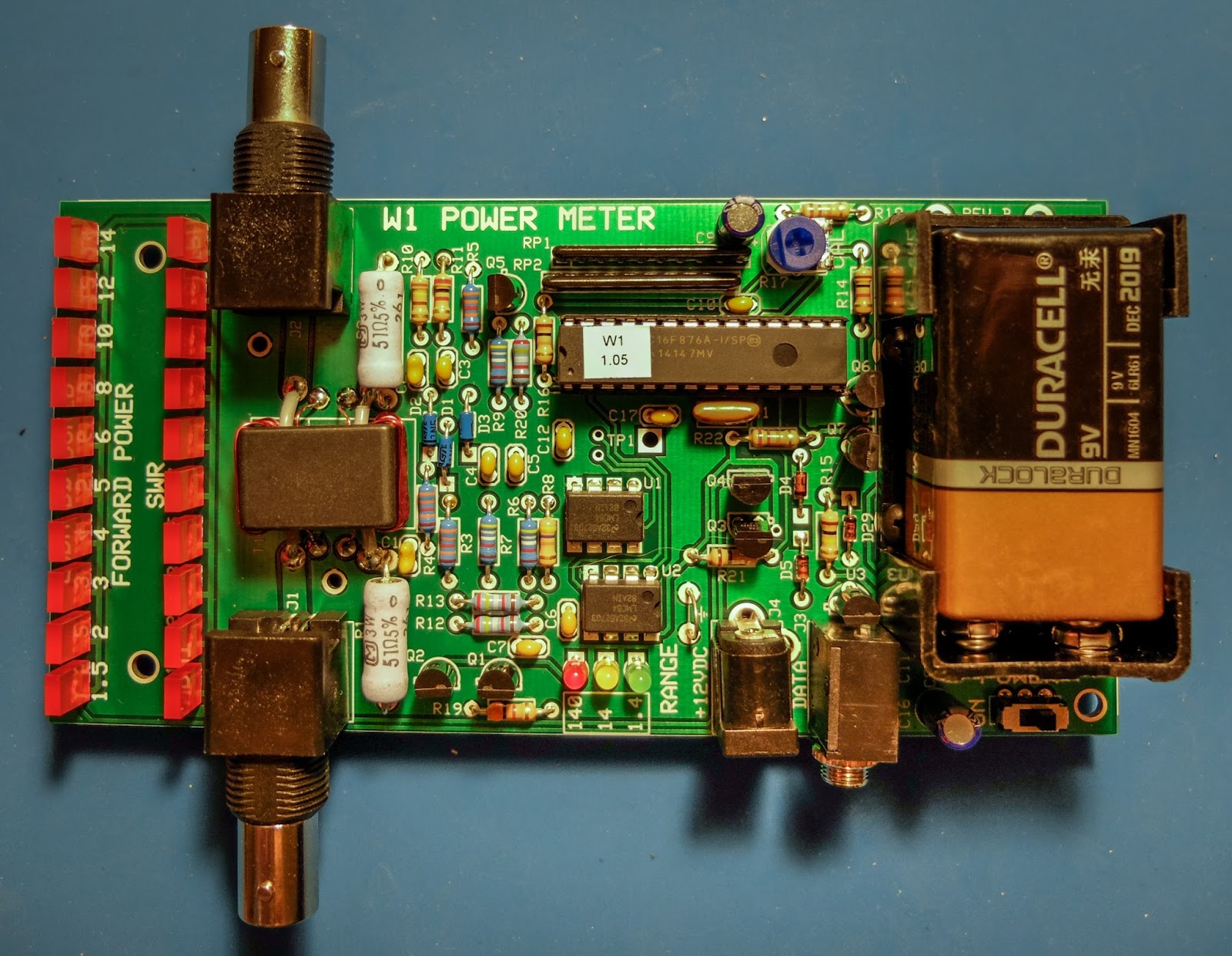 |
| Elecraft W1 Power Meter |
That's all for now
So lower your power and raise your expectations
73/72
Richard, N4PBQ
Get a taste of the RF coming and going
Elecraft CP1 - A tasty RF treat
I had some time this afternoon to assemble another Elecraft mini-module kit. This time it was the Elecraft CP1 directional coupler.
 |
| Elecraft CP1 Kit |
Couple what?
Ah, so if your new to this like me you might be asking what does a coupler do? Well it sorta listens in on the signal going out (forward) and reflected (back) and is able to send an attenuated sample of the signal to other devices. It attenuates the sample by either 20db or 30db depending on how you build the kit.The 20db version is good for signals 25 watts and less so that's the way I built it. It was easy to build but my glue under the second toroid wasn't strong enough and you can see it popped up a bit. Also the Elecraft instructions had one confusing instruction concerning mounting the toroids. The instructions say "... When wound and mounted correctly, the enamel wire will emerge from the top of each core and connect to the top hole at each inductor location". Well when you wind a toroid only one of the wires can "emerge from the top of the core" while the other comes from underneath. This confused me for a minute until I finally just went on with the install. Anyway, if you're a stickler for following instructions that one may cause a moment of pause...
The switches for the two outputs forward, reflected (J3, J4) are in the up position when they are not in use. When the switch(es) are in the up position the 50 ohm 3 watt resistor(s) take the place of the switched off output. Don't disconnect an output and leave the switch in the bottom position. I'm not sure what will happen... maybe nothing, probably a bit of a mismatch on the SWR, or maybe it could be like "Crossing the streams" in Ghostbusters. Your mileage may vary.
My uses for a coupler
My old Ten-Tec Century 21 has an analog VFO dial that gives me a good guess at where I'm at but I use an external frequency counter to give me more information. I had it sorta rigged my frequency counter to sample the signal from RF leaked on the shield but I didn't really know how much power I was sending to the counter so this coupler allows it, as well as other devices, to be safely connected to the transmitted signal.I also plan to use the coupler for IMD tests using a oscilloscope and other projects. It's handy device to have in your collection.
My confusion
I will admit I am still such an idiot when it comes to understanding how this stuff works. After I built it I was testing continuity and saw that input/output (J1, J2) both showed a short from ground to center pin on both BNC connectors. I thought I'd mis-soldered something and spent the next two hours unsoldering components and trying to trace the fault...
There was no fault. The way this thing works is a bit of mystery to me but as best I can tell it simply reverses the phase of the signal coming in one side (J1) and leaving the other (J2) and as far as continuity tests go, EVERYTHING has almost zero impedance. I'm still bewildered but it's AC not DC so my continuity tests don't mean much.
But in the end - It works
I finally just resoldered it, scratched my head and thought I'd give it a try. I connected the coupler between my radio and a dummy load and transmitted a watt and noted that the SWR on the radio was fine. Then I hooked up my frequency counter and it worked like a charm sending an attenuated signal to J3 for the frequency counter.
My MFJ watt meter doesn't seem to be all that accurate but I did a power test with it both in-line and absent. My MFJ watt meter measures 300w / 30w so it isn't very accurate at QRP levels. But I noted a slight difference in power reported when the coupler was in-line. If I had to guess by "Mark-One-Eyeball" I'd say the coupler was stealing about 1/2 watt. Maybe a bit more so that's something to consider. I'll know better once I build my Elecraft watt meter since it's accurate down to a tenth of a watt.
That's all for now
So lower your power and raise your expectations
72/73
Richard, N4PBQ