Author Archive
 Loop on Ground (LoG) Receive Antenna
 December 19th, 2025 |
  Author:
 Dirt Shark Antenna
How a Humble Wire on the Ground Can Transform Your Radio Listening
My Noisy, Old-Faithful 80m OCF
Receive Only Antennas?
- Magnetic loops- Too fiddly to re-tune when you change bands
- Beverage - Give me land, lots of land
- LNA augmented, phased verticals - Money, money, money
- Loop on Ground - Cheap, but they can't possibly work
Loop on Ground Antenna
How to Make One


Results
Signals are being picked up by the LoG that are lost in the noise and are invisible on the waterfall of the FT-DX10 no matter how much I fiddle with the display gain and display peaking filters. But I can work them when I find them because that 80m OCF is a good performer as a TX antenna.
Conclusion
"Now I see" said the blind man
Begali Intrepid
The Perfect Bug?

A New Design
- The pendulum hinge is at the rear of the key rather than the middle
- The adjustments are all based on magnets rather than springs
- The dwell for the dits has a real control, rather than using various pieces of foam, string or clips to change dwell time
- The dit contact is a sprung plunger that always remains centered on the contact rather than brushing against it at various angles
- The split lever mechanism operates at the center of the key placing the DAH and DIT contacts much closer to one another than a traditional bug
- There is less mass in the pendulum itself than a Vibroplex Bug
- It has a sprung, nylon wheel damper that doesn't clatter
- It weighs a TON (well about 6 lbs) and feels welded to the desk without having to use non-slip material or using spit to semi glue them in place (yech, yes I use spit to hold my keys to my desk)

Preparing for Use

In Use


Conclusions?

Ham Radio – QRP 2023-04-25 01:28:00
TX Relay, Power and TX REQ IN

Wiring the Break Out Box and TX-REQ-IN


Partial Success


Portable Ops in Comfort
 |
| Working my rolling shack portable station from air-con comfort |

 |
| Early try with a military fiberglass pole mast |
 |
| Now I use a Flagpole Buddy with a 30 foot telescoping mast |
 |
| Gone RF fishing with a 30 foot pole and a big sinker. |
 |
| Palm Radio Single Paddle |
 |
| On the Eagle the Palm Radio Single magnetically attaches to the side |
 |
| Note the power and antenna connections under the table |
Benefits of the Yaesu XF-130CN 300 Hz Crystal Roofing Filter
Do You Need That Filter?
The Yaesu FT-DX10 comes standard with a 500 Hz crystal (xtal) roofing filter, but offers an optional 300 Hz roofing filter. Should you purchase the optional filter?
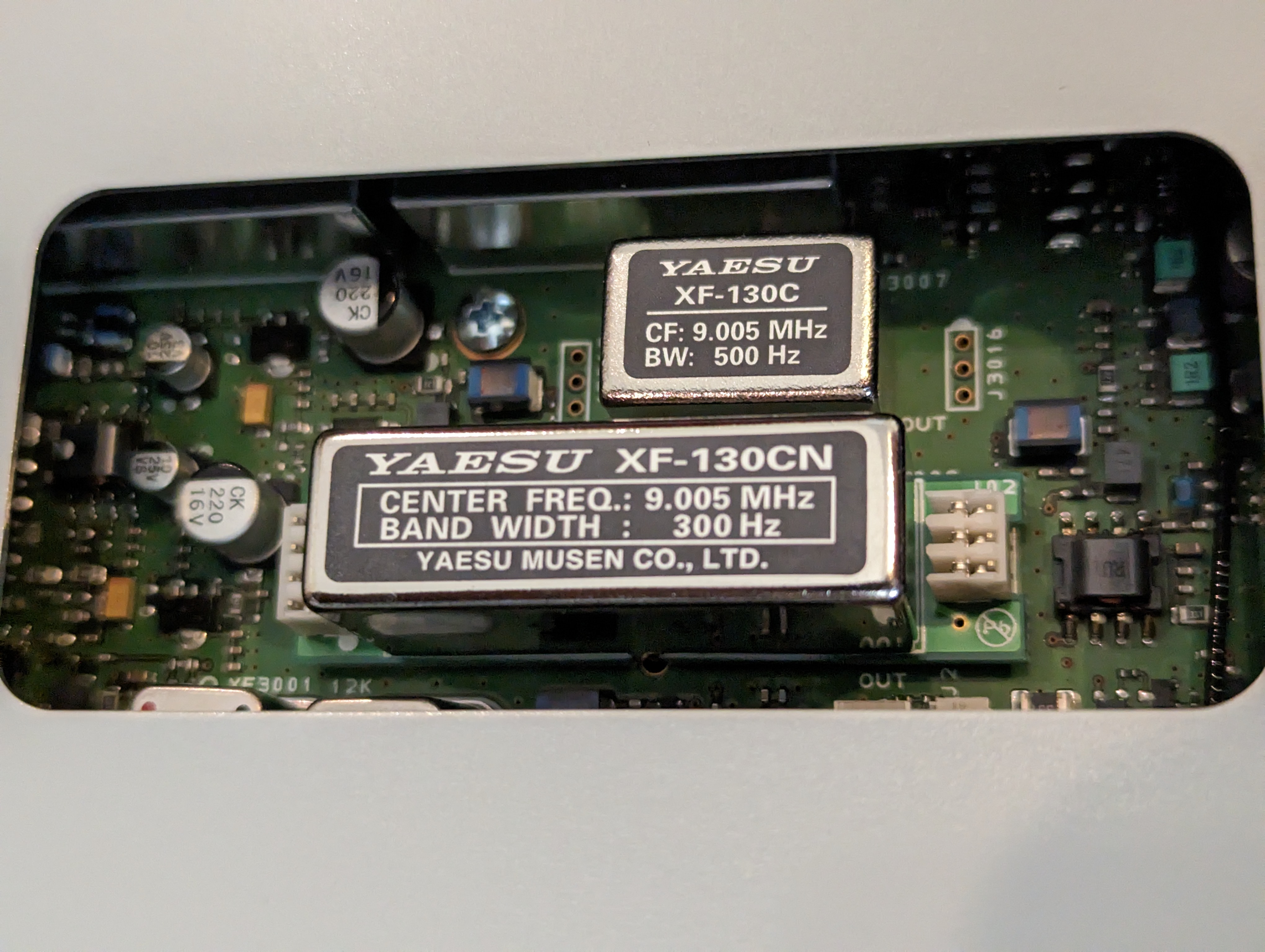
The 300 Hz roofing filter is twice the size of the 500 Hz filter so it must be twice as good right?
If you casually switch back and forth between the two filters on a noisy band, it sounds like the 300 Hz filter markedly improves selectivity and quiets the noise. But try this: Select the 500 Hz filter and narrow the bandwidth (using the bandwidth control) to 300 Hz, then switch to the 300 Hz filter.
When you digitally narrow the bandwidth of the 500 Hz filter to 300 Hz you will "hear" the same reduction in noise as you have cut out 200 Hz of higher frequency sound. Engaging the 300 Hz filter lowers the volume a bit (3-6 dB) due to insertion loss.
So what you are actually "hearing" when you switch back and forth between the filters without changing the digital bandwidth is the reduction of the higher frequency noise that can be accomplished using the bandwidth control alone with the 500 Hz filter.
So, from a selectivity standpointthe 300Hz filter doesn't gain you anything over using the digital filtering with the 500 Hz filter. The real benefit should come in the form of adjacent signal rejection. So let's look at that.
In the video below I demonstrate the signal rejection of a 40 dB over S9 adjacent signal to a weaker S3 - S5 signal.
From the video you can hear that there is a very small demonstrable difference in strong signal rejection when using the 300 Hz optional filter, but the difference is so small that I doubt many of us would find practical benefit over simply narrowing the DSP bandwidth while using the 500 Hz filter. Even when contesting. The digital filtering built into the FT-DX10 is really, really good when using the included 500 Hz roofing filter alone.
Yes, I spent the $200 for the optional filter thinking it would help, but I wished I had known what I do now. I would have $200 for some other nifty radio gadget to spend instead.
That's all for now.
Lower your power and raise your expectations
Richard AA4OO
Yaesu FT-DX10
Shiny new Rig -- Yaesu FT-DX10
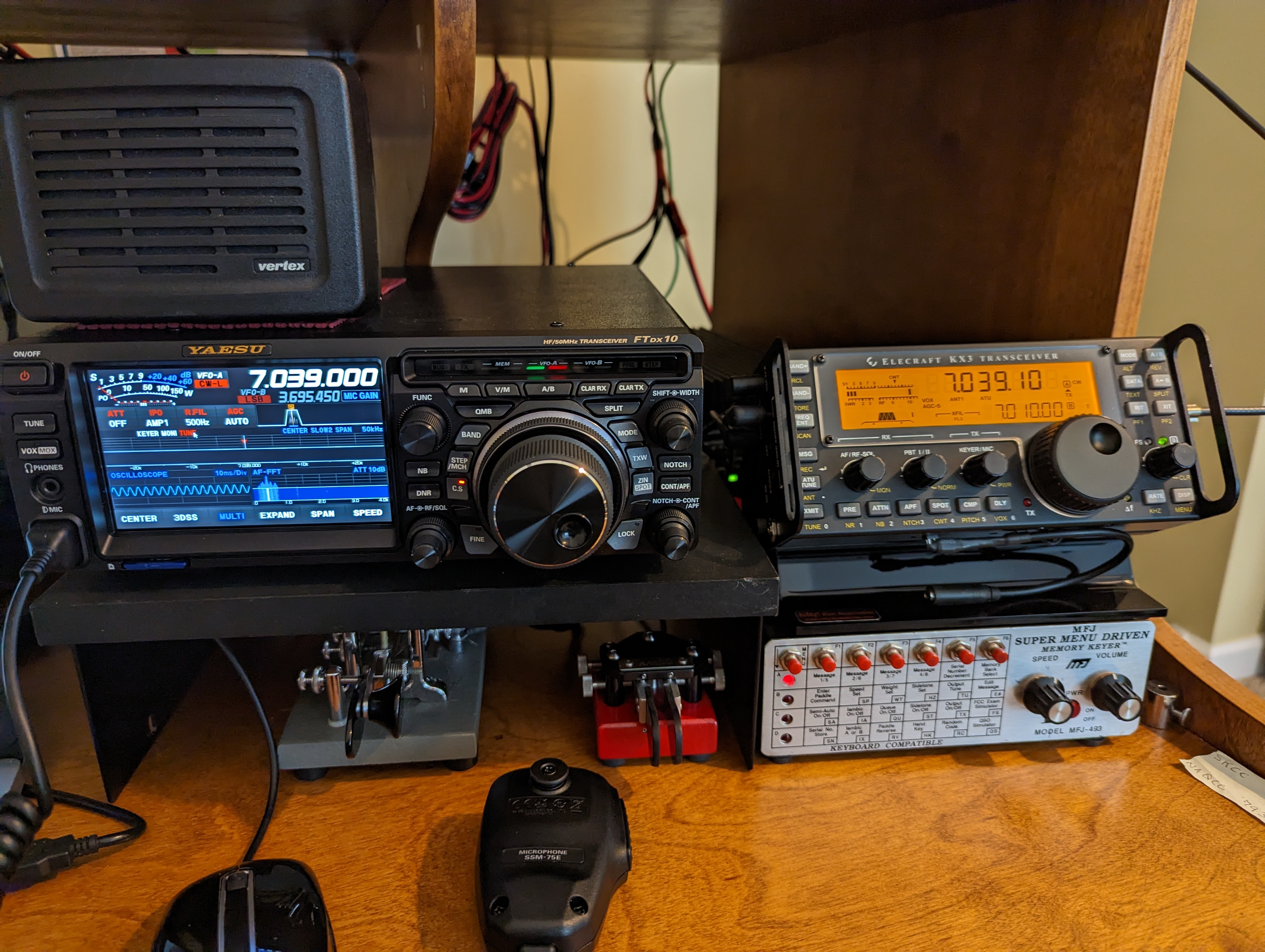 |
| FT-DX10 next to the KX3 |
Initial Impressions
In Use
Audio
Button mashing
Features
Nits
Conclusion
GAS is Rearing its Ugly Head
GAS - Gear Aquisition Syndrome
I have some excellent radios. I have a KX3 that does everything including ironing my pants (well almost) and a Ten-Tec Eagle that has the smoothest CW anyone could ever want. I also have old crumugeonly radios that require the patience of Job to operate. I've been well pleased with my collection of RF generating and receiving gear for quite a while. However, my Eagle is showing its age. I had to recently replace its T/R relay and the encoders need some cleaning, but it still sounds beautiful.
The problem is these newfangled rigs with their dang, pretty front panels providing information overload with aluring displays of 3D waterfalls and teleporter controls (maybe I mis-read that last one in the specs). Many of my QSOs now are with operators that have shiny new rigs. It's just not fair that I'm staring at a segmented LCD display... or in the case of my GRC/9, the front panel equivalent of a Slide Ruler.
 |
| The GRC/9 has the operating interface of a Slide Ruler but wow it's fun to operate... slowly and noisily |
 |
| The KX3 interfaces wonderfully to my Computer but it looks dated |
Surely ham life must be better when I can gaze at the equivalent of a smart phone on the front panel when using the oldest operating mode known to man?
The Genesis of "Want More"...
In preparation for the upcoming camping season in our RV, I wired a spare 12v 25A circuit in the camper's inverter to bring 12v rig power to the dining table, and co-opted the 75ohm cable running to the cable TV output outside the camper for watching TV (why would anyone watch TV outside the camper). That cable TV output now takes my antenna connection out of the camper without drilling any holes. I bought a stellar thing called a "flagpole buddy" to hold my 30 foot telescoping mast on the ladder and wallah, I have a portable Ham shack. I was using my Ten-Tec Eagle on the dining table, and my wife was not-enthused with having half of the dining table consumed by my bleeping radio. I assured her I'd set it on the seat when not in operation, but I still received "the look".
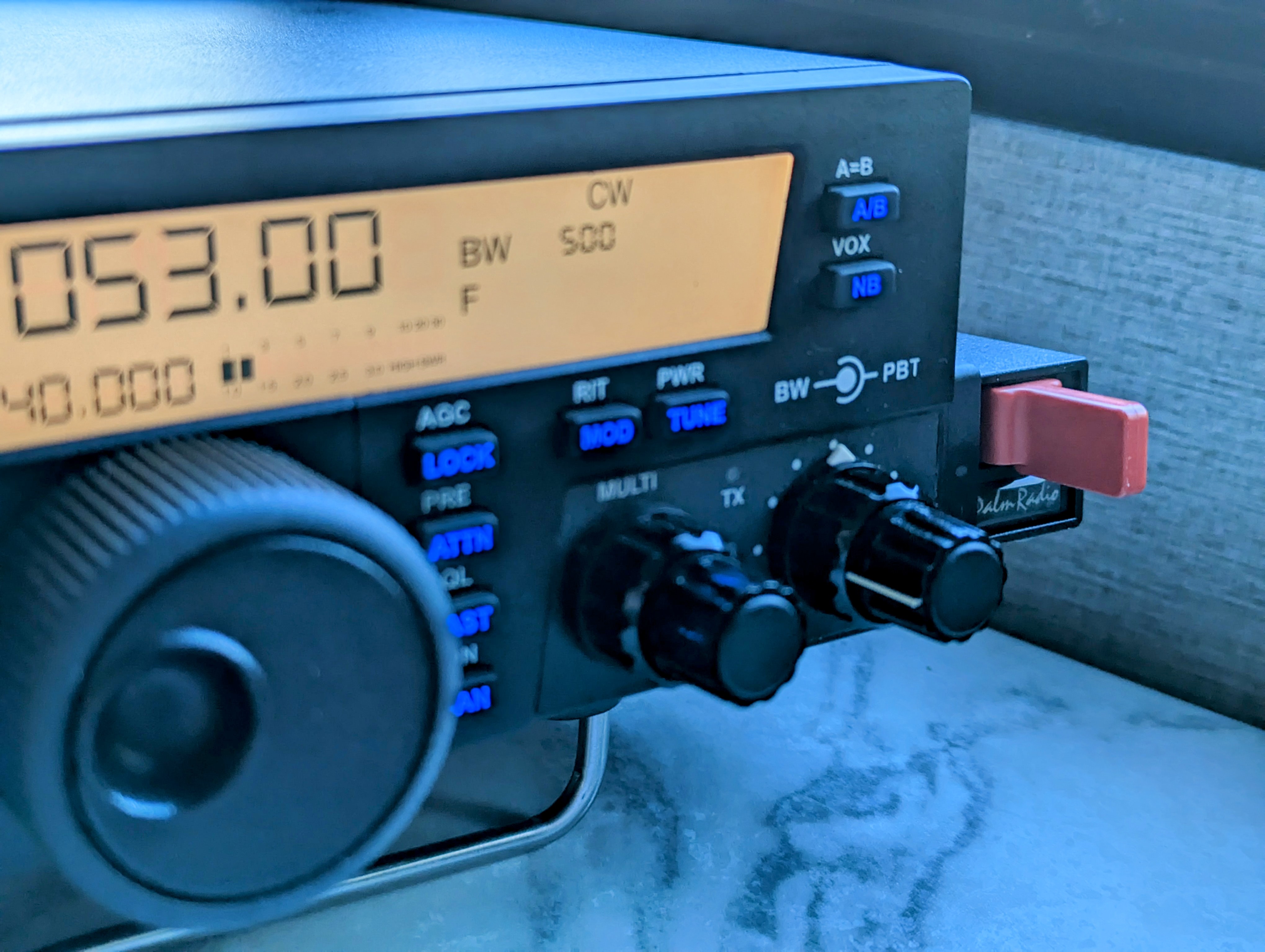 |
| The magnetic in the Palm Radio Paddle attaches to the side of the Eagle when operating portable |
 |
| Flagpole buddy holds the mast extending up to 35 feet |
My KX3 would take up less space than the Eagle but it's a pricey little thing to leave in the camper, and I primarily use it now as my primary station in my home shack now because it's wired up to the computer using HDSDR to provide a panadapter display.
I convinced myself that the KX3 should stay in the Shack. Sometimes I do raise my power beyond QRP if the other station is struggling to copy me and as I'd be operting from a compromised antenna I wanted a rig capable of QRO, when necessary.
So being the wise and kind husband that I am; I started looking for a small, portable, inexpensive radio capable of QRO. All this was to please my wife of course.
I used to own a Yaesu FT-857 that I kept in my truck, but it was terrible at CW (IMO) and that rig seems to be pretty rare now... After considerable searching I settled on a Yaesu FT-891. They had good reports and I could separate the face and it would take up very little room on the table. Plus it had a band-scope of sorts (ah shiny). But alas, I couldn't find used ones that didn't look like they'd lived under the seat of an off-road vehicle racing in the Baja, and the new ones are out of stock everywhere. All that web searching kept popping up the rigs with the pretty front panels. Google decided it needed to serve me advertisements of pretty radios everytime I opened any web site.














