Author Archive
 Thank you Pietro and Bruna!
 February 27th, 2014 |
  Author: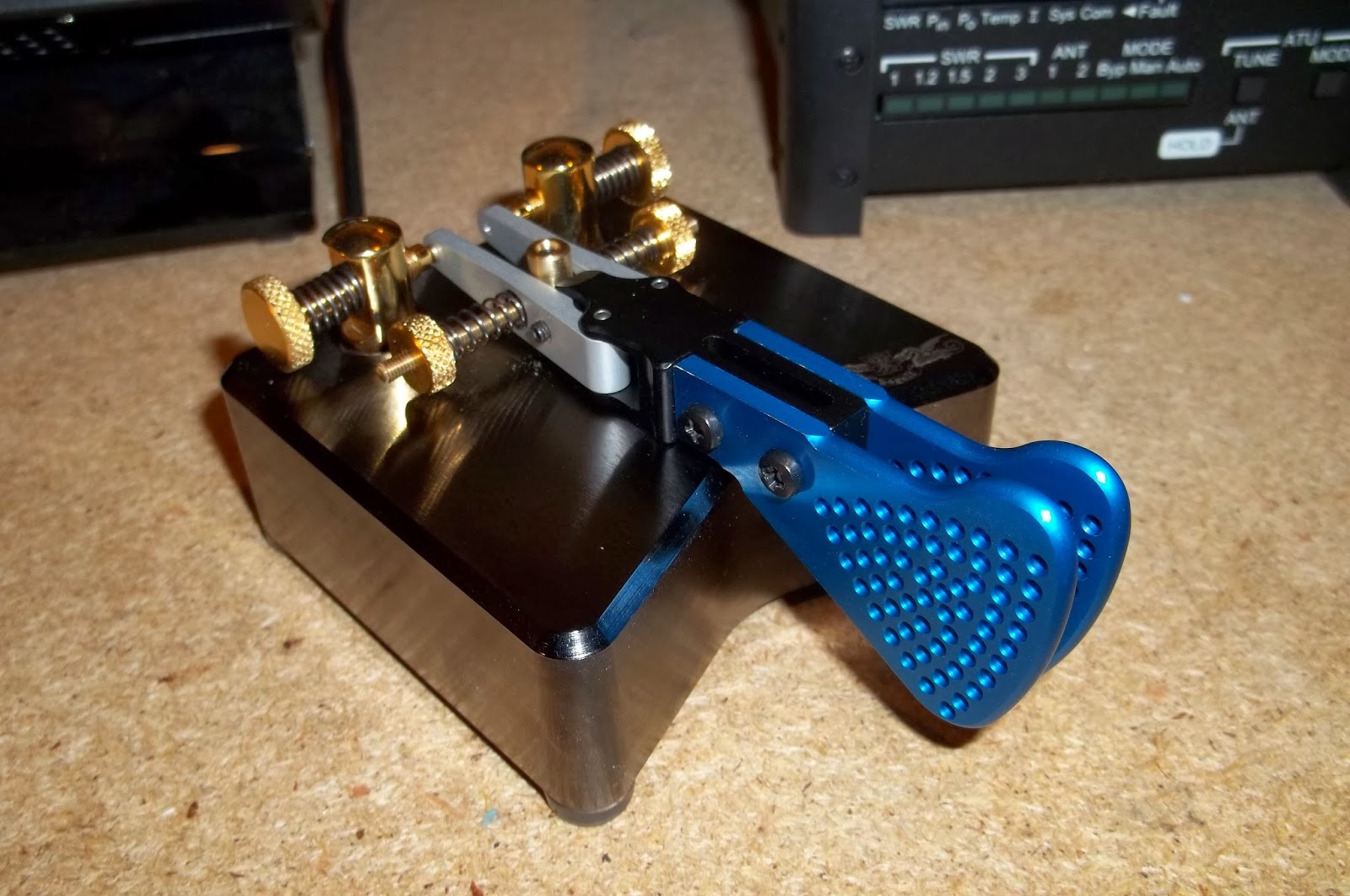
Thanks for the sexy, royal blue aluminum finger pieces! I removed the black plastic ones and put these on. Oh, and by the way, they also sent me a spare pair of black aluminum ones, too!
72 de Larry W2LJ
QRP – When you care to send the very least!
I guess I am not the hardiest individual
This past weekend, we enjoyed some temperatures in the upper 40s and lower 50s (9 to 12C) and we had a lot of snow melt. I’ve even seen some robins hopping about – a sure sign that Spring is on the way. These Polar Vortices that we have been enduring, bringing bone chilling cold and snow down into our midst have sure taken a bite out of my lunch time QRP operating sessions.
I guess I am not the hardiest individual. While I love QRP and CW, and getting on the air as much as I can, I do not cherish the cold weather. I have not been on the air at lunchtime since last December. Way back then, daytime temperatures were tolerable, and I didn’t mind sitting in the car and pounding brass. It was chilly, but not mind numbingly cold.
The past few Winters spoiled me. I look back at my logbook, and I see that there were actually days that were so mild in January and February, that I actually spent some lunch hours out of doors in the local park! This year, that would have been the height of insanity. Hating the cold weather as much as I do, even Amateur Radio is not enjoyable for me if I am not comfortable. Operating under adverse conditions during an emergency is one thing. Doing it when you’re supposed to be just having everyday fun is not my cup of tea.
The good news is that, if the weather prognosticators are correct, we should be heading into more normal temperatures come maybe the second week of March. So even if it isn’t balmy, it will be more than warm enough to head out to the car for some daily lunch hour QRP. The old 60’s song rings true – “Don’t it always seem to go that you don’t what you’ve got ’til it’s gone?” I really miss my daily fix of QRP.
72 de Larry W2LJ
QRP – When you care to send the very least!
Between a rock and a hard place
That’s where I found myself tonight, as one of the two Foxes in the 40 Meter QRP Fox Hunt. As a Fox, you try to find a relatively clear frequency, where you can work the Hounds rather easily. And that’s precisely what I thought I did tonight. I found a frequency, called “QRL?”, and hearing no response in the negative, I began working Hounds. For the first few minutes, things were going great. Then I found myself giving the Fox exchange to stations who weren’t coming back to me.
After that sinking-in-the-pit-of-my-stomach “uh oh” feeling quickly passed by, I snuck a peak at the Cluster, to realize that I was being encroached by one of the W1AW/X pileups! A lot of those stations had no interest in me, and probably couldn’t even hear me, for that matter.
So I quickly QSYed to calmer waters and decided to operate simplex instead of split. Even though there was a lot of QRM and the band was treating me to a lot of QSB, a very quick after-the-event count shows that I handed out close to 60 pelts.
A post-hunt e-mail from Todd N9NE informed me that I had managed to position myself right in between W1AW/8 and W1AW/4. I’m glad I didn’t know that! Some things you’re better off not knowing, and I think that is one of them.
My ears hurt a little bit from trying to pull out some weaker call signs from among the loud QRM, but I am pretty satisfied by my effort. I wanted to work at least 60 stations going in, and I made that a goal for myself. Looks like I just made it.
72 de Larry W2LJ
QRP – When you care to send the very least!
Location, location, location
I might not be in the best location for the QRP Fox hunts, but I do have to admit that I am blessed when it came to achieving QRP DXCC. Those of us in the Northeast definitely do not have the edge in Fox hunting that our fellow Hounds from the Midwest have. When you look at the Hound’s scores, the guys “who get ’em all” are usually, if not exclusively, from the middle of the US. But those of us in the Northeast, and on the East coast in general have the edge when working Europe and the Caribbean. I believe that Jim W4QO in Georgia posted that he worked over 100 different DXCC entities just this past weekend. That’s nothing to sneeze at and is a great accomplishment!
But if your a new QRPer you may be saying to yourself, “That’s all well and good, but I’m just starting out and I don’t have a tower and a beam or a fancy antenna farm.” I’m not saying that those wouldn’t be helpful, but you can achieve a lot with simple antennas. I posted yesterday that I worked about half a DXCC award this past weekend. I did it with a Butternut HF9V antenna and a home brewed 88′ Extended Double Zepp antenna. These antennas are surely within the reach of beginner QRPers (HOAs notwithstanding). With 5 Watts, I worked (in no particular order):
Estonia
Norway
France
Czech Republic
Belgium
Columbia
Italy
Slovenia
Bulgaria
Poland
Spain
Bahamas
Puerto Rico
The Ukraine
European Russia
The Azores
Mexico
Brazil
Chile
Morocco
The Turks & Caicos
The Cayman Islands
Alaska
Madeira Island
Portugal
US Virgin Islands
Sweden
Nicaragua
French Guiana
Lithiuania
Aruba
Curacao
Anguilla
Finland
Atigua & Barbuda
England
Scotland
The Balearic Islands
Germany
Jamaica
Belize
The Canary Islands
Bonaire
Belarus
Denmark
That’s 45 DXCC entities in just around four hours of operating. So I don’t want to hear about how QRP DXCC is hard or impossible. I’ve done it and believe me, if a ham and egger like me can work 100 different countries using 5 Watts, then you can do better! And when you come down to it, my performance this past weekend was really nothing to crow about. If you want to read a great story, then make sure to read Phil AK2MA’s recount of his ARRL DX Contest effort – 150 QSOs and 57 countries worked with an INDOOR Buddipole on just one band (15 Meters)! THAT my friends is an achievement!
There is a price to pay, however, and that is you’re going to have to work on your Morse Code. Life is not a dish of assorted fancy cashews. QRP DXing and CW go together like hand and glove. Some of these contest stations were sending so fast that it took me 7 or 8 listens to get their calls right. Normally I am comfortable copying up to 25-28 WPM; and on a good day, I can stretch that to 35 WPM if the code being sent well and the exchange is short (like a contest exchange). Some of these guys were sending around the 40 WPM stratosphere and I had to just pass them by. But with dedication and practice you can get to the “mere human neighborhood” of 25 WPM without going crazy.
And that’s part of what this is all about, too. Constantly improving your station, your antennas, and yourself!
72 de Larry W2LJ
QRP – When you care to send the very least!
Up and running
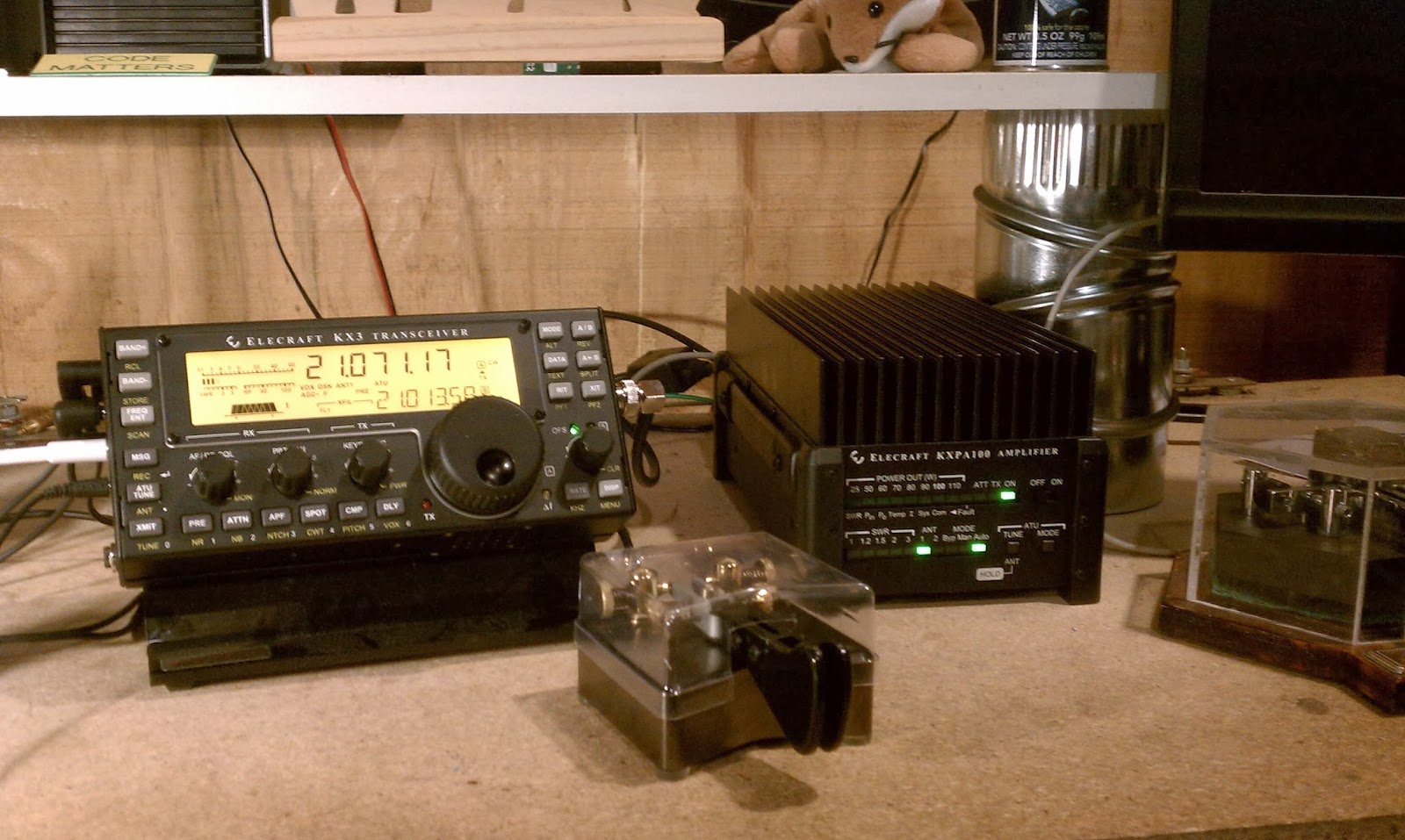
Today, after completing a few chores, I finally got a chance to assemble my KXPA100. For the record, I did not pre-download the assembly or instruction manuals. Maybe I should have, but I didn’t. I decided to just wing it and go with the flow after opening the box.
A few guys on the KX3 e-mail reflector claimed an assembly time of two hours. I completed mine in just a little over one hour. Basically, all you’re doing is securing the autotuner board to the amplifier, and then putting the housing on. Not much work, easy as pie to do, and you end up saving a couple hundred dollars.
I learned a few things the hard way:
1) Don’t assume you have the latest firmware in your KX3 just because you normally upgrade often. I thought I had the latest version, only to discover I didn’t. When I couldn’t get my KX3 to go above the 12 Watt level, I knew something was wrong. A firmware update took care of that.
2) Keep the KXPA tuned “off”. Sounds strange, doesn’t it? There is an “On/Off” switch on the KXPA100, but it is meant for when you are using the amp with a radio other than a KX3. If you use a KX3, it totally controls the amp. Turning on the KX3 turns on the KXPA100. Turning off the KX3 turns off the KXPA100. If you have the “On/Off” switch turned on while using the KXPA100 with a KX3, the LED indicators don’t work properly. You may set the KX3 for, say 75 Watts – but the LED indicators won’t light up properly. Turnng the switch off remedies that.
Item 1 was prominently mentioned in the manual. I had assumed something, and you know what happens when you assume. I didn’t see anything about the “On/Off” switch in the manual, but admittedly, I glossed through it and did not read it as carefully as I should have – again, my fault.
It is working properly, and I did give it a trial run my making some ARRL DX Contest QSOs at higher power just because I could – not because I needed to. I think in most cases, QRP would have worked. Tomorrow, however, I want to take the amp on a “shake down cruise” and really give it a go – just to see how these boots feel and break them in a bit.
Not that I am abandoning QRP – by no means. For 95 to 99% of the time, my KX3 will continue to purr along at the 5 Watt or less level. But having this amp sure would have been handy a week ago for adding FT5ZM to my log. I’m enough of a DXer to regret having missed that opportunity.
73 de Larry W2LJ
QRP – When you care to send the very least!
Snow bound – not quite.
Yesterday was a day spent working from home – as much as I could via my company issued laptop. We received about 14 inches of snow.
I am back at the office today and am looking forward to the upcoming three day weekend. There’s lots of Amateur Radio stuff to look forward to.
1) This weekend is the big ARRL CW DX contest.
2) This weekend is the monthly Polar Bear Moonlight Madness Event
3) This is the weekend my KXPA100 gets built and put online.
I am NOT looking forward to another 2-4″ of snow tomorrow, along with the necessary snow removal chores. BUT Spring is closer than farther away at this point, so you have to keep your eyes on the prize.
I did manage to get on the air last night for the 80 Meter QRP Fox Hunt and bagged both Foxes – Dave N1IX in NH and Rick NK9G in WI. I was able to get on between bouts of thundersnow. Yes, that’s right – thundersnow. As the big Nor’Easter rotated around, the rain that had started falling changed back to snow as the low pressure system started siphoning cold air. The warmer/colder air mix started a little battle which generated a few instances of lightning and thunder during a snow event. Not common, but not the rarest, either.
I do have to admit that I was spoiled rotten by the last few years of drier, milder Winters that we have been experiencing. This year, we have made up for that in spades, and I am more ready for Spring than I have been in a while!
72 de Larry W2LJ
QRP – When you care to send the very least!
2 Foxes in the bag
OK, so I couldn’t get into FT5ZM’s log … but I did snare both Foxes in the 40 Meter Fox hunt tonight. So I guess not all is lost. The fact is that both Paul K4FB and Kevin W9CF have fantastic ears, and I owe my call in their logs to that fact.
I used my new Begali Simplex Mono as my CW sending weapon of choice. It took a lot of trial and error over the last few days to get it set up the way I wanted. But now that I have it set up to my liking, I have to say that, “Yes, Begali keys ARE what they are cracked up to be.”
The key is silky smooth with a minimum of movement. It feels as close to using a touch paddle as you can get without actually using one. I can send at about 25 to 28 WPM effortlessly, even though I prefer my cruising altitude of about 23 WPM. The paddle’s sexy good looks don’t hurt, either. I would not hesitate recommending a Begali to anyone.
And to think, I bought the econo model. I can only imagine how the luxury version drives!
72 de Larry W2LJ
QRP – When you care to send the very least!













