Author Archive
 Back to front
 June 13th, 2010 |
  Author:
  Last night for the first time in a very long time I operated RTTY. I made ten contacts in the BARTG RTTY 75 contest. The reason was that Elecraft had released a beta version of firmware for the K3 that enhances the built-in DSP modems to support the 75baud RTTY mode that was being used in the contest. Now that the K3 also supports a way to get decoded text into a computer program I thought it would be fun to give it a try.
For those unfamiliar with the K3, the transceiver boasts a built-in Morse decoder plus DSP based modems (encoders and decoders) for PSK31, standard 45.5baud RTTY and now 75baud RTTY. As the K3 doesn’t allow direct input from a keyboard, the usual way to use this facility is to send text using a Morse paddle and read received text on a scrolling 7-character window of the K3 display. However, using a program like KComm it is possible to send and receive text using software commands over the CAT interface as well. Since, like most things that require good motor skills, I’m hopeless with a paddle (or key) at anything much above 12wpm, that’s what I did.
I installed the new firmware and it decoded 75baud RTTY signals perfectly, so I waited for the contest to begin. After it did, I soon found that although people were hearing me they weren’t decoding me. I got lots of QRZ?, ??????? and SRI NO PRINT. I started to get frustrated and began thinking that RTTY is an obsolete mode that has no place in the 21st century because I know I could have made contact with these stations easily using PSK31 and a fraction of the power.
I decided to switch to soundcard mode and use Fldigi to try to make some contest contacts, and then found that people were replying to me on the first call! So clearly there was something wrong with the RTTY being generated by my K3.
This morning I tried receiving some of my transmitted RTTY using the FT-817 and Fldigi on my NC-10 netbook. When the RTTY was generated by Fldigi it was received perfectly. However when it was generated by the K3 I received gibberish unless I switched the K3 to REV DATA mode (i.e. reverse sideband.) Since I was receiving the RTTY perfectly OK using the normal sideband I presume that the K3’s transmitted RTTY was reversed. I have reported it to Wayne and await comments.
Unfortunately I did have some problems with KComm as well. After a while, it started aborting the transmission of any macro after the first few diddles. Like many programs, it has grown to the point where it is hard to understand what is going on any more and my interest in programming has fallen off a cliff in the last few months. I don’t know if I will ever get around to fixing the problems and releasing the final version. I do like using it, and KComm is the only program that really supports the K2 and K3 properly because it doesn’t treat them like a Kenwood TS2000 (whose command set it nominally shares) but was written to take account of the way these radios actually work.

QRP antenna
I bought a copy of Practical Wireless today and noticed the following in the Waters and Stanton ad inside the front page.
 It isn’t often words fail me, but three hundred quid delivered for a hand held QRP antenna?!? I guess it would perform about as well as my home-made Wonder Loop.

Avoiding the Microsoft Tax
I need a new office notebook. Yesterday, while working on something a thin bright blue vertical line appeared on the screen. It’s still there this morning. I guess the TFT display is going on the fritz. Well, this Toshiba Satellite M60 is 4 1/2 years old and has been in heavy use 10 hours a day 5 days a week for nearly all that time, so I can’t complain. Time for a replacement. The trouble is, I use Linux on my work PC and it doesn’t seem to be possible to buy a high-spec laptop with Linux ready installed and working on it.
 Obviously, I’d like to avoid paying for a copy of Windows I’m not going to use. If you’ve ever seen it on sale, you’ll know that the cost of a copy of Windows is quite substantial. Since, thanks to Microsoft’s obsessive copy protection, it will be an OEM copy locked to the hardware and without installation media I won’t even be able to install and use this copy under VirtualBox if I want to.
But also, as it’s a work machine, I’d like to buy one on which the operating system is supported and all the hardware works with it. I’ve installed operating systems far too many times in my life to have any enthusiasm for doing it one more time, and I know from experience that laptops often contain hardware that isn’t supported out of the box by Linux.
When we bought a new laptop for Olga a couple of years ago I bought a budget HP laptop that came with Windows Vista – which ran so slowly it took two hours just to finish it’s automated initial setup routine. I installed Linux but had an anxious couple of hours as I couldn’t get the wi-fi adapter to be recognized. I did in the end, and the chances are that any problems with whatever system I got this time could be resolved after hours of ferreting through support forums. But that long ago ceased being fun and I would really prefer to avoid it.
However, it is virtually impossible to buy a PC or laptop with Linux installed and supported. Dell appears to offer a small selection of laptops preinstalled with a long superseded version of Ubuntu. There is also a firm called The Linux Emporium that offers a limited range of Lenovo laptops with Ubuntu installed on them. But they have nothing that meets my spec. This old Toshiba has a 17in display with WGXA+ 1440×900 resolution and I’m not going to settle for anything smaller. So it seems the only way I am going to get what I want is to buy the laptop I want, pay the Microsoft Tax, throw away Windows and do my own Linux installation.
Is it any wonder that Microsoft enjoys such a virtual monopoly when people who buy PCs don’t even know there is an alternative? Why hasn’t the EU done something about this? It has taken months and cost millions to force Microsoft to install a screen that lets people choose what web browser to use, despite the fact that a) the browser market already has healthy competition and b) switching browsers later on if you want to isn’t a problem. But it has done nothing about a situation that forces people to pay for a Microsoft operating system even if they know enough not to want one. Even if computer manufacturers don’t want to offer Linux because they don’t wish to support it, they should at least be required to offer the OS as an optional extra so those who don’t want it don’t have to pay for it.

KREF3 let-down
I often use WSPR, the very narrow band, low power, automatically reported beacon mode, which operates in a 200Hz wide band and reports the frequencies of received stations to 1Hz accuracy. I also sometimes use other digital modes where I want to be able to set my transceiver to a specific frequency with confidence. So one Elecraft K3 add-on that I had been eagerly awaiting was the KREF3 board that was supposed to allow you to lock the K3 reference oscillator to an external frequency standard. In fact, readers of this blog may recall that only a couple of weeks ago I posted an item about rubidium frequency standards being sold on eBay.
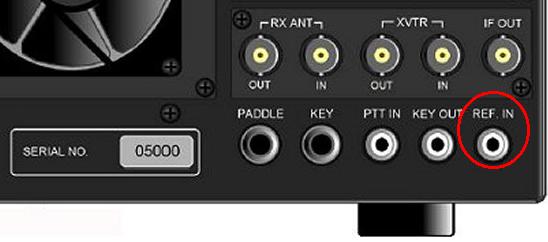 A few days ago Trevor G0KTN, who is actually the person responsible for turning me on to WSPR in the first place, posted a question to the Elecraft reflector asking for a comment from Elecraft as to when the KREF3 might be available. When no answer was received he asked again, and eventually received this reply from Eric WA6HHQ: The KREF3 is not in current planned development. I thought we had removed the references to it in all of our docs. Is it still showing up somewhere?
It is still showing up in the copies of the manuals I have. There is still a labelled, blanked-off hole for it on the back of my radio. More importantly, it showed up in the specification and brochure that Elecraft produced at the time I ordered the radio.
In the past I have been flamed quite harshly by members of the Elecraft fan club for suggesting that Elecraft had broken promises or even acted dishonestly by failing to provide advertised features. But is it being honest, when deciding not to provide a feature that was initially advertised and promised, to quietly delete all references to it and hope no-one notices? Perhaps Elecraft figured that since most hams are in their 60s or later we all have Alzheimer’s and will have forgotten the KREF3 was ever offered.

PLT DX Contest
For someone as plagued with HF band interference as me this sounds like a sick joke or an April 1 spoof that passed it’s read-by date. The Electromagnetic Compatibility Industry Association (bet you didn’t even know there was one) has announced a contest to see who can detect interference furthest from a power line adapter installation. Yes, really. There are two prizes: the Long Distance Award (LDX) for the person who detects interference the greatest distance from the installation, and the Most Typical prize (MTY) for the entrant whose detection distance is closest to the median value.
Well I suppose when interference blots out HF entirely we need to use our radios for something. I believe a CQ WW Wi-Fi contest in the offing. You collect SSIDs for multipliers. Double points if the network is unencrypted.

Small minded Britain
I’m sorry for another non-radio related post but as someone whose wife is an immigrant from outside the EU I can’t let this news pass by without comment. The British government has announced today that it is bringing forward measures to require people from outside the EU who marry British citizens to demonstrate a knowledge of English in order to obtain a visa. I think this is discriminatory, insulting and a denial of what ought to be a basic human right to be able to live in your own home with the person you have chosen to marry.
Although Olga knew sufficient English when she came to the UK to have met the requirement had it existed at the time, I know of British men who have married women they met whilst working or holidaying in Russia, China or Asia who spoke little or no English at the time they came here. I’m sure most of them learned the language after they got here, which of course is now (quite rightly) a requirement for gaining British citizenship. But there is a world of difference between allowing someone to learn the language in their own time, if they choose to (after all, gaining citizenship is not essential to live in Britain) once they are here, instead of compelling them to do so before they are allowed to live in the country that is home to the person they married. It’s the difference between treating someone with respect or as a second class citizen.
I’m sickened by some (the majority, actually) of the small minded comments supporting this measure on the various blogs and news media forums. It seems that most people in this country view all immigrants as idle spongers who contribute nothing and only come to the UK to claim benefits and become a drain on public services. I’m sure that’s true of some, but all of those I know are hard working and pay their taxes. I also know of many born and bred Brits who prefer living on benefits to getting off their backsides and earning a living. Perhaps we should cut benefits and make them less attractive?
If it’s OK to stereotype immigrants then I guess it’s also OK to stereotype working class Brits as lazy uneducated whingers who think the world owes them a living just because they are British, and who complain about immigrants taking their jobs when the truth is employers prefer immigrants because the British are idle, useless and far too prone to “take a sickie.” There was a TV programme a couple of months ago where firms that employed East Europeans were persuaded to hire some unemployed Brits and they either were late for their first day, called in sick, or had egos that couldn’t take being shown up for being too dumb to do even a simple manual job properly. I’d employ a Pole instead of a Brit any day.
There is a latent racism in British society which is pandered to by the right wing mass media, with the result that the government can get away with policies like this that go completely against the old British tradition of fairness. It’s perfectly reasonable to expect that someone coming to live in Britain has a means of support, whether that is a Swiss bank account, a job or a husband. But to keep people out because they can’t speak the language when they have a husband to support them (spouses from outside the EU aren’t even allowed to work for the first two years in another nonsensical piece of regulation) is pure discrimination which I’m sure we’d be up in arms about if it started to be applied when we want to live in their countries. It’s well known that the British are useless at languages. When in Rome – or Paris, or Madrid, or Moscow – JUST SPEAK ENGLISH LOUDER.

About ads and websites
This morning I see that Peter G4NKX has written on his blog about “Personal Web Targeting“. Peter wrote it after noticing that ads were appearing on various sites that were related, not to that site, but to things he had previously been looking for. These days I earn my living from internet marketing, so it is something I know a bit about. I was going to comment on Peter’s post but it would have been rather a long comment. In the past I have been asked by a couple of my readers to write about topics related to running a website and blog but there have always been other topics that took priority. Someone even slammed my blog’s rating at eHam because “the ads were annoying.” So this is perhaps a good opportunity to tackle this topic. If it is of no interest to you, you may as well skip the rest of this post.
First, why ads on websites? Put simply, there’s no such thing as a free lunch. Web hosting costs money. If you run a professional site and need to employ people to run it, paying their salaries costs money too. Sites like Fred AA7BQ’s QRZ.com cost a lot of money to run and the ads allow people like me to access it for free. If you don’t like the ads, Fred provides the option to remove them by paying a subscription. If you don’t want to pay, you also have the option of not visiting QRZ.com. I certainly don’t expect Fred to pay the running costs out of his own pocket. The same goes for most of the sites you visit on the internet. If there weren’t ads, most of the web wouldn’t exist and a lot of the rest would be subscription-only, as the websites owned by Rupert Murdoch’s News Corporation have recently become. It will be interesting to see where that ends.
I’ve sometimes been asked why there are ads on my website. I’ll be as brief as I can. For best part of the last 20 years I have worked freelance. As the demand for my services declined due to recession, people who hired me moving on and so on, I was forced to look for new ways to make money. I stumbled into internet marketing more or less by accident and since my ham radio hobby site was one of my most popular sites I thought I’d try advertising on it. I certainly couldn’t live off the income generated by this site, far from it, but during times when my income only just paid the bills the fact that my hobby made a bit of money allowed me to resist selling my gear and even make the occasional new purchase.
Currently my business website makes us a comfortable living. But as I will eventually be retiring without the benefit of a final salary or inflation-linked pension scheme, in fact without much of a pension at all, I will soon be back in the situation where hobby expenditure is a luxury. So I expect I will be trying to make pocket money from my hobby right up until the day I finally become a silent key.
The issue Peter raised in his post was about ads appearing that related to something he had previously searched for, not the site he was currently on. Though he doesn’t mention it specifically, I presume he is referring to Google, which recently changed the way its context based advertising service AdSense worked. Previously, the ads that were displayed on a web page through the Adsense program were related solely to the content of that web page. When I first tried AdSense on my sites I felt that it actually enhanced the value of the pages. I have found out about radio products I might otherwise never have known about through the ads that have appeared on my and other ham radio web pages, so on balance I consider AdSense a good thing.
For the last couple of years the world has been in recession. The number of internet advertisers and the amount of money they have to spend has fallen. So Google has looked at ways to try to maintain advertising revenues. It has gone into partnership with DoubleClick, a long established web advertising company, to create what it calls interest-based advertising. Essentially it gets your browser to store a piece of information called a cookie when you visit a site, containing information about the topic of that site. When you visit another site that displays Google ads it can display ads related to the previous topic rather than the topic of the current site if the previous topic’s ads are likely to be more profitable to Google (and the site owner.)
Personally I think this is a step backwards. I would prefer people who visit my site to see radio-related ads primarily, not ads about bathroom fittings or whatever else they have been looking for. I haven’t observed a significant increase in advertising revenue since Google introduced its new policy. But in this new tough economic environment where people have to justify every cost website owners have to take what the advertisers will give them. I don’t think the subscription-only model is going to work for News Corporation, it certainly isn’t an option for hobby sites like mine (or even QRZ.com) and I am not going to forego my small but still worthwhile advertising earnings just because some people consider that advertising invades their privacy. You open a newspaper or watch TV and see ads about all kinds of things that aren’t relevant to what you’re reading or watching. Why does it become such a big deal when it’s on a web page?
Google has a Privacy Center which sets out its privacy policy with regard to advertising and also provides a link to the DoubleClick privacy policy. There you will find an Opt Out button that allows you to opt out of interest-based advertising or alternatively to set preferences for the types of ads you don’t mind seeing.
There are also software tools including plug-ins for Firefox that can block ads from appearing in your browser. However I hope you don’t use them. Personally I regard blocking the ads that help pay to keep a site running as a bit like stealing. As I said earlier, there’s no such thing as a free lunch and every website that you visit for free is costing somebody something to provide it.














