Author Archive
 No comment
 July 6th, 2010 |
  Author:
 I think something must be broken in Blogger. Two people posted comments today, one each to the two postings I made. I know this because I received an emailed copy of the comments. Neither of the comments are showing up in the blog. In the Blogger dashboard, one of the posts shows “1 comment” but when I click on that link I can’t see it.
So, Paul and S.o.a.l., don’t be offended. I didn’t delete your comments.

I don’t belieeeve it!
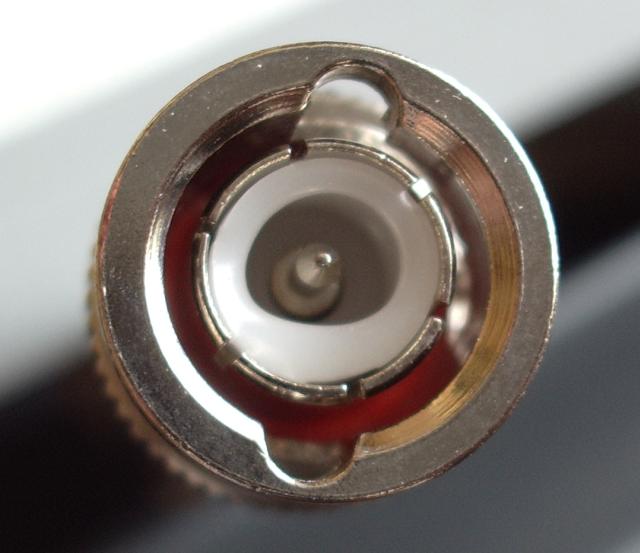 No, this isn’t a post that was meant to go in my other blog One Foot in the Grave. But I just cannot believe the amount of bad luck I have ordering radio goods from suppliers.
A few months ago I wrote about what a difference it made to the effectiveness of helical “rubber duck” VHF antennas if they were tuned precisely to 145MHz and I described how I had tried to lower the resonant frequency of some helical antennas I already had that were too high in frequency.
A few days ago I discovered that Waters and Stanton sell a tunable VHF rubber duck with BNC socket that can be trimmed to frequency by the user. As I have decided to switch completely to BNC antennas on my hand helds I needed another so I decided to order one.
It came this morning, but when I tried to fit it to the BNC adapter on my antenna analyzer in order to start trimming it, it wouldn’t go. When I examined the BNC closely I saw that the insulation had melted and deformed, presumably during the process of applying heat shrink tubing. So it is completely useless! You would have thought an “ISO 9001 Registered Firm” would have heard of quality control, wouldn’t you?
I have written Waters and Stanton a snotty email containing a copy of the photograph asking if they would send me a replacement. Since I have no desire to incur additional expense sending the faulty one back I have also asked how they will reimburse me for the postage.

Save Analogue FM
 Practical Wireless editor Rob Mannion G3XFD has been writing to radio clubs urging members to support a campaign to save analogue radio. However, the radio he wants to save is not ham radio but broadcast FM radio, which has been threatened with closure in the UK forcing users to switch over to the “new” Digital Audio Broadcast (DAB) system.
The much vaunted DAB was supposed to re-invigorate the UK’s radio industry, provide a raft of new and interesting IP based services to audiences, permit the launch of new national, regional and local radio stations and generate new marketing revenue for radio stations. However, DAB is almost dead on its feet, as users have been reluctant to buy expensive new radios which in many cases offer poorer reception and fewer stations than they can get on FM. If this reminds you of something more amateur radio related you can probably guess where I am going with this.
D-Star was supposed to re-invigorate VHF radio usage, deliver a raft of new, interesting IP based services like text messaging, DPRS and file transfer to users, permit international, national, regional and local contacts and generate new revenue for Icom. However it is struggling to gain acceptance as people have been reluctant to buy expensive new radios that will provide access to fewer repeaters and fewer local contacts than they can get on FM and have been underwhelmed by the new features offered. Nevertheless the creeping D-Starization of the VHF and UHF bands continues, with the regulatory authorities now apparently refusing to allow new analogue repeater proposals whilst fast tracking D-Star applications through the system.
It does not seem to me to be beyond the bounds of possibility for the powers that be to decide at some point that there will be a ham radio digital switchover, that all analogue repeaters should be switched off and sections of the bands previously authorized for analogue FM use will be allocated to digital.
Perhaps we amateurs need our own campaign to Save Analogue Radio before it is too late. If you oppose the D-Starization of the amateur VHF and UHF bands, feel free to use the “No D-Star” logo on your website, your forum avatar and anywhere else that people might see it.

Threat to APRS, Echolink, D-Star in New Zealand
Steve, GW7AAV, spotted a news item on the NZART web page which states that the authorities in New Zealand have become concerned about IRLP, D-Star, Echolink, APRS and similar modes as they do not appear to fit within the New Zealand license conditions. Their concerns include the use of unattended transmitters and unlicensed digipeaters for APRS and amateurs based overseas operating a NZ amateur station via the internet.
It’s easy to forget that other countries don’t have such liberal licensing conditions as we do in the UK, although I would point out that operating an Echolink, D-Star, IRLP or packet radio (including APRS) node is not within the standard license conditions here either – you are supposed to apply for special permission. I know there are many who feel that is a good thing, and even that internet linking is not amateur radio and should not be allowed anywhere in the world, at all, but my opinion is that prohibiting it devalues amateur radio.
This policy is probably one of the main reasons why the APRS RF network is broken for messaging as many people (myself included) who are unwilling or unable to comply with the requirements for obtaining permission avoid the problem by operating receive-only gateways. Consequently we have the situation where smartphone-based APRS using mobile internet connections are more useful than APRS over radio.
I certainly believe that the point of our hobby is to use radio wherever possible, but where the internet makes possible something that could not practically be achieved using RF alone I think that we should be permitted to use it.

Riding with Lynn
I’ve just been for a pleasant afternoon drive down to the coast with Lynn, KJ4ERJ, developer of the APRSISCE software, currently on holiday in Spain. No, I didn’t nip down on EasyJet for the day. Actually I was following him on APRS using the Google Street View feature in the beta version of aprs.fi.
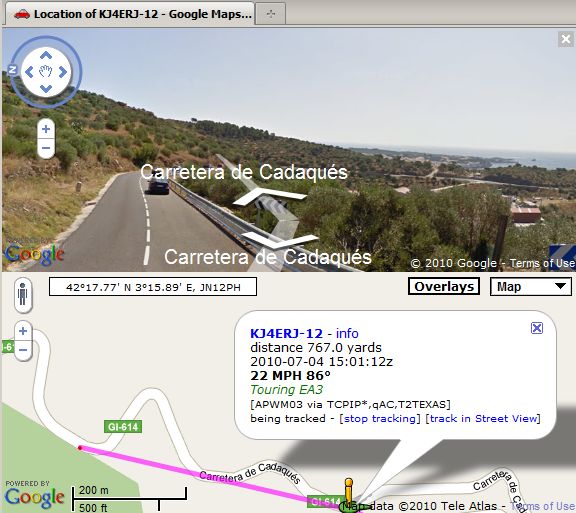 With the new software, when you click on a station you get the option to Track in Street View. If you do then the browser window splits in two, with the top half showing the view the person you are tracking sees, facing the direction he is going, and the bottom half showing the track on the map. It works pretty well. You just have to remind yourself that you are viewing images previously taken by Google, not live images!
This is beta software, so you won’t find it on the regular aprs.fi just yet. But it’s a pretty cool application, I think you’ll agree!

VHF NFD washout
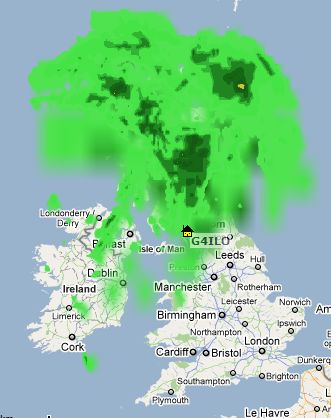 Conditions could hardly have been worse for the RSGB’s VHF Field Day contest this weekend. Yesterday I worked a few southern Scottish portables on 2m and 6m, plus the Lincoln Radio Club station G5FZ/P on 2m, and that was that. There did not appear to be a shred of Sporadic-E on either 2m or 6m, according to DX Sherlock. 6m was so quiet my K3 S-meter wasn’t even moving.
Today when I turned on the radio I tuned both 2m and 6m without hearing a single signal. The map on the right probably shows why. We awoke to heavy rain and gale force winds, and I immediately thought of those poor guys on hilltop sites with their guyed poles supporting their beam antennas. If the wind didn’t force them to take the antennas down I dare say the rain and the poor propagation made them decide they might just as well give up.
This has been a really disappointing year for me too, VHF-wise. After working Spain and Portugal on 2m on two separate occasions last year – the last being exactly one year ago – I improved my antenna by 3dB and my output power by 6dB in the hope of doing better during this year’s season. But I have worked nothing and as far as I know the sporadic-E this year has hardly been heard this far north. DX Sherlock showed that a couple of well-sited northerly stations managed to make a few contacts a few weeks ago and I fleetingly heard a station from Romania complete a contact and call CQ at that time, but that was that.
Something is becoming clear to me that I never realized when I lived in the south, which is that just a couple of degrees of latitude can make a huge difference to the amount of Sporadic-E you get. The season isn’t over now but it must be on the wane and I’m soon going to be away from the radio for a couple of weeks, so it’s looking as if 2010 is going to pass for me without any 2m Sporadic-E DX.

D-Star’s hidden blacklist
The QRZ.com thread resulting from the news about the French petition to have D-Star made legal has not degenerated into the usual flame war. This afternoon it produced this interesting post by Gavin, G0LGB whe makes some observations that are quite jaw-dropping.
Gavin claims that “Repeater groups are being persuaded by financial incentives, free or drastically reduced equipment, fast-track applications via RSGB/Ofcom, to convert their under used repeaters to D-Star.” The logic of how converting an under used repeater to use a little-used digital mode will increase traffic escapes me. More likely it has to do with starting to establish a network by the back door in the hope of encouraging more users, after which the busy repeaters will come under pressure to change too. We are having D-Star forced upon us whether we want it or not!
The other worrying claim Gavin makes is that the repeater keeper has the ability to ban users, not just from the repeater but from the D-Star network as a whole. This would be fine if it was simply used to ban miscreants – though why someone would pay £500 for a radio just to swear or play music is also a mystery – but apparently people have been banned just for voicing opinions unpopular with the repeater owners (somewhat reminiscent of my own experience with the ROS digital mode!) This is possible because the system is digital – all packets of audio or data originating from you are stamped with your call so the network knows who you are and where you are (or at least which repeater you are in range of.)
I think that, regardless of the merits or otherwise of using digital voice on the VHF bands, D-Star is not the way to go. It vests too much power in the hands of one manufacturer, Icom, and in individual repeater owners. It’s just unacceptable to have a situation that could result in you being barred from your hobby just because a repeater owner disagrees with your views. I suspect that the people who find APRS too much like Big Brother won’t like this either.














