Author Archive
 APRS for Blackberry
 August 10th, 2010 |
  Author:
 Hot off the press. An APRS client for Blackberry smartphones is being developed. More information about it can be found here.

Internet killed the radio chat
The unwillingness of many hams to chat or ragchew on the air is becoming a frequently raised topic on blogs and forums. One QRP blogger recently complained after one of his CQs received a “599 TU OM” type of reply.
It’s sad but, I think the disappearance of the ragchewer is inevitable. Thirty five years ago when I was first licensed, if I wanted advice on something I was doing I would call CQ and hope someone knowledgeable would reply. Much of what I learned about radio after getting my ticket I learned from on the air conversations. Today I would go on the internet where I can find out much more, much faster.
In the late 1980s I added my first modem to my home computer and discovered bulletin boards – the forerunner of today’s internet. There I could chat with fellow computer enthusiasts without any of the aggravations of QRM, QRN and QSB that afflicted ham radio communications. My ham radio usage fell right off to the extent that I eventually sold my gear and let my license lapse for several years.
Whilst playing with radio is fun, especially if you like building electronic things or are interested in propagation, the internet is a much better system for finding like-minded people to chat with and provides more reliable ways to communicate with them. We’re all guilty! Every mailing list or forum thread and every blog post with its follow-on comments is a conversation that once upon a time might have been conducted on the air. The internet has changed ham radio and there is nothing anyone can do about it.
That isn’t to say there is no point to ham radio any more. But the point is increasingly about how far (or where) your radio signals reach, not what you actually say. Contesting and award chasing with their “599 TU” exchanges are popular like never before. And there is lots of interest in modes like WSPR and QRSS beaconing that allow you to see how far your transmissions go without the bother of having to contact somebody and receive a report from them.
The art of on the air conversation is dying out. The reluctance of digital mode users to venture beyond sending their pre-prepared macros is one example of this. Making a ham radio contact no longer requires an exchange of personal information, you simply need to receive enough of someone’s signal for it to be identifiable as theirs. And digital modes have been developed that facilitate the exchange of just this minimum information.
The popularity of the JT65A mode on HF can be explained by the fact that it allows people to make “contacts” without having to speak or type anything, because the exchanges are all coded into the software. VHF enthusiasts now work each other using weak signal digital modes whilst they are in constant contact, not using radio, but via ON4KST Chat, an internet chat channel. When you need to keep in contact, it seems, radio is too unreliable. The same appears to be true for DX Cluster spots. How many people still receive them using packet radio?
The ham bands are becoming no more than a playground for those in which the unpredictable vagaries of propagation provide the key element that makes their activities a challenging and absorbing pastime. But as a serious communications medium, unless you’re half way up a mountain or in the middle of Africa where the internet and cellular networks aren’t available, radio is becoming somewhat redundant.
If you want to talk to somebody about your favourite ham radio topic why worry whether the propagation gods are feeling kind to you when you could just start a thread on Yahoo Groups or QRZ.com or go on Echolink?

New digital mode for LF
A new narrow band digital mode optimized for MF and LF (160m and down) has just been released. Developed by Con, ZL2AFP the new mode is called CMSK.

CMSK uses Minimum Shift Keying (MSK). This is similar to Phase Shift Keying (PSK) but the frequency is shifted smoothly, achieving a 180 degree phase shift within one bit period, with the result that no amplitude variations occur, so the transmit amplifier need not be linear.
The mode has been designed specifically for use on the lower frequencies which provide good phase stability on received signals and low Doppler shift but can suffer from a high level of impulse interference. Four variants are available, ranging from CMSK8 which has a 12.5Hz bandwidth and supports a typing speed of 3.75wpm to CMSK125 which requires 200Hz and gives a typing speed of 60wpm. The default mode is CMSK63 which uses a 100Hz bandwidth and supports typing at up to 30wpm.
The software can be downloaded from Murray Greenman ZL1BPU’s website.

Look, no antenna
If you are frustrated by the inability to put up as good an antenna as you would like, take a look at the experiments being conducted by Roger, G3XBM, using an antenna made in the ground using 20m spaced earth electrodes. The results are quite amazing.
Unfortunately many of us in the UK cursed with antenna restrictions also have postage stamp sized plots where achieving 20m separation would involve having one electrode in next-door-but-one’s garden. But if your only problem is awkward neighbours, not the size of your plot, this might be something to try.

R is for Readability
A couple of times I have been told by a station I was in contact with that my signal was “Radio Five”. I was a bit offended. As a classical music lover I would have preferred to have been “Radio 3”, or at least “Radio 4” which is the BBC’s highbrow channel with news, arts and current affairs programming. But joking apart, what were they trying to tell me?
I don’t want to sound like one of those curmudgeonly old farts who believe that it would have been better if newly licensed hams had never been born in the first place. I’m well aware of how such an attitude can, and has, put off newcomers to the hobby, and don’t wish to discourage someone who might just have plucked up the courage to make their first QSOs by telling them they are doing it wrong. At the same time, I’m afraid that if one does nothing, says nothing, these nonsensical phrases will slip into common usage like a virus as others hear them on the air and think that’s what they are supposed to say too.
So let’s set things straight. The only “Radio” you need to mention during a contact is the make and model of the box you are talking to me with. If you are giving me a report on how well you are receiving my signal then the term is READABILITY.

Pileup on the fells
The hills are alive with the sound of “CQ SOTA” and “CQ WOTA”. These two adventure radio programmes are becoming so popular that anyone trying to make contacts from a hilltop this last weekend on 2m FM had trouble finding a clear frequency. The sight of radio amateurs on mountain summits is becoming so commonplace that soon it will be the ones without radios getting the funny looks.
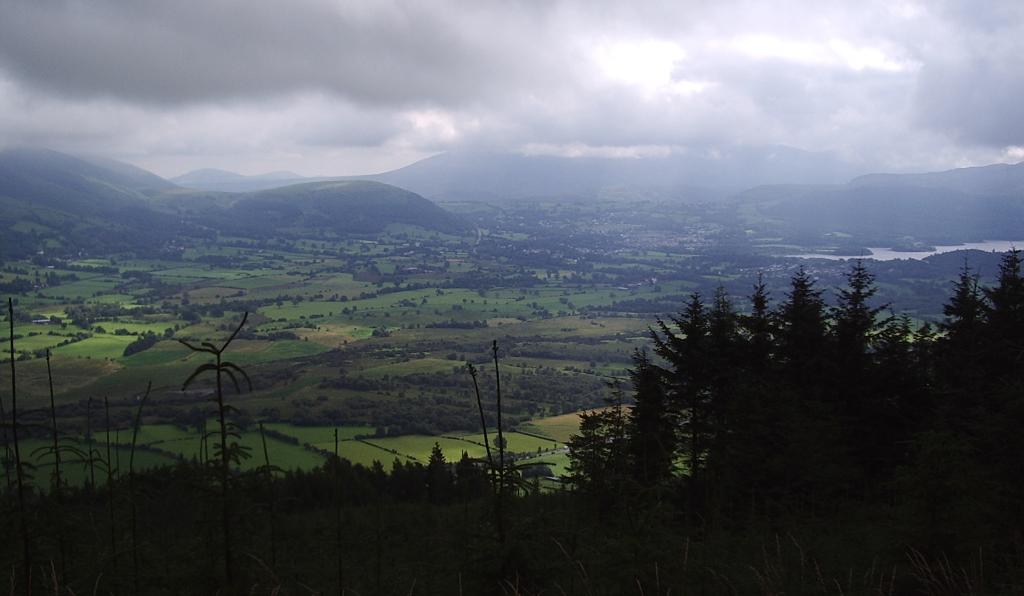
On Sunday morning Olga said to me “You should go for a walk”. Needing no further encouragement, I tossed the VX-8GR and a few bits and pieces into my rucksack and off I went. I parked at Thornthwaite near the old Swan Hotel and made my way up through the forestry roads to the minor summit of Barf. I didn’t go up by the direct path from opposite the Swan as it is very steep and slippery – I came down that way once a few years ago and it was enough for me.
On the way up I had a contact with top Wainwrights activator Phil, G4OBK/P on the summit of Brandreth. Phil is well on his way to completing the challenge of activating all 214 Wainwright summits in the English Lake District within two years and reached the half way mark this weekend. Visit Phil’s Wainwrights blog if you get a chance.
Shortly after contacting Phil I saw two ospreys circling over Bassenthwaite Lake and calling to each other with their high-pitched cry. I stopped and took the picture shown above of the view towards Keswick. About ten minutes later a small red deer came out of the forest about 100m ahead of me and trotted into the distance. Perfect!
It was cool but humid, but the misty weather creates a special atmosphere in the forest that is very pleasant. However once on the top of Barf a drying breeze was experienced. I made another contact with Phil, who was now en route for Great Gable, so he could tick Barf off on his “worked” list, and made another contact with Geoff GM4WHA. I also received an APRS message from Colin 2E0XSD, who unfortunately couldn’t hear me direct due to the amount of rock between us.
I then set off for the higher summit of Lords Seat, which I reached in about half an hour, where I stopped and had my lunch. By then Phil had reached Great Gable so we had a summit-to-summit contact. I made numerous other contacts, including Geoff and Colin and a couple people on SOTA summits outside the Lake District. I received a lot of comments about wind noise in the microphone, despite trying to shield the radio with both hands. The VX-8GR is the only one of my 2m hand-helds not to have a speaker mic, due to the fact that the only option is the expensive original Yaesu version. I should probably carry the VX-8GR just for the APRS and take the Motorola GP300 for voice contacts.
Simon, M3IWN/P called CQ from the top of Scafell Pike in the Lake District, which is England’s highest mountain. He was doing a SOTA activation and had a beam antenna with him. On a clear day I could probably see his summit from where I was, but he had so many callers that after 10 minutes of trying he still hadn’t heard me. I decided to move to another frequency and make some contacts of my own, checking back on Simon’s frequency now and again until eventually he got my call and we had a contact. At the time I worked him Simon had filled two and a half log pages with contacts including several summit to summits.
The QRM up there had to be heard to be believed. I was only using a 2m helical. The VX-8GR receiver tends to die in the presence of strong signals and I have heard strange things when using anything better than the stock antenna. Another reason for taking the Motorola, which has a better receiver. First, though, I will need to reprogram it to cover 145.300MHz, the frequency Phil likes to use on his activations.
Over the weekend I think something like 20 Wainwright summits were activated by around half a dozen different operators. Scafell Pike was actually activated twice on Sunday! Later in the afternoon after Simon had left I saw a spot had been posted for another station on the same summit.
I returned to the car via the forestry roads for a very pleasant walk with a lot of radio fun as well. If you want to join in, come to the English Lake District on a summer weekend – you won’t regret it!

Making HF APRS MOR robust
I was surfing around looking at information about robust digital modes, as you do, and stumbled across something called the WINMOR Sound Card TNC. WINMOR is a free, open and documented protocol intended for reliable HF data communications. Originally developed as a low cost alternative to Pactor for emergency communications systems such as Winlink, it has been made available as a virtual TNC for other developers to incorporate in their products. I started to wonder if this is the solution people are looking for to make APRS over HF more reliable, rather than trying to use digital modes such as PSK63 or GMSK that weren’t designed for this type of application, as is being tried by G4HYG in APRS Messenger.

The documentation for the software is somewhat over my head, but from what I can deduce the Sound Card TNC (shown above) does not provide an interface like a regular packet TNC. However there is a module called BPQ32 that appears (from the description) to implement a TNC-like interface. I’ve probably misunderstood something – in which case hopefully someone will point this out to me – but it doesn’t seem beyond the bounds of possibility to connect an APRS client like APRSISCE to this TNC and then you would be able to send APRS using the reliable WINMOR protocol with forward error correction (FEC).
The only problem would be finding a place to operate, since SCS’s proprietary Robust Packet protocol seems to have already established itself below the FSK300 APRS channel on 30m.














