Author Archive
 Garden party
 August 21st, 2010 |
  Author:
 Olga is having a little party on Sunday afternoon to show off her garden to a few friends and neighbours. So there will not be much time for radio this weekend as I will need to be on hand to help tidy things up, fetch anything she suddenly finds she needs whilst preparing, and finally the hard part – drinking wine and being sociable! But I thought you might appreciate seeing some pictures of the garden taken a few days ago.
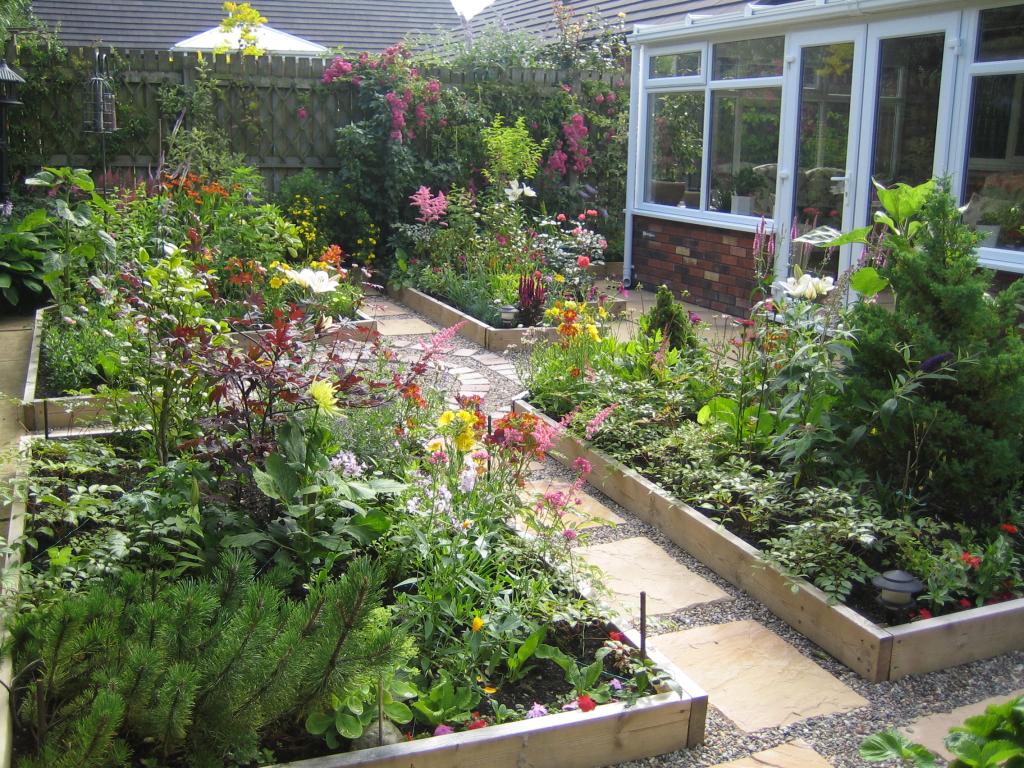


The photos don’t give much of an idea of scale, but the garden is tiny. It is about 20 feet from the back of the conservatory to the thick, high hedge at the bottom of the garden, and about 30 feet from one neighbour’s fence to the other. The lack of space, and the desire not to spoil Olga’s floral wonderland, are just two of the reasons why I think attic antennas are the best option in the circumstances.

Too many radios
If your better half complains that you have too much radio equipment, just show her this article.

Avoidable Acronym
You’ve all seen it: a new or prospective radio amateur joins a web forum and posts: “I’m looking for advice on how to get started in HAM radio.” HAM is not an acronym. What do they think it stands for? I consulted the Acronym Finder and could find nothing remotely relevant.
Having been in computing for more years than I care to remember, I know that the avoidable acronym is not a new invention. The one that really used to bug me is HELP, as in “Software includes full online HELP.” For goodness sake! Help is a word, not an acronym. I don’t think it was meant as a cry for assistance: HEEELLLPPP!!!! though I have come across a few programs where that would be appropriate.
Another example is FAX. Again, I can’t think of three words it could be an acronym for. It’s short for facsimile, so it’s just fax.
And ham is short for amateur, so capitalization is not required. There are many suggestions as to why amateur radio became known as ham radio. No-one really knows. Some say it has the same origins as “ham actor”, though that’s a pejorative term for an actor who overacts and generally isn’t very good. Others suggest it comes from British English. Cockneys (working class Londoners) drop the leading H from words like “hurry” or “have”, so they would often insert it in front of words where it doesn’t belong when trying to “speak posh.” Hence “amateur” would become “hamateur” and then “ham”.
Who knows? But whatever the origin, ham certainly isn’t an acronym.

K3 Killer imminent?
Kenwood Corporation recently announced the October launch of the long-awaited TS-590 HF/6m transceiver. Described in some quarters as a “K3 killer”, the new transceiver uses the novel (for modern Japanese radios) approach of a single conversion receiver with a low (11.374MHz) IF on the amateur bands to give what is claimed to be exceptional dynamic range.
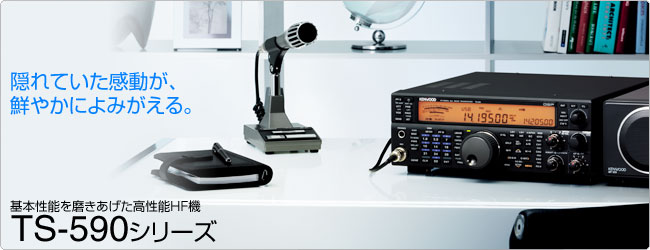
The news release bears careful reading, as what it doesn’t say is as interesting as what it does. The receiver will have a 6KHz roofing filter directly after the mixer, followed by a 500Hz or 2.7KHz filter (both included as standard) after the post-amplifier. But a footnote states that “For 1.8/3.5/7/14/21MHz amateur bands, when receiving in CW/FSK/SSB modes down conversion is selected automatically if the final passband is 2.7kHz or less” which suggests that a conventional (for the Japanese) up conversion will be used for the short wave bands, AM or FM modes, the WARC bands, 10 and 6m.
I think the current obsession with receiver performance figures is absurd. I am far from being a member of the Elecraft fan club, but even assuming the TS-590 does turn out to outperform the K3 on the main amateur bands, I think anyone considering swapping their K3 for the Kenwood on that basis would be foolish.
As far as I know, the Kenwood will not have an option for a second receiver, nor one for a panadapter. It will not have the transverter and external preamp interfacing (which I use to insert the MFJ noise canceller) nor an independent receive antenna input. I doubt that it will have fully isolated audio inputs for data nor a soft ALC in digital modes that allows you to vary the power output in PSK31 without fiddling with computer mixer settings to avoid IMD problems. I’m sure it won’t have an internal 144MHz option either.
Whenever I look at the features of the K3 that I am currently using, I realize that there is nothing else on the market at a price I am willing to pay, nor which would fit on my operating desk, that could do what my K3 is doing.
The price of the TS-590 will be 228,900 Yen, or about £2,000 by the time you have added on VAT (never mind the usual exorbitant UK dealer mark-up.) If it goes on sale here at £2,499 I will not be surprised. Compared to currently available HF radios and Kenwood’s previous HF models including the TS-570 to which this new rig bears a considerable similarity, the TS-590 looks overpriced for what in the end is nothing more than a compact HF/6m radio.
A K3 killer? I don’t think so!

Sound card packet modem
Last night I spent a couple of hours trying a program that had been mentioned by Chris, G4HYG in the Cross Country Wireless Yahoo group called AX25-SCS. It is a sound card modem for 300baud and 1200baud packet which was written by Frank Perkins, WB5IPM for use with a now unsupported APRS program called APRS-SCS (nothing to do with the SCS that makes TNC hardware.) Chris claimed it works better than AGW Packet Engine at decoding HF APRS. It is also freeware. I had never heard of this program before despite quite a bit of time spent searching for packet sound card software. You can get it from the TAPR website, installation is simply a matter of unzipping it into a folder, and there is a .pdf file that tells you almost all you need to know to run it.
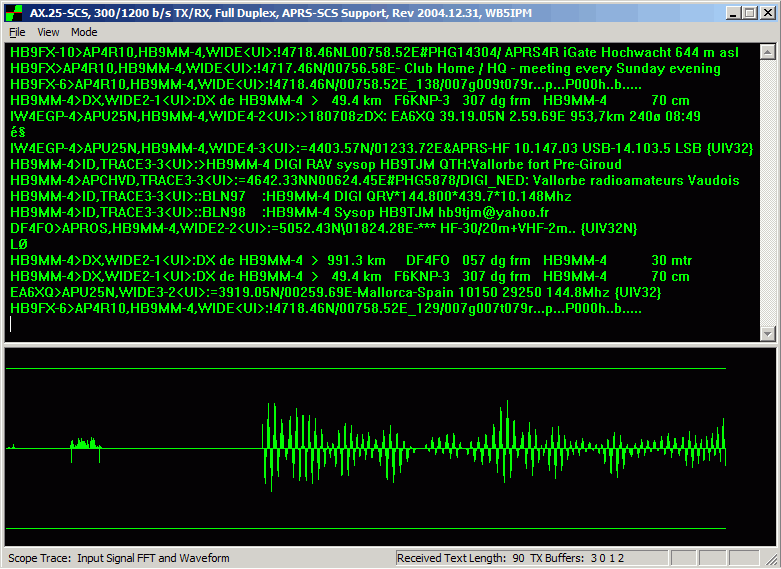
One of the things the documentation doesn’t tell you is that AX25-SCS uses the default Windows sound card. For testing, I had to make the sound card used by my Elecraft K3 the default. This is not convenient, as it robs my computer of the ability to play sound through the speakers (and risks broadcasting Windows sounds and web audio over the airwaves) so sadly I am unable to make permanent use of it.
The documentation also doesn’t advise you to select “Cancel APRS-SCS support” when you first run it. If you don’t, nothing will appear in the window until an APRS client connects to it, making you think that the program just isn’t working.
For HF use you need to select 300baud from the menu, as 1200baud is the default. You also need to select Enable SCS TX to allow transmission. It would be a bit of an annoyance that you have to do this every time you start the program as the settings are not remembered.
Once the receiver is tuned in – AX25-SCS uses the KAM standard 1600 / 1800Hz tones for HF – and the sound levels adjusted so that packets are being decoded, you can close and then restart the program this time choosing “Enable APRS-SCS support” from the initial dialog. After that, start APRSIS32 and create a KISS TNC RF port at address 127.0.0.1 port 4000. When APRSIS32 connects, the display should appear on the AX25-SCS window as it did before and this time any packets received should be displayed in APRSIS32 as well. Beacons and messages sent from APRSIS32 should result in audio being generated by the sound card modem for transmission.
For transmit, APRS-SCS requires the transceiver to use VOX. This is not a problem with my K3 which supports VOX via the rear audio connections and which allows the delay to be adjusted down to a very short interval, but it would make the program unusable with other transceivers like the FT-817 which don’t.
I tried running APRS-SCS and AGWPE Pro in parallel to see which was the better decoder but it was difficult to do a fair trial as APRS-SCS needs a lower level of audio input so the signal level was either too high for one program or too low for the other. As far as I could tell, APRS-SCS appeared more tolerant of off-frequency signals but less sensitive to weak ones than AGWPE Pro. This is also the verdict of Chris, G4HYG.
I would be willing to give APRS-SCS more of a try, but the inability to specify which sound card to use makes that impractical. It’s a pity that APRS-SCS is not open source so that someone could fix that and the other minor niggles, because it is a nice program that is quite easy to set up and use with APRSIS32.

Nice Nagoya
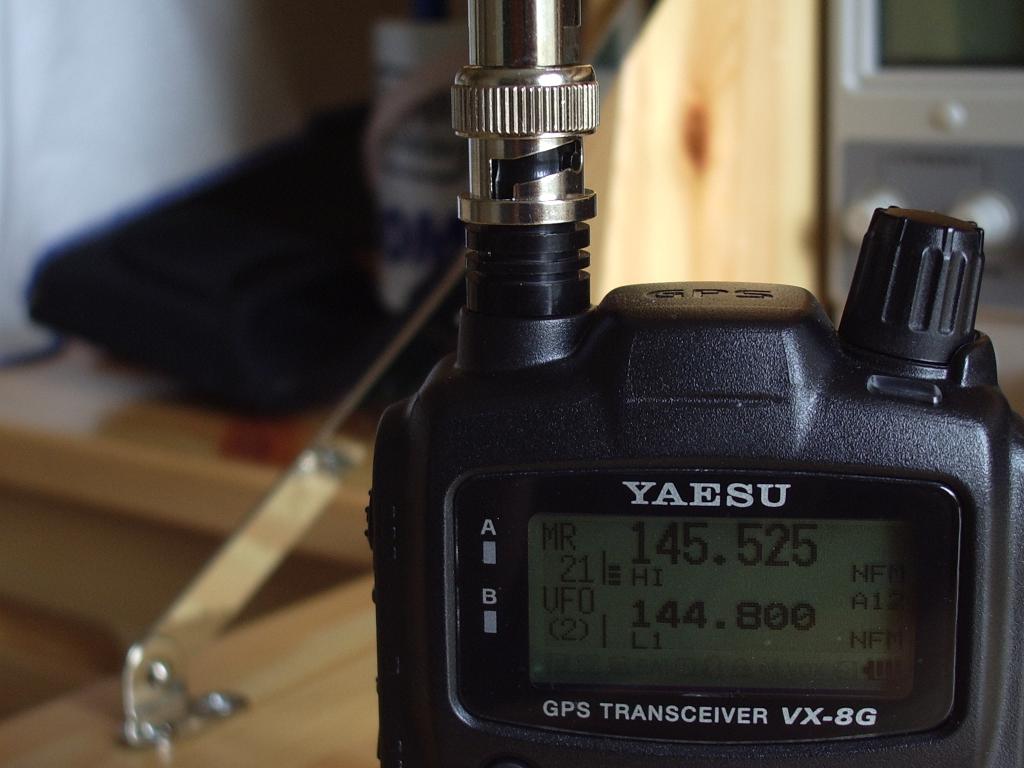
As regular readers may recall, I have a pathological hatred of SMA connectors when used as antenna connectors for hand-held radios, which has become even more entrenched since I had the centre pin of the TH-F7E stock antenna break off in the adapter I use for testing such antennas on my antenna analyzer. I now have an SMA to BNC adapter permanently installed on my VX-8GR. The picture on the right shows my latest adapter which is anodized black and looks like an integral part of the radio. The previous one I used was gold plated with a knurled body and whilst it worked perfectly and provided a robust fitting for the BNC antennas it looked a bit ugly.
If you never change the antenna on your HT then one of these adapters isn’t necessary, but SMA connectors were never designed for multiple connections and disconnections (in one email group I saw someone state they were rated for 100 disconnections) so if you want to change between a short stubby antenna for inconspicuous local use and one with more gain the BNC adapter is the way to go.

All of my BNC whips are 2m antennas, which is fine most of the time as almost all my operating is done on 2m, but there are rare occasions when I might want to use 70cm and removing the BNC adapter in order to attach the stock antenna kind of defeats the object of it. So I ordered from eBay a Nagoya NA-701 antenna which is a short dual band whip similar in size to the ones supplied with amateur dual band handhelds but with a BNC connector.
I tried it out on my antenna analyzer and it showed a nice sharp SWR curve with the minimum around 147MHz. It could be better, but it’s closer than some stock antennas I’ve tested. I couldn’t check it on 70cm as my antenna analyzer doesn’t go up that high.
I need to devise way to make comparative tests of all these HT antennas, because asking for signal reports or seeing if you can hit a repeater is a pretty crude measure of performance that won’t reveal small differences. This little antenna doesn’t perform as well as a six inch monoband helical on 2m, nor a quarter wave telescopic, but that is only to be expected. The beauty of the BNC adapter is that if you need a gain antenna you can easily whack on something like my 5/8 wave Black Whip, which you certainly couldn’t use with a standard SMA connector.

Mystery beacon
For the last three hours or so I’ve been driven mad by an APRS beacon on 2m that I can’t decode and which is not being gated to the internet by Richard MM1BHO’s gateway. The amount of activity on VHF APRS round here is so low that I normally leave the receiver audio on so that I can hear whether anyone is about. The signal I’m hearing is quite solid, obviously from a fixed station or a stationary mobile, and though it isn’t massively strong – just about making 1 bar on the Kenwood’s signal strength meter – it sounds fully quieting and as good as other signals I hear which are decoded.
I tried both wide and narrow FM modes and when that didn’t help I switched the antenna over to the FT-817 so I could try the AGWPE sound card decoder. I even tried plugging the antenna into the VX-8GR to see if that could decode it, but no joy. Listening to the sound of the beacon compared to the sound of my VX-8GR’s beacon, the one I can’t decode is quite a bit louder. I think it might be over-deviated.
So on the off-chance that someone trying APRS round here might read my blog, I thought I’d publish this posting. If it’s you, try turning the audio into the transmitter down and you might get gated.














