Author Archive
 The best cheap sound card for digimodes
 September 5th, 2010 |
  Author:
 The popularity of web videos and podcasts means that most ham radio enthusiasts who want to use sound card digital modes no longer want to dedicate their computer’s built-in sound card for that purpose. The usual solution is to buy a purpose made interface such as a RigExpert or SignaLink (expensive but highly recommended by all who own one) or an external USB sound card. However a great many people claim that the cheapest USB sound card “dongle” costing just 99p on eBay is good enough. Take it from me, it isn’t.
I have had several online discussions bordering on arguments with self proclaimed experts who claim that the sound chip in these cheapo “dongles” is exactly the same as the one in a £100 SignaLink USB interface so the £1 dongle must be just as good. I have no idea if they are right about the chip. What I do know is that when I played back a recording of very weak CW using one of these devices all I could hear was noise. And when I tried to use one of these devices to decode a fast digital mode such as packet, I decoded nothing at all, not a single packet, even though I could see the signal loud and clear on the waterfall.

I have tried a number of these cheap devices. I bought two of the cheap thumb sized “dongles”. One I threw away after seeing the noise it introduced on the waterfall. The second I bought thinking it would be good enough for computer audio, which it was, but had to throw it away when it failed after a week. I also spent a bit more on a slightly fancier sound card “dongle” which I currently use for computer audio, but which still displayed the inadequacies on weak signals and fast data modes that I have mentioned.
Finally I tried the device pictured above. It doesn’t have a brand name but can be readily identified from the picture and is advertised on eBay as something like “USB 6 Channel 5.1 External Sound Audio Card For Laptop”. It costs around £8.50 including postage from China. It comes in a small extruded aluminium case, has connections for SP/DIF input and supports sample rates of up to 48kHz so it would probably be suitable for basic SDR use. It has decoded every digital mode I have so far tried it with. And it’s small enough to build into your own box to make a DIY SignaLink.
It comes with a mini-CD containing a Windows driver. This installs a small mixer/control panel application that loads in the task bar and provides the usual control over the various sound effects. I used one of the start-up program managers (Autoruns) to remove it and find that it works perfectly well for my purposes without it, just using the standard Windows mixer settings. This is certainly preferable to the Creative SoundBlaster USB device that some people recommend which allegedly installs 200MB of junk on your hard drive.
I think this is probably the cheapest external sound device that is worth using for sound card digital modes. I’d be interested to know of alternatives, but please don’t recommend something unless you have actually done A/B comparisons with a known good sound card using weak signals, fast modes and different software packages. I hate to think of the frustration some people must have experienced following the advice of the self proclaimed experts, buying one of the £1 “dongles” and wondering why they can see a trace on the waterfall and can’t decode it.

WOTA success
 I think it’s fair to say the Wainwrights On The Air (WOTA) scheme has become a big success. At the start it was probably true that the main participants were existing Summits On The Air (SOTA) enthusiasts who appreciated the opportunity to make more of their Lake District excursions by activating the hills they would otherwise have walked past on their way to a SOTA summit. But recently several local amateurs have got started specifically in WOTA chasing and activating. There has even been a request for a list of the easiest Wainwrights to climb! There isn’t an award for that, but it does suggest that WOTA is encouraging people to get out on the hills who were not previously enthusiastic fellwalkers and I think that is one of the best possible outcomes for the scheme.
It’s a pity, though, that no-one offered to design a nice award certificate for the scheme, which the Workington Radio Club was then going to get professionally printed. The ones I made using a free online certificate maker and print on our cheapo HP multifunction printer (with expensivo ink cartridges) look a poor reward for all the time and sweat that has been expended earning them. I always have a fight getting them to print correctly anyway, so having some professionally printed certificates would have saved me a lot of hassle.

APRS Chat
It has been a while since I wrote about the new APRS client for Windows and Windows Mobile being developed by Lynn, KJ4ERJ and known as APRSISCE/32 but it has been coming on apace with new versions being released almost every day. Many of the improvements probably won’t mean much to anyone who doesn’t know anything about APRS. But one of the more recent and quite revolutionary developments has been the chat window, which allows you to carry out a two-way text chat conversation with another APRS user.
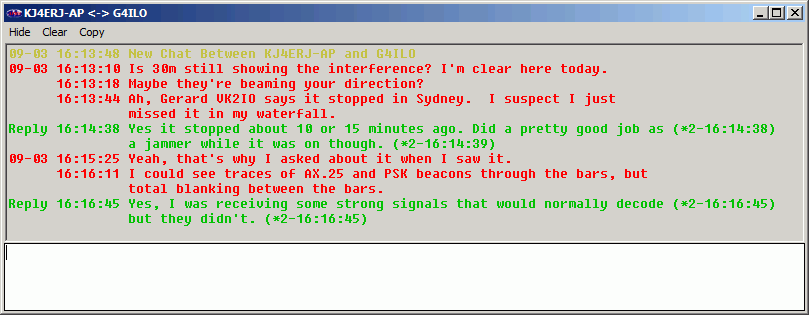
Instead of the primitive edit box found in most APRS clients in which you would have to type your messages in 64-character chunks due to the limitations of APRS messaging you can now type just what you want and APRSISCE/32 will split it up and send it as separate messages transparently. It also takes care of ensuring the parts are displayed in the right order at the other end. You can also view the entire conversation in its own window – useful if you are having conversations with two or more people when you are tired late at night and lose track of what you are saying to whom!
You can chat with anyone, anywhere in the world. True, at the moment most of these conversations are being conveyed over the internet not RF, which will inevitably incur the complaints that “it’s not ham radio.” But they could just as easily use RF. The only problem is that for most of us an adequate APRS RF infrastructure to support worldwide messaging doesn’t exist. But the more people are attracted to the mode – and even the hobby – by cool developments like this, the more likely it is that an effective infrastructure will be built. In many parts of the world you could certainly link up across town on VHF like this.
Regular digital modes are fun. But is there any reason why the only way to have a contact is for two people to have sole occupancy of a frequency and one sends to the other, then the other replies back, repeat until finished, the way contacts have been made ever since Marconi first picked up a morse key?

Interference on 30m
I was in the shack making a few adjustments to the Echolink software configuration. The K3 was on 30m APRS with the speaker volume turned down to almost inaudible. Suddenly, at about 1410 UTC, I heard a buzzing type of interference. I looked at the TrueTTY waterfall and saw there were interference bars every 50Hz right across the screen, strong enough to prevent anything from being decoded.

50Hz is the mains frequency here in the UK. With a sinking feeling my immediate thought was that one of the neighbours had discovered a new way to make the HF bands unusable. Then I remembered that Lynn, KJ4ERJ had posted a screenshot of similar interference only the day before in an APRS forum. I checked back, and sure enough the interference Lynn had seen in Florida was exactly the same.
I don’t know what it is, but I don’t think even my neighbours are capable of generating interference that could be heard across the Atlantic. It’s still going strong 30 minutes later. I haven’t seen an HF band wiped out like this since the Woodpecker fell silent back in the ’80s. Well, at least I’ve got Echolink!

The mystery of the failing filters
A couple of months ago I acquired a Kenwood TM-D710 dual band FM transceiver with APRS as it was the best solution to the problem of how to operate an APRS gateway without losing the ability to monitor for voice contacts on 2m when you do not have the space for two widely separated antennas. I have been quite pleased with the radio but rather alarmed at the number of reports of loss of sensitivity due to the failure of one or more of the IF filters. I asked on the Kenwood Yahoo group whether this was just a faulty batch of filters affecting radios of a certain age or a generic problem that was likely to affect any TM-D710 eventually and was directed to this explanation in the blog of Tasos, SV8YM.
It has been a long time since I read such a well written explanation of a technical phenomenon and I’m sure you’ll find it interesting, especially if you own a VHF radio with 455kHz IF filters. In fact I’m sure many of you will find other articles of interest in this blog. I’ve added it to my regular reading list.

The death of VHF
Olga and I have returned from a long weekend in London. I took my VX-8GR along, hoping to see some APRS activity or even make some contacts. But I heard absolutely nothing, nada, zilch, not a braap on the APRS frequency nor any signs of life on the simplex or repeater frequencies.
Twenty years ago I lived in London, in Charlton SE7 and I seem to recall that in those days there were four London repeaters on 2m and plenty of activity. I also seem to recall that some of the repeaters were plagued with abuse. Last weeked even a kerchunker or a pirate playing music would have been a welcome sign that someone was using the amateur frequencies.
I took a laptop with me – the small Eee PC running Ubuntu Linux, with APRSIS32 under wine – to monitor activity and see if my RF beacons were heard. I received a greeting from G5YC via the APRS-IS internet network and that was that. What a contrast to Prague, where I was a month ago, where the APRS activity just didn’t stop.
Tim, G4VXE, posted yesterday about creating APRS objects for repeaters using OpenAPRS.net. I commented that it was all very well, but these internet created objects are never transmitted on RF so they never fulfil the intended purpose of the mode which is to inform visiting mobiles of the local repeater frequencies. Unfortunately with the lack of radio activity here in the UK one cannot deny that APRS works much better as an internet application than it does over RF. Anyone who has a computer can call up aprs.fi and see the local picture – if anyone has taken the trouble to create the objects. If they were transmitted on RF, would anyone hear them?
I could say much the same about 2m FM. If I’d had an iPhone I could have made some contacts using the newly released Echolink app, which again is more than I was able to do using my Yaesu. What has happened to ham radio that one can’t find any activity even in the UK’s biggest city? It seems to me that we have all decided that cellphones are a much better tool for contacting our ham buddies. If we lost the use of the VHF and UHF bands would anyone actually notice?

Screenshots and copyright
Yesterday I received a comment in the site guestbook from Murray Greenman, ZL1BPU, which says: “While I appreciate your ad-hoc publicity for ZL2AFP CMSK, it would have been much better if you had asked permission to use my screen-shot on your blog site! While web pictures and text are widely plagiarized, that doesn’t make it right to do so. Copyright still applies and the image is still mine.” I have removed the image and inserted a comment directing the reader to this posting in its place.
Since I am on holiday at the moment and did not intend making any blog postings I will leave it to readers of the blog to lead the discussion on this issue. But I would just like to say that part of my career has been made publicizing software. I have always found software authors to be glad of the publicity and have never, until today, received a complaint about using their own images to this end. It is not always possible to take your own screenshots. In this case, I was unable to try the software on the air because of its insistence on using the default soundcard and I thought that it was more interesting to readers to see the live screenshot made by ZL1BPU than a blank one made by me.
As to the question of whether I should have asked permission first, I wonder if ZL1BPU understands what blogging is about? Part of the motivation for writing about some new development in a blog is to be one of the first, and if you have got to write an email asking permission and wait for a reply then it’s likely that others will pip you to the post. It’s not like writing an article, which may take several days to prepare and where time is not of the essence. Blogging is a bit like tweeting, but more verbose.
Finally I would argue that a screenshot is not an original work of art. I’m not depriving anyone of earned revenue by using it. Anyone can install the software and obtain one that is pretty similar. So why make an issue out of copying someone’s screenshot, particularly when the purpose of doing so is to give publicity to the software not to use it with any adverse intent?
I shall certainly think twice about giving publicity to any more new ham radio programs in my blog in future. Perhaps all of you bloggers who happily copy people’s QSL cards and shack photos to illustrate your stories about contacts should pause for thought as well. Ought this not to count as “reasonable use” – the clause in copyright laws that allows you to quote part of an article when referring to it?














