Author Archive
 ISS success
 September 18th, 2010 |
  Author:
 Over the last few days Lynn, KJ4ERJ has been adding some very cool features to APRSISCE/32 which I’ve been helping to test. The ISS packet digipeater is still operating so as there were several good passes during the daytime I’ve been playing on it as well.
Today I managed to hear my own beacon repeated back by the space station, and this time it was also gated to the internet by TF8TTY so my call showed up on the map of stations heard through the ISS at ariss.net. I also managed to send a couple of messages through the bird. Tim, G4VXE was impressed to receive a greeting relayed via the space station. I also managed a two-way exchange with Marc, PD4U, which I think counts as an actual satellite contact.
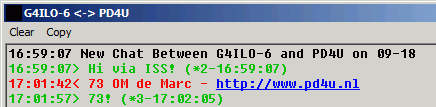
Of course, whilst it’s fun to bounce radio waves off a satellite it isn’t a very practical method of communication. The ISS is the best QTH ever and it can hear all the activity on a frequency at the same time, so communication is only possible if not too many people use it. Lots of messages never get anywhere because they are sent at the same time as messages from other people which you can’t avoid transmitting over because you can’t hear them. The space station decodes only the strongest, so turning the power up improves your chances of success quite a bit. You can get through the ISS using a hand-held VX-8, but only at 4 o’clock in the morning when most sane people are asleep, unless you are incredibly lucky.
The new feature in APRSISCE that I mentioned is the ability to open separate windows so you can track individual stations at a more detailed mapping level. Lynn has called this Multi-Track(TM) and he thinks it will be very popular with emergency communications teams who will be able to see the entire area of the event in the main window and see exactly where individual team members are at the same time. It’s only available in the development (beta test) versions at the moment, though.

The GPS you didn’t know you had
The great thing about the internet is that you can find the answer to anything. You may not understand the answer, it may not even be the correct answer, but you can find it. And sometimes you will find out more than you were expecting.
Yesterday I happened to think “If I have a computer or smartphone with a GPS, can my position be accessed from its web browser?” A quick search of Google turned up the answer that yes, it could, in newer browsers that support HTML 5 like Firefox 3.6 and Google Chrome and the Android web browser. I even found some example code showing how to use it. I made a test page to try it out for myself. The results were a little unexpected.
First I tried it using my shack PC, which is a mini-tower with only a wired connection to my router. It told me that I was in Sheffield. This was actually not unexpected, as that is similar to the location I see when visiting some blogs that have a widget to show where visitors come from. I presume they, and the web browser, use geolocation by IP address if that is the only available method, and Sheffield is presumably the location of my broadband ISP’s data centre.
When I tried using my smartphone running Android I saw the GPS status icon flicker on for a couple of seconds and my page then reported my position as being in Broughton, a village a couple of miles west of here. I’m guessing that the GPS didn’t have time to get a good fix so I got a poor one, or else it is reporting the location of the cell the phone is connected to.
But the really surprising result was when I tried using my laptop. This doesn’t have a GPS and is connected using wi-fi to my router, so it has the same IP address on the web as the shack system. Yet my test page pinpointed my location as across the street over the back, only about 20 yards from my actual location. I tried my netbook as well and got more or less the same position . How the heck did it know where I am?
After a bit more Googling I discovered that this is done by triangulating your position using the names or SSIDs of the wi-fi access points your computer can receive. A firm called Skyhook has created a database of access points and their locations by driving around every street in every town and city in the US. There is also a site called Geomena.org that has an access point database created by ordinary individuals. You can even add to it by installing a client app in your iPhone or Android phone and going walkabout. Google has a database which it presumably created at the same time it drove around doing Street View mapping and snooping on people’s unsecured data. In Firefox you can see which wi-fi geolocation database is used by going to the address about:config (no http://) and examining the value of geo.wifi.uri. By default it’s Google’s. You can also disable browser geolocation by changing the value of geo.enabled.
I think the geolocation feature is pretty cool but I’m sure many privacy-obsessed types will be horrified by the thought that even without an actual GPS their position can be located to that kind of accuracy.
If you are interested in trying this for yourself then you can visit the Geolocation Test page that I created. If your browser supports geolocation (and you have Javascript turned on, which is necessary for the page to work) then you will be asked if you want to share your location with g4ilo.com. This is presumably a privacy thing, because if I wanted to I could log all the positions in a database. I don’t, and in any case you’re all hams so I can find out where you are from qrz.com, so hopefully you won’t have a problem with that. If you allow the site to see your position it will then display your latitude, longitude and Maidenhead locator and show the position on a map so you can easily see if it is accurate.
If you do try my test page I’d be interested to know, via comments, how accurate the position was and whether your computer had a GPS, wi-fi or you were using a smartphone. If you have a mobile wi-fi device, does it track your position as you move around? If the results are promising I might make a permanent page for determining your grid locator using geolocation.

Experiences with Android
The Micro SD card I ordered arrived on Monday so I was eventually able to try installing the Google Android OS on my HTC Touch Pro. The delay turned out to be a benefit as I was able to take the advice of Eric SA5BKE who commented to my earlier post that he had found a better set of installation instructions to the ones I mentioned.

Still, as usual when I try to do anything with computers, if something can go wrong it will. First, the phone could not see the new SD Card. I had to format it with a utility from the SD Card Association. Then I messed up the screen calibration where you have to click, when prompted, on the corners of the screen, and wasted some time trying to recover from my mess-up. But eventually I was rewarded with the sight of the Android home screen on my HTC Touch Pro.
The effort was worthwhile. I really like the Android OS. It is so much better a smartphone operating system than Windows Mobile 6.1. You still feel that you are using a phone, not a Windows PC that has an annoyingly small screen. Making phone calls and sending text messages is really simple, as it should be. And once you have found out how the new OS is supposed to be used (since the download doesn’t come with a user guide) it’s easy to use.
I am a huge fan of Google – I have five GMail accounts and probably make hundreds of Google searches a week – and what I really like about Android is the way Google features are integrated into the OS. Until now I could never understand why people liked smartphones and would actually want to use them to answer email because my experience was based on trying to access GMail using one of the two awful web browsers on my Windows phone. But now I get a notification whenever a new email comes into any of my inboxes and I can either clear it or click on the email to read it in full or reply on a display designed to make full use of the small screen. I guess that’s how other smartphones work if you have a corporate mail server running Microsoft Exchange, but I’ve never had one.
I was also very impressed with the Google search widget on one of the virtual desktops of the home screen. It had a microphone icon so, out of curiosity, I clicked it and was invited to speak. A moment later it typed what I had said into the search box and was performing a search on it. Fortunately I hadn’t said something rude! I then had some fun composing emails and text messages without using the keyboard. Unfortunately the speech engine doesn’t recognize words like “comma”, “full stop” or “newline” as punctuation and formatting, nor does it recognize commands like “send.” But I was very impressed with the accuracy with which it understood what I said – the last time I tried voice input was at least a decade ago on a PC and I found it ultimately frustrating.
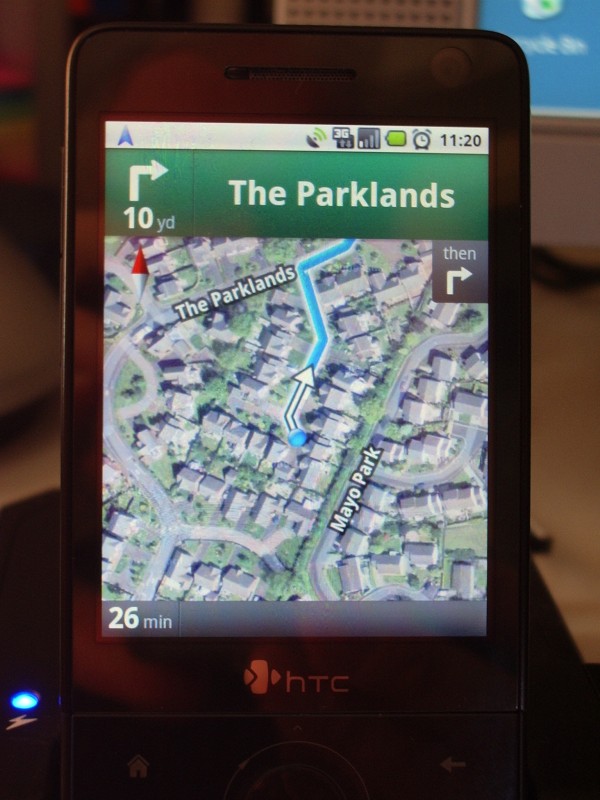
One of the applications I was keen to try out was Navigation, Google’s free satnav program based on Google Maps which is not available for Windows Mobile. I haven’t had a chance to test it in the car, but it seems like the full works, with a text to speech engine that barks directions at you. The optional but probably rather unnecessary satellite view looks rather cool, though I was rather less impressed by the route it suggested from home to Keswick, south-east of here, which involved turning right at the end of the cul-de-sac and going north, then west for a mile to reach the A66 before going east, instead of turning left and heading east which would save best part of two miles. My old satnav does that too, but that’s because the estate hadn’t been completed when the maps were made and it believes the top of the estate is still a building site.
The Android Market contains thousands of apps that you can download, either free or for a modest charge. However, sorting the wheat from the chaff seems like one of those things life’s too short for. It reminds me a bit of the early Windows “shareware” market when anyone who had taught themselves Visual Basic thought they would be the next Bill Gates by releasing some flaky software that did very little and usually crashed as soon as it experienced some condition the programmer hadn’t thought of.
There seem to be very few ham radio applications, though, and almost no really good ones. I saw quite a few apps to do with Morse, giving the lie to the idea that code is dead, but nothing that looked worth trying. The only professional quality radio application I could find is the new EchoLink client for Android.
My feelings about this have mellowed a bit since I wrote about it just over a week ago. Last Friday just before dinner I received a call through my EchoLink node from Practical Wireless VHF columnist and fellow blogger Tim Kirby, G4VXE, who was on his way home from work by train and called me using the EchoLink client for his iPhone. Though we’ve exchanged blog comments a few times it was very pleasant to speak with Tim for the first time. This was a contact we would be unlikely to make over radio and certainly not in that particular situation. Only EchoLink made it possible.
In the interests of research I had a conversation with myself using the EchoTest server and found the audio quality to be just as good as when I use my Kenwood TH-F7E to make contacts via my RF node. However the cellphone client has one disappointing limitation. You can’t make a direct connection using the cellular network. You have to use a communication option called “Relay” which only allows you to call other non-cellphone EchoLink users. It doesn’t allow other EchoLink users to call you. It’s a bit like having a radio and not being able to call CQ.
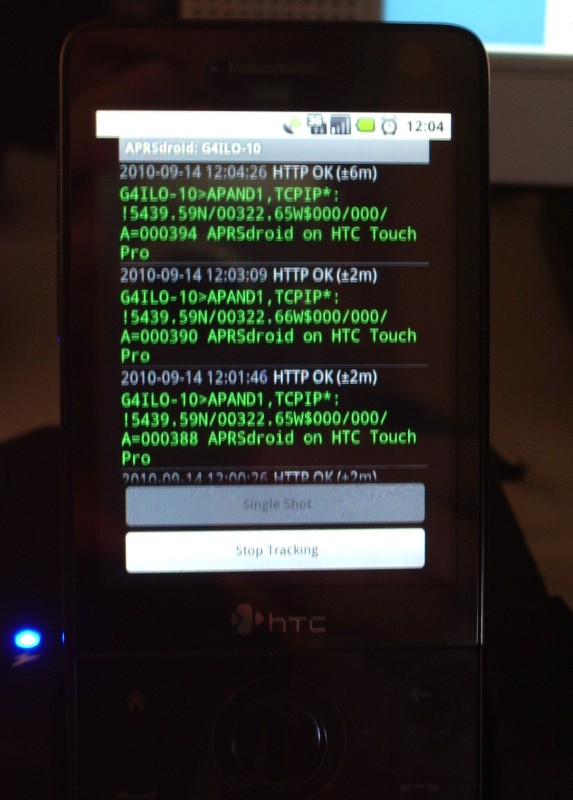
I was somewhat unimpressed by the Android APRS app, APRSdroid, not just in comparison with Lynn, KJ4ERJ’s APRSISCE for Windows Mobile, but even with the iBCNU app for the iPhone. The user interface is basically a console window: you can see position packets going out, and if you wish you can see raw packets of other users within a selected radius of your location. There is no support for messaging at all in the present version.
Tracking doesn’t seem to work very well either, unless you are also running another application such as Navigation that keeps the GPS on all the time. I think the problem is that the app tries to save power by turning on the GPS, waiting for a fix and then turning it off again until the next time interval. It didn’t work too badly when the phone was sitting in its charger cradle on my desktop, but getting a GPS fix when you are moving can take a very long time. There is a need for a simple APRS tracking and messaging application for Android but this has a way to go before it gets there.
The HTC port of Android OS is not an official release and has quite a few bugs and things that are still To Be Done. I’ve had the phone lock up and fail to respond to anything and have had to pull the battery a few times. There is no support for the built-in camera and the battery charge indication is completely fictitious. It’s also best not to use wi-fi as it warms up the phone and consumes a lot more power than under Windows Mobile.
Unlike most people I bought my HTC Touch Pro SIM-free and unlocked because I don’t like to be tied to a network. As a consequence I’m not going to be offered an upgrade for no extra cost when my contract runs out. I need to keep the phone for a while but I’d be more than happy to dump Windows Mobile because as a phone it’s too much hassle, even though it does allow me to run some pretty powerful applications. I hope that the issues with the HTC Android port will be resolved in order that it becomes stable enough and functional enough for me to use it on my phone all the time.

Hard drive update
As so many people commented on my post about my apparently failing hard drive I thought I’d post an update. Dell had me run some diagnostics that are on a special diagnostic partition. I ran the entire set of hard disk diagnostics which took most of the day including a full surface scan and the drive passed all tests without a single error. Therefore as far as Dell is concerned there is nothing wrong with the hard drive. It’s possible that as Steve GW7AAV commented the operating system has marked the bad sectors so they won’t be used any more, in which case hopefully the issue was just a one-off.
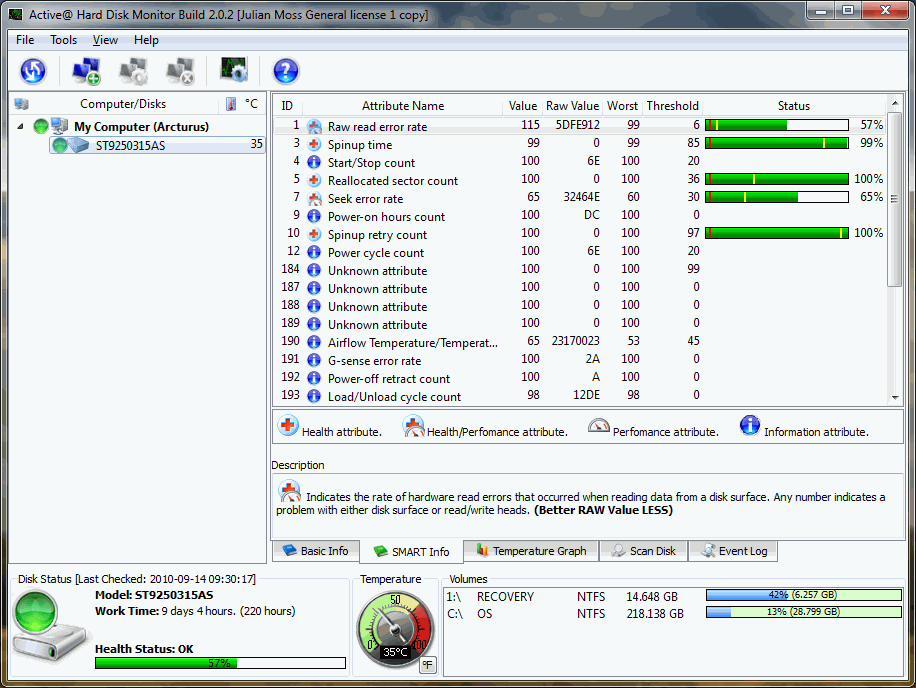
In order to keep an eye on the situation I decided to look around for a SMART hard drive monitoring utility which can display the statistics stored on the hard drive controller, preferably a free one. My searches located one called Active@ Hard Disk Monitor Free which seemed to display an impressive amount of information. This program said the Health Status of my hard drive was OK, though the value was only 55% which didn’t seem too healthy to me. It’s up to 57% now, which makes me think that something bad did happen and the value will slowly improve with continued error-free operation. A look at other screenshots of the program showed values in the high 60s so perhaps I shouldn’t expect to see close to 100%. Hopefully if the problem occurs again this program will provide more information about what actually happened.
Annoyingly, when I started the computer the next day and looked at the stats I saw that Active@ Hard Disk Monitor Free is not free at all. It is a 14-day trial version. When I checked download.com I saw there were a lot of complaints about this. The old version was free, but not the current version. However it is only $6.99 to purchase a license for one PC so rather than waste more time trying to find another free alternative I have decided to pay for it.

Hard drive failing
Two months ago I got a new Dell Inspiron laptop to use for my work. I have been very pleased with the computer which is quite fast and has a good keyboard and a very nice screen. However this afternoon I switched it on to do a bit of work and was typing away when the hard drive started making a noise like a cat with indigestion – which anyone who has ever done tech support will recognize as the sound of a hard drive attempting to read a bad sector.
Windows froze, there was no way out but to long-press the power switch, losing the work I had been doing. On start-up, Windows insisted on doing a disk check and printed up a lot of messages that appeared to be to do with errors on the hard drive. Eventually I was able to restart, Windows booted up and it seems to be working normally again. But my confidence in the system’s reliability has taken a blow. In my experience hard drives don’t malfunction once and then run perfectly for ever after. But there’s no sign of any fault now, so I have little option but to wait until the next time it starts making funny noises. 🙁

Japan on 15m
This morning I worked Kei, JI1BBN, on 15m PSK31 using 50W to the MFJ magnetic loop in the attic.
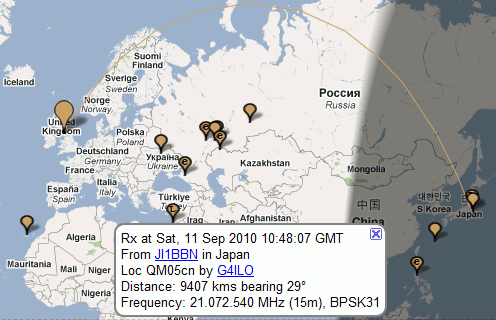
I heard several other DX stations on both the loop and the dipole, including DU3MEL in the Philippines whom I last worked in 2003, also on 15m. That was also the last time I worked Japan. Then I would only have been using QRP with my Elecraft K3, and the antenna would have been a horizontal loop of wire round the perimeter of the attic, with a 4:1 balun at the centre of one side, tuned using the K2 internal ATU.
What’s that about stealth antennas not working?

SatGates needed
The International Space Station has had its packet BBS / digipeater active for the last few days on 145.825MHz. Noel G4PEW asked me in a short APRS chat last night if I had tried listening to it. It had been a long time since I tried bouncing anything off the ISS as I got fed up with checking if the station was operational and finding that it wasn’t, so I decided to give it a go to break the monotony of nothing much happening terrestrially.
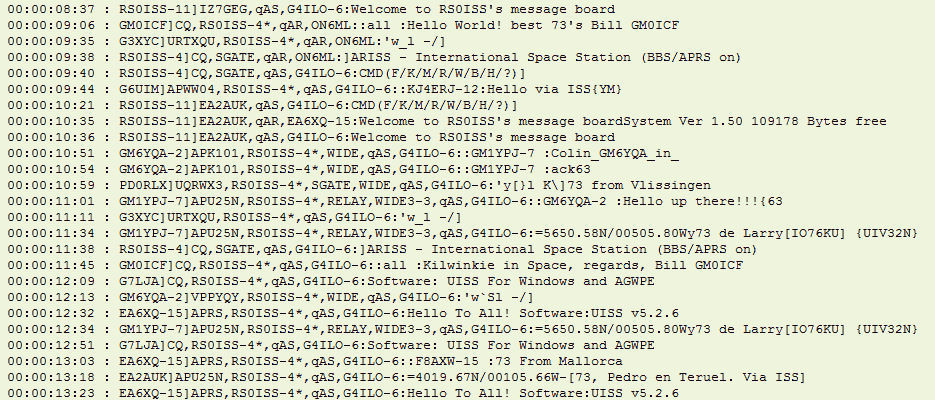
There was a good pass this afternoon and I received ten stations. I even received my own digipeated beacon and a copy of my reply to GM0ICF’s message to ALL. Unfortunately my own transmissions didn’t show up on the map and list of stations that worked through the ISS at ariss.net as it appears that I was the only station gating the signals from the space station to the internet, as the list above shows (you’ll need to click on it to enlarge it enough to be readable.)
I was using APRSIS32 to send the beacons and messages and I guess that it didn’t gate my digipeated packets as having been received via the ISS because it had already sent them to the internet direct at the time I sent them.
I’m surprised that none of the other stations sending signals up to the space station were gating them during the receive periods. We aren’t talking about important communications here, just seeing if it can be done, but it would be nice to have the proof of it afterwards. Come on, chaps, play the game and get your gateways working!














