Author Archive
 Rannerdale Knotts
 September 27th, 2010 |
  Author:
 On Sunday Olga and I went for a walk in the Lakes. As Olga doesn’t like climbing my Wainwright activation possibilities were limited so I decided to head for Rannerdale Knotts, LDW-209, the fifth from lowest Wainwright.
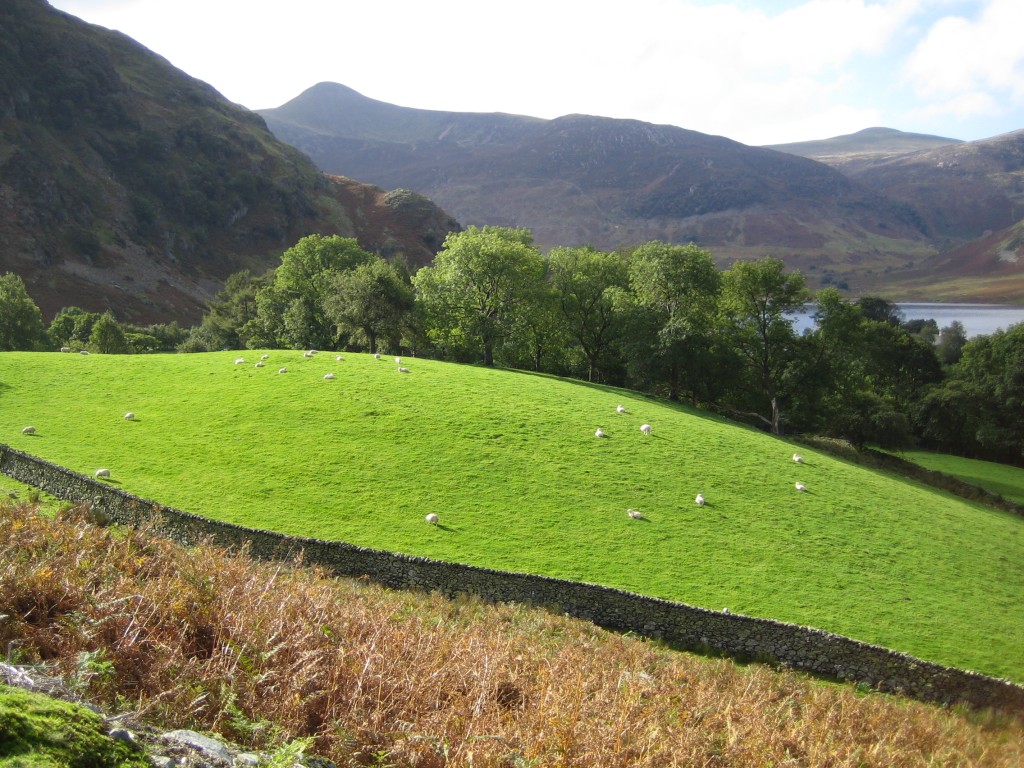
Despite its low height, Rannerdale Knotts looks quite forbidding. The most direct path is very steep. However the summit is also accessible by an easy walk up the valley named Rannerdale which brings you on to a ridge that leads directly to it. On the way there are great views back over Crummock Water and Loweswater out to the Solway estuary.
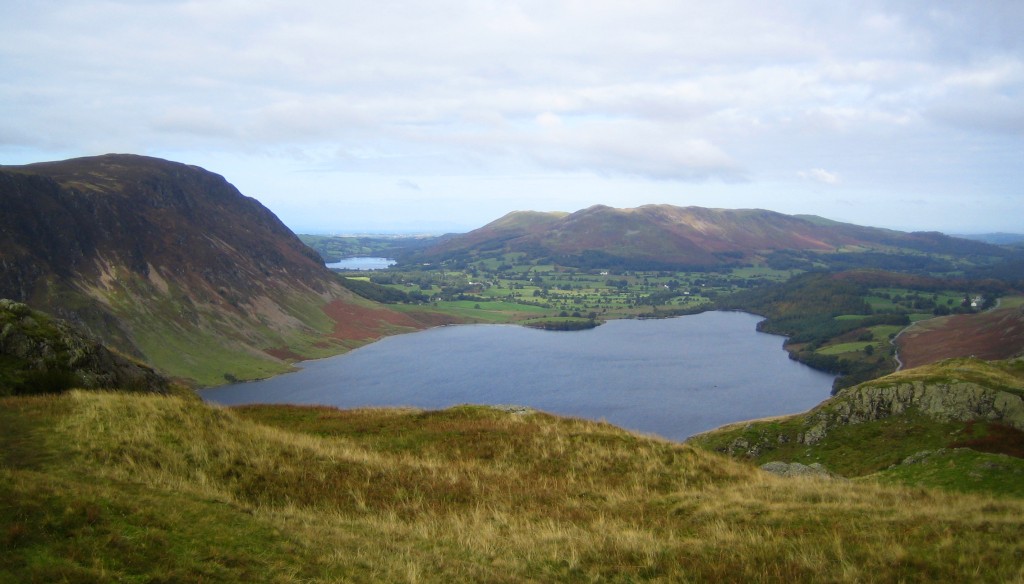
Just as we were about to climb on to the ridge I heard Phil G1OPV/P calling from the summit of Mellbreak (the hill on the left in the above picture.) Though only a couple of miles away I could only just hear him due to the steep ground between us. I hurried to the top to make contact and agree to work again when I reached the summit of Rannerdale Knott for a true summit-to-summit.
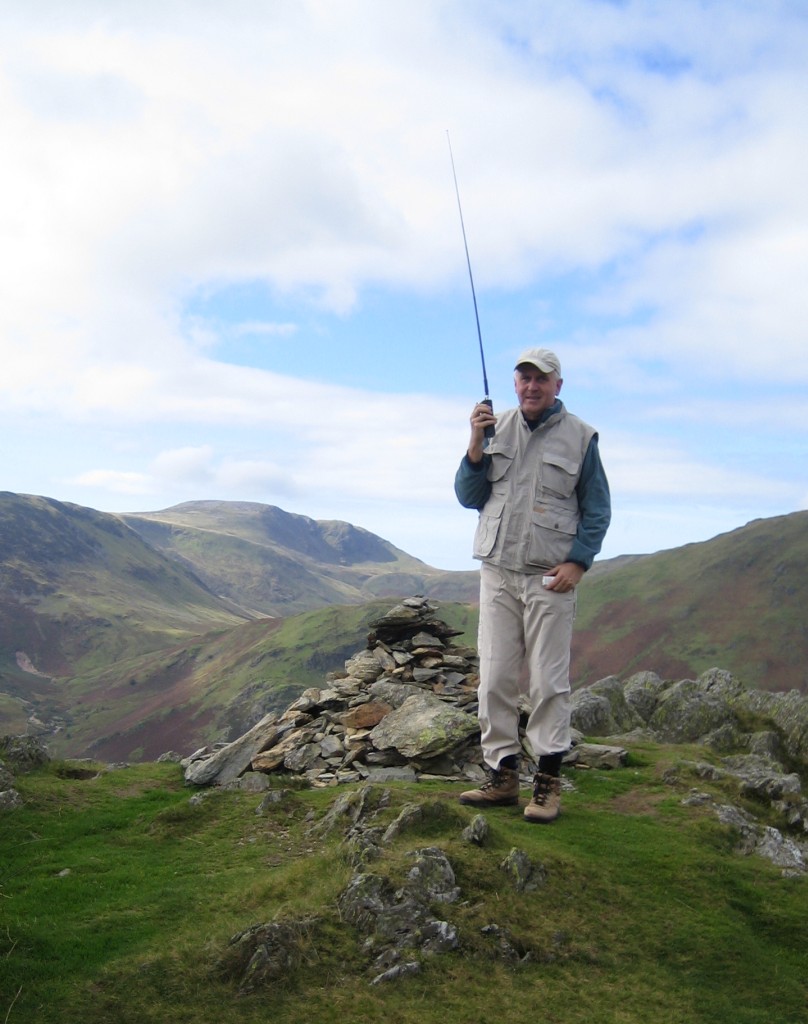
I had barely reached the summit and was still getting my breath back when I heard a “CQ WOTA” call and made contact with M0AYB/P (also Phil) who was on Dodd, another fairly low fell beside Bassenthwaite Lake. Anyone who knows the area was surprised that VHF signals could travel between two such low hills with a large mass of mountains in between. Olga captured me making the contact with Phil on her camera. I was using the Motorola GP300 on this occasion, with 4W out to a 5/8 wave telescopic “Black Whip” antenna. In my left hand you can see the Olympus personal voice recorder I use for logging.
After signing with Phil I was immediately called by Geoff, G4WHA/P who had arrived on the Causey Pike, the summit I climbed a few weeks earlier and failed to recognize or activate! Whilst I sneaked up on it the back way making it easy to reach, Geoff tackled it by the direct route which he informed me had turned out to be tougher than he anticipated. Accompanying Geoff on his first Wainwright outing – a baptism of fire – was Mark M1MPB/P so I made two contacts with the same summit. Then I contacted Phil G1OPV/P again to make the summit to summit with Mellbreak. I suspect we could have made the contact by shouting if the wind had been in the right direction, in fact I think I could just see Phil silhouetted against the skyline on the summit.
After that I was called by Robert M3XJV/P who was on Birkhouse Moor, on his way to Helvellyn. This was a nice addition to my chaser total as the Helvellyn hills seem to be out of range of my home station in Cockermouth. Finally I made two contacts with home based stations: Roger G0MWE in Dearham and Ron G0UQC in Keswick before I was able to sit down and join Olga having our picnic lunch and enjoying the view over Buttermere.
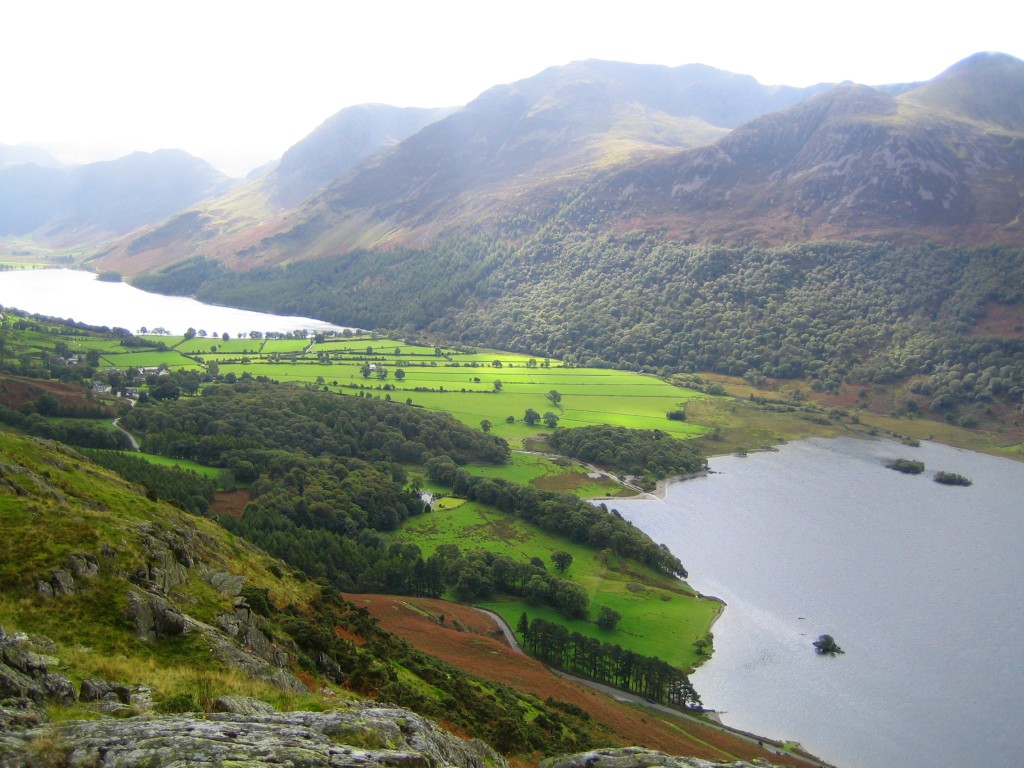
We returned to the car via the precipitous direct descent down to the lake. It was a short walk but a successful one. Seven contacts including five summit to summits from a low fell that on previous visits (before WOTA) you would never expect to make a contact from. I think Wainwrights On The Air is transforming VHF activity in the Lake District and the comment from one activator that it is getting hard to find a clear frequency is proof of it.

Serial addition
I installed a four port RS-232 serial card in my shack PC today. When I bought the computer earlier in the year I purchased and installed a two port serial card, thinking that would be enough. But it wasn’t. You can never have enough serial ports if you want to interface with radios. With four, I can now have CAT control of both the K2 and the K3, the TNC connection to the Kenwood TM-D710 and one more which is currently controlling the PTT of the FT-817 for the EchoLink node but could be used for the control port of the Kenwood if I ever decided to use that for EchoLink. No more hassles with USB to serial adapters, and all my USB ports are free for things like sound cards. I don’t know why people use laptops for shack computers, they provide far fewer options.
Needless to say, things did not go as smoothly as they could have done. I thought I could have COM2 for the K2, COM3 for the K3 which would be easy to remember. But Windows gave the ports the designators COM3, 4, 10 and 11. There’s an option to reassign the port numbers but Windows claimed that everything from COM2 to COM9 was in use. By what, was my unanswered question.
In the end I decided to name the ports COM2 through COM5 as I wanted regardless of Windows’ protestations. They did work, but finding out which port was which was a matter of attaching a radio to one socket, loading a program and trying all possible COM port numbers until it worked, as there was no logical correspondence between the numbering and the sockets on the back of the computer. Who said it was meant to be easy anyway?
Despite all this I managed to make a few contacts using JT65A on 20m including DU1GM, N0OB and K1CF, using 25W to the dipole.
Although I now have computer control of the K2 I don’t have a sound card interface as I have cracked open the plastic case of the USB audio dongle and superglued the bottom half containing the PCB to the stripboard on which I will be building my homebrew SignaLink clone. Of course, now I have a serial cable connection between the computer and the K2 I don’t need a VOX controlled interface, never mind an isolated one because the serial cable will bypass the isolation anyway!

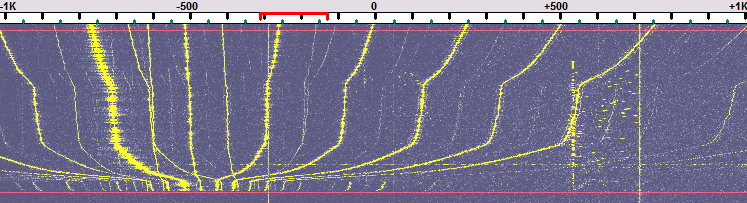

Flash in the pan
I’m not exactly a fan of Flash in websites but I think you’ll agree that that this example from the home page of the Dutch store HEMA is very amusing. When the page opens, don’t click on anything, just wait…

JT65 on HF
Several of my blogging compadres have written recently about using the JT65-HF software by W6CQZ so I thought I would give it another try to see if I could understand what all the fuss is about. This is not the first time I have tried the program. I tried it at the beginning of the year. In fact, it was the main reason for upgrading my shack computer because the old one could not decode the received signals quickly enough to give me time to reply to calls. But having got the new PC I found the mode rather uninvolving as contacts are made just by clicking buttons to send computer-determined reports and you can’t even tell which of the signals you can hear is the one you are replying to.
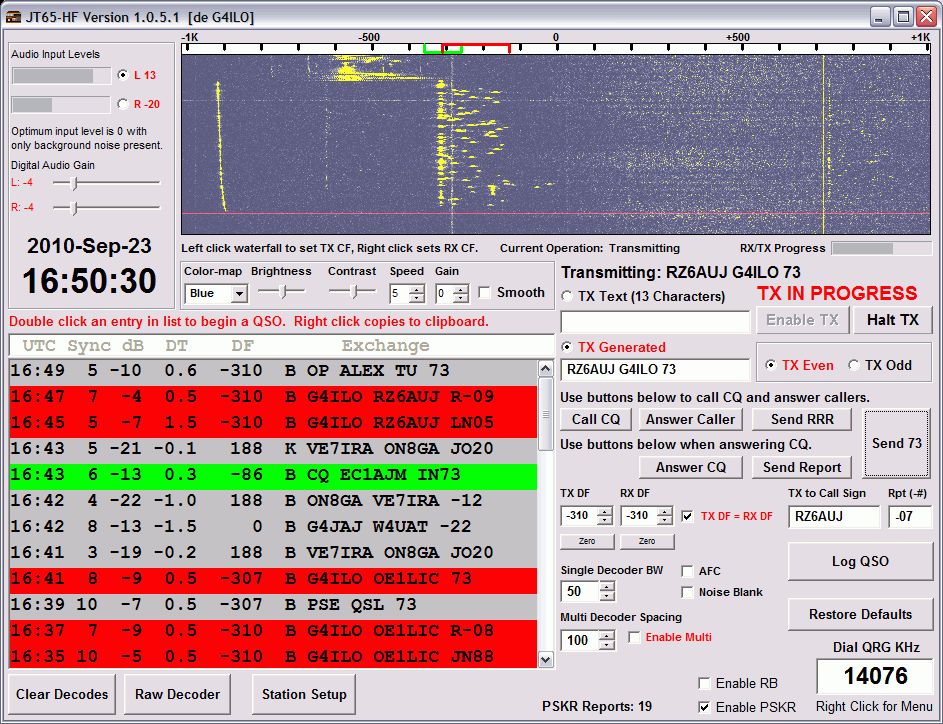
I decided to run the K3 at 5W into the dipole because the K2 was doing 30m APRS gateway duty on the magnetic loop and the two antennas are only a few feet apart. But there was no interference. I’m not sure how much power people normally use on this mode but I might try more next time. My new shack computer coped easily, decoding the received JT65A signals in a second or so despite the fact that it was simultaneously running two APRS gateways one of which was using TrueTTY and a USB sound card to decode the packet data.
I found a free spot on the waterfall, sent a CQ and two people immediately came back to me at the same time. I didn’t decode anything! I called again and this time three people replied! I sent CQ once more and this time the first two must have decided I was either deaf or an idiot which left just one signal on my frequency: OE1LIC, for my first contact of the day. My second CQ raised RZ6AUJ, Alex for another contact and that was all I had time for before dinner.

One of the features of JT65-HF is that it automatically links in to the PSK Reporter network so you can see all the stations you heard on a map and, even more interestingly, all those that heard you. I remembered this and popped up to the shack after dinner to grab a screen shot. As you can see, my 5W to an attic dipole was heard by two stations on the west coast of the USA, and I was only on the air for about 20 minutes! The small blob on the west coast is VE7IRA who was heard by me despite the appalling S9 interference I get on this band, which was reduced to about an S3 by the MFJ-1026 noise canceller using a PA0RDT mini-whip for a noise antenna.
I still find using JT65A on HF feels a bit odd but I can understand why it has become so popular, even addictive. It takes up little band space and doesn’t interfere with other band users unlike a certain R** digital mode. I said this before and didn’t end up doing it but I think I will spend a bit more time using JT65-HF to see what I can work and whether I can join the crowd of enthusiasts for this unusual digital mode.

A view on privacy
If you’ve used Google Maps then you have probably tried the Street View feature that lets you look around a place on the map as if you were actually there. Unless you are in Germany, that is. Germany remains the largest European country that is not covered by the Street View service. The German government has forced Google to offer an opt out service that allows people to request that their houses are blurred out of the pictures in the same way faces and vehicle registration plates are. Some privacy campaigners in Germany would prefer that appearing in Street View should be an opt-in feature.

Street View has been available as an option on the aprs.fi APRS tracking site for a few months now. It’s fun to virtually travel along with an APRS user and see what they see. But Street View has a serious use too. If you’re house hunting then it would be a great way to see whether you like the neighbourhood, for example. When Olga and I went to Prague last month the taxi driver from the airport wasn’t sure exactly where our rented apartment was but because I’d “visited” the area in Street View a few days earlier I recognized where we were and was able to direct him right to the door. (Incidentally the Czech government has also called a halt to further data collection in the Czech Republic pending talks with Google.)
I don’t know what people think they are achieving by insisting on being able to opt out of Street View. It shows nothing that you can’t see just by being there. What are they trying to hide? Anyone can take pictures of an area, upload them to the internet (without blurring anyone’s face or vehicle registration number) and link them in a way that anyone searching for pictures of that place will find them. All Google has done is go about it in a more methodical way. Are we going to have controls on publishing photos on the internet now?

Tinkering about
One of the reasons I’m not endlessly filling my log with DX contacts is because I actually get more enjoyment and interest out of trying new things or just tinkering about. On Sunday I decided to try using my K2 – which has been redundant since the few mobile excursions I made earlier in the year when Olga was away – for HF 30m APRS. I connected it up to the magnetic loop. I didn’t have a spare sound card I could use for the packet modem, but the microphone input of the USB dongle I use for computer audio playback was free, so I set it up for receive only.
When I previously tried to use that USB audio device to decode HF packet via the AGW Packet Engine I had no luck at all. At the time, I concluded that this was due to 300baud packet being a higher speed mode than PSK31 and the USB device was somehow losing the information necessary to decode it. However it now appears that the reason it didn’t work before is because the AGW Packet Engine opens the device at a higher sample rate than most digital mode programs. For the last few weeks I have been using TrueTTY as a packet decoder and this uses a 11025Hz sample rate. I used TrueTTY to decode the audio coming from the cheap dongle and it appears to be just as sensitive as it was when the audio was coming from my best sound card.
This morning I tried listening on 14076kHz, the JT65A frequency, and decoded several stations despite the high noise level on 20m. So it seems to me that it is possible to use these cheap USB dongles for sound card digimodes as long as the software you use samples at 11025Hz. Some programs unfortunately don’t let you set the sample rate and may use a rate as high as 48000Hz. This is unlikely to work if my experience is anything to go by, so I still don’t recommend that you buy one of these cheap devices for digimode use unless you have a specific application in mind that you know it will work with.
I have now ordered another of these cheap USB dongles which I plan to make into a “DIY SignaLink USB” with the aid of the digital VOX circuit developed by Skip Teller, KH6TY. This will allow me to use the K2 for HF APRS, WSPR or other QRP activities using the magnetic loop, and free up the K3 for other purposes using the multiband dipole. In fact I will then be able to use four amateur bands and four different radios simultaneously if I want to!














