Author Archive
 Home-build D-Star radio
 May 11th, 2011 |
  Author:
 Years ago, after I built my Elecraft K2 I had the idea that I would only use home-built radio equipment. However I found that it was no longer possible to buy a kit to build a 2m FM radio. This afternoon I visited a site mentioned by Tim, G4VXE in his latest blog posting and was intrigued to find that a Dutch group is working on a design for a VHF/UHF transceiver kit. Not only that, it is apparently being developed in consultation with Elecraft and is built into an Elecraft EC-1 (K2) enclosure!
The basic kit will be for an analogue FM transceiver with modules for 2m, 70cm and 23cm (it isn’t clear to me whether you must choose one of these bands or whether you can fit all of the modules.) But with the addition of another module it can also become a D-Star transceiver!
Now I have never made any secret of my dislike of D-Star, mainly due to the fact that one manufacturer has a monopoly on the provision of radios. But a home-brew D-Star transceiver that doesn’t require you to buy anything from Icom and would sit neatly alongside my K2 in a matching enclosure could just be the thing that makes me swallow my objections. Yes, it will still have an AMBE chip containing the proprietary codec. But most of my radios contain chips with proprietary firmware so I don’t think that’s a good enough reason for continuing to avoid D-Star.

New video: Interfacing APRSISCE/32 to a radio
I have just uploaded a new video to G4ILO’s YouTube channel showing how to set up the APRSISCE/32 software to connect with a GPS and a TNC or radio. In the video I actually set up a connection between the software and a Kenwood TH-D72 and you can see and hear packets being received by the radio.
I also cover how to set up a connection with a GPS and how to use the AGW Packet Engine which allows you to use a soundcard as a packet modem.

Another eBay dud
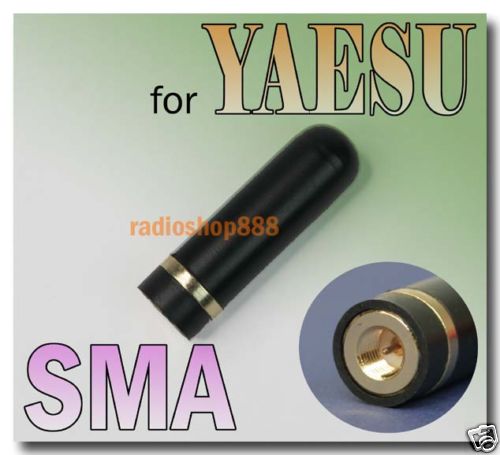

It’s the same on 433MHz as well.
In fact I couldn’t find any frequency at which this so-called antenna is resonant!

Soaked through on Gowbarrow Fell
I’m finally eligible to claim one of my own WOTA certificates! This morning I made a contact with Phil G4OBK/P on Souther Fell and thereby completed working all of Wainwright’s Northern Fells.
Phil had preannounced his intention to visit Souther Fell on the WOTA website, which was the last one I needed. This fell is blocked by higher mountains so I can’t work it from home – I would have to get to a good vantage point. I could have driven to a suitable spot, parked and waited for Phil to appear but I decided to make the contact from a summit. The weather forecast was for rain, however, not the kind of conditions I normally choose for an activation. Out of the rucksack came the antenna mount (so I could use the waterproof rucksack cover) and the APRS radios (too expensive to risk getting wet.) The rig for the day was the Motorola GP300 with the base loaded Nagoya half wave telescopic.
The weather lived up to the forecast. By the time I reached the summit my boots had taken on water from the numerous puddles and long wet grass I had to traverse to reach it. My Goretex waterproof was letting in the rain, too. Only the inside of my rucksack remained dry. The views from this summit can be spectacular, but today was no day for a camera. So no photos. Instead, I’ll link to a page that has some pictures of what I could have seen on a better day.
I had to make several calls before I could raise anyone. Finally Malcolm M0XAT heard me. Next the Penrith duo, G0TDM and G4WHA, and then Colin G4UXH and Sue G1OHH from “down south” who were both at good signal strength. I then had a bit of a wait before Phil arrived on summit and began to call. I passed the time trying to wring the water out of my socks.
Mission accomplished I headed back down to the car, home and a hot bath. The radio and antenna are now in the hot water tank cupboard drying out. My boots will probably take a bit longer.

Dodd [LDW-174] all to myself
The weather forecast suggests that the fine spell we have enjoyed for the last few days – which has caused the G4ILO shorts to be brought out of the wardrobe unusually early – is going to end soon. So I thought I would try an activation this morning of the small summit of Dodd, LDW-174 for Wainwrights On The Air. Being a tightwad, I didn’t want to pay the Forestry Commission’s exorbitant charges to park at the visitor centre so I parked off the road at a spot about a mile north of the official car park. I’ll happily walk an extra two miles to save £6.50!
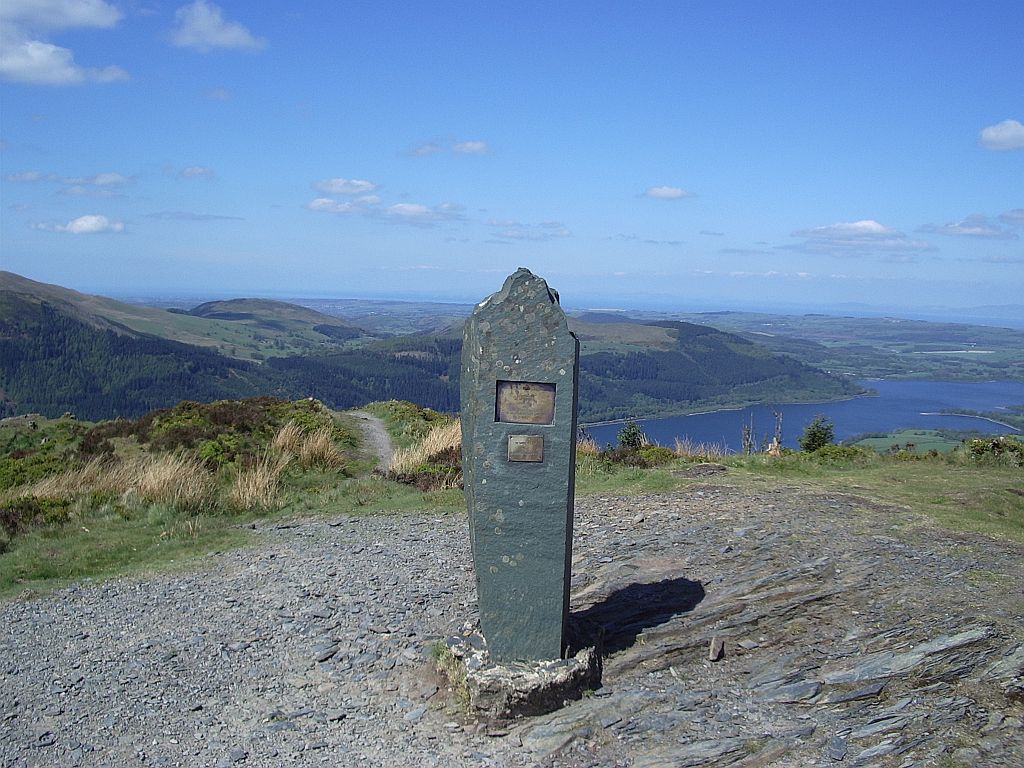
I was afraid this well-known parking spot would be full but in fact there were only two other cars there, a silver Nissan and an old BMW that was very dusty and looked suspiciously as if it might have been there a while. I set off along the path and had hardly walked a few paces when I saw some car keys in the undergrowth beside the path. “I bet they are BMW keys” I thought to myself as I picked them up and sure enough they were.
Now I had a dilemma. Perhaps someone had dropped their keys and would be coming back to look for them, so I should leave them where they were. It was just a gut instinct that made me suspect the BMW had been stolen and some thief had left it in this quiet spot and thrown away the keys before switching to another car. If it wasn’t a stolen car, surely it soon would be if I left the keys so close to the vehicle itself. So I decided to walk to the visitor centre and hand the keys in, explain what had happened and suggest they called the police to investigate.
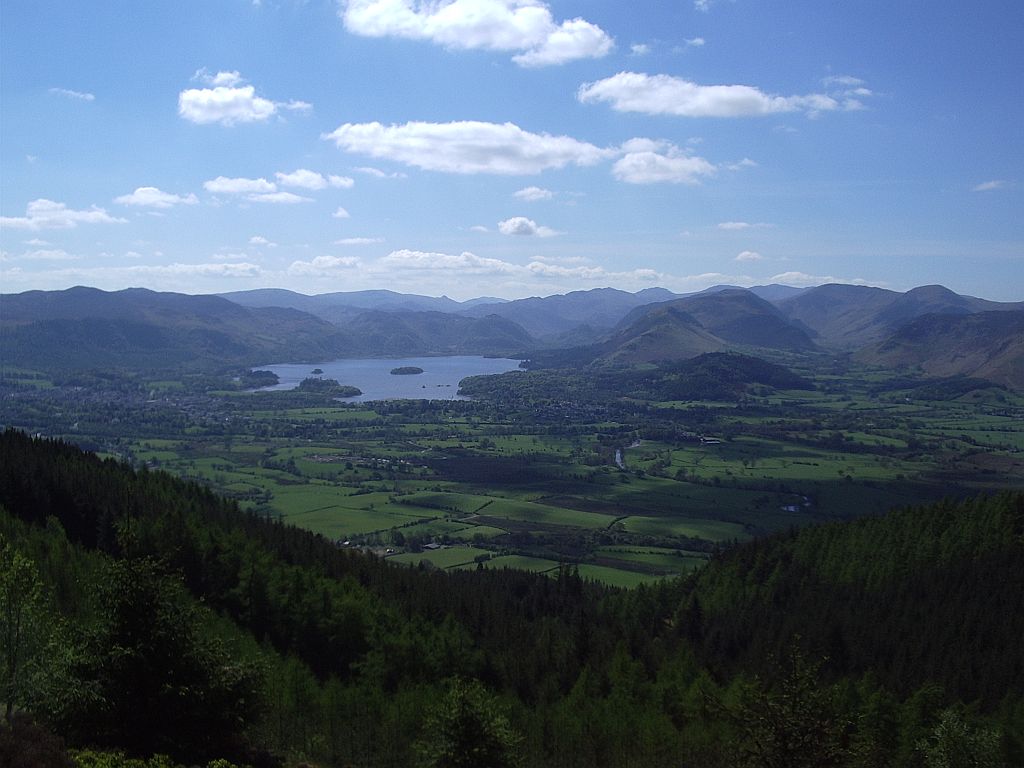
This I did, before beginning the ascent of Dodd up the forestry road. It is a rather dull plod until you reach the col between Dodd and the Ullock Pike ridge and the path curves round Dodd’s conical summit until this view over Derwentwater opens up. Then it is another short upward plod until you reach the summit (top picture.)
As I reached the higher altitudes it was clear that the stiff cold wind that has been a feature of the entire weekend and made conditions a lot less pleasant than the photos suggest was still with us. The WOTA Pole was still broken (and probably won’t be repaired) so in its place I was using my new rucksack mounted telescopic 5/8 vertical. This is the old telescopic 5/8 BNC antenna with a new more robust whip fitted to the spring/loading coil. Because the weight of the whip makes the spring bend over it is encased in a piece of plastic electrical conduit which is Araldited to the base of the telescopic whip. This fits into the base section of conduit using one of the famous fragile jointing pieces. A female BNC plugs into the BNC base of the antenna, with the coax and a 19in pigtail counterpoise. This gave a perfect 1:1 SWR at 145MHz when tested at home using my antenna analyzer. It fits nicely in the rucksack with the telescopic whip sticking up above my head, the ultimate fashion accessory for the keen WOTAphile.
The radio was the Kenwood TH-D72 stuck on my belt. The headset I first tried on Carrock Fell proved itself once again, both in helping me to hear the other stations in the howling gale and in keeping the wind noise out of my audio. Regular readers can probably detect a trend here. I think the Kenwood is finally coming into its own as my APRS radio of choice.
I called CQ WOTA a couple of times, with no replies! Was this going to be a failed activation? Eventually to my great relief Mark MM1MPB came back. He gave me only a 5 by 5, which I improved to a 5 by 9 by walking a short way to the other side of the summit. I was concerned that perhaps something was wrong with the antenna so I swapped to the Nagoya NA-701 short dual band flexy-whip and Mark gave me only 5 by 3 so the 5/8 seemed to be doing its stuff. Dodd is quite a hemmed-in summit and although I could see across the Solway to Scotland it’s possible that the path to Annan was blocked by the Ullock Pike ridge and the northern flanks of Skiddaw.
A few more calls and I was pleased to be answered by Colin G4UXH in Milnthorpe who had noticed the website spot placed by Mark, and then Steve M0IGG from Walney Island. Both stations were beyond the southern boundary of the Lake District and so at a fair distance. Clearly I was getting out, just not many people were listening. I also worked M6BDV/P on Little Mell Fell for a summit to summit contact, who confused me at first by using the call MW6… his home area being Wales. But that was it. None of the Workington mob or the Penrith crew. I guess everyone was WOTAed out after all the activations over the weekend.

I didn’t even see another person on the summit, which is quite unusual. Not that I minded that at all, in fact I always prefer to have a summit to myself than have hordes of people wondering what I am doing.
The views as always from Dodd on a clear day were stunning. But it was damn cold no thanks to that icy wind, so I was pleased to pack up and head back down to the car again. The BMW had gone by the time I returned. How it came to be there with its keys tossed in the undergrowth will probably forever remain a mystery.

Life on 6m
The 6 metre band is showing signs of life, as this map of WSPR activity from this afternoon shows.
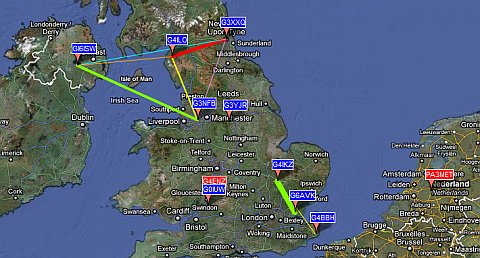
However, some of the traces on the WSPR application screen look a bit odd.

I don’t claim to be an expert but I think what I am seeing is the result of doppler shift on the signals being reflected by fast-moving Sporadic-E clouds. In several cases what seems to be a trace has not been decoded.
I’ve said this before, but I wonder if WSPR mode with its 110 second transmit periods and tiny frequency shift encoding is really suitable for detecting Sporadic-E propagation. But no-one has ever commented on this, leaving me to wonder whether they think I’m an idiot who doesn’t know what he is talking about or whether nobody knows.
The digital mode most people seem to use on 6m is JT6M, however this entails using the WSJT program which I find rather confusing. I’m interested in trying JT65A but I’m not sure if it is any more suitable than WSPR for this type of work.
In the absence of any expert advice I’m going to try JT65A using a dial frequency of 50.276MHz. With the JT-Alert accessory to tell me when anyone replies I can leave the rig calling CQ whilst I am otherwise occupied. It will be interesting to see what we can work on 6m with the JT65A mode.

High Pike [LDW-107] and Carrock Fell [LDW-105]
Sometimes conditions on the fell-tops are not what you expect when you leave home. Yesterday, having no desire to watch the big event in London, I decided to have a big event of my own, namely to activate two of the Northern Fells for Wainwrights On The Air (WOTA). Although the weather was a little hazy there had been several sunny days and I anticipated two leisurely activations lazing in the grass and basking in the sun beside my guyed WOTA Pole, perhaps even some DX due to atmospheric conditions. I did notice a chilly breeze as I went out to the car, so I went back and got an extra fleece. That turned out to be a good move.

It was about 45 minutes drive to the parking spot at Caldbeck Common. I set off on a circuitous but easy climb up to High Pike, the first summit, working Jimmy on Blencathra who was using a special Wedding call MR3EYP/P on the way. No getting away completely from thoughts of the big event in London.
Half way up I noticed the wind was getting stronger and chillier. The extra fleece was quickly donned, and I worked another activator with a Royal call, MR1EYO/P on Red Screes. By the time I reached the summit I felt conditions were such that I didn’t want to stay long up there. After a contact with Bill G4WSB/P on Grasmoor whose voice was at times unintelligible due to wind getting into the mic of his Quansheng, I walked down from the summit in search of a slightly less windy spot to eat my packed lunch.
Whilst eating my lunch I weakly heard Derek 2E0MIX/P on Maiden Moor but I didn’t dare nip up to the top to make a contact in case my rucksack and other things blew away. When I did return to the summit I found the wind was blowing icy rain into my face. I didn’t have any enthusiasm for putting the WOTA Pole up as I didn’t intend staying there long enough for the effort to be worthwhile. I also didn’t want to get the non-waterproof Kenwood TH-D72 – which I’d taken after realizing the limitations of the receiver of the VX-8R – wet. So I sat on the stone bench near the wind break on the summit and using the 8in. helical rubber duck rapidly worked 7 of the ‘usual suspects’, contest-style, then stuffed the Kenwood in the rucksack and set off on my way to the next summit.
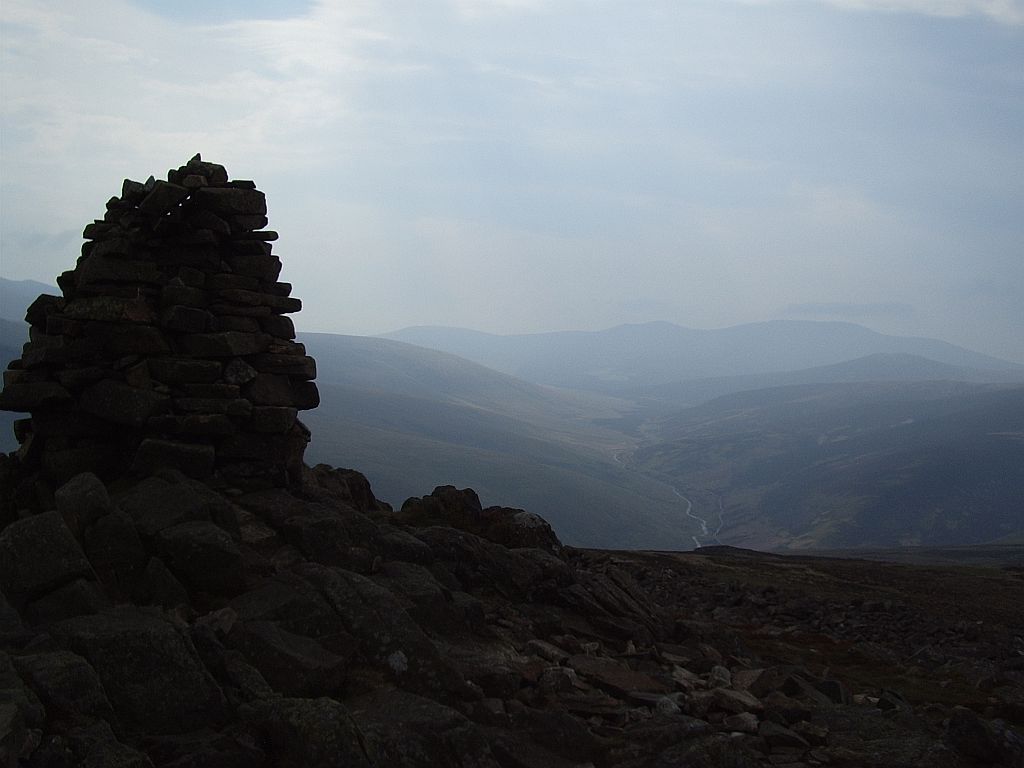
Carrock Fell is is a rocky summit with a big cairn, overlooking a valley. By the time I got there the rain had stopped and the wind had dropped a bit and seemed less cold. There were numerous large rocks scattered about making inviting seats. I decided to put up the WOTA Pole. First, I had a fight untangling the guys, which had knotted themselves together. Then, while pulling up the antenna using the third guy, doing my trick of using my walking stick as a bottom section for extra height, there was a crack and the antenna fell back on the ground. The jointing piece between the lower two sections of plastic tube had cracked. Arrgh!
So I was forced once again to do the activation using the 8in. helical rubber duck. However one piece of equipment favourably surprised me. Well, two, really. I began to get used to the Kenwood TH-D72 and felt that perhaps it is a viable alternative to the VX-8GR to use on activations. I received several APRS messages while I was up in the hills and found it easy to read and reply to them. Before I set off I used ?APRSO to load APRS objects for the two summits into the radio which I used to help navigation and check proximity. Very useful, though having to page forward a couple of times is less convenient than the VX-8’s all in one view.
I’m still not convinced that the Kenwood’s snazzy metallic grey paint and plasticky casing isn’t going to start showing marks from the rough and tumble of use up in the mountains. And the radio does sometimes do things I don’t understand, like beep and do nothing when I press the PTT, or beep and mute the audio of the station I’m listening to until I press the PTT again. I think this may be something to do with the APRS functions but it confuses me. The battery endurance doesn’t seem to be as good as the Yaesu either. But I’m learning to love it.
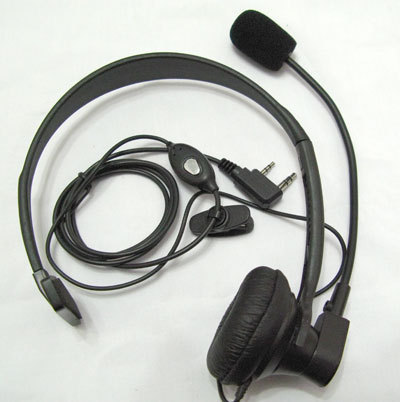
This was also the first time I could try out a headset for the Kenwood that I’d bought for £3.99 on eBay. The price, which included shipping from Hong Kong, was so low I doubted that it could be any good. But it was also cheap enough to be worth a gamble. It turned out to be the ideal accessory for operating from windy hilltops. The microphone has a foam muffler and even with my head turned so that wind was blowing on to the mic stations reported that there was only very slight wind noise, not enough to interfere with copy. With my head turned away there was no wind noise at all. Experienced activators will know just how hard it is, when it is windy, to find a position that keeps the wind out of the mic on the front of the radio.
Despite the unexpectedly nasty weather I had a nice walk and two successful activations. I may have one last try with the WOTA Pole. I will superglue the cracked jointing piece and then try reinforcing them with nylon cable ties. If that doesn’t help then I must give up the idea or accept that it will only work with longer tubes and only one joining section.














