Author Archive
 SDR Radio
 December 14th, 2011 |
  Author: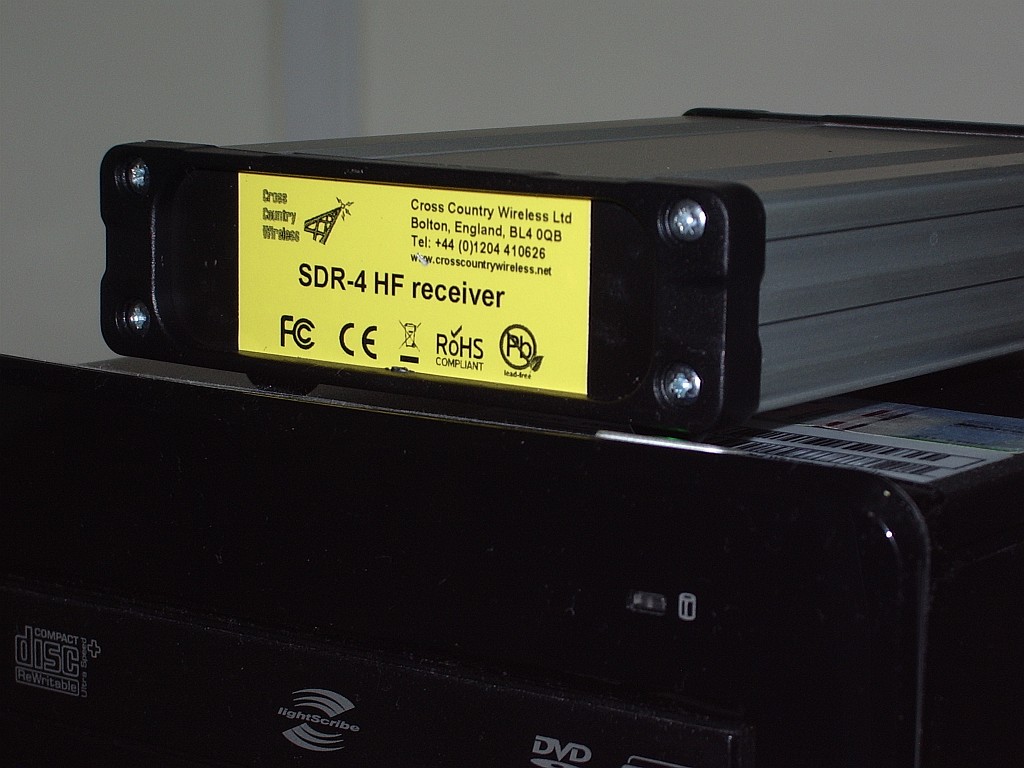
An early Christmas present to myself is this SDR-4 HF receiver from Cross Country Wireless. Actually, it wasn’t intended to be a Christmas present. I decided to get one a couple of months ago when I first found out about it.
I think the SDR-4 is the lowest cost ready built HF bands software defined radio on the market (£150 or about $250 US). Unless you know different, of course. However it seems that a lot of other people thought so too, as there is a waiting list – people are ordering them faster than the designer Chris G4HYG can make them!
The SDR-4 works with the usual free SDR applications. But it also works with the free version of Simon Brown HB9DRV’s SDR-Radio.com application. This is the best SDR software by a mile, though due to all the treatment and medication I am receiving for my brain tumour my mind is a bit slow at the moment and I find figuring out how to do what I want with it a bit challenging.
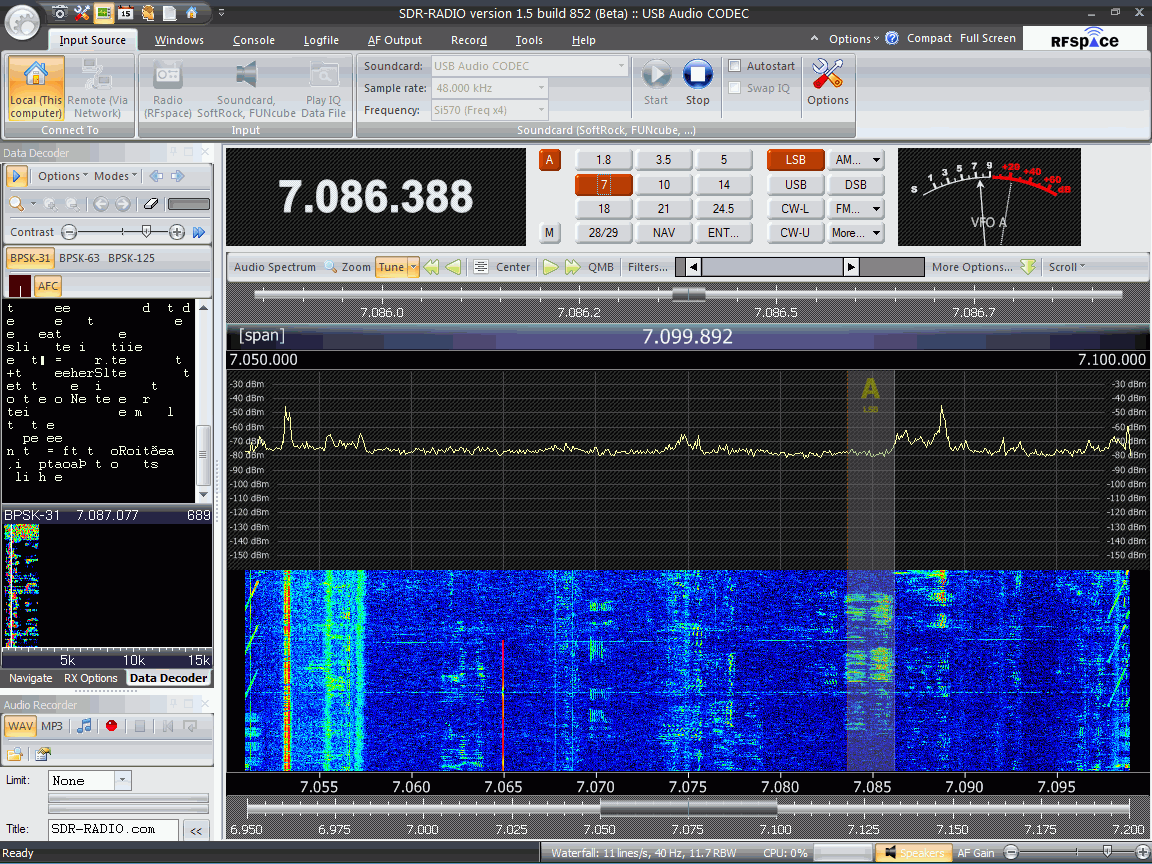
As you might expect from the author of Ham Radio Deluxe, SDR-Radio.com has built-in support for decoding digital modes. Unfortunately I haven’t managed to work out yet how to get the digital decoder waterfall to be a reasonable size: At the moment it’s a small window on the left hand side which is trying to display 15kHz worth of spectrum and although I’m hearing PSK31 I can’t find a trace to click on! I’m also still trying to discover if there is a PSK Browser in the program that sends reports to the PSK Reporter reverse beacon site. Hopefully someone will enlighten me.
I’m sure I’ll be writing more about the SDR-4 receiver and SDR-Radio.com in due course, but in the meantime if you want more information or to ask questions about the receiver there is a Cross Country Wireless Yahoo! group. You can even try an SDR-4 out over the Internet if you follow the instructions posted by Chris. I did and it worked perfectly – and it was so nice to hear the amateur bands without the awful frying noise I have to endure here.
Yahoo! is also the place to go for information and support of SDR-Radio.com (the software.) I look forward to seeing some comments and experiences of any of my readers who are tempted into trying this software defined radio.

Link between radio use and brain tumours?
A news item in the December 2011 CQ magazine caught my attention yesterday. It reported that a Danish study of more than 350,000 people found no evidence of a link between cellphone use and cancer. Cancer rates have not increased during the time that cellphone use has become widespread. “That’s good news” I thought.
However, some websites that reported the story carried the additional information that the Danish researchers found a hint of a link between heavy phone use and the rare but usually fatal glioma brain tumours – exactly the bugger I have. Not such good news after all, then.
Another study by Swedish researchers found an increase in cancer in areas of the brain exposed to microwave energy during a mobile phone call. Most of this data was from users of older analogue phones which run higher power and cause three times the exposure of newer digital systems. However that would still apply to use of VHF and UHF FM hand-helds which are typically operated at a power of 5 watts.
I think you would have to be an extremely active ham radio operator to expose yourself to as much RF as a heavy mobile phone user. But most hams are using much lower frequencies – though potentially higher power levels. Are the frequencies commonly used by hams more or less likely to cause cancer? I don’t think anyone definitively knows the answer to that.
But it is certainly food for thought. I’d be more inclined now to use my HTs on low power or with a speaker mic so as to get the antenna further from the head. And if you must use indoor or stealth antennas that can only be sited a few feet from the operating position, life’s too short for QRO!

Still alive and kicking (just!)
I don’t see things getting much better for the next 4 months when the chemotherapy will be over as although I do detect an improvement in how I feel as I get towards the end of a cycle I am quickly back to square one after starting the next one. There is not enough change in how I feel from day to day to warrant more frequent postings to One Foot in the Grave. My days seem to merge together so that most of the time I couldn’t even tell you what day of the week it is!
Despite what I have just written I will not actually be one of the people feverishly refreshing the Elecraft order page in order to secure a place near the top of the list for KX3 orders. Though I don’t doubt that the KX3 is a seriously cool piece of radio equipment that will be a big success for Elecraft, I have come to the decision that my FT-817ND meets all my current needs of a portable ham radio. I also can still remember my frustration at the length of time I had to wait to receive my K3 (and the even longer wait until the firmware actually worked and it all performed as expected.) I don’t wish to cause myself the stress of wondering whether I will live long enough to receive my KX3!
That’s not to say I don’t see an Elecraft KX3 in my life (and my shack) at any point. I can envisage a situation where a new toy to play with could make life seem a lot more cheerful. One day it will be possible to order a KX3 and get instant gratification. But until then I’ll content myself with reading the experiences of the early adopters and watching their YouTube videos.

Flummoxed!
In the APRS world a new piece of software has been creating some excitement. It is a soundcard modem for packet radio by UZ7HO. It runs under Windows and emulates the AGW Packet Engine so that it can be used by any program that is designed to work with it. The reason for the excitement is that this packet modem can decode several packet signals on slightly different frequencies in parallel, resulting in many more decodes on HF where it is quite common for stations to be 50Hz or more off-frequency.
Unfortunately I haven’t been able to try the new packet engine as the PTT won’t key my Elecraft K2 and I don’t know why. My K2 CAT cable has a transistor switch on the DTR line which goes to a 3.5mm jack plug that plugs in the K2 key socket. This was originally used for computer Morse keying using software like MixW, but it can also be used for PTT with digital mode software as the key and PTT lines are common. Using fldigi and even using a serial port test program I am able to activate the DTR line on COM2 and the K2 will respond by switching to transmit. But if I use this software modem no PTT ever occurs so although the audio is generated the packet signal is never transmitted. If I was using a SignalLink or other device such as my homebrew USBlink with fast audio derived VOX then this wouldn’t matter but as I have a PTT connection on this serial port I’d really prefer to make use of it.
If I change the serial port to COM3 then the program will key my Elecraft K3, which uses a different serial cable but still uses DTR for PTT. I tried the original AGW Packet Engine, both free and paid-for Pro versions but that won’t key the K2 either. So the problem must be something to do with my K2 CAT cable. But my poor old brain has been having rather a tough time recently with all the treatment making me feel like a bit of a zombie and I’m finding it rather difficult to think things through logically and find the solution which is probably staring me in the face!

Not so chirpy
Yesterday I attempted to have a QSO using the XBM-10-2 two transistor “Chirpy” transceiver for 10m. I asked Jim, G3XPD, who is about 8km south of G4ILO to listen out for me. Jim could hear the distinctive sound of my 100mW transmission, but I could not hear Jim, not even when he called using 100W.
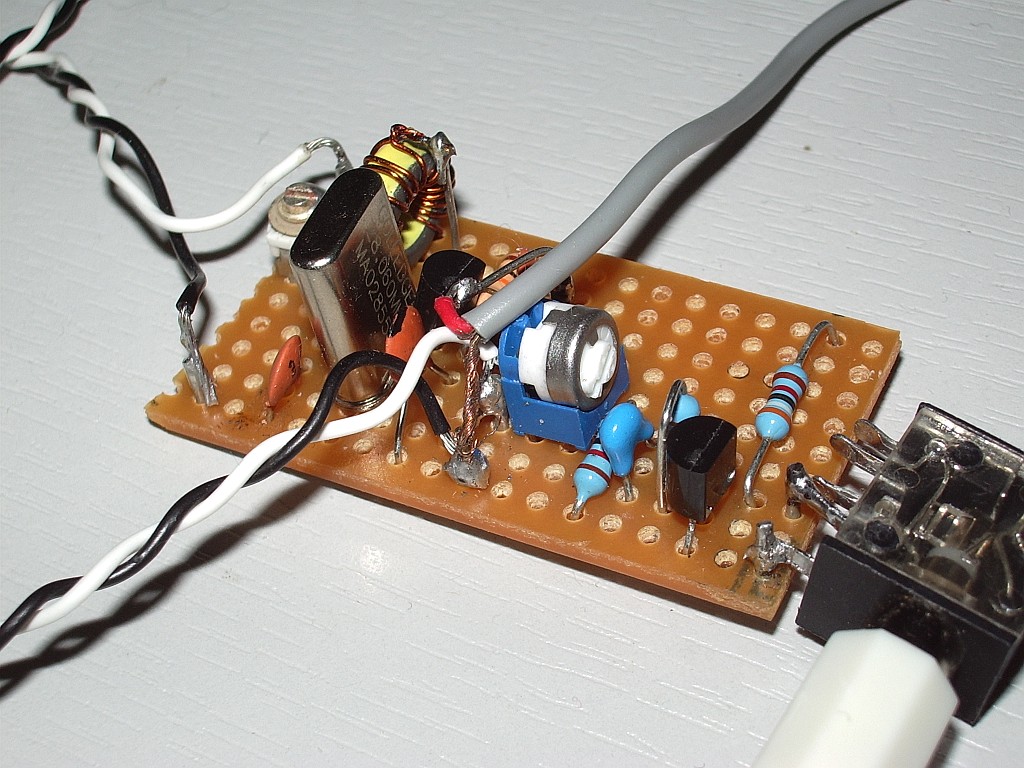
I know the Chirpy receiver works because I can receive a locally generated signal such as my antenna analyzer. But I guess even that is a big signal compared to one received off the air. I need to find a way to improve the receive sensitivity if it is to be possible to make a real two-way contact using this simple transceiver circuit.
I have tried adjusting C2 for maximum noise in the earpiece rather than maximum output when the key is down, to see if that gives some improvement. If nothing else it seems to have tamed the chirp a bit.

Feeling chirpy
Not without some difficulty due to my shaking hands, I managed to modify my copy of Roger G3XBM’s XBM-10-2 two transistor transceiver for 10m to his latest version. It is now named the “Chirpy” for reasons that will become obvious when you hear one on the air.
My version is exactly the same as Roger’s except that R3 is a trimpot not a fixed resistor. This allows me to adjust the power output to what I want. I am getting 150mW output on a 13.8V supply, this drops to 50mW with a 9V power source.
So far I have yet to make a contact with the little rig. I have called CQ on 28.060 many times but my signal is yet to be spotted on the Reverse Beacon Network. I don’t know if that is because my signal is too weak or too chirpy for decoding by the skimmer stations. Or perhaps the skimmers don’t receive that far up the 10m band. I will probably have to arrange a sked with a local station who is near enough to hear me.

Two Transistor Tranceiver for Ten
With ten metres opening up it seemed the right time to try building Roger G3XBM’s latest project: the XBM10-2. Roger describes it as probably just about the simplest CW transceiver possible for use on 10m, using just two transistors to produce about 60mW out.

This was my first attempt at construction since my radiotherapy and chemotherapy and I found it to be quite a struggle. First of all I found it difficult to concentrate while trying to work out the perf board layout. After that I got a bit frustrated with constantly juggling three pairs of spectacles due to my eyes apparent inability to focus at different distances. I also found soldering difficult due to my hands shaking whenever I brought the iron bit close to a component. I created quite a few solder bridges which I then had to clean up.
Construction took much longer than I would have taken a few months ago. But in the end it did work. Though not on ten metres yet. I’m waiting for a 28.060MHz crystal from the G-QRP club shop before I can try it out on the air.
One issue I have found (which Roger also comments on) is that the rig has a major chirp. It is definitely not T9 and I don’t know whether it is possible to improve on that. But at least it has character. If you hear a weak, chirpy signal near to the 10m QRP activity frequency give it a call. It might be me!














