Author Archive
 13 Apr 2012 – 10m
 April 13th, 2012 |
  Author:
 A different picture of 10m propagation than a week ago. The band was dead for most of the morning. Then I started to receive and be spotted by German stations at around 1200km distance – weak Sporadic-E I think.
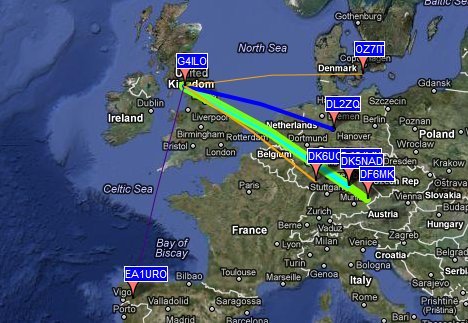 |
| 10m WSPR spots for G4ILO – 13 April 2012 |
Someone asked me whether these WSPR spots were obtained using the Propeller beacon I have been writing about. I’m afraid not. I haven’t managed to solve the frequency stability problems of my Gadget Gangster board so I’ve been using my K3 for transmit and receive.

Speaker failure

Yesterday the Medion computer speakers that I used with my Elecraft K3, failed. I was WSPRing on 10m and had the speakers switched off at the time but I saw some unusual interference on the waterfall and switched them on to listen. Nothing happened. No audio, nor did the blue power LED light up.
I checked the obvious things such as the cables and that the power supply was delivering 14V DC. It was. I took the speaker containing the audio amp over to the workbench and tried it on the bench power supply. Although the speaker was behaving as if no power was being applied, 20mA was being consumed when the switch was on. I have no idea where it was going.
Without a schematic there isn’t much I can do but I doubt that the speakers are repairable anyway. There are no active components on the circuit board apart from one integrated module attached to a small aluminium heatsink. This has presumably let its smoke out. There are a number of capacitors on the board and the cable connections are extremely well filtered against RFI. I have never seen such attention paid to preventing RFI. I guess that this is because Medion is a German company and Germany seems to be the only country that takes compliance with EMC standards seriously. The speakers were almost completely immune even when I ran 100W. Having a tone control they produced very rich-sounding audio from the K3, unlike its internal speaker which is shrill to listen to and has very little bass response.
I’ve now replaced the Medions with a pair of passive speakers that I originally got for this task but with those the audio sounds boxy no matter how I fiddle with the K3’s RX EQ settings. The only benefit of them is that I’m using one less wall wart!
These Genius speakers look like they might be a good replacement but ordering a pair would be a lottery as I have no way of knowing if they are RF-proof enough. One pair of Logitech speakers I bought were a dead loss. They were handed to the local Oxfam shop within an hour of the postman delivering them as they were so sensitive to RF they were beyond hope.


OAFS redux
A couple of days ago I decided to take another look at the Spectrum Communications Off-Air Frequency Standard (OAFS). It had been suggested that its failure to work might be the result of a solder bridge or similar error. I had a good look at the board using a high power magnifier and found a pair of pads that were suspiciously linked to ground. A moment’s work with the desoldering braid and sure enough there was a solder bridge exactly the width of a PCB track.
Having found a fault I was optimistic that the board would work. The setup adjustments were completed OK. But instead of hearing BBC Radio 4 in the speaker as the instruction sheet suggested I received a loud heterodyne with some speech faintly in the background, like listening to an AM signal in SSB mode with the BFO a couple of kHz off-tune.
I was looking at the Spectrum Communications advert in Practical Wireless to check how the ferrite rod was mounted and noticed that the description said “Background heterodyne whistle at 2kHz confirms lock condition.” That is exactly what I was getting. Odd that the instructions didn’t mention it though. Nevertheless I gave a cheer and went ahead with installing the board in its box.
My happiness was short-lived when I put my frequency counter on the output. It was 10MHz sure enough, but it was not phase locked to anything. I was only receiving the output of the uncontrolled 10MHz crystal oscillator which could be tuned a few tens of Hz either side of 10.000MHz. No adjustment I could make would cause lock to occur.
Comments made to my original post about this suggested that I might have problems with the OAFS as I am not in a good location to receive a strong signal from BBC Radio 4. I’m unhappy with the amount of time I’ve wasted on this. I think it would be best to write it off and forget about it. I’d rather not be bugged by it or have it taking up scarce space in the G4ILO shack. If anyone would like to have it and see if they can make it work then it’s yours for the cost of the postage.

Prolific problems
A package from China arrived in the post this morning – a USB programming cable for the Baofeng UV-3R+. I got it from eBay seller happyhamshop where it was sold as a “USB programming cable for Wouxun handheld radio” but Baofeng claims that the UV-3R+ is compatible with Wouxun accessories. I was going to make my own cable but I didn’t have a 2.5mm stereo jack plug in my parts box so I decided to take the easy option and get a ready made cable for not much more than the cost of the plug from a components vendor.
The cable was detected and appeared as COM1 – the same com port number as my other USB to serial adapters that use the Prolific chipset. I haven’t tried it on the Wouxun – I can’t think of a reason to program channels on 4m – but it works with the Baofeng using both the manufacturer’s software and CHIRP, the platform and rig-independent memory management program.
It took me several attempts to transfer the memories from the old UV-3R to the new one. Writing a file taken from the old radio to the new one using either program caused the frequency display to read DDDD.25. Fortunately I knew enough about this issue to have used the software to make a backup of the factory configuration, which was easily restored.
The solution, if you’re interested, was to use CHIRP to export the memories from a file saved from the old radio to a rig-independent .chirp file, then load the factory configuration from the radio and import the file you just exported.
Problems with programming cables seem to be making up half the traffic in forums and groups dedicated to handheld radios. The problems are all associated with cables that use (or claim to use) Prolific USB adapters. These days, programming cables come with USB adapters built-in, so the need for separate USB to RS-232 converters – which could use a less troublesome FTDI or Silicon Labs chipset – is eliminated. But so, unfortunately, is the option to solve the problem by using a different type of adapter.
A couple of days ago I became aware of something that is certainly not going to make this issue any less common. Apparently a Chinese chip manufacturer has produced an unlicensed clone of the Prolific PL2303 USB to serial chip which is now being used in many of the USB cables that come from China. Prolific is understandably not very happy about this. It has released a new driver that detects the clone chip and fails with an error code 10, causing much frustration for the innocent end user. The solution, apparently, is to turn off automatic updating and install an older driver (the cable vendor will hopefully have a link to a driver that works with the cable they sold you.) The problem seems to be worst for users of 64-bit Windows 7 for which there are fewer old drivers in circulation. I deliberately stay as far from the bleeding edge as possible, and have automatic updates disabled on my shack PC. So far I have had no problems with the 32-bit Windows XP Prolific driver I’ve been using for the last couple of years.

New WSPR map
In case you didn’t know about it already, check out this new map of recent WSPR spots. (Editor’s note: please be advised that we have had a report of this link freezing a computer and requiring a reboot. I do not believe that it’s a malicious link, but it may be very resource intensive to load…)
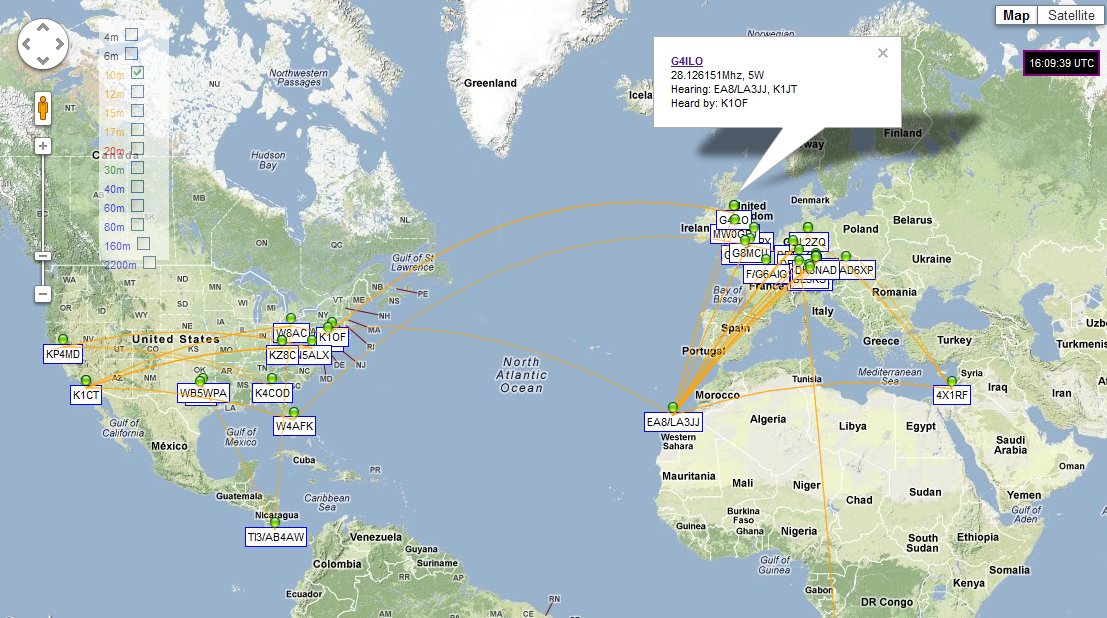
It’s much faster than the ‘official’ one, which could bring Firefox to its knees on a slow computer. And it remembers allyour preferences including zoom level. A must-bookmark, if you’re a WSPR fan.

Gremlins
This year I have decided to focus on the high frequency bands – 10m and 6m – this spring and summer. The predictions for the peak of this solar cycle are not very good, as you can read in several blogs, but it’s all we’re going to get for the next 10 years so I may as well make the best of it.
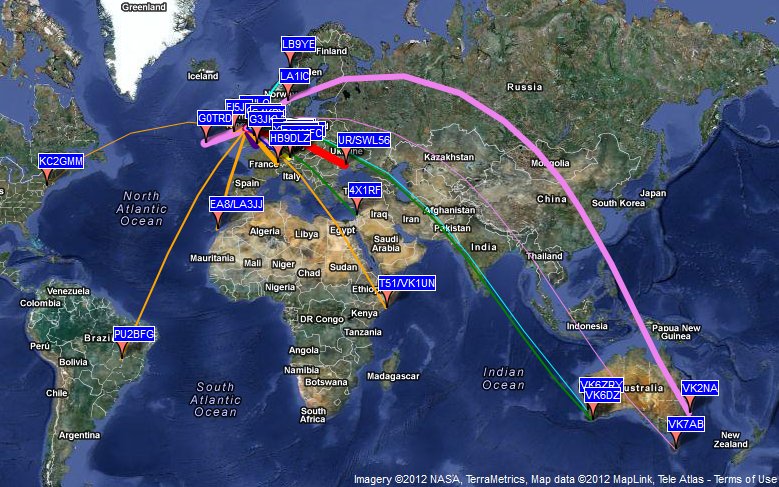
To this end I have started WSPRing on 10m when I switch on in the morning, with the intention of moving up to 6m if there appears to be a chance of propagation. On the previous few days I have been rewarded with a two-way path to VK on 10m at quite decent signal strengths. Not bad for 5 watts to an attic dipole. But today I received not a single spot, not a single trace.
Although not the reason for the lack of spots today, I think there is a gremlin in the machine. Twice I have come up to the shack to see what is happening and found the K3 in transmit mode but with no RF output. The K3 monitor mode shows no audio is being sent to the radio, so it isn’t a radio problem. The WSPR software settings haven’t changed, and are correct. Restarting the program makes no difference. The only solution is that hoary old first resort of the computer technician: Switch it off and then switch it on again. Works every time. But I wish I knew why it is doing it.














